
Influenced: On the evening of August 12, 1961, East German workers began stringing barbed wire across the streets of Berlin. By morning, a city had been divided. Over the following days, the wire became concrete blocks; the concrete became a wall.
For 28 years, the Berlin Wall - guarded by armed soldiers with shoot-to-kill orders - stood as the most visible symbol of a conflict that divided not just a city but an entire world into opposing camps.
The Cold War is often described as a "rivalry" between two superpowers. This undersells it.
Between 1947 and 1991, the United States and the Soviet Union organized virtually every aspect of international relations around their competition: which nations got aid and which got sanctions, which governments were propped up and which were overthrown, which technologies were developed and which were suppressed, even which sports teams won Olympic medals.
The Cold War shaped the structure of the internet, the design of highways, the architecture of universities, the literature of science fiction, and the political identities of dozens of nations that were pawns in a game played by others.
Understanding why the Cold War happened, how it functioned, and why it ended illuminates not just a historical period but the structural forces that continue to shape international relations - and the specific disputes that remain unresolved decades after the Soviet Union's dissolution.
"We may be likened to two scorpions in a bottle, each capable of killing the other, but only at the risk of his own life." - J. Robert Oppenheimer, Foreign Affairs (1953)
The total human cost of the Cold War is impossible to calculate with precision, but it is staggering. Historians estimate that proxy conflicts directly fueled by superpower competition killed between 10 and 20 million people between 1947 and 1991 (Westad, 2007).
Millions more died as a result of famines, political repression, and development failures in states caught in the Cold War's gravitational field.
The nuclear arsenals maintained at hair-trigger readiness throughout the period represented the potential extinction of human civilization - a sword of Damocles that hung over every decade of the conflict's duration.
Key Definitions
Cold War - The period of geopolitical rivalry (1947-1991) between the United States and the Soviet Union, characterized by ideological competition, arms races, proxy conflicts, propaganda, and economic competition - but no direct military combat between the superpowers.
The "coldness" was maintained primarily by the threat of mutual nuclear annihilation.
Containment - The US foreign policy strategy, articulated by diplomat George Kennan in his 1946 "Long Telegram" and 1947 "X Article," of preventing Soviet expansion rather than rolling back existing Soviet power.[9]
Containment became the organizing principle of US Cold War strategy, implemented through military alliances, economic aid (Marshall Plan), and support for governments threatened by communist movements.
Detente - A policy of relaxation of tensions between the superpowers, pursued primarily during the Nixon-Kissinger era (1969-1979). Included the SALT I and SALT II arms control agreements, Nixon's opening to China (1972), and Helsinki Accords (1975).
Detente ended with the Soviet invasion of Afghanistan (1979) and was succeeded by Reagan's more confrontational approach.
Mutually Assured Destruction (MAD) - The strategic doctrine that a nuclear first strike by either superpower would trigger a retaliatory strike that would destroy both sides, making nuclear war irrational. MAD provided stability through the threat of total annihilation - the perverse logic of deterrence.
The development of second-strike capability (submarine-launched ballistic missiles that could survive a first strike) was essential to making MAD credible.
Truman Doctrine (1947) - US President Truman's declaration that the US would support free peoples who resist subjugation by armed minorities or outside pressures. The immediate context was civil war in Greece and Turkish vulnerability to Soviet pressure.
The doctrine effectively committed the US to global opposition to communist expansion.
Marshall Plan (1948-1952) - US economic assistance program providing approximately $13 billion (roughly $150 billion in 2023 dollars) to rebuild Western European economies after World War II. The strategic logic: economically devastated countries were vulnerable to communist political movements.
The USSR prohibited Eastern European countries from participating, cementing the division of Europe.
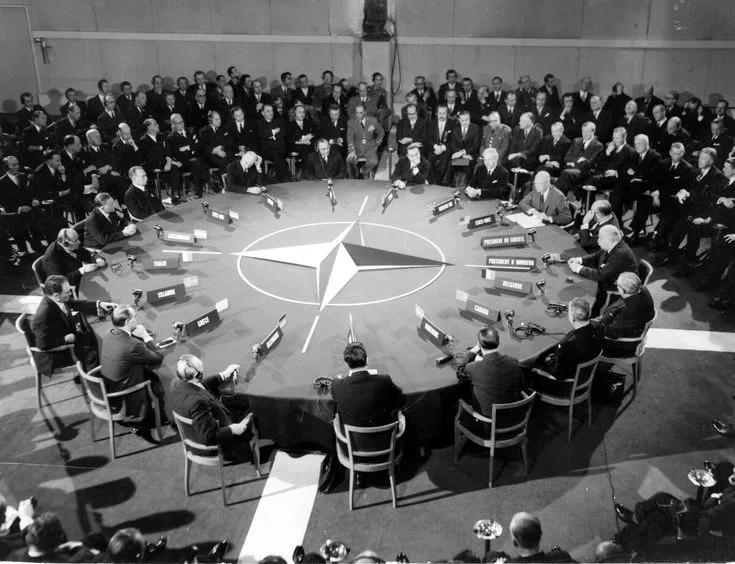
NATO (North Atlantic Treaty Organization) - The military alliance formed in 1949 by the US, Canada, and Western European nations. NATO's Article 5 commits members to treat an attack on one as an attack on all - the collective defense guarantee that made US protection of Western Europe credible.
The Warsaw Pact (1955) was the Soviet-led Eastern European counterpart.
Proxy war - A conflict in which the superpowers support opposing sides in a third country's conflict without directly engaging each other. The Korean War, Vietnam War, Soviet-Afghan War, and numerous African and Latin American conflicts were proxy wars.
Nuclear triad - The three-component nuclear delivery system: land-based intercontinental ballistic missiles (ICBMs), submarine-launched ballistic missiles (SLBMs), and strategic bombers. The triad ensures survivability: no first strike can destroy all three components, guaranteeing retaliation.
Non-Aligned Movement - A grouping of states, founded at the 1955 Bandung Conference, that sought to avoid alignment with either superpower. Key leaders: Nehru (India), Tito (Yugoslavia), Nasser (Egypt), Sukarno (Indonesia). In practice, most non-aligned states still received aid from one superpower or the other.
The Origins: Why the Allies Became Enemies
In 1945, the United States and Soviet Union had just won the greatest war in history together. Within two years, they were adversaries locked in a rivalry that would define half a century. How did this happen?
Structural Tensions
The ideological incompatibility was fundamental. The Soviet Union was committed to Marxism-Leninism: a one-party state, centrally planned economy, and international communist revolution. The United States promoted liberal democracy, market capitalism, and an open international economic order.
These were not merely different policy preferences - they were mutually exclusive visions of how human societies should be organized.
Beneath ideology lay competing security interests. The Soviet Union, twice invaded from Western Europe (1914 and 1941), sought a buffer zone of friendly (i.e., controllable) states.[14]
The US, which had prospered under an open international order enforced by British naval power, sought to recreate that order with American power at its center. Both were rational objectives - but they were incompatible in the specific geography of postwar Europe.
Diplomatic historian John Lewis Gaddis (2005), in The Cold War: A New History, argues that the conflict had a "structural inevitability": given the ideological commitments of both sides and the security vacuum created by the defeat of Germany and Japan, some form of superpower competition was nearly unavoidable regardless of the specific decisions made by individual leaders.[7]
This structuralist view stands in tension with accounts emphasizing contingency - the argument that different decisions at Yalta, or different responses to the Berlin blockade, might have produced a less rigid division of the world.
The Yalta Divide
At the Yalta Conference (February 1945), Roosevelt, Churchill, and Stalin divided postwar Europe into spheres of influence - a division that was partly explicit (free elections in Eastern Europe were promised but not enforced) and partly the result of which armies occupied which territory at war's end.
By 1947, the Soviets had installed communist governments in Poland, Czechoslovakia, Hungary, Romania, Bulgaria, and East Germany.
Winston Churchill, in his famous 1946 Fulton, Missouri speech, declared: "From Stettin in the Baltic to Trieste in the Adriatic, an iron curtain has descended across the Continent."
The actual negotiation at Yalta has been more nuanced than either triumphalist or condemnatory retrospectives suggest. Roosevelt was gravely ill (he died two months after Yalta) and deeply preoccupied with securing Soviet entry into the Pacific War before the anticipated invasion of Japan.
He understood that Stalin's armies already occupied Eastern Europe; formal guarantees of free elections were gestures toward principle rather than enforceable commitments.
The tragedy of Yalta is not that Western leaders were naive or complicit but that the military situation left them with limited leverage over territory already controlled by Soviet force.
The Truman Doctrine and Marshall Plan
In 1947, two events crystallized American policy. Greece was in civil war; Britain, exhausted and broke, informed Washington it could no longer maintain its traditional role as a counterbalance to Soviet influence in the Eastern Mediterranean. Truman responded with the Truman Doctrine: the US would fill the vacuum.
The Marshall Plan followed: $13 billion to rebuild Western European economies, explicitly designed to prevent the economic despair that communist movements were exploiting. Stalin rejected Marshall Plan aid for Eastern Europe, recognizing it as a tool to bind Western Europe to American economic hegemony - which it was.
The plan succeeded: Western Europe recovered rapidly and became a pillar of American power.
Economic historian Barry Eichengreen (2007), in The European Economy Since 1945, documents that Western European GDP per capita grew at an average of 4.5 percent per year between 1950 and 1973 - the fastest sustained economic growth in modern European history - with the Marshall Plan providing crucial early capital and institutional confidence.[4]
The Nuclear Dimension: Living Under MAD
The first Soviet atomic bomb test in 1949 transformed the Cold War. What had been a conventional rivalry became an existential standoff.
The Arms Race
Nuclear arsenals grew from single digits (1945) to tens of thousands of warheads. At the peak in the early 1980s, the US held approximately 23,000 nuclear warheads; the Soviet Union approximately 40,000. The combined arsenals were sufficient to destroy human civilization many times over.
The arms race logic was self-reinforcing: any American advantage might tempt a Soviet first strike; any Soviet advantage might tempt an American first strike; therefore, both sides raced to maintain superiority or at least equivalence.
Development of multiple independently targetable re-entry vehicles (MIRVs) meant each missile could carry multiple warheads aimed at separate targets, multiplying arsenals without requiring more missiles.
| Year | US Warheads | Soviet Warheads | Key Event |
|---|---|---|---|
| 1945 | 6 | 0 | US atomic monopoly |
| 1950 | 299 | 5 | Soviet first test (1949) |
| 1960 | 18,638 | 1,605 | US still dominant |
| 1970 | 26,662 | 11,643 | Soviet buildup |
| 1986 | 23,317 | ~40,000 | Cold War peak |
| 2023 | ~5,550 | ~6,255 | Post-reduction |
The financial cost of the nuclear arms race was enormous but asymmetric in its effects. The US spent an estimated $5.5 trillion on nuclear weapons between 1940 and 1995 (Schwartz, 1998, Atomic Audit).[11]
Soviet military spending, estimated by the CIA at 15-20 percent of GDP (compared to roughly 6-7 percent for the US), was unsustainable for a smaller and less productive economy, contributing to the fiscal pressures that accelerated the Soviet collapse (Kotkin, 2008).[10]
The Cuban Missile Crisis
In October 1962, American U-2 spy planes discovered Soviet nuclear missiles being installed in Cuba, 90 miles from Florida. Thirteen days of the most dangerous crisis in nuclear history followed.
President Kennedy imposed a naval "quarantine" (blockade) of Cuba and demanded the missiles be removed. Soviet ships carrying additional missiles steamed toward the blockade line. Khrushchev's letters to Kennedy swung between threatening and conciliatory.
Unknown to American planners, Soviet submarines near the quarantine line were armed with nuclear torpedoes - and authorized to use them if they came under attack and could not contact Moscow. When USS Beale depth-charged submarine B-59 to force it to surface, the submarine's captain wanted to launch the nuclear torpedo.
First Officer Vasili Arkhipov refused. His refusal required unanimous agreement among three senior officers; he provided the single dissenting vote that may have prevented nuclear war.
The crisis resolved when Kennedy privately agreed to remove US Jupiter missiles from Turkey in exchange for the Soviets removing their Cuban missiles. The public face-saving - presented as a Soviet capitulation - obscured the mutual concessions.
The crisis led to the establishment of the Moscow-Washington "hotline" and renewed arms control efforts.
Historian Michael Dobbs (2008), in One Minute to Midnight, reconstructed the crisis from newly declassified Soviet and American documents and concluded that both Kennedy and Khrushchev were less in control of events than the official narrative suggested.[3]
Nuclear-armed aircraft were flying unauthorized missions; field commanders had independent authority that might have been exercised. The crisis did not demonstrate the effectiveness of nuclear deterrence so much as the extraordinary luck that prevented its failure.
Deterrence Theory
The logic of nuclear deterrence was elaborated by strategists at the RAND Corporation and elsewhere. Herman Kahn published On Thermonuclear War (1960), arguing that nuclear war could be "thinkable" and that survival was possible with sufficient civil defense.
Deterrence required credibility: the threat to retaliate had to be believed, which required maintaining survivable second-strike capability.
This logic produced some strange conclusions: a perfectly accurate first-strike capability was destabilizing (it might tempt a preemptive attack); some vulnerability was stabilizing (it guaranteed retaliation).
The anti-ballistic missile (ABM) controversy of the 1970s operationalized this: effective missile defense might make a first strike more tempting by limiting the damage from retaliation. The 1972 ABM Treaty limited missile defense precisely to preserve MAD stability.
Psychologist Daniel Ellsberg, who worked on nuclear targeting at RAND before leaking the Pentagon Papers, later published The Doomsday Machine (2017) - a devastating insider account of nuclear command and control.[6]
He documented that US war plans in the 1960s called for the simultaneous nuclear attack of the Soviet Union, China, and their allies in the event of Soviet aggression in Europe, with projected casualties of 600 million - roughly a quarter of the world's population.
The plans bore no relationship to the actual political disputes they were theoretically designed to resolve.
Proxy Wars: The Cold War's Hot Frontiers
The Cold War killed millions - not the superpowers' citizens, but those of countries that became theaters of their competition.
Korea (1950-1953)
When North Korea invaded South Korea in June 1950, Truman intervened under UN authorization. The subsequent three years of combat included China's entry when US forces approached the Chinese border, MacArthur's firing for advocating escalation against China, and an armistice restoring essentially the pre-war border.
The Korean War killed approximately 5 million people (including civilians) and left the peninsula divided at the 38th parallel - a division that persists.
Historian David Halberstam (2007), in The Coldest Winter, emphasizes how poorly American intelligence understood the Chinese willingness to enter the war and the extraordinary human cost of fighting a modern army in one of the world's most brutal winter environments.[8]
The Korean War established the pattern of limited conflict under nuclear constraint that would define Cold War proxy fighting: neither superpower could escalate to decisive victory without risking nuclear war, so both accepted costly stalemates.
Vietnam (1955-1975)
American involvement in Vietnam escalated from advisory missions (Eisenhower) to full-scale combat (Johnson) to "Vietnamization" and withdrawal (Nixon). The strategic logic: if South Vietnam fell to communism, other Southeast Asian states would follow ("domino theory").
The actual outcome: Vietnam's communist government was hostile to China, not a Soviet or Chinese proxy. The dominos mostly did not fall.
The Vietnam War cost approximately 58,000 American lives, 2-3 million Vietnamese lives, and ended in the complete collapse of South Vietnam in 1975.
It transformed American political culture, generating anti-war movements, undermining institutional trust, and creating a "Vietnam syndrome" of reluctance toward military intervention that persisted for decades.
Pentagon analyst Daniel Ellsberg, whose release of the Pentagon Papers in 1971 revealed that four administrations had systematically deceived the public about the war's prospects, argued that the fundamental error was not strategic miscalculation but deliberate dishonesty: decision-makers knew they could not win but continued the war to avoid the domestic political cost of admitting defeat (Ellsberg, 2002, Secrets: A Memoir of Vietnam and the Pentagon Papers).[5]
Afghanistan (1979-1989)
The Soviet invasion of Afghanistan to prop up a communist government became the Soviet Union's Vietnam. The CIA, coordinating with Pakistan and Saudi Arabia, armed and funded the Mujahideen - Afghan resistance fighters, including groups that would later constitute the Taliban and Al-Qaeda.
The war cost approximately 15,000 Soviet lives and 500,000-2 million Afghan lives, and is widely seen as a contributing factor in the Soviet collapse.
The blowback from arming Islamist militants to fight Soviet communism would materialize on September 11, 2001 - a canonical case of unintended consequences in foreign policy.
Zbigniew Brzezinski, Carter's National Security Advisor who authorized the covert program in 1979, was asked in a 1998 interview whether he regretted the policy given the emergence of Al-Qaeda.[2] His reply: "What is most important to the history of the world?
The Taliban or the collapse of the Soviet empire?
Some stirred-up Moslems or the liberation of Central Europe?" The September 11 attacks answered his question in a way he had not anticipated.
The Third World as Cold War Battlefield
Decolonization and the Cold War intersected fatally. As European empires withdrew from Asia, Africa, and the Middle East in the 1950s-70s, the US and Soviet Union competed to fill the vacuum, often with catastrophic results for the newly independent countries.
The US pattern: support for anti-communist authoritarian governments regardless of their democratic qualities. CIA-orchestrated coups removed elected governments in Iran (1953, Mossadegh), Guatemala (1954, Arbenz), and Chile (1973, Allende).
US support for Mobutu in Zaire, Pinochet in Chile, Suharto in Indonesia, and the Saudi royal family reflected the principle that "he may be a bastard, but he's our bastard."
The Soviet pattern: support for socialist or Marxist movements and governments, delivering arms and advisors. Angola, Mozambique, Ethiopia, and Nicaragua received Soviet backing. Cuba - where Fidel Castro's revolution in 1959 brought a Soviet ally 90 miles from Florida - became the most strategically significant Soviet client.
Odd Arne Westad's The Global Cold War (2007) is the definitive scholarly account of this Third World dimension, drawing on newly available Soviet archives alongside American sources.[13]
Westad argues that the Cold War's most lasting damage was not in Europe - where the Iron Curtain fell bloodlessly and the continent recovered - but in Africa, Asia, and Latin America, where superpower competition destroyed nascent institutions, militarized societies, and diverted resources from development to warfare.
The legacy in affected countries is still visible. Guatemala's Cold War interventions contributed to a 36-year civil war. Afghanistan's destabilization has not ended. Congo's post-Mobutu chaos traces to the deliberate destruction of civil society under a US-backed regime.
The Space Race: Science as Geopolitical Competition
No aspect of Cold War competition captured the public imagination more vividly than the Space Race. The Soviet launch of Sputnik on October 4, 1957 - the first artificial satellite, orbiting Earth and broadcasting a radio beep audible to amateur receivers worldwide - produced genuine alarm in the United States.
If the Soviets could launch a satellite, they could launch a nuclear warhead. The psychological impact of Sputnik on American public opinion was comparable to Pearl Harbor: a sudden, visceral demonstration of vulnerability.
The US response transformed American education and science policy. The National Defense Education Act of 1958 injected federal funding into mathematics, science, and foreign language education at a scale unprecedented in American history. NASA was created in 1958.
Defense research funding doubled. The institutional infrastructure of Cold War science - the national laboratories, the research universities dependent on defense contracts, the military-industrial complex that Eisenhower famously warned about in his farewell address - was shaped decisively by the need to match Soviet technological achievement.
The Space Race culminated in the Apollo moon landings of 1969-1972, still the most technically ambitious achievement in human history.
The geopolitical calculation was explicit: John Kennedy, after being briefed that the Soviet space program was ahead of America's in virtually every category, identified the moon landing as the one area where the US might have a realistic chance of winning a symbolic competition.
"Why the moon?" he asked in his 1961 address to Congress.
The answer was that landing on the moon was just barely possible - and that beating the Soviets there would demonstrate American technological supremacy to the watching world.
The Soviet Collapse
The Soviet Union's dissolution on December 25, 1991 was one of the most consequential events of the 20th century - and one of the least predicted by the experts who studied it.
The Economic Foundation
Soviet central planning achieved remarkable industrialization in the 1930s-1950s, transforming a largely agricultural country into a major industrial power. But the system could not sustain innovation or efficiency. Without price signals, planners could not know what to produce or in what quantities.
Soviet industrial output increasingly consisted of goods no one wanted produced at costs that exceeded their value. Technological development stagnated in civilian sectors while military technology advanced under special programs.
By the 1980s, the Soviet economy was stagnant. The arms race - estimated at 15-20% of Soviet GDP vs. 5-7% for the US - was sustainable for the US but crushing for a smaller, less productive economy.
The collapse of oil prices in 1986 dealt a further blow: petroleum exports were the Soviet economy's primary source of hard currency, and the price collapse cut that revenue in half.
Historian Stephen Kotkin (2008), in Armageddon Averted, argues that the Soviet collapse was essentially overdetermined by the 1980s: the combination of structural economic failure, the arms race burden, the information revolution that the Soviet system could not accommodate, and the loss of ideological faith among the elite created pressures that would have forced fundamental change under any Soviet leader.
Gorbachev's Reforms
Mikhail Gorbachev, who became General Secretary in 1985, understood that the Soviet system needed reform. His twin programs - glasnost (openness, allowing some political speech and press freedom) and perestroika (restructuring, attempting to introduce some market mechanisms) - were intended to modernize the system, not dismantle it.
The reforms produced the opposite of their intent. Glasnost enabled suppressed grievances to surface - ethnic nationalism in the Baltic states, Ukraine, Georgia, and Armenia, as well as open acknowledgment of historical crimes (the Gulag, the Ukrainian famine, the Molotov-Ribbentrop Pact).
Perestroika disrupted existing production without creating functional markets, producing shortages and economic chaos.
In 1989, communist governments in Poland, Hungary, East Germany, Czechoslovakia, Bulgaria, and Romania fell in rapid succession - the "Velvet Revolutions." Gorbachev declined to use Soviet military force to maintain them, reversing the Brezhnev Doctrine.[12] The Berlin Wall fell on November 9, 1989.
The Soviet Union formally dissolved when Russia, Ukraine, and Belarus signed the Belavezha Accords on December 8, 1991, creating the Commonwealth of Independent States that eight more republics joined under the Alma-Ata Protocol on December 21. Gorbachev resigned on Christmas Day.
"We are not abandoning our convictions, our philosophy or traditions. We are not seeking to impose our ideals on anyone. But neither are we renouncing them." - Mikhail Gorbachev, farewell address, December 25, 1991
The Cold War's Enduring Legacies
The Cold War ended institutionally in 1991. Its consequences did not.
Nuclear arsenals: The US and Russia still hold approximately 90% of the world's nuclear weapons - approximately 12,000 between them. The arms control architecture built during detente (SALT, START, INF, ABM treaties) has largely unraveled since 2000.
Russia suspended its participation in New START in 2023, leaving the world without a binding bilateral nuclear arms limitation agreement for the first time since 1972. Nine states now possess nuclear weapons; the Non-Proliferation Treaty framework that contained their spread is under increasing strain.
NATO's expansion: After 1991, NATO expanded eastward - incorporating former Warsaw Pact states and former Soviet republics. Russia views this as a broken promise (US Secretary of State James Baker told Gorbachev in 1990 that NATO would not expand "one inch eastward") and a security threat.
Vladimir Putin cited NATO expansion as a central justification for the 2022 invasion of Ukraine - a dispute with direct Cold War genealogy.
Whether the promise was genuine, whether it was reneged, and whether it would have been binding are contested among scholars, but the political perception in Moscow that the West exploited Soviet weakness to encroach on Russia's sphere has profoundly shaped Russian foreign policy.
The internet: ARPANET, the precursor to the internet, was funded by DARPA (Defense Advanced Research Projects Agency) in 1969 to create a communications network that could survive nuclear attack. GPS was a US military satellite navigation system.
Space exploration, microwave ovens, jet engines, and much of modern medical imaging have Cold War defense research origins. The Information Technology revolution of the late 20th century had a Cold War military research base that shaped its direction and timing in ways that remain underappreciated.
China: Nixon's 1972 opening to China - the strategic masterstroke of using China as a counterweight to the Soviet Union - normalized the People's Republic and began China's integration into the global economy.
The long-term result was a China that grew to become a potential peer competitor to the US, creating the 21st century's defining strategic challenge in ways that were not anticipated by Cold War strategists.
As Graham Allison (2017) argues in Destined for War, the US-China competition of the 2020s echoes the structural dynamics of the Cold War's superpower rivalry even as it differs in crucial ways.[1]
The third world: The countries that were arenas of proxy war - Afghanistan, Angola, Nicaragua, Cambodia, Korea - still carry the scars. The Cold War's end did not resolve the conflicts it had fueled; many continued for decades after the superpowers lost interest.
According to Westad (2007), the post-Cold War period's most persistent failed states and humanitarian crises are concentrated in regions that bore the heaviest burden of proxy conflict during the Cold War.
The domestic surveillance state: The Cold War's intelligence apparatus - the CIA, NSA, FBI's COINTELPRO program, Britain's MI5 and MI6 - built institutional capabilities and legal frameworks that survived the Cold War and were repurposed after September 11.
The NSA surveillance programs revealed by Edward Snowden in 2013 drew directly on Cold War-era technical and legal infrastructure. The tension between national security and civil liberties that the Cold War generated has not been resolved; it has been transformed.
For related concepts, see why wars start, why the Roman Empire fell, and how democracy works.
Sources & Further Reading
- Allison, G. (2017). "Destined for War: Can America and China Escape Thucydides's Trap?" Houghton Mifflin Harcourt.
- Brzezinski, Z. (1997). "The Grand Chessboard: American Primacy and Its Geostrategic Imperatives". Basic Books.
- Dobbs, M. (2008). One Minute to Midnight: Kennedy, Khrushchev, and Castro on the Brink of Nuclear War. Alfred A. Knopf.
- Eichengreen, B. (2007). The European Economy Since 1945: Coordinated Capitalism and Beyond. Princeton University Press.
- Ellsberg, D. (2002). Secrets: A Memoir of Vietnam and the Pentagon Papers. Viking.
- Ellsberg, D. (2017). The Doomsday Machine: Confessions of a Nuclear War Planner. Bloomsbury.
- Gaddis, J. L. (2005). The Cold War: A New History. Penguin Press.
- Halberstam, D. (2007). The Coldest Winter: America and the Korean War. Hyperion.
- Kennan, G. F. ("X"). (1947). "The Sources of Soviet Conduct". Foreign Affairs, 25(4), 566-582.
- Kotkin, S. (2008). Armageddon Averted: The Soviet Collapse 1970-2000 (updated ed.). Oxford University Press.
- Schwartz, S. I. (Ed.). (1998). Atomic Audit: The Costs and Consequences of U.S. Nuclear Weapons Since 1940. Brookings Institution Press.
- Service, R. (2015). The End of the Cold War: 1985-1991. PublicAffairs.
- Westad, O. A. (2007). The Global Cold War: Third World Interventions and the Making of Our Times. Cambridge University Press.
- Zubok, V. M. (2007). A Failed Empire: The Soviet Union in the Cold War from Stalin to Gorbachev. University of North Carolina Press.