
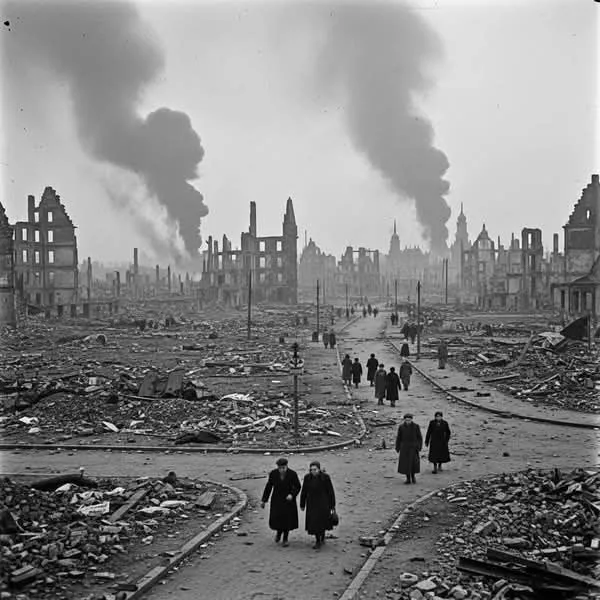
On September 1, 1939, Germany invaded Poland with 1.5 million troops across multiple fronts. Two days later, Britain and France declared war. The most destructive conflict in human history had begun. By the time it ended in August 1945, between 70 and 85 million people were dead - roughly 3 percent of the entire world population.
Whole cities had been vaporized. Six million Jews had been systematically murdered. The Soviet Union alone had lost 27 million people.
And the war ended not with exhausted armistice but with nuclear weapons incinerating two Japanese cities, inaugurating a new form of terror that would define the following century.
Unlike World War One, which surprised its architects with its scale and duration and which emerged from a tangle of alliances, miscalculations, and mobilization timetables that no single actor controlled, World War Two had a specific and identifiable cause: the ideology, decisions, and actions of Adolf Hitler.
That is not to say it was inevitable. At multiple points between 1933 and 1939, different choices by different actors might have prevented or contained it.
But understanding why those choices were not made - why Versailles created the conditions Hitler exploited, why the Weimar Republic collapsed, why appeasement failed, why Stalin signed a pact with his ideological enemy - requires following the logic of each actor in its historical context.
What emerges is a portrait of a catastrophe that was not predetermined by structural forces but was nonetheless made possible by a specific convergence: the economic devastation of the Great Depression, the institutional fragility of Germany's new democracy, and the trauma of a generation that had lived through the Somme and had no appetite to fight again.
Above all, it was made possible by the presence of a man of exceptional will, ideological fanaticism, and tactical cunning who knew exactly what he wanted and correctly judged that those standing in his way lacked the resolve to stop him.
"Hitler was not the inevitable product of a German 'special path' or the logical culmination of German history. He was a highly improbable figure whose rise depended on contingent circumstances - above all, the Depression - that nobody could have fully anticipated." - Ian Kershaw, Hitler: 1889-1936 Hubris (1998)[1]
| Cause | Region / Actor | Mechanism |
|---|---|---|
| Treaty of Versailles humiliation | Germany | Fueled resentment and ultranationalism |
| Great Depression | Global | Destabilized democracies, empowered extremists |
| Rise of Fascism | Germany, Italy | Aggressive expansionist ideology |
| Japanese imperialism | Asia-Pacific | Conquest of Manchuria, China, Southeast Asia |
| Appeasement policy | Britain, France | Failed to deter Hitler's expansion |
| Nazi-Soviet Pact (1939) | Europe | Removed eastern check on German aggression |
| Invasion of Poland | Europe | Triggered British and French declarations of war |
Key Definitions
Appeasement policy: The British and French diplomatic strategy of the 1930s that sought to avoid war by accommodating German territorial demands, based on the judgment that Hitler's grievances were limited and negotiable.
Versailles Treaty: The 1919 peace settlement ending World War One, which imposed war guilt, reparations, and territorial losses on Germany. Article 231 assigned Germany sole responsibility for the war.
Nazi ideology: The worldview of the National Socialist German Workers' Party, combining extreme nationalism, racial hierarchy with "Aryans" at the top and Jews at the bottom, anticommunism, and the goal of German territorial expansion eastward.
Lebensraum: "Living space" - Hitler's territorial goal of conquering Eastern Europe and European Russia to provide agricultural land and resources for an expanded German population, necessarily at the expense of Slavic peoples designated as racially inferior.
Anschluss: The annexation of Austria by Nazi Germany in March 1938, achieved without military resistance and in violation of the Versailles Treaty's prohibition on German-Austrian union.
Sudetenland crisis: The 1938 confrontation over the Sudetenland, a region of Czechoslovakia with a large ethnic German population. Resolved at Munich in September 1938 by transferring the territory to Germany.
Molotov-Ribbentrop Pact: The non-aggression treaty signed between Nazi Germany and the Soviet Union on August 23, 1939, with secret protocols dividing Eastern Europe into spheres of influence.
Blitzkrieg: "Lightning war" - the German military doctrine combining tanks, motorized infantry, and close air support in fast-moving coordinated operations designed to penetrate and encircle enemy forces before they could respond.
Totalitarianism: A form of government that seeks total control over every aspect of public and private life, characterized by a single party, state terror, propaganda, and suppression of independent institutions.
Fascism: A political ideology characterized by ultranationalism, authoritarian government, glorification of violence and war, and opposition to liberalism, democracy, and Marxism.
German Sonderweg debate: The historical argument that Germany followed a "special path" of development - with a powerful bureaucratic state but weak liberal civil society - that made it uniquely susceptible to authoritarianism and Nazism.
Taylor controversy: A.J.P. Taylor's revisionist 1961 argument that Hitler was an ordinary nationalist statesman who exploited opportunities rather than executing a master plan - a view almost universally rejected by subsequent historians.
Pacific War origins: The sequence of Japanese imperial expansion, Western economic pressure, and strategic miscalculation that produced the attack on Pearl Harbor in December 1941 and brought the United States into the war.
The Versailles Legacy
The peace settlement at Versailles in 1919 was shaped by competing pressures. France, having lost 1.4 million soldiers and seen its industrial north devastated, wanted security guarantees and reparations sufficient to prevent Germany from quickly rearming.
Britain sought a settlement that would prevent future German aggression without creating the conditions for another war. Woodrow Wilson brought Fourteen Points and a vision of self-determination that was inconsistently applied.
Germany, which had expected a "Wilson peace" based on the Fourteen Points and was appalled by the actual terms, signed under protest.
The terms were severe. Article 231, the "war guilt clause," assigned Germany sole responsibility for the war and formed the legal basis for reparations. The actual reparations figure, set at 132 billion gold marks in 1921, was enormous in nominal terms.
Germany lost Alsace-Lorraine to France, the Polish Corridor separating East Prussia from the rest of Germany, the city of Danzig placed under League of Nations authority, and all overseas colonies. The German military was restricted to 100,000 men with no air force and no submarines.
The economist John Maynard Keynes resigned from the British delegation and published The Economic Consequences of the Peace (1919), a devastating polemic arguing that the reparations were economically catastrophic and would destabilize Europe.[4]
Keynes became famous for this argument, and "Versailles caused World War Two" became a cliche repeated for decades. But subsequent scholarship has substantially revised this picture.
The economic historian Sally Marks and others demonstrated that the actual payments Germany made were far less than the nominal figure: Germany paid roughly 21 billion marks before payments were suspended, restructured under the Dawes Plan (1924) and Young Plan (1929), and effectively ended.[10]
Germany borrowed more from American banks than it paid in reparations. What Versailles created was not an economic catastrophe but a political wound - a burning sense of injustice, a "stab in the back" mythology, and a right-wing narrative of national humiliation that Hitler would exploit with devastating skill.
Crucially, the Versailles settlement was harsh by the standards of the eventual post-WWII settlement with Germany but mild by the standards of what Germany had imposed on Russia at Brest-Litovsk in 1918 - stripping Russia of a third of its European territory, a third of its population, and most of its coal and iron.
Other nations also suffered severe post-war settlements without generating a Hitler. What Versailles explains is German grievance; it does not explain why that grievance produced Nazism rather than democratic revision.
The Weimar Republic's Failure
The Weimar Republic, established in November 1918 on the ruins of the Kaiser's government, was Germany's first sustained experiment in democracy.
It faced challenges from the start: founded in military defeat, associated with the humiliating peace, attacked from the left by Communist uprisings and from the right by the Kapp Putsch (1920) and Hitler's own Beer Hall Putsch (1923).
The hyperinflation of 1923, which wiped out middle-class savings, left a legacy of anxiety about currency stability that would shape German political psychology for decades.
The republic stabilized in the mid-1920s under the Dawes Plan's economic relief and the diplomatic successes of Foreign Minister Gustav Stresemann. But it never developed deep roots in German political culture.
The Weimar constitution's system of pure proportional representation produced a fragmented parliament with dozens of parties, making stable coalition government nearly impossible.
Article 48, which allowed the President to rule by emergency decree, was used with increasing frequency as parliamentary deadlock deepened.
The Great Depression was the Weimar Republic's death blow. Between 1929 and 1932, German industrial production fell by 40 percent and unemployment rose to over 30 percent of the workforce. Banks collapsed. Middle-class families who had rebuilt their savings since 1923 lost them again.
The existing parties of the center and center-left appeared impotent. In this context, the NSDAP's electoral performance is explained: from 2.6 percent in 1928, it rose to 18.3 percent in September 1930, 37.4 percent in July 1932. It was the largest party in the Reichstag, though never commanding an outright majority.
Hitler's appointment as Chancellor on January 30, 1933 was not an inevitable product of electoral results - the NSDAP had actually fallen to 33.1 percent in November 1932, suggesting the tide might be turning.
President Paul von Hindenburg despised Hitler personally but was persuaded by Franz von Papen and other conservative advisors that Hitler could be controlled, used as a battering ram against the left, and tamed by the responsibilities of office.
Hindenburg's decision was the critical hinge: it converted an electoral plurality into state power. The conservatives who thought they could manage Hitler were among the most consequentially wrong people in modern history.
Hitler's Ideology and Intentions
Adolf Hitler was not a man of conventional political ambitions. Mein Kampf, written during his imprisonment after the 1923 putsch and published in two volumes in 1925 and 1926, outlined with unusual clarity what he intended to do if he gained power: eliminate the Jews as a racial contamination, acquire Lebensraum in Eastern Europe and European Russia at the expense of the Slavic populations he considered racially inferior, and make Germany the dominant continental power.
These were not campaign promises to be renegotiated once in office. They were the consistent organizing principles of his political life.
The historiographical debate between intentionalists and functionalists concerned the mechanism of implementation, not the goals themselves. A.J.P.
Taylor's The Origins of the Second World War (1961) made the extreme revisionist argument that Hitler was essentially a conventional German nationalist statesman who did not want a general European war and simply responded to opportunities created by Allied weakness.[3]
Taylor's argument rested on a selective reading of diplomatic documents and ignored the ideological record entirely.
It was almost universally rejected by subsequent historians, but it had the salutary effect of forcing historians to confront Allied agency and the mechanisms of appeasement with greater rigor.
The current consensus, articulated most fully in Ian Kershaw's two-volume biography Hitler: 1889-1936 Hubris (1998) and Hitler: 1936-1945 Nemesis (2000), is a sophisticated synthesis.[2] Hitler held consistent ideological goals but pursued them with tactical flexibility, timing each move to exploit the weaknesses of those he faced.
When the Western powers gave him the Rhineland, Austria, and the Sudetenland without fighting, he read each concession as confirmation that they would not fight. When they finally guaranteed Poland, he did not believe them - and he was nearly right.
The Failure of Appeasement
British and French policy toward Nazi Germany between 1933 and 1939 is easily mocked in hindsight but harder to condemn from within its context. Both countries were traumatized by the First World War.
The British electorate had delivered a "peace ballot" in 1935 in which 11.6 million people voted for collective security and disarmament.
Military planners in both countries knew their armed forces were unprepared for a major war. And there was a genuine question, at least initially, of whether Hitler's demands were limited - whether a Europe revised to accommodate German ethnic grievances might produce a stable settlement.
The critical failures came in sequence. In March 1936, Germany remilitarized the Rhineland in violation of the Versailles and Locarno treaties. German generals had orders to retreat if France responded militarily. France did not move without British backing; Britain did not move.
The message Hitler drew: the Western powers would not fight for the Versailles order. In March 1938, Germany absorbed Austria in the Anschluss - a violation of Versailles and a fundamental change to the European balance - without military resistance from any power.
The Munich Agreement of September 1938 was the nadir. Hitler demanded the Sudetenland, the border region of Czechoslovakia containing its strongest fortifications, most of its heavy industry, and 3 million ethnic Germans. Britain's Prime Minister Neville Chamberlain flew to Germany three times to negotiate.
At Munich on September 29-30, Britain, France, and Italy agreed to transfer the Sudetenland to Germany. Czechoslovakia, whose territory was being disposed of, was not represented at the conference. Chamberlain returned to London proclaiming "peace for our time."
In March 1939, Germany occupied the remainder of Czechoslovakia in open violation of the Munich agreement - not territorial revision but naked conquest of a non-German people. Britain and France finally drew a line: they guaranteed Poland's independence. When Germany invaded Poland on September 1, 1939, they declared war.
The lesson historians have drawn is not that appeasement was obviously irrational but that it suffered from a fatal misreading of Hitler. Appeasement could work with a statesman whose demands were ultimately limited and negotiable. Hitler was not such a statesman.
Each concession taught him that his opponents would retreat rather than fight, reinforcing his contempt for them and his willingness to escalate.
The Molotov-Ribbentrop Pact
The most startling diplomatic event of the summer of 1939 was the announcement on August 23 of a non-aggression pact between Nazi Germany and the Soviet Union - two regimes that had been sworn ideological enemies, whose armies had fought a proxy war in Spain, and whose theoretical worldviews described each other as the supreme civilizational enemy.
The public treaty contained the expected non-aggression provisions. The secret protocols were explosive: they divided Eastern Europe into German and Soviet spheres of influence. Poland was to be partitioned along the Narew-Vistula-San line.
Finland, Estonia, Latvia, Lithuania (in a subsequent revision), and the Romanian province of Bessarabia were assigned to the Soviet sphere.
Stalin's motivations remain debated. The most persuasive interpretation is that he was buying time. The Red Army officer corps had been devastated by Stalin's purges of 1937-38, which executed approximately 35,000 officers including three of five marshals, 13 of 15 army commanders, and 50 of 57 corps commanders.
The Red Army was in no condition to fight a major war. A German-Western war might exhaust all three parties while the Soviet Union rearmed.
The territorial gains in Eastern Poland, the Baltic states, and Finland provided a buffer zone. It was cold-blooded calculation that ultimately failed: Hitler attacked the Soviet Union in June 1941 anyway, nearly destroying it.
For Germany, the pact was strategically essential. It eliminated the two-front war that had destroyed the Kaiser's Germany. With the Soviet Union neutralized, Hitler could attack Poland knowing France and Britain would face Germany alone in the west.
The Soviet invasion of Poland from the east on September 17, 1939 - barely mentioned in Western accounts of WWII's origins - sealed Poland's fate and demonstrated that the Molotov-Ribbentrop Pact was not merely defensive but actively collaborative.
The Pacific War's Origins
The war in Asia and the Pacific had roots extending back to Japanese expansionism in the late 19th century.
Japan's invasion of Manchuria in 1931 - conducted by the Kwantung Army in defiance of the civilian government in Tokyo - established the pattern: military factions driving policy beyond civilian control, international condemnation without consequence, and League of Nations impotence.[7]
The full-scale invasion of China beginning in July 1937 brought the most horrific atrocity of the Pacific War's early years: the Rape of Nanking (December 1937 to January 1938), during which Japanese forces killed an estimated 200,000 to 300,000 Chinese civilians and prisoners of war in six weeks of systematic slaughter.
The mechanism that brought the Pacific War into direct collision with the European war was oil. Japan lacked indigenous oil supplies and imported approximately 80 percent of its oil from the United States.
When Japan occupied French Indochina in July 1941 - using the fall of France to seize a strategic position threatening British Malaya and Dutch East Indies oil fields - the Roosevelt administration responded with a total oil embargo, joined by Britain and the Netherlands.
Japan had roughly two years of oil reserves for its military operations. The choice, as Japanese planners framed it, was withdrawal from China (politically impossible for the military faction that controlled the government) or war.
The decision to attack Pearl Harbor on December 7, 1941 represented a gamble that a swift, decisive blow could knock the US Pacific Fleet out of the war long enough for Japan to seize the resource-rich territories of Southeast Asia and create a defensive perimeter so formidable that the US would accept a negotiated settlement rather than pay the cost of reconquest.
Admiral Isoroku Yamamoto, who commanded the attack, reportedly said afterward: "I fear all we have done is to awaken a sleeping giant and fill him with a terrible resolve." Whether he actually said it, the sentiment was accurate.
Japan had underestimated American industrial capacity, American political resolve, and the effect of Pearl Harbor in unifying a divided American public.[5]
Historiographical Debates
The causes of World War Two have generated more historical controversy than almost any subject in modern history. Several fault lines run through the scholarship.
The German Sonderweg (special path) debate asks whether German authoritarianism was structurally determined by Germany's particular path of historical development: a powerful Prussian bureaucratic tradition, rapid industrialization without an accompanying liberal revolution, a bourgeoisie that deferred to aristocratic values rather than developing its own.
Hans-Ulrich Wehler and the Bielefeld school argued that German society's structural features made it susceptible to fascism in ways that Britain or France were not.
Critics counter that the Sonderweg thesis is teleological - reading German history backward from Hitler - and ignores the genuine democratic achievements of the Weimar period.
The debate over perpetrators - who killed, why, and with what motivation - produced one of the most controversial books in modern history: Daniel Jonah Goldhagen's Hitler's Willing Executioners (1996), which argued that ordinary Germans participated in mass murder because of a uniquely German "eliminationist antisemitism" that predated Hitler.[9]
Christopher Browning's Ordinary Men (1992), studying the same Reserve Police Battalion 101, reached different conclusions: the perpetrators were not specifically ideologically committed to antisemitism but responded to group conformity, deference to authority, careerism, and the incremental normalization of atrocity.[8]
The Browning interpretation, echoed by Zygmunt Bauman's Modernity and the Holocaust (1989), has been more broadly influential, not least because it raises the more disturbing question of whether ordinary people in other societies might behave similarly under comparable institutional pressures.[11]
Winston Churchill called World War Two "the unnecessary war" - preventable at almost any stage by firm Allied resistance. Historians largely agree that firmer resistance earlier would have deterred or constrained Hitler.
Whether that means the war was "unnecessary" is a different question: it implies the Allied democracies had more agency than they subjectively felt they had, which is easy to see in retrospect but was genuinely difficult to perceive at the time.
Consequences and Legacy
The consequences of World War Two reshaped every dimension of the post-war world.[6] The 70-85 million dead included 27 million Soviets, 15-20 million Chinese, 6 million Jews and 5-6 million others murdered in the Holocaust, 7-8 million Germans, and 6 million Poles representing roughly 17 percent of Poland's entire population.
These numbers are abstractions; what they represent is the near-total destruction of European Jewish civilization, the physical ruination of every major German, Japanese, British, and Soviet city, and the demographic devastation of a generation.
The political consequences were equally transformative. Germany was divided into occupation zones that became, by 1949, two separate states. The United Nations was established in 1945 with the explicit goal of preventing future wars through collective security.
The Nuremberg trials established the principle that individuals - including heads of state - could be held criminally accountable for crimes against humanity and wars of aggression, creating the foundations of international humanitarian law.
The Marshall Plan channeled $13 billion of American aid into Western European reconstruction, helping build the prosperous, democratic Western Europe that would become NATO.
The Cold War emerged directly from WWII's outcome: the Soviet Union's military occupation of Eastern Europe became permanent political domination, and the rivalry between the American and Soviet spheres defined global politics for the next four decades.
Decolonization accelerated: the war had demonstrated that European powers could be defeated, and it had morally discredited the racial hierarchies that had justified empire.
Nuclear deterrence - the doctrine that nuclear weapons' destructive capacity made great-power war suicidal - shaped military strategy for the rest of the 20th century.
The war's central lesson, absorbed into Western political culture, was the danger of appeasement - a lesson so deeply internalized that it would be invoked in contexts (Korea, Vietnam, Iraq) where the analogy was questionable.
But the underlying principle was sound: a regime with unlimited ideological ambitions cannot be satisfied by limited territorial concessions, because the concessions are not the point.
Sources & Further Reading
- Kershaw, I. (1998). Hitler: 1889-1936 Hubris. Allen Lane.
- Kershaw, I. (2000). Hitler: 1936-1945 Nemesis. Allen Lane.
- Taylor, A.J.P. (1961). The Origins of the Second World War. Hamish Hamilton.
- Keynes, J.M. (1919). The Economic Consequences of the Peace. Macmillan.
- Overy, R. (1995). Why the Allies Won. W.W. Norton.
- Weinberg, G.L. (1994). A World at Arms: A Global History of World War II. Cambridge University Press.
- Ienaga, S. (1978). The Pacific War, 1931-1945. Pantheon Books.
- Browning, C.R. (1992). Ordinary Men: Reserve Police Battalion 101 and the Final Solution in Poland. HarperCollins.
- Goldhagen, D.J. (1996). Hitler's Willing Executioners: Ordinary Germans and the Holocaust. Alfred A. Knopf.
- Marks, S. (1978). The Myths of Reparations. Central European History, 11(3), 231-255. DOI: 10.1017/S0008938900017696
- Bauman, Z. (1989). Modernity and the Holocaust. Cornell University Press.