
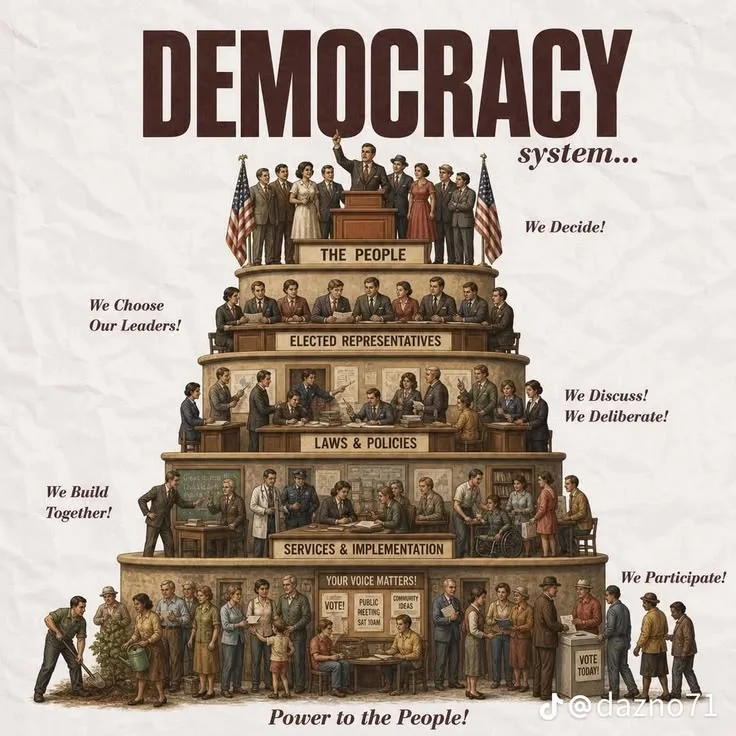
How democracy functions comes down to turning political authority from citizens into government through elections, rights, rule of law, and constraints on power. Elections and governance depend heavily on institutional design: representative and direct mechanisms, electoral rules, checks and balances, courts, and civil society all shape outcomes. The same institutions that enable collective rule can weaken through democratic backsliding when norms and safeguards erode.
Democracy is a system of government in which political power is derived from the governed, expressed through free and fair elections, protected by rule of law, and constrained by guaranteed rights. In 507 BCE, the Athenian statesman Cleisthenes introduced a series of reforms that historians mark as the birth of democracy.
The word itself - demokratia - combined demos (people) and kratos (rule or power). For Cleisthenes, "the people" meant male citizens of Athens; slaves, women, and foreigners were excluded.
But the core innovation was radical: political decisions would be made by citizens collectively, not by a hereditary elite or a single ruler.
The Athenian experiment lasted less than two centuries before conquest and internal contradictions ended it. But its core idea - that political authority derives from the governed, not from gods or bloodlines - has proven to be the most powerful organizing principle in the history of governance.
Today, approximately 50-60% of the world's countries use some form of democratic government, according to Freedom House's 2024 report, compared to fewer than 10% at the start of the 20th century.
The Pew Research Center estimated in 2019 that 57% of the world's 167 countries with populations of at least 500,000 were democracies of some form.
Yet democracy remains fragile, contested, and increasingly under strain. Understanding how democracy actually works - its mechanics, its variants, its institutional requirements, and its vulnerabilities - is essential for any serious analysis of modern politics.
"Democracy is the worst form of Government, except for all those other forms that have been tried from time to time." - Winston Churchill, House of Commons, November 11, 1947
Key Definitions
Representative democracy - A system in which citizens elect representatives who make decisions on their behalf. Distinct from direct democracy, in which citizens vote directly on laws.
Virtually all large-scale modern democracies are representative; direct democratic elements (referendums, initiatives) exist in many, with Switzerland being the most notable example - Swiss citizens vote on federal referendums approximately four times per year.
Liberal democracy - Representative democracy that also protects individual rights and minority interests through constitutional constraints, an independent judiciary, and rule of law.
The "liberal" refers to classical liberalism's emphasis on individual rights, not left-wing political ideology. Liberal democracy is the dominant form in Western countries.
Electoral system - The rules determining how votes are translated into seats or offices. Major systems: First-Past-the-Post (FPTP), Proportional Representation (PR), Ranked Choice Voting (RCV), Mixed systems. The electoral system profoundly shapes party systems, coalition dynamics, and government stability.
Checks and balances - The constitutional distribution of governmental powers among multiple branches (executive, legislative, judicial) or levels (federal, state/regional, local) such that each can limit the others. Designed to prevent the concentration of power in a single person or institution.
First systematically articulated by Montesquieu in The Spirit of the Laws (1748).
Democratic backsliding - The gradual erosion of democratic norms, institutions, and practices by elected governments, without a formal coup or revolution. Also called autocratization. The V-Dem Institute at the University of Gothenburg identified 42 countries undergoing significant autocratization in their 2024 report.
Civil society - The sphere of organized life between government and private individuals: civic associations, trade unions, religious organizations, non-profits, universities, media organizations, and advocacy groups.
Political scientist Robert Putnam's influential 2000 book Bowling Alone documented the decline of American civil society participation and its consequences for democratic health.
Duverger's Law - The political science observation (Maurice Duverger, 1954) that plurality electoral systems (FPTP) tend to produce two-party systems, while proportional representation systems tend to produce multi-party systems.
Explained by strategic voting: under FPTP, voting for a third-party candidate is "wasted" if they cannot win, incentivizing consolidation around the two strongest parties.
Populism - A political style that frames politics as a conflict between "the pure people" and a "corrupt elite," with the populist leader claiming to represent the authentic will of the people against established institutions.
Political theorist Cas Mudde (2004) provided the most widely cited academic definition, describing populism as a "thin-centered ideology" that can attach to either left-wing or right-wing substantive policies.
The Mechanics of Elections
Translating Votes into Power
The electoral system is the central mechanism of democracy - the rules determining how citizen preferences become government. No electoral system is neutral; each systematically advantages certain types of parties and produces different governance outcomes.
Political scientist Arend Lijphart, in his landmark 2012 study Patterns of Democracy, compared 36 democracies over decades and found that electoral system choice was the single most consequential institutional variable in determining how a democracy functions.
First-Past-the-Post (used in US House races, UK Parliament, Canadian Parliament, Indian Parliament):
- The candidate with the most votes wins, even without a majority
- Simple and decisive: produces clear winners
- Can produce massive seat majorities from narrow vote margins (UK 2019: Conservatives won 56% of seats with 44% of votes; Canada 2015: Liberals won 54% of seats with 39.5% of votes)
- Severely underrepresents parties with geographically dispersed support
- Creates strong incentive for two-party consolidation
Party-List Proportional Representation (Netherlands, Israel, most of Europe):
- Voters choose parties; seats are allocated proportionally to vote share
- Accurately represents voter preferences
- Typically requires coalition formation - the Netherlands' 2021 election produced 17 parties in parliament, with coalition negotiations lasting a record 299 days
- Small parties can survive and grow
- Governments may be less stable but research by Lijphart suggests they are no less effective
Mixed-Member Proportional (Germany, New Zealand, Scotland):
- Combines FPTP constituency seats with proportional party-list seats
- Attempts to combine local representation with proportional outcomes
- Germany's system, designed after World War II to prevent both the instability of Weimar-era pure PR and the distortions of FPTP, is often cited as particularly successful
- New Zealand adopted MMP in 1996 after a referendum rejecting FPTP
Ranked Choice Voting / Instant Runoff (Australia, Ireland, many US cities including New York and San Francisco):
- Voters rank candidates in preference order
- Candidates with fewest first-choice votes are eliminated; their votes are redistributed to second choices
- Continues until one candidate has a majority
- Eliminates "spoiler" problem; allows voters to support smaller parties without wasting votes
- Results in majority winners; reduces strategic voting
- FairVote, a US electoral reform organization, reports that RCV elections tend to produce more civil campaigns because candidates seek to be voters' second choice as well as their first
| System | Used In | Two-Party Tendency | Coalition Needed | Local Representation |
|---|---|---|---|---|
| FPTP | US, UK, Canada, India | High | Rarely | Strong |
| Party-List PR | Netherlands, Israel | Low | Usually | Weak |
| Mixed-Member PR | Germany, New Zealand | Moderate | Often | Moderate |
| Ranked Choice | Australia, Ireland | Moderate | Often | Strong |
Electoral College and Indirect Election
The United States uses the Electoral College for presidential elections - an indirect system in which voters technically choose electors who then cast electoral votes for president. Each state receives electoral votes equal to its congressional delegation (House members + 2 senators).
The candidate reaching 270 of 538 electoral votes wins.
The system was designed by the Constitutional Convention (1787) as a compromise between direct popular election (which smaller states feared would disadvantage them) and congressional selection.
It produces a winner-take-all dynamic in most states that concentrates campaign resources in "swing states" and has twice in recent history (2000, 2016) produced a president who lost the popular vote.
Political scientist Jesse Richman has calculated that under the Electoral College, a vote in Wyoming carries approximately 3.6 times the mathematical weight of a vote in California in determining the outcome - a structural inequality that generates persistent debate about democratic fairness.
Voter Turnout: The Participation Problem
The quality of democratic governance depends partly on how many citizens actually participate. Voter turnout varies enormously across democracies.
According to the International Institute for Democracy and Electoral Assistance (IDEA), average turnout in parliamentary elections from 2008-2023 ranged from over 87% in Australia and Belgium (both have compulsory voting) to approximately 50-60% in the United States and Switzerland.
Low turnout creates a representativeness problem: if only certain demographics vote, the government represents those demographics rather than the full citizenry.
Research by political scientist Arend Lijphart (1997) identified compulsory voting, weekend voting, automatic registration, and proportional representation as the strongest institutional predictors of high turnout.
The United States, with Tuesday voting, opt-in registration, and FPTP elections, has nearly every institutional feature associated with low turnout.
Institutional Architecture
Separation of Powers
James Madison, designing the US Constitution, borrowed from Montesquieu's theory of separated powers and added the mechanism of institutional rivalry. His insight in Federalist No.
51 (1788) was both cynical and brilliant: "Ambition must be made to counteract ambition." Rather than relying on virtuous officeholders, the system pitted institutional interests against each other, so that power's own dynamics would constrain itself.
The three branches of US government have distinct powers that check each other:
- Legislative (Congress): Makes laws, controls the budget, can impeach and remove executives and judges
- Executive (President): Implements laws, commands the military, appoints judges and officials, can veto legislation
- Judicial (Courts): Interprets laws, can strike down laws and executive actions as unconstitutional
This design, replicated in various forms in most democratic constitutions, creates institutional friction. Laws require agreement between branches. Unconstitutional actions can be struck down.
But it also creates potential gridlock and, in polarized conditions, can become weaponized - each branch using its powers primarily to obstruct rather than govern.
Political scientists Thomas Mann and Norman Ornstein documented this dynamic in their 2012 book It's Even Worse Than It Looks, arguing that increasing partisan polarization was turning the American system's checks and balances into instruments of dysfunction.
Presidential vs. Parliamentary Systems
The fundamental difference between presidential and parliamentary systems is the relationship between executive and legislative power:
Presidential systems (US, Brazil, Mexico, South Korea):
- Voters separately elect the executive and legislature
- Executive has a fixed term and cannot be removed except by impeachment
- The executive and legislature may be of different parties (divided government)
- Clear separation of powers
- Greater risk of deadlock between branches
Parliamentary systems (UK, Germany, Japan, Australia, Canada):
- The executive (prime minister, cabinet) is chosen from and accountable to the legislature
- The prime minister commands a legislative majority
- The legislature can remove the government through a vote of no confidence
- The head of government and legislative majority are necessarily aligned
- Elections can be called more flexibly
Political scientist Juan Linz's influential 1990 essay in the Journal of Democracy argued that presidentialism is inherently more prone to democratic breakdown because fixed terms allow incompetent or abusive presidents to serve out their terms with no removal mechanism short of impeachment; and because divided government creates irresolvable conflicts between two institutions each claiming democratic legitimacy.
Linz pointed to Latin America, where presidential democracies had repeatedly collapsed into authoritarianism, as evidence.
Subsequent research by Jose Antonio Cheibub (2007) has partially challenged Linz, arguing that the correlation between presidentialism and democratic failure is partly explained by the regions where presidential systems tend to exist rather than the system itself.
The Role of Courts and Constitutional Review
Independent courts - particularly courts with the power of constitutional review - are a critical institutional check in modern democracies.
The US Supreme Court's power to strike down laws as unconstitutional was not explicitly stated in the Constitution but established through Chief Justice John Marshall's landmark ruling in Marbury v. Madison (1803).
Constitutional courts serve multiple democratic functions: protecting minority rights against majority tyranny, enforcing constitutional limits on government power, resolving disputes between governmental branches, and providing stability by insulating certain principles from simple majority override.
Courts also represent a democratic tension: in striking down legislation passed by elected majorities, unelected judges overrule democratic decisions.
This "counter-majoritarian difficulty," first articulated by legal scholar Alexander Bickel in The Least Dangerous Branch (1962), is a persistent feature of constitutional democracy and philosophical debate about the proper scope of judicial power.
Why Democracies Fail
Democratic Backsliding
The most common way 21st-century democracies have ended is not through military coups but through gradual internal erosion - what Steven Levitsky and Lucan Way called "competitive authoritarianism" (2002) and what Daniel Ziblatt and Levitsky describe in their 2018 bestseller How Democracies Die.
The pattern is consistent: an elected leader with popular support gradually dismantles institutional constraints.
Hungary under Viktor Orban (2010-present) represents the paradigm: a democratically elected leader who, on obtaining a supermajority, rewrote the constitution, packed the constitutional court, changed electoral rules to entrench his party's advantage, consolidated media ownership among allies (by 2020, approximately 80% of Hungarian media was controlled by government-aligned entities, according to Reporters Without Borders), and restricted civil society.
The V-Dem Institute now classifies Hungary as an "electoral autocracy" rather than a democracy - achieved through elections, not a coup. Orban himself describes the system as "illiberal democracy," embracing the term that scholars use critically.
Turkey under Erdogan, Venezuela under Chavez and Maduro, and Poland (partially reversed after 2023 elections) under the Law and Justice party all followed variations of this playbook.
Levitsky and Ziblatt identify four key warning signs in would-be authoritarian leaders:
- Rejection of democratic rules of the game
- Denial of the legitimacy of political opponents
- Tolerance or encouragement of political violence
- Willingness to restrict civil liberties of opponents
The Role of Norms
Constitutions provide the formal rules of democratic governance. But democracy also depends on informal norms - unwritten understandings about how political actors should behave. Levitsky and Ziblatt emphasize two as especially important:
Mutual toleration: Accepting opponents as legitimate competitors with a right to exist and win. The opposite is treating political opponents as existential threats to be destroyed rather than rivals to be defeated in elections.
Institutional forbearance: Restraint in using legal powers to their maximum extent against opponents. A president with the legal authority to appoint 50 judges simultaneously could do so - but democratic norms suggest this would be inappropriate. When forbearance erodes, the formal rules become weapons rather than guardrails.
"Democracies may die at the hands not of generals but of elected leaders - presidents or prime ministers who subvert the very process that brought them to power." - Steven Levitsky and Daniel Ziblatt, How Democracies Die (2018)
Economic Conditions and Democratic Stability
The relationship between economic development and democracy has been studied since political scientist Seymour Martin Lipset proposed the "modernization hypothesis" in 1959: that economic development creates conditions favorable to democracy (an educated middle class, urbanization, exposure to diverse perspectives).
Adam Przeworski and Fernando Limongi (1997) refined this in an influential study of 135 countries from 1950-1990, finding that while economic development does not necessarily cause democratization, it strongly predicts democratic survival.
No democracy with a per-capita income above approximately $6,000 (in 1985 purchasing-power-parity dollars) has ever collapsed, suggesting that prosperity creates a buffer against democratic failure - though this threshold may not hold indefinitely as wealthy democracies face new stresses.
Democracy in the Digital Age
Social media has transformed democratic politics in ways that are still being understood.
Early optimism - that internet access and social media would empower citizens, expose corruption, and strengthen democracy - has given way to concern about filter bubbles, disinformation, polarization, and the ease with which bad-faith actors can manipulate public information.
Research on social media's effects on democracy is mixed but generally concerning:
- Social media platforms optimize for engagement, and emotionally arousing content (particularly outrage and fear) drives more engagement than accurate, balanced reporting. A 2018 study by Soroush Vosoughi, Deb Roy, and Sinan Aral at MIT, published in Science, found that false news stories on Twitter spread six times faster than true ones, and reached far more people - not because of bots but because humans preferentially shared novel, emotionally charged content.
- Algorithmic recommendation systems create filter bubbles that reinforce existing beliefs. Research by Eli Pariser (2011) and subsequent empirical studies suggest these effects are real but smaller than feared - most people encounter more diverse viewpoints online than offline.
- The low cost of producing and distributing false information creates an "epistemic pollution" problem that is genuinely new. Renee DiResta of the Stanford Internet Observatory has documented how state actors, commercial spam operations, and ideological activists all exploit the same infrastructure.
- Foreign interference campaigns (documented Russian operations in the 2016 US election, confirmed by the US Senate Intelligence Committee's bipartisan 2019-2020 reports) can amplify domestic divisions at scale for minimal cost.
Whether these effects are primarily responsible for democratic backsliding, or whether they amplify underlying social and economic causes (inequality, cultural anxiety, institutional distrust), is actively debated.
Yochai Benkler, Robert Faris, and Hal Roberts argued in their 2018 study Network Propaganda that traditional media dynamics - particularly partisan cable television - were more consequential than social media in driving political polarization in the United States.
Is Democracy Declining?
Most major democracy indices show a global decline since the mid-2000s. Freedom House's annual Freedom in the World report found 2023 was the 18th consecutive year in which declines outnumbered gains.
The V-Dem Institute classifies approximately 42 countries as undergoing significant autocratization, affecting 4.2 billion people - roughly 72% of the world's population.
This represents a reversal of the "third wave of democratization" (Samuel Huntington's 1991 term) that ran from 1974 to roughly 2006, during which the number of democracies nearly tripled - from approximately 40 to over 120.
The causes of the current backsliding are debated: economic inequality and its political discontents, the failure of economic development to deliver for working-class populations in established democracies, the rise of disinformation, deliberate promotion of autocratic models by authoritarian states (China, Russia), and the institutional weaknesses exposed by polarization.
Yet the picture is not uniformly bleak. Democracies have shown resilience in unexpected places. Taiwan, South Korea, and Poland have demonstrated that democratic norms can be defended and backsliding reversed.
Public opinion surveys by Pew Research Center (2023) and the World Values Survey consistently show that democratic governance remains the most popular form of government globally - even in countries experiencing backsliding, majorities typically prefer democracy to alternatives.
The future of democracy depends not on the system's abstract merits but on whether democratic institutions can deliver - addressing economic inequality, adapting to technological disruption, maintaining legitimacy across increasingly diverse populations, and defending themselves against leaders who would hollow them from within.
Democracy has always been a work in progress, fragile by design but resilient through participation.
For related concepts, see how incentives shape outcomes, what is civil society, and stakeholder theory explained.
Sources & Further Reading
- Levitsky, S., & Ziblatt, D. (2018). How Democracies Die. Crown.
- Acemoglu, D., & Robinson, J. A. (2006). Economic Origins of Dictatorship and Democracy. Cambridge University Press.
- Dahl, R. A. (1971). Polyarchy: Participation and Opposition. Yale University Press.
- Duverger, M. (1954). Political Parties: Their Organization and Activity in the Modern State. Wiley.
- Lijphart, A. (2012). Patterns of Democracy: Government Forms and Performance in Thirty-Six Countries (2nd ed.). Yale University Press.
- Linz, J. J. (1990). The Perils of Presidentialism. Journal of Democracy, 1(1), 51-69.
- Huntington, S. P. (1991). The Third Wave: Democratization in the Late Twentieth Century. University of Oklahoma Press.
- Przeworski, A., & Limongi, F. (1997). Modernization: Theories and Facts. World Politics, 49(2), 155-183.
- Vosoughi, S., Roy, D., & Aral, S. (2018). The Spread of True and False News Online. Science, 359(6380), 1146-1151.
- Putnam, R. D. (2000). Bowling Alone: The Collapse and Revival of American Community. Simon & Schuster.
- Benkler, Y., Faris, R., & Roberts, H. (2018). Network Propaganda: Manipulation, Disinformation, and Radicalization in American Politics. Oxford University Press.
- Freedom House. (2024). Freedom in the World 2024. View source
- V-Dem Institute. (2024). Democracy Report 2024. University of Gothenburg. View source
- Mudde, C. (2004). The Populist Zeitgeist. Government and Opposition, 39(4), 541-563.