
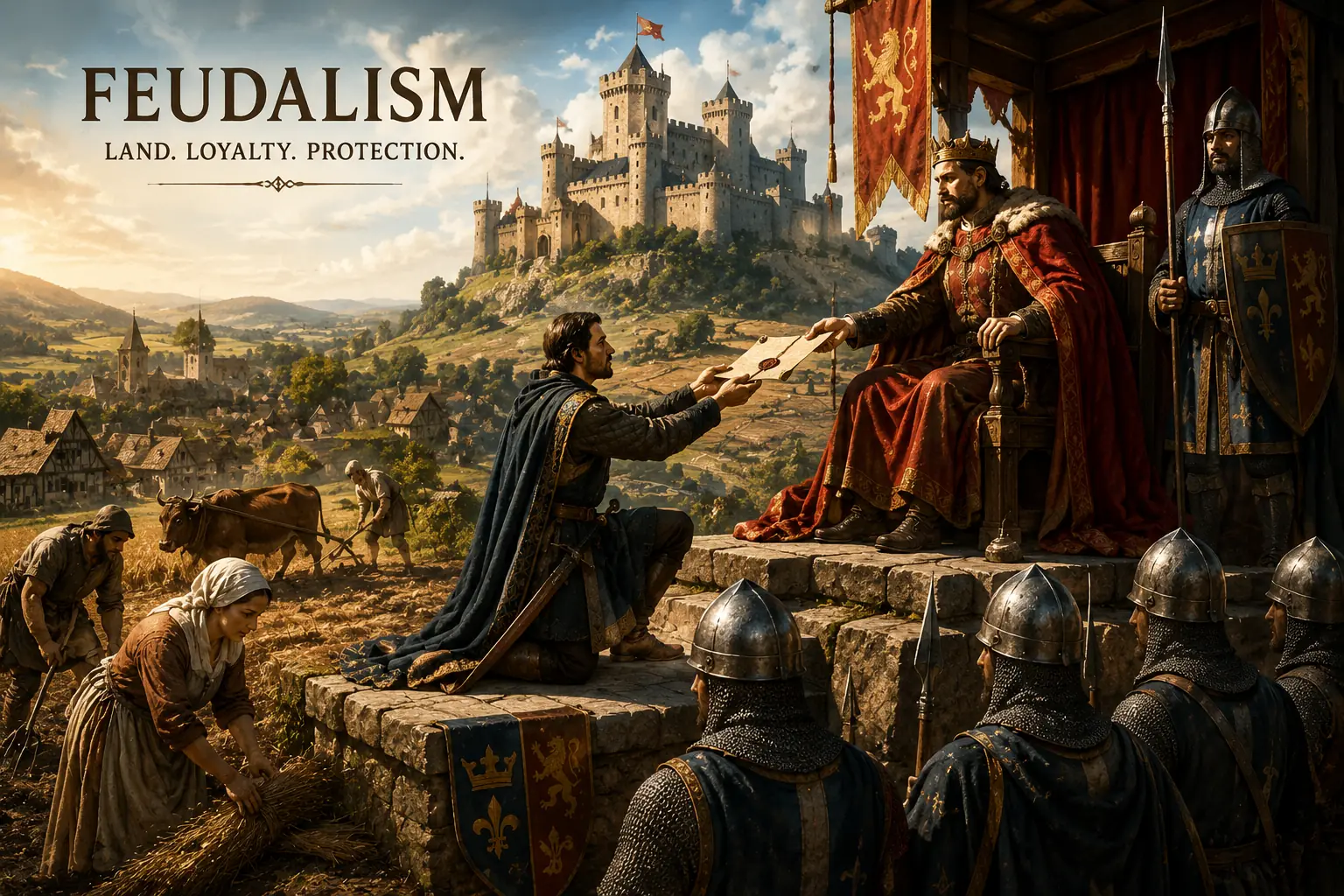
What was feudalism? It is a debated label for medieval European arrangements organized around land tenure, military service, lord-vassal bonds, manors, and peasant obligations. The model helps describe recurring patterns of protection and dependence after political fragmentation, but historians caution that regional practice was varied and later legal vocabulary can impose a false uniform system on the past. Serfdom was binding but distinct from slavery.
In the spring of 1939, as Europe was sliding toward its second catastrophic war in a generation, the French historian Marc Bloch sat down to complete a book he had been working on for years.
"Feudal Society" would become one of the landmarks of 20th-century historical scholarship - a comprehensive account of medieval European social organization, its origins in the breakdown of Carolingian order, its characteristic institutions of land tenure and mutual obligation, and its long dissolution under the pressure of demographic and economic change.
Bloch wrote in full awareness that the world around him was collapsing. He was a veteran of the First World War, a Jewish Frenchman in a Europe convulsing with antisemitic violence, and a historian who understood that social orders that had seemed permanent could be swept away with terrible speed.
When France fell to Nazi Germany in 1940, Bloch joined the French Resistance. He was arrested by the Gestapo in 1944 and executed before the Liberation.
That a man who would die for his country's freedom was also the author of the defining study of medieval serfdom - of a system built on the binding of peasants to land and their subjection to armed lords - is not merely biographical irony.
Bloch's method was to treat medieval people as full human beings moving through a comprehensible social world, not as primitive forebears of modernity.[3] His feudal society was not simply a collection of barbaric arrangements awaiting the progress of civilization.
It was a system that made sense within its historical conditions - a response to specific political, economic, and military circumstances - and whose decline made sense too when those circumstances changed.
"The system was human, and therefore confused and complex." - Marc Bloch, Feudal Society (1939-1940)
| Actor | Role in Feudal System | Obligations |
|---|---|---|
| King | Supreme lord; sovereign authority | Grant land to nobles; provide justice and protection |
| Lord / Baron | Holds land (fief) from king | Military service to king; administer estates |
| Knight | Mounted warrior; holds land from lord | Military service; maintain order locally |
| Church | Spiritual authority; holds land | Pray for souls; education; social services |
| Serf / Villein | Bound to the land; agricultural labor | Labor services; pay dues to lord; cannot leave |
Key Definitions
Feudalism: A term of disputed utility used by historians to describe the characteristic social, political, and economic arrangements of medieval Europe, centered on land tenure, military obligation, and the relationship between lord and vassal. The term was not used in the Middle Ages itself.
Fief: A grant of land made by a lord to a vassal in exchange for homage, fealty, and military service. The fief (from Latin "feudum") is the etymological origin of "feudalism."
Vassal: A person who holds a fief from a lord and owes that lord loyalty, service (primarily military), and defined obligations in exchange for the land and its revenues and the lord's protection and justice.
Homage: The formal ceremony in which a vassal knelt before a lord, placed his hands in the lord's hands, and swore loyalty and service - the ritual act that created the feudal bond.
Serfdom: The legal condition of peasants bound to the land, obligated to provide labor services and payments to the lord, unable to leave the manor without permission. Distinct from slavery: serfs were not personal property and moved with the land rather than being sold separately from it.
Demesne: The portion of a manor's land farmed directly for the lord rather than granted to peasants, who owed labor services to work it.
Manorial system: The economic organization of medieval rural life around the manor - typically a village and its surrounding lands - with the lord's demesne, peasant strips in common fields, common grazing and woodland, and the lord's mill and other facilities.
Open field system: The medieval agricultural arrangement in which a village's arable land was divided into large fields, each field periodically left fallow, with individual holdings scattered in strips across the fields rather than consolidated in private enclosures.
The Historian's Quarrel: Is "Feudalism" Even Useful?
Before describing feudalism, it is worth acknowledging that historians have been arguing about whether the concept is usable at all.
In 1974, Elizabeth Brown published an article in the American Historical Review titled "The Tyranny of a Construct: Feudalism and Historians of Medieval Europe." Her argument was pointed: "feudalism" groups together such a variety of arrangements - different types of land tenure, different forms of obligation, different power structures across different regions and centuries - that the label obscures more than it reveals.[5]
Using "feudalism" as if it describes a coherent system can lead historians to impose a false uniformity on a diverse historical reality and to retroactively read institutional patterns that contemporaries did not recognize.
Susan Reynolds extended this critique in Fiefs and Vassals (1994), arguing that the technical vocabulary of feudalism - vassalage, fealty, the fief contract - was elaborated by later lawyers and theorists reading back into earlier arrangements that were actually more informal and varied.[15]
Reynolds's detailed examination of primary sources from France, England, Italy, and Germany showed that the neat conceptual architecture of feudo-vassalic relations was frequently imposed retrospectively by legal commentators from the 12th century onward, not simply recorded from pre-existing practice.
These are serious critiques. The response from most working historians is not to abandon the term but to use it with care: as a rough label for characteristic patterns of medieval European social organization rather than as a description of a precisely defined, universally shared institutional system.
Something recognizable as feudal organization - land grants in exchange for service, peasant obligations to lords, devolved political authority - can be found across medieval western Europe, even if the details varied enormously. The term is indispensable for teaching and for cross-regional comparison, however imperfect.
Why Feudalism Developed: The Historical Conditions
Feudalism did not arise because medieval people were primitive or pre-rational. It arose because specific historical conditions made it a practical response to real problems of governance, defense, and economic organization.
The collapse of the Western Roman Empire in the 5th century left an enormous political vacuum. Roman administrative structures - the professional army, the tax system, the road network, the urban economy with its monetary circulation - largely disappeared in the west within a generation.
What replaced them was fragmented political authority, an overwhelmingly agrarian economy, and very limited monetary circulation. The few surviving institutions of any scale were ecclesiastical.
Peter Heather, in The Fall of the Roman Empire (2006), argued that the collapse was primarily driven by external pressure from migrations and invasions rather than internal decay, but the consequence for governance was the same: the administrative infrastructure of a literate, monetized, centrally organized state gave way to localized, largely illiterate, barter-and-labor economies.[12]
Bryan Ward-Perkins's The Fall of Rome and the End of Civilization (2005) documented the material consequences in extraordinary detail - archaeology shows sharp declines in the quality and quantity of pottery, construction, animal bone size, and long-distance trade goods across the former western provinces, indicating a genuine collapse in living standards rather than merely a political reorganization.[17]
Charlemagne briefly reconstituted something like centralized authority over a large part of western Europe in the early 9th century. The Carolingian empire maintained something resembling taxation and a professional administrative apparatus.
But Charlemagne's successors could not hold it together. By the late 9th century, the empire had fragmented into competing kingdoms, and those kingdoms faced threats from multiple directions simultaneously: Viking raiders attacking coastal and river settlements from the north, Magyar cavalry raiding deep into central Europe from the east, and Saracen raiders threatening the Mediterranean coast from the south.
In this environment, local defense became the overriding priority, and land became the currency of governance. Kings and emperors could not pay professional armies in cash - there was not enough monetary circulation to support them.
Instead, they granted land to warriors who would maintain themselves from agricultural revenues and provide military service when summoned.
Those grants - initially called "beneficia," eventually "fiefs" - created a system of distributed military power that made local defense possible without centralized fiscal capacity.
The warrior-lords who received these grants built castles - the characteristic architectural expression of feudalism - from which they could defend their territories against raids and assert authority over the surrounding countryside. The castle was both a military installation and a seat of local government.
The peasants who farmed in a castle's shadow lived under its lord's protection and jurisdiction.
Robert Bartlett, in The Making of Europe (1993), showed how castle-building was not simply defensive but aggressive - the instrument by which lords carved out new territories and asserted dominance over rural populations, particularly in frontier regions being incorporated into the feudal order.[1]
The Carolingian Military System
The specific form that feudalism took in its early centuries owed much to the military requirements of Carolingian warfare. Heavy cavalry - the armed and armored knight on horseback - was the decisive military force of the period.
Maintaining a war horse, armor, weapons, and the training to use them effectively required significant resources. A knight could not both farm his land and maintain himself in military readiness; he needed others to farm for him.
Lynn White Jr.'s controversial argument in Medieval Technology and Social Change (1962) proposed that the adoption of the stirrup enabled the heavy cavalry charge - the shock combat that made the mounted knight so formidable - and that this military revolution drove the development of the fief system as the only way to finance a cavalry force.[18]
While subsequent historians have questioned whether the stirrup was as causally decisive as White argued, the connection between heavy cavalry warfare and the economic demands it created remains a significant part of the feudalism's origins story.
The Church and the Three Orders
Medieval European society was articulated through a conceptual framework provided by the Church: the three orders. Those who pray (oratores) - the clergy; those who fight (bellatores) - the warriors; those who work (laboratores) - the peasants.
The schema was ideological rather than descriptive - it presented the social order as divinely ordained and each estate as performing its necessary function for the whole - but it shaped how medieval people understood their society and justified its arrangements.
Georges Duby's intellectual history The Three Orders: Feudal Society Imagined (1980) traced the development and deployment of this ideology, showing how it was articulated by 11th-century clergy partly in response to social tensions rather than simply as a neutral description of existing order.
The three orders schema was an attempt to naturalize and consecrate a social hierarchy that was in practice contested and unstable. Duby's analysis revealed how ideology functions not merely to reflect social reality but to produce it - to make contingent arrangements appear natural and God-given.[8]
The Church was itself a major economic and political actor within the feudal system. Medieval monasteries and cathedral chapters owned enormous amounts of land - estimates of Church land ownership in medieval Europe reach a third of all agricultural land in some regions and periods.
Christopher Dyer, in Making a Living in the Middle Ages (2002), estimated that the Church held perhaps 25-30% of cultivated land in England by the eve of the Black Death.[9]
Bishops and abbots were feudal lords in the temporal sphere as well as spiritual leaders: they received fiefs, owed military service, administered estates, and participated in the same networks of obligation as secular lords.
This created a recurring tension between the Church's spiritual claims and its temporal entanglements.
The Investiture Controversy of the late 11th and 12th centuries - the conflict between the papacy and the Holy Roman Emperor over who had the right to appoint bishops - was precisely a struggle over whether the Church's lords were primarily spiritual leaders answerable to Rome or feudal vassals answerable to their secular overlords.
The compromise reached in the Concordat of Worms (1122) did not fully resolve the tension but established a principle of separate spheres that had long-term consequences for the distinctively Western separation of religious and secular authority.
The Church also played a crucial civilizing and stabilizing role within the feudal system. The Peace of God movement (beginning c. 989) and Truce of God movement (c.
1027) were Church-sponsored attempts to limit feudal violence by declaring certain people (clergy, peasants, merchants) and certain times (Lent, Advent, holy days) off-limits for military activity.
Richard Landes, in Relics, Apocalypse, and the Deceits of History (1995), documented how these movements involved mass assemblies of people swearing peace oaths over relics - one of the most dramatic examples of the Church mobilizing popular religious sentiment to constrain the behavior of the warrior class.[14]
The Manorial System in Practice
At the level where most medieval people actually lived their lives, the relevant institution was not the kingdom or the noble court but the manor.
The manor was the basic unit of rural economic and social organization: a village with its surrounding agricultural lands, a church, the lord's residence (modest castle, fortified manor house, or simply a large farm), and the various infrastructure - mill, oven, sometimes brewery - that supported agricultural life.
The open field system characteristic of much of northern and central Europe divided arable land into two or three large fields, with one field left fallow each year to restore soil fertility.
Individual holdings were not consolidated parcels but scattered strips across the fields - a holding might consist of dozens of individual strips spread across multiple fields.
This ensured that everyone shared both the good land and the bad, but it also meant that agricultural decisions required communal coordination.
When to plow, when to sow, when to harvest, when to let the cattle graze the stubble - all were collective decisions that reinforced the communal character of village life.
Peasants owed their lord labor services on the demesne - typically several days per week - in addition to working their own strips. They owed portions of their produce: heriot (the best animal on death), merchet (a fee to marry), tallage (periodic taxation at the lord's discretion in some arrangements).
They were subject to the lord's court and owed suit to it. They used the lord's mill, oven, and press and paid for the privilege.
In exchange, the lord provided protection - military security against raiders and the threat of feudal violence - and access to common resources: common pasture, woodland for gathering and sometimes for pigs, the common fields themselves.
The relationship was not merely exploitative in a simple sense; it was also one of mutual dependence, however unequal. A lord whose peasants starved or fled would have an empty manor and no income.
What Peasant Life Actually Looked Like
The historiography of medieval peasant life has been transformed in the last half-century by the excavation and analysis of village sites and manorial records.
Medieval village archaeology, pioneered at sites such as Wharram Percy in Yorkshire (systematically excavated from the 1950s to 1990), has revealed the material realities of peasant existence: small stone or timber longhouses often shared with livestock, vegetable plots, and the evidence of diet, health, and work stress in skeletal remains.
Life expectancy at birth in medieval England was approximately 30-40 years, heavily influenced by high infant mortality. Those who survived childhood could expect to live into their 50s or 60s.
Work was physically demanding: analysis of skeletal remains from medieval cemeteries shows patterns of joint wear and back injury consistent with the postures required by plowing, harvesting, and milling.
Diet was heavily grain-based, with the protein and variety that accompanied access to common pasture, woodland, and fish being significant differentiators between comfortable and marginal peasant households.
But peasant life was not without its compensations. The religious calendar provided roughly 50-60 feast days per year when ordinary work was suspended, creating a rhythm of labor and celebration unusual by modern industrial standards.
Village institutions - the parish, the manorial court, the communal agricultural system - generated strong local social bonds.
Christopher Dyer's meticulous reconstruction of peasant living standards across the medieval period showed significant regional and temporal variation, with some periods and regions offering peasants a genuinely adequate material existence rather than the bare subsistence of the stereotype (Dyer, 2002).
The Feudal Hierarchy: Theory and Reality
The classic image of medieval feudalism is a pyramid: at the apex, the king; beneath him, great lords (barons, dukes, counts); beneath them, lesser lords and knights; at the base, peasants. This image captures something real but simplifies the actual messiness of medieval power.
In practice, a major lord might hold lands from multiple overlords - some from the king of France, some from the king of England, some from a local bishop - creating divided loyalties that the simple pyramid model cannot accommodate.
The feudal bond was personal: it ran between a specific vassal and a specific lord, not between abstractions. When a king died, the feudal bonds technically needed to be renewed with the successor.
Moreover, the "feudal pyramid" model tends to present the system from the top down. From the bottom up - from the perspective of the village - the relevant authority was the local lord who collected dues, administered justice in manorial courts, and maintained or failed to maintain order.
The king was a distant figure. What the peasant experienced as "feudalism" was the immediate reality of obligation to the lord of the local manor.
The feudal hierarchy also had temporal limits. Feudal obligations were specific and defined by custom and contract. A lord who demanded more than custom allowed could face resistance - the customary rights of peasants were a real constraint on lordly power, even if enforcement was difficult and unequal.[11]
The legal concept of custom as a source of binding obligation was central to medieval law and gave even relatively powerless actors some protection against arbitrary extraction.
Magna Carta and the Limits of Royal Power
Magna Carta (1215) is the most famous document produced by the contradictions within the feudal hierarchy itself.
When King John of England exceeded the customary obligations he could demand from his barons - imposing arbitrary financial exactions, seizing properties without legal process, abusing feudal incidents such as wardship and marriage - the barons collectively forced him to sign a charter acknowledging the limits of royal authority.
The Charter's 63 clauses addressed a wide range of specific grievances, but its lasting significance came from two principles: that the king was subject to the law, and that free men could only be imprisoned or dispossessed according to the law of the land by the judgment of their peers.
These principles were originally addressed to the barons, not to ordinary subjects, but they established a template for constitutional limitation of royal power that would be invoked by Parliamentary reformers, American colonists, and human rights advocates for centuries afterward.
Japan: A Parallel Feudalism
Medieval Japanese society developed political and social arrangements that historians have long compared to European feudalism, though the comparison is instructive precisely because of both similarities and differences.
The Japanese feudal period - roughly from the rise of the Kamakura shogunate in 1185 through the Edo period's end in 1868 - featured a warrior class (the samurai) holding land grants (known as shoen) in exchange for military service and loyalty to lords (daimyo), with a formal hierarchy culminating in the shogun and, nominally, the emperor.
The samurai code of bushido echoed the European chivalric ideal of the warrior class. The relationship between daimyo and samurai had structural parallels to the European lord-vassal bond.
But the differences are equally significant. The Japanese imperial institution survived as a cultural and religious center through all the feudal period, while in Europe the emperor's authority was repeatedly contested and fragmented.
The Japanese feudal period ended through the Meiji Restoration - a top-down modernization program that deliberately dismantled feudal arrangements - rather than through the gradual economic dissolution that characterized Western Europe.
The samurai class was abolished by decree in the 1870s, their stipends converted to government bonds.
Historian Karl Friday, in Samurai, Warfare and the State in Early Medieval Japan (2004), cautioned against pressing the comparison too far: Japanese vassalage operated differently from European vassalage at the level of legal obligation, and Japanese land tenure involved more complex layered claims than the European fief model implies.[10]
The comparison illuminates both the analytical utility of "feudalism" as a concept - similar historical conditions produce similar institutional responses - and the danger of assuming that the same label describes identical realities.
Parallels to feudalism have also been identified in other contexts: in medieval India, where the Rajput system of land grants and military service had structural similarities; in sub-Saharan Africa, where some pre-colonial political systems involved analogous patron-client relationships based on land and service; and in pre-Columbian Mesoamerica, where Aztec tributary arrangements have been compared to feudal extraction.
These comparisons are more contested but point to a general insight: the problems of governance, defense, and surplus extraction that feudalism addressed are not unique to medieval Europe.
The Black Death and the End of Serfdom in the West
The Black Death reached Europe in 1347, carried by rat-flea vectors along the trade routes from Central Asia. It killed between 30 and 60 percent of Europe's population in a few years - the most catastrophic demographic event in recorded European history.
In some regions, the mortality was higher still. Villages were abandoned. Fields went untilled. The scale of death was incomprehensible to those living through it.
The consequences for the manorial system were immediate and transformative. Labor became suddenly, dramatically scarce. The structural condition that had sustained serfdom - the labor surplus that made peasants dependent on access to land and unable to bargain for better terms - was reversed overnight.
Lords competed for peasant labor. Peasants who survived found they could demand higher wages, reduced obligations, freedom of movement.
In Western Europe, the outcome was the erosion of serfdom. Not immediately and not without resistance: the English Statute of Laborers of 1351 attempted to freeze wages at pre-plague levels, and it was resisted with widespread evasion.
The Peasants' Revolt of 1381 - in which rebels marched on London, burned tax records, and briefly occupied the Tower - reflected both the heightened expectations created by the labor shortage and the tensions of lords trying to reimpose old obligations.
Wat Tyler's rebels demanded the abolition of serfdom, a fixed rent for land, freedom to buy and sell in any market, and a pardon for participants. The revolt was suppressed with exemplary violence, but serfdom continued to dissolve through the 15th century through market processes rather than dramatic emancipation.
Samuel Cohn's Lust for Liberty: The Politics of Social Revolt in Medieval Europe (2006) examined the wave of popular revolts that swept Europe in the second half of the 14th century - not only the English Peasants' Revolt but the French Jacquerie (1358), the Florentine Ciompi revolt (1378), and numerous others.[7]
Cohn argued against the traditional interpretation of these revolts as desperate responses to immiseration, showing instead that they were often led by relatively prosperous peasants and artisans making new demands made plausible by the post-plague labor market.
The revolts were the political expression of economic shifts that the plague had set in motion.
In Eastern Europe, the same plague produced the opposite outcome. Robert Brenner's influential 1976 article argued that Eastern lords, facing a similarly scarce labor supply, were able to intensify coercion rather than accommodate labor demands - precisely because peasant communities in the East were less well-organized and lords more powerful than their Western counterparts.
The "second serfdom" of Poland, Russia, and the Bohemian lands intensified feudal obligations at the very moment Western serfdom was declining, creating a divergence in social organization that would have consequences for centuries of European history.
Women in Feudal Society
The feudal system's gendered dimensions deserve specific attention. The formal feudal hierarchy was overwhelmingly male: the lord-vassal bond was a relationship between men, and military service - the primary obligation attached to the fief - was male.
But women participated in the feudal system in ways that its formal vocabulary obscures.
Noblewomen could and did hold fiefs in their own names, particularly when male heirs were absent. They administered estates, presided over manorial courts, and negotiated feudal obligations with the same authority as male lords.
Eleanor of Aquitaine, one of the most powerful rulers of 12th-century Europe, held Aquitaine as a fief in her own right and exercised political influence that shaped the politics of both France and England.
Judith Bennett's Women in the Medieval English Countryside (1987) documented how peasant women participated fully in the economic life of the manor - working in the fields, managing the household economy, participating in village institutions - while facing legal subordination and vulnerability to sexual exploitation.[2]
The doctrine of coverture in English common law - which held that a married woman's legal identity was subsumed in her husband's, giving him control of her property - was partly a consequence of the feudal system's needs: consolidated male landownership simplified the chain of military obligation.
But its effects on women's autonomy lasted well beyond the feudal context that helped produce it, persisting in English and American law until the 19th century.
From Feudalism to Capitalism
The question of how medieval feudal society gave way to early modern capitalism is one of the most contested debates in historical and social theory.
The Dobb-Sweezy debate of the 1950s - between British economist Maurice Dobb and American economist Paul Sweezy, carried out through exchanges in the journal Science and Society - defined the terms.[13]
Dobb emphasized the internal class contradictions of feudalism, particularly the pressure on lords to extract more surplus while facing peasant resistance, as the primary driver of transition.
Sweezy emphasized external factors, particularly the growth of long-distance trade, as the solvent that dissolved feudal arrangements.
Brenner's contribution, mentioned above, shifted attention to class structure and the outcomes of class conflict.[4]
His argument was that different outcomes of the class struggles unleashed by the Black Death - different degrees of peasant autonomy and lord power - explain why capitalism first developed in England rather than France or Germany, and why Eastern Europe developed a different path altogether.
The transition was not a single event but a centuries-long process: the growth of commercial agriculture and proto-industry, the rise of towns and a merchant class, the reconsolidation of monarchical power that replaced feudal military arrangements with professional armies funded by taxation, and the gradual shift from customary land tenure to market-based property rights.
By the 16th and 17th centuries, the characteristic institutions of feudalism - serfdom, the open field system, personal feudal obligation - had largely dissolved in Western Europe, though their traces remained in law, custom, and economic life long afterward.
The enclosure movement in England - the conversion of common fields and pastures into privately owned enclosures, primarily for sheep farming - was a decisive episode in this transition.
Enclosure destroyed the communal agricultural system, displaced rural populations into urban labor markets, and concentrated landownership in fewer hands.
Thomas More, in Utopia (1516), famously described sheep as "devouring men" in his condemnation of enclosures.
E.P. Thompson's later analysis in The Making of the English Working Class (1963) traced how the dispossession of customary rights that enclosure represented - the loss of access to common land, woodland, and the subsistence agriculture it supported - was one of the defining experiences that shaped working-class consciousness and the political radicalism of the early industrial period.[16]
The Legacy of Feudalism
Feudalism's formal institutions dissolved centuries ago in western Europe, but its legacy persisted in ways that continue to shape economic and social life.
Land ownership patterns established under feudalism were extraordinarily durable: the great aristocratic estates of England, for example, reflected Norman land grants made after 1066, modified but not fundamentally redistributed for nearly a millennium.
Kevin Cahill's Who Owns Britain (2001) showed that as late as the early 21st century, roughly 69% of the UK's land area was still owned by less than 1% of the population - a concentration of land ownership with deep feudal roots.[6]
The concept of eminent domain - the state's power to appropriate private property for public use, with compensation - is a direct descendant of the feudal principle that all land ultimately belonged to the king.
Constitutional provisions governing property rights in the United States, France, and elsewhere reflect, in transmuted form, the feudal relationship between sovereignty and land tenure.
The vocabulary of feudalism persists in legal and institutional language long after the reality has dissolved. The British monarch is still formally the owner of all land in England under a fiction of absolute feudal title.
Certain English properties still carry feudal obligations - the right to provide a glove for the king's coronation, or to hold a specific piece of land at the annual service of providing the king with an arrow, a pound of pepper, and a horseshoe.
These survivals are curiosities, but they are also reminders that the social arrangements we inhabit today were built on foundations laid in the medieval past, and that the relationship between property, obligation, and political authority that feudalism expressed is a perennial problem of social organization, not merely a historical relic.
For related reading, see what made the Industrial Revolution happen, what was the Renaissance, and what is capitalism.
Sources & Further Reading
- Bartlett, R. (1993). The Making of Europe: Conquest, Colonization and Cultural Change, 950-1350. Princeton University Press.
- Bennett, J. M. (1987). Women in the Medieval English Countryside: Gender and Household in Brigstock Before the Plague. Oxford University Press.
- Bloch, M. (1961). Feudal Society (L. A. Manyon, Trans., 2 vols.). University of Chicago Press. (Original work published 1939-1940)
- Brenner, R. (1976). Agrarian class structure and economic development in pre-industrial Europe. Past and Present, 70, 30-75.
- Brown, E. A. R. (1974). The tyranny of a construct: Feudalism and historians of medieval Europe. American Historical Review, 79(4), 1063-1088.
- Cahill, K. (2001). Who Owns Britain: The Hidden Facts Behind Land Ownership in Britain and Ireland. Canongate.
- Cohn, S. K. (2006). Lust for Liberty: The Politics of Social Revolt in Medieval Europe, 1200-1425. Harvard University Press.
- Duby, G. (1980). The Three Orders: Feudal Society Imagined (A. Goldhammer, Trans.). University of Chicago Press.
- Dyer, C. (2002). Making a Living in the Middle Ages: The People of Britain, 850-1520. Yale University Press.
- Friday, K. F. (2004). Samurai, Warfare and the State in Early Medieval Japan. Routledge.
- Hatcher, J. (1981). English serfdom and villeinage: Towards a reassessment. Past and Present, 90, 3-39.
- Heather, P. (2006). The Fall of the Roman Empire: A New History of Rome and the Barbarians. Oxford University Press.
- Hilton, R. H. (Ed.). (1976). The Transition from Feudalism to Capitalism. New Left Books.
- Landes, R. (1995). Relics, Apocalypse, and the Deceits of History: Ademar of Chabannes, 989-1034. Harvard University Press.
- Reynolds, S. (1994). Fiefs and Vassals: The Medieval Evidence Reinterpreted. Oxford University Press.
- Thompson, E. P. (1963). The Making of the English Working Class. Victor Gollancz.
- Ward-Perkins, B. (2005). The Fall of Rome and the End of Civilization. Oxford University Press.
- White, L., Jr. (1962). Medieval Technology and Social Change. Oxford University Press.