
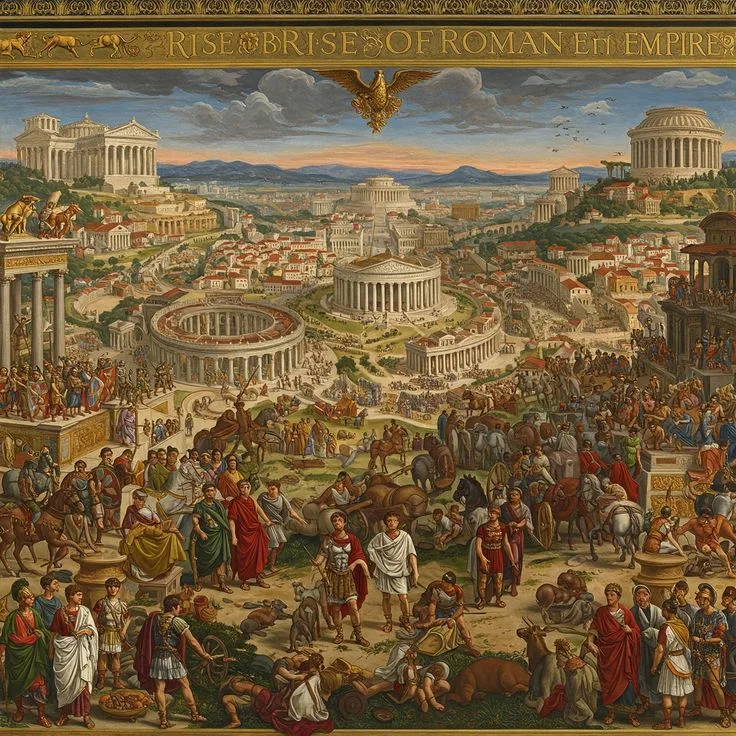
Roman: On the night of August 24, 410 CE, the Visigoth king Alaric led his army through the Salarian Gate and into Rome. For three days, his forces sacked the city - the first time Rome had been taken by a foreign enemy in 800 years.
The philosopher Jerome, living in Bethlehem when he received the news, wrote that he was so stunned he could not speak.
Augustine of Hippo, in Carthage, began writing The City of God partly in response to pagan accusations that Christianity had weakened Rome's defenses. The civilized world reeled.
And yet, the Roman Empire did not end in 410. The sack was catastrophic symbolically more than practically - Alaric held the city for only three days, most of the wealthy had already fled, and the Empire continued for another 66 years.
The "fall" of the Western Roman Empire was not a single event but the outcome of centuries of slow structural deterioration, punctuated by crises that each accelerated the decline, until the last Western emperor was deposed in 476 CE without anyone at the time apparently thinking it especially significant.
Why the greatest empire in Western history fell apart has been debated for over 1,500 years. Edward Gibbon's The History of the Decline and Fall of the Roman Empire (1776-1789) attributed it primarily to Christianity and barbarism.[1]
Modern historians have added dozens of additional factors: political fragmentation, economic contraction, climate change, plague, lead poisoning, military overextension, tax collapse, and the simple accumulated weight of centuries.
Nineteen competing theories, one scholar counted in the 1980s; subsequent historians have found the count to be an underestimate.
"The fall of Rome is the greatest problem of historical causation that has ever confronted the scholar." - Henri Pirenne, Mohammed and Charlemagne (1937)[13]
Key Definitions
Western Roman Empire - The western half of the Roman Empire after its administrative division in 285 CE by Emperor Diocletian. Ruled from Mediolanum (Milan) and later Ravenna rather than Rome itself. Collapsed in 476 CE when the Germanic chieftain Odoacer deposed the last Western Emperor, Romulus Augustulus.
Eastern Roman Empire (Byzantine Empire) - The eastern half of the Roman Empire, centered on Constantinople (modern Istanbul). Survived the fall of the Western Empire by nearly a thousand years, finally conquered by the Ottoman Turks on May 29, 1453 CE. Byzantine emperors continued to call themselves Roman emperors throughout this period.
Crisis of the Third Century - A period of catastrophic instability (235-284 CE) during which the Roman Empire simultaneously faced external invasions, plague, economic chaos, and political fragmentation. Approximately 50 emperors or claimants in 50 years.
The Empire nearly dissolved and was only reunified by Aurelian (270-275 CE), who was promptly assassinated.
Foederati - Germanic and other non-Roman troops who served in the Roman army under their own commanders, in exchange for land or payment. Increasingly used from the 3rd century onward as the Roman citizen army declined.
The Battle of Adrianople (378 CE) was fought largely by Gothic foederati fighting for Rome against other Gothic invaders.
Usurpation - The act of seizing imperial power without legitimate succession. The 3rd through 5th centuries saw constant usurpations - military commanders declaring themselves emperor, often backed by their legions.
Between 235 and 476 CE, there were at least 50 emperors in the West, many of them brief usurpers who ruled for months before being assassinated by the next claimant.
Barbarization - The incorporation of Germanic, Gothic, and other non-Roman peoples into Roman institutions - including the army, administration, and eventually the imperial family.
By the 5th century, most Western generals were Germanic; Stilicho, Rome's greatest general of the period, was of Vandal origin. Whether "barbarization" was a cause of collapse or an adaptation to changing circumstances is debated.
Diocletian's reforms - Emperor Diocletian (284-305 CE) stabilized the Empire after the Crisis of the Third Century through sweeping administrative, military, and economic reforms: dividing the Empire into four administrative units (the Tetrarchy), doubling the size of the army, restructuring the tax system, and imposing price controls (the Edict on Maximum Prices, 301 CE).
Constantine's conversion - Emperor Constantine I converted to Christianity (312 CE) and issued the Edict of Milan (313 CE) legalizing Christian worship. He later convened the Council of Nicaea (325 CE) to resolve theological disputes and moved the capital to Constantinople (330 CE).
Christianity became the state religion under Theodosius I (380 CE).
LALIA (Late Antique Little Ice Age) - A period of global cooling beginning around 536 CE, triggered by volcanic eruptions, that reduced agricultural productivity across Eurasia for decades. Combined with the Plague of Justinian (541-549 CE), it contributed to demographic and economic collapse across the former Western Empire.
The Plague of Antonine - A pandemic (probably smallpox or measles) that swept the Roman Empire in 165-180 CE, killing an estimated 5-10 million people, including Emperor Marcus Aurelius. Repeated outbreaks continued intermittently. The demographic impact weakened the military and tax base.
The Long Deterioration: 200-476 CE
The Crisis of the Third Century
The Roman Empire at its height under the Five Good Emperors (96-180 CE) was a system of extraordinary stability - law, roads, commerce, and cultural achievement unified under a single political authority from Scotland to Mesopotamia. The deterioration that followed was not a sudden collapse but a system under progressively greater stress.
The Crisis of the Third Century (235-284 CE) was the first phase of terminal deterioration. Emperor Maximinus Thrax, an illiterate Thracian soldier who had never been to Rome, inaugurated a half-century in which the army made and unmade emperors at will.
The currency was debased to fund military expenses (silver content of the denarius fell from 85% to under 5%), triggering inflation. Plague killed millions. The Persian Sassanid Empire in the east and Germanic tribes in the north pressed simultaneously against a weakened frontier.
At one point, the Empire fragmented into three competing governments.
That Rome survived this crisis at all is remarkable, and credit is due largely to a series of capable "soldier emperors" - Aurelian, Probus, and eventually Diocletian - who stabilized the frontiers, reunified the Empire, and reformed the administrative structure.
But the cost of survival was permanent: a larger, more expensive army, higher taxes to pay for it, a more authoritarian administrative structure, and an economy squeezed between military demands and demographic decline.
The Military Transformation
The Roman legions that conquered the world in the 1st century BCE were citizen soldiers - men with a stake in Roman society, serving defined terms and returning to civilian life.
By the 4th century, the Roman army had transformed into a primarily professional force increasingly dependent on Germanic foederati - warriors who fought for payment or land grants under their own commanders with their own loyalties.
This transformation was not the result of military failure but of success: as Rome's borders expanded and stabilized, the legions became permanent frontier garrisons rather than offensive forces. Frontier legions, isolated from Roman civic life, developed regional loyalties.
Their commanders - who controlled the only armed force in their region - became political powers.
When the Eastern general Stilicho commanded Rome's defense against Alaric in the early 5th century, he commanded armies composed primarily of Gothic troops, and his ultimate loyalty - to Rome or to the Germanic world - was genuinely uncertain.
The fundamental problem was fiscal: the army required more money to maintain than the economy could provide at existing tax levels. Raising taxes drove farmers off the land and into serfdom (coloni), shrinking the tax base and requiring yet more taxation of those who remained, in a downward spiral.
Political Fragmentation
From 235 to 476 CE, the Western Empire had roughly 50 emperors - an average reign of less than 5 years.
Political instability was not merely a symptom of decline but a cause: each usurpation required military campaigns, each campaign required money taken from the civilian economy, each exaction of money reduced economic capacity and political legitimacy, enabling the next usurpation.
The late Empire also suffered from systematic short-termism: emperors who expected to rule briefly (and who knew they would likely be assassinated) had little incentive to undertake costly long-term reforms. The administrative apparatus became increasingly self-serving, extracting rents rather than delivering services.
"The fall of the Roman Empire... was the natural and inevitable effect of immoderate greatness. Prosperity ripened the principle of decay; the causes of destruction multiplied with the extent of conquest." - Edward Gibbon, Decline and Fall of the Roman Empire (1776)
The Major Theories
1. Military Overextension and the Army Problem
Most historians give substantial weight to the military-fiscal crisis. The Empire was simply too large to defend with available resources, and the effort to defend it consumed the resources that might otherwise have enabled reform.
The length of Rome's European frontier alone - the Rhine-Danube line - was approximately 5,000 kilometers.
Defending it against increasingly organized Germanic confederations (the Alemanni, Franks, Goths) and an aggressive Persian Empire required an army that by the 4th century numbered 400,000-600,000 men. Paying, feeding, and equipping this force consumed most imperial revenues.
The critical observation of historian Peter Heather: the Germanic migrations that overwhelmed the Western Empire in the 5th century were not the disorganized tribal raids of earlier centuries.[3]
The Hunnic expansion, pushing Gothic and other Germanic peoples westward, created large, militarized Gothic confederations that Rome's frontier system was not designed to handle.
The Battle of Adrianople (378 CE), in which Emperor Valens and two-thirds of his army were killed by the Visigoths, was not a fluke but a demonstration that the frontier system had been fundamentally compromised.
Edward Luttwak's The Grand Strategy of the Roman Empire (1976) analyzed Rome's frontier defense in strategic terms, identifying three phases: an early preclusive defense in depth (keeping enemies outside Roman territory entirely), a shift to elastic defense using mobile reserves, and a final phase of reliance on foederati.[9]
Each shift represented a strategic adaptation to declining resources. Luttwak's framework was influential but contested - John Mann and others pointed out that attributing strategic coherence to a system that evolved over centuries rather than being consciously designed may be anachronistic.
2. Economic Decline
The Roman economy at its height was sophisticated by ancient standards: monetized trade across the Empire, specialized agricultural regions, urban manufacturing, and a relatively efficient taxation system. By the 4th and 5th centuries, this system had contracted severely.
Currency debasement - The debasement of the currency to fund military spending triggered inflation that eroded savings and disrupted the price signals that made long-distance trade possible.
By the time Diocletian issued his Edict on Maximum Prices (301 CE) attempting to control inflation, the silver denarius had become effectively a copper coin.
Trade contraction - Archaeological evidence (pottery distributions, ship wrecks, grain pollen analysis) shows that trade networks shrank progressively from the 3rd century onward. Urban populations declined as commercial specialization became less viable.
The complex, integrated economy of the high Empire gave way to more localized, subsistence-oriented production.
Tax collapse and the coloni system - As the tax burden increased, free peasants abandoned their land or sold themselves into a form of serfdom (colonatus) to avoid direct taxation.
This removed them from the tax rolls, forcing higher taxation on those who remained, driving more people into serfdom - a classic downward spiral that reduced both the tax base and the supply of free military recruits.
The lead pipe and vessel debate deserves mention here: the historian S.C. Gilfillan proposed in 1965 that chronic lead poisoning from lead plumbing, lead-lined cookware, and wine sweetened with lead acetate contributed to cognitive impairment and population decline among the Roman elite.[14]
The theory gained popular attention but has been contested by most Roman historians. While Romans certainly were exposed to lead at elevated levels, the evidence for a causal relationship to imperial decline is thin, and the Eastern Empire's survival weakens a general toxic causation argument.
Bryan Ward-Perkins's analysis of ceramic evidence in The Fall of Rome and the End of Civilization (2005) is particularly compelling.[2] During the high Empire period, even ordinary Romano-British households possessed wheel-thrown pottery made in specialized kilns - a sign of market integration and commercial production.
After the Roman withdrawal from Britain, the pottery record essentially collapses: handmade, poorly fired wares replace the commercial products.
This is not simply a change in cultural style but evidence of the collapse of the market systems, specialist craft production, and long-distance trade that had supported Roman material culture.
3. Political Fragmentation and Institutional Decay
The Empire's political institutions - the Senate, the law, the administrative bureaucracy - never fully recovered from the Crisis of the Third Century. The Senate had been largely irrelevant since Augustus but remained symbolically important.
The law continued to function remarkably well even in the declining Empire. The bureaucracy expanded dramatically under Diocletian and Constantine, becoming expensive, corrupt, and less effective.[8]
Succession was the deepest institutional failure. Rome never developed a reliable mechanism for transferring power. Biological inheritance was unreliable (capable emperors often had incompetent sons). Military selection (the army acclaiming a capable soldier) produced strong emperors but also constant civil war.
Adoption (the mechanism of the Five Good Emperors) worked brilliantly for a century but was abandoned by Marcus Aurelius, who fatally chose to pass power to his biological son Commodus.
The contrast with the Eastern Empire is instructive. Constantinople's greater concentration of population and wealth, its more defensible geography, and the relative stability of its dynastic politics - the Eastern Empire never experienced anything as catastrophic as the Crisis of the Third Century - allowed it to survive for another thousand years.
The West's political disintegration reflected specific structural vulnerabilities rather than an inevitable fate for Rome as a whole.
4. The Role of Christianity
Gibbon's argument - that Christianity diverted Roman civic energy into theological controversy and pacifist otherworldliness - has been partially rehabilitated by modern scholarship, though with important qualifications.
Christianity did not cause the Empire's military problems, but it may have accelerated certain institutional changes. The Church absorbed substantial resources - buildings, land endowments, the labor of clergy - that had previously funded civic life.
The theological controversies of the 4th and 5th centuries (Arianism, Donatism, Monophysitism) generated civil conflict and occupied the attention of emperors who might otherwise have focused on military problems.
More importantly, Christianity changed the meaning of Roman identity. Gibbon noted that Christian writers often expressed indifference or contempt for earthly power - the earthly city was not the important city.
This shift in values, toward otherworldliness and away from civic virtue, may have reduced the willingness of elites to sacrifice for the earthly state.
Bryan Ward-Perkins argues against over-emphasizing Christianity: the Eastern Empire, equally Christian, survived for another thousand years. Religion was a cultural background to the fall, not its driving cause.
Peter Heather's counterpoint is subtler: the theological controversies within Christianity, particularly Arianism, complicated Rome's relationship with the Germanic foederati.
Many Germanic peoples - including the Visigoths and Vandals - had been converted to Arian Christianity (which held that the Son was subordinate to the Father) by missionaries from the Eastern Empire.
The Nicene orthodoxy that became Roman state religion under Theodosius I defined Arian Christianity as heresy.
When Alaric's Visigoths sacked Rome, the religious conflict between Nicene Romans and Arian Visigoths added an additional dimension to what was already a complex political and military confrontation.
5. Climate and Plague
Recent paleoclimatic research has added a dimension that previous historians lacked: systematic evidence for climate instability during Rome's decline.
The Roman Climate Optimum (roughly 200 BCE - 200 CE) coincided with Rome's rise to power: warm, stable conditions that supported high agricultural productivity across the Mediterranean basin. The 3rd century saw the beginning of a cooling trend.
The Late Antique Little Ice Age, triggered by a cluster of volcanic eruptions beginning in 536 CE, brought severe cooling and crop failures across Eurasia.
Plague compounded climate stress. The Antonine Plague (165-180 CE) may have killed 5-10 million. The Plague of Cyprian (249-262 CE), at its peak, reportedly killed 5,000 people per day in Rome alone.
The Plague of Justinian (541-549 CE) - the first confirmed outbreak of bubonic plague - killed perhaps 25-50 million people across the Mediterranean world, devastating the demographic base that might have sustained recovery.
Kyle Harper's The Fate of Rome (2017) argues that these ecological factors - climate change and pandemic disease - were underestimated causes of the Western Empire's collapse, compounding political and military vulnerabilities that might otherwise have been survivable.[5]
Harper used ice core data, tree ring analysis, and ancient DNA evidence from plague victims to reconstruct a picture of successive ecological shocks that would have stressed any preindustrial agricultural civilization.
Harper's thesis has been critiqued by historians who argue he overstates the causal role of climate and underweights the autonomous political and military factors.
Michael Kulikowski (The Tragedy of Empire, 2019) argued that the political disintegration of the Western Empire in the 5th century was primarily the result of decisions made by identifiable political actors - not ecological determinism.[12]
The debate between ecological and agency-based explanations mirrors similar debates in the historiography of other civilizational collapses, from the Bronze Age collapse to the Maya.
6. The Transformation Interpretation
Not all historians accept the narrative of catastrophic collapse.[7] Walter Goffart, Peter Brown, and others in the "transformationist" school argue that the replacement of Roman administration by Germanic kingdoms was often a relatively peaceful process of accommodation - the Roman upper classes worked with Germanic leaders, Roman law continued, Christianity unified the successor cultures, and Roman culture was transmitted rather than destroyed.[6]
Bryan Ward-Perkins The Fall of Rome and the End of Civilization (2005) challenged this comfortable narrative with archaeological evidence: ceramic evidence shows dramatic contraction of trade and manufacturing; bone evidence shows declining health and nutrition; the density of excavated coin hoards shows economic insecurity.
Something genuinely catastrophic happened to material living standards, at least in Britain and the northwestern Empire.
The truth varies by region. In North Africa and Gaul, the transition to Vandal and Frankish rule was relatively orderly.[10] In Britain, Roman civilization essentially vanished within a generation of the legions' withdrawal (407 CE): urban life collapsed, literacy fell, and the population declined substantially.
Comparison of Explanatory Theories
| Theory | Primary Proponent | Strength | Weakness |
|---|---|---|---|
| Military overextension | Heather, Gibbon | Explains frontier collapse | Doesn't explain why solutions weren't found |
| Economic decline | Ward-Perkins, Jones | Strong archaeological support | Economy had recovered from worse before |
| Political fragmentation | Luttwak, many | Explains dysfunction | Doesn't explain why politics declined |
| Christianity | Gibbon | Explains cultural shift | Eastern Empire was equally Christian |
| Climate and plague | Harper | New evidence, explains timing | Correlation not certainty |
| Transformation (no collapse) | Goffart, Brown | Explains continuities | Ignores material decline evidence |
| Barbarian invasions | Heather | Explains trigger events | Doesn't explain vulnerability |
Why the East Survived and the West Did Not
One of the most underappreciated questions in the debate about Rome's fall is why the Eastern Empire survived for a thousand years while the West collapsed.
The two halves shared the same legal system, the same religion, the same dynasty in many periods, and the same theoretical political structure. Yet their fates diverged dramatically after 395 CE.
Several structural differences explain the divergence. The Eastern Empire was economically richer: the Aegean and Anatolian regions had denser urban populations, more productive agriculture, and more sophisticated commercial networks than the Rhine-Danube frontier zones that dominated the West.
Constantinople's strategic location - on the narrow strait between Europe and Asia - was nearly impregnable; the city's land walls, built under Theodosius II in the 5th century, were not breached until 1453.
The East faced different and, on balance, more manageable external pressures: Persia was a formidable but predictable adversary; the Arab conquests of the 7th century reduced the empire significantly but did not destroy it.
The East also handled the barbarian challenge differently. Where the West increasingly allowed foederati to settle within its territory as semi-autonomous units, the East generally maintained tighter control over its military forces, used gold diplomacy to play Germanic and Hunnic groups against each other, and had the fiscal resources to pay for professional soldiers.
When the East did face a major Gothic challenge - as after the Battle of Adrianople - it could absorb the shock more effectively.
Peter Heather (Empires and Barbarians, 2009) synthesizes these factors: the West's collapse was not inevitable but reflected the specific combination of Hunnic pressure from the east forcing large, militarized Gothic confederations into Western Roman territory, coinciding with a Western Empire that had been economically and politically weakened by the third-century crisis in ways the East had not.[4]
Change the timing, the geography, or the fiscal baseline, and the outcome might have been different.
Lessons and Legacies
The Roman Empire's fall has been studied as a warning for every subsequent civilization that considered itself dominant. The lessons most frequently drawn:
Fiscal sustainability matters more than military power: Rome's military deterioration was downstream of fiscal deterioration. The tax base eroded under the weight of military demands; the military deteriorated when the tax base could no longer sustain it. The loop was self-reinforcing.
Political legitimacy is fragile and slow to rebuild: The Century of soldier-emperors created a precedent that military force creates legitimate rulership. Decades of usurpations normalized the idea that anyone with an army could be emperor. Once established, that precedent was nearly impossible to reverse.
Complexity creates brittleness: Rome's sophisticated, interdependent economy was vulnerable to disruption in ways that a simpler economy was not. When trade networks contracted, the specialized agricultural regions that had fed cities could not pivot quickly enough.
The very complexity that had created prosperity accelerated its undoing.
Gradual decline is harder to respond to than sudden crisis: The most striking feature of Rome's fall is how slowly it happened. Decision-makers responded to immediate crises but rarely to the underlying structural trends.
Each individual decision - to debase the currency, to settle Gothic foederati on imperial land, to exempt the wealthy from taxation - was defensible in isolation. Their cumulative effect was catastrophic.
Institutions matter more than individuals: The contrast between the Five Good Emperors (who maintained stability through sound institutional practices) and the soldier-emperors who followed demonstrates that individual competence cannot substitute for institutional structure.
Rome's failure to solve its succession problem - to institutionalize legitimate power transfer - was arguably its single most consequential political failure.
The question of whether Rome's fall offers lessons for contemporary complex societies has attracted scholars from Gibbon onward.
Joseph Tainter's The Collapse of Complex Societies (1988) drew on Rome and other collapsed civilizations to argue that complexity itself is the mechanism of collapse: civilizations add administrative, military, and economic complexity to solve problems, but complexity has diminishing marginal returns; eventually the costs of maintaining complexity exceed the benefits, and the system collapses to a simpler equilibrium.[11]
The Rome analogy has been applied - with varying degrees of rigor - to discussions of American imperial overextension, European welfare state sustainability, and global financial system fragility.
For related concepts, see US-China rivalry explained, how civilizations collapse, and how oil shapes geopolitics.
Sources & Further Reading
- Gibbon, E. (1776-1789). The History of the Decline and Fall of the Roman Empire (6 vols.). Strahan & Cadell.
- Ward-Perkins, B. (2005). The Fall of Rome and the End of Civilization. Oxford University Press.
- Heather, P. (2006). The Fall of the Roman Empire: A New History of Rome and the Barbarians. Macmillan.
- Heather, P. (2009). Empires and Barbarians: The Fall of Rome and the Birth of Europe. Oxford University Press.
- Harper, K. (2017). The Fate of Rome: Climate, Disease, and the End of an Empire. Princeton University Press.
- Goffart, W. (1980). Barbarians and Romans, A.D. 418-584: The Techniques of Accommodation. Princeton University Press.
- Brown, P. (1971). The World of Late Antiquity: AD 150-750. Thames & Hudson.
- Jones, A. H. M. (1964). The Later Roman Empire, 284-602 (3 vols.). Blackwell.
- Luttwak, E. N. (1976). The Grand Strategy of the Roman Empire. Johns Hopkins University Press.
- Wickham, C. (2009). The Inheritance of Rome: Illuminating the Dark Ages 400-1000. Viking.
- Tainter, J. A. (1988). The Collapse of Complex Societies. Cambridge University Press.
- Kulikowski, M. (2019). The Tragedy of Empire: From Constantine to the Destruction of Roman Italy. Harvard University Press.
- Pirenne, H. (1937). Mohammed and Charlemagne (B. Miall, Trans.). W. W. Norton.
- Gilfillan, S. C. (1965). Lead Poisoning and the Fall of Rome. Journal of Occupational Medicine, 7(2), 53-60.