
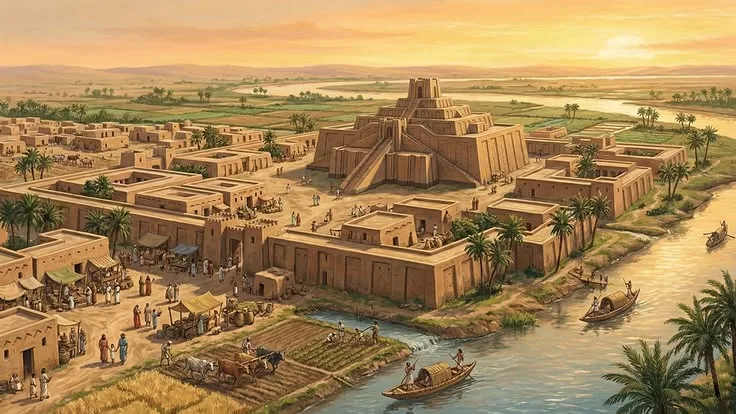
Legacy: Between the Tigris and Euphrates rivers, in the flat alluvial plain of what is now Iraq, human beings did something that had never been done before: they built cities.
Not merely large villages, not seasonal gathering places, but permanent, densely populated, architecturally ambitious urban centers with professional administrators, specialized craftsmen, monumental temples, armies, bureaucracies, and written records.
The earliest of these cities appeared during the Uruk period, around 4000 to 3100 BCE.
By 3000 BCE, the city of Uruk held an estimated 50,000 people within walls that stretched nine kilometers in circumference. Ur, Lagash, Nippur, Kish, and Eridu followed, each with its ziggurat pointing skyward and its clay tablet archives recording grain disbursements and cattle inventories.
This was not civilization as metaphor. It was civilization in the most literal and material sense: the organization of large numbers of human beings into a system of interdependent roles and relationships, sustained by irrigated agriculture, governed by law, and transmitted across time through writing.
Everything that we associate with complex society - the state, the city, the market, the school, the law court, the literary tradition - has its earliest known form somewhere in Mesopotamia.
The Greeks who gave the region its name - Mesopotamia, the land between the rivers - understood they were standing on ancient ground. By the time Herodotus visited Babylon in the 5th century BCE, the cities he walked through had been inhabited for three thousand years.
The ziggurat of Babylon had been built, destroyed, and rebuilt. Hammurabi's laws were already a thousand years old. The Epic of Gilgamesh had been written and rewritten by generations of scribes.
Mesopotamia was old when the Western tradition was young, and it shaped that tradition in ways that took centuries of modern scholarship to recover and recognize.
"In those days, in those far remote times, in those nights, in those faraway nights, in those years, in those far remote years, at that time the wise one who knew how to speak in elaborate words lived in the Land." - Opening lines of a Sumerian hymn, c. 2000 BCE
| Civilization | Period | Key Contribution |
|---|---|---|
| Sumer | c.4500-2000 BCE | Cuneiform writing; city-states; irrigation |
| Akkadian Empire | 2334-2154 BCE | First empire; Akkadian language; Sargon of Akkad |
| Babylon (Old) | 1894-1595 BCE | Code of Hammurabi; mathematics; astronomy |
| Assyrian Empire | 911-609 BCE | Military power; libraries; administration |
| Neo-Babylonian | 626-539 BCE | Hanging Gardens; astronomy; Nebuchadnezzar II |
| Achaemenid Persia | 550-330 BCE | Conquered Mesopotamia; administrative empire |
Key Definitions
Mesopotamia: From the Greek mesos (middle) and potamos (river), meaning "land between the rivers." The region defined by the Tigris and Euphrates rivers, corresponding broadly to modern Iraq.
Cuneiform: The world's first writing system, invented around 3200 BCE. Named for the wedge-shaped (Latin: cuneus) impressions made by a reed stylus in wet clay. Used to write Sumerian, Akkadian, Babylonian, Assyrian, and other ancient Near Eastern languages for over 3,000 years.
Ziggurat: A massive stepped temple tower of sun-dried or fired brick, characteristic of Mesopotamian religious architecture. The ziggurat served as the earthly dwelling of the city's patron deity and as the symbolic axis between heaven and earth.
Lugal: Sumerian term for king, literally "big man." The political title used by rulers of city-states, eventually superseded by more imperial designations as Mesopotamian political organization expanded.
Hammurabi's Code: A collection of 282 laws promulgated by the Babylonian king Hammurabi around 1754 BCE, one of the oldest and most complete surviving law codes, inscribed on a diorite stele now housed in the Louvre.
The Land and Its Conditions
Irrigation and Agricultural Surplus
Southern Mesopotamia receives approximately 150 millimeters of rainfall per year - well below the threshold for rain-fed agriculture. The civilization that arose there was therefore not a product of natural abundance but of organized human labor applied to the transformation of an unpromising landscape.
The Tigris and Euphrates, fed by snowmelt from the mountains of Anatolia, carried enormous volumes of water and extraordinarily rich alluvial silt.
Beginning in the Ubaid period (c. 6500-3800 BCE), the inhabitants of the southern plain developed an increasingly sophisticated system of canals, irrigation channels, levees, and storage basins that converted arid land into some of the most productive farmland in the ancient world.
This agricultural surplus was the indispensable foundation of everything else. It fed craftsmen and soldiers, priests and scribes, merchants and administrators - the entire apparatus of complex society.
Managing the irrigation system required coordination across communities, settlement of disputes over water rights, and the maintenance of infrastructure on a scale that no single family or village could accomplish.[1]
The administrative needs of irrigation management were among the pressures that drove the invention of writing and the development of the state.
The First Cities: Ubaid and Uruk
The Ubaid period (c. 6500-3800 BCE) saw the transition from scattered farming villages to the first proto-urban settlements.
Ubaid communities were characterized by distinctive painted pottery, mud-brick architecture, and evidence of increasing social differentiation - larger buildings that probably served as community gathering places or temples alongside smaller domestic structures.
The site of Eridu, on the southern edge of the alluvial plain, was continuously occupied from the Ubaid period through the later historic periods, and the Sumerians themselves believed it to be the world's first city, the place where "kingship first descended from heaven."
The Uruk period (c. 4000-3100 BCE) saw the explosive growth of urban centers to a scale without parallel anywhere in the ancient world.[6] Uruk itself grew to cover approximately 250 hectares by 3000 BCE, encircled by a massive city wall.
Its central precinct, the Eanna ("House of Heaven"), was dominated by massive temple platforms and colonnaded halls whose architectural scale would not be matched anywhere in the ancient Near East for centuries.
The production of standardized pottery on a fast wheel, the development of cylinder seals (stone cylinders engraved with scenes that could be rolled across clay to make an identifying impression), and the first clay tablets with proto-cuneiform signs all emerge in this period.
Sumerian Civilization
City-States, Rulers, and Religion
Sumerian civilization was organized around a network of competing city-states, each centered on a temple complex and governed by a ruler who was simultaneously the earthly representative of the city's patron deity and the administrator of its economic resources.
Early rulers were probably called en (lord) - a title connoting priestly authority - or ensi (governor). The title lugal (king) later emerged to designate rulers whose authority was primarily military and political.
The Sumerian King List, a document compiled in the Ur III period (c. 2112-2004 BCE), recorded the legendary sequence of royal dynasties stretching back before the Flood, when "kingship descended from heaven," listing rulers with reigns of tens of thousands of years.[2]
The ziggurats - massive stepped temple towers that dominated the skylines of Sumerian cities - were not merely religious monuments but economic hubs. The temple estates owned agricultural land, organized craft production, and distributed rations to workers and dependents.[9]
The temple of the city's patron deity held the symbolic authority of the divine owner of the city; the ruler administered it as steward. This fusion of economic and religious power in a single institution was the administrative kernel around which the Mesopotamian city-state developed.[7]
The Royal Tombs of Ur
The Royal Tombs excavated at Ur by Leonard Woolley in the 1920s - dating to approximately 2600-2500 BCE - offer the most vivid surviving evidence of the scale of Sumerian royal power and the sophistication of Sumerian material culture.[5]
In sixteen "death pits," rulers (identified as Puabi, Meskalamdug, and others) were interred with extraordinary wealth and with the bodies of their attendants - court ladies in elaborate headdresses of gold, lapis lazuli, and carnelian; soldiers with spears and helmets; musicians with lyres, including the famous Bull's Head Lyre with its gold and lapis lazuli bull's head decoration.
Up to 74 people were killed or voluntarily accompanied their ruler into the grave.
Whether this represented sacrifice, suicide, or some form of honor-driven choice is debated by archaeologists, but the scale and elaboration of the burials demonstrates a concept of royal power and divine status that demanded the service of the living in death as in life.
Mathematics and the Sexagesimal System
The Sumerians developed a mathematical system based on 60 (the sexagesimal system), combined with elements of base 10.
The reasons for choosing 60 as a base are debated - 60 has the advantage of being divisible by 1, 2, 3, 4, 5, 6, 10, 12, 15, 20, and 30, making it exceptionally convenient for division - but the consequences of this choice persist in modern life in forms most people never think about.
The 60-minute hour, the 60-second minute, and the 360-degree circle are all direct inheritances of Sumerian mathematical convention, transmitted through Babylonian astronomy and Greek science into modern practice.
Mesopotamian mathematicians also produced sophisticated multiplication tables, reciprocal tables for division, tables of squares and square roots, and solutions to quadratic equations - mathematical achievements that would not be matched in the West until the medieval period.
The Epic of Gilgamesh: The World's Oldest Literature
The Epic of Gilgamesh is the oldest surviving long literary composition in human history - a narrative poem written in cuneiform Akkadian that reached something close to its canonical form during the Old Babylonian period (c.
2000-1600 BCE) and was substantially edited and expanded by a scholar-scribe named Sin-leqi-unninni around 1200 BCE.[3]
The story centers on Gilgamesh, the historical king of Uruk who ruled around 2700 BCE, presented in the epic as two-thirds divine and one-third human - a mighty king whose energy and ambition both achieve great things and exhaust his people.
The epic's narrative arc moves from heroic adventure to a confrontation with mortality that feels remarkably modern. Gilgamesh and his wild-man companion Enkidu slay the monster Humbaba in the Cedar Forest and kill the Bull of Heaven.
When Enkidu dies as divine punishment for these transgressions, Gilgamesh is undone by grief and terror.
For the first time, he understands that he too will die. He sets out across the sea and through the realm of darkness to find Utnapishtim - the one man granted immortality by the gods - who survived a great flood by building a boat and loading it with his family and animals.
The flood narrative, preserved in Tablet XI, predates the Genesis account of Noah by at least a thousand years and parallels it so closely - divine decision to flood the world, a man warned to build a boat, the sending out of birds to test the recession of the waters - that it is impossible to regard the two traditions as independent.[8]
Utnapishtim tells Gilgamesh of a plant on the ocean floor that restores youth. Gilgamesh retrieves it, only to have a snake steal it while he sleeps - hence why snakes shed their skin and renew themselves while humans do not.
Gilgamesh returns to Uruk empty-handed, with nothing to show for his quest but the walls of his city and the knowledge that he built them. The epic's consolation is the human achievement of civilization itself: the walls that will outlast the king.
The Akkadian Empire and Its Successors
Sargon of Akkad: The First Empire
Around 2334 BCE, a man named Sargon seized power in the Mesopotamian city-state system and created something qualitatively new: the first empire in history.[4]
Sargon (whose name means "legitimate king" - suggesting his origins were anything but) was, according to later tradition, the abandoned son of a humble woman, discovered floating in a basket on the river by a gardener.
He rose through service at the court of Kish and then overthrew the Sumerian king Lugalzaggesi to establish the Akkadian Empire, ruling from a new capital called Akkad (whose location remains unidentified archaeologically) and extending his authority from the Persian Gulf to the eastern Mediterranean.
Sargon's title - "King of Akkad, Sumer, the Four Quarters of the World" - announced a fundamentally new political concept: universal empire, the claim of a single ruler to authority over all known peoples.
The Akkadian Empire replaced Sumerian as the dominant language of administration (though Sumerian continued as a literary and religious language for centuries, analogously to Latin in medieval Europe) and created an integrated economic and administrative system across Mesopotamia.
The empire lasted for roughly a century and a half before collapsing under a combination of internal revolt, external pressure from the Gutians (a mountain people from the Zagros), and - according to the famous "Curse of Akkad" text - divine anger provoked by Sargon's grandson Naram-Sin's desecration of the temple at Nippur.
The Third Dynasty of Ur
The Third Dynasty of Ur (Ur III, c. 2112-2004 BCE), established by King Ur-Nammu and brought to its peak by his son Shulgi (r. 2094-2047 BCE), represented the most thoroughly documented bureaucratic state of the ancient world.[12]
The Ur III state generated an astonishing volume of administrative records - over 100,000 cuneiform tablets have been recovered, recording ration distributions, labor assignments, animal inventories, and inter-provincial transfers with obsessive precision.
Shulgi standardized weights and measures, built roads with rest stations, reformed the calendar, patronized the scribal schools that produced and preserved Sumerian literary tradition, and was deified during his own lifetime - the first Mesopotamian king to claim divine status while living.
The Ur III state collapsed around 2004 BCE under the combined pressure of an Amorite tribal migration into the settled agricultural zone and an Elamite invasion from the east.
Babylon and the Code of Hammurabi
The Babylonian Empire of the Old Babylonian period (c. 2000-1600 BCE) is defined in popular memory by Hammurabi (r. 1792-1750 BCE), the sixth king of the First Dynasty of Babylon, whose reign expanded Babylon's control across Mesopotamia and whose law code is one of the foundational documents of world legal history.
Hammurabi's Code - 282 laws inscribed on a diorite stele surmounted by a relief showing Hammurabi receiving the laws from Shamash, the sun god and deity of justice - was not the first law code in Mesopotamian tradition. The earlier codes of Ur-Nammu (c.
2100 BCE) and Lipit-Ishtar (c. 1930 BCE) survive in fragmentary form. But Hammurabi's code is the most complete and the most revealing.
Its 282 laws cover commercial contracts and interest rates, property disputes, wages for skilled workers, agricultural obligations, marriage and divorce, inheritance, adoption, medical fees, and criminal punishment.[11]
The famous lex talionis formula - "an eye for an eye, a tooth for a tooth" - appears in Laws 196-197 as a principle of proportional justice, not license for private vengeance: the punishment should match the crime in kind and severity.
The code reveals a three-class society (awilum, mushkenum, and wardum) in which the same offense attracted different penalties depending on the social standing of both perpetrator and victim - a structural inequality frankly embedded in the law.
See also: /culture/global-cross-cultural/what was-ancient-rome for how Roman legal tradition developed separately and /culture/global-cross-cultural/what was-ancient-greece for the Greek synthesis with Near Eastern thought.
The Assyrian Empire
The Assyrian Empire, centered in the city of Assur (and later Nineveh and Nimrud) on the upper Tigris, represented one of the most powerful military states of the ancient world.
The Neo-Assyrian period (roughly 900-612 BCE) saw Assyrian armies equipped with iron weapons, sophisticated siege technology, and military organization that made them effectively unbeatable in the field for over two centuries.
Tiglath-Pileser III (r. 745-727 BCE) reformed the military, extended Assyrian control from Iran to the Mediterranean, and introduced the systematic deportation policy that became Assyria's most feared instrument of imperial control: conquered populations were uprooted and resettled in distant parts of the empire, destroying local cultural and political cohesion and preventing the formation of the national identities that could sustain resistance.
The Assyrian royal inscriptions celebrate these deportations with frank boastfulness that has troubled modern readers: hundreds of thousands of people dragged from their homes, cities razed, rebel leaders flayed or impaled, pyramids of severed heads erected as warnings.
Sennacherib (r. 705-681 BCE) destroyed Babylon in 689 BCE - a sacrilege that shocked the ancient world - and rebuilt Nineveh as a city of unprecedented scale and magnificence, complete with botanical gardens housing plants collected from across the empire.
His grandson Ashurbanipal (r. 668-627 BCE) assembled at Nineveh the greatest library of the ancient world: over 30,000 clay tablets including the standard version of the Epic of Gilgamesh, astronomical and medical texts, ritual compendia, and historical records that are the primary source for much of what we know about Mesopotamian civilization.
The Neo-Assyrian Empire collapsed between 616 and 609 BCE in a remarkably swift military catastrophe, destroyed by a coalition of Babylonians and Medes.[10] Nineveh fell in 612 BCE and was left a ruin.
Neo-Babylonian Empire and Persian Conquest
The Neo-Babylonian Empire (626-539 BCE) that succeeded the Assyrians was a self-conscious restoration of ancient Babylonian cultural and religious tradition, and its greatest king, Nebuchadnezzar II (r. 605-562 BCE), was among the most powerful rulers of the ancient Near East.
Nebuchadnezzar's campaigns in the west brought him into conflict with Egypt and the Levantine states.
He destroyed Jerusalem in 587/586 BCE, burned the First Temple, and deported the Judean elite to Babylon - the Babylonian Captivity that profoundly reshaped Jewish religious identity and gave the world, through the Hebrew Bible, one of its most powerful literary and theological traditions.
Babylon under Nebuchadnezzar was the largest city in the world, with an estimated population of 200,000 surrounded by massive double walls - the outer wall measured 18 kilometers in circumference.
The Ishtar Gate (now partially reconstructed in the Pergamon Museum in Berlin) blazed with blue-glazed bricks and golden relief images of dragons and bulls.
The Hanging Gardens of Babylon, listed by Hellenistic sources as one of the Seven Wonders of the Ancient World, are not securely attested in contemporaneous Babylonian sources, and their location and even their existence remain subjects of scholarly debate.
The Neo-Babylonian Empire fell without significant military resistance to the Persian king Cyrus the Great in 539 BCE.
The Hebrew Bible presents this conquest as divine liberation: Cyrus, who permitted the Judean exiles to return to their homeland and rebuild their Temple, is described in Isaiah as the Lord's "anointed" (mashiach).
Persian rule ended Mesopotamia's role as an independent political center, though Babylonian cultural and intellectual traditions - astronomy, mathematics, divination, and literary learning - continued to flourish under Achaemenid, then Seleucid, and finally Parthian rule.
Cuneiform Writing and Its Decipherment
The decipherment of cuneiform in the 19th century was one of the great intellectual achievements of modern scholarship and one of the most consequential: it unlocked an archive of human thought and experience that had been entirely inaccessible for two thousand years.
The key was the trilingual Behistun inscription, carved on a cliff face in western Iran by the Persian king Darius I around 520 BCE. The inscription recorded the same text in three languages - Old Persian, Elamite, and Babylonian cuneiform - analogously to the role of the Rosetta Stone for Egyptian hieroglyphics.
Henry Rawlinson, a British army officer stationed in Persia, copied the inscription at considerable personal risk (it is carved 100 meters up a cliff face) from the 1830s onward and achieved the first substantial decipherment of the Old Persian version, then used this as a key to the Babylonian cuneiform.
The subsequent reading of the Babylonian Flood narrative - published by the British Museum's George Smith in 1872, who caused a sensation when he announced that a cuneiform tablet from Ashurbanipal's library told a story almost identical to Noah's Flood - demonstrated that the recovery of Mesopotamian civilization would transform understanding of the ancient world and of the Bible's origins.
Legacy
Mesopotamia's legacy for subsequent civilizations is so fundamental as to be nearly invisible - present everywhere precisely because it has been so thoroughly absorbed. Writing itself, in the sense of a systematic method for recording language, originated in Mesopotamia and diffused outward from there.
The concept of codified law - written, publicly declared, systematically organized - entered the world's legal traditions from Mesopotamian precedent.
The sexagesimal number system gives us our division of time and the geometry of the circle. Mesopotamian astronomical observations accumulated over centuries by Babylonian scribes provided the data on which Greek mathematical astronomy was built.
The flood narrative in Genesis, the Tower of Babel, and the legal structure of sections of the Torah all bear the imprint of Mesopotamian literary and legal tradition.
The concept of empire - universal rule over all known peoples, claimed in the name of divine authorization - was first articulated and practiced by the Akkadian Empire under Sargon around 2334 BCE and became the template from which every subsequent imperial ideology in the ancient Near East drew.
Persia, Macedon, Rome, and their heirs were all, in this sense, the children of Mesopotamia.
See also: /culture/global-cross-cultural/what was-the-byzantine-empire and /culture/global-cross-cultural/what was-the-silk-road for how Near Eastern civilizations continued to shape the world after Mesopotamia's political decline.
Sources & Further Reading
- Postgate, J.N. Early Mesopotamia: Society and Economy at the Dawn of History. Routledge, 1992.
- Kramer, Samuel Noah. The Sumerians: Their History, Culture, and Character. University of Chicago Press, 1963.
- George, Andrew, trans. The Epic of Gilgamesh: The Babylonian Epic Poem and Other Texts in Akkadian and Sumerian. Penguin Classics, 1999.
- Van De Mieroop, Marc. A History of the Ancient Near East, ca. 3000-323 BC. 3rd ed. Wiley-Blackwell, 2015.
- Woolley, Leonard. Ur of the Chaldees: A Record of Seven Years of Excavation. Ernest Benn, 1929.
- Leick, Gwendolyn. Mesopotamia: The Invention of the City. Penguin, 2001.
- Oppenheim, A. Leo. Ancient Mesopotamia: Portrait of a Dead Civilization. University of Chicago Press, 1964.
- Dalley, Stephanie, trans. Myths from Mesopotamia: Creation, the Flood, Gilgamesh, and Others. Oxford University Press, 1989.
- Bottero, Jean. Everyday Life in Ancient Mesopotamia. Translated by Antonia Nevill. Edinburgh University Press, 2001.
- Roux, Georges. Ancient Iraq. 3rd ed. Penguin, 1992.
- Driver, G.R., and John C. Miles. The Babylonian Laws. 2 vols. Oxford University Press, 1952-55.
- Kuhrt, Amelie. The Ancient Near East c. 3000-330 BC. 2 vols. Routledge, 1995.