
Impact: In late 1517, Martin Luther's 95 Theses began circulating across the German-speaking lands at a speed that no previous controversy in European intellectual history had achieved. Within two months, the document had reached every major German city; within two years, it was being read and debated across the continent.
The speed was not accidental. What Luther had available - what no previous theological dissident had possessed - was a printing press, and a Europe already equipped with hundreds of them.
The Protestant Reformation, which would shatter the religious unity of Latin Christianity, rearrange European politics for two centuries, and reshape the relationship between individuals and institutions throughout the Western world, was in crucial ways the first information revolution.
The technology that made this possible had been developed approximately 60 years earlier in Mainz by Johannes Gutenberg, a goldsmith whose precise identity remains somewhat obscure behind the surviving legal documents of his financial disputes.
Gutenberg's contribution was not the idea of mechanical reproduction - woodblock printing had existed in China for eight centuries, and the Chinese had developed moveable type four hundred years before Gutenberg's birth.
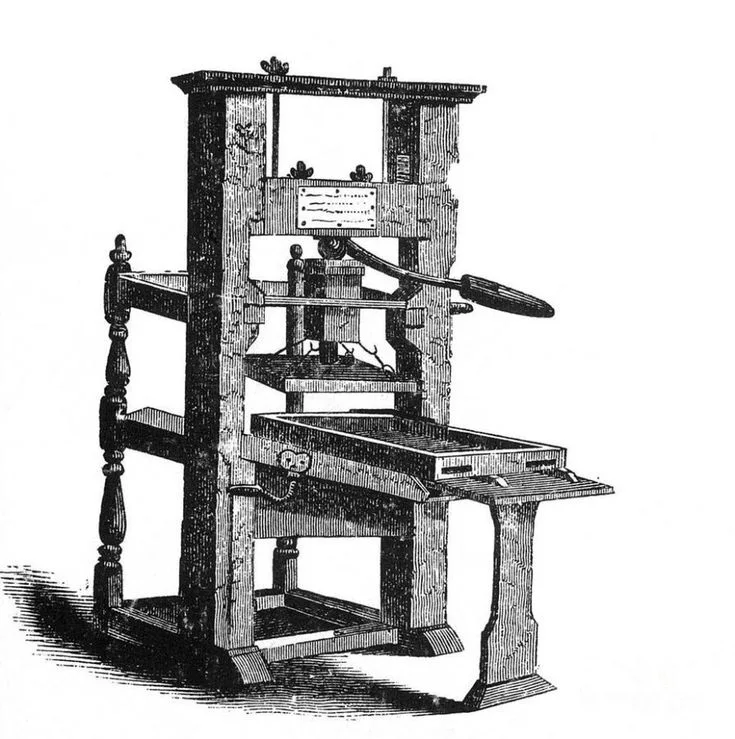
What Gutenberg invented was a specific and powerful combination of technologies suited to European conditions: metal moveable type cast to precise tolerances, oil-based ink that adhered to metal surfaces, and a screw press borrowed from wine-making, together capable of producing identical pages at a rate that made the economics of book production unrecognizable.
A trained scribe could copy perhaps four pages per day. A Gutenberg-style press could produce 250 to 300 pages per hour.
By 1500 - 45 years after the Gutenberg Bible - approximately 20 million books had been printed in Europe. By 1600 the figure was perhaps 200 million.
To understand what this meant, consider that the entire manuscript tradition of European learning accumulated over fifteen centuries amounted to some hundreds of thousands of volumes before print arrived.
Within two generations of Gutenberg's press, Europe had produced vastly more books than all of Western history had previously accumulated.
The consequences - theological, scientific, political, literary, and cognitive - were transformative and, at many points, deeply destabilizing.
"Printing is the ultimate gift of God and the greatest one." - Martin Luther (attributed, c. 1520s)
| Development | Date | Impact |
|---|---|---|
| Gutenberg's movable type press | c.1440s | First mechanized book printing in Europe |
| Gutenberg Bible | c.1455 | First major printed book; demonstrated viability |
| Protestant Reformation pamphlets | 1517-1520s | Luther's ideas spread rapidly via cheap print |
| Scientific texts disseminated | 1500s-1600s | Copernicus, Vesalius; scientific revolution enabled |
| Vernacular literature | 1500s | National languages standardized through printing |
| Early newspapers | 1600s | Corantos in Amsterdam, London; public information |
| Mass literacy rise | 1700s-1800s | Print drove education and political participation |
Key Definitions
Moveable type: Individual characters cast in metal that can be arranged to form text, printed, disassembled, and reused - the core innovation of Gutenberg's press.
Incunabula: Books printed before the year 1500, from the Latin for 'cradle' - the earliest products of the printing press.
Folio, quarto, octavo: Book formats defined by how many times a large sheet is folded; folios are large, quartos medium, octavos (Aldus Manutius's innovation) small and portable.
Vernacular: The native spoken language of a region, as distinct from Latin, the scholarly and liturgical language of medieval Europe.
Public sphere: Habermas's concept of a social space of rational-critical public discussion, historically associated with the rise of print culture and the educated reading public.
Republic of Letters: The informal international community of European scholars and intellectuals of the 16th-18th centuries who communicated through correspondence and print.
Index Librorum Prohibitorum: The Catholic Church's list of forbidden books, first issued in 1559 as a response to the uncontrolled spread of Protestant and heterodox literature through printing.
Pre-bunking: The inoculation strategy of informing audiences about misinformation techniques before they encounter specific false claims - analogous to the early modern strategy of providing readers with guides for evaluating printed sources.
Gutenberg's Innovation: The Technical Achievement
Johannes Gutenberg was born in Mainz around 1400 and worked as a goldsmith - a trade that provided him with the metallurgical skills his invention required. The key technical challenges he solved were interrelated and mutually reinforcing.
Metal Type and the Type Mold
Printing in quantity required thousands of identical letter pieces that could be set in rows, inked, pressed against paper, disassembled, and reset for the next page. Woodblock letters were inconsistent in size and wore out quickly.
Gutenberg developed a hand mold that could cast individual letters in a lead-antimony-tin alloy with the dimensional precision needed for letters to align properly in rows.
The alloy was chosen for its appropriate properties: it melted at a workable temperature, expanded slightly on cooling (filling the mold fully), and was hard enough to withstand thousands of impressions before wearing.
A complete printing type required approximately 290 distinct characters for Latin text - uppercase, lowercase, punctuation, ligatures, and abbreviation marks. Casting thousands of each letter, maintaining consistent dimensions across all of them, was a substantial manufacturing achievement by 15th-century standards.
Oil-Based Ink
Water-based inks, used for manuscripts and woodblock printing, bead off metal surfaces. Gutenberg developed an oil-based ink - essentially a modification of the linseed oil paints used by contemporary painters - that adhered to metal type.
The formulation had to be viscous enough to coat type uniformly without dripping, and to transfer cleanly to paper or vellum under the pressure of the press.
The Screw Press
Gutenberg adapted the screw press used for extracting juice from grapes and olives - a mechanism well understood in the wine-producing Rhineland region where he worked.
The press needed to apply even pressure across a full page of type simultaneously; the screw mechanism accomplished this reliably and was adjustable for different paper thicknesses.
The Gutenberg Bible
The Biblia Latina, printed around 1455, is the most celebrated product of this system. Approximately 180 copies were printed, roughly 45 on vellum (requiring approximately 170 calfskins per copy) and the rest on paper. Around 48 survive, making it one of the most extensively preserved major early printed works.
The physical quality of the printing - two columns per page, 42 lines per column in most copies, with precise margins and consistent type - demonstrates the maturity of the system at its first major deployment.
Gutenberg's financial situation was, however, difficult: his primary investor Johann Fust sued him in 1455 and took possession of the press and type as partial debt repayment, leaving Gutenberg largely excluded from the commercial benefits of the invention that bore his name.[8]
The Spread of Print: Venice, London, and the Aldine Press
Across Europe by 1480
The diffusion of printing across Europe was extraordinarily rapid by pre-modern standards.
Gutenberg's associates and apprentices carried the technology to other German cities in the 1450s and 1460s, and from there it spread quickly: Rome and Venice by 1469, Paris by 1470, London by 1476 (William Caxton, who learned printing in Cologne and Bruges), and most major European centers by 1480.
The incentive structure was powerful: anyone with sufficient capital to acquire a press, type, and ink could enter the most profitable new industry in Europe.
Aldus Manutius and the Democratization of Classical Learning
The Aldine Press, founded in Venice by Aldus Manutius around 1494, became the most celebrated press of the incunabula period and the direct forerunner of modern book design. Manutius's innovations were both scholarly and commercial.
His scholarly contribution was the production of authoritative editions of Greek and Latin classical texts - including the first printed editions of many Greek authors - with precise scholarship and elegant typography.[9]
His commercial contribution was the invention of the portable octavo format, small enough to be held comfortably in one hand and to fit in a saddlebag, enabling books to travel with readers rather than remaining fixed in libraries.[10] Italic type - still in use - was developed at the Aldine Press to save space and therefore reduce costs.
The Aldine Press made the classical heritage accessible to educated Europeans who could not afford the large folio volumes that had previously been the only format available, and it established the model of scholarly publishing - the edited, annotated, portable text - that has persisted with relatively modest modifications for five centuries.
The Protestant Reformation: Printing and the Fracture of Christendom
Luther's Media Phenomenon
When Martin Luther sent his 95 Theses to Archbishop Albrecht of Mainz on October 31, 1517 - or, as later tradition would have it, nailed them to the Wittenberg church door - he was entering a theological dispute that had many predecessors: Jan Hus, John Wycliffe, and others had challenged aspects of Church authority and practice in preceding centuries, and all had been suppressed.
What made Luther's challenge different was not its content alone but its medium.
Andrew Pettegree's 'Brand Luther' (2015) provides the most analytically sophisticated account of how Luther used printing to create what was, in effect, the first modern media campaign.[6]
Between 1517 and 1520, Luther published 30 works that sold approximately 300,000 copies - in a market where a substantial sale had previously been in the hundreds.
Luther wrote in a style calibrated for the medium: vernacular German addressed to a broad literate public, polemical enough to be arresting, consistent enough to build reader recognition, theologically serious but accessible. He understood that the press required content that the public would want to read and to share, and he produced it.
The institutional response confirmed the analysis: when Leo X's bull 'Exsurge Domine' (1520) threatened Luther with excommunication if he did not recant, Luther burned it publicly and printed his response.
The Church's condemnation was distributed through the limited mechanisms of canonical authority; Luther's reply was distributed through the commercial press, which had no reason to withhold it.
The German Bible and Direct Scriptural Access
Luther's translation of the New Testament into German, published in September 1522 - the 'September Testament' - and the complete Bible in 1534, was the most consequential single publishing event of the Reformation. Over 100,000 copies were sold in the first 40 years.
Its theological significance was inseparable from its technological dependence: the argument that Christians should have direct access to scripture, without priestly mediation, was only practicable when scripture was available in a language they could read, at a price they could afford, in quantities sufficient to supply a population.
The pamphlet wars that accompanied the Reformation - an outpouring of printed argument, counter-argument, satire, propaganda, and apocalyptic prediction - demonstrated simultaneously the press's power to spread reform and its power to spread confusion.
The same press that circulated Luther's careful theological arguments also circulated Thomas Müntzer's apocalyptic revolutionary manifestos, the antisemitic polemics of the age, and quantities of sensational popular print that exploited the new medium's commercial potential without its intellectual seriousness.
The Reformation was shaped by print; it was also distorted and radicalized by it.
The Council of Trent and the Index
The Catholic Church's response to the Reformation included the first systematic attempt to regulate printing. The Council of Trent (1545-1563) addressed doctrinal questions partly as responses to printed theological challenges.
The Index Librorum Prohibitorum, established in 1559 and maintained until 1966, was a list of books Catholics were forbidden to read - an attempt to impose content regulation on an information environment that had already escaped effective control.
The Index demonstrated the limits of institutional information control in a printed world: books prohibited in one jurisdiction could be printed in another and smuggled across borders, as Protestant Bibles were smuggled into Catholic territories throughout the 16th and 17th centuries.
The attempt to maintain a Church monopoly on theological interpretation had failed because the press had made such monopoly structurally impossible.
The Scientific Revolution: Standardization, Criticism, and the Republic of Letters
Identical Copies and the New Scientific Baseline
Elizabeth Eisenstein's central claim in 'The Printing Press as an Agent of Change' (1979) was that printing's most profound intellectual effect was not the democratization of knowledge but its standardization.[1]
The manuscript tradition was inherently variable: every copy of a text was different, because every scribe introduced changes through error, misreading, deliberate improvement, or the insertion of marginalia into the main text.
Natural philosophers working from different manuscript copies of the same classical text were in effect working with different texts.
Print created an entirely different epistemic situation. When Vesalius published 'De Humani Corporis Fabrica' in 1543, every copy contained the same 273 woodcut illustrations, meticulously detailed and accurate to a standard that no manuscript could have sustained.
Natural philosophers across Europe could discuss the same anatomy, referring to the same images - plate numbers and page numbers meant the same thing regardless of whose copy you held.
When Tycho Brahe distributed his astronomical observations through print, they became a shared resource that could be checked against further observation and built upon cumulatively.
Adrian Johns's 'The Nature of the Book' (1998) challenged Eisenstein's emphasis, arguing that standardization was not an inherent property of print but an achievement that required sustained institutional effort to maintain.[2]
Early printing was rife with piracy (unauthorized reprints of other printers' works, sometimes with deliberate alterations), variant editions, and typographical errors introduced in the setting of type.
A reader encountering a printed book could not assume its text was correct, authorized, or identical with other copies bearing the same title page.
The reliability of print had to be socially constructed - through the reputation of specific printers and booksellers, the development of scholarly editions with named editors, the emergence of copyright law, and eventually the institutions of peer review.
Both Eisenstein and Johns are right about different aspects of print's effects: printing created the possibility of standardization but not its automatic realization.
The Republic of Letters and the First Scientific Journals
The 'Republic of Letters' - the informal international community of scholars, naturalists, philosophers, and theologians who communicated through correspondence and shared books - was a social formation that depended on print for its existence.
It could not have been sustained through manuscript circulation alone; the volume and speed of communication required by a network of thousands of scholars across dozens of countries required the infrastructure of print.
The Royal Society of London, founded in 1660, established 'Philosophical Transactions' in 1665 - the first scientific journal in English and arguably the model for all subsequent scientific journals.
The journal's model was simple and revolutionary: natural philosophers reported their observations and experiments in writing, the journal published them for the community to read, and others could respond, criticize, and attempt replication in subsequent issues.
This was genuinely new: science conducted in public, in print, with a shared textual record that could be consulted, cited, and challenged. The cumulative nature of modern science - each generation building on what the previous generation documented - required the permanence and accessibility of print to function.
Literacy, Newspapers, and the Public Sphere
The Rise of Reading
Literacy rates in early modern Europe were low by modern standards but rising, and the press was partly cause and partly consequence. The incentive to learn to read increased as readable material became available; the press created demand for literacy as well as supplying material for literate readers.
Protestant communities that emphasized direct scriptural access had both theological reasons and practical means to expand literacy: the same printing press that distributed vernacular Bibles served as infrastructure for basic literacy education through primers and catechisms.
Lucien Febvre and Henri-Jean Martin's 'The Coming of the Book' (1958) remains the foundational historical analysis of print culture's broader social effects.[3]
They documented the press's role in vernacular language standardization: London's printing houses gradually converged on a standard written English from the diversity of regional dialects that characterized manuscript culture, partly simply because printers needed to make choices that would maximize their market.
Newspapers and the Concept of Public Opinion
The periodical press - newspapers published on a regular schedule - emerged in the early 17th century. The 'Relation' published in Strasbourg from 1605 and the 'Avisa Relation oder Zeitung' (1609) are among the earliest regular newspapers.
By the late 17th century, newspapers had become a significant part of urban reading culture across Western Europe, carrying news of trade, politics, war, and crime to literate urban populations.
Jürgen Habermas, in 'The Structural Transformation of the Public Sphere' (1962), argued that the bourgeois public sphere - the social space of rational-critical public discussion that he regarded as the foundation of democratic legitimacy - was historically produced by the print culture of coffeehouses, journals, and newspapers in 17th and 18th century England, France, and Germany.[7]
The idea that private individuals could form collective rational judgments about public affairs, and that those judgments should constrain governmental power, required both the information infrastructure of print and the social spaces (coffeehouses, salons, reading societies) where printed material was discussed.[11]
The Enlightenment is impossible to imagine without the press. Denis Diderot and Jean le Rond d'Alembert's Encyclopedie, published in 28 volumes from 1751 to 1772, containing approximately 72,000 articles from over 150 contributors, was a printer's project as much as a philosophical one - and it disseminated the systematic application of reason to all domains of knowledge across the reading public of Europe with an efficiency that only print made possible.
Print and Misinformation: The History the Optimists Forget
Elizabeth Eisenstein's emphasis on print's stabilizing and enlightening effects has been influential partly because it flatters the assumption that information technologies are inherently progressive.
But Johns's corrective points to something important: the same press that distributed Vesalius and Luther also distributed astrology almanacs, sensational accounts of crimes and monsters, false medical cures, apocalyptic prophecies, and political disinformation.
The democratization of information production that printing enabled was simultaneously the democratization of misinformation production.
This is not a trivial footnote. Astrology almanacs outsold serious scientific texts for the first two centuries of printing. Sensational pamphlet literature, with its combination of moral panic, fabricated atrocity, and titillating detail, preceded the yellow journalism of the 19th century and the clickbait of the 21st.[12]
The print market rewarded controversy and novelty as well as accuracy and depth - a structural feature that digital media has amplified rather than introduced.
McLuhan, Print, and the Digital Age
Marshall McLuhan's 'The Gutenberg Galaxy: The Making of the Typographic Man' (1962) proposed that the printing press was not merely a technology for distributing information but a medium that restructured human cognition.[4]
Typography's uniform, linear, sequential character - each letter identical, each page laid out from left to right, each argument developed through sequential argument - trained Western minds in the habits of linear logic and individual silent reading.
McLuhan's broader argument - that 'the medium is the message' - implied that what mattered about a medium was not its content but the cognitive and social patterns it imposed.[5]
The comparison with the internet is instructive and cautionary. The printing press and the internet share several structural features: both dramatically lowered the cost of information reproduction and distribution, both undermined existing gatekeeping institutions, both enabled faster communication across long distances, and both created new forms of misinformation alongside new forms of knowledge.
The differences are also significant: the internet is interactive, searchable, instantaneous, and global in ways that print was not.
Eisenstein's comparison suggests that the disruptions associated with digital information - institutional delegitimization, misinformation proliferation, political fragmentation - are not unprecedented but recapitulate, at greater speed and scale, what printing produced in the 16th and 17th centuries.
If so, the long view offers some comfort: Europe eventually developed the institutional infrastructure - universities, scientific societies, legal systems, a professional press - that partially channeled printing's anarchic energies into productive forms.
The question is whether the digital world can develop analogous institutions before the disruption produces comparably destructive consequences.
See also: What Was the Reformation?, What Is the Enlightenment?, Why Disinformation Spreads
Sources & Further Reading
- Eisenstein, E. L. (1979). The Printing Press as an Agent of Change: Communications and Cultural Transformations in Early Modern Europe (2 vols.). Cambridge University Press.
- Johns, A. (1998). The Nature of the Book: Print and Knowledge in the Making. University of Chicago Press.
- Febvre, L., & Martin, H.-J. (1976). The Coming of the Book: The Impact of Printing 1450-1800. (D. Gerard, Trans.). New Left Books. (Original French, 1958.)
- McLuhan, M. (1962). The Gutenberg Galaxy: The Making of the Typographic Man. University of Toronto Press.
- McLuhan, M. (1964). Understanding Media: The Extensions of Man. McGraw-Hill.
- Pettegree, A. (2015). Brand Luther: 1517, Printing, and the Making of the Reformation. Penguin Press.
- Habermas, J. (1989). The Structural Transformation of the Public Sphere. (T. Burger, Trans.). MIT Press. (Original German, 1962.)
- Man, J. (2002). Gutenberg: How One Man Remade the World with Words. Wiley.
- Lowry, M. (1979). The World of Aldus Manutius: Business and Scholarship in Renaissance Venice. Blackwell.
- Manguel, A. (1996). A History of Reading. Viking.
- Wittmann, R. (1999). Was there a reading revolution at the end of the eighteenth century? In G. Cavallo & R. Chartier (Eds.), A History of Reading in the West (pp. 284-312). University of Massachusetts Press.
- Ball, P. (2022). The Modern Myths: Adventures in the Machinery of the Popular Imagination. University of Chicago Press.