
Writing is one of the most consequential technologies in human history - not merely a tool for recording speech but a force that restructured cognition, made complex civilization possible, and fundamentally altered the relationship between the living and the dead.
The spoken word vanishes the moment it is uttered; the written word persists. That gap between performance and permanence is the gap between prehistory and history, between oral culture and literate civilization.
Understanding how writing was invented, by whom, in what forms, and with what consequences is to understand something essential about the human project itself.
Scholars estimate that writing has been independently invented only three to four times in human history - a remarkably rare event given the intelligence and creativity of our species across hundreds of thousands of years.
This rarity underscores how specific the conditions for writing's emergence must have been: not merely cognitive capacity but a particular constellation of social, economic, and political pressures that made recording language worth the enormous effort of inventing a new technology.
The historian Andrew Robinson observed that "writing is not a mirror of language but a representation of it" - a distinction that carries profound implications for how we understand all the systems that evolved across different civilizations (Robinson, 1995).[21]
The Question of Origins: Was Writing Invented Once or Many Times?
The question of whether writing was a single invention that spread globally or a series of independent discoveries is both historically and philosophically significant.
The scholarly consensus, supported by extensive archaeological evidence, is that writing emerged independently in at least three and possibly four separate locations across human history - making it one of the rare genuine cases of independent invention in cultural history.
The earliest writing system that clearly represents language - rather than simple record-keeping with symbols - is Sumerian cuneiform, which developed in Mesopotamia (modern southern Iraq) beginning around 3200 BCE.
The earliest Egyptian hieroglyphics appear at approximately the same time, raising the question of whether these were truly independent inventions or whether Egypt developed writing under Sumerian influence.
Current evidence suggests the Egyptian system developed independently, drawing on the idea of writing without copying Sumerian conventions.
Peter Daniels and William Bright, editors of the landmark reference work The World's Writing Systems (1996), argued that the parallel developments in Egypt and Mesopotamia most likely represent stimulus diffusion - the idea of writing spreading while the implementation remained entirely original.[5]
Mesoamerican writing developed wholly independently, with Olmec or related early cultures producing the oldest confirmed examples from around 900 BCE. The later Maya and Zapotec traditions developed sophisticated logosyllabic scripts from roughly 300 BCE onward.
Chinese writing in the form of oracle bone inscriptions appears around 1200 BCE, representing an already-developed script whose origins may be centuries earlier.
Some researchers, including William Boltz in his analysis of early Chinese writing (1994), argue that the Chinese script shows no evidence of contact with Near Eastern traditions and must be considered a fully independent invention.[1]
The existence of multiple independent writing inventions reveals a pattern: writing emerges when complex societies reach a threshold of administrative, commercial, and communicative need that memory alone cannot satisfy - particularly the need to record transactions and obligations that extend across generations.
The archaeological record confirms this: in every case where we can trace the emergence of writing, it appears first not in poetry or prayer but in record-keeping.
| Writing System | Approximate Origin | Region | Script Type |
|---|---|---|---|
| Sumerian cuneiform | c. 3200 BCE | Mesopotamia (modern Iraq) | Logosyllabic |
| Egyptian hieroglyphics | c. 3100 BCE | Nile Valley | Mixed logographic/phonetic |
| Chinese oracle bone script | c. 1200 BCE | Yellow River Valley | Logographic with phonetic elements |
| Olmec/Zapotec | c. 900 BCE | Mesoamerica | Logosyllabic |
| Phoenician alphabet | c. 1050 BCE | Eastern Mediterranean | Consonantal alphabet |
| Greek alphabet | c. 800 BCE | Aegean | Full phonemic alphabet |
The comparative study of writing systems has itself become a rich interdisciplinary field. Florian Coulmas, in The Writing Systems of the World (1989), identified roughly 50 writing systems that have been used historically for major languages, though the number of surviving scripts in active use today is considerably smaller.
Linguist John DeFrancis estimated in Visible Speech: The Diverse Oneness of Writing Systems (1989) that there are approximately 200 distinct scripts associated with the world's languages, though many are used by small communities or have only recently been created.[7]
Proto-Writing: Before Language Was Recorded
Proto-writing refers to visual communication systems that use symbols to convey information but cannot represent the full range of spoken language.
The boundary between proto-writing and writing proper is contested, but the conventional distinction is that true writing can encode any utterance in a spoken language, while proto-writing conveys restricted categories of meaning - typically numerical, categorical, or mnemonic.
The oldest known examples of deliberate symbolic marking come from Blombos Cave in South Africa, where ochre pieces engraved with geometric patterns have been dated to approximately 75,000 years before the present.[8]
These crosshatch engravings are the oldest known intentional symbolic markings by anatomically modern humans, though their meaning - if any - cannot be recovered.
Similarly, the Chauvet Cave paintings in France (c. 36,000 BP) involve deliberate symbolic representation, but not in a form that records language.
Francesco d'Errico and colleagues, in research published in the Journal of Human Evolution (2001), documented a series of geometric notations from African sites spanning tens of thousands of years, arguing for a long tradition of symbolic marking that preceded but eventually fed into writing proper.
The evolutionary step toward writing in Mesopotamia can be reconstructed with considerable confidence. Beginning around 8000 BCE, accounting practices in Neolithic communities used clay tokens of various shapes to represent different commodities - a sphere for grain, a cone for a smaller grain measure, a cylinder for livestock.
Denise Schmandt-Besserat's landmark work in the 1970s and 1980s, culminating in Before Writing (1992), traced the complete lineage from tokens through bullae (hollow clay balls) to flat clay tablets.[22]
When large transactions were recorded, tokens were sealed inside hollow clay balls to prevent tampering, with the outside impressed with marks indicating what was inside.
The decisive step was to abandon the tokens entirely and simply impress or incise marks on a flat clay surface - a two-dimensional record conveying the same information with greater flexibility.
Schmandt-Besserat's work remains one of the most successful tracing of a technology's evolutionary lineage in the entire archaeological record.
"Writing was not invented to record poetry or prayer but to keep accounts. The earliest texts are shopping lists and receipts, not epics."
- Andrew Robinson, The Story of Writing (1995)
From these accounting tablets, the script gradually expanded its expressive range to include phonetic signs, allowing it to represent names and eventually any spoken content. The Kish tablet (c. 3500 BCE) and the Uruk tablets (c.
3200-3000 BCE) mark the transition from pure pictography to increasingly abstract and linguistically capable signs.
Christopher Woods, curator at the Oriental Institute at the University of Chicago, has noted that the Uruk corpus alone contains nearly 6,000 sign-forms, most of which remain undeciphered, suggesting the early writing system was considerably more complex than its later, more streamlined successors (Woods, 2010).[28]
Cuneiform: The World's First Writing System
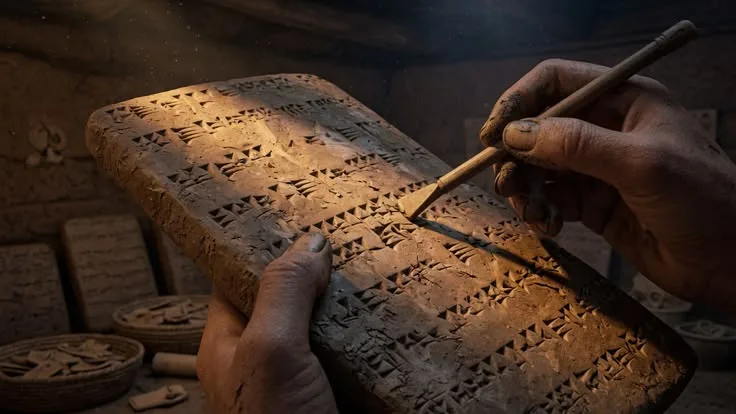
Cuneiform - the name derives from the Latin cuneus, meaning wedge - was written by pressing a reed stylus into soft clay to produce wedge-shaped marks. In its earliest form it was pictographic, with signs resembling the objects they represented.
Over centuries, through the process of writing thousands of tablets, the pictures became increasingly abstract, rotated 90 degrees from their original orientation, and finally reduced to combinations of wedge-shaped impressions bearing no visual resemblance to their referents.
Cuneiform was adapted by multiple languages beyond Sumerian. Akkadian scribes borrowed the Sumerian sign system in the third millennium BCE, adapting it to their Semitic language. Babylonian and Assyrian dialects of Akkadian used cuneiform for the next two thousand years.
Elamite, Hittite, Hurrian, and Ugaritic all used cuneiform scripts adapted to their phonological systems.
For roughly 3,000 years - from its invention around 3200 BCE until it fell out of use around 100 CE - cuneiform was the dominant writing technology of the ancient Near East, used for everything from royal chronicles and law codes (Hammurabi's code, c.
1754 BCE) to private letters, contracts, and astronomical observations.
The Epic of Gilgamesh, portions of which date to the Third Dynasty of Ur (c. 2100 BCE) and which survive in the twelve-tablet Akkadian version from the library of Ashurbanipal (c. 650 BCE), is the oldest substantial literary work recovered from antiquity.[12]
Its survival on baked clay tablets across three and a half millennia is itself testimony to the durability of the medium.
Andrew George's critical edition of the Epic (The Epic of Gilgamesh: The Babylonian Epic Poem and Other Texts in Akkadian and Sumerian, 1999) drew on over 73 fragments from multiple archives to reconstruct the most complete text yet assembled, demonstrating how the decipherment of cuneiform continues to yield new knowledge two centuries after its rediscovery.
The Scribal Tradition
The edubba - the Sumerian "tablet house" or school - was the institution through which cuneiform literacy was transmitted across generations. Students began by impressing simple wedge combinations, progressing through a standardized curriculum of word lists, literary texts, and mathematical exercises.
Niek Veldhuis, in History of the Cuneiform Lexical Tradition (2014), documented how a remarkably stable curriculum was transmitted across more than a millennium, from roughly 2500 BCE to 500 BCE, attesting to an institutional continuity rarely matched in educational history.[25]
The curriculum included not only language but mathematics, medicine, and divination - cuneiform literacy was the gateway to the entire intellectual inheritance of ancient Mesopotamia.
The profession of scribe carried high social status. In a world where perhaps 1-2% of the population was literate, the ability to read and write was a practical monopoly over administrative, legal, and religious functions. The Mesopotamian city-states maintained archives of thousands of tablets.
The Royal Library of Ashurbanipal at Nineveh, assembled in the seventh century BCE, contained an estimated 30,000 tablets - the ancient world's most ambitious effort at systematic knowledge collection.
Egyptian Hieroglyphics: A Parallel Invention
Egyptian hieroglyphics developed at approximately the same time as Sumerian cuneiform, with the oldest confirmed examples dating to around 3200-3100 BCE. The Narmer Palette and inscriptions from the royal tombs at Abydos mark the earliest phase.
The term hieroglyphics comes from the Greek for "sacred carved letters," reflecting the monumental character of the script as encountered by Greek visitors - though hieroglyphs were also used for administrative and literary purposes.
The Egyptian system was more complex than cuneiform. It combined logograms (signs representing whole words or morphemes), phonetic signs (consonantal signs representing one, two, or three consonants), and determinatives (unpronounced signs indicating the semantic category of a word).
The number of signs in common use was roughly 700-800 in the classical period, expanding to thousands in the Greco-Roman period as priests elaborated the system for theological purposes.
John Coleman Darnell's excavations at Wadi el-Hol in the Egyptian desert in 1994 unearthed inscriptions now dated to approximately 1800 BCE that appear to represent an early alphabetic script closely related to Proto-Sinaitic - a find that illuminated the transition from Egyptian to alphabetic writing in remarkable detail (Darnell et al., 2005).[6]
Egyptian writing developed three related scripts over time. Hieroglyphics proper was used for monumental and formal inscriptions. Hieratic was a cursive form used for everyday documents written on papyrus. Demotic, emerging around 650 BCE, was a further simplified form used for business, literature, and personal documents.
The Rosetta Stone (196 BCE), carrying a priestly decree in all three scripts plus Greek, provided the key that enabled Jean-Francois Champollion to decipher hieroglyphics in 1822 - one of the great intellectual achievements of the nineteenth century.
Champollion's breakthrough, described in his Lettre a M.[2] Dacier (1822), followed decades of unsuccessful attempts by scholars including Thomas Young, who had correctly identified the phonetic principle but could not systematize it.
The Medical and Scientific Papyri
Egyptian hieroglyphic writing produced one of the ancient world's most impressive medical literatures. The Edwin Smith Papyrus (c.
1600 BCE, though likely copied from a source two centuries older) contains 48 case studies of wounds and injuries presented in systematic format: title, examination, diagnosis, treatment, and prognosis.
James Henry Breasted, who published the first translation in 1930, described it as the oldest known surgical text.
The Ebers Papyrus (c. 1550 BCE) contains over 700 remedies and discusses conditions ranging from crocodile bites to heart disease. These texts demonstrate that writing enabled not just administration and literature but the systematic accumulation and transmission of empirical knowledge - a function essential to the development of science.
The Alphabet: The Most Consequential Simplification in Intellectual History
The alphabet is one of the most important technological inventions in human history, not because it was the first writing system but because its radical simplicity made widespread literacy achievable for the first time. All writing systems before the alphabet required learners to master hundreds or thousands of complex signs.
An alphabet reduces the writing system to a small set of signs - typically 20 to 30 - each representing a single phoneme (speech sound). Anyone who can learn to recognize and reproduce 22 to 26 signs can in principle read and write any text.
The alphabet emerged from a process of simplification and reanalysis of Egyptian hieroglyphics by Semitic speakers in the ancient Near East. The Proto-Sinaitic script, discovered at Serabit el-Khadim in the Sinai Peninsula and dated to approximately 1800 BCE, is the oldest confirmed alphabetic inscription.
Semitic workers quarrying turquoise for Egyptian authorities apparently adapted a small subset of Egyptian hieroglyphic signs, using each sign not for its Egyptian phonetic value but for the first sound of the Semitic word for the object the sign depicted - the acrophonic principle.
The sign for "ox" (aleph in Semitic) came to represent the sound /a/; the sign for "house" (beth) represented /b/; and so on.
From Proto-Sinaitic developed the Phoenician alphabet of approximately 1050 BCE, which had 22 signs representing only consonants - a logical choice for Semitic languages, in which vowels are grammatically regular and predictable from context.
The Phoenicians were maritime traders operating across the Mediterranean, and their alphabet spread widely: to Aramaic (the parent of Hebrew, Arabic, and many other scripts) and westward to Greece. The spread was not accidental.
The alphabet's simplicity made it ideal for trade: a merchant needed weeks to master the Phoenician alphabet, versus years to learn cuneiform. Literacy became an accessible tool rather than an elite monopoly.
The Greeks made the decisive innovation of representing vowels, adding signs for /a/, /e/, /i/, /o/, /u/ by assigning phonetic values to Phoenician consonant signs that had no equivalent in Greek. This adaptation, made around 800 BCE, created the first truly complete alphabet capable of unambiguous phonetic representation.
The Greek alphabet was the ancestor of Latin, Cyrillic, and most European scripts. The roughly 150 scripts in use today all descend, directly or indirectly, from this single Semitic innovation.
As linguist Florian Coulmas observed, the alphabet's triumph was not inevitable - it was a contingent historical outcome that might easily not have occurred - but once adopted by the Greeks and transmitted to Rome, its global dominance became nearly impossible to displace (Coulmas, 1989).[3]
The Social Impact of Alphabetic Literacy
The simplification wrought by the alphabet had profound social consequences. In ancient Mesopotamia and Egypt, literacy was the professional tool of a scribal class. Estimates suggest that literacy rates in these societies were perhaps 1-5% of the population (Harris, 1989).[15]
The alphabet made literacy achievable for a far wider population. William Harris, in Ancient Literacy (1989), estimated that classical Athens may have achieved literacy rates of 20-30% among male citizens - extraordinary by ancient standards, made possible by the relative accessibility of the Greek alphabet and the civic demands of Athenian democracy.
The relationship between democracy and alphabetic literacy was not coincidental: an informed electorate requires the ability to read laws, decrees, and political arguments.
Mayan Glyphs: Independent Invention and Long Delayed Decipherment
Mayan hieroglyphic writing is one of the most visually elaborate scripts ever produced, and its decipherment is one of the great intellectual detective stories of the twentieth century.
The Maya and their predecessors in Mesoamerica developed writing wholly independently of Old World traditions, producing a logosyllabic script combining logograms with syllabic signs in a system capable of recording the full range of spoken language.
The decipherment was delayed for decades by institutional resistance. The Soviet linguist Yuri Knorozov argued in 1952 that Mayan script was partly syllabic rather than purely logographic - a conclusion he reached by applying phonetic values of signs recorded in a colonial-era document, the Landa alphabet compiled by the Spanish bishop Diego de Landa in the 1560s.
His argument was resisted for decades by the dominant American school led by J. Eric Thompson, who held that Mayan script represented abstract cosmological concepts rather than spoken language.
Thompson's institutional authority and dismissal of Knorozov's Soviet-era scholarship delayed acceptance.
The syllabic interpretation was eventually confirmed through the work of Linda Schele, David Stuart, and others from the 1970s onward, enabling the reading of royal dynastic histories and ritual texts that transformed understanding of Maya civilization entirely.
The decipherment revealed that Mayan monumental inscriptions record detailed royal histories, dynastic succession, military conquests, and ritual obligations - turning what had been interpreted as abstract astronomical data into a rich historical record.
The Dresden Codex (c. 13th-14th century CE), one of only four surviving pre-Columbian Maya books, contains sophisticated astronomical calculations including accurate tables of Venus cycles.
Simon Martin and Nikolai Grube, in Chronicle of the Maya Kings and Queens (2000), drew on the decipherment to reconstruct the political histories of 11 major Maya cities spanning nearly a millennium - a work that would have been entirely impossible without the mid-century breakthrough in decipherment.[18]
The survival of only four pre-Columbian Maya books is itself a sobering reminder of writing's fragility. When the Spanish Bishop Diego de Landa burned Maya books at Mani in 1562, describing them as "lies of the devil," he was destroying a written tradition of perhaps a thousand years.
The irony that Landa's own record of the Mayan alphabet - compiled to help Spanish missionaries convert Maya speakers - later became instrumental in the script's decipherment is one of history's stranger episodes.
Writing Across Cultures: The Indus Valley and Easter Island
Two writing-like systems remain undeciphered and illustrate the limits of our current knowledge. The Indus Valley script, associated with the cities of Mohenjo-daro and Harappa in modern Pakistan and India (c. 2600-1900 BCE), consists of short inscriptions on seals, pottery, and copper tablets.
Approximately 400-600 distinct signs have been identified, arranged in sequences that are almost certainly linguistic.
Despite decades of effort by scholars including Asko Parpola, whose Deciphering the Indus Script (1994) remains the most comprehensive treatment, the script has not been deciphered - partly because no bilingual text comparable to the Rosetta Stone has been found, and partly because the underlying language remains unknown.[20]
Rongorongo, the undeciphered script of Easter Island (Rapa Nui), is among the most mysterious writing systems in the world.
Discovered by Europeans in the nineteenth century, it consists of incised signs on wooden tablets, recording a script read in alternating directions (boustrophedon-style, rotating the tablet 180 degrees at the end of each line).
Most tablets were destroyed or lost following the catastrophic population collapse of the island in the 1860s, and the few survivors who could read the script died before adequate records were made.
Only 26 tablets survive. Steven Fischer's attempted decipherment (Rongorongo: The Easter Island Script, 1997) identified what he argued were cosmogonic chants, but the decipherment remains contested.[11]
Rongorongo may represent an independent invention of writing or a script developed after contact with writing brought by Spanish missionaries in 1770 - a genuinely open question.
The Printing Press: From Manuscript Culture to Print Culture
Johannes Gutenberg's development of a system of movable type printing in Mainz, Germany, around 1440-1450 was not the invention of printing - woodblock printing had been practiced in China since at least the 7th century CE, and Bi Sheng had invented movable ceramic type around 1040 CE.
But Gutenberg's system was a suite of innovations that made mass production of texts dramatically faster, cheaper, and more flexible: a press mechanism adapted from existing screw presses, an oil-based ink suited to metal type, and above all a practical method for casting and composing individual metal type characters that could be rearranged indefinitely.
The Gutenberg Bible (completed c. 1455), of which approximately 180 copies were produced in two years, illustrated the scale of transformation. A handwritten Bible required a scribe perhaps two years of labor; Gutenberg's press produced 180 in the same time.
The cost per copy was roughly a fifth of a manuscript Bible. By 1500, there were printing establishments in some 250 European towns, and an estimated 15-20 million books had been printed.
Lucien Febvre and Henri-Jean Martin, in The Coming of the Book (1958, translated 1976), estimated that by 1600 the total number of books printed in Europe exceeded 200 million - a quantity unimaginable before Gutenberg.[10]
Elizabeth Eisenstein'sThe Printing Press as an Agent of Change (1979) provided the most comprehensive analysis of these consequences, arguing that print culture created the conditions for both the Reformation and the Scientific Revolution through three mechanisms: standardization (identical copies reduced the copying errors that had accumulated through medieval manuscript production),
dissemination (dramatically reduced cost expanded the reading public),
and fixity (printed works could be cited precisely and accumulated over time into indexed reference collections).[9]
Luther's Ninety-Five Theses circulated across Germany within weeks of their composition in 1517 - a speed of cultural transmission entirely new in human history.
Eisenstein's thesis has been challenged and qualified by subsequent scholarship, most notably by Adrian Johns in The Nature of the Book (1998), who argued that print did not automatically confer fixity and that early printed books were less standardized than Eisenstein assumed.[16]
The debate between them shaped the entire field of book history for two decades.
Literacy Rates and the Long-Term Impact of Print
The printing press's consequences for literacy rates can be traced through historical data.
William St Clair, in The Reading Nation in the Romantic Period (2004), showed that book prices in Britain fell by roughly 90% between 1500 and 1800 as print production became more efficient - a democratization of text that made reading achievable for classes that could never have afforded manuscripts.
Literacy rates in England, estimated at perhaps 30% for men and 10% for women in 1600, had risen to roughly 60% for men and 40% for women by 1750, with further dramatic increases in the nineteenth century following mass schooling.[23]
Writing and Cognition: How Writing Restructures Thought
The relationship between writing and human thought is one of the most ambitious questions in cognitive science, linguistics, and cultural history. Walter Ong's influential study Orality and Literacy (1982) argued that writing does not merely record thought but restructures consciousness.[19]
In purely oral cultures, knowledge exists only in living memory and can be transmitted only through performance. This creates a fundamentally different relationship to knowledge: it must be memorable, formulaic, participatory, and situational.
Writing, by contrast, allows knowledge to be stored outside the mind, accumulated across generations, examined at leisure, and subjected to analysis and revision by people remote in time and place from the original composition.
Ong identified several specific cognitive consequences of literacy: writing enables abstract, analytical thought by making language itself an object of reflection; it enables list-making and classification; it creates the conditions for systematic science, philosophy, and law, all of which depend on the ability to work with large bodies of accumulated, indexed, and cross-referenced text.
Archaeological and historical evidence supports some of these claims. The earliest Sumerian tablets are inventories and accounting records; the capacity to maintain complex palace economies requiring the coordination of thousands of people appears to have depended on writing.
The codification of law in Hammurabi's code, the accumulation of astronomical observations in Babylonian libraries, and the development of systematic medicine in Egyptian medical papyri all reflect the cognitive and organizational capacities that writing enables.
Critics of Ong's thesis, including anthropologist Brian Street in Literacy in Theory and Practice (1984), argue that it romanticizes oral cultures as cognitively limited and overstates the cognitive transformation involved in literacy.[24]
Sophisticated abstract thought clearly existed in pre-literate cultures; oral traditions carry complex philosophical, legal, and scientific content.
The relationship between writing and cognition is more accurately understood as one of expansion rather than replacement: writing supplements and extends cognitive capacities rather than creating them from scratch.
"The development of writing is perhaps the greatest single achievement of the human mind. It brought about a radical transformation not just of communication but of how we think."
- Jack Goody, The Logic of Writing and the Organization of Society (1986)
Jack Goody's cross-cultural comparative work, particularly The Logic of Writing and the Organization of Society (1986) and The Domestication of the Savage Mind (1977), elaborated Ong's insights with anthropological depth.[13]
Goody argued that writing enabled specific cognitive tools - tables, lists, recipes, formulas - that are difficult to produce and use in purely oral contexts, and that these tools had significant consequences for the kinds of reasoning that became possible.[14]
His work remains controversial but has been foundational to the anthropology of literacy.
Major Writing Systems: A Comparative Overview
| Script Family | Direction | Phonographic Unit | Examples |
|---|---|---|---|
| Alphabetic | L-to-R or R-to-L | Consonants and vowels | Latin, Greek, Cyrillic, Arabic (abjad) |
| Syllabic | Variable | Syllable | Japanese kana, Cherokee, Linear B |
| Logographic | Variable | Word/morpheme | Chinese characters (partially) |
| Logosyllabic | Variable | Words and syllables | Cuneiform, hieroglyphics, Mayan |
| Alphasyllabic (abugida) | L-to-R | Consonant with inherent vowel | Devanagari, Thai, Ethiopic |
The diversity of writing systems reflects not just phonological differences between languages but cultural choices and historical contingencies.
The Cherokee syllabary, invented by the Cherokee scholar Sequoyah between approximately 1809 and 1821, is one of history's most remarkable documented cases of a single individual creating a complete writing system from scratch.
Having no prior literacy in any language, Sequoyah understood that European writing captured speech and set out to do the same for Cherokee.
Within a few years of the syllabary's completion, the Cherokee Nation had achieved remarkably high literacy rates - reportedly higher than those among neighboring white Americans at the time.
Ellen Cushman's The Cherokee Syllabary: Writing the People's Perseverance (2011) documents how the syllabary became central to Cherokee cultural survival and resistance to forced assimilation.[4]
The Modern Transformation: Typewriters, Word Processors, and Digital Text
The history of writing is not only about the invention of scripts but about the technologies through which writing is produced.
The typewriter, commercially practical from the 1870s onward, transformed office work and made writing faster and more legible, but it also imposed a significant constraint: the fixed arrangement of keys required a specific physical form of engagement with language.
Christopher Sholes's QWERTY keyboard layout, designed in the 1870s to prevent mechanical jamming of adjacent keys on early typewriters, persisted into the digital age through sheer institutional momentum even after its original rationale had disappeared.
The word processor transformed writing practice more fundamentally than the typewriter. The ability to revise text without retyping it changed the relationship between drafting and editing, enabling a more recursive, iterative approach to composition.
Anne Mangen and colleagues, in a series of studies published in Reading and Writing (2013) and subsequent journals, examined how the physical substrate of writing affects the writer's cognitive engagement with text, finding evidence that handwriting recruits different neural systems than keyboard typing and may have advantages for memory consolidation and conceptual processing in learning contexts.[17]
Writing in the Digital Age
Digital technology has transformed writing more rapidly than any development since Gutenberg.
The quantity of text produced has increased enormously - email, text messaging, social media, and blog commenting have made writing a common activity for hundreds of millions of people who in previous generations would have written little outside formal contexts.
This democratization of writing has expanded the range of voices in public discourse and created records of daily life at a scale without historical precedent.
At the same time, much digital writing has characteristics that differ significantly from the extended, sequential prose that Ong associated with literate consciousness.
Maryanne Wolf'sProust and the Squid (2007) and subsequent research argue that deep reading - the slow, attentive engagement with extended text that develops complex inference and empathy - is a practiced skill that may be eroded by habits of rapid digital skimming.[27]
Wolf's follow-up study Reader, Come Home (2018) developed these concerns further, presenting evidence from brain imaging studies that the neural circuits recruited for deep reading are partially distinct from those used for surface scanning of digital text, and that these circuits require sustained practice to develop and maintain.[26]
The most recent development adds a genuinely new dimension: large language models can now generate fluent, contextually appropriate text at scale, raising fundamental questions about authorship, authenticity, and the future of writing as a distinctively human practice.
The oldest writing systems emerged to meet the record-keeping needs of complex administrative societies; the newest writing technologies raise questions about what uniquely human purposes writing will serve when machines can produce indistinguishable text.
The 5,000-year history of writing suggests that each new technology changes practices while preserving functions that earlier technologies could not serve. What those functions will be in an AI-saturated environment remains genuinely open.
Practical Guide: Understanding Writing System Types
When encountering an unfamiliar script, several analytical questions help situate it:
Is it phonographic or logographic? Phonographic scripts represent sounds (letters or syllables); logographic scripts represent words or morphemes directly. Most modern scripts are phonographic. Chinese is a mixed system with extensive phonetic components.
What phonographic unit does it use? Alphabets represent individual consonants and vowels. Syllabaries represent whole syllables (Japanese kana has about 50 signs for 50 syllables). Abjads represent consonants only (Arabic and Hebrew, descendants of the Phoenician alphabet).
Abugidas represent consonants with inherent vowels modified by diacritics (most South and Southeast Asian scripts).
What direction does it run? Most modern scripts run left-to-right. Arabic and Hebrew run right-to-left. Traditional Chinese and Japanese can run top-to-bottom. Ancient Greek was sometimes written boustrophedon (alternating direction, as an ox plows a field), one of the early stages in fixing a conventional direction.
What was it derived from? Very few writing systems were invented from scratch. Most were adapted from existing systems. Understanding the genealogy of a script reveals its structural logic and the choices made in adaptation.
The Preservation and Loss of Writing
The history of writing is also a history of irretrievable loss. The Library of Alexandria, the ancient world's most ambitious collection of written knowledge, was damaged and partially destroyed on multiple occasions.
Julius Caesar's fire in 48 BCE, the decree of Theophilus in 391 CE, the Arab conquest of 642 CE are among the events traditionally blamed, though the library's decline was probably more gradual and complex than any single catastrophic destruction.
The loss of classical Greek literature is substantial: we have perhaps a tenth of what was written, and our entire knowledge of many Greek tragedies, comedies, and philosophical works comes through a small number of medieval manuscript copies.
The deliberate destruction of indigenous writing traditions by colonial powers compounded natural and accidental losses.
The burning of Maya books by Bishop de Landa (1562), the suppression of African knowledge systems, and the deliberate policy of cultural assimilation that destroyed indigenous knowledge archives across the Americas, Australia, and elsewhere represent forms of epistemicide - the systematic destruction of knowledge systems - whose consequences for human knowledge are incalculable.
Conversely, the digital age has produced the largest expansion of preserved text in human history. The Internet Archive, established in 1996, had archived over 750 billion web pages by 2023. Google Books had scanned over 40 million books as of 2019 - a significant fraction of all books ever printed.
The preservation challenge has shifted from preventing loss to managing abundance: when everything is preserved, finding and evaluating what is significant becomes the central problem.
The history of writing is ultimately the history of humanity's effort to extend its cognitive reach beyond the limits of individual memory and presence - to speak across distance and time, to accumulate knowledge beyond any single lifetime, and to make the invisible world of thought legible to others.
That effort, which began with clay tokens in Neolithic Mesopotamia and continues with every message sent across the internet today, remains one of our defining achievements.
Sources & Further Reading
- Boltz, W. G. (1994). The Origin and Early Development of the Chinese Writing System. American Oriental Society.
- Champollion, J.-F. (1822). Lettre a M. Dacier relative a l'alphabet des hieroglyphes phonetiques. Firmin Didot.
- Coulmas, F. (1989). The Writing Systems of the World. Blackwell.
- Cushman, E. (2011). The Cherokee Syllabary: Writing the People's Perseverance. University of Oklahoma Press.
- Daniels, P. T., & Bright, W. (Eds.). (1996). The World's Writing Systems. Oxford University Press.
- Darnell, J. C., Dobbs-Allsopp, F. W., Lundberg, M. J., McCarter, P. K., & Zuckerman, B. (2005). Two early alphabetic inscriptions from the Wadi el-Hol. Annual of the American Schools of Oriental Research, 59, 63-124.
- DeFrancis, J. (1989). Visible Speech: The Diverse Oneness of Writing Systems. University of Hawaii Press.
- d'Errico, F., Henshilwood, C., Lawson, G., Vanhaeren, M., Tillier, A.-M., Soressi, M., & Joris, O. (2001). Archaeological evidence for the emergence of language, symbolism, and music. Journal of World Prehistory, 17(1), 1-70.
- Eisenstein, E. (1979). The Printing Press as an Agent of Change (2 vols.). Cambridge University Press.
- Febvre, L., & Martin, H.-J. (1976). The Coming of the Book: The Impact of Printing, 1450-1800 (D. Gerard, Trans.). NLB. (Original work published 1958)
- Fischer, S. R. (1997). Rongorongo: The Easter Island Script. Oxford University Press.
- George, A. (1999). The Epic of Gilgamesh: The Babylonian Epic Poem and Other Texts in Akkadian and Sumerian. Penguin.
- Goody, J. (1977). The Domestication of the Savage Mind. Cambridge University Press.
- Goody, J. (1986). The Logic of Writing and the Organization of Society. Cambridge University Press.
- Harris, W. V. (1989). Ancient Literacy. Harvard University Press.
- Johns, A. (1998). The Nature of the Book: Print and Knowledge in the Making. University of Chicago Press.
- Mangen, A., Walgermo, B. R., & Bronnick, K. (2013). Reading linear texts on paper versus computer screen. Computers and Education, 71, 23-31.
- Martin, S., & Grube, N. (2000). Chronicle of the Maya Kings and Queens. Thames and Hudson.
- Ong, W. J. (1982). Orality and Literacy: The Technologizing of the Word. Methuen.
- Parpola, A. (1994). Deciphering the Indus Script. Cambridge University Press.
- Robinson, A. (1995). The Story of Writing. Thames and Hudson.
- Schmandt-Besserat, D. (1992). Before Writing (2 vols.). University of Texas Press.
- St Clair, W. (2004). The Reading Nation in the Romantic Period. Cambridge University Press.
- Street, B. V. (1984). Literacy in Theory and Practice. Cambridge University Press.
- Veldhuis, N. (2014). History of the Cuneiform Lexical Tradition. Ugarit-Verlag.
- Wolf, M. (2007). Proust and the Squid: The Story and Science of the Reading Brain. HarperCollins.
- Wolf, M. (2018). Reader, Come Home: The Reading Brain in a Digital World. HarperCollins.
- Woods, C. (Ed.). (2010). Visible Language: Inventions of Writing in the Ancient Middle East and Beyond. Oriental Institute of the University of Chicago.