
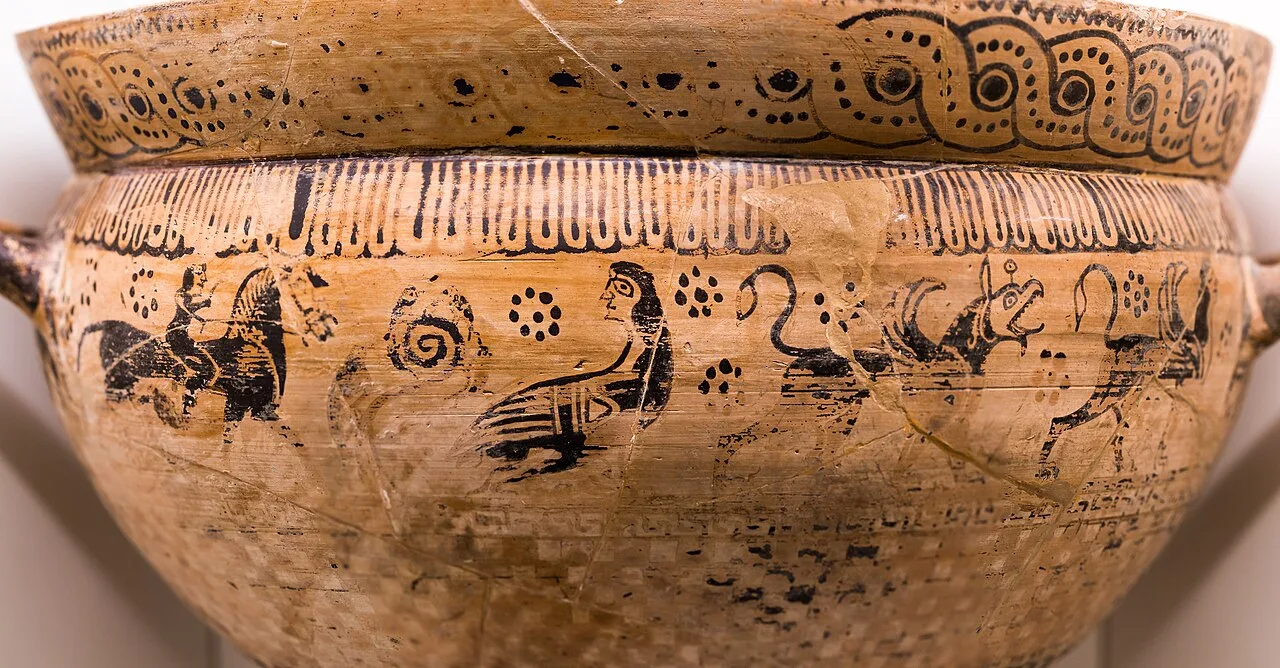
Art history studies how images and objects acquire meaning, function within societies, relate across cultures and time, and shape changing ideas about art itself. Its methods include iconography and formalism, alongside attention to patrons, institutions, and historical context. The field traces major periods from ancient and medieval art through the Renaissance, modernism, and contemporary pluralism while continually reassessing which works belong in the canon.
Thirty-six thousand years ago, someone entered a deep cave in what is now southern France and, by firelight, drew a pride of lions stalking across a limestone wall.
The animals are rendered with extraordinary skill: their bodies overlap to suggest depth, their muscles are implied by the manipulation of contour, and their posture communicates the focused tension of predators on the move.
The person who made these images in the Chauvet Cave was anatomically and cognitively identical to a person living today.
We know nothing about them: their name, their social position, whether they were honored or forgotten, whether the images were made in an hour or over years. What we have is the work itself, still speaking across an incomprehensible gulf of time.
The history of art is the discipline that tries to make sense of that speech: to understand not just what images and objects look like but what they meant to the people who made them, what functions they served, how they relate to one another across time and culture, and what they can tell us about the societies that produced them.
It is also the story of how humans have thought about art itself, how the very concept of art has changed, expanded, and been contested, and how the discipline charged with studying art has had to confront its own assumptions about whose art matters and whose does not.
The story begins in darkness, literally, with painted caves. It passes through the pyramids and the Parthenon, through the cathedrals of Gothic Europe and the frescoes of Renaissance Italy, through the revolutionary canvases of the Impressionists and the philosophical provocations of Duchamp, to arrive at a contemporary art world of bewildering diversity, global reach, and staggering market valuations.[12]
Along the way, the definition of art has expanded to include objects that the makers would not have recognized as art, and contracted to exclude things that were once considered art's highest achievements.
"All art is at once surface and symbol. Those who go beneath the surface do so at their peril. Those who read the symbol do so at their peril. It is the spectator, and not life, that art really mirrors."
- Oscar Wilde, Preface to "The Picture of Dorian Gray" (1890)
| Period / Movement | Era | Key Characteristics |
|---|---|---|
| Ancient (Egypt, Greece, Rome) | 3000 BCE-500 CE | Idealization; religious function; civic monumentality |
| Medieval | 500-1400 CE | Christian symbolism; gold backgrounds; hierarchical scale |
| Renaissance | 1400-1600 | Perspective; humanism; naturalism; patronage |
| Baroque | 1600-1750 | Drama; chiaroscuro; emotion; Catholic Counter-Reformation |
| Romanticism | 1780-1850 | Emotion; nature; individual; national identity |
| Modernism | 1860-1960 | Abstraction; rejection of tradition; avant-garde |
| Contemporary / Postmodern | 1960-present | Pluralism; concept over craft; installation; digital |
Key Definitions
Iconography: The study of the subject matter and symbolic meaning of works of art, identifying and interpreting the themes, figures, and narratives depicted.
Formalism: An approach to art criticism and history that emphasizes the formal elements of a work (line, color, shape, composition) as the primary carriers of meaning and value, independent of subject matter or historical context.
Mimesis: The Greek concept of imitation or representation; in art, the principle that art achieves value through faithful representation of the visible world.
Avant-garde: A French military metaphor applied to art movements that position themselves as ahead of their time, challenging established conventions and anticipating future developments.
Readymade: A term coined by Marcel Duchamp for a mass-produced everyday object, selected and presented by the artist as a work of art, without transformation.
Plein air: French for "open air"; the practice of painting outdoors in direct observation of the landscape, associated primarily with the Impressionists.
Canon: The collection of works, artists, and periods treated as central, exemplary, or authoritative within a discipline; in art history, the Western tradition of great masters whose work defined standards and influenced successors.[1]
Before Writing: Prehistoric Art
The art of the Paleolithic era forces a question that the discipline of art history rarely has to ask so bluntly: what do we mean by art, and how do we know it when we see it? The Chauvet Cave paintings, dated to approximately 36,000 years before the present, are the oldest securely dated figurative art in Europe.
The Sulawesi cave paintings in Indonesia, with hand stencils and figurative animal images dated to over 45,000 years ago, suggest that the capacity for symbolic representation may have emerged even earlier than the European evidence implies. The Venus of Willendorf, dated to roughly 28,000-25,000 BCE, is one of hundreds of small female figurines found across Europe and dating to the Upper Paleolithic.
Their exaggerated sexual characteristics have generated speculation about their function: goddess worship, fertility magic, erotic objects, or representations of pregnant women from a first-person viewpoint.
None of these interpretations is provable, but the very abundance of the figurines suggests that the impulse to represent the human form was widespread and persistent from the earliest periods of anatomically modern human existence.
Cave art poses particular interpretive challenges because we have no access to the social and ritual contexts in which it was produced. The paintings are typically in the deepest and most inaccessible parts of caves, reached only with difficulty, which argues against them serving as everyday decoration.
The French archaeologist Abbe Breuil proposed the hunting magic hypothesis: the paintings were made to ensure success in the hunt through sympathetic magic.
Andre Leroi-Gourhan's structural analysis found patterns in the placement of different animal species that he interpreted as reflecting a symbolic opposition between male and female principles.
David Lewis-Williams's shamanistic interpretation relates the geometric phosphenes found alongside figurative images to the visual phenomena of trance states.[6]
What all these interpretations share is the recognition that Paleolithic art was not merely decorative but served functions we can only guess at through indirect evidence. The people who made it lived in a world permeated by the sacred, in a sense of the word that our own secular frameworks may systematically underestimate.
Ancient Civilizations: Egypt, Greece, and Rome
The ancient Egyptians produced art over a period of roughly three thousand years with a remarkable degree of stylistic consistency, maintained by the centralized control of artistic production through royal and priestly institutions.
Egyptian art was not concerned with representing the visible world as it actually appears from a single viewpoint but with providing the most complete and characteristic representation of each subject: a head shown in profile, a torso shown frontally, an eye shown as seen from the front even when the face is in profile.
This composite convention, which modern Western viewers schooled in linear perspective find disorienting, served the primary function of Egyptian art, which was not aesthetic pleasure but the effective service of religious and funerary ritual.
Greek art undertook what its own commentators understood as a progressive mastery of naturalistic representation. The Archaic period's kouros figures (standing male figures) show a stiff, frontal symmetry that reflects the influence of Egyptian sculpture.
The Classical period of the fifth and fourth centuries BCE developed the idealized representation of the human figure in motion and repose that would provide a model for Western art for two and a half millennia.
The concept of mimesis, the imitation of nature, was developed by Greek writers on art and became the dominant framework for evaluating artistic achievement in the Western tradition.
Roman art was largely derivative of Greek achievement in terms of sculptural style, but the Romans made original contributions in architectural scale and engineering, in portraiture that insisted on individual physiognomic specificity rather than idealization, and in narrative relief sculpture documenting historical events.
The Ara Pacis and Trajan's Column illustrate a sophisticated approach to representing historical narrative in continuous visual sequence.
The Medieval Period
The art of the medieval Christian world in Europe is often described, following Vasari's dismissive characterization, as a period of decline from classical achievement. This assessment reflects the assumptions of Renaissance humanism rather than an accurate evaluation of medieval art on its own terms.
Medieval art was organized not around the representation of natural appearances but around the communication of theological truth.
The elongated figures, non-naturalistic proportions, and gold backgrounds of Byzantine mosaics and icon painting were not failures of skill but deliberate rejections of illusionism in favor of a transcendent spiritual register.
The stained glass of Gothic cathedrals, which could not represent space convincingly but could flood interior spaces with colored light, created a sensory environment designed to overwhelm the individual in an experience of the divine.
The Renaissance and the Invention of the Artist
Giorgio Vasari's Lives of the Artists, first published in 1550, invented art history as a discipline organized around individual biography and progressive development.
For Vasari, the history of art from Cimabue through Giotto to Leonardo, Michelangelo, and Raphael was a story of steady recovery from the barbarian decline of the Middle Ages, with Michelangelo as its supreme achievement.[2]
This narrative was partial, Eurocentric, and shaped by Vasari's Florentine loyalties, but it established the biographical and developmental framework within which art history would operate for centuries.
The Renaissance transformation of art involved technical innovation, new subjects, a new conception of the artist, and new intellectual frameworks.
The technical innovations included linear perspective (codified by Alberti in 1435), the systematic study of human anatomy through dissection, and the development of oil paint as the dominant medium of panel and canvas painting.
Oil paint, which dried slowly and could be worked and reworked, allowed for the subtle gradations of light and shadow that Leonardo called sfumato and that became fundamental to illusionistic painting in the Western tradition.
The new conception of the artist was perhaps the most consequential change. Medieval craftsmen who made painted altarpieces or sculpted cathedral figures were skilled artisans whose social status was roughly equivalent to that of other craft workers.
Renaissance humanists developed the concept of the artist as intellectual, a practitioner of a liberal art rather than a mechanical one, whose creative achievement reflected divine inspiration. Michelangelo was celebrated in his own lifetime as il divino, the divine one, and treated by popes and princes as a cultural monument.
Leonardo was the paradigm of the universal man, combining painting with anatomy, engineering, natural philosophy, and music. This elevation of the artist to the status of creative genius was a historical construction, not a natural category, but it has proved extraordinarily durable.
Baroque, Rococo, and Neoclassicism
The Baroque style that emerged in Catholic Europe in the late sixteenth century was the artistic expression of the Counter-Reformation's project of emotional persuasion.
Caravaggio's dramatic use of light emerging from darkness (tenebrism), his shocking naturalism in depicting sacred figures, and his ability to generate visceral emotional impact set the terms for an art of theatrical intensity.
Bernini's sculpture in Rome created illusions of weightlessness, drapery in motion, and ecstatic emotional states that served the devotional purposes of the reformed Catholic Church. The Rococo of eighteenth-century France represented a secularization and lightening of the Baroque impulse: smaller in scale, more decorative, associated with aristocratic leisure and erotic subject matter.
Watteau's fetes galantes, idealized images of elegantly dressed figures in outdoor settings, established a genre that celebrated a world of cultivated pleasure on the edge of melancholy.
Neoclassicism arose in the second half of the eighteenth century as a reaction against Rococo frivolity, drawing on the archaeological rediscovery of Pompeii and Herculaneum and the art historical writings of Johann Joachim Winckelmann, who celebrated Greek art as the expression of noble simplicity and quiet grandeur.
The Neoclassical style of Jacques-Louis David provided the visual language of the French Revolution and Napoleonic Empire.
Romanticism contested Neoclassicism's rationalism and emphasis on ancient models, asserting the primacy of feeling, imagination, and individual creativity over rule and precedent. Eugene Delacroix's Liberty Leading the People (1830) combined Baroque dramatic energy with contemporary political content.
The Romantic movement elevated landscape painting from a minor genre to a vehicle for transcendent experience: Caspar David Friedrich's lonely figures contemplating vast natural vistas dramatized the individual's confrontation with a sublime nature.
Impressionism and the Break with the Academy
The French academic system of the nineteenth century organized artistic training, exhibition, and reward through a hierarchical system. The Ecole des Beaux-Arts provided the dominant form of training, and the annual Salon provided the primary venue for public exhibition and critical attention.
The system privileged certain kinds of work, history painting on serious subjects executed with smooth academic finish, and marginalized others.
Claude Monet, Pierre-Auguste Renoir, Camille Pissarro, Alfred Sisley, and their circle worked outside this system by choice and by rejection.
They were interested in the transient effects of light on surfaces, the shimmer of water, the haze of a foggy morning, the movement of crowds in a Paris street, effects that required rapid execution and left the visible traces of the brush on the canvas.
When they submitted work to the Salon, it was routinely rejected, and the famous first Impressionist exhibition of 1874 was organized as an independent show in the studio of the photographer Nadar.
Edgar Degas, often grouped with the Impressionists though he was skeptical of the label, brought a sharper compositional intelligence and an interest in Japanese woodblock prints that influenced his asymmetrical framing and high viewpoints.
Berthe Morisot was the most significant woman associated with the movement, her work characterized by loose, gestural brushwork and an intimate attention to domestic and family scenes.
The Post-Impressionist generation took the technical and conceptual licenses that Impressionism had opened and pushed them in several directions simultaneously.
Paul Cezanne abandoned Impressionist interest in transient atmospheric effects in favor of the underlying structure of visual experience, constructing space through modulated patches of color that would point directly toward Cubism.
Georges Seurat developed pointillism, the systematic application of small dots of pure color intended to mix optically on the retina.
Vincent van Gogh used intensified color and swirling brushwork as expressive vehicles for emotional states that Impressionist technique had not attempted to carry.
Paul Gauguin sought an art of primitive intensity in Brittany and then Tahiti, appropriating non-Western forms in ways that combined genuine artistic engagement with the assumptions of colonial primitivism.
Modernism: The Turn Inward
The canonical account of modernism in visual art, associated most influentially with the American critic Clement Greenberg, describes a progressive self-criticism in which each art form identifies and purifies the elements unique to its medium, eliminating everything borrowed from other arts.[4]
For painting, this meant the progressive abandonment of illusionistic depth, literary subject matter, and sculptural form, culminating in the flat, purely optical art of Color Field painting in the 1960s.
Greenberg's account was contested even while it was influential, but it captures something real about the trajectory from Cezanne through Cubism to abstraction.
Picasso and Braque's Analytic Cubism (1908-1912) decomposed objects into multiple simultaneous viewpoints, creating faceted surfaces that acknowledged the picture plane rather than subordinating it to the illusion of depth.
Synthetic Cubism introduced collage, incorporating fragments of newspaper, wallpaper, and other materials into paintings and drawings, introducing the principle of heterogeneous material directly into the art object.
The Dada movement, which emerged during the First World War in Zurich and subsequently in Berlin, New York, and Paris, was explicitly anti-art: a nihilistic rejection of the cultural pretensions of a civilization that had just demonstrated its willingness to kill millions of young men in industrial-scale warfare.
Marcel Duchamp's readymades, his retirement from art to play chess, and his later statement that he was interested in ideas rather than retinal painting established the conceptual art tradition that would become dominant in the 1960s.
Surrealism drew on Freudian psychoanalysis to explore the territory of the unconscious, dreams, and irrational desire.
Salvador Dali's meticulous illusionistic technique applied to hallucinatory content, Rene Magritte's linguistic-philosophical investigations of the image-word relationship, and Joan Miro's biomorphic abstraction represent different approaches to the Surrealist project of breaching the rational surface of conscious life.[5]
Abstract Expressionism in postwar America combined the scale and ambition of European modernism with an emphasis on the act of painting as existential declaration.
Jackson Pollock's drip paintings, made by pouring industrial enamel paint in loops and skeins from above, eliminated the distinction between drawing and painting and made the gestural trace of the artist's movement the primary subject.
Mark Rothko's large color fields, luminous rectangles of subtly modulated color against contrasting grounds, aimed at a contemplative, quasi-religious experience that Rothko himself described in terms of ancient tragedy.
Postmodernism and the Questioning of Masters
The transition from modernism to postmodernism in art, roughly located in the late 1960s to early 1970s, involved a shift from the question "what is the essence of art?" to the question "who decides what counts as art, and on whose authority?" This shift was simultaneously aesthetic, philosophical, and political.[8]
Andy Warhol's deadpan appropriation of commercial imagery, his Factory production methods, his celebrity persona, and his explicit embrace of money as a medium all performed a demolition of the modernist ideology of authentic artistic expression.
Conceptual art, in which the idea behind a work was asserted to be more important than its physical realization, dissolved the art object entirely into language and documentation.[9]
Feminist art, from Judy Chicago's collaborative The Dinner Party (1979) to Barbara Kruger's text-based billboard works, used art's institutional frames to argue about the institutions themselves.
The Pictures Generation of the late 1970s and early 1980s, artists including Cindy Sherman, Richard Prince, Sherrie Levine, and Barbara Kruger, systematically investigated how images construct meaning rather than reflect reality.
Sherman's Untitled Film Stills, in which she posed as characters from imaginary B-movies, argued that femininity is a performance of culturally available scripts rather than an authentic natural state.
Levine's rephotographed rephotographs of Walker Evans's Depression-era photographs questioned the concepts of original, copy, and authorship that underpin both the art market and art history.
The 1980s art market boom, which dramatically inflated prices for Neo-Expressionist painting and elevated artists like Jean-Michel Basquiat and Keith Haring to mass cultural celebrity, created uncomfortable questions about the relationship between postmodernism's anti-capitalist theoretical commitments and its comfortable accommodation within the commercial gallery system.
Art History's Contested Canon
The discipline of art history as it developed from Vasari through German academic Kunstgeschichte to twentieth-century universities was built on a canon of works that was, with minimal exceptions, Western European, largely Italian and French, and almost exclusively made by men.
The challenges to this canon have been among the most significant intellectual developments in the humanities over the past half century.[11]
Linda Nochlin's 1971 essay "Why Have There Been No Great Women Artists?" reframed the question in a way that exposed the ideological assumptions embedded in the category of greatness.[3]
The answer was structural: women were systematically excluded from the training, patronage, and institutional recognition that produced "great artists" in the Western tradition.
Artemisia Gentileschi, long known primarily as the daughter of Orazio Gentileschi, was recovered as a major Baroque painter in her own right.
Berthe Morisot was recognized as an Impressionist of the first rank rather than a peripheral female associate of male painters.[7]
Postcolonial art history has addressed the Eurocentrism of a discipline that treated Western modernism as the universal endpoint of artistic development and other traditions as either precursors or exotic alternatives.[10]
The Benin bronzes, extraordinary works of West African court art looted by British forces in 1897 and distributed to European museums, are among the most contested objects in the repatriation debates that have forced museums to reckon with the imperial circumstances of their collections.
World art history attempts to construct a genuinely comparative account of visual culture across all human societies, without the implicit or explicit hierarchy of the Western canon.
This project is still very much in progress, and it faces genuine methodological difficulties: the concepts and vocabulary developed to describe Western art may not translate without distortion into other cultural contexts, and the institutional incentives of academic art history still tend to reproduce existing canonical hierarchies.
Cross-References
- /culture/arts-culture-history/what was-the-renaissance
- /culture/global-cross-cultural/what-is-anthropology
- /culture/global-cross-cultural/what-is-colonialism
- /culture/global-cross-cultural/what was-ancient-greece
- /culture/global-cross-cultural/what-is-the-enlightenment
- /culture/arts-culture-history/what was-the-scientific-revolution
- /concepts/psychology-behavior/what-is-creativity
- /concepts/decision-making/what-is-political-philosophy
Sources & Further Reading
- Gombrich, E.H. "The Story of Art". 16th ed. London: Phaidon, 1995.
- Vasari, Giorgio. "Lives of the Artists". Translated by George Bull. 2 vols. London: Penguin, 1987.
- Nochlin, Linda. "Why Have There Been No Great Women Artists?" ARTnews 69, no. 9 (January 1971): 22-39.
- Greenberg, Clement. Art and Culture: Critical Essays. Boston: Beacon Press, 1961.
- Chipp, Herschel B., ed. Theories of Modern Art: A Source Book by Artists and Critics. Berkeley: University of California Press, 1968.
- Lewis-Williams, David. The Mind in the Cave: Consciousness and the Origins of Art. London: Thames and Hudson, 2002.
- Pollock, Griselda. Vision and Difference: Femininity, Feminism and Histories of Art. London: Routledge, 1988.
- Crow, Thomas. The Rise of the Sixties: American and European Art in the Era of Dissent. New Haven: Yale University Press, 2005.
- Foster, Hal, Rosalind Krauss, Yve-Alain Bois, Benjamin H.D. Buchloh, and David Joselit. Art Since 1900: Modernism, Antimodernism, Postmodernism. 3rd ed. New York: Thames and Hudson, 2016.
- Clunas, Craig. Art in China. 2nd ed. Oxford: Oxford University Press, 2009.
- Preziosi, Donald, ed. The Art of Art History: A Critical Anthology. 2nd ed. Oxford: Oxford University Press, 2009.
- McAndrew, Clare. The Art Market 2023. Basel: Art Basel and UBS, 2023.