
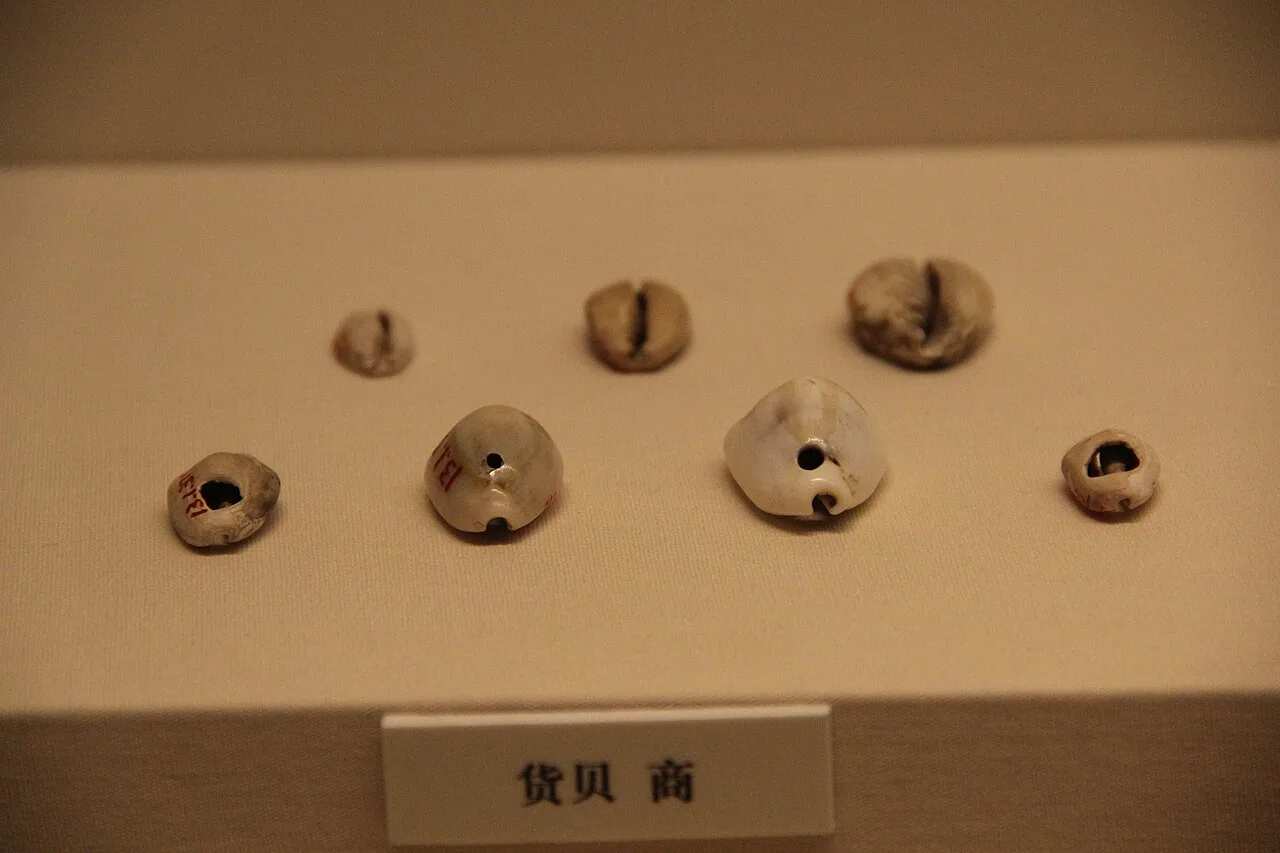
A complete history of money traces changing systems for exchange, storage, and accounting from commodity goods and coins through paper notes, central banking, gold standards, fiat currencies, cards, digital payments, and cryptocurrencies. Money works not through intrinsic value alone but through shared confidence, institutions, debt, law, and state power. Each monetary form encodes choices about control, stability, credit, and the social relationships behind economic exchange.
Money is one of humanity's most powerful inventions, and also one of its most mysterious. We handle it every day without thinking about what it is. A banknote is a piece of paper with ink on it. A bank deposit is a number in a database.
A cryptocurrency token is an entry in a distributed ledger. None of these things has any intrinsic value. They are worth what they are worth because enough people agree that they are worth it - a collective social fiction so successful and so universal that its fictional nature becomes invisible.
The moment it stops being invisible, as it occasionally does in hyperinflations and financial crises, economies collapse with terrifying speed.
Money is not just an economic institution. It is a social technology that encodes a society's most fundamental relationships: between debtors and creditors, between states and citizens, between the present and the future. Every monetary system reflects and enforces a particular set of social arrangements.
The decision to peg a currency to gold embeds certain ideas about the proper limits of government and the primacy of economic stability. The decision to issue fiat money embeds different ideas about governmental responsibility and the possibility of managing economic cycles.
Bitcoin embeds the conviction that governmental monetary control is intrinsically untrustworthy. The history of money is, in large measure, the history of those arguments.
From Lydia's electrum coins in 600 BCE to the trillion-dollar digital payment flows of the twenty-first century, the story of money passes through technological revolutions, philosophical debates, imperial ambitions, and ordinary human needs.
Commodity exchange, coins, paper notes, central banking, the gold standard, fiat currency, credit cards, digital wallets, and cryptocurrency each represent a different answer to the question of how to facilitate exchange, store value, and measure economic activity across time and space.
Each answer has worked in some contexts and failed in others. Understanding why tells us a great deal about what money actually is.
"Money is not a thing, it is a relationship. To understand what money is, you must understand what human beings are to each other." - David Graeber, 'Debt: The First 5,000 Years' (2011)
| Era | Form of Money | Key Feature | Notable Example |
|---|---|---|---|
| Prehistoric / early civilisation | Barter and commodity exchange | No universal medium; reciprocal obligation | Sumerian grain accounts, 3000 BCE |
| Ancient Near East | Commodity money (grain, cattle, shells) | Intrinsic value; widely accepted | Shekel as grain-weight unit |
| 700 BCE | Metal coinage (Lydia, then Greece, Rome) | Standardised weight and value; state guarantee | Lydian electrum staters |
| Medieval | Gold and silver coins; early credit | Long-distance trade; bills of exchange | Medici bills of exchange |
| 1024 CE | Paper money (China, Song Dynasty) | State-issued notes; redeemable for coin | Jiaozi notes |
| 1600s-1800s | Paper money backed by metal (gold standard) | Convertible notes; central banking begins | Bank of England notes (1694) |
| 20th century | Fiat currency; Bretton Woods | National currencies; USD as reserve currency | Nixon Shock (1971) |
| 1950s-1990s | Credit and debit cards | Separation of purchase from cash payment | Diner's Club (1950), Visa (1958) |
| 21st century | Digital money; mobile payments | Electronic transfer; instant settlement | M-Pesa (2007), Apple Pay (2014) |
| 2008-present | Cryptocurrency; blockchain | Decentralised ledger; no central authority | Bitcoin, Ethereum |
Key Definitions
Commodity money: Money that has intrinsic value in itself - cattle, grain, salt, gold, silver - as distinct from representational or fiat money.
Commodity money's value is guaranteed by the physical properties of the commodity itself, which makes it inherently limited in supply but also creates problems of divisibility, transportability, and perishability.
Fiat currency: Money whose value rests on governmental decree rather than physical backing. The word derives from the Latin for 'let it be done.' All major national currencies are currently fiat currencies.
Their value depends on public confidence, the government's taxing authority (which requires payment in the national currency), and the stability of the economy they represent.
Fractional reserve banking: The banking practice, standard since at least the Renaissance, in which banks hold only a fraction of deposited money as liquid reserves and lend out the remainder.
Fractional reserve banking is how banks create money: when a bank makes a loan, it creates a new deposit, increasing the total money supply. Most money in modern economies is created by commercial banks through lending, not by governments printing banknotes.
Legal tender: The currency that a government specifies must be accepted for payment of debts within its jurisdiction. The legal tender designation is part of what gives fiat currency its practical value - creditors cannot legally refuse payment in legal tender.
The concept assumes a functioning state with the authority to enforce financial contracts.
Velocity of money: The rate at which money circulates in an economy - how many times a given unit of money is used in transactions within a period.
A high velocity of money amplifies its economic effects; low velocity (money being hoarded or held rather than spent and invested) reduces economic activity even when the money supply is large.
Seigniorage: The profit a government or central bank earns from issuing currency. When a government prints a $100 bill that costs a few cents to produce, the seigniorage is approximately $99.95.
Historically, debasement of coins - reducing their gold or silver content while maintaining their face value - was a form of covert seigniorage that kings and emperors used to finance wars and expenditure when taxation was insufficient.
Hyperinflation: An extreme and self-reinforcing monetary collapse in which loss of confidence in a currency produces rapid price increases, which further erode confidence. Philip Cagan's classic 1956 definition set the threshold at 50 percent per month.
The most severe hyperinflation in recorded history occurred in Hungary in 1946, when the monthly inflation rate reached 41.9 quadrillion percent. Germany's 1921-1923 Weimar hyperinflation, less extreme but culturally more resonant, saw prices double roughly every three and a half days at its peak in November 1923.
Before Coins: Credit, Gifts, and Grain
The Barter Myth
Adam Smith, in 'The Wealth of Nations' (1776), described a natural progression from primitive barter to money: tribes, he imagined, began by exchanging goods directly, then found certain commodities serving as convenient intermediaries, which gradually became money.[12]
This story has shaped economic thinking ever since. It is almost certainly false.
David Graeber's 2011 anthropological survey 'Debt: The First 5,000 Years' documented that no archaeologist, historian, or anthropologist has ever found evidence of a society primarily organised around commodity barter before the introduction of money.
What they have found is complex systems of credit, tribute, gift exchange, and social obligation. The earliest written records - Sumerian clay tablets from Mesopotamia dating to around 3000 BCE - are accounting records of debts, credits, and obligations.
Money, in this reading, did not arise from barter but from the need to track obligations in increasingly complex societies.
The anthropological evidence consistently supports Graeber's critique.[1] Marshall Sahlins documented in 'Stone Age Economics' (1972) that gift economies - where exchange is embedded in social relationships rather than isolated transactional events - are the dominant form of exchange in small-scale societies.[13]
The economics of social obligation and reciprocity are the baseline; commodity exchange is the derived form, not the origin.
Temple Economies and Grain Accounting
The earliest monetary accounting systems appear to have been developed by temples in ancient Mesopotamia, which functioned as redistributive economic centres.
Temple administrators recorded debts and credits in grain and silver using clay tablets, creating what historians Michael Hudson and Marc Van De Mieroop have described as the world's first banking system.
The standard unit of value was the shekel - originally a unit of weight in barley - and interest-bearing loans are documented in Sumerian records from at least 2400 BCE.
The fundamental concepts of credit, debt, interest, and account are thus older than coined money by at least two millennia.
Hudson has further argued, in a series of papers from the 1990s onwards, that ancient Near Eastern economies had sophisticated mechanisms for debt cancellation - the jubilee traditions described in Leviticus 25 - that periodically wiped out personal debts to prevent the permanent enslavement of debtors.[6]
These debt jubilees were not utopian fantasies but practical institutions documented in Mesopotamian royal proclamations as early as the third millennium BCE. The social awareness that debt accumulation produces inequality and instability is, on this account, as old as debt itself.
The Invention of Coins
Lydia and Electrum
The kingdom of Lydia in Asia Minor (present-day western Turkey) is generally credited with the invention of standardised coinage around 600 BCE. Lydian coins were made from electrum, a naturally occurring alloy of gold and silver found in the region's rivers.
What made them money was not the metal but the stamp: the seal of the Lydian king guaranteed the coin's weight and purity, removing the need to test each piece of metal at every transaction. The guarantee reduced transaction costs dramatically and enabled commerce at a scale that untested metal could not support.
King Croesus, whose name became proverbial for wealth, later refined the system by separating gold and silver into pure coins of known value - the first bimetallic monetary system. The innovation spread rapidly.
Greek city-states adopted coinage within decades, using it not only for commerce but as a medium of political expression: city coins carried images of patron deities, famous victories, and civic symbols.
Richard Seaford's analysis in 'Money and the Early Greek Mind' (2004) argues that coined money profoundly shaped Greek philosophy - that the abstract, universal, and impersonal character of coined money influenced the development of concepts like abstract number and universal law, which are preconditions for much Greek philosophical thought.[5]
China's Independent Development
China independently developed coinage systems around the same period, though through a different path. Chinese bronze 'tool money' - miniature replicas of spades, knives, and other implements - served as standardised exchange tokens from around 700 BCE.
The Qin state, which unified China in 221 BCE, standardised the copper cash coin with a square hole in the centre - a design so effective that it remained in use, with variations, for over two thousand years.
China's monetary history ran parallel to the Mediterranean world's for millennia, producing innovations in paper money that the West would not develop for another thousand years.
Debasement: The Original Monetary Crisis
One of the most persistent temptations in monetary history has been debasement - reducing the precious metal content of coins while maintaining their nominal value. Roman emperors began debasing the silver denarius in the third century CE to finance growing military expenditure.
The silver content of the denarius fell from approximately 85 percent under Augustus (31 BCE - 14 CE) to under 5 percent by 270 CE. The predictable result was price inflation, economic disruption, and the erosion of commercial confidence.
The pattern - a government with pressing expenditure needs expanding the money supply in ways that erode its value - is one that recurs through monetary history in every era and with every monetary technology.
Paper Money: China's Invention
Tang Dynasty Flying Money
The first recognisable paper money emerged in Tang Dynasty China (618-907 CE) as 'flying money' (feiqian) - certificates issued by government agencies and wealthy merchants that could be exchanged for coin in distant cities, replacing the dangerous transport of copper coins over long distances.
These were not yet true paper money - they were essentially early letters of credit - but they established the institutional infrastructure of paper monetary instruments.
Song Dynasty Jiaozi
The first true paper currency - state-issued notes redeemable for commodity money - appeared during the Song Dynasty in the early eleventh century.
Sichuan province, cut off from copper supplies, developed a system of merchant-issued exchange notes that the government eventually nationalised, issuing standardised jiaozi notes from 1024 CE.
When the government issued more notes than it held in commodity backing, the first recorded paper money inflation occurred - a pattern that would recur, catastrophically, across monetary history.
The subsequent Yuan Dynasty (Mongol) administration issued paper money on a still larger scale, backed by the authority of the state rather than commodity reserves.
This experiment in pure fiat currency, documented in detail by economists including Richard Von Glahn in 'Fountain of Fortune: Money and Monetary Policy in China, 1000-1700' (1996), ended in hyperinflation and monetary collapse - demonstrating, six centuries before the Weimar Republic, both the possibilities and the dangers of state-issued irredeemable paper money.[9]
Marco Polo's Astonishment
When Marco Polo described Chinese paper money in his accounts of his travels in the 1270s-1290s, European readers were incredulous. The idea that a piece of paper, by order of the Great Khan, should function as money - that merchants were required to accept it under pain of death - seemed either miraculous or fraudulent.
Europe would not develop comparable paper money systems for another four centuries.
The fact that China had solved the institutional problems of paper money six hundred years before Europe reflects a broader pattern: Chinese financial innovation was consistently ahead of European practice across most of monetary history until the industrial revolution.
European Banking and Paper Notes
The Medici and Double-Entry Bookkeeping
The Italian city-states of the medieval and Renaissance periods developed sophisticated banking institutions that transformed European monetary life.
The Medici Bank, established in Florence in 1397, operated branches across Europe and developed instruments - bills of exchange, letters of credit, deposit accounts - that created a virtual monetary circuit enabling international trade without the movement of coins.
Luca Pacioli's codification of double-entry bookkeeping in 1494 provided the accounting infrastructure that modern banking still uses.
The bill of exchange - a written order to pay a specified sum in a different currency at a future date in a different city - was the key instrument. It allowed merchants to finance transactions across Europe without moving gold, which was slow, expensive, and dangerous.
The Italian bankers who facilitated this system were effectively operating as an international payment network five centuries before SWIFT. Historian Niall Ferguson, in 'The Ascent of Money' (2008), identifies the Medici bill of exchange system as the prototype of modern international banking.[2]
The Bank of Amsterdam and Goldsmith Bankers
The Bank of Amsterdam, founded in 1609, was Europe's first recognisable central bank: a public institution that accepted deposits of coin and bullion and issued receipts that circulated as money.
English goldsmith bankers developed a parallel innovation in the mid-seventeenth century: goldsmiths who held customers' gold for safekeeping began issuing receipts (eventually, bank notes) that customers used for payments.
When goldsmiths noticed that most customers never reclaimed their gold simultaneously, they began lending against the deposits - discovering fractional reserve banking by experiment.
The moral status of fractional reserve banking was immediately controversial. If a goldsmith had issued receipts for more gold than he held, was he committing fraud?
The legal and theological arguments of the seventeenth century are recognisably the same arguments advanced in the twenty-first century by critics of modern banking who object that banks 'create money out of thin air.' The economic benefits of credit creation have never eliminated the underlying anxiety about the gap between monetary claims and physical resources.
The Bank of England
The Bank of England, founded in 1694 to finance William III's wars against France, was established on principles that became the template for modern central banking.
The bank lent money to the government in exchange for the right to issue banknotes, creating a symbiotic relationship between government finance and monetary issuance that persists in modified form today.
The Bank of England's notes gradually became the dominant medium of exchange in Britain, as the public came to trust government-backed paper over goldsmiths' private notes.
The Bank of England was also the institution in which the concept of the lender of last resort was developed. Walter Bagehot's 'Lombard Street' (1873) articulated the principle that a central bank should lend freely in a financial crisis, at a penalty rate, to solvent institutions that lacked liquidity.[16]
This principle - essential to preventing bank runs from cascading into systemic collapse - was applied (with varying fidelity) in every major financial crisis from the 1890s through to the 2008-2009 global financial crisis.[11]
The Gold Standard and Its Collapse
The Classical Gold Standard (1870)
The international gold standard, as a coordinated system, was established in the 1870s when Germany adopted it after the Franco-Prussian War, and the United States and most other major economies followed.
Under the classical gold standard, each currency was defined as a specific quantity of gold, and paper money was convertible to gold on demand.
Exchange rates were therefore fixed, and price levels ultimately determined by gold supply. The system provided remarkable price stability and facilitated international trade and investment.
Barry Eichengreen's authoritative 'Golden Fetters' (1992) documents the paradox of the gold standard: it worked reasonably well when the major economies cooperated, as they did in the late nineteenth and early twentieth centuries, but became catastrophically rigid when that cooperation broke down.[7]
The rules of the game - that countries with gold outflows should deflate, contracting their economies to restore balance - could be followed in peacetime when deflation's costs were distributed across the whole economy.
After the First World War, with organised labour demanding employment guarantees and democratic governments facing electoral accountability, the political economy of deflation had fundamentally changed.
The Great War and the Interwar Chaos
The gold standard was suspended by all major belligerents when World War One began in 1914, as governments needed to finance war expenditure beyond what gold reserves permitted. The attempt to restore the gold standard in the 1920s, at pre-war parities, contributed to the deflation and depression that preceded the Great Crash of 1929.
As John Maynard Keynes argued in 'The Economic Consequences of the Peace' (1919) and subsequent writings, the gold standard was not a neutral technical arrangement but an ideological one - it constrained governments' ability to manage employment and economic activity in the interests of maintaining exchange rate stability and satisfying creditors.[3]
Keynes described the gold standard as a 'barbarous relic' in 1923, a phrase that became one of the most cited in monetary history. His argument was that monetary policy should serve economic objectives - full employment, stable growth - not the mechanical requirements of a commodity-linked monetary rule.
The debate between rules-based and discretionary monetary policy, between the primacy of price stability and the primacy of employment, that Keynes initiated remains unresolved in contemporary macroeconomics.
Bretton Woods and the Nixon Shock
After World War Two, the Bretton Woods system (1944) created a modified gold standard: the dollar was pegged to gold at $35 per ounce, and other currencies were pegged to the dollar.
The system held until 1971, when President Nixon suspended dollar-gold convertibility in response to balance-of-payments pressures generated by the costs of the Vietnam War and domestic Great Society programmes.
The 'Nixon Shock' ended the last institutional link between major currencies and gold, creating the fully fiat monetary system that governs global finance today.
The consequences were profound and not uniformly anticipated. The subsequent decades saw both the worst inflation in post-war developed-world history (1970s oil crises and wage-price spirals) and, after the Volcker disinflation of 1979-1982, a long period of relative price stability combined with financial innovation, credit expansion, and the growing financialisation of Western economies.
The Nixon Shock did not so much solve the problems of the Bretton Woods system as exchange them for different ones.
Digital Money and Cryptocurrency
The Credit Card Revolution
The Diner's Club card (1950) and Bank Americard (later Visa, 1958) began the transition to electronic payment, separating the act of payment from the immediate transfer of physical currency. Credit cards created a new form of private credit money - consumer debt - that expanded dramatically through the late twentieth century.
By 2023, global credit and debit card transactions totalled approximately $50 trillion annually, according to the World Payments Report published by Capgemini Research Institute.[17]
The credit card industry created something genuinely new in monetary history: a global private payment infrastructure, operated by a small number of network companies (Visa, Mastercard, American Express), that sits between buyers and sellers for a significant fraction of all commercial transactions.
These networks charge approximately 2 percent of transaction value - a significant toll on global commerce - and their control over access to the payment system gives them substantial power over which merchants and industries can operate in the formal economy.
Mobile Money and Financial Inclusion
The Kenyan mobile money system M-Pesa, launched in 2007 by Safaricom, demonstrated that mobile networks could provide basic banking services to populations without conventional bank access. By 2023, M-Pesa had more than 50 million active users across Africa, processing transactions equivalent to a significant share of Kenya's GDP.
Research by Tavneet Suri and William Jack, published in Science (2016), found that M-Pesa access significantly reduced poverty rates in Kenya, particularly for women-headed households, who were able to save, invest, and smooth consumption in ways previously unavailable to them.[15]
The global unbanked population - approximately 1.4 billion adults as of 2021, according to the World Bank's Global Findex database - has no reliable access to the financial services that the rest of the world takes for granted.[10]
Mobile money systems have made banking services accessible to tens of millions of people without conventional bank accounts, and digital payment infrastructure is increasingly prioritised in international development frameworks.
This expansion of financial access is arguably the most significant monetary development of the twenty-first century for the largest number of people.
Bitcoin and the Blockchain
Bitcoin, described in Satoshi Nakamoto's 2008 white paper 'Bitcoin: A Peer-to-Peer Electronic Cash System,' proposed a radical alternative to the trust-based monetary system: a currency whose integrity was guaranteed not by governmental authority but by cryptographic proof and the distributed consensus of a public ledger (the blockchain).[4]
Bitcoin's architecture elegantly solved the double-spending problem that had prevented earlier digital currency attempts, without requiring any trusted third party.
The philosophical ambition behind Bitcoin - creating money beyond state control, resistant to inflation and debasement - resonated with libertarian and anarchist critiques of fiat currency and central banking.
Its practical performance as a currency has been more ambiguous: extreme price volatility, high transaction costs, and substantial energy consumption have limited its adoption as a medium of exchange even as it has attracted enormous speculative investment.
Bitcoin's price rose from essentially zero in 2010 to approximately $69,000 in November 2021 before collapsing to below $16,000 in 2022 and recovering above $100,000 in 2024 - price volatility orders of magnitude greater than any functioning currency.
The energy consumption of Bitcoin's proof-of-work consensus mechanism has attracted particular criticism. The Cambridge Centre for Alternative Finance estimated in 2022 that Bitcoin mining consumed approximately 131 terawatt-hours of electricity annually - comparable to the annual electricity consumption of Argentina.[18]
This energy cost, which is intrinsic to the security model of proof-of-work blockchains, has prompted both regulatory scrutiny and the development of alternative consensus mechanisms like proof-of-stake, used by Ethereum following its 'Merge' transition in 2022.
Central Bank Digital Currencies
In response to the growth of private digital payment systems and cryptocurrency, central banks globally have been developing Central Bank Digital Currencies (CBDCs) - digital forms of existing fiat currencies issued directly by central banks.
As of 2024, the Bahamas (Sand Dollar, 2020), Nigeria (eNaira, 2021), and Jamaica (JAM-DEX, 2022) had launched CBDCs, while China's digital yuan was in extensive pilot operation and the European Central Bank had initiated design work on a digital euro.
CBDCs represent the most significant redesign of monetary infrastructure since the introduction of electronic interbank payment systems in the 1970s.
They raise profound questions about privacy (central banks could monitor every transaction), financial inclusion (CBDCs could provide banking services to the unbanked), and monetary transmission (CBDCs could allow direct stimulus payments to consumers without commercial bank intermediation).
The design choices made in CBDC development will shape monetary relationships between states and citizens for decades.
What Money Reveals About Society
Money as Power
Every monetary system reflects and enforces a power structure. Who issues money? Who controls the supply? Who benefits from inflation or deflation? These are not technical questions but political ones. The gold standard benefited creditors and was hostile to debtors.
Fiat money gives governments the power to stimulate economies - and to inflate away debts. Cryptocurrency proposes to remove money from governmental control entirely. Each arrangement encodes a theory about who should have monetary power and on what terms.
Historian Jack Weatherford, in 'The History of Money' (1997), argues that monetary innovation has consistently tracked the shifting of economic power - from priests to merchants, from monarchs to nation-states, from states to transnational corporations.[8]
The question of who controls money is never purely technical; it is always also a question about who controls society.[14]
The Moral Dimensions of Debt
Throughout monetary history, debt has carried moral weight that goes beyond its purely economic function.
The words for debt in many languages overlap with words for guilt or sin - the German 'Schuld' means both debt and guilt; in many religious traditions, the usury prohibition reflects the view that extracting interest from a person in need is morally wrong regardless of its economic effects.
Graeber's 'Debt' (2011) traces how the framing of debt as a moral obligation - the debtor's duty to repay, whatever the circumstances - has been used throughout history to discipline populations and concentrate wealth.
The 2008 financial crisis, in which banks whose reckless lending created a global economic catastrophe were bailed out by governments while homeowners who could not repay their mortgages lost their homes, illustrated this moral asymmetry with particular clarity.
The question of who is morally responsible for a debt - and in what circumstances that responsibility can be forgiven - is not merely philosophical. It determines the distribution of suffering when monetary systems fail.
Practical Takeaways
The history of money consistently reveals that monetary systems are social institutions, not natural phenomena. They are designed, contested, and changed.
Understanding this matters because the monetary arrangements that feel permanent - the fiat currency system, central banking, fractional reserve banking - are recent historical developments, not the inevitable expression of some monetary natural law.
It also matters for evaluating current monetary debates. Cryptocurrency's appeal rests partly on genuine problems with existing monetary institutions - opacity, inequality in monetary transmission, barriers to access - and partly on oversimplified diagnoses of those problems.
Digital payments and central bank digital currencies will continue to reshape monetary infrastructure. Mobile money is extending financial services to populations that have been excluded from the formal economy for their entire histories.
Understanding what money has been - a temple accounting system, a piece of stamped metal, a piece of paper backed by state authority, a number in a database, a cryptographic proof - helps evaluate what it is becoming. Money has always been, at its core, a system for encoding trust.
What changes is the institutional architecture of that trust, and who controls it.
Sources & Further Reading
- Graeber, D. (2011). "Debt: The First 5,000 Years". Melville House.
- Ferguson, N. (2008). "The Ascent of Money: A Financial History of the World". Penguin Press.
- Keynes, J. M. (1919). "The Economic Consequences of the Peace". Macmillan.
- Nakamoto, S. (2008). Bitcoin: A peer-to-peer electronic cash system. Bitcoin.org.
- Seaford, R. (2004). Money and the Early Greek Mind: Homer, Philosophy, Tragedy. Cambridge University Press.
- Hudson, M., & Van De Mieroop, M. (Eds.). (2002). Debt and Economic Renewal in the Ancient Near East. CDL Press.
- Eichengreen, B. (1992). Golden Fetters: The Gold Standard and the Great Depression, 1919-1939. Oxford University Press.
- Weatherford, J. (1997). The History of Money. Crown Publishers.
- Von Glahn, R. (1996). Fountain of Fortune: Money and Monetary Policy in China, 1000-1700. University of California Press.
- World Bank. (2021). The Global Findex Database 2021: Financial Inclusion, Digital Payments, and Resilience in the Age of COVID-19. World Bank Group.
- Kindleberger, C. P., & Aliber, R. (2005). Manias, Panics and Crashes: A History of Financial Crises. Palgrave Macmillan.
- Smith, A. (1776). "An Inquiry into the Nature and Causes of the Wealth of Nations". W. Strahan and T. Cadell.
- Sahlins, M. (1972). Stone Age Economics. Aldine-Atherton.
- Zarlenga, S. A. (2002). The Lost Science of Money: The Mythology of Money - The Story of Power. American Monetary Institute.
- Suri, T., & Jack, W. (2016). The long-run poverty and gender impacts of mobile money. Science, 354(6317), 1288-1292.
- Bagehot, W. (1873). Lombard Street: A Description of the Money Market. Henry S. King.
- Capgemini Research Institute. (2023). World Payments Report 2023. Capgemini.
- Cambridge Centre for Alternative Finance. (2022). Cambridge Bitcoin Electricity Consumption Index. University of Cambridge.