
Music is among the oldest and most universal of human activities. Long before the first city was built, before writing was invented, before organized religion formalized its rites, human beings were making organized sound.
The history of music is in one sense the history of human culture itself: every society that has ever existed has had music, and every society has used it to bind communities, mark transitions, express the inexpressible, and transmit knowledge across generations.
To trace music's history is to trace the arc of human civilization from bone flutes in Paleolithic caves to algorithmic composition in the age of artificial intelligence.
The Deepest Roots: Music Before History
Prehistoric Instruments and Their Significance
The earliest confirmed musical instrument is the Hohle Fels vulture-bone flute, discovered in the Swabian Jura of Germany and dated by radiocarbon analysis to approximately 43,000 to 40,000 years ago. Manufactured by anatomically modern humans, it has five finger holes and a V-shaped mouthpiece.
Several additional instruments from the same region and period - including a flute made from mammoth ivory - establish that Upper Paleolithic behavioral revolution included sophisticated musical practice.
An earlier candidate, the Divje Babe flute found in Slovenia and dated to approximately 60,000 years ago, remains contested: some researchers argue its holes were made by carnivore teeth rather than deliberate drilling. If it is genuine, it would suggest music-making predated the emergence of modern humans out of Africa.
The existence of instruments this early raises profound questions about the evolutionary origins and functions of music. Why did music evolve at all?
Why Music Evolved: Competing Theories
Charles Darwin proposed in The Descent of Man (1871) that music may have evolved through sexual selection, functioning analogously to birdsong as an advertisement of genetic fitness to potential mates. The peacock's tail has its musical equivalent in the virtuoso singer.
Robin Dunbar has argued for a social bonding hypothesis: music, like grooming and laughter, triggers endorphin release and serves to maintain social cohesion in groups too large for physical grooming to serve.
This "grooming at a distance" function would have been critical as human groups grew beyond the roughly 150-person Dunbar number.
Ellen Dissanayake's mother-infant communication hypothesis emphasizes the proto-musical features of infant-directed speech - the exaggerated pitch contours, rhythmic regularity, and emotional expressiveness of how adults speak to babies across all cultures - suggesting a deep evolutionary connection between music and attachment.
Steven Mithen, in The Singing Neanderthals (2005), proposed that a holistic protolanguage combining music and gesture preceded the evolution of referential language itself. On this view, music is not a luxury added onto language but language's evolutionary ancestor.
None of these hypotheses has been definitively established, and they are not mutually exclusive. Music's evolutionary significance likely reflects multiple convergent selection pressures.
Ancient Worlds: Music in Early Civilizations
Mesopotamia and the Ancient Near East
The earliest documented musical tradition comes from ancient Mesopotamia. Sumerian hymns inscribed on clay tablets represent some of the oldest written references to music in the world, though the texts themselves were not yet musically notated.
The Hurrian Hymn to Nikkal, discovered at Ugarit in modern Syria and dated to approximately 1400 BCE, is the oldest substantially complete notated song known, written in a cuneiform notation system.
Mesopotamian music was primarily functional: hymns for temple worship, laments for funerals, songs to accompany agricultural labor.
The instruments recovered from royal burials at Ur, including magnificent bull-headed lyres, demonstrate that music was already an elaborate art form associated with royal prestige more than four thousand years ago.
Ancient Greece: Mathematics, Ethics, and Music
In ancient Greece, music was inseparable from poetry, drama, and mathematics. Pythagoras, according to tradition, derived the mathematical basis of musical intervals from the proportions of vibrating strings: the octave corresponds to a 2:1 ratio, the perfect fifth to 3:2, the perfect fourth to 4:3.
Whether these observations originated with Pythagoras or were attributed to him retrospectively, they established the Western tradition of understanding music through numerical relationships - a framework that persists in music theory today.
Greek modes, named for regions such as Dorian, Phrygian, and Lydian, were believed to have specific ethical and emotional effects on listeners - a doctrine called ethos that Plato endorsed in the Republic and that persisted into the Renaissance.
The Dorian mode was considered manly and warlike; the Phrygian emotional and ecstatic; the Lydian soft and effeminate. Plato proposed restricting which modes could be used in the ideal city to prevent musical corruptions of character.
Medieval and Renaissance: Building a Written Tradition
Plainchant and the Invention of Notation
Medieval European music was dominated for centuries by plainchant - the monophonic liturgical song of the Christian church. Gregorian chant, named retrospectively for Pope Gregory I though not composed by him, became the canonical form, codifying a vast repertoire of melodies organized by the liturgical calendar.
The decisive technological breakthrough of the medieval period was Guido d'Arezzo's development of a four-line staff notation system around 1000 CE. For the first time, melodies could be written down precisely enough that singers who had never heard a piece could learn it from the page.
Guido also developed the solmization system - ut, re, mi, fa, sol, la - the ancestor of the modern do-re-mi used to teach sight-singing. His innovations enabled the accumulation and transmission of a written musical repertoire across time and space, a prerequisite for the growing complexity of later Western music.
Renaissance Polyphony
Renaissance polyphony represented the first mature achievement of composed music for multiple independent voices.
Over the fifteenth and sixteenth centuries, composers including Guillaume Dufay, Johannes Ockeghem, Josquin des Prez, Orlando di Lasso, and Giovanni Pierluigi da Palestrina developed imitative counterpoint - a technique in which a melodic idea is passed between voices in overlapping entries - into an art of extraordinary sophistication.
Palestrina's smooth, rule-governed polyphony became so associated with the Catholic ideal of sacred music that it was later codified as the standard for ecclesiastical style. Students of music theory still study Palestrina counterpoint today as the foundational model of the Renaissance style.
Claudio Monteverdi's madrigals of the late sixteenth and early seventeenth centuries pushed toward chromatic expressiveness and word-painting, bridging the Renaissance and Baroque and helping launch opera as a genre.
Baroque to Romantic: Three Centuries of Art Music
| Period | Approx. Dates | Key Features | Representative Composers |
|---|---|---|---|
| Baroque | 1600-1750 | Ornamentation, figured bass, tonal harmony, opera | Bach, Handel, Vivaldi, Monteverdi |
| Classical | 1750-1820 | Sonata form, balanced phrase structure, clarity | Haydn, Mozart, early Beethoven |
| Romantic | 1820-1900 | Chromaticism, program music, nationalism, large orchestra | Beethoven, Brahms, Wagner, Tchaikovsky |
| Late Romantic/Post-Romantic | 1880-1920 | Harmonic expansion, verismo, symbolism | Mahler, Strauss, Debussy, Elgar |
The Baroque Achievement
The Baroque period (roughly 1600 to 1750) was characterized by ornate counterpoint, the figured bass system of harmonic shorthand, the rise of opera, and the formalization of tonal harmony around major and minor scales.
Johann Sebastian Bach's output represents the culmination of Baroque counterpoint: his Well-Tempered Clavier demonstrated the possibilities of well temperament, an unequal but circulating tuning in which all keys became usable while each retained a distinct character.
George Frideric Handel brought Baroque style to its most public form in oratorios including Messiah, premiered in Dublin in 1742.
Classical Clarity and Beethoven's Revolution
The Classical period (roughly 1750 to 1820) developed sonata form as the primary structural principle for instrumental music.
Joseph Haydn systematized it across his 104 symphonies and string quartets; Wolfgang Amadeus Mozart achieved incomparable melodic fluency within it, producing in his final decade a body of work - the Jupiter Symphony, the piano concertos K.
466-503, the late string quartets, Don Giovanni, Cosi fan tutte, The Magic Flute - that remains unmatched for sustained perfection.
Ludwig van Beethoven expanded every form he touched, extending the symphony to philosophical dimensions.
His Third Symphony (the Eroica, 1804) nearly doubled the expected length and density of the form; his Fifth Symphony introduced the concept of organic motivic development from a four-note cell; his Ninth Symphony (1824) introduced vocal soloists and chorus into the symphony for the first time, setting Schiller's "Ode to Joy."
"Music is a higher revelation than all wisdom and philosophy." - attributed to Ludwig van Beethoven
Romanticism and Musical Nationalism
The Romantic period through the nineteenth century was characterized by increasing chromaticism, larger orchestras, program music linked to extra-musical narratives, and especially musical nationalism.
Bedrich Smetana'sMa vlast (My Homeland, 1874-1879) and Jean Sibelius'sFinlandia (1900) were explicit expressions of Czech and Finnish national identity through orchestral music, at a time when both nations were subject to external political domination.
Sibelius became a national symbol of Finnish cultural independence from Russian rule.
Richard Wagner'sRing cycle (completed 1874) represented perhaps the most ambitious artistic project of the century: a four-opera epic drawing on Norse and Germanic mythology and pursuing what Wagner called the Gesamtkunstwerk (total artwork), integrating music, drama, poetry, and visual spectacle into a unified whole.
The Twentieth Century: Breaking Every Consensus
No century in music's history produced more radical rupture with tradition than the twentieth.
The End of Tonality
Arnold Schoenberg's development of atonality from around 1908 and his subsequent formalization of the twelve-tone or dodecaphonic method in the early 1920s replaced the hierarchy of tonal relationships with a system in which all twelve pitches of the chromatic scale are treated as equally important, organized by a "tone row" that must be heard in all its permutations before any pitch recurs.
The Second Viennese School - Schoenberg, Alban Berg, and Anton Webern - produced music of extraordinary intellectual rigor and emotional intensity that most concert audiences found incomprehensible, creating a rift between avant-garde composition and the listening public that has never fully healed.
Igor Stravinsky's trajectory was equally disruptive. The Paris premiere of The Rite of Spring in 1913, with its driving rhythmic irregularity and percussive harmonic violence, caused what may be the most famous riot in concert history.
Stravinsky subsequently embraced neoclassicism before adopting serial technique late in his career, demonstrating a restless refusal of any single aesthetic position.
Cage, Minimalism, and New Directions
John Cage's4'33" (1952), in which a performer sits at a piano for four minutes and thirty-three seconds without playing a note, challenged the definition of music itself by asserting that all ambient sound constitutes music in the right frame of attention.
His work drew on Zen Buddhist philosophy and redefined the relationship between composition, performance, and listening.
Minimalism, developed in the 1960s by Terry Riley, Steve Reich, and Philip Glass, rejected both the complexity of serialism and the silence of Cage in favor of gradually evolving patterns rooted in repetition and process.
Reich's Drumming (1971) and Music for 18 Musicians (1978) drew explicitly on African drumming traditions and the cross-rhythm techniques he studied in Ghana.
These composers found larger audiences than their serial contemporaries and influenced popular music, film scores, and ambient music significantly.
Jazz: America's Indigenous Art Form
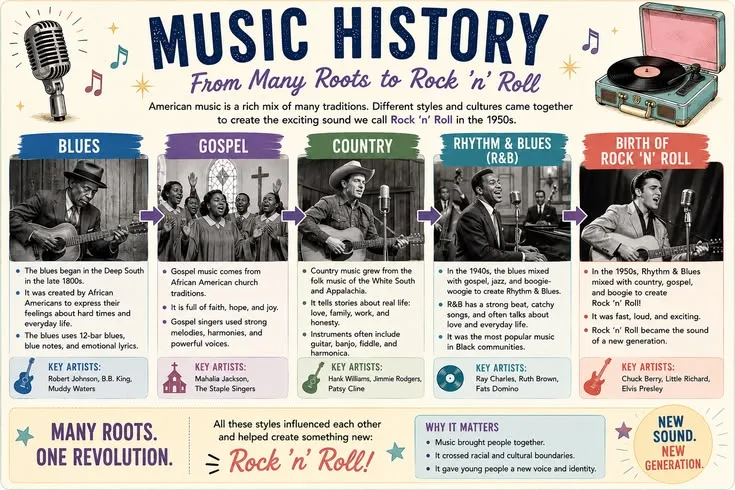
Jazz emerged in New Orleans in the first two decades of the twentieth century from a confluence of African American musical traditions: the blues, ragtime, gospel, and the brass band traditions unique to New Orleans's cultural environment.
Its defining features were improvisation, syncopated rhythm, call-and-response patterns inherited from African musical practice, and a harmonic language inflected with blue notes - flattened thirds and sevenths that resist simple major-or-minor classification.
W.C. Handy's codification of blues form from 1912 onward made the twelve-bar blues structure widely known.
Louis Armstrong's recordings of the 1920s defined hot jazz and established improvised melodic invention as the central value of the music, while his unmatched technical virtuosity and charismatic recordings made him the first jazz musician to achieve genuine international celebrity.
The bebop revolution of the mid-1940s, led by alto saxophonist Charlie Parker and trumpeter Dizzy Gillespie, dramatically raised the harmonic and technical complexity of jazz: accelerating tempos, introducing extended chord substitutions, creating a music explicitly unsuited to dancing.
Bebop was a statement of artistic seriousness and, implicitly, of the dignity of Black musical intellect at a time when American society denied that dignity in almost every other domain.
Miles Davis moved through multiple transformations across his career: the cool jazz of Birth of the Cool (1949), the modal jazz of Kind of Blue (1959) - which remains the best-selling jazz album ever recorded - and the electric fusion experiments of Bitches Brew (1970).
Davis's restless innovation across three decades makes him an embodiment of jazz's core principle: the tradition is defined by its refusal to merely repeat the tradition.
Rock, Soul, and Hip-Hop: Popular Music's Transformations
The Origins of Rock and Roll
Rock and roll emerged in the early 1950s at the intersection of Black rhythm and blues and white country music, a convergence shaped by the geography of American racial segregation and the economics of the recording industry. Little Richard, Chuck Berry, Fats Domino, and Bo Diddley established the sonic template.
Elvis Presley's recordings at Sun Studio in Memphis in 1954 and 1955 brought Black musical styles to white radio audiences on a transformative scale.
The racial dynamics were openly exploitative. Black originators were frequently bypassed commercially while white performers profited from their innovations - a pattern documented by music historians including Nelson George and Greil Marcus.
Chuck Berry's complex guitar figures and narrative lyrical wit were foundational to a genre that made billions for others more than for him.
The Beatles' synthesis of rock and roll, skiffle, and British music hall traditions from 1963 onward redefined global popular music, while Jimi Hendrix extended the electric guitar into sonic territories - feedback, controlled distortion, whammy-bar manipulation - that remain foundational reference points.
Hip-Hop's Specific Origins
Hip-hop emerged at a specific time and place: the South Bronx, New York City, in the summer of 1973. DJ Kool Herc performed at a back-to-school party on August 11, 1973, and began isolating the percussion break sections of funk and soul records, extending them by using two copies of the same record on two turntables.
From this foundational innovation, the culture developed its four recognized elements: DJing, MCing (rapping), breakdancing, and graffiti art.
Sampling - the digital appropriation and recontextualization of existing recordings - became hip-hop's central musical technique and generated decades of legal disputes about copyright.
Scholars including Tricia Rose, in Black Noise (1994), have situated sampling within the longer African American tradition of signifying - creatively responding to and recontextualizing prior texts - giving it cultural depth beyond the question of legality.
World Music and Globalization
The term world music was largely invented as a marketing category in London in 1987, when a group of independent record labels met to discuss how to shelve non-Western music in record shops.
Despite its condescending origin as a catch-all for music from outside the Western mainstream, the category pointed to genuine transformations in global musical circulation.
The Cuban son's transformation into salsa across New York, Puerto Rico, and Colombia; the West African guitar tradition's influence on American blues and its reverse influence as American blues returned to Africa via records; Jamaica's development of ska, rocksteady, and reggae from American R&B filtered through sound system culture: all of these represent globalizing processes predating the world music label.
Afrobeats - the genre centered on Nigerian artists including Fela Kuti's earlier Afrobeat and the later generation of Wizkid, Burna Boy, and Davido - represents the most commercially successful emergence of African popular music into global distribution in the 2020s.
K-pop, South Korean popular music characterized by highly produced sounds, synchronized choreography, and sophisticated fandom management, became a genuinely global phenomenon with the international success of BTS and Blackpink, demonstrating that American or British cultural production no longer defines the global mainstream by default.
The musicologist Kofi Agawu has argued that world music categorization perpetuates a problematic othering of non-Western traditions, treating them as exotic supplements to a Western norm.
Others see the increased global circulation of diverse musical practices as a genuine expansion of musical possibility. The tension between these views reflects the broader unresolved politics of cultural globalization.
The Digital Revolution and Music's Present
Streaming technology has simultaneously democratized access to music from around the world and concentrated revenue in ways that disadvantage most working musicians.
The emergence of platforms including Spotify, Apple Music, and YouTube has shifted the music industry's economic model from ownership (purchasing recordings) to access (subscribing to libraries).
A song that earns a listener one cent per stream requires millions of plays to generate meaningful income for its creator.
Algorithmic curation creates new forms of genre formation and dissolution, as playlists replace albums as the primary listening unit and listeners encounter music decontextualized from its cultural origins.
Generative AI music tools - capable of producing competent imitations of almost any style in seconds - raise new questions about authorship, creativity, and what music is for that earlier technological disruptions only partially anticipated.
Yet music persists in its oldest function. In hospitals, on battlefields, at funerals and weddings, in the intimate space between a parent and an infant, in the coordination of collective labor, human beings continue to organize sound into meaning. The history of music is, in this sense, not a history with an ending.
Frequently Asked Questions
What is the oldest known musical instrument?
The Hohle Fels vulture-bone flute from Germany, dated to approximately 43,000-40,000 years ago, is the oldest confirmed musical instrument. An earlier candidate from Slovenia - the Divje Babe flute, dated to about 60,000 years ago - remains contested.
The existence of instruments this ancient establishes music as a feature of the Upper Paleolithic behavioral revolution, contemporary with cave painting and other complex symbolic behaviors.
How was music transmitted before notation?
For most of human history, music was transmitted entirely through oral tradition and apprenticeship - listening, imitation, and practice. Written music notation began in ancient Mesopotamia with cuneiform symbols but remained limited.
The decisive breakthrough was Guido d'Arezzo's four-line staff system around 1000 CE, which allowed music to be transmitted to singers who had never heard the piece. This made the accumulation of a written repertoire across time and space possible for the first time.
What was the most disruptive moment in Western music history?
Two candidates stand out. Beethoven's late works in the 1820s pushed tonality and form toward their limits.
Schoenberg's abandonment of tonality around 1908 and his twelve-tone method in the 1920s broke the harmonic consensus that had governed Western music for three centuries, creating a rift between avant-garde composition and audiences that persists.
The 1913 Paris premiere of Stravinsky'sRite of Spring provoked a riot - perhaps the most dramatic single performance in music history.
How did jazz change the course of popular music?
Jazz established improvisation as the central value of an art music tradition, democratized virtuosity by making it accessible to self-taught musicians working in oral traditions, and created the harmonic and rhythmic vocabulary from which nearly all subsequent popular music - rhythm and blues, rock and roll, funk, soul, hip-hop - descended.
Jazz also performed the first sustained integration of African and European musical traditions, a synthesis that defines American music as a whole.