
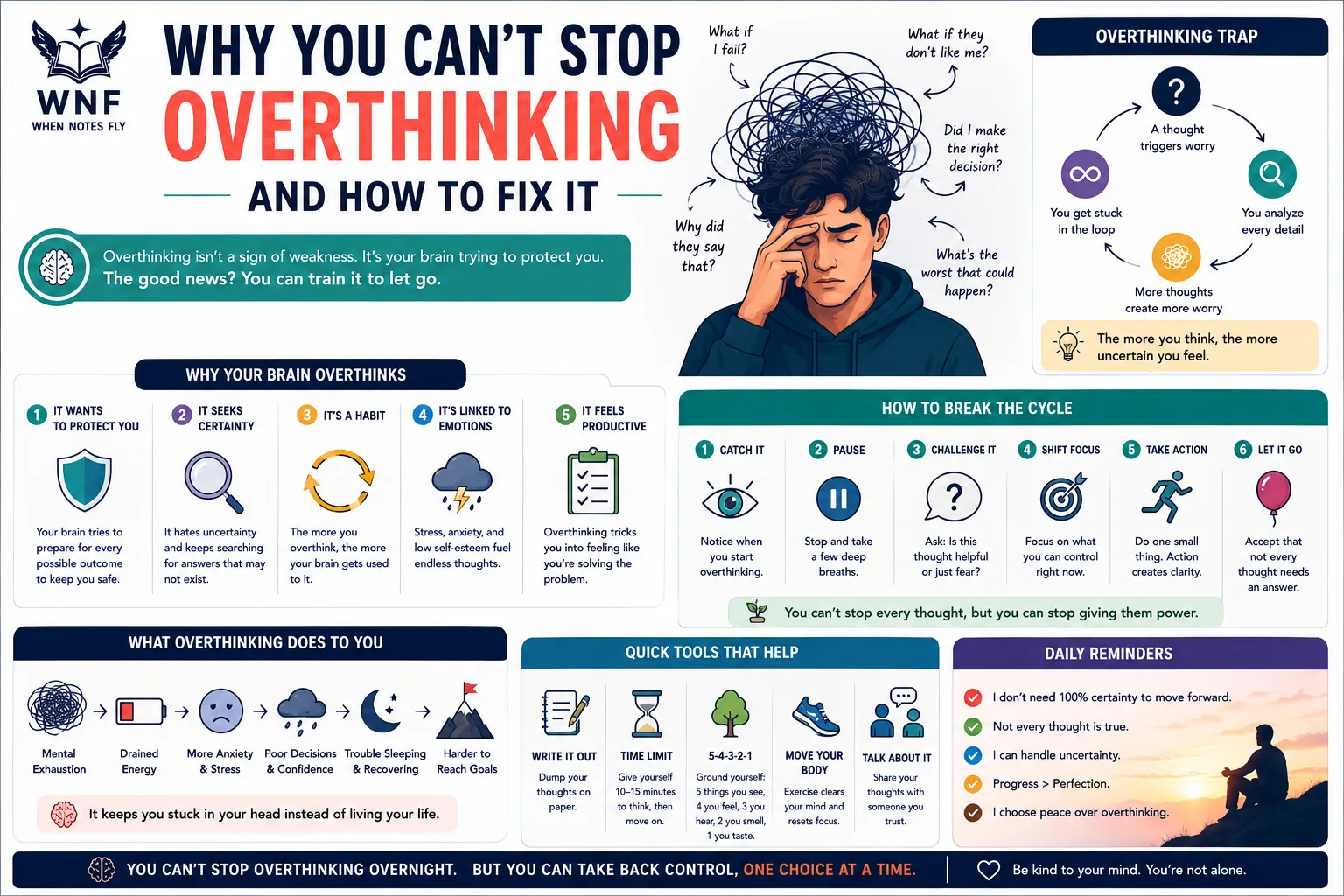
Overthinking and rumination are repetitive, unproductive thought patterns rather than careful reasoning that leads toward a decision or plan. Rumination tends to focus on distress and its causes, while worry is future-focused; both can interfere with action and problem-solving. Helpful responses distinguish the loop from productive thinking and can shift attention through cognitive defusion, evidence gathering, behavioral activation, or a provisional decision.
Overthinking is not the same as thinking carefully. Thinking carefully is a deliberate, goal-directed process that converges on a decision or an understanding. Overthinking is repetitive thought that circles without converging: it is often automatic and difficult to disengage from, and it can consume attention, interfere with problem-solving, and contribute to distress and fatigue.
Most people who describe themselves as overthinkers are not describing a fixed personality trait, but a pattern of thinking with recognisable features, several plausible mechanisms, and interventions with reasonable evidence behind them.
A note on the word itself. Overthinking is an informal umbrella term, not a clinical construct. People use it to describe depressive rumination, generalised worry, obsessive doubt, post-event processing in social anxiety, perfectionistic indecision, trauma-related replay, and ordinary decision paralysis.
These processes overlap, but they are not interchangeable. This article focuses primarily on depressive rumination and worry, the two repetitive-thinking processes with the strongest direct research base.
The dominant term in the clinical research is rumination, defined by Susan Nolen-Hoeksema at Yale in the 1990s as the tendency to passively and repetitively focus on the symptoms of distress and their possible causes and consequences without moving toward solution.[1]
Her research over two decades supports the view that rumination is not neutral: it has been associated with prolonged depressed mood, increased risk of major depressive episodes, impaired problem-solving, and erosion of social support.
This distinction matters because confusing careful thought with overthinking leads people toward responses that can make things worse. Someone who believes they have a thinking problem often tries to think their way out of it: more analysis, more options, more searching for the right framework.
When thought remains repetitive without producing new information or action, continued analysis may become less useful than pausing, gathering evidence, or making a provisional decision. A practical question follows, though it is a WhenNotesFly heuristic rather than a research finding: when you notice the loop, ask whether the thinking is still producing anything new.
Key Definitions
Common differences between productive problem-solving and rumination
These are typical tendencies rather than a validated clinical checklist; some productive thinking lasts months, and rumination can occur in brief episodes.
| Distinction | Productive Thinking | Overthinking |
|---|---|---|
| Direction | Usually forward toward resolution | Often circular around a concern |
| Output | Typically a decision, plan, or understanding | Often no observable output |
| Specificity | Typically concrete and situation-specific | Often abstract and general |
| Termination | Usually ends when the question is answered | Often ends from exhaustion or distraction |
| Response to input | Usually incorporates new information | Often resistant to new information |
Metacognition, thinking about thinking, plays a role throughout: beliefs about thinking can support regulation or help sustain rumination.
What Brain Research Does and Does Not Show
The default mode network, a set of interconnected regions including medial prefrontal cortex, posterior cingulate cortex, and angular gyrus, shows elevated activity during self-referential thinking and mind-wandering than during many external tasks. Rumination has been associated with altered activity and connectivity within this network and its interaction with cognitive-control systems, particularly in depression.
These are group-level associations: a brain scan does not allow a clinician to identify rumination from one individual image.
Two cautions matter here. First, the relationship is not a simple one-network cause; Hamilton and colleagues describe complex interactions involving default-mode, cognitive-control, and salience systems.[6] The default mode network is not the brain's overthinking circuit.
Second, these imaging findings concern people with depression or depressive rumination, and should not be assumed to explain every form of everyday overthinking.
Difficulty disengaging attention from emotionally salient material, together with reduced cognitive control, may contribute to rumination, but this is not an established neurological deficiency in everyone who ruminates, and rumination is not reducible to a single defective inhibitory system.
For practical purposes, one implication does hold: simply commanding yourself to stop is often ineffective, because repetitive thinking can become automatic and emotionally reinforced. Structured attention, behavioral, and metacognitive strategies are generally more useful, and the interventions below were developed through different psychological rationales, not as treatments for one shared neural deficit.
The Difference Between Problem-Solving and Rumination
The subjective experience of rumination often feels like problem-solving: the ruminator feels engaged in cognitive work, turning over the problem from different angles. But Nolen-Hoeksema and colleagues have reported experimentally that briefly induced rumination, compared with briefly induced distraction, impairs subsequent problem-solving on standardised tasks.
Participants asked to focus on their feelings for a short period generated fewer interpersonal solutions, rated lower in effectiveness, and showed more avoidance of active coping than participants asked to distract themselves.
A distinction that holds up well in research is between concrete and abstract processing. Concrete thinking stays specific to the situation: what exactly happened, what specifically might I do next. Abstract thinking moves upward to generalisations: why does this keep happening to me, what does this say about my life.
Edward Watkins has produced a body of research on this distinction, finding that training people to shift from abstract to concrete thinking can reduce depressive symptoms and rumination.[2] The content of the concern can be identical in the two modes; the processing style is what differs.
Abstract thought is not inherently harmful and is essential in science, ethics, and meaning-making; it becomes a problem when repetitive negative thinking remains broad, evaluative, and disconnected from action.
A question to ask when you catch the loop: am I asking something I can act on, or something open-ended. "What should I say to my sister" is answerable. "Why is our family like this" is broad and may sustain an open-ended loop, though family patterns can be explored meaningfully through history, conversation, or therapy.
The Cognitive Defusion Technique
Acceptance and Commitment Therapy, developed primarily by Steven Hayes, takes a specific position on intrusive and repetitive thought: the relationship to the content matters more than the content itself.[3] ACT calls this distinction fusion and defusion. Fusion is taking thoughts as literal truths about reality; defusion is observing thoughts as mental events that may or may not correspond to anything.
A core technique is a verbal shift: instead of "I am not good enough for this," the defused version is "I am having the thought that I am not good enough for this." The content is identical; the relationship has shifted.
ACT, which includes defusion alongside acceptance, values clarification, and committed action, has been studied across several conditions including depression, anxiety, and chronic pain, though the evidence concerns ACT as a package rather than establishing that defusion alone produces broad clinical outcomes in every condition.
Defusion is not thought suppression. Daniel Wegner's white bear studies in the 1980s showed that deliberate thought suppression can produce rebound effects, particularly when people continue monitoring whether the unwanted thought has returned.[4]
Defusion is the opposite move: the thought is allowed to be present but loses its controlling power, which for chronic overthinkers may be more workable than repeatedly trying to force thoughts away.
Scheduled Worry Time
A specific protocol from cognitive behavioral therapy research addresses worry, the future-focused counterpart to rumination. The person sets aside a brief, consistent worry period, often around 15 to 30 minutes depending on the protocol being followed, at the same time each day, and worries on purpose about anything on their mind. Outside the window, when a worry arises, they note it briefly and postpone it to the scheduled window.
Thomas Borkovec developed and tested this stimulus-control approach in research on generalized anxiety disorder.[5] Worry postponement has shown promising effects on daily worry in several studies, although the evidence base is smaller and less definitive than it is sometimes presented, and effects on sleep in particular are less well established than the technique's popularity suggests.
Proposed mechanisms include weakening habitual cue-triggered worry and increasing the person's sense that worry can be delayed and controlled, though the mechanism has not been conclusively established.
Behavioral Activation
Behavioral activation is an established treatment approach for depression, in which people engage in specific goal-directed activities regardless of current mood. It has produced outcomes comparable to cognitive therapy, and in some studies favourable outcomes for severe depression.
Neil Jacobson's influential 1996 component analysis found that the behavioral components performed comparably to the full cognitive-therapy package in that study, though it did not settle every question about the mechanisms of cognitive behavioral therapy.[10]
The relevance to overthinking is that rumination and behavioral withdrawal can reinforce each other: someone who ruminates may stop engaging in activities, which reduces the varied sensory and social input that would otherwise compete with self-referential content, deepening the rumination.
Entering the cycle from the behavioral side, by scheduling and performing activities even when motivation is absent, reduces avoidance and can produce reductions in rumination without direct cognitive intervention. Activities involving movement, sensory engagement, mastery, or social connection can interrupt withdrawal; the most useful activity varies by person, and research does not establish a fixed hierarchy in which one category always outperforms another.
The 5-5-5 Rule and Other Containment Techniques
Several practical techniques in circulation are worth using as in-the-moment containment tools when rumination is active. These are coping exercises, not primary treatments, and the distinction matters.
The 5-5-5 rule prompts a quick three-question check when worry or rumination appears: will this matter in five minutes, will it matter in five months, will it matter in five years. It is a popular perspective-taking exercise, not a clinically validated treatment, and it loosely resembles temporal-distancing strategies studied in emotion-regulation research.
Ethan Kross's work on self-distancing has shown that adopting a distanced or third-person perspective on one's own concerns can reduce emotional reactivity and support more effective problem-solving,[7] but that research is conceptually related to the 5-5-5 rule and not a test of it.
Use the technique to assess proportionality, not to dismiss problems with immediate consequences: a concern may not matter in five years and still require action today, and the exercise can feel dismissive during grief, abuse, financial crisis, or health problems.
The 5-4-3-2-1 exercise is a commonly used grounding technique that redirects attention to current sensory input: five things you see, four you feel, three you hear, two you smell, one you taste. Sensory attention may temporarily compete with self-focused repetitive thought, though people can notice sensory details while still ruminating.
Affect-labeling research suggests that putting feelings into words can alter emotional responses. In one imaging study, labeling emotional states was associated with reduced amygdala activity and greater prefrontal activity,[11] though the practical effect varies by person, and reduced activation in a scan is not a guaranteed reduction in felt intensity.
Mindfulness and Metacognitive Therapy
Metacognitive therapy was developed specifically to target rumination and worry.[8] The theory holds that what maintains these processes is not the content of thoughts but the beliefs the person holds about thinking itself: positive metabeliefs (thinking about this will help me solve it) and negative metabeliefs (I cannot control my thinking) can both sustain the process, and MCT targets these beliefs directly.
Trials of MCT have reported promising results across several disorders, though the size and maturity of the evidence base vary by condition.
Mindfulness-based cognitive therapy takes a related approach, teaching an observer stance toward thought similar in spirit to ACT defusion.[9]
In people with recurrent depression, MBCT can reduce relapse risk and has performed comparably to maintenance antidepressant strategies in some trials, though those comparisons depend on study design and other factors, and this does not mean mindfulness is generally equivalent to medication for acute depression.
For everyday overthinkers without a clinical presentation, regular mindfulness practice may modestly reduce repetitive negative thinking in some non-clinical populations, although effects vary and brief exercises are not a guaranteed treatment. Mindfulness is generally considered low risk, but it can be uncomfortable or destabilising for some people, particularly during intensive practice or in the presence of trauma-related symptoms.
When Repetitive Thinking May Reflect a Condition
Repetitive thinking appears across depression, generalized anxiety disorder, obsessive-compulsive disorder, trauma-related conditions, social anxiety, insomnia, and grief. It is worth being cautious about self-diagnosis, because the content and pattern of the thoughts alone do not reliably identify the underlying condition.
Repetitive thinking is not a diagnostic criterion for ADHD, and overthinking is not a recognised core ADHD symptom. ADHD diagnosis requires a persistent pattern of inattention and/or hyperactivity-impulsivity that begins in development and causes impairment across settings, not merely racing or sticky thoughts.
ADHD may contribute indirectly to repetitive thinking through distractibility, difficulty shifting attention, emotional dysregulation, or co-occurring anxiety, but profiles vary substantially and a single cognitive-deficit description cannot diagnose the condition.
It is tempting to sort people by the shape of their thoughts, with anxiety producing narrow worry about one feared outcome and ADHD producing diffuse topic-jumping. That is not an accepted diagnostic distinction: anxiety can involve many shifting worries, and people with ADHD can ruminate persistently on a single rejection, mistake, or conflict.
Treatment planning follows assessment rather than thought content. For anxiety, evidence-based care may include cognitive behavioral therapy, applied relaxation, metacognitive approaches, acceptance-based treatments, and medication, depending on symptoms and clinical judgment.
For ADHD, effective treatment may improve attention regulation, but repetitive negative thinking may require separate assessment, particularly when anxiety or depression is also present. A persistent pattern of overthinking that has not responded to self-help is worth discussing with a clinician, since many people have more than one contributing pattern.
A Practical Daily Plan (WhenNotesFly Synthesis)
The following is a WhenNotesFly practical synthesis based on several evidence-informed strategies. The complete routine has not been evaluated as a single clinical protocol, and the specific timings below are practical suggestions rather than research findings. Treat it as a starting structure to adapt, not a validated prescription.
Morning: Some benefit from a planned activity, such as walking or reading on paper, before opening stimulating digital feeds. Work blocks: Use focused periods with defined goals; structured tasks reduce unbounded thinking for some, though rumination that continues during work may need dedicated treatment rather than a scheduling tweak. Note mid-work worries briefly and return to the task.
Scheduled worry window: A brief, consistent daily period for whatever has been on your mind, on paper or digitally; neither has been shown superior. Evening: Set a cutoff for work-related thinking; physical activity, social interaction, and reading fiction can all help some people disengage.
Sleep: Protect it, since deprivation worsens mood and makes disengaging from repetitive thought harder; keep consistent hours and reduce stimulating screen activity before bed when it interferes with sleep. Journaling: Use brief, structured prompts focused on facts and next steps; repetitively documenting the same distress without structure can intensify rumination, so stop if that happens.
When to Seek Help
If you are in immediate danger: anyone at immediate risk of self-harm, or unable to remain safe, should contact local emergency services or an appropriate crisis service in their country straight away. That is a different situation from the routine evaluation described below, and it should not wait.
Rumination that persists despite consistent application of behavioral and cognitive strategies for several weeks, or that occurs alongside persistent low mood, substantial sleep disruption, thoughts of suicide, or significant impairment in functioning, warrants clinical evaluation. Depression and anxiety are treatable conditions, and rumination is often a symptom that responds to treatment of the underlying condition more efficiently than to overthinking-targeted self-help alone.
The line between a habit of overthinking and a clinical condition is a continuum rather than a sharp boundary, and access and cost vary considerably depending on location, insurance, and available services.
Practical Implications
For individuals: Treat overthinking as a pattern with specific interventions rather than a fixed personality trait. Distinguish productive from unproductive thinking by asking whether you are moving toward an answer or an action, and use defusion and scheduled worry windows rather than attempting to suppress thoughts directly.
For partners and family: Avoid repeatedly debating the same feared scenario or offering endless certainty, which can settle into a cycle without resolving anything. Acknowledge the distress, ask what kind of support is actually wanted, and encourage a shift toward coping or professional help when the same reassurance cycle repeats; a distressed person may genuinely need empathy or practical help, and mechanically refusing reassurance can feel punitive.
For therapeutic discussions: The distinction between rumination and reflection is often obscured by the experience of overthinking as thoughtful; explicit psychoeducation about the difference can improve engagement with behavioral strategies.
This article is educational and does not provide diagnosis or treatment. It is written and edited by the WhenNotesFly editorial team and has not been reviewed by a licensed clinician. For personal medical or mental-health advice, consult a qualified professional.
See also: Are Human Attention Spans Really Shrinking? | Behavioral Economics Explained | Why Social Comparison Makes Us Miserable
Sources & Further Reading
- Nolen-Hoeksema, S., Wisco, B. E., & Lyubomirsky, S. (2008). "Rethinking Rumination." Perspectives on Psychological Science, 3(5), 400-424. DOI: 10.1111/j.1745-6924.2008.00088.x
- Watkins, E. R. (2008). "Constructive and Unconstructive Repetitive Thought." Psychological Bulletin, 134(2), 163-206. DOI: 10.1037/0033-2909.134.2.163
- Hayes, S. C., Luoma, J. B., Bond, F. W., Masuda, A., & Lillis, J. (2006). "Acceptance and Commitment Therapy: Model, Processes and Outcomes." Behaviour Research and Therapy, 44(1), 1-25. DOI: 10.1016/j.brat.2005.06.006
- Wegner, D. M., Schneider, D. J., Carter, S. R., & White, T. L. (1987). "Paradoxical Effects of Thought Suppression." Journal of Personality and Social Psychology, 53(1), 5-13. DOI: 10.1037/0022-3514.53.1.5
- Borkovec, T. D., Wilkinson, L., Folensbee, R., & Lerman, C. (1983). "Stimulus Control Applications to the Treatment of Worry." Behaviour Research and Therapy, 21(3), 247-251. DOI: 10.1016/0005-7967(83)90206-1
- Hamilton, J. P., Farmer, M., Fogelman, P., & Gotlib, I. H. (2015). "Depressive Rumination, the Default-Mode Network, and the Dark Matter of Clinical Neuroscience." Biological Psychiatry, 78(4), 224-230. DOI: 10.1016/j.biopsych.2015.02.020
- Kross, E., & Ayduk, O. (2011). "Making Meaning out of Negative Experiences by Self-Distancing." Current Directions in Psychological Science, 20(3), 187-191. DOI: 10.1177/0963721411408883
- Wells, A. (2009). Metacognitive Therapy for Anxiety and Depression. Guilford Press.
- Segal, Z. V., Williams, J. M. G., & Teasdale, J. D. (2018). Mindfulness-Based Cognitive Therapy for Depression (2nd ed.). Guilford Press.
- Jacobson, N. S., Dobson, K. S., Truax, P. A., Addis, M. E., Koerner, K., Gollan, J. K., Gortner, E., & Prince, S. E. (1996). "A Component Analysis of Cognitive-Behavioral Treatment for Depression." Journal of Consulting and Clinical Psychology, 64(2), 295-304. DOI: 10.1037/0022-006X.64.2.295
- Lieberman, M. D., Eisenberger, N. I., Crockett, M. J., Tom, S. M., Pfeifer, J. H., & Way, B. M. (2007). "Putting Feelings into Words." Psychological Science, 18(5), 421-428. DOI: 10.1111/j.1467-9280.2007.01916.x