
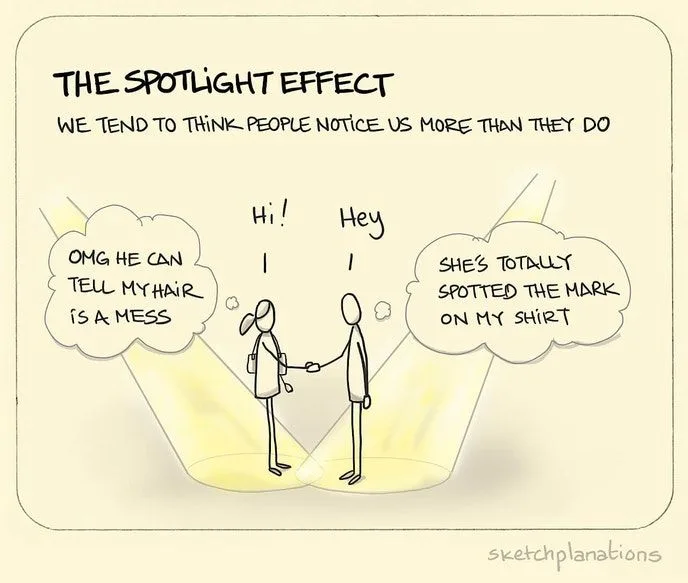
Understanding the spotlight effect means recognizing that other people usually notice and remember less about one's appearance, behavior, and mistakes than one expects. Self-awareness anchors estimates of others' attention, making personal events feel unusually visible and enduring. Research finds this overestimation applies to embarrassing and flattering features alike, and is related to the illusion that inner feelings are more transparent than they are.
Picture this: you walk into a meeting room five minutes late. Everyone is already seated. You feel every head turn. You are certain that every person in the room is registering your tardiness, clocking your appearance, forming a judgment.
The sensation is vivid and uncomfortable, as if a physical spotlight is following you across the room.
Now consider: the people already seated in that room were, ten seconds before you walked in, absorbed in their own thoughts. Their own upcoming presentations. Their own concerns about how they appear. Their own mild anxiety about the day.
When you entered, they glanced at the door briefly and automatically, then returned to their own internal worlds.
The gap between what you felt and what actually happened is the spotlight effect.
What the Spotlight Effect Is
The spotlight effect is the cognitive bias by which people overestimate how much others notice, observe, and judge their appearance, behavior, and mistakes.
The term was formally named and documented by Thomas Gilovich, Victoria Husted Medvec, and Kenneth Savitsky in a landmark paper published in the Journal of Personality and Social Psychology in 2000.
The effect does not mean that others never notice you. It means that the subjective sense of visibility (the feeling that your behavior and appearance are under scrutiny) substantially exceeds the actual level of observation.
The mechanism is straightforward: because you are intensely aware of your own state, your focus has a tendency to anchor estimates of others' awareness. You have access to your internal experience in vivid detail; you have no direct access to the experience of others.
When you imagine what others are seeing and thinking, you unconsciously reason from your own state outward, and because your own state is salient and significant to you, you overestimate its salience to others.
The spotlight effect belongs to a broader family of egocentric biases: systematic ways in which self-focused information distorts judgments about the social world. These biases are not signs of narcissism; they are features of a cognitive system that necessarily takes one's own experience as its default vantage point.
Understanding the spotlight effect requires understanding why the brain is organized this way and what corrections it systematically fails to make.
The Research: Gilovich, Medvec, and Savitsky (2000)
The Barry Manilow Experiment
The most cited study in the original 2000 paper is the T-shirt experiment. Cornell University undergraduate participants were asked to wear a T-shirt bearing an image chosen for its embarrassment potential (a photograph of Barry Manilow, a figure associated with a particular kind of uncool in late-1990s student culture) and to enter a room where other students were completing questionnaires.
Before entering the room, each participant estimated how many of the other students would notice and remember the T-shirt. The median estimate was approximately 50 percent.
After the participant entered, spent a brief period in the room, and exited, the researchers asked the students who had been in the room whether they could identify what the participant had been wearing. The actual recognition rate was 23 percent, less than half the predicted rate.
The participant had walked in feeling conspicuous. They had walked out having been, by most people's accounts, unremarkable. The spotlight they felt so intensely was largely imaginary.
The Good Performance Condition
The spotlight effect is not limited to embarrassing situations. In a parallel condition, participants wore T-shirts bearing the faces of admired figures: Bob Marley, Martin Luther King Jr. The same basic result held: participants estimated that far more people would notice and remember the shirt than actually did.
The effect is not specifically about embarrassment; it is about the general overestimation of one's own visibility. Whether you think your appearance makes you look bad or good, you overestimate how much others are paying attention.
This symmetry is important. It rules out explanations based on anxiety about negative evaluation alone. The spotlight effect is not merely a fear of judgment: it is a systematic overestimation of personal salience that applies equally when we expect others to be impressed as when we fear they will be critical.
Temporal Dimensions: The Lingering Spotlight
Gilovich and colleagues also investigated how long people believe others will notice them. A follow-up study asked participants how long observers would remember a conspicuous behavior or appearance feature. Participants consistently overestimated the duration of others' awareness, not just its initial intensity.
This temporal dimension has particular relevance for social anxiety. The worry that others will remember your stumbling answer in a meeting, your anxious expression during a presentation, or your awkward comment at a party is sustained partly by the false belief that others' memories are as tenacious as your own.
Research on observer memory suggests that in fact, people's memories for others' social behavior are much weaker and less detailed than their own first-person memories of the same events.
Replication and Generalization
The original findings have been replicated in various forms across different populations and situations. Research has found spotlight effects in contexts including:
- Social performance in group settings
- Physical appearance and clothing
- Making mistakes or social blunders in public
- Good behavior (generosity, skill demonstrations)
- Emotional expression in social settings
- Online and virtual social environments (Zhao and colleagues, 2016)
The pattern is consistent: subjective visibility significantly exceeds objective noticeability.
The Illusion of Transparency
The illusion of transparency is a closely related phenomenon documented in the same research program. Where the spotlight effect concerns what others see, the illusion of transparency concerns what others detect, specifically the overestimation of how visible one's internal states are.
When people feel anxious, nervous, embarrassed, or guilty, they tend to believe that these states are clearly visible to observers. They are not, nearly as much as the person experiencing them believes.
Gilovich, Savitsky, and Medvec (1998) demonstrated this with a "lie detection" study in which some participants answered questions truthfully while others lied.
The liars predicted that they would be detected at far higher rates than they actually were: observers could not tell who was lying much above chance levels, even though the liars felt their deception was obvious.
In a public speaking context: people presenting to audiences typically predict their nervousness will be clearly visible. Post-presentation evaluations by observers typically show far lower ratings of visible nervousness than the speaker anticipated.
The physical sensations of anxiety (racing heart, dry mouth, trembling hands) are dramatically more salient to the person experiencing them than to the audience watching.
"We are the center of our own worlds. The challenge is remembering that we are not the center of anyone else's.", Thomas Gilovich, How We Know What Isn't So (1991)
The illusion of transparency has been documented in several specific emotional domains beyond lying and anxiety. Individuals who are angry but attempting to conceal it typically predict that observers can detect their anger; observers cannot, at rates much above chance.
People who are disgusted, scared, or embarrassed show similar patterns. The general principle is that the subjective intensity of an emotional state predicts how detectable the person believes it to be, but this subjective intensity is largely inaccessible to outside observers.
Why the Brain Creates This Illusion
The spotlight effect is, at its root, an anchoring and adjustment error. The starting anchor for estimating others' awareness of you is your own intense, privileged access to your own behavior and appearance.
You then adjust downward to account for the fact that others do not share your perspective, but you do not adjust far enough. The initial anchor is too powerful.
Several cognitive and motivational factors amplify this:
Egocentrism as a Default
Human cognition defaults to an egocentric perspective. This is not vanity; it is an unavoidable feature of inhabiting a single body with a single vantage point.
The research on perspective-taking consistently shows that adjusting from one's own perspective to another's is effortful and imperfect. Errors tend toward the egocentric baseline.
Adam Galinsky and colleagues' research on perspective-taking (2006) found that people consistently anchor on their own knowledge, emotional state, and perceptual experience when making judgments about others, and that adjustments away from this anchor are systematically insufficient, a pattern Epley and Caruso (2008) described as "insufficient adjustment from an egocentric anchor" across a wide range of social judgments.
The Availability of Self-Focused Information
Your appearance, your behavior, your mistakes, your intentions: all are immediately and continuously available to your awareness. Other people's awareness of you is not available to you at all without direct evidence.
In the absence of evidence, people fill the gap with their own experience as a proxy, and that proxy overstates others' observation.
This information asymmetry is what makes the spotlight effect so persistent. Every data point you have about the salience of your behavior comes from your own experience of it. There is no direct counter-evidence available in the moment: no signal telling you that the person across the room is not thinking about your late arrival.
The correction requires inferring the absence of a mental state, which is cognitively much harder than inferring the presence of one.
Social Salience of Self-Relevant Events
Events that are personally significant feel significant full stop. When you spill coffee on yourself before an important meeting, the event is highly salient to you. You carry awareness of the stain through the rest of the day.
The people you interact with, lacking any particular reason for the stain to be salient, likely forgot about it in moments.
Nicholas Epley and Thomas Gilovich (2004) described this as the differential salience account of egocentric biases: self-relevant events have privileged cognitive access and persistence in memory for the person experiencing them, but are processed as ordinary perceptual events by observers who lack the motivational and contextual investment to encode them deeply.
Failure to Account for Others' Preoccupations
When estimating others' awareness, people tend to model themselves as the object of attention without fully modeling what else might be competing for that attention.
In reality, the people around you are also the centers of their own worlds, also preoccupied with their own appearance and performance, also engaged in their own internal monologues. The mental bandwidth available for sustained observation of others is genuinely limited.
Research on inattentional blindness (the failure to notice unexpected but clearly visible stimuli when attention is focused on another task) illustrates how selective human attention actually is.
Simons and Chabris's famous 1999 experiment showing that participants missed a person in a gorilla suit walking through a visual scene while counting basketball passes is one of the most dramatic demonstrations of how little we notice when attention is engaged elsewhere.
Most social interactions involve substantial competing demands on attention; the belief that observers are focused on you requires imagining that they have suspended their own concerns entirely.
Social Anxiety and the Spotlight Effect
Social anxiety disorder is characterized by a persistent, intense fear of scrutiny and negative evaluation in social situations. The spotlight effect and illusion of transparency are not merely interesting cognitive quirks in the context of social anxiety: they are core maintaining mechanisms.
Research by Clark and Wells (1995) and subsequent work in cognitive models of social anxiety has identified several spotlight-effect-adjacent processes central to how social anxiety is maintained:
- Self-focused attention: In social situations, anxious individuals direct attention toward themselves (monitoring their performance, symptoms, and appearance) rather than toward the external social environment.
- The safety behavior trap: Because anxious individuals assume they are visibly incompetent or distressed, they engage in safety behaviors (avoiding eye contact, rehearsing sentences before speaking, staying at the periphery of groups) that paradoxically increase self-focus and maintain the false belief that external performance is poor without the safety behaviors.
- Post-event processing: After social events, anxious individuals systematically review their performance with a negative bias, reinforcing the belief that they were observed and judged poorly.
Clark and Wells' (1995) model proposed that social anxiety is maintained by a cycle of self-focused attention and safety behaviors that prevents disconfirmation of feared beliefs.
When anxious individuals avoid situations or engage in protective strategies, they never discover that their feared outcomes (being visibly incompetent, causing offense, being rejected) would not actually occur, or occur far less severely than expected.
Cognitive behavioral therapy (CBT) for social anxiety directly targets these distorted estimates. Behavioral experiments ask clients to predict, in specific quantitative terms, how many people will notice a specific behavior, what they will think, and how long they will think about it, then go test the prediction.
Repeated experience of disconfirmed predictions (fewer people notice, the social consequences are less severe, the duration of others' attention is briefer) gradually calibrates the model toward accuracy.
A 2015 meta-analysis by Mayo-Wilson and colleagues in Psychological Medicine found that CBT produced significantly greater improvements in social anxiety than control conditions, with large effect sizes.
The behavioral experiment component, which directly targets spotlight-effect overestimates, is among the most important active ingredients in these treatments.
Distinguishing Social Anxiety from Introversion
It is worth noting that the spotlight effect is not the same as introversion. Introversion refers to a preference for less stimulating social environments and a tendency to recharge through solitude; it is not primarily characterized by the fear of social scrutiny.
Many introverts are not socially anxious, and many extroverts suffer from significant social anxiety despite their social confidence in other respects.
The spotlight effect, and the anxiety it can produce, is also distinct from shyness: a temperamental wariness in novel social situations that diminishes with familiarity. Shyness is more state-dependent; clinical social anxiety persists across a wide range of situations regardless of familiarity.
Practical Implications
For Everyday Social Anxiety
Simply knowing about the spotlight effect can provide modest relief. When you feel the subjective intensity of social self-consciousness, having a framework that says "this feeling is a systematic cognitive error, not accurate information about reality" can interrupt automatic catastrophizing.
But awareness is insufficient on its own. The more effective intervention is behavioral testing: intentionally putting yourself in situations that trigger spotlight-effect-driven anxiety, making a specific prediction about how others will respond, and observing what actually happens.
The gap between prediction and outcome, experienced repeatedly, is what recalibrates the underlying cognitive model.
Research by Thorpe and Salkovskis (1995) and later expanded by Clark and colleagues found that awareness of biases alone produces minimal long-term change; it is the behavioral disconfirmation, directly experiencing that the feared outcomes do not occur, that produces lasting shifts in both beliefs and anxiety levels.
For Public Speaking
The illusion of transparency is particularly relevant to public speakers. The near-universal experience among novice public speakers is the belief that their nervousness is visible and that the audience is registering and judging it.
Research and the practical experience of communication coaches consistently show that this is false: audiences cannot detect most of the physiological anxiety a speaker experiences, and what they can detect is judged far more charitably than the speaker anticipates.
A study by Savitsky and Gilovich (2003) directly tested speaker-audience discrepancy in nervousness ratings. Speakers who had delivered a speech rated their own performance as significantly more anxious-seeming than did audience members who watched the same speech.
Critically, when speakers were told in advance about the illusion of transparency, their self-ratings remained high but their performance actually improved, consistent with the interpretation that the attempt to hide non-visible anxiety creates its own performance costs.
The practical implication: the effort that nervous speakers put into hiding their nervousness (slowing down deliberately, avoiding pauses, over-preparing every transition) is largely unnecessary. The audience is not nearly as attuned to the speaker's internal state as the speaker believes.
For Performance and Mistakes
The spotlight effect means that most social blunders are less memorable and less damaging than they feel at the time.
Research on the fading affect bias (the finding that negative emotions associated with personal memories fade faster than positive ones) compounds this: not only does the audience notice less than you think, they forget faster than you think as well.
This is not an argument for carelessness. Genuine mistakes with real consequences deserve genuine accountability. But the pervasive human tendency to dwell on social missteps, replaying them with embarrassment for days or weeks afterward, is sustained by a model of others' awareness that the evidence does not support.
The spotlight effect and rumination interact in a particularly costly way: the more you replay a social blunder in your own mind, the more salient it feels, and the more you overestimate its salience to others, driving more rumination in a self-sustaining cycle.
Breaking the cycle requires challenging the underlying estimate: testing whether others actually noticed and remembered what feels so vividly memorable to you.
The Spotlight Effect in Context: Limits and Nuances
The Effect Varies With Salience
The spotlight effect is strongest when the stimulus is mildly salient: visible but not dramatically unusual. If you walk into a room wearing formal evening wear when everyone else is in casual clothes, you will genuinely be noticed more than the spotlight effect suggests people typically are.
The effect operates in the zone of normal social variation; it does not apply equally to extreme situations.
Gilovich and colleagues noted this boundary condition in their original studies. The overestimation of noticeability was largest for moderately embarrassing or unusual stimuli.
For stimuli that were genuinely conspicuous, people's estimates were more accurate, because in those cases, observer attention genuinely was elevated, and there was less gap between felt and actual visibility.
Status and Hierarchy Matter
Research suggests that people with higher social status in a group (leaders, celebrities, people who are explicitly central to a situation) are genuinely attended to more than others. In those situations, the "spotlight" is real.
The effect overestimates noticeability for ordinary people in ordinary situations; it does not mean that genuinely central figures are not observed.
This nuance matters for public figures, executives, and others who are genuinely subject to heightened scrutiny. For most people in most situations, the spotlight effect applies, but in high-visibility roles, the fear of scrutiny may be calibrated more accurately to reality.
Cultural Variation
Some research suggests cross-cultural variation in self-focused attention and social monitoring.
Cultures with higher collectivism or stronger face concerns (the importance attached to maintaining public social standing) may show different patterns of social self-consciousness, though the basic asymmetry between felt and actual visibility has been documented in multiple cultural contexts.
A 2012 study by Heine and colleagues comparing spotlight effect magnitude in North American and Japanese samples found that while the basic effect appeared in both groups, Japanese participants showed somewhat greater sensitivity to social observation, consistent with cultural differences in independent versus interdependent self-construal, and with the greater face concerns documented in collectivist cultures.
What the Research Tells Us
After more than two decades of research following the original Gilovich et al. paper, several conclusions are robust:
- People systematically overestimate how much others notice and remember their appearance and behavior in social situations.
- People systematically overestimate how visible their internal states (anxiety, embarrassment, deception) are to observers.
- The mechanism involves anchoring on one's own salient self-focused information and insufficient adjustment.
- The effect is not limited to embarrassment but extends to neutral and positive self-relevant content.
- Social anxiety amplifies and is maintained by spotlight-effect-related overestimates.
- Behavioral testing (making predictions and checking them against reality) is more effective than awareness alone in recalibrating the overestimates.
| Spotlight effect finding | Research evidence |
|---|---|
| Overestimation of T-shirt noticeability | Gilovich, Medvec & Savitsky (2000) |
| Overestimation of lie detectability | Gilovich, Savitsky & Medvec (1998) |
| Overestimation of visible nervousness in speakers | Savitsky & Gilovich (2003) |
| Role in social anxiety maintenance | Clark & Wells (1995), numerous replications |
| Temporal overestimation (others remember longer) | Gilovich et al. (2000) follow-up studies |
| Cross-cultural presence with variation | Heine et al. (2012); documented in multiple samples |
| Inattentional blindness as mechanism | Simons & Chabris (1999) and related work |
The spotlight effect is a reminder that the social world, as we experience it from inside, is importantly different from the social world as it actually is. Other people are not watching you as closely as you feel. They are not registering your stumbles as carefully as you do.
They do not remember your awkward moments as long as you replay them. They are too busy being the star of their own show, subject to the same overestimates about their own visibility that you are carrying about yours.
The insight is not just psychologically interesting. For the millions of people whose social anxiety, fear of judgment, or reluctance to take risks is sustained by an inaccurate model of how closely they are observed, recalibrating that model, through knowledge and through behavioral experience, may be one of the most practically valuable shifts in self-understanding available.