
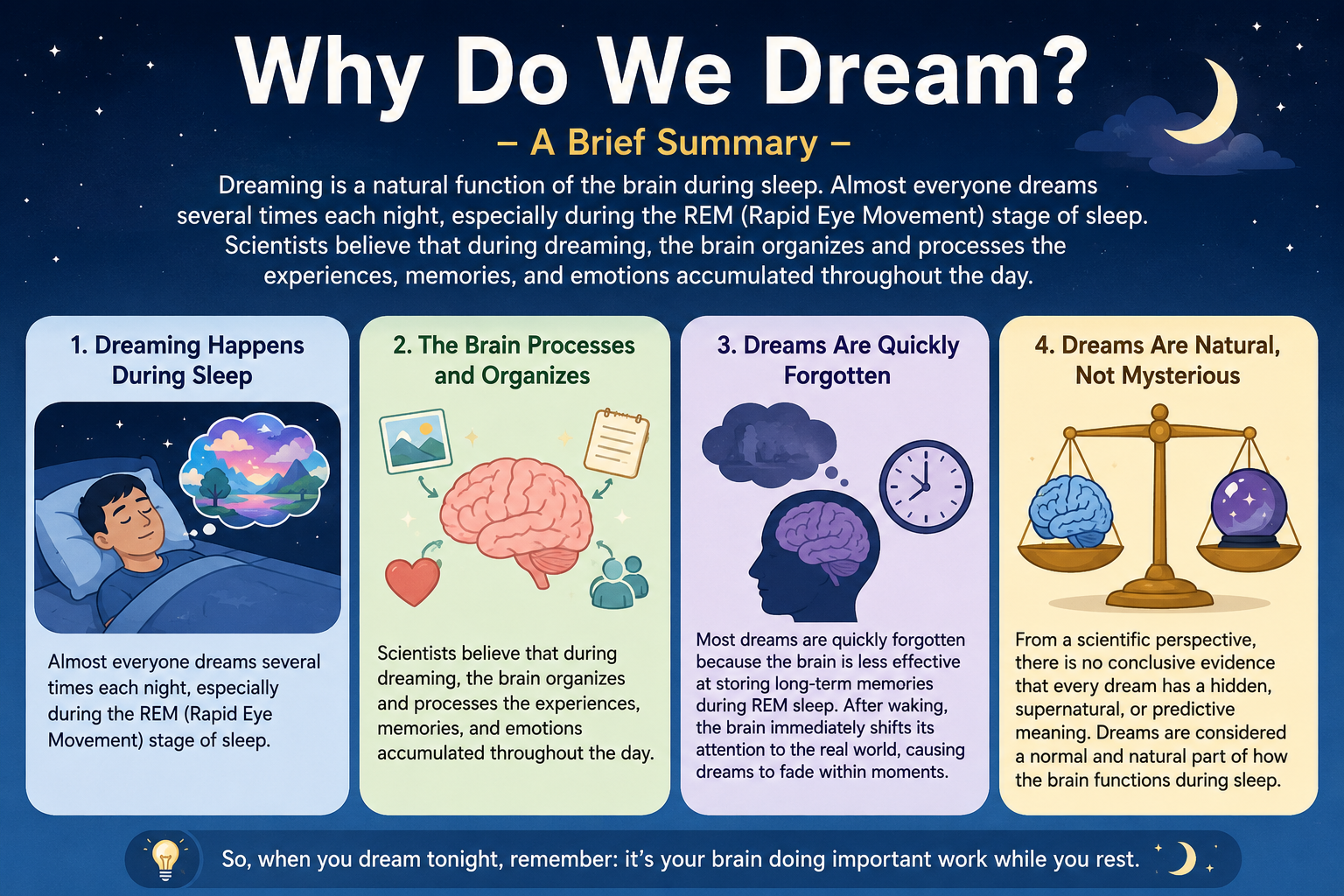
Dream: Every night, for roughly two hours, your brain constructs an experience indistinguishable from waking life.
You walk through places that don't exist, speak to people who have been dead for decades, flee from threats that evaporate the moment you wake, and sometimes - in one of the stranger experiences of human consciousness - become aware that you are inside a dream and begin to direct it.
Dreaming is universal. Every human culture across recorded history has dreamed, documented their dreams, sought meaning in them, and developed elaborate theories about their purpose. Ancient Egyptians recorded dreams in hieroglyphics and consulted dream interpreters as advisors.
The Talmud devotes more than 60 passages to dreams. Aristotle wrote a treatise on them. Freud built a career and a school of psychology on their interpretation.[8]
What modern neuroscience has discovered is that all of these traditions were built on something real but may have been interpreting it incorrectly. Dreams are not random, but they are not symbolic messages from the unconscious either.
They are a product of a specific brain state - one that we now understand in considerable depth - and current science offers several competing theories about what evolutionary and cognitive function they serve.
"In dreams we are not mere spectators. We are architects of an alternative reality constructed from the materials of memory, emotion, and imagination - and the brain doing the constructing is simultaneously the subject of the experience." - Matthew Walker, Why We Sleep (2017)[4]
Key Definitions
Dream - A sequence of images, sensations, emotions, and narratives experienced during sleep, particularly during REM sleep.
Dreams feel vivid and real during the experience but typically lack the logical consistency of waking thought: locations shift, narrative continuity is unstable, and impossible events feel normal. Most dreams are forgotten immediately after waking.
REM sleep (Rapid Eye Movement sleep) - A sleep stage characterized by rapid movement of the eyes under the lids, muscle atonia (paralysis of voluntary muscles), and brain electrical activity resembling wakefulness. Most vivid dreaming occurs during REM sleep.
REM sleep occurs in cycles throughout the night, with cycles of approximately 90 minutes; REM periods grow longer in later cycles, with the most intense dreaming occurring in the early morning hours.
| Theory of Dreams | Main Proponent | Core Claim | Evidence Level |
|---|---|---|---|
| Memory consolidation | Matthew Walker, Robert Stickgold | REM sleep processes and consolidates emotional memories | Strong neuroscientific evidence |
| Threat simulation | Antti Revonsuo | Dreams evolved to simulate threats for rehearsal | Moderate; consistent with content analysis |
| Emotional regulation | Rosalind Cartwright | Dreams help process difficult emotions and experiences | Moderate; depression-dream correlation research |
| Psychoanalytic wish fulfillment | Sigmund Freud | Dreams are disguised expressions of unconscious wishes | Not empirically supported; largely abandoned |
| Random activation (activation-synthesis) | Hobson & McCarley | Dreams are the brain making sense of random neural firing | Accounts for bizarreness; insufficient for content patterns |
NREM sleep (Non-REM sleep) - The three stages of sleep outside REM, progressing from light sleep (N1, N2) to deep slow-wave sleep (N3). NREM sleep is associated with physical restoration, immune function, and certain types of memory consolidation.
Dreaming does occur in NREM sleep but is typically less vivid, narrative, and emotionally intense than REM dreaming.
Sleep architecture - The structure of a night's sleep: the sequence and proportion of sleep stages. A typical night contains 4-6 cycles of 90 minutes each, with early cycles dominated by slow-wave NREM sleep and later cycles dominated by REM sleep. This means most vivid dreaming occurs in the final hours before waking.
Activation-synthesis theory - The theory proposed by Allan Hobson and Robert McCarley (1977) that dreams are the cortex's attempt to make sense of random neural activity during REM sleep.[1]
The brainstem randomly activates the cortex; the cortex, following its usual function of constructing coherent narratives, interprets these signals into a story. Dreams are by-products of neural housekeeping, not psychologically meaningful communications.
Memory consolidation theory - The theory that sleep, including dreaming, plays a crucial role in consolidating memories from short-term to long-term storage and in integrating new experiences with existing knowledge.
Evidence includes studies showing that sleep after learning improves retention, and that dream content often reflects recent experiences and problems. Matthew Walker and Robert Stickgold are leading proponents.
Threat simulation theory - Proposed by Finnish psychologist Antti Revonsuo, this theory argues that the function of dreaming is to simulate threatening situations - essentially practicing responses to dangers in a safe environment.[2]
Supporting evidence: threatening events are overrepresented in dreams compared to waking life; dreams tend to involve more negative emotions than positive; the simulation includes motor responses that are only blocked from execution by REM atonia.
Emotional processing theory - The theory that dreaming allows the brain to process and integrate emotionally charged experiences in a state where stress hormones (particularly norepinephrine) are reduced.
REM sleep decreases norepinephrine levels, allowing emotional memories to be reactivated and processed without the distress that waking reactivation would cause. Proposed by Rosalind Cartwright and developed by Matthew Walker.
Continuity hypothesis - The empirically supported observation that dream content tends to reflect waking concerns, preoccupations, and experiences - the "day residue" phenomenon. Dreams are not random or purely symbolic; they tend to incorporate recent events, ongoing worries, and significant relationships.
People who are anxious dream about anxiety-provoking scenarios; people going through breakups dream about their former partners; students dream about exams.
Lucid dreaming - Dreaming while being aware that you are dreaming. Lucid dreamers can often exert varying degrees of control over dream content.
EEG studies confirm lucid dreams occur during REM sleep and show distinctive gamma-wave activity in the frontal cortex, consistent with the return of self-reflective awareness. Experienced by approximately 50-80% of people at least once; regularly experienced by about 11%.
Sleep paralysis - The phenomenon of waking from REM sleep while the REM muscle atonia persists, rendering the person unable to move while still partially conscious. Often accompanied by hypnagogic hallucinations - vivid, often threatening perceptual experiences.
Sleep paralysis is thought to be the basis for many historical reports of supernatural visitations (the "old hag" phenomenon, alien abductions, incubus/succubus experiences).
What Happens in the Brain During Dreaming
The Neural State of REM Sleep
During REM sleep, the brain is active in a distinctive, asymmetric way. Understanding the neural state helps explain the characteristic features of dreams - their emotional intensity, their visual richness, and their bizarre logical structure.
Hyperactivated systems:
- Visual cortex: Active at high levels, generating the vivid visual imagery of dreams
- Limbic system (amygdala, hippocampus, cingulate cortex): The brain's emotional centers are highly active during REM, explaining the intense emotional quality of dreams
- Motor cortex: Active, but the corresponding motor signals are blocked by brainstem circuits generating muscle atonia
Deactivated systems:
- Prefrontal cortex: The region responsible for logical reasoning, working memory, self-monitoring, and critical thinking is significantly deactivated. This explains why impossible events in dreams feel normal - the critical evaluator is offline.
- Dorsolateral prefrontal cortex: Reduced activity correlates with reduced metacognitive awareness - the ability to step back and evaluate one's own experience, including recognizing that one is dreaming.
This combination - emotions running hot, visual cortex generating imagery, motor systems active but blocked, logic offline - produces the characteristic dream phenomenology: vivid, emotional, narratively flowing but logically incoherent, involving movement and action that cannot be physically enacted.
REM Atonia: Why You Can't Move in Dreams
REM muscle atonia is not incidental. It is a specifically evolved mechanism that prevents people from physically acting out their dreams. The brainstem's locomotor centers actively suppress voluntary muscle movement during REM sleep.
The evidence for atonia as an adaptive mechanism comes from a condition called REM sleep behavior disorder (RBD): a neurological disorder in which REM atonia is absent or incomplete, causing people to physically enact their dreams - walking, fighting, shouting, sometimes injuring themselves or their bed partners.
RBD reveals what dreams look like from the outside when atonia fails: people enact aggressive, defensive, or active scenarios with remarkable consistency with their reported dream content. Their movement is purposeful and complex. The dreams they are enacting are not passive or static.
RBD is also a significant early warning sign for neurodegenerative diseases: approximately 80% of RBD patients eventually develop Parkinson's disease or a related alpha-synuclein disorder, as the same neurodegeneration that disrupts REM atonia circuits eventually spreads to dopaminergic neurons.
Why We Dream: The Leading Theories
1. Memory Consolidation and Integration
The strongest experimental support exists for sleep's role in memory - and REM sleep's specific contribution to certain memory types.
The evidence: Studies consistently show that people who sleep between learning sessions retain information better than people who stay awake between sessions.
The retention benefit is specific to REM sleep for certain memory types: procedural skills (learning to play an instrument, learning a new motor task), emotional memory processing, and creative insight.
Robert Stickgold and colleagues showed that REM sleep specifically benefits the integration of information - connecting newly learned material with previously learned material in novel ways.
People who had slept, and specifically who had spent more time in REM, showed better performance on tests requiring creative problem-solving and analogical reasoning than those who stayed awake or slept without REM.
"REM sleep is not about strengthening individual memories. It's about connecting the dots between memories - finding the patterns, the associations, the insights that the waking brain, focused on day-to-day detail, tends to miss." - Robert Stickgold, Nature (2005)[3]
The dream-memory connection: Dream content often features recent experiences (the "day residue") and incorporates them into contexts that include older, related memories. The hippocampus is active during REM sleep, reactivating recently encoded memory traces.
The dream narrative may reflect the ongoing process of integrating new experiences into existing neural networks.
2. Emotional Regulation
Rosalind Cartwright pioneered the study of dreaming and emotional regulation through clinical research on depressed patients in the 1980s.[7]
She found that depressed patients who dreamed about their depressive content - who incorporated their emotional distress into dream narratives - had significantly better outcomes over follow-up than those who did not.
Matthew Walker extended this framework: REM sleep is characterized by low norepinephrine - a stress hormone that is high during emotionally challenging waking experiences.
Walker proposes that REM sleep allows emotional memories to be reactivated (by the active amygdala) in this low-norepinephrine state, which gradually strips the emotional charge from the memory without erasing the memory's informational content.[5]
The practical implication: sleeping "on it" after emotionally distressing events is not just folk wisdom. The overnight REM processing reduces the emotional intensity of the memory, facilitating coping.
PTSD as a failure case: Post-traumatic stress disorder is characterized by the intrusive reactivation of traumatic memories with full emotional intensity - as if the emotional charge was never processed.
Walker and van der Kolk have both argued that PTSD represents, in part, a failure of the REM sleep emotional processing mechanism - the traumatic memory is reactivated but cannot be successfully processed, perhaps because elevated norepinephrine levels (characteristic of PTSD) persist even during REM sleep, preventing the usual deactivation.
3. Threat Simulation
Antti Revonsuo's threat simulation theory starts from an observation about dream content: threatening scenarios - being chased, physically threatened, falling, public humiliation, failures - are dramatically overrepresented in dreams relative to their frequency in waking life.
Most people have far fewer threatening experiences awake than they do in dreams.
Revonsuo argues this is not coincidental. From an evolutionary standpoint, practicing threat responses in a simulated environment - one where mistakes have no real consequences - could produce significant adaptive benefits.
An organism that had repeatedly dreamed about (and therefore rehearsed responses to) dangerous predators, hostile conspecifics, or environmental threats would be better prepared to respond to these threats in waking life.
The theory makes sense of several otherwise puzzling features of dream phenomenology:
- Why nightmares are so common (threats are exactly what the system is designed to simulate)
- Why dreams involve motor action (practice requires enacted movement, which is blocked by atonia to prevent injury)
- Why the emotional tone of dreams is predominantly negative (threat responses require strong emotional activation)
- Why children's dreams are so often about predators (ancestrally relevant threat categories are prioritized)
4. Default Mode and Consciousness
A newer perspective connects dreaming to the brain's default mode network (DMN) - the network active during mind-wandering, self-referential thought, and imagining future or hypothetical scenarios. The DMN is active during both waking mind-wandering and REM dreaming.
Under this view, dreaming is continuous with the waking brain's tendency to simulate possible futures and explore hypothetical scenarios.
The difference between waking imagination and dreaming is primarily one of degree: during REM, external sensory input is suppressed and the DMN runs unconstrained, producing the fully immersive simulation we experience as dreams.
Why We Forget Dreams
The near-complete amnesia for dreams that most people experience is not a flaw - it appears to be a feature.
Several mechanisms contribute:
Hippocampal inactivity: The hippocampus, critical for converting short-term experiences into long-term memories, is less active during REM sleep. Dream experiences are not effectively encoded into the autobiographical memory system.
Rapid decay: Dream memories appear to be stored in a fragile, short-term form. Without immediate attention and rehearsal upon waking, they decay within minutes.
Norepinephrine: Norepinephrine, which is lower during REM sleep, plays a role in memory consolidation. Its low levels during REM may specifically impair the encoding of dream content.
Acetylcholine dominance: The neurochemical balance during REM - high acetylcholine, low monoamines - may specifically favor vivid experience and novelty generation (the acetylcholine contribution) over stable memory encoding (the monoamine contribution).
Practically: people who wake during or immediately after REM sleep (natural wakers in the later morning, or those awakened by alarm) remember more dreams. Writing dreams down immediately upon waking significantly improves recall for those who want to remember them.
Lucid Dreaming
Lucid dreaming - awareness that you are dreaming while the dream continues - is neither rare nor universal. About 50-80% of people have experienced a lucid dream at least once; regular lucid dreamers represent perhaps 11% of the population.
EEG studies by Ursula Voss and colleagues (2009) showed that lucid dreaming is associated with increased gamma-wave activity in the frontal and frontolateral cortex - the region responsible for self-reflective awareness.[6]
In ordinary dreaming, frontal gamma activity is low; in lucid dreaming, it approaches waking levels. Essentially, the self-reflective part of the brain switches back on while the dreaming continues.
This neural distinction has implications for theories of consciousness: it suggests that the bizarre features of ordinary dreaming - the failure to recognize impossibilities, the loss of self-monitoring - are specifically associated with frontal deactivation, not with the dream state per se.
Restore frontal activity while maintaining REM and you get lucid dreaming.
For related concepts, see why sleep matters explained, how memory works, and the neuroscience of emotion.
Sources & Further Reading
- Hobson, J. A., & McCarley, R. W. (1977). The Brain as a Dream State Generator: An Activation-Synthesis Hypothesis of the Dream Process. American Journal of Psychiatry, 134(12), 1335-1348. DOI: 10.1176/ajp.134.12.1335
- Revonsuo, A. (2000). The Reinterpretation of Dreams: An Evolutionary Hypothesis of the Function of Dreaming. Behavioral and Brain Sciences, 23(6), 877-901. DOI: 10.1017/S0140525X00004015
- Stickgold, R. (2005). Sleep-Dependent Memory Consolidation. Nature, 437(7063), 1272-1278. DOI: 10.1038/nature04286
- Walker, M. P. (2017). Why We Sleep: Unlocking the Power of Sleep and Dreams. Scribner.
- Walker, M. P., & van der Helm, E. (2009). Overnight Therapy? The Role of Sleep in Emotional Brain Processing. Psychological Bulletin, 135(5), 731-748. DOI: 10.1037/a0016570
- Voss, U., Holzmann, R., Tuin, I., & Hobson, J. A. (2009). Lucid Dreaming: A State of Consciousness with Features of Both Waking and Non-Lucid Dreaming. Sleep, 32(9), 1191-1200. DOI: 10.1093/sleep/32.9.1191
- Cartwright, R. D. (2010). The Twenty-Four Hour Mind: The Role of Sleep and Dreaming in Our Emotional Lives. Oxford University Press.
- Freud, S. (1900). Die Traumdeutung [The Interpretation of Dreams]. Franz Deuticke. (Standard Edition translation, Hogarth Press, 1953.)