
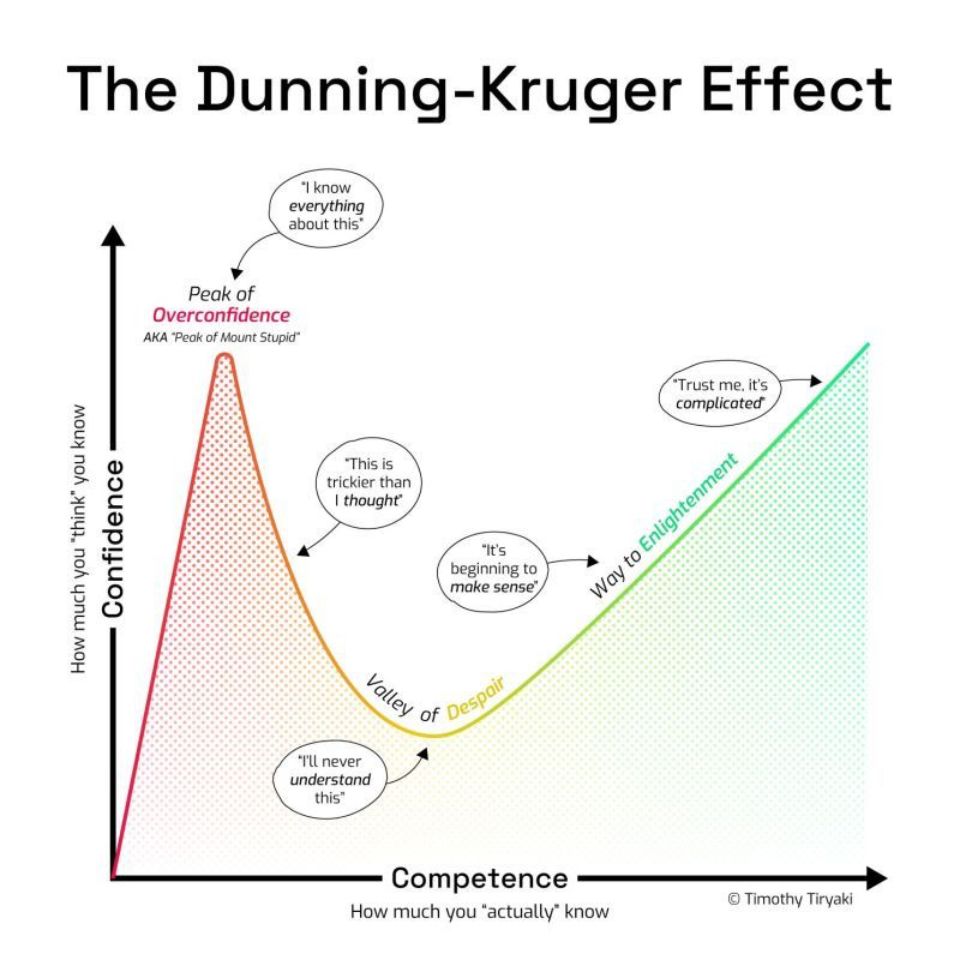
The question what is the Dunning-Kruger effect concerns a specific form of miscalibration in which poor performers overestimate their standing partly because they lack the skill to evaluate themselves accurately. The original research was narrower than its popular use suggests, and later analyses question how much of the familiar pattern reflects statistical artifacts. The enduring lesson is calibrated self-assessment, not a slogan about confidence and incompetence.
There is a certain satisfaction in the Dunning-Kruger effect as popularly understood. It confirms something many people suspect: that confident, opinionated people who seem to know rather less than they think they do are exhibiting a well-documented cognitive bias.
The internet has embraced it enthusiastically, deploying it as an explanation for everything from bad online arguments to political polarisation to the behaviour of incompetent managers. It has become one of those pieces of psychological knowledge that people cite with the kind of confidence that the effect itself warns against.
The irony is appropriate, because the Dunning-Kruger effect, as applied in popular discourse, is itself often misunderstood, overstated, and misapplied.
The original 1999 study by David Dunning and Justin Kruger at Cornell University was a careful, nuanced piece of work with specific findings about metacognitive failure in undergraduate participants on specific tests.
What it became - a universal principle explaining why incompetent people are always the most confident - is a considerably simpler and less defensible claim.
Recent statistical reanalyses have further complicated the picture, suggesting that part of the original finding may be an artefact of the way the data were analysed rather than a feature of human psychology.
None of this means the underlying observation is false. Poor performers do tend to overestimate their relative standing, and there is a plausible and well-grounded mechanism for why this happens.
But the magnitude, universality, and precise nature of the effect are more contested than popular usage suggests, and understanding the debate is itself an exercise in the kind of calibrated epistemic humility that Dunning and Kruger were trying to illuminate in the first place.
"The first principle is that you must not fool yourself, and you are the easiest person to fool." - Richard Feynman
Key Definitions
Metacognition: Thinking about thinking; the capacity to monitor and evaluate one's own cognitive processes and their outputs. Flavell's foundational work in the 1970s established the developmental trajectory of metacognitive capacity.[5]
Calibration: The correspondence between subjective confidence and actual accuracy. A well-calibrated person is confident when they are likely to be correct and uncertain when they are likely to be wrong. The Dunning-Kruger effect describes a specific miscalibration in which low performers are overconfident.[2]
| Competence Level | Confidence Pattern | Reason |
|---|---|---|
| Novice / Low competence | Overconfident (Dunning-Kruger peak) | Lacks metacognitive skill to recognize incompetence |
| Intermediate | Slightly underconfident ("valley of despair") | Aware of complexity; knows what they don't know |
| Advanced | Accurately confident or slightly underconfident | Good calibration; sometimes assumes others know as much |
| Expert | Well-calibrated | Deep domain knowledge with accurate self-assessment |
Regression to the Mean: A statistical phenomenon where extreme measurements on one variable tend to be less extreme on a second related variable. A significant methodological critique of the Dunning-Kruger findings argues that the observed pattern partially reflects this artefact.
Double Burden: Dunning and Kruger's description of incompetence as carrying two costs: the direct cost of poor performance, and the metacognitive cost of impaired ability to recognise that performance as poor.
Unskilled and Unaware: The title phrase from Dunning and Kruger's 1999 paper, drawn from Kruger and Dunning's reading of the metacognition literature. The inability to know that you do not know is the defining feature of the effect.
The Original Study: What Dunning and Kruger Actually Found
The 1999 paper 'Unskilled and Unaware of It: How Difficulties in Recognizing One's Own Incompetence Lead to Inflated Self-Assessments' appeared in the Journal of Personality and Social Psychology.
Dunning and Kruger were motivated by an apparent paradox: people with little expertise in a domain often seemed more confident than experts, rather than less.
They constructed a series of experiments to test whether poor performance and poor self-assessment were systematically linked.
Their first three studies presented Cornell undergraduates with tests of logical reasoning ability, English grammar, and humour (the ability to identify jokes rated funniest by professional comedians). After completing each test, participants estimated their own score as a percentile relative to other participants.
The results showed a consistent pattern. Participants in the bottom quartile on the objective tests significantly overestimated both their raw score and their percentile rank.[1]
Those who actually scored in the 12th percentile believed they had scored in the 62nd. Those who scored in the 14th percentile on grammar estimated they were in the 61st. The overestimation was large and remarkably consistent across different domains.
The pattern for top performers was different but also notable. Participants in the top quartile slightly underestimated their percentile rank, not because they thought they had done poorly, but because they assumed the test was roughly as easy for others as it had been for them.
This 'false consensus' among competent participants reflects a different metacognitive error: the projection of one's own ease of performance onto others.
A fourth study provided a pointed demonstration of the role of skill acquisition. Participants were given their test scores and shown sample responses from other participants, some clearly better and some clearly worse than their own.
This training in evaluating others' work improved the accuracy of bottom-quartile participants' self-assessments significantly - supporting the hypothesis that the original overestimation stemmed from lack of the evaluative skills needed to accurately assess their own performance.
Learning to recognise competence in others improved the ability to recognise its absence in themselves.
The Metacognitive Mechanism
Dunning and Kruger's theoretical explanation for their findings drew on research by John Flavell, who had spent the 1970s establishing the developmental psychology of metacognition - the set of skills involved in monitoring and evaluating one's own thinking.
Flavell found that young children have poor metacognitive capacity: they are overconfident about their own knowledge and memory, do not recognise when they have failed to understand something, and cannot effectively evaluate the quality of their own performance.
The crucial insight Dunning and Kruger imported from this tradition was that the skills required to assess performance in a domain are largely identical to the skills required to produce competent performance. This is not merely a clever observation; it has a precise implication.
If you lack competence in logical reasoning, you will reason poorly when evaluating your own reasoning, and find it satisfactory.[9] The same cognitive machinery that fails to produce valid inferences also fails to identify invalid inferences.
You are applying a flawed ruler to measure your own flaws, and the flaws in the ruler prevent it from registering the flaws it is measuring.
This 'double burden' - performing poorly and being metacognitively unable to recognise that performance as poor - is the defining feature of the effect.
It is distinct from ordinary overconfidence (where people know their limitations but underweight them) and from motivated self-deception (where people know but choose not to acknowledge).
The claim is stronger: the incompetence genuinely impairs the recognition of the incompetence. It is a more thoroughgoing epistemic failure.
The Statistical Critique and the Regression Debate
The most significant scientific controversy around the Dunning-Kruger effect has emerged not from failures of replication but from statistical reanalysis.
The critique, developed most rigorously by Gignac and Zajenkowski (2020) in Intelligence, raises the possibility that the original pattern is partly or largely an artefact of the method Dunning and Kruger used to display their data.[3]
The problem concerns regression to the mean. When you plot 'estimated percentile rank' against 'actual percentile rank,' the characteristic Dunning-Kruger pattern - poor performers overestimate, good performers slightly underestimate - will appear with any data in which the correlation between self-estimates and actual scores is less than perfect, including randomly generated data.
This is because people with very low actual scores have much more room to overestimate than to underestimate (they cannot estimate below zero), while people with very high actual scores have more room to underestimate than to overestimate.
The asymmetric constraint alone produces a pattern that visually resembles the Dunning-Kruger effect.
Gignac and Zajenkowski found that when they controlled for regression to the mean statistically, the residual effect was substantially smaller than Dunning and Kruger's original depictions implied.
The correlation between self-estimated ability and actual ability was modest but positive (typically around r = 0.3 to 0.5 in their analysis) - meaning people do have some accuracy, and the poorest performers do somewhat overestimate, but the dramatic pattern of confident ignorance in the graphical representation is partly statistical illusion.[4]
This critique has been met with responses from Dunning and others arguing that the methodological issues do not eliminate the real phenomenon, and that the disagreement is partly about the magnitude rather than the existence of the effect.
Other researchers have offered more charitable reanalyses, arguing that genuine metacognitive inaccuracy, independent of any statistical artefact, remains detectable.[8]
The debate continues, and is a useful example of how scientific knowledge is revised through methodological criticism rather than simply through failed replication.
Expert Underestimation: The Other Side of the Chart
Dunning and Kruger's attention to top-performer underestimation is often overlooked in popular accounts of the effect, which typically focus exclusively on incompetent overconfidence. But the underestimation among experts is theoretically important and practically significant.
The mechanism Dunning and Kruger proposed is different from the metacognitive failure driving overestimation. Top performers underestimate their relative standing not because they believe they have done poorly, but because they assume that performance easy for them will be similarly accessible to others.
This 'false consensus' or 'curse of expertise' reflects a projection of one's own cognitive experience onto others.
Research by Pamela Hinds at Stanford on the 'curse of knowledge' in expert communication demonstrates related effects: experts in a domain consistently fail to predict the difficulty that novices will have with material the expert finds straightforward.[6]
They cannot mentally 'undo' their own knowledge to accurately model the novice's cognitive experience.[7] This impairs expert teaching, technical communication, and management of learning expectations.
The overall picture of self-assessment across the competence spectrum is therefore more complex than 'ignorant people are overconfident.' Both ends of the competence distribution show characteristic miscalibration, in opposite directions, through partially different mechanisms.
The middle of the distribution tends to show the most accurate self-assessment, consistent with having enough knowledge to evaluate performance but not so much knowledge that projection of one's own experience distorts the assessment.
Cross-Cultural and Domain Replication
A key scientific question for any cognitive bias is whether it generalises across cultures and domains. If the Dunning-Kruger effect were culturally specific - reflecting, for example, the particular relationship to self-promotion in North American university culture - its theoretical significance would be limited.
The available evidence suggests it generalises, though with cultural modulation. Studies in East Asian countries, where cultural norms tend to favour modest self-presentation and collective rather than individual performance, show smaller magnitude effects, suggesting that the overconfidence component is partly culturally calibrated.
However, the basic metacognitive pattern - poor performers being less aware of their underperformance - appears across cultures, consistent with it reflecting a genuine cognitive limitation rather than purely a cultural display norm.
Domain generalisation is also supported. Studies have found the pattern in medical diagnosis (medical students in the lowest quartile show the most overconfident self-assessments), financial literacy (people with the lowest financial literacy show the most confidence about financial decisions), driving ability (poor drivers show the most extreme overestimation of their skills), and a range of professional and academic domains.
The convergence across domains with different social valences supports the basic metacognitive mechanism rather than a domain-specific artefact.
Recognising the Effect in Real-World Contexts
The practical significance of the Dunning-Kruger effect lies less in judging incompetent strangers on the internet and more in the implications for education, professional development, hiring, and self-assessment.
In education, the insight from Dunning and Kruger's fourth study - that training in evaluating others' work improves self-assessment - suggests that rubrics, peer assessment, and exposure to diverse examples of performance are pedagogically valuable not just for improving work but for calibrating self-understanding.
Students who develop richer conceptions of what excellent work looks like become better positioned to evaluate their own work against those standards.
In professional hiring and promotion, the implication is that expressed confidence should be weighted carefully. Confident incompetence is not always detectable from the outside, particularly in domains where the evaluators are not themselves experts.
This is one argument for structured interviews, work samples, and objective performance tests in selection, which are less susceptible to confidence inflation than unstructured impressions.
For personal epistemic practice, the effect supports habits of calibration: seeking specific, concrete feedback from people with genuine expertise rather than general social approval; tracking predictions against outcomes over time; deliberate engagement with the strongest counterarguments to current views; and special caution in domains where you feel most confident but have had least external feedback.
The Meta-Irony: Who Is the Effect About?
The popular use of the Dunning-Kruger effect carries its own irony. The effect is typically deployed by one person to explain the confident errors of another.
It functions as a cognitive superweapon: once you have diagnosed someone as Dunning-Kruger, their disagreement with you can be attributed to their incompetence rather than addressed on its merits.
This is precisely the sort of epistemic move the effect, properly understood, should make one more cautious about.
Dunning himself has observed in interviews that the effect is most dangerous not in domains where you are a novice (where you expect to be uncertain) but in domains where you have just enough knowledge to feel competent - the 'competent novice' stage where you have passed through initial confusion but have not yet encountered the depths of your remaining ignorance.
These are the domains where confident overestimation is most likely and most consequential.
The practical upshot is neither cynicism about one's own judgement nor paralytic uncertainty.
It is calibrated humility: holding beliefs with a confidence proportional to the quality of evidence and feedback one has received, remaining genuinely open to revision, and treating strong subjective confidence as a prompt for checking rather than as confirmation of accuracy.
Practical Takeaways
The Dunning-Kruger effect, understood accurately rather than in its caricatured form, points toward a set of practices for better epistemic calibration.
Feedback quality matters more than feedback quantity. General social validation ('that was great!') does not calibrate self-assessment; specific, expert evaluation ('here is where the reasoning fails, here is where it succeeds') does.
Seeking that quality of feedback in important domains is an investment in metacognitive accuracy.
Comparative exposure helps. Dunning and Kruger's fourth study demonstrated that seeing high-quality work from others improves self-assessment. Reading widely in a domain, studying exemplary work, and engaging with practitioners at higher levels of skill all develop the comparison standards needed for accurate self-evaluation.
The feeling of certainty is not evidence of accuracy. High confidence is sometimes justified and sometimes a symptom of the double burden. Distinguishing between them requires external validation, not more internal reflection.[10]
The person who never asks 'am I right about this?' because the answer feels obvious is exhibiting exactly the metacognitive gap the effect describes.
Sources & Further Reading
- Kruger, J., & Dunning, D. (1999). Unskilled and unaware of it: How difficulties in recognizing one's own incompetence lead to inflated self-assessments. Journal of Personality and Social Psychology, 77(6), 1121-1134.
- Dunning, D. (2011). The Dunning-Kruger effect: On being ignorant of one's own ignorance. Advances in Experimental Social Psychology, 44, 247-296.
- Gignac, G. E., & Zajenkowski, M. (2020). The Dunning-Kruger effect is (mostly) a statistical artefact: Valid approaches to testing the hypothesis with individual differences data. Intelligence, 80, 101449.
- Nuhfer, E., Fleisher, S., Cogan, C., Wirth, K., & Gaze, E. (2016). How random noise and a graphical convention subverted behavioral scientists' explanations of self-assessment data. Numeracy, 9(1), Article 4.
- Flavell, J. H. (1979). Metacognition and cognitive monitoring: A new area of cognitive-developmental inquiry. American Psychologist, 34(10), 906-911.
- Hinds, P. J. (1999). The curse of expertise: The effects of expertise and debiasing methods on prediction of novice performance. Journal of Experimental Psychology: Applied, 5(2), 205-221.
- Heath, C., & Heath, D. (2007). Made to Stick: Why Some Ideas Survive and Others Die. Random House.
- Ehrlinger, J., Johnson, K., Banner, M., Dunning, D., & Kruger, J. (2008). Why the unskilled are unaware: Further explorations of (absent) self-insight among the incompetent. Organizational Behavior and Human Decision Processes, 105(1), 98-121.
- Pennycook, G., Ross, R. M., Koehler, D. J., & Fugelsang, J. A. (2017). Dunning-Kruger effects in reasoning. Thinking and Reasoning, 23(3), 317-337.
- Nisbett, R. E., & Wilson, T. D. (1977). Telling more than we can know: Verbal reports on mental processes. Psychological Review, 84(3), 231-259.
Further Reading
- Muller, D., Judd, C. M., & Yzerbyt, V. Y. (2005). When moderation is mediated and mediation is moderated. Journal of Personality and Social Psychology, 89(6), 852-863.
- Ames, D. R., & Kammrath, L. K. (2004). Mind-reading and metacognition: Narcissism, not actual competence, predicts self-estimated ability. Journal of Nonverbal Behavior, 28(3), 187-209.