
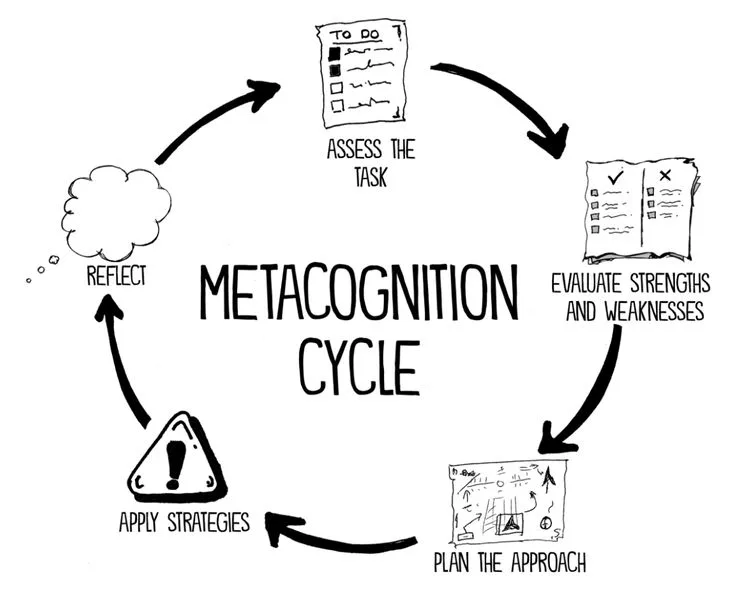
Metacognition: In the mid-1970s, developmental psychologist John Flavell was conducting research on how children develop memory. The specific task was simple: children were asked to study a list of words and signal when they thought they had learned the words well enough to recall them.
Younger children, around age five or six, would signal readiness almost immediately - even when they couldn't recall more than a few words.
Older children, around age ten, would study longer, rehearse items aloud, organize words into categories, test themselves, and wait to signal readiness until they could actually recall the full list.
Flavell noticed something important in this difference. The older children were not simply better at memorizing. They were monitoring their own memory processes - tracking what they knew, noticing when they didn't know it yet, and deploying strategies to address the gap.
They were thinking about their own thinking in a way the younger children were not.
This observation led Flavell to introduce the term "metacognition" in a 1976 paper, elaborated in his 1979 paper in American Psychologist.[1]
The capacity to think about your own cognitive processes, to know what you know and recognize what you don't, turned out to be one of the most consequential differences between effective and ineffective learners - and one of the most teachable cognitive skills identified in a century of educational research.
"Metacognition refers to one's knowledge concerning one's own cognitive processes and products or anything related to them." - John H. Flavell, American Psychologist (1979)
Key Definitions
Metacognition - The capacity to monitor, evaluate, and regulate one's own cognitive processes. Thinking about one's own thinking, knowing what one knows and doesn't know, and adjusting cognitive strategies accordingly. Coined by John H. Flavell in 1976, elaborated in his 1979 paper.
Metacognitive knowledge - What a person knows about cognition in general and their own cognition in particular. Includes knowledge about persons (different people think differently), tasks (some tasks are harder than others), and strategies (which approaches work for which purposes).
| Metacognitive Component | Definition | Example |
|---|---|---|
| Metacognitive knowledge | What you know about how your own memory and thinking work | Knowing you learn better by retrieval practice than re-reading |
| Metacognitive monitoring | Real-time assessment of your own comprehension and performance | Noticing you don't actually understand a paragraph you just read |
| Metacognitive control | Adjusting study or problem-solving strategy based on monitoring | Switching from re-reading to self-testing after noticing poor recall |
| Calibration | Accuracy of confidence relative to actual performance | Predicting you'll score 85% and actually scoring 83% |
Metacognitive monitoring - The ongoing tracking of one's own cognitive state during a task - awareness of whether one understands, whether a strategy is working, whether the goal is being achieved. Monitoring supplies the diagnostic information that control acts upon.
Metacognitive control - The regulation of cognitive processes based on monitoring - deciding to slow down, change strategy, seek more information, or allocate more attention when monitoring signals that the current approach is insufficient.
Judgment of learning (JOL) - A metacognitive judgment about how well a piece of information has been learned, typically made during or just after studying. JOLs are frequently inaccurate - people often believe they have learned material they cannot subsequently recall.
Feeling of knowing (FOK) - The metacognitive sense that one knows something even when one cannot currently retrieve it. The classic experience of a word on the tip of the tongue. Nelson and Narens' 1990 framework analyzed FOK as a monitoring process at the meta level.[2]
Calibration - The match between confidence and accuracy. A well-calibrated person who says they are 80% confident in an answer is correct approximately 80% of the time. Most people are overconfident - their expressed confidence exceeds their actual accuracy.
The illusion of knowing - The subjective sense of familiarity with material that exceeds actual retrievability. Re-reading produces familiarity that is subjectively indistinguishable from understanding, but that does not support active recall or application.
The Architecture of Metacognition
John Flavell, a developmental psychologist at Stanford whose primary research program concerned children's cognitive development, introduced the term "metacognition" in a 1976 paper and developed it systematically in his 1979 paper in the American Psychologist.
His original formulation was broad: metacognition encompasses not only self-monitoring but also the accumulated knowledge one holds about cognitive processes - knowledge of persons (including oneself), tasks, and strategies.
The person-task-strategy framework proved highly generative. Knowledge about persons includes beliefs about one's own cognitive strengths and weaknesses (I am better at spatial reasoning than at verbal working memory) and beliefs about others' cognitive capacities (novices rely on surface features; experts organize knowledge around deep principles).
Knowledge about tasks concerns how the properties of different types of tasks - their length, abstractness, familiarity, or the match between their format and one's competencies - predict difficulty.
Knowledge about strategies concerns awareness of which cognitive tools work best for which purposes: that spaced practice is more effective than massed practice for long-term retention, that elaborative interrogation - asking "why is this true?" rather than simply re-reading - produces deeper encoding.
Thomas Nelson and Louis Narens at the University of Maryland formalized the mechanisms in a 1990 paper in Psychological Review that has become the canonical technical account. They proposed that metacognition is best understood as a relationship between two levels of cognitive processing.
The object level is where primary cognitive tasks are performed: reading, calculating, remembering. The meta level holds a model of what is happening at the object level.
Two processes connect them. Monitoring involves information flowing upward from object to meta level: the sense of knowing whether one understands, feelings of familiarity or confusion, judgments of learning.
Control involves commands flowing downward from meta to object level: decisions to re-read a passage, to allocate more study time, to switch strategy, to stop.
The Nelson-Narens model generates a set of empirically testable predictions. Monitoring failures - inaccurate upward information - lead to poor control decisions, since the meta level is acting on faulty data.
A student who feels confident that she has mastered a chapter and consequently stops studying has not failed at effort; she has failed at monitoring.
Conversely, accurate monitoring with impaired control produces a different failure mode: the person who correctly identifies a problem but cannot execute the appropriate corrective response. Clinical interventions targeting metacognition must diagnose which part of the system has failed.
Learning, Memory, and the Illusion of Knowing
The most extensively studied practical application of metacognition concerns learning.
The central finding, replicated across hundreds of studies, is that the subjective experience of learning is an unreliable guide to objective learning outcomes - and that the strategies that produce the strongest subjective sense of understanding are often among the least effective for durable retention.
Re-reading is the dominant study strategy among students across educational levels. Surveys consistently show that students consider it effective, and it is easy to understand why: repeated exposure to material increases familiarity, and familiarity is subjectively indistinguishable from understanding.
Glenberg, Wilkinson, and Epstein's 1982 study in the Journal of Memory and Language documented this illusion directly: students who re-read passages showed high confidence in their comprehension despite performing poorly on tests of actual retention.[11]
The feeling of knowing is generated by the ease of processing - the fluency with which text flows - not by accurate assessment of whether one could reproduce or apply the information.
The alternative strategy with the most extensive evidence behind it is retrieval practice: the active effort to reconstruct information from memory rather than to re-expose oneself to it.
Henry Roediger and Jeffrey Karpicke's 2006 paper in Psychological Science compared three study conditions: studying a passage once, re-reading it multiple times, or studying it once and then attempting to recall it without looking at the text (followed by further study-test cycles).[4]
One week later, students in the retrieval practice condition significantly outperformed those in the re-reading condition, despite the fact that immediately after studying, re-readers reported higher confidence in their retention.
The testing effect is robust: retrieval practice produces durable learning regardless of whether the retrieval is successful, and even retrieval attempts that fail to produce the correct answer improve later retention of corrected information.
The mechanism is metacognitive as well as memorial. Attempting retrieval generates accurate monitoring information - you discover, concretely and unmistakably, what you cannot recall - that re-reading does not. The student who attempts to recall what they learned and fails is getting precise feedback on their actual knowledge state.
The student who re-reads and feels increasingly fluent receives no such feedback. Retrieval practice thus improves both the objective learning outcome and the calibration of confidence - two distinct benefits from a single mechanism.
Spacing effects compound the testing effect. Distributing study over time - returning to material after an interval rather than massing all study in a single session - produces substantially better long-term retention.
Cepeda, Pashler, Vul, Wixted, and Rohrer's 2006 meta-analysis across 254 studies found strong consistent evidence for spacing advantages.[9]
Here, too, the metacognitive component is critical: massed practice generates a stronger subjective sense of mastery than spaced practice precisely because information is more accessible immediately after recent review.
The student correctly perceives that the massed session produced better immediate recall; the inference that it therefore produced better long-term retention is the error.
Interleaving - alternating between different types of problems or topics rather than completing one block before moving to another - is a third strategy supported by strong evidence and consistently undervalued by students.
Doug Rohrer and Harold Pashler's work (2010, Psychological Science) demonstrated that interleaving produces substantially better performance on subsequent mixed tests despite producing worse immediate performance during practice.
Again, the metacognitive failure is characteristic: learners rate blocked practice as more effective because it feels smoother, and they rate interleaved practice as less effective because it feels harder. The subjective experience is inversely correlated with the objective outcome.
Overconfidence and the Dunning-Kruger Phenomenon
Overconfidence is among the most replicated findings in cognitive psychology. Lichtenstein, Fischhoff, and Phillips's 1977 analysis of calibration across multiple domains found systematic overconfidence in assessments of factual accuracy.
Subjects who said they were 100% certain were right only about 70-80% of the time.
Fischhoff, Slovic, and Lichtenstein (1977) found that subjects setting confidence intervals for uncertain quantities (the distance from London to Paris, the year of a historical event) consistently set intervals that were too narrow - their 90% confidence intervals contained the correct answer far less than 90% of the time.
Dunning and Kruger's 1999 findings gave the overconfidence literature a memorable face.[3] They had subjects complete tests of logical reasoning, grammar, and humor detection, then asked them to estimate their own performance and their standing relative to other participants.
Subjects scoring in the bottom quartile consistently estimated their performance in the 60th to 70th percentile. Top-quartile subjects, by contrast, tended to underestimate their relative standing - not because they were less confident in absolute terms, but because they assumed others had performed similarly well.
Both findings follow from the same theoretical account: the skills that produce good performance also produce accurate monitoring. High performers can recognize quality reasoning; low performers cannot recognize either quality reasoning in others or its absence in themselves.
The Dunning-Kruger phenomenon has occasionally been mischaracterized as a simple claim that ignorant people are arrogant while experts are humble.
The actual claim is more specific: metacognitive accuracy - the correlation between subjective confidence and objective accuracy - is worse for low performers than for high performers in most domains.
The effect has been replicated across many domains and cultures, though cross-cultural research by Heine, Kitayama, and colleagues suggests that the magnitude differs across cultural contexts.
In some East Asian samples, the pattern of top performers underestimating their standing is more pronounced, possibly reflecting culturally embedded norms of modesty and self-improvement orientation.
Calibration research has practical implications beyond individual cognition. Tetlock's long-running forecasting tournament research, summarized in Superforecasting (2015, with Dan Gardner), found that expert commentators were only marginally better than chance at predicting geopolitical events, and that their confidence in their predictions substantially exceeded their accuracy.
The superforecasters who outperformed experts were distinguished not by domain expertise alone but by metacognitive practices: actively seeking disconfirming evidence, tracking their own prediction records, updating beliefs incrementally on new information, and treating forecasting as a skill to be measured rather than an expression of intelligence.
Metacognition, Intelligence, and the Expert-Novice Distinction
Metacognition is related to general intelligence but is not reducible to it. The correlation between IQ and metacognitive accuracy is positive but modest - roughly 0.3 in most studies - which leaves substantial variance in metacognitive skill not accounted for by fluid intelligence.
More importantly, while general intelligence is highly heritable and relatively resistant to environmental intervention after childhood, metacognitive skills are trainable across the lifespan.
This asymmetry has practical importance: interventions targeting metacognition can improve learning and reasoning even in populations whose fluid intelligence is not being changed.
The expert-novice distinction illustrates the metacognitive dimension of expertise. Novices and experts in any domain differ not only in their knowledge but in their knowledge about their knowledge.
Expert chess players can rapidly identify positions they do not recognize - a metacognitive judgment about recognition failure - and allocate analytical effort accordingly. Novice chess players cannot reliably distinguish positions they genuinely understand from those they do not.
Expert problem solvers in physics, studied by Chi, Feltovich, and Glaser (1981, Cognitive Science), categorize physics problems by deep structural principles (conservation of energy, Newton's second law) while novices categorize by surface features (inclined planes, pulleys, springs).[8]
This is both a difference in knowledge and a difference in the meta-level organization of that knowledge: experts have more accurate models of what they know and how their knowledge is structured.
David Perkins at Harvard Project Zero proposed the concept of the "intelligent novice" - a learner who may lack domain knowledge but whose metacognitive capacities enable effective self-directed learning.
The intelligent novice monitors their own understanding, identifies gaps accurately, selects effective strategies, and knows when to seek help. This is not a substitute for domain knowledge but a capacity that dramatically accelerates its acquisition.
Perkins and colleagues found that explicit instruction in metacognitive strategies - teaching students not just what to think but how to monitor their thinking - improved learning outcomes across subjects and age groups.
Metacognition and Mental Health: Wells's Metacognitive Model
The most clinically significant extension of metacognition research is Adrian Wells's metacognitive model of psychological disorder, developed from the mid-1990s and systematically articulated in Metacognitive Therapy for Anxiety and Depression (2009).[6]
Wells argued that the key driver of many common psychological disorders is not the content of negative thoughts - the specific beliefs about danger, worthlessness, or failure - but dysfunctional metacognitive beliefs about the nature and significance of mental events.
In Wells's model, anxiety and depression are maintained not by the anxiety-provoking thoughts themselves but by beliefs about those thoughts: that worry is uncontrollable, that it is a necessary and effective coping strategy, that certain types of mental events are dangerous or meaningful (the "thought-action fusion" common in OCD, where thinking about a harmful action is treated as equivalent to performing it).
These beliefs trigger cognitive coping strategies - rumination, worry, thought suppression - that paradoxically maintain and amplify the conditions they are intended to manage.
Rumination is the clearest example. Repetitive, self-focused thinking about one's symptoms, problems, and distress is the cognitive feature most consistently associated with depression severity and chronicity, as established in Susan Nolen-Hoeksema's extensive research programme from the 1990s onwards.
Wells's metacognitive analysis does not treat rumination as the fundamental problem but rather as a behavior that is maintained by metacognitive beliefs: the belief that ruminating helps you find solutions, understand problems, or prevent recurrence.
The goal of Metacognitive Therapy (MCT) is not to change the content of thoughts or to challenge the accuracy of beliefs about the external world, but to modify the metacognitive beliefs that maintain dysfunctional cognitive strategies.
MCT trials have produced encouraging results across multiple disorders. Adrian Wells's randomized controlled trial for generalized anxiety disorder (2009, Journal of Consulting and Clinical Psychology) found that MCT was significantly more effective than applied relaxation at 6-month and 12-month follow-up, with 80% of MCT patients meeting criteria for recovery.
Trials in PTSD (Wells and colleagues, 2008) and depression (Papageorgiou and Wells, 2003) have produced similarly favorable results, though the evidence base remains more limited than for CBT.
The theoretical implication is significant: effective treatment for some of the most prevalent psychiatric disorders may require changing not what people think but how they think about thinking.
Richard Nisbett and Timothy Wilson's 1977 paper in Psychological Review - "Telling More Than We Can Know: Verbal Reports on Mental Processes" - established a fundamental limit on metacognitive access: people's verbal accounts of why they made decisions or chose preferences are often confabulations.[5]
In a series of experiments, subjects chose between pairs of stockings in a display array and explained their choices; in fact, they showed a strong positional bias (choosing items on the right side), but no subject cited position as the reason for their choice, and subjects explicitly rejected position when it was suggested.
The mechanisms that actually drive behavior are often not accessible to introspection, and the explanations we generate post hoc are plausible constructions rather than accurate reports of causal processes.
This finding does not dissolve the metacognitive program; it specifies its limits. Metacognitive monitoring is not perfect transparency into mental processes but rather a set of inferential practices - some more accurate than others - that can be trained, calibrated, and refined.
The task is not to achieve direct access to mental mechanisms but to develop better external practices: record keeping, feedback loops, behavioral tests, and deliberate exposure to information that is difficult to generate purely through introspection.
How to Improve Metacognition
The evidence base for metacognitive training is strongest in educational settings, where it has been the subject of sustained experimental research.
Hattie's synthesis of over 800 meta-analyses, Visible Learning (2009), identified metacognitive and self-regulation strategies as among the highest-effect-size interventions for student achievement, with an average effect size exceeding 0.60 - substantially larger than many conventional instructional interventions.[10]
Effective metacognitive training involves several components.
Retrieval practice, as discussed above, improves monitoring accuracy as a direct consequence of generating honest feedback about what one cannot recall. Students who regularly test themselves develop more accurate models of their knowledge state than students who review.
The practice of writing down everything one can recall about a topic before reviewing notes is a simple implementation requiring no special materials.
Metacognitive prompting - structuring study or work with explicit reflection questions - has been shown to improve both learning outcomes and monitoring accuracy.
Questions such as "What did I not understand in this section?", "What strategy am I using and why?", and "What would I predict my performance to be on a test of this material?" engage the monitoring process explicitly and create opportunities for control responses.
King's 1991 study in American Educational Research Journal found that prompting students to generate and answer such questions during learning produced significantly better comprehension than re-reading.
Thinking aloud - verbalizing one's reasoning process as one works through a problem - makes metacognitive processes visible and therefore improvable.
Ericsson and Simon's research on verbal protocols (1984) documented that concurrent verbalization of thinking, unlike retrospective verbal report, does provide valid data about cognitive processes and also appears to improve performance on complex tasks by slowing the process and making monitoring more accessible.
Bayesian reasoning training improves calibration. Tetlock and colleagues found that forecasters who received training in Bayesian updating - incrementally revising probability estimates as new information arrives, maintaining records of predictions, and reviewing them against outcomes - produced substantially better-calibrated forecasts than untrained forecasters.[7]
The systematic exposure to feedback on one's own predictions, combined with the habit of expressing confidence numerically, creates the conditions for calibration to improve over time.
The broader principle across all these interventions is the same: metacognitive skill improves when there is honest feedback between subjective assessments and objective outcomes, and when that feedback is sought rather than avoided.
The cognitive orientation that makes metacognitive training possible is intellectual humility - the willingness to be wrong, to discover gaps, and to update rather than defend one's prior beliefs.
This is not a personality trait but a trained disposition, and it is among the most consequential cognitive tools available to anyone who wishes to learn and reason effectively.
For related concepts, see the Dunning-Kruger effect explained, how memory works, and how to improve your memory.
Sources & Further Reading
- Flavell, J. H. (1979). Metacognition and Cognitive Monitoring: A New Area of Cognitive-Developmental Inquiry. American Psychologist, 34(10), 906-911. DOI: 10.1037/0003-066X.34.10.906
- Nelson, T. O., & Narens, L. (1990). Metamemory: A Theoretical Framework and New Findings. Psychology of Learning and Motivation, 26, 125-173. DOI: 10.1016/S0079-7421(08)60053-5
- Kruger, J., & Dunning, D. (1999). Unskilled and Unaware of It: How Difficulties in Recognizing One's Own Incompetence Lead to Inflated Self-Assessments. Journal of Personality and Social Psychology, 77(6), 1121-1134. DOI: 10.1037/0022-3514.77.6.1121
- Roediger, H. L., & Karpicke, J. D. (2006). Test-Enhanced Learning: Taking Memory Tests Improves Long-Term Retention. Psychological Science, 17(3), 249-255. DOI: 10.1111/j.1467-9280.2006.01693.x
- Nisbett, R. E., & Wilson, T. D. (1977). Telling More Than We Can Know: Verbal Reports on Mental Processes. Psychological Review, 84(3), 231-259. DOI: 10.1037/0033-295X.84.3.231
- Wells, A. (2009). Metacognitive Therapy for Anxiety and Depression. Guilford Press.
- Tetlock, P. E., & Gardner, D. (2015). Superforecasting: The Art and Science of Prediction. Crown Publishers.
- Chi, M. T. H., Feltovich, P. J., & Glaser, R. (1981). Categorization and Representation of Physics Problems by Experts and Novices. Cognitive Science, 5(2), 121-152. DOI: 10.1207/s15516709cog0502_2
- Cepeda, N. J., et al. (2006). Distributed Practice in Verbal Recall Tasks: A Review and Quantitative Synthesis. Psychological Bulletin, 132(3), 354-380. DOI: 10.1037/0033-2909.132.3.354
- Hattie, J. (2009). Visible Learning: A Synthesis of Over 800 Meta-Analyses Relating to Achievement. Routledge.
- Glenberg, A. M., Wilkinson, A. C., & Epstein, W. (1982). The Illusion of Knowing: Failure in the Self-Assessment of Comprehension. Memory and Cognition, 10(6), 597-602. DOI: 10.3758/BF03202442