
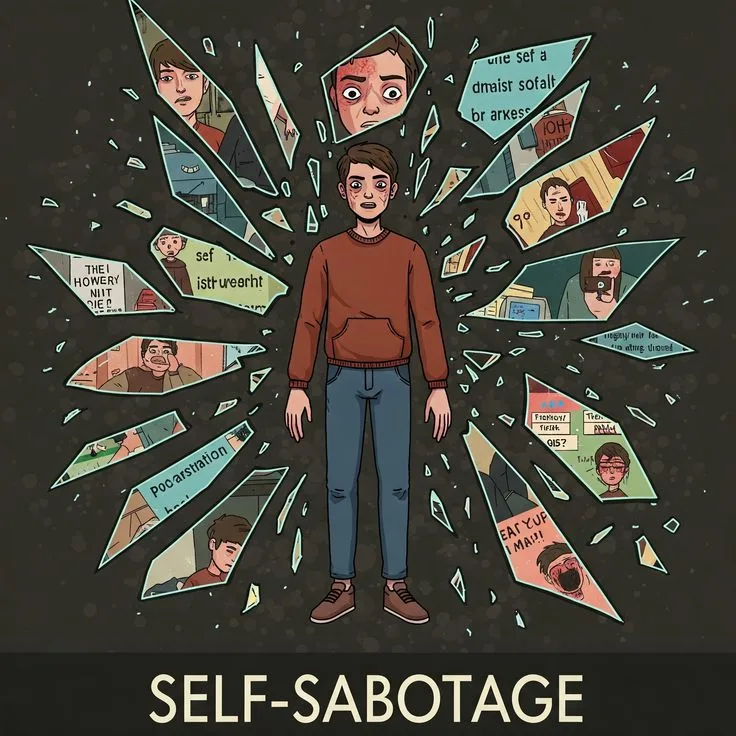
Understanding self means asking what apparently self-defeating behavior may be protecting. Repeated procrastination, conflict, missed opportunities, or self-handicapping can reduce fear, preserve a familiar self-concept, manage cognitive dissonance, or guard against rejection. Early maladaptive schemas and insecure attachment can sustain these cycles, so the behavior may feel like a reasonable response in the moment despite repeatedly frustrating long-term goals.
There is something puzzling about self-sabotage that makes it almost philosophically interesting.
The behaviours are often clearly self-defeating: the relationship that seemed to be going well until you picked an inexplicable fight; the job offer that fell through because you delayed returning the call; the exam you failed because you somehow could not bring yourself to prepare.
These patterns are not random. They recur. The same person finds themselves in the same outcomes across years, across different contexts, across different opportunities. If it happened once, it would be bad luck. When it happens repeatedly, it begins to look like a system.
The difficulty in understanding self-sabotage is that it feels, from the inside, like anything but deliberate self-destruction. The procrastination feels like tiredness. The argument feels like a genuine grievance. The missed opportunity feels like circumstances.
The person engaged in self-sabotage rarely has the experience of deciding to undermine themselves; they have the experience of making reasonable choices that happen to produce reliably disappointing outcomes.
This is what makes the pattern so durable: it operates below the level of conscious intention, in the gap between what people say they want and what their behaviour systematically produces.
Understanding self-sabotage requires looking at what the behaviour accomplishes, even when what it costs seems obvious.
Every self-defeating pattern, examined carefully, turns out to be managing something - protecting against a feared outcome, maintaining a familiar self-concept, resolving the dissonance between inner belief and outer reality.
The apparent paradox resolves when you ask not "what is this costing?" but "what is this protecting?"
"Your biggest challenge is not fear of failure. It is your upper limit - the unconscious thermostat that controls how much good you will allow yourself." - Gay Hendricks, The Big Leap (2009)
How Widespread Is Self-Sabotage?
Before examining mechanisms, it is worth establishing how common self-defeating behaviour actually is. The answer, across multiple research traditions, is: very.
A 2014 study by Baumeister, Bushman, and Campbell estimated that roughly 25% of college students exhibited classic self-handicapping behaviours before important evaluations - a conservative estimate that examined only one form of one sub-type of self-sabotage.
Research on procrastination, which overlaps substantially with self-sabotage, has found that approximately 20% of adults identify as chronic procrastinators, with rates higher in younger populations and in academic settings (Steel, 2007, published in Psychological Bulletin).[13]
In clinical populations, rates of self-defeating patterns are substantially higher. Research by Young and colleagues found that early maladaptive schemas - the deep cognitive structures that drive much of the most chronic self-sabotage - were present in elevated form in the majority of people seeking psychotherapy.
Borderline personality disorder, for instance, which is characterized in part by patterns of self-sabotage in relationships and other domains, affects an estimated 1.6-5.9% of the general population, with much higher rates in clinical settings.
The economic costs are also measurable. The American Institute of Stress estimates that procrastination-related productivity losses cost U.S. employers approximately $650 billion annually.
While the causal chain from procrastination to self-sabotage to lost productivity is not always clean, the aggregate signal is clear: self-defeating behaviour is not an edge case. It is a pervasive feature of how people navigate their lives.
Key Definitions
Self-handicapping - A strategy described by Jones and Berglas (1978) of creating obstacles or claiming impediments before a performance to protect self-esteem by providing external attributions for potential failure.
The self-handicap creates a "no-lose" attribution structure: failure can be blamed on the impediment; success looks doubly impressive.
Upper Limit Problem - Gay Hendricks' concept (2009) of an unconscious ceiling on wellbeing or success, beyond which a person unconsciously engineers a return to a familiar, more comfortable level.[2] When life exceeds this ceiling, self-sabotage restores the familiar baseline.
Cognitive dissonance - Leon Festinger's 1957 theory describing the psychological discomfort of holding conflicting beliefs, attitudes, or behaviours. Self-sabotage can be a dissonance-reduction strategy when success conflicts with a deeply held negative self-concept.
Early maladaptive schema - Jeffrey Young's construct from schema therapy describing deeply ingrained patterns of belief about oneself and the world, derived from unmet childhood needs, that drive repetitive adult life patterns.
Schemas such as "I am fundamentally defective" or "I do not deserve good things" produce self-perpetuating self-defeating cycles.
Attachment style - John Bowlby's framework for the internal working models of relationships formed in early childhood, shaping adult relational patterns.[9]
Insecure attachment styles - particularly anxious attachment (hypervigilance for rejection) and fearful-avoidant attachment (simultaneous desire for and terror of intimacy) - drive characteristic relationship self-sabotage.
Attribution - The causal explanation assigned to an event or outcome. Self-handicapping manipulates attributional structure to protect self-esteem by providing external explanations for failure.
Schema surrender - In Young's framework, behaving in ways that directly confirm and perpetuate a negative schema. A person with a "defectiveness/shame" schema choosing partners who confirm their sense of unworthiness is demonstrating schema surrender.
Self-regulation failure - Roy Baumeister's framework for understanding how depletion of executive resources leads to inability to maintain goal-directed behaviour, producing the characteristic "giving up" patterns of self-sabotage under stress.
Common Self-Sabotage Patterns and Their Mechanisms
| Pattern | Surface Behaviour | Underlying Mechanism | Psychological Function |
|---|---|---|---|
| Procrastination on important opportunities | Delaying until the opportunity passes | Self-handicapping; fear of evaluation | Protects self-concept from failure test |
| Picking fights when relationships improve | Creating conflict at moments of closeness | Anxious/fearful attachment; upper limit | Restores familiar distance; prevents feared abandonment |
| Underperforming when success is near | Reduced effort at the critical stage | Cognitive dissonance; schema surrender | Restores consistency with "I don't succeed" narrative |
| Rejecting help and support | Dismissing legitimate assistance | Shame; independence as identity defense | Avoids vulnerability; confirms self-sufficiency schema |
| Sabotaging health goals | Reverting to old patterns after progress | Upper limit; schema surrender | Returns to familiar self-concept baseline |
| Missing deadlines for desired outcomes | Inexplicable failures to submit/apply | Fear of rejection if fully committed | Maintains hope by avoiding definitive tests |
| Chronic lateness in professional settings | Repeatedly arriving late to important events | Passive resistance; identity threat | Asserts autonomy; sabotages outcomes that feel threatening |
| Substance use before evaluations | Self-medicating before tests or presentations | Classic self-handicapping (Jones and Berglas, 1978) | Creates external explanation for potential failure |
Self-Handicapping: The Architecture of Protective Failure
The scientific study of self-sabotage begins, in its most rigorous form, with Edward Jones and Steven Berglas.
In a 1978 paper in the Journal of Personality and Social Psychology, they introduced the concept of self-handicapping: the strategic adoption of impediments or the amplification of existing obstacles before a performance evaluation, to protect self-esteem through the manipulation of causal attributions.
The logic is elegant in its perversity. If a student studies inadequately before an exam and fails, the failure is attributable to lack of preparation rather than lack of ability. The student's self-concept as a potentially capable person is preserved.
If they study inadequately and somehow succeed, the success is particularly impressive - they did well despite adversity. The self-handicap creates what researchers call a "no-lose" attributional situation from the perspective of protecting self-concept, at the cost of actually increasing the probability of failure.
Jones and Berglas initially documented self-handicapping in drug and alcohol use - finding that people who feared negative evaluation of their abilities were more likely to self-medicate before a performance, providing a ready-made explanation for any subpar result.[1]
Subsequent research found self-handicapping in many forms: deliberate reduction in effort before evaluations, choice of difficult or impossible tasks that guarantee failure, claiming illness or emotional distress, and withdrawing from evaluative situations entirely.[6]
Christopher Rhodewalt at the University of Utah extended this research through the 1990s, finding that self-handicapping was particularly prevalent among individuals high in contingent self-esteem - those whose sense of worth was heavily tied to performance outcomes.
For people who have built their identity around being competent or successful, the prospect of evaluation creates acute threat. Self-handicapping is their pre-emptive defensive manoeuvre.
The costs are substantial. Rhodewalt's research found that chronic self-handicappers show lower actual performance over time, reduced self-regulatory efficiency, and paradoxically lower self-esteem in the long run - as the pattern of underperformance becomes part of their self-concept.[5]
The short-term protection is purchased at the cost of long-term development.
A key finding from this research tradition is gender differences in self-handicapping style. Men tend to use behavioural self-handicaps - actually creating the obstacle (not studying, drinking before the event).
Women tend to use claimed self-handicaps - reporting impediments without actually creating them (claiming anxiety, reporting pre-existing stress).
Hirt, McCrea, and Kimble (2000) demonstrated that this difference reflects differential concerns about impression management: behavioural self-handicapping is more transparent and more likely to draw criticism for failing to try, making it riskier for women in contexts where effort is socially expected.[16]
Fear of Success: When Achievement Feels Dangerous
The idea that people might fear success - not just failure - entered psychology through controversial territory.
In 1970, Matina Horner at Harvard published research claiming to identify a "motive to avoid success" in women, arguing that high-achieving women faced social penalties for success and therefore unconsciously sabotaged their achievements.[10]
Horner's methodology was subsequently challenged. But the underlying phenomenon - that success can feel threatening and activate avoidance - has been supported by subsequent research through different frameworks. The fear is rarely about success itself; it is about its perceived social and psychological consequences.
Several mechanisms are now better understood:
Identity threat arises when success would require revising a self-concept built around limitation. A person who has spent decades identifying as "someone who struggles" may find success as disorienting as failure, because it demands a different story about who they are.
Role identity threat is particularly relevant in contexts where success would move a person out of their social group or away from relationships built on a shared identity of not-yet-succeeding.
Survivor guilt - common among first-generation professionals, immigrants, and others who have transcended their origin circumstances - can drive self-sabotage as an unconscious bid to remain in solidarity with those left behind.
Dacher Keltner at UC Berkeley has documented how transitions across social class create identity conflicts that produce self-defeating patterns as people navigate between the world they came from and the world they have entered.
The self-sabotage in these cases is not pathology in the narrow sense; it is a response to genuine psychological and social complexity.
Research by Croizet and Claire (1998) on stereotype threat showed a related mechanism: when people from stigmatized groups perform in domains where negative stereotypes about their group's ability are salient, their performance suffers - not because they are less capable, but because the psychological burden of disconfirming the stereotype consumes cognitive resources.[15]
Success in those domains carries a particular kind of psychological weight that members of non-stigmatized groups do not experience.
Self-sabotage in these contexts is not irrational; it is a response to a genuinely more costly and more threatening psychological situation.
Cognitive Dissonance and the Consistency Drive
Leon Festinger's theory of cognitive dissonance (1957) provides perhaps the most elegant explanation for certain forms of self-sabotage.[3] People are motivated to maintain consistency among their beliefs, attitudes, and behaviours, and inconsistency creates psychological discomfort (dissonance) that motivates resolution.
The relevant application is to self-concept. If a person holds a deeply established belief - "I am not the kind of person who has healthy relationships," "I am fundamentally inadequate," "People like me do not get to have this kind of life" - then experiences that contradict this belief create dissonance.
The most cognitively efficient resolution, particularly for beliefs that have been held for a long time and are closely tied to identity, is to restore consistency rather than revise the belief.
Undermining the success, mishandling the relationship, or creating conditions for the expected outcome restores the internal consistency of the self-narrative.
Swann's self-verification theory (1990) provided empirical support for this mechanism.[12]
Swann found that people actively seek feedback that confirms their self-concept, even when that self-concept is negative - and that people with negative self-views chose partners who viewed them negatively, reported greater intimacy with partners who saw them negatively, and reported feeling more secure in relationships where their negative self-view was confirmed.
The preference for consistency over positivity was robust and appeared particularly strongly in committed relationships, where self-verification needs are highest.
This process is not conscious. The person does not reason "I believe I am undeserving of success, this success creates cognitive dissonance, therefore I will undermine it." The dissonance is experienced as vague anxiety, as an irrational impulse, as a sudden compelling reason to act in a particular way.
The self-sabotaging behaviour feels motivated by entirely legitimate surface concerns - a genuine grievance, a reasonable decision, an unavoidable circumstance - while the underlying motivational logic remains inaccessible to conscious reflection.
Schema Therapy and Early Programming
Jeffrey Young's development of schema therapy in the 1990s provided a clinical framework for understanding the deepest forms of self-sabotage.
Young proposed that chronically self-defeating patterns in adults are driven by early maladaptive schemas - pervasive, self-perpetuating belief structures formed in childhood in response to unmet core emotional needs.[4]
Young grouped these schemas into five domains:
- Disconnection and Rejection: "I am unlovable"; "I will be abandoned"
- Impaired Autonomy and Performance: "I am incompetent"; "I cannot cope independently"
- Impaired Limits: "Rules don't apply to me"; "I don't have to endure frustration"
- Other-Directedness: "I must subordinate my needs to others"
- Overvigilance and Inhibition: "Emotions are dangerous"; "I must suppress myself"
These schemas are maintained through three processes: schema avoidance (avoiding situations that would trigger the schema), schema compensation (overcorrecting in the opposite direction), and schema surrender (behaving in ways that confirm the schema directly).
Schema surrender is the most direct form of self-sabotage. A person with a "defectiveness/shame" schema repeatedly chooses partners who confirm their sense of being fundamentally flawed.
A person with an "unrelenting standards" schema drives themselves toward breakdown to confirm the belief that nothing they do is good enough.
Young's therapeutic model involves extended work to identify the specific schemas, access the early experiences that created them, and systematically practise behaviour that contradicts rather than confirms the schema.
The empirical support for schema therapy is substantial. A randomized controlled trial by Giesen-Bloo and colleagues, published in the Archives of General Psychiatry in 2006, found that schema therapy significantly outperformed transference-focused psychotherapy for borderline personality disorder, with 45.5% of schema therapy patients recovering fully compared to 23.7% in the comparison condition.[14]
Given that borderline personality disorder is defined in significant part by chronic self-defeating relational patterns, this represents direct evidence for the efficacy of schema-focused approaches to the deepest forms of self-sabotage.
Attachment Patterns and Relationship Self-Sabotage
Relationship self-sabotage - the pattern of undermining connections that are genuinely good - is often best understood through attachment theory, developed by John Bowlby and extended by Mary Main, Philip Shaver, and others.
Adults with insecure attachment styles tend to recreate patterns of relational distress that feel familiar rather than functional:
Anxious attachment produces hypervigilance for signs of rejection, compulsive need for reassurance, and escalating demands that can drive partners away - confirming the feared abandonment.
Fearful-avoidant attachment creates simultaneous hunger for and terror of closeness, producing push-pull dynamics that repeatedly bring relationships to crisis at precisely the moments of greatest potential depth.
Research by Cindy Hazan and Philip Shaver at Cornell in the 1980s established that attachment styles developed with primary caregivers in infancy persist into adult romantic relationships, influencing partner selection, conflict management, and responses to intimacy.[7]
The "earned security" that comes through secure adult relationships or therapeutic work demonstrates that the patterns are revisable - but revision requires recognition and deliberate practice of different relational behaviours over extended time.
The mechanism: internal working models function as prediction machines. A person who learned in childhood that closeness leads to abandonment or hurt will unconsciously behave in ways that reproduce that dynamic - choosing partners with avoidant attachment, misinterpreting neutral behaviour as rejection, escalating conflict when intimacy deepens.
Each reproduction feels like more evidence that the original model was correct.
A key statistic from attachment research: the concordance rate between parents' attachment style (as measured by the Adult Attachment Interview) and their infant's attachment classification is approximately 75% (Main, Hesse, and Kaplan, 2005).[8]
This cross-generational transmission of attachment patterns is not genetic; it operates through the behavioural and emotional patterns that parents enact in their relationships with children, which then become the child's internal working models. Self-sabotage in relationships is, in this sense, often an inheritance.
The Neuroscience of Self-Sabotage
More recent research has begun to illuminate the neural substrates of self-defeating behaviour, moving beyond purely psychological or behavioral accounts.
Research on the default mode network - the brain's "resting state" network, active during self-referential thought, autobiographical memory retrieval, and future imagining - has shown that people prone to rumination and self-critical thought show elevated and dysregulated default mode network activity.
Grimm and colleagues (2009) found that the degree of default mode network activation during rest predicted the intensity of ruminative self-focus, which is closely linked to the self-critical and self-undermining cognitive patterns associated with self-sabotage.
The amygdala's role in threat detection is also central. For people with histories of early threat or insecure attachment, the amygdala shows heightened reactivity to social and performance cues - interpreting neutral or even positive situations as dangerous.
This heightened vigilance drives avoidance, defensiveness, and conflict escalation in situations that objectively warrant no such response. The brain's threat-detection system, calibrated to a more threatening early environment, generates false alarms in a safer present.
Cortisol dysregulation - the flattened or blunted cortisol awakening response associated with chronic stress and early adversity - also impairs executive function, reducing the capacity for self-regulation that would allow patterns to be interrupted.
This creates a particularly cruel interaction: the people most prone to self-sabotage, often those with histories of early adversity, are also those with the most compromised neurobiological capacity to interrupt the patterns.
Breaking the Pattern
The evidence across these frameworks converges on a process that is uncomfortable but tractable.
Recognition is necessary but not sufficient. Most chronic self-sabotagers are aware, at some level, that they have a pattern - but awareness without understanding of the mechanism does not produce change, and often produces additional self-criticism that makes the problem worse.
Understanding the specific function of the self-sabotage - what threat it is managing, which belief it is protecting - is more useful than simply resolving to stop.
This understanding is most effectively developed in therapy, particularly schema therapy or attachment-informed approaches, because the relevant material is often pre-verbal and emotionally charged.
Behavioural experiments - deliberately and repeatedly acting in ways that contradict the schema-driven pattern - are the primary mechanism of change.
The person who believes they are undeserving of success must take the actions associated with deserving success: accepting recognition, advocating for their interests, following through on opportunities. Each time the feared catastrophe does not materialise, the schema's grip weakens slightly.
Research on what is sometimes called corrective emotional experience - the therapeutic process of experiencing relationships and situations differently than one's schemas predict - confirms that schema change is possible through repeated disconfirming experiences, particularly in the context of a secure therapeutic relationship.
The change is gradual, rarely linear, and requires tolerance of the anxiety that accompanies acting against deeply entrenched patterns.
Self-compassion is essential infrastructure for this work. The patterns of self-sabotage were formed in response to real experiences and served real protective functions.
Kristin Neff's research demonstrates that self-compassion - treating one's own struggles with the same kindness one would extend to a friend - is associated with greater resilience, better mental health outcomes, and (counter-intuitively) higher rather than lower motivation.
Neff and Germer (2013), in a randomized controlled trial of the mindful self-compassion program, found significant improvements in well-being, depression, anxiety, and self-compassion at six months follow-up.[11] Contempt toward the pattern produces shame; shame produces more avoidance.
Timing awareness is also a practical tool. Because self-sabotage often intensifies at moments of particular promise - just before a deadline, just as a relationship deepens, just as success becomes real - learning to recognize the pattern at those specific inflection points can interrupt it.
Keeping a brief journal noting "when do I most strongly want to sabotage this?" can reveal the triggering moments and create a small window of awareness before the behaviour occurs.
Sources & Further Reading
- Jones, E. E., & Berglas, S. (1978). Control of attributions about the self through self-handicapping strategies: The appeal of alcohol and the role of underachievement. Personality and Social Psychology Bulletin, 4(2), 200-206.
- Hendricks, G. (2009). The Big Leap: Conquer Your Hidden Fear and Take Life to the Next Level. HarperOne.
- Festinger, L. (1957). A Theory of Cognitive Dissonance. Stanford University Press.
- Young, J. E., Klosko, J. S., & Weishaar, M. E. (2003). Schema Therapy: A Practitioner's Guide. Guilford Press.
- Rhodewalt, F., & Davison, J. (1986). Self-handicapping and subsequent performance: Role of outcome valence and attributional certainty. Basic and Applied Social Psychology, 7(4), 307-322.
- Berglas, S., & Baumeister, R. F. (1993). Your Own Worst Enemy: Understanding the Paradox of Self-Defeating Behavior. Basic Books.
- Hazan, C., & Shaver, P. (1987). Romantic love conceptualized as an attachment process. Journal of Personality and Social Psychology, 52(3), 511-524.
- Main, M., Hesse, E., & Kaplan, N. (2005). Predictability of attachment behavior and representational processes at 1, 6, and 19 years of age. In Grossmann, Grossmann, & Waters (Eds.), Attachment from Infancy to Adulthood. Guilford Press.
- Bowlby, J. (1969). Attachment and Loss: Volume 1, Attachment. Basic Books.
- Horner, M. (1970). Femininity and successful achievement: A basic inconsistency. In Feminine Personality and Conflict. Brooks/Cole.
- Neff, K. D., & Germer, C. K. (2013). A pilot study and randomized controlled trial of the mindful self-compassion program. Journal of Clinical Psychology, 69(1), 28-44.
- Swann, W. B. (1990). To be adored or to be known: The interplay of self-enhancement and self-verification. In E. T. Higgins & R. M. Sorrentino (Eds.), Handbook of Motivation and Cognition, Vol. 2. Guilford Press.
- Steel, P. (2007). The nature of procrastination: A meta-analytic and theoretical review of quintessential self-regulatory failure. Psychological Bulletin, 133(1), 65-94.
- Giesen-Bloo, J., van Dyck, R., Spinhoven, P., van Tilburg, W., Dirksen, C., van Asselt, T., ... & Arntz, A. (2006). Outpatient psychotherapy for borderline personality disorder. Archives of General Psychiatry, 63(6), 649-658.
- Croizet, J. C., & Claire, T. (1998). Extending the concept of stereotype threat to social class: The intellectual underperformance of students from low socioeconomic backgrounds. Personality and Social Psychology Bulletin, 24(6), 588-594.
- Hirt, E. R., McCrea, S. M., & Kimble, C. E. (2000). Public self-focus and sex differences in behavioral self-handicapping. Personality and Social Psychology Bulletin, 26(9), 1131-1141.
Further Reading
- Keltner, D., Gruenfeld, D. H., & Anderson, C. (2003). Power, approach, and inhibition. Psychological Review, 110(2), 265-284.