
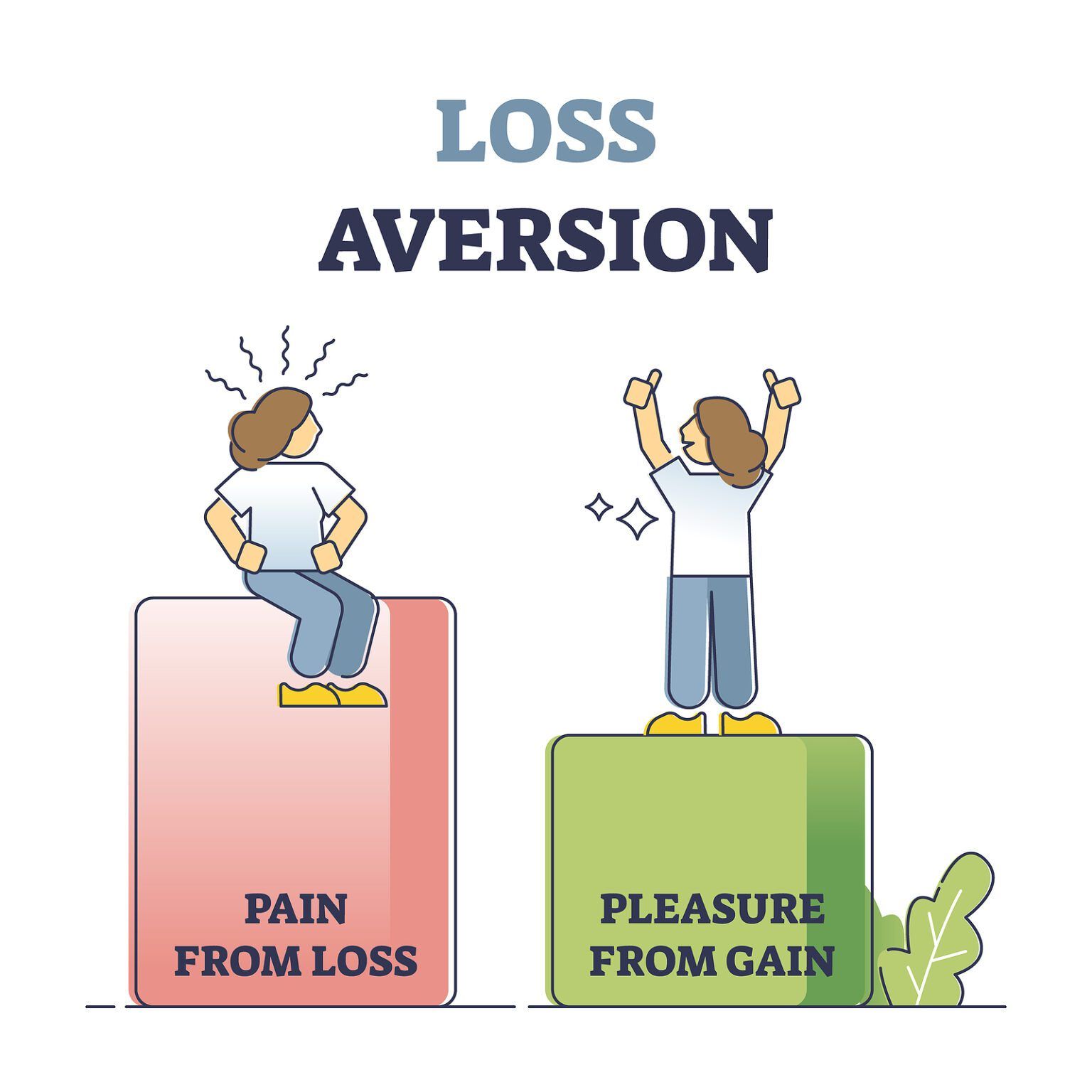
People commonly experience an equivalent loss as more painful than a gain is pleasurable, making the framing of an outcome consequential even when the amounts are identical. Loss aversion differs from risk aversion because it can shape choices with no uncertainty at all, relative to a reference point. The article connects this asymmetry to evolutionary pressures and measurable differences in neural responses to gains and losses.
Consider a coin flip. Heads, you win $150. Tails, you lose $100. The expected value of this gamble is positive: (0.5 x $150) + (0.5 x -$100) = +$25. A rational agent guided purely by expected monetary value should accept without hesitation.
Most people refuse. When Daniel Kahneman and Amos Tversky ran this problem systematically with experimental subjects in the late 1970s, they found that most participants required winning stakes of roughly $200 to $250 before they were willing to accept the bet - two to two-and-a-half times the potential loss of $100.
The asymmetry was not a product of confusion or innumeracy. It was a structural feature of how human minds evaluate outcomes. Losses, their research established, loom roughly 2 to 2.5 times larger in subjective experience than equivalent gains.
That finding, published in Econometrica in 1979, became the empirical foundation of modern behavioral economics.[1]
"Losses loom larger than gains: the pain of losing something is about twice as powerful as the pleasure of gaining something of equal value." - Daniel Kahneman & Amos Tversky, 1979
Definition
Loss aversion is the cognitive tendency for the subjective pain of losing a given amount to be approximately twice as intense as the subjective pleasure of gaining the same amount, such that the value function is steeper in the domain of losses than in the domain of gains relative to any reference point.
Loss Aversion vs. Risk Aversion
These two concepts are consistently conflated in popular discussion. They are related but structurally distinct phenomena with different mechanisms, different historical roots, and different empirical signatures.
| Dimension | Loss Aversion | Risk Aversion |
|---|---|---|
| Core claim | Losses hurt roughly twice as much as equivalent gains feel good | People prefer a certain outcome to a gamble with equal expected value |
| Domain of operation | Applies even between certain outcomes; framing as loss vs. gain changes preference without any uncertainty | Applies in choices involving uncertainty and probability |
| Theoretical origin | Kahneman & Tversky, 1979 Prospect Theory; value function asymmetric at reference point | Daniel Bernoulli, 1738; diminishing marginal utility of wealth produces concave utility curve |
| Mathematical signature | Kink in the value function at the reference point; loss slope steeper than gain slope | Concavity of the utility curve across all levels of wealth |
| Example | Being told you will pay a $10 surcharge feels worse than being told you will lose a $10 discount, even when amounts are identical | Preferring $50 guaranteed over a 50% chance at $100, even though expected values are equal |
| Eliminated by perfect information? | No - framing of the same certain outcome as a loss vs. a gain still changes behavior | Partially - risk-neutral agents given complete probability information should not exhibit pure risk aversion in standard expected utility models |
| Neural substrate | Amygdala central; asymmetric response in ventral striatum (Tom et al., 2007) | Associated with activity in prefrontal cortex and insula in uncertain-outcome contexts |
The critical test is this: remove all uncertainty. Present two certain outcomes that are mathematically identical - a $10 price described as a surcharge, or the same $10 described as the loss of a discount. Risk aversion cannot operate here; there is nothing to be uncertain about.
Yet loss aversion does operate, because the framing of one as a loss relative to a reference point activates the asymmetric valuation. This is what makes loss aversion a more fundamental departure from classical utility theory than risk aversion: it occurs in choices that involve no risk at all.
Cognitive Science: The Architecture of Loss
Evolutionary Context
The asymmetric weighting of losses and gains is not arbitrary. For the bulk of human evolutionary history, losses were not symmetric with gains in their consequences. Losing food, shelter, or social standing during a resource-scarce winter carried the possibility of death.
Acquiring an equivalent additional quantity of food offered a better meal. The stakes were structurally asymmetric, and cognition calibrated accordingly. Organisms that responded more urgently to threats of loss than to opportunities for gain left more descendants.
Loss aversion is the psychological residue of that selection pressure - a heuristic that was adaptive in the environment in which it evolved and that misfires in the abstract financial and professional decisions to which it is now routinely applied.
Neural Correlates
The neural underpinnings of loss aversion were mapped with unusual precision in a 2007 study by Sabrina Tom, Craig Fox, Christopher Trepel, and Russell Poldrack, published in Science (volume 315, pages 515-518).[6]
Using functional magnetic resonance imaging, they examined how neural activity tracked the potential gains and losses of mixed monetary gambles.
Activity in the ventral striatum - the brain's primary reward-processing region - scaled upward with potential gains and downward with potential losses, but the slope of response to losses was measurably steeper than the slope to gains.
The behavioral loss aversion coefficient of individual participants correlated directly with the asymmetry in their neural gain/loss response slopes. The subjective asymmetry that subjects reported was grounded in a measurable asymmetry in the underlying neural architecture.
The amygdala's role was established by a rare and consequential natural experiment.
Benedetto De Martino, Colin Camerer, and Ralph Adolphs published a 2010 study in the Proceedings of the National Academy of Sciences (volume 107, pages 3788-3792) examining two patients with focal bilateral amygdala lesions - damage confined to the amygdala with surrounding structures intact.
Both patients responded normally to changes in expected value and probability.
Both showed dramatically reduced loss aversion relative to healthy matched controls. The amygdala, the brain's primary threat-detection system, is the structure that amplifies the emotional weight of potential losses. Without it, the asymmetry largely disappears.
The implication is that loss aversion is not a reasoning error layered on top of correct perception - it is a feature of the emotional system that processes the evaluation, prior to and largely independent of explicit reasoning.
The Reference Point Problem
Kahneman and Tversky's 1979 framework introduced the concept of the reference point: losses and gains are not defined in absolute terms but relative to whatever state the decision-maker treats as the neutral baseline. Reference points shift.
They are set by current ownership, recent experience, social comparison, and expectation. The same outcome - a salary of $80,000 - is experienced as a gain by someone who expected $70,000, as neutral by someone who expected $80,000, and as a loss by someone who expected $90,000.
This reference-dependence means that the same objective state produces different subjective experiences depending on context, which is why framing and presentation matter so disproportionately in human decision-making.
Nathan Novemsky and Daniel Kahneman published a 2005 paper in the Journal of Marketing Research (volume 42, pages 119-128) titled "The Boundaries of Loss Aversion," which examined the conditions under which loss aversion applies and the conditions under which it does not.[5]
Their key finding: goods exchanged as intended in a transaction - money paid for a product, for example - are not coded as losses, even though they leave the decision-maker's possession.
Loss aversion applies to outcomes that the decision-maker did not intend to give up, not to the routine exchanges of normal commerce. A buyer does not experience handing over $30 for a book as a painful loss, because the exchange is the intended purpose of the transaction.
But if that same $30 is taken unexpectedly or framed as a price increase above what was expected, the loss framing activates.
This boundary condition is practically significant: it means that how transactions are structured and presented - as expected exchange versus unexpected cost - can dramatically affect whether loss aversion is triggered.
Four Case Studies
Case Study 1: The Housing Market (Genesove and Mayer, 2001)
David Genesove and Christopher Mayer published one of the most consequential real-estate studies in behavioral economics in the Quarterly Journal of Economics in 2001 (volume 116, pages 1233-1260).[8]
They analyzed condominium sales in downtown Boston from 1982 to 1997, a period that included a dramatic price boom of more than 150 percent followed by a bust of approximately 40 percent.
This created a natural experiment: sellers who faced nominal losses relative to their purchase price versus sellers who held nominal gains.
Sellers facing losses - whose expected market value fell below what they had originally paid - set asking prices 25 to 35 percent higher, as a proportion of the gap between purchase price and expected market value, than comparable sellers in gain positions.
They achieved selling prices 3 to 18 percent above prevailing market levels, but at substantial cost: dramatically extended time-on-market and a significantly reduced probability of selling at all.
The purchase price had become a psychological reference point. Selling below it felt like crystallizing a loss. To avoid that loss, sellers were willing to pay real economic costs - carrying costs, foregone investment, reduced liquidity - that in many cases exceeded the paper loss they were trying to avoid.
Owner-occupants showed the effect at roughly double the intensity of investors, suggesting that personal attachment and daily habitation amplified the reference point effect.
The study is important because it demonstrates loss aversion operating in a market with high stakes and sophisticated participants making deliberate, long-considered decisions. This is not a laboratory artifact. It was visible in actual property transactions across fifteen years of a real urban housing market.
Case Study 2: NFL Fourth-Down Decisions (Romer, 2006)
David Romer published a rigorous analysis in the Journal of Political Economy in 2006 (volume 114, pages 340-365) examining fourth-down decision-making in professional American football.[9]
The core question was simple: do NFL coaches go for it on fourth down at the frequency that maximizes expected points, or do they systematically deviate from the expected-value-maximizing strategy?
Romer calculated the expected-value-maximizing decision for every fourth-down situation across a large sample of regular season games, using historical conversion rates and field position data.
The finding was unambiguous: coaches systematically and substantially over-punt and over-kick field goals relative to what expected value analysis recommends.
On fourth-and-short from the opposing team's 35-yard line, for example, going for the first down has a higher expected point value than punting, yet coaches almost universally punt.
The dominant explanation is loss aversion applied to the loss of possession. Punting is the choice that avoids the immediate, salient, visible loss of failing to convert on fourth down.
Going for it on fourth down and failing produces a concrete, attributable, newsworthy loss - the defense takes over in good field position - that is given far more weight than the statistical analysis justifies.
The gain from converting is diffuse and probabilistic; the loss from failing is immediate and vivid.
Romer estimated that the magnitude of the suboptimal decision-making cost teams approximately 0.4 points per game on average - modest in any single game but compounding significantly across a season and career. Subsequent analyses using more granular win probability models have confirmed and extended the finding.
Professional coaches with decades of experience, operating under explicit performance incentives and with access to statistical analysis staff, systematically sacrifice expected wins to avoid the pain of a visible, attributable failure. This is loss aversion operating at the highest level of a major professional sport.
Case Study 3: The Endowment Effect (Kahneman, Knetsch, and Thaler, 1990)
The most replicated laboratory demonstration of loss aversion as mechanism is the endowment effect mug experiment published by Daniel Kahneman, Jack Knetsch, and Richard Thaler in the Journal of Political Economy in 1990 (volume 98, pages 1325-1348).[4]
Coffee mugs were randomly distributed to half the participants in experiments at Cornell University. Markets were then conducted. Sellers - those who had received mugs - were asked the minimum price at which they would sell.
Buyers - those without mugs - were asked the maximum they would pay. Choosers were offered the option of receiving either a mug or its cash equivalent.
The median selling price was $7.12. The median buying price was $2.87. Choosers valued the mug at approximately $3.12 - closely matching buyers, not sellers.
The Coase theorem predicts that trade will occur whenever there is a mutually beneficial price; with buyers and sellers randomly assigned, approximately half the mugs should change hands.
Observed trading volume was consistently and significantly below this prediction. The mechanism was precisely what prospect theory specified: for sellers, giving up the mug was coded as a loss relative to the reference point of ownership.
Losses require roughly 2.5 times the compensation that buyers demand in gains. The gap between willingness to accept and willingness to pay is the endowment effect - and the endowment effect is loss aversion applied to ownership.
Tversky and Kahneman addressed the endowment effect directly in their 1991 paper "Loss Aversion in Riskless Choice: A Reference-Dependent Model," published in the Quarterly Journal of Economics (volume 106, pages 1039-1061).[2]
This paper extended the loss aversion framework from risky gambles - its original context - to riskless choices between goods and money, establishing that the asymmetric valuation of losses and gains is not limited to probabilistic gambles but operates wherever a reference point is present.
Case Study 4: New York City Taxi Drivers (Camerer et al., 1997)
Colin Camerer, Linda Babcock, George Loewenstein, and Richard Thaler published a field study of New York City taxi driver labor supply decisions in the Quarterly Journal of Economics in 1997 (volume 112, pages 407-441).[10]
Using trip sheet data across hundreds of thousands of individual trips, they examined whether drivers worked more hours on high-earning days - as standard labor economics predicts - or whether their behavior conformed to a different pattern.
Drivers worked shorter shifts on high-earning days and longer shifts on low-earning days. Standard economic theory predicts the opposite: rational workers should supply more labor when the effective hourly wage is high. The behavioral explanation was loss aversion operating through daily income targets.
Drivers appeared to set an informal daily earnings reference point. Exceeding the target felt pleasant but not urgent; continuing to work offered only additional gains with diminishing urgency.
Falling short of the target felt like a loss, and losses, being weighted roughly twice as heavily, motivated extended working hours to avoid crystallizing the shortfall.
The estimated wage elasticity for inexperienced drivers was approximately -1 in two of three data samples - a strongly negative relationship between effective hourly earnings and hours worked, the signature of daily income targeting driven by loss aversion.
The researchers estimated the behavioral pattern cost drivers approximately 5 percent of potential annual earnings.
Intellectual Lineage
The concept of loss aversion did not emerge in isolation. It was the product of a specific intellectual challenge to a specific dominant paradigm, and its genealogy runs through several centuries of economic and psychological thought.
Classical decision theory, from Adam Smith's utility discussions through Jeremy Bentham's hedonic calculus to Daniel Bernoulli's 1738 formalization of diminishing marginal utility, assumed that rational agents evaluate outcomes in terms of their final states of wealth.
A gain of $100 and a loss of $100 were symmetric: they moved the utility function the same distance in opposite directions, weighted by the local slope of the curve.
The asymmetry between losses and gains was not modeled because it was not considered: it was treated either as absent or as reducible to diminishing marginal utility (the concavity of the utility curve means that $100 gained in a rich state is worth less than $100 lost in a poor state, but this is risk aversion, not loss aversion).
John von Neumann and Oskar Morgenstern's 1944 axiomatization of expected utility theory gave the classical model its most rigorous formulation and its most explicit predictions.
Maurice Allais cracked the framework in 1952 by demonstrating that actual human choices systematically violated the independence axiom of expected utility theory - the Allais Paradox. But Allais's demonstration was a finding without a replacement model.
Kahneman and Tversky filled that gap. Through a series of precisely designed experiments conducted at Hebrew University across the 1970s, they documented the systematic ways in which human choice under uncertainty deviated from expected utility predictions - not randomly, but in predictable, coherent patterns.
Their 1979 paper in Econometrica (volume 47, pages 263-291) provided both the empirical documentation and the alternative model: Prospect Theory, with its reference-dependent value function, asymmetric loss/gain weighting, and probability weighting function that overweights small probabilities and underweights large ones.
The paper is today the most cited paper ever published in Econometrica, the leading technical journal in economics.
The decision to submit to Econometrica was not incidental. Kahneman and Tversky were psychologists by training.
Publishing in the most mathematically demanding economics journal was a deliberate strategic choice to engage economists in the formal language they respected rather than producing psychological findings that economists could dismiss as domain-irrelevant.
Richard Thaler, then at the University of Rochester, read the 1979 paper and immediately recognized its implications for consumer behavior and market outcomes.[15]
His 1980 paper "Toward a Positive Theory of Consumer Choice," in the Journal of Economic Behavior and Organization (volume 1, pages 39-60), introduced the endowment effect and mental accounting concepts, applying loss aversion to everyday economic phenomena.
His subsequent collaboration with Kahneman and Knetsch on the mug experiments and his development of the "Save More Tomorrow" automatic escalation retirement savings program with Shlomo Benartzi demonstrated that loss aversion could be identified, described, and redirected into beneficial architectures rather than merely documented.
Kahneman received the Nobel Memorial Prize in Economic Sciences in 2002, shared with experimental economist Vernon Smith - the first time the prize had been awarded to a psychologist. Amos Tversky had died of melanoma in June 1996 at age 59; the Nobel is not awarded posthumously.
Kahneman accepted the prize with explicit acknowledgment that Tversky bore equal intellectual responsibility for every finding they produced together. Richard Thaler received the Nobel in 2017, with the committee specifically citing his role in transforming behavioral insights into a rigorous applied science of policy design.
Empirical Research
The empirical literature on loss aversion spans five decades, multiple methodologies, and an exceptional range of real-world contexts.
The original Kahneman and Tversky (1979) paper estimated the loss aversion coefficient at approximately 2 to 2.5 based on choices among hypothetical monetary gambles presented to Israeli and American university students.
Their 1992 cumulative prospect theory paper, "Advances in Prospect Theory: Cumulative Representation of Uncertainty," in the Journal of Risk and Uncertainty (volume 5, pages 297-323), refined the estimate to approximately 2.25 and reformulated the probability weighting function to eliminate first-order stochastic dominance violations in the original model.[3]
Tversky and Kahneman's 1991 Quarterly Journal of Economics paper extended the evidence base from risky gambles to riskless choices, establishing that the fundamental asymmetry between losses and gains operates even when no probability weighting is involved - a critical extension that grounds loss aversion in the basic structure of preference rather than in judgment under uncertainty alone.
Novemsky and Kahneman (2005) in the Journal of Marketing Research refined the conditions under which the loss frame activates, showing that intended exchanges - money paid in normal commerce - are not coded as losses, while unexpected costs, price increases above expectation, and foregone savings are.
This boundary condition has practical implications for pricing strategy, subscription models, and negotiation framing.
Tom et al. (2007) in Science provided neural grounding, correlating individual behavioral loss aversion coefficients with the asymmetry in ventral striatum responses to potential gains versus losses across a series of mixed gambles.
The loss/gain neural asymmetry predicted behavioral loss aversion both at the group level and at the individual level.
De Martino, Camerer, and Adolphs (2010) in the Proceedings of the National Academy of Sciences established causal evidence for the amygdala's role by showing that bilateral amygdala lesions sharply reduce loss aversion while leaving expected-value sensitivity intact.[7]
The dissociation between loss aversion (impaired) and expected-value computation (preserved) is important: it establishes that loss aversion is not a computational heuristic that can be overridden by the same system that computes value. It is a separate emotional weighting process with distinct neural hardware.
A 2017 meta-analysis by Wang, Rieger, and Hens, in the Journal of Behavioral Decision Making (volume 30, pages 270-281), synthesized cross-cultural data from 53 countries and found that loss aversion coefficients vary significantly across cultures.[13]
The effect was weakest in collectivist East Asian societies and strongest in individualist Western societies.
The proposed mechanism - the "cushion hypothesis" - holds that societies with stronger social safety nets and risk-sharing norms reduce the catastrophic asymmetry of real-world losses, which in turn reduces the adaptive pressure that calibrates loss aversion.
The finding means that the loss aversion coefficient is not a universal human constant but a culturally and institutionally modulated tendency.
Limits and Nuances
Loss aversion is among the most robust findings in behavioral science, but a mature understanding of the concept requires attention to the conditions under which it weakens, disappears, or ceases to constitute a bias.
When Loss Aversion Is Rational
The most fundamental limit is that loss aversion is not always irrational. If the structure of a game involves ruin - if losing eliminates the player from future play - then weighting potential losses more heavily than equivalent gains is not a bias.
It is the correct strategy. Kelly criterion betting, developed by John Kelly at Bell Labs in 1956, is a formal expression of this principle: the optimal bet size for a player with finite bankroll is determined by the asymmetry between ruin (game-ending) and profit (game-continuing), not by the symmetric expected value of individual bets.
Nassim Nicholas Taleb has made a related point about ergodicity: for a system in which one catastrophic loss cannot be recovered from, the time-average behavior diverges from the ensemble-average, and loss-heavy weighting is mathematically appropriate.
Loss aversion is adaptive precisely in environments with catastrophic downside risk. The problem is that the same system applies this weighting to routine, reversible, small-stakes decisions where the ruin logic does not hold.
Professional Experience as Partial Attenuator
Michael Haigh and John List published a 2005 study in the Journal of Finance (volume 60, pages 523-534) comparing professional futures traders at the Chicago Board of Trade with student controls in myopic loss aversion experiments - paradigms involving repeated investment choices under short evaluation windows.[11]
Professional traders showed significantly lower myopic loss aversion than students in the short-evaluation conditions. Professional training and sustained high-frequency feedback appeared to partially suppress the bias in the relevant domain.
The finding has boundary conditions: it applies to the specific type of decision that professionals make repeatedly with clear feedback, not to novel loss-gain tradeoffs outside their professional domain.
Peter Sokol-Hessner, Ming Hsu, Nicole Curley, Mauricio Delgado, Colin Camerer, and Elizabeth Phelps published a 2009 paper in the Proceedings of the National Academy of Sciences (volume 106, pages 5035-5040) on reframing high-stakes decisions.
They showed that instructing subjects to adopt a detached "trader's perspective", to think about the current gamble as one of many rather than as an isolated high-stakes decision, reduced loss aversion and its associated physiological stress responses significantly compared to normal choice conditions.[12]
Cognitive framing, even without professional experience, can modulate the degree to which the loss aversion circuit activates. This suggests partial tractability: while loss aversion cannot be eliminated, its influence on specific decisions can be reduced through deliberate reframing and context manipulation.
The Boundaries of Novemsky and Kahneman
As established in their 2005 Journal of Marketing Research paper, Novemsky and Kahneman demonstrated that money paid in the context of intended exchange is not coded as a loss. Buyers who pay $40 for a product they intended to buy do not experience loss aversion over the $40 departure.
But the same $40 framed as an unexpected surcharge, a price increase above expectation, or a fee that was not anticipated at the point of purchase does trigger loss aversion.
The boundary is between expected exchange (no loss aversion) and unexpected cost (loss aversion activated).
This explains why shrinkflation - reducing product quantity without changing price - is a strategically preferred alternative to overt price increases: the unexpected price increase triggers loss aversion in a way that a gradual, less salient quantity reduction does not.
Cross-Cultural Variation
Wang, Rieger, and Hens (2017) found that the loss aversion coefficient varies meaningfully across the 53 countries in their sample. The finding challenges any claim that a specific numerical coefficient (2.25, or 2 to 2.5) is a universal human constant.
The coefficient is a population-level central tendency that appears to be modulated by cultural norms, institutional structures, and the actual asymmetry of real-world stakes in the relevant society. Loss aversion is a robust cross-cultural tendency, but its magnitude is not fixed.
Awareness Does Not Eliminate the Bias
Kahneman noted explicitly - in Thinking, Fast and Slow (2011) and in numerous interviews - that after decades of studying loss aversion, he remained unable to eliminate his own. The neural architecture that amplifies loss responses fires before deliberate reasoning engages.
System 1 generates the asymmetric emotional response; System 2 then operates on an already-distorted input.[14] Knowing about loss aversion is necessary for designing decision architectures that account for it but is not sufficient for overriding it in real-time.
The practical implication is that interventions should focus on structural design - pre-commitment devices, default settings, evaluation criteria established before stakes are visible - rather than on in-the-moment appeals to rationality.
Sources & Further Reading
Kahneman, D., & Tversky, A. (1979). Prospect theory: An analysis of decision under risk. Econometrica, 47(2), 263-291.
Tversky, A., & Kahneman, D. (1991). Loss aversion in riskless choice: A reference-dependent model. Quarterly Journal of Economics, 106(4), 1039-1061.
Tversky, A., & Kahneman, D. (1992). Advances in prospect theory: Cumulative representation of uncertainty. Journal of Risk and Uncertainty, 5(4), 297-323.
Kahneman, D., Knetsch, J. L., & Thaler, R. H. (1990). Experimental tests of the endowment effect and the Coase theorem. Journal of Political Economy, 98(6), 1325-1348.
Novemsky, N., & Kahneman, D. (2005). The boundaries of loss aversion. Journal of Marketing Research, 42(2), 119-128.
Tom, S. M., Fox, C. R., Trepel, C., & Poldrack, R. A. (2007). The neural basis of loss aversion in decision-making under risk. Science, 315(5811), 515-518.
De Martino, B., Camerer, C. F., & Adolphs, R. (2010). Amygdala damage eliminates monetary loss aversion. Proceedings of the National Academy of Sciences, 107(8), 3788-3792.
Genesove, D., & Mayer, C. (2001). Loss aversion and seller behavior: Evidence from the housing market. Quarterly Journal of Economics, 116(4), 1233-1260.
Romer, D. (2006). Do firms maximize? Evidence from professional football. Journal of Political Economy, 114(2), 340-365.
Camerer, C., Babcock, L., Loewenstein, G., & Thaler, R. (1997). Labor supply of New York City cab drivers: One day at a time. Quarterly Journal of Economics, 112(2), 407-441.
Haigh, M. S., & List, J. A. (2005). Do professional traders exhibit myopic loss aversion? An experimental analysis. Journal of Finance, 60(1), 523-534.
Sokol-Hessner, P., Hsu, M., Curley, N. G., Delgado, M. R., Camerer, C. F., & Phelps, E. A. (2009). Thinking like a trader selectively reduces individuals' loss aversion. Proceedings of the National Academy of Sciences, 106(13), 5035-5040.
Wang, M., Rieger, M. O., & Hens, T. (2017). The impact of culture on loss aversion. Journal of Behavioral Decision Making, 30(2), 270-281.
Kahneman, D. (2011). Thinking, Fast and Slow. Farrar, Straus and Giroux.
Thaler, R. H. (1980). Toward a positive theory of consumer choice. Journal of Economic Behavior and Organization, 1(1), 39-60.
Further Reading
Samuelson, W., & Zeckhauser, R. (1988). Status quo bias in decision making. Journal of Risk and Uncertainty, 1(1), 7-59.