
It is one of the most anxiety-producing facts of modern parenting culture: a section of virtually every bookstore is devoted to reassuring parents that if they just read enough, attend carefully enough, and choose the right style, they can optimize their children's outcomes.
The books sell in enormous numbers. They contradict each other on nearly everything. Attachment parenting vs. Babywise scheduling. Tiger Moms vs. permissive Scandinavians.
Free-range children vs. helicopter supervision. The market for parenting advice is essentially unlimited because the anxiety that drives it is essentially unlimited, and because the question it promises to answer - what should I do to help my child thrive? - is genuinely among the most important any person ever asks.
Diana Baumrind did not start with that question. When she began her systematic observations of preschool children at UC Berkeley in the early 1960s, she was trying to understand why some children were notably more self-reliant, curious, and socially competent than others.
She suspected that parenting was involved, but she did not assume it. She watched children in free play, in structured situations, and under stress. She identified distinct patterns of social competence.
Then she went home with the children - literally, making extensive home visits - and watched their parents. What she found shaped developmental psychology for the next six decades.
The children who were most socially competent, curious, and self-controlled had parents who combined warmth and responsiveness with clear, consistent, and reasoned expectations. They were not the strictest parents (those had children who were obedient but less self-reliant).
They were not the most permissive parents (those had children who were more impulsive and less persistent). They were something more demanding and more nuanced: parents who were both demanding and responsive.
Baumrind called this pattern authoritative. The name has caused confusion ever since - it is distinct from authoritarian, though generations of students have confused the two - but the empirical finding behind it has proven remarkably durable.
"The question 'what is the best way to parent?' has a real answer, in the sense that some parenting approaches reliably produce better average outcomes across populations.
But the question 'does parenting matter as much as parents believe?' has a different and more disturbing answer." - Judith Rich Harris, The Nurture Assumption, 1998
Key Definitions
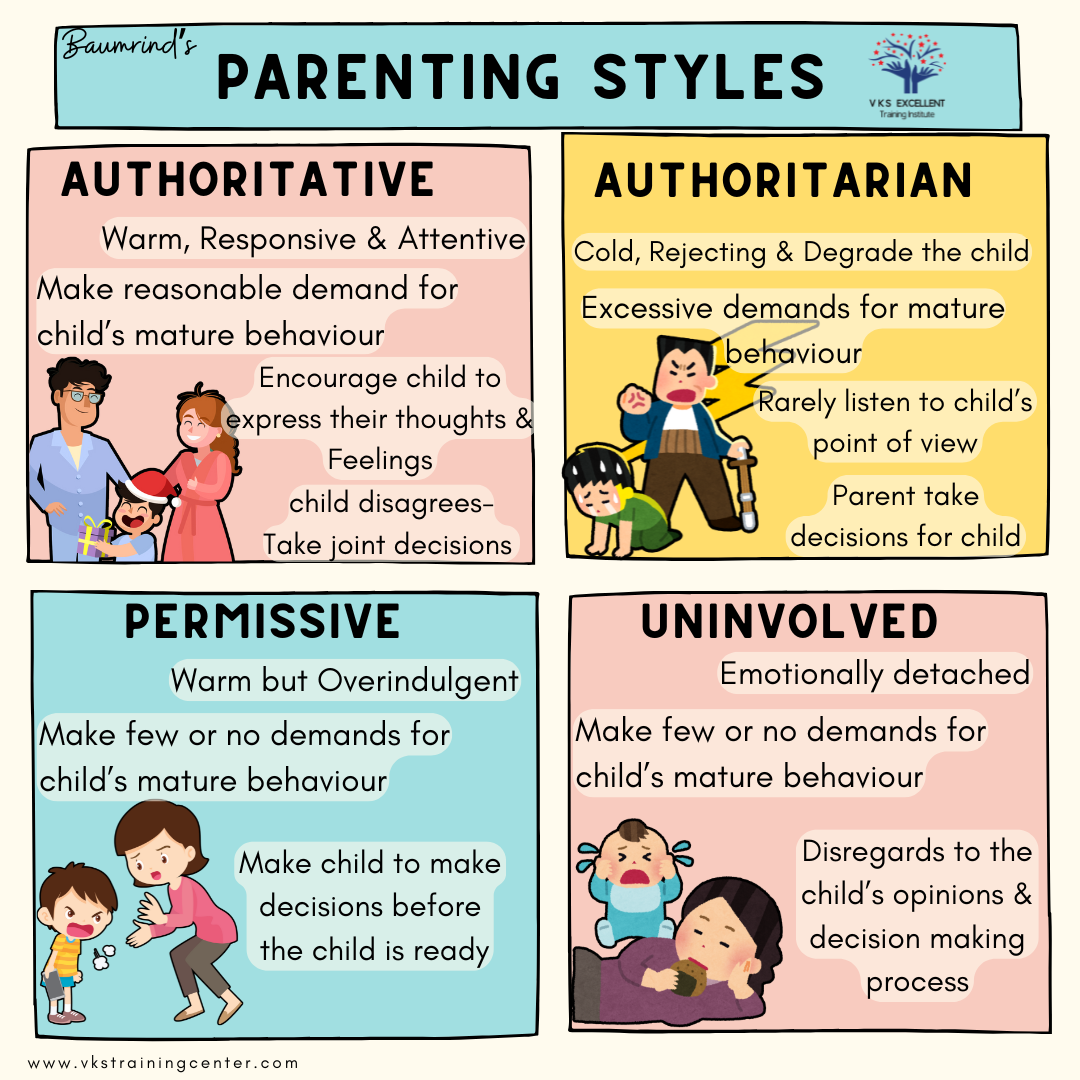
Authoritative parenting: Baumrind's term for the style characterized by high warmth and responsiveness combined with high structure, consistent expectations, and reasoning rather than arbitrary enforcement.
Children are listened to and their needs are taken seriously; rules are explained rather than simply imposed; autonomy is supported within appropriate limits. Associated with the best average outcomes across cognitive, social, and emotional domains in Western samples.
Authoritarian parenting: High demands with low warmth; obedience-focused, rule-following, with punishment for non-compliance but limited explanation or negotiation.
Associated with children who are obedient and proficient in structured environments but show less independent initiative, lower self-esteem in some studies, and more behavioral problems in adolescence - though cultural context significantly moderates these effects.[11]
| Parenting Style | Warmth | Control | Child Outcomes |
|---|---|---|---|
| Authoritative | High | Moderate (firm, consistent) | Best outcomes: high self-esteem, academic success, social competence |
| Authoritarian | Low | High (rigid, punitive) | Lower self-esteem, poorer social skills, higher anxiety |
| Permissive | High | Low (indulgent, few rules) | Poor self-regulation, lower academic achievement |
| Uninvolved | Low | Low (neglectful) | Worst outcomes: behavioral problems, poor attachment, academic failure |
Permissive parenting: High warmth with low demands; responsive and indulgent, avoiding confrontation and rarely enforcing expectations. Associated with lower academic achievement, lower self-regulation, and higher rates of impulsive behavior in some studies, though children show high social confidence and creativity in others.
Uninvolved/neglectful parenting: Low demands combined with low warmth; emotionally disengaged, providing minimal supervision, guidance, or emotional support. Associated with the worst outcomes across all measured domains - this category overlaps substantially with the adverse childhood experiences literature.
Attachment security: The quality of the emotional bond between infant and primary caregiver as assessed by the Strange Situation Procedure (Ainsworth, 1970s): secure, anxious-ambivalent, avoidant, or disorganized.[4]
Secure attachment - in which the caregiver is experienced as a reliable safe haven and the world is experienced as safe enough to explore - is associated with better social competence, emotional regulation, and relationship quality in subsequent development, though the effect sizes are more modest than popular attachment parenting advocacy suggests.
Baumrind's Four Styles: The Foundational Research
Diana Baumrind's initial work was longitudinal, intensive, and qualitatively rich in ways that subsequent large-scale survey studies have struggled to replicate. Her 1967 and 1971 papers, drawing on detailed observational data from preschoolers and their families, established the basic taxonomy.
Her subsequent follow-up of these same children through adolescence (published in 1991) found that the advantages associated with authoritative parenting were remarkably stable: the children of authoritative parents in the preschool study showed significantly higher academic competence, social maturity, and lower rates of substance use and internalizing problems as adolescents, compared to children of authoritarian or permissive parents.
The effect sizes in Baumrind's work are substantial enough to be policy-relevant.[1]
Her 1991 study found that adolescent competence scores - a composite of cognitive, social, and behavioral dimensions - were approximately 0.5 standard deviations higher for children of authoritative parents than for children of authoritarian parents, and approximately 0.7 standard deviations higher than for children of uninvolved parents.
These are meaningful differences, not trivial statistical artifacts.
Subsequent research by Laurence Steinberg and colleagues, using large-scale survey samples of adolescents across multiple US states, replicated and extended Baumrind's findings.[6]
Their 1992 study of approximately 6,000 teenagers found consistent advantages for authoritative parenting on academic achievement, self-reliance, and social competence, even after controlling for demographic variables.
Steinberg's work also identified a key mechanism: authoritative parents were more likely to grant appropriate psychological autonomy as children matured, which facilitated the development of self-regulation and intrinsic motivation rather than dependence on external control.
The Behavior Genetics Challenge
The most significant challenge to the straightforward parenting-causes-outcomes story comes not from alternative developmental theories but from behavior genetics.
The logic of this challenge has been clear since the work of behavioral geneticists in the 1980s and 1990s, but it gained popular salience with Judith Rich Harris's 1998 book The Nurture Assumption.
Harris, a textbook author without academic affiliation, synthesized the behavior genetics literature to make a provocative argument: the evidence for shared family environment - the conditions experienced by all children in a family, and which most people assume includes parenting style - was surprisingly weak for most developmental outcomes.[2]
Twin studies, which compare identical twins (sharing 100% of their genes) to fraternal twins (sharing 50%), can partition variation in outcomes into three sources: genetic factors, shared environment (what identical and fraternal twins have in common), and non-shared environment (what makes twins different from each other despite sharing a family).
The striking finding, replicated across hundreds of such studies, is that shared environment typically explains only 0-10% of variance in personality traits, academic achievement, and most behavioral outcomes measured in adulthood.
Genetic factors typically account for approximately 50%, and non-shared environment (which includes peer relationships, differential treatment by parents, and random developmental events) accounts for the remaining 40-50%.
Harris's conclusion was that parents were essentially failing to show up in the data as the dominant force they are assumed to be. The consistent finding that adopted children resemble their biological parents more than their adoptive parents on most personality and behavioral measures is particularly striking.
The response to Harris from developmental psychologists was vigorous. Several lines of criticism deserve acknowledgment.
First, behavior genetics studies typically measure environmental variation within normal ranges - they do not capture the effects of severely deprived or abusive environments, which are specifically excluded from most samples.
Second, what twin studies call "non-shared environment" is a residual category that includes measurement error as well as genuinely environmental factors; the true contribution of peer and non-family experiences is therefore uncertain.
Third, the absence of shared environment effects on adult personality does not mean parenting has no effects on childhood wellbeing, academic outcomes in specific developmental windows, or the quality of the parent-child relationship itself, which has intrinsic value.
Attachment Theory: What Bowlby and Ainsworth Found
Parallel to Baumrind's work, the attachment theory tradition established by John Bowlby and Mary Ainsworth generated a different but complementary set of findings about the consequences of early caregiving.
Bowlby, a British psychiatrist and psychoanalyst, developed his theory of attachment in the 1950s-70s drawing on ethological observations of other primates and his own clinical experience with children who had experienced early maternal deprivation.[3]
His three-volume Attachment and Loss (1969, 1973, 1980) proposed that human infants are biologically primed to form strong selective attachments to primary caregivers, and that the security of these attachments - determined by the caregiver's consistent responsiveness - shapes the child's developing model of relationships: whether others can be trusted, whether the self is worthy of care, and whether the world is safe enough to explore.
Mary Ainsworth operationalized these ideas in the Strange Situation Procedure (1970), a standardized laboratory observation in which infants' responses to brief separations from and reunions with their caregiver are coded to classify attachment as secure, anxious-ambivalent, avoidant, or (added later by Mary Main) disorganized.
Securely attached infants use the caregiver as a secure base for exploration, show distress at separation, and are soothed by reunion. Insecure patterns reflect different strategies for managing the emotional consequences of inconsistent or inadequate caregiving.
The evidence for long-term consequences of infant attachment security is real but more modest in magnitude than the popular attachment parenting movement typically acknowledges.
A 2016 meta-analysis by Pinquart and colleagues, pooling data from 127 studies, found correlations in the range of r=0.25-0.30 between infant attachment security and social competence in middle childhood, with smaller effects on academic outcomes.
These are statistically reliable effects but explain a small fraction of variance - meaning that infant attachment security is one of many factors shaping later development, not a determinant of it.
The importance of recognizing developmental plasticity - the brain's capacity for change across the lifespan - is particularly relevant here.
The Harvard Center on the Developing Child, drawing on research by Charles Nelson and others, emphasizes that sensitive periods in development create windows of heightened plasticity, but these windows do not foreclose later change.
Children who experienced early insecure attachment can and do form secure relationships later. Adverse early experiences increase risk; they do not determine outcome.
The ACEs Study: When Parenting Genuinely Harms
If the behavior genetics literature argues that differences between moderate parenting styles matter less than typically assumed, the ACEs (Adverse Childhood Experiences) literature provides equally clear evidence that severe adversity in childhood has profound and lasting biological effects.
Vincent Felitti and Robert Anda's ACEs study, launched in 1995 with Kaiser Permanente in San Diego, initially recruited over 17,000 predominantly white, middle-class adults seeking routine medical care.[5]
Participants completed a survey measuring exposure to ten categories of childhood adversity - physical, sexual, and emotional abuse; physical and emotional neglect; and five categories of household dysfunction including parental substance abuse, mental illness, incarceration, and domestic violence.
The results were analyzed against medical records and self-reported health outcomes.
The dose-response relationship was striking and consistent across outcomes. Compared to individuals with zero ACEs, those with four or more ACEs showed: a 7-fold increase in alcoholism, a 10-fold increase in intravenous drug use, a 4-fold increase in depression, a 12-fold increase in attempted suicide, a 2-fold increase in ischemic heart disease, and a significant increase in cancers, chronic lung disease, liver disease, and premature mortality.
The biological mechanism involves what researchers call the toxic stress response. Normal stress (a manageable challenge that builds competence) and tolerable stress (a serious adversity buffered by supportive relationships) produce adaptive outcomes.
Toxic stress - strong, prolonged adversity activation without the buffer of a supportive adult - produces lasting changes in neural architecture, particularly in prefrontal cortex development (affecting executive function), hippocampal development (affecting memory and stress regulation), and the functioning of the hypothalamic-pituitary-adrenal (HPA) axis.
These biological changes persist into adulthood and explain the elevated physical health risks associated with high ACE scores.
The ACEs findings have direct implications for parenting: they establish that the extreme end of the parenting spectrum - not neglect as a style but genuine deprivation, abuse, and household chaos - produces biological harm with decades-long consequences.
The Felitti-Anda findings do not support the view that parenting style differences within normal ranges have comparably large effects, but they strongly support the view that children require minimally adequate caregiving for healthy development.
Helicopter Parenting: The Costs of Protection
A different end of the parenting spectrum has attracted substantial research attention since the early 2000s: the intensive, over-involved parenting style variously called helicopter parenting, intensive parenting, or concerted cultivation (in sociologist Annette Lareau's framing from her 2003 ethnographic study Unequal Childhoods).[12]
Julie Lythcott-Haims, former Dean of Freshmen at Stanford, documented this phenomenon from the institutional perspective in How to Raise an Adult (2015): students arriving at elite universities who had never chosen their own courses, managed a conflict without parental intervention, or experienced a consequence that a parent had not appealed.[10]
The anecdotal case was compelling; the research evidence developed alongside it.
A 2014 study by Holly Schiffrin and colleagues at the University of Mary Washington, surveying 297 undergraduates, found that self-reported helicopter parenting was associated with lower autonomy, lower competence, lower relatedness, and lower overall life satisfaction compared to students reporting less intrusive parenting.[8]
The effects were mediated by reduced satisfaction of basic psychological needs (autonomy, competence, relatedness - the triad central to Self-Determination Theory).
A 2016 study by Nicole Perry and colleagues found that children of helicopter parents showed worse executive function development, with effects attributable to reduced opportunities for self-directed problem-solving.
The mechanism appears to operate through practice deprivation: children develop competence by encountering problems and solving them, experiencing failure and recovering, and gradually calibrating their own capabilities.
Parents who consistently remove obstacles, resolve conflicts, and protect children from failure are not protecting their children; they are preventing the developmental experiences through which competence is constructed.
Carol Dweck's growth mindset research adds a relevant dimension. Dweck and colleagues showed that praising children for intelligence rather than effort produces a fixed mindset orientation - children avoid challenging tasks that might reveal that they are not smart - while effort-focused praise produces a growth mindset orientation more associated with persistence and learning.[9]
The helicopter parenting pattern often involves process-undermining rather than process-praising: parents take over rather than encouraging effort, and protect from failure rather than processing failure as information.
Cultural Variation: The WEIRD Problem
Almost all of the research described above was conducted in Western, Educated, Industrialized, Rich, and Democratic (WEIRD) samples - primarily the United States, with some British and other European data.
Cross-cultural developmental research has found significant variation in both the prevalence of parenting styles and their consequences.
Ruth Chao's influential 1994 paper challenged the straightforward application of Baumrind's framework to Chinese-American families.
Chao observed that many Chinese-American parenting practices would be classified as authoritarian by Baumrind's criteria - high control, less verbal explanation, strong emphasis on academic performance and parental authority - yet Chinese-American children consistently show strong academic outcomes.
Chao argued that the authoritarian classification misapplied a Western individualist framework to practices whose meaning in collectivist cultural contexts was fundamentally different: parental involvement and high expectations expressed care rather than control.[7]
Subsequent research has found similar patterns in Korean-American, Japanese, and other East Asian samples. It has also found cultural variation in the optimal balance of parental warmth and control in African-American, Latino, and other US subgroup samples.
The most defensible interpretation is that Baumrind's authoritative style represents an effective approach within Western individualist cultural contexts, but that the components that make it effective - responsiveness, emotional support, age-appropriate autonomy scaffolding, consistent and fair expectations - may be expressed through different behavioral practices across cultures.
Amy Chua's Battle Hymn of the Tiger Mother (2011) popularized these debates beyond the academy and generated significant heat.
Her account of intensive Chinese parenting was less empirical than polemical, but it focused attention on genuine research questions about cultural variation in parenting that the mainstream literature had inadequately addressed.
Practical Takeaways
The research supports several conclusions that are more specific and defensible than the parenting advice industry typically provides.
First, the authoritative combination of warmth and consistent expectations represents the best-supported approach for general use in Western cultural contexts.
The key is that warmth and structure are complementary, not competing: children need both to develop the secure base from which to explore and the regulatory scaffolding that external structure initially provides.
Second, the distinction between involvement and intrusion is crucial. Parental involvement in children's lives, combined with warmth and appropriate monitoring, is associated with positive outcomes.
Parental intrusion - taking over tasks children could manage themselves, resolving conflicts that children could negotiate, protecting from consequences that would provide learning - appears to harm the development of self-regulation and competence.
Third, the ACEs evidence establishes a clear floor: children require freedom from abuse, neglect, and severe household dysfunction to develop normally. The biological consequences of toxic stress are real, dose-dependent, and preventable.
The public health priority should be directing intensive support to families at risk of adverse experiences, not optimizing differences between adequate parenting styles.
Fourth, the behavior genetics findings call for proportionality: parents probably matter less than parenting culture suggests, peers and genetics matter more.
This is not a license for indifference but a call for perspective - and for reducing the anxiety-driven hypervigilance that produces the over-parenting documented in the helicopter research.
For the broader context of how school environments interact with these developmental foundations, see what is wrong with education. For the related question of how childhood social environments predict adult social wellbeing, including the consequences of early isolation, see why loneliness is a public health crisis.
Sources & Further Reading
- Baumrind, D. (1991). The influence of parenting style on adolescent competence and substance use. Journal of Early Adolescence, 11(1), 56-95.
- Harris, J. R. (1998). The Nurture Assumption: Why Children Turn Out the Way They Do. Free Press.
- Bowlby, J. (1969). Attachment and Loss: Vol. 1. Attachment. Basic Books.
- Ainsworth, M. D. S., Blehar, M. C., Waters, E., & Wall, S. (1978). Patterns of Attachment: A Psychological Study of the Strange Situation. Lawrence Erlbaum Associates.
- Felitti, V. J., Anda, R. F., et al. (1998). Relationship of childhood abuse and household dysfunction to many of the leading causes of death in adults. American Journal of Preventive Medicine, 14(4), 245-258.
- Steinberg, L., Lamborn, S. D., Darling, N., Mounts, N. S., & Dornbusch, S. M. (1994). Over-time changes in adjustment and competence among adolescents from authoritative, authoritarian, indulgent, and neglectful families. Child Development, 65(3), 754-770.
- Chao, R. K. (1994). Beyond parental control and authoritarian parenting style: Understanding Chinese parenting through the cultural notion of training. Child Development, 65(4), 1111-1119.
- Schiffrin, H. H., Liss, M., Miles-McLean, H., Geary, K. A., Erchull, M. J., & Tashner, T. (2014). Helping or hovering? The effects of helicopter parenting on college students' well-being. Journal of Child and Family Studies, 23(3), 548-557.
- Dweck, C. S. (2006). Mindset: The New Psychology of Success. Random House.
- Lythcott-Haims, J. (2015). How to Raise an Adult: Break Free of the Overparenting Trap and Prepare Your Kid for Success. Henry Holt.
- Pinquart, M. (2017). Associations of parenting dimensions and styles with externalizing problems of children and adolescents: An updated meta-analysis. Developmental Psychology, 53(5), 873-932.
- Lareau, A. (2003). Unequal Childhoods: Class, Race, and Family Life. University of California Press.