
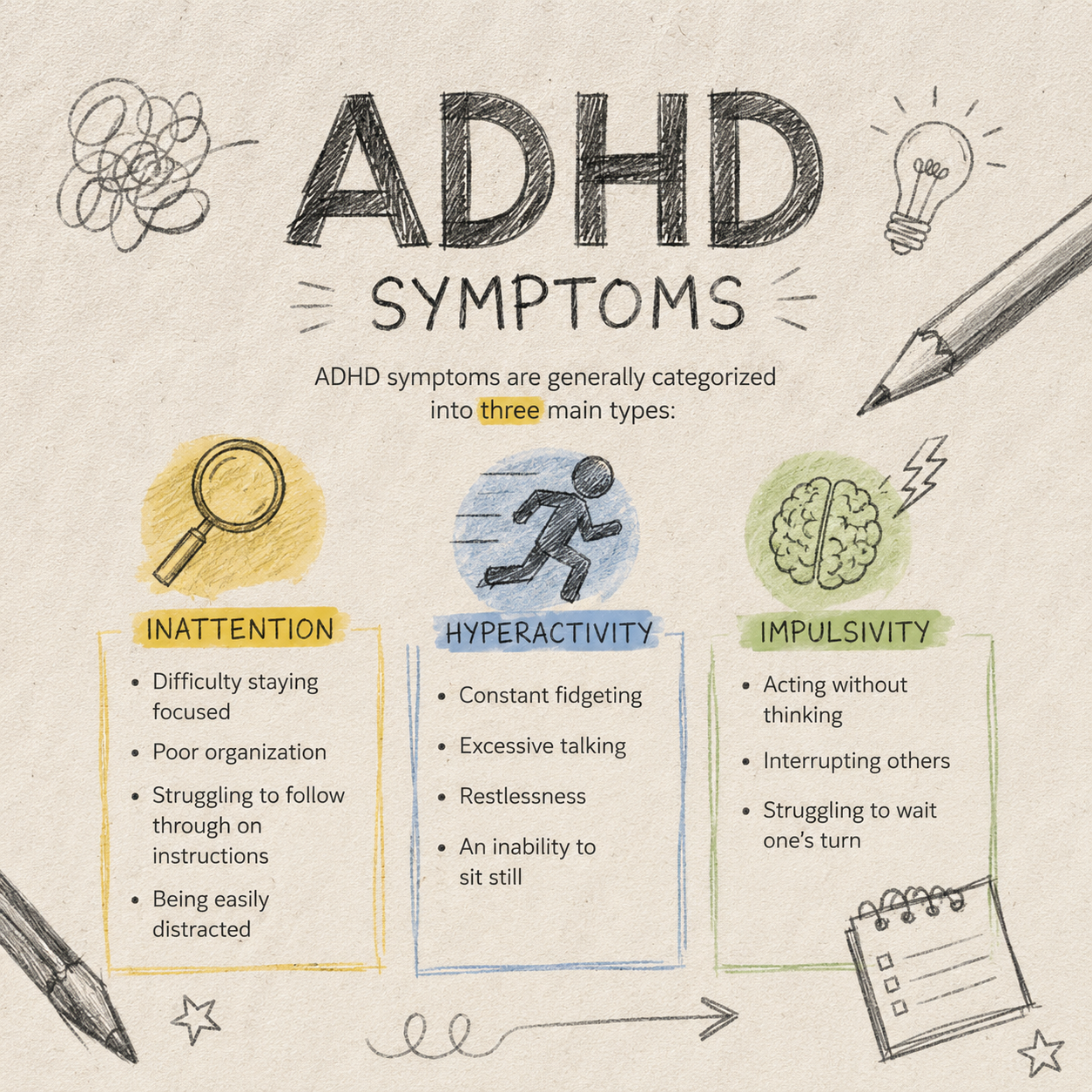
ADHD is a neurodevelopmental condition involving persistent, impairing difficulties with attention, impulse control, and sometimes hyperactivity, rather than ordinary variation in focus. A comprehensive overview of ADHD distinguishes inattentive, hyperactive-impulsive, and combined presentations, along with executive-function challenges. Diagnosis requires symptoms across settings, functional impairment, and onset before age 12, while debate continues over recognition and diagnosis patterns.
In the 1990s, rates of ADHD diagnosis in American children began to rise sharply. Clinicians who had rarely encountered the diagnosis started seeing it on referrals weekly, then daily. Pharmaceutical representatives were visiting pediatricians' offices.
School administrators were pressuring parents to have children evaluated. By 2016, 9.4% of US children had been diagnosed with ADHD at some point in their lives - approximately 6.1 million children, according to the CDC's National Survey of Children's Health.
Adult diagnosis rates began climbing too, as people who had struggled silently for decades found language for what had been happening to them.
Critics argued that ADHD was being manufactured. Pharmaceutical companies had a financial interest in expanding the diagnostic category. The DSM was pathologizing normal childhood behavior - particularly the behavior of active boys who did not thrive in the increasingly sedentary, academically demanding classrooms of the post-NCLB era.
Some critics pointed to the fact that diagnosis rates varied dramatically by state, by county, even by school district, in ways that were hard to reconcile with a genuinely biological condition of stable prevalence. They had a point.
Defenders of ADHD as a real and serious condition argued that the disorder had been genuinely underdiagnosed for decades, particularly in girls, who were systematically missed because they did not fit the hyperactive boy template.
They pointed to adults who had compensated, failed, suffered, and blamed themselves for years before receiving a diagnosis in their thirties or forties. They argued that untreated ADHD caused real, measurable damage to lives.
They also had a point. Understanding the actual science requires disentangling these competing narratives without forcing a false choice between them.
"ADHD is not a disorder of knowing what to do. It is a disorder of doing what you know." - Russell Barkley, ADHD and the Nature of Self-Control (1997)
Key Definitions
ADHD (Attention-Deficit/Hyperactivity Disorder): A neurodevelopmental condition characterized by persistent, impairing difficulties with attention, impulse control, and (in some presentations) hyperactivity, with onset before age 12.
Inattentive presentation: An ADHD subtype characterized primarily by difficulty sustaining attention, following through on tasks, organizing activities, and avoiding distraction. Previously called "ADD."
| ADHD Presentation | Core Symptoms | Commonly Mistaken For |
|---|---|---|
| Predominantly Inattentive | Difficulty focusing, forgetfulness, losing things, disorganization | Laziness, anxiety, depression, learning disability |
| Predominantly Hyperactive-Impulsive | Fidgeting, interrupting, difficulty waiting, excessive talking | Oppositionality, anxiety, mania |
| Combined Presentation | Both inattention and hyperactivity-impulsivity | Complex to distinguish; most common overall type |
Hyperactive-impulsive presentation: An ADHD subtype characterized primarily by fidgeting, difficulty remaining seated, excessive talking, interrupting, and difficulty waiting.
Combined presentation: Meeting criteria for both inattentive and hyperactive-impulsive subtypes simultaneously. The most common presentation.
Executive function: A set of higher-order cognitive processes including working memory, inhibitory control, cognitive flexibility, planning, and self-monitoring - primarily associated with the prefrontal cortex.
Working memory: The ability to hold and manipulate information in mind over short periods. A core deficit in ADHD.
Delay discounting: The tendency to prefer smaller immediate rewards over larger delayed rewards. Strongly elevated in ADHD, reflecting difficulty with temporal regulation of behavior.
Dopamine and norepinephrine systems: The primary neurotransmitter systems implicated in ADHD. Stimulant medications work by increasing synaptic concentrations of both.
Methylphenidate: A stimulant medication (Ritalin, Concerta) that blocks reuptake of dopamine and norepinephrine. Most widely used ADHD medication.
Amphetamine: A stimulant medication (Adderall, Vyvanse) that both blocks reuptake and increases release of dopamine and norepinephrine.
Cortical maturation delay: The finding that ADHD brains follow a similar developmental trajectory to neurotypical brains but approximately three years behind, particularly in prefrontal regions.
Impairment criterion: The DSM requirement that symptoms cause demonstrable functional impairment in academic, occupational, or social domains - what distinguishes ADHD from normal attention variation.
What ADHD Actually Is
The Diagnostic and Statistical Manual of Mental Disorders, Fifth Edition (DSM-5), defines ADHD through two symptom clusters and several accompanying criteria.
The inattention cluster includes nine symptoms: failing to give close attention to details, difficulty sustaining attention in tasks or play, seeming not to listen when spoken to directly, failing to follow through on instructions, difficulty organizing tasks and activities, avoiding tasks requiring sustained mental effort, losing things necessary for tasks, being easily distracted by extraneous stimuli, and being forgetful in daily activities.
The hyperactive-impulsive cluster includes nine symptoms: fidgeting, leaving one's seat, running or climbing in inappropriate situations, being unable to engage in leisure activities quietly, being "on the go," talking excessively, blurting out answers, having difficulty waiting one's turn, and interrupting or intruding on others.
For children, a diagnosis requires six or more symptoms from either cluster. For adolescents 17 and older and adults, the threshold is five.
The symptoms must be present in two or more settings, must cause demonstrable impairment, must not be better explained by another mental disorder, and - crucially - must have been present before age 12.
This last criterion is important: it rules out conditions that superficially resemble ADHD but emerge later in life in response to trauma, medical illness, or environmental stressors.
Worldwide prevalence estimates have been the subject of considerable methodological debate.
A landmark 2007 meta-analysis by Polanczyk and colleagues in the American Journal of Psychiatry reviewed 33 studies covering approximately 1.7 million children across multiple continents and found a pooled prevalence estimate of around 5.29% (doi: 10.1176/appi.ajp.2007.06081033).[1]
Later analyses suggested that much of the variation in prevalence across studies was explained by methodological differences - whether the study required impairment in addition to symptoms, which diagnostic criteria were applied, and how information was gathered.
When consistent methods are applied, prevalence estimates converge around 5-7% in children and 2.5-5% in adults globally. The significant variation in diagnosis rates between countries reflects differences in diagnostic practice and health system access more than genuine differences in underlying prevalence.
The concept of ADHD as a "disorder" deserves scrutiny. What makes a pattern of behavior a disorder rather than simply a variation? The functional answer, which the DSM attempts to operationalize, is impairment. Not everyone who scores high on attention variability suffers for it.
Many people with genuinely inattentive cognitive styles find environments and careers that accommodate or even value their tendencies. The diagnosis is warranted when the pattern of symptoms consistently interferes with the person's ability to function in ways they themselves recognize as problematic.
The Neuroscience
The most reliably replicated structural finding in ADHD is delayed cortical maturation.
In a 2007 study published in the Proceedings of the National Academy of Sciences, Shaw and colleagues at the National Institute of Mental Health conducted longitudinal MRI assessments of 223 children with ADHD and 223 typically developing children over an average of five years (doi: 10.1073/pnas.0707741104).[2]
They measured the age at which cortical thickness in different brain regions reached its developmental peak.
In typically developing children, the median age of peak cortical thickness was around 7.5 years. In the ADHD group, it was around 10.5 years - a roughly three-year delay. The delay was most pronounced in the prefrontal cortex, the region most closely associated with executive function, impulse control, and working memory.
This finding has important implications. It means ADHD does not represent a fundamentally abnormal brain but rather a brain that is on a slower developmental schedule. It helps explain why some children appear to outgrow their most impairing symptoms as the prefrontal cortex eventually catches up.
It also helps explain why stimulant medications, which acutely enhance prefrontal function by increasing available dopamine and norepinephrine, produce rapid symptomatic improvement even before any developmental change occurs.
The prefrontal cortex's connections to the striatum - the reward-processing hub of the brain - are particularly relevant to understanding ADHD's characteristic delay discounting. Individuals with ADHD consistently show a steeper preference for smaller immediate rewards over larger delayed ones.
This is not simply impulsivity in the colloquial sense; it reflects a genuine difference in the temporal dynamics of reward signaling. Dopamine release in response to anticipated future rewards is attenuated, making the distant reward feel less real and motivationally compelling than the immediate one.
Functional neuroimaging research has consistently found that the default mode network (DMN) - a set of brain regions that activate during rest and mind-wandering - shows abnormal intrusion during tasks requiring focused attention in individuals with ADHD.
In typical brains, the DMN is suppressed when external tasks demand attention. In ADHD, this suppression is incomplete, contributing to the subjective experience of being pulled off task by internal thoughts and associations even when trying to concentrate.
The cerebellum, involved in timing and sequencing, also shows consistent differences in ADHD, which may contribute to the timing difficulties and temporal disorganization characteristic of the condition.
Heritability and Genetics
ADHD is among the most heritable of all psychiatric conditions. Twin studies consistently estimate heritability at 70-80%, meaning that genetic differences account for approximately three-quarters of the variation in ADHD traits in the population.
A 2015 meta-analysis by Brikell and colleagues synthesizing data from multiple large twin registries confirmed this estimate. If one identical twin has ADHD, the other has roughly a 70-80% chance of meeting criteria as well.
Despite this high heritability, identifying the specific genes involved has proven more complex than early research suggested.
The early candidate gene era produced promising findings for variants in genes related to dopamine signaling - DAT1 (the dopamine transporter gene), DRD4 (a dopamine receptor gene), and DRD5 - but many of these associations have failed to replicate consistently in large genome-wide association studies.
This is a familiar story in psychiatric genetics: early small-sample findings give way to genome-wide analyses showing that the genetic architecture is highly polygenic, with hundreds or thousands of common variants each contributing tiny individual effects.
The genetic overlap between ADHD and other neurodevelopmental and psychiatric conditions is substantial. ADHD shares genetic risk variants with autism spectrum disorder, bipolar disorder, schizophrenia, major depression, and intellectual disability.
This pleiotropy - the same genes influencing multiple conditions - helps explain why these conditions so frequently co-occur. Approximately 30-50% of children with ADHD have a co-occurring condition, with anxiety disorders, learning disabilities, oppositional defiant disorder, and autism spectrum disorder being the most common.
Environmental risk factors for ADHD do exist but their effects are considerably smaller than genetic effects. Very premature birth, lead exposure, prenatal tobacco or alcohol exposure, and severe early psychosocial adversity are all associated with elevated ADHD risk, but none explains more than a small fraction of cases.
The majority of ADHD cases do not involve any identifiable environmental insult; they reflect the normal polygenic variation in attention and inhibitory systems that exists in the human population.
ADHD in Girls and Women
The historical exclusion of girls from ADHD research was not a minor oversight. It produced a diagnostic framework calibrated to one presentation of one demographic, then applied universally. The original hyperkinetic children described by researchers like Chess and Thomas, and later Barkley, were predominantly boys.
DSM criteria were developed and validated largely on male samples. The result was a set of diagnostic benchmarks that systematically underidentified the presentation more common in girls.
Girls with ADHD are more likely to present with the inattentive subtype. They are less likely to be hyperactive in the visible, classroom-disruptive sense. They are more likely to be perceived as daydreamy, spacey, or anxious.
They are more likely to develop masking strategies - using social observation, extra preparation, and effortful compensation to appear more functional than they are.
This masking is cognitively costly: it works, to a degree, at the expense of exhaustion, anxiety, and a pervasive sense of inadequacy that girls often internalize as personal failure rather than neurological difference.
Work by Kathleen Nadeau, Ellen Littman, and Patricia Quinn, consolidated in their 1999 book "Understanding Girls with ADHD," documented systematic differences in female ADHD presentation that went unrecognized by mainstream clinical practice for decades.
Girls with undiagnosed ADHD show elevated rates of anxiety disorders, eating disorders, self-harm, and depression compared to both neurotypical girls and boys with ADHD.
They tend to blame themselves for their difficulties in ways that boys are less likely to do, because their behavior does not match the externalizing, disruptive pattern that gets recognized and referred.
The interaction between ADHD and hormonal cycles is a relatively recent area of clinical recognition. Estrogen modulates dopamine systems, and fluctuations across the menstrual cycle produce corresponding fluctuations in attention, working memory, and impulse control.
Many women with ADHD report significantly worsened symptoms in the premenstrual phase.
Perimenopause and menopause, which involve sustained decline in estrogen, are frequently reported as the trigger that rendered previously manageable ADHD symptoms acutely disabling - leading many women to seek evaluation for the first time in their forties and fifties.
ADHD in Adults
The assumption that ADHD was a childhood condition that resolved at puberty persisted well into the 1980s and was embedded in early diagnostic criteria, which required symptom onset before age seven.
Longitudinal follow-up research, most notably the work of Gabrielle Weiss and Lily Hechtman culminating in their 1993 book "Hyperactive Children Grown Up," established that this assumption was wrong.[6]
Following their original cohorts into adulthood, they found that the majority continued to experience impairing symptoms, even if the gross hyperactivity of childhood had diminished.
Current estimates suggest that 60-70% of children diagnosed with ADHD continue to meet full criteria or have significant impairing residual symptoms in adulthood. Adult ADHD prevalence is estimated at approximately 4-5% of the population.
The presentation shifts: outward hyperactivity becomes inner restlessness, a difficulty sitting through meetings, a sense of agitation without obvious external cause.
Inattention remains prominent, but now it expresses itself in missed deadlines, difficulty completing long projects, chronic disorganization, and the pattern Russell Barkley has described as time-blindness - an inability to feel the passage of time and organize behavior accordingly.[4]
Emotional dysregulation is increasingly recognized as a central feature of adult ADHD rather than a secondary comorbidity.
Adults with ADHD frequently experience rapid, intense emotional reactions, difficulty modulating frustration, and what some describe as rejection-sensitive dysphoria - extreme sensitivity to perceived criticism or failure.
These emotional features often cause more disruption to relationships and work than the attentional symptoms, yet they receive less attention in standard clinical descriptions.
The real-world impairments of adult ADHD are well-documented. Research reviewed by Barkley in 2002 showed elevated rates of traffic accidents, job terminations, relationship dissolution, financial mismanagement, and substance use disorders in adults with ADHD relative to matched controls.
Late diagnosis in adults - increasingly common as awareness has grown - is often accompanied by complex emotional processing: grief for lost years, relief at finally having an explanation, and the task of re-evaluating a history of self-blame through a new lens.
Treatment
The evidence base for ADHD treatment is exceptionally deep relative to most psychiatric conditions. Stimulant medications have been studied in randomized controlled trials since the 1960s, and the cumulative evidence is unambiguous in showing large effects on core symptoms.
A 2018 network meta-analysis by Cortese and colleagues in Lancet Psychiatry (doi: 10.1016/S2215-0366(18)30269-4), synthesizing 133 randomized trials covering more than 10,000 participants, found that methylphenidate and amphetamine compounds showed the largest effects on core ADHD symptoms in children, with effect sizes in the range of Cohen's d = 0.78 to 1.0.[3]
These are large effects by the standards of psychiatric pharmacology.
Methylphenidate (marketed as Ritalin, Concerta, and others) works by blocking the reuptake transporter for dopamine and norepinephrine, increasing their synaptic concentration. Amphetamine compounds (Adderall, Vyvanse) both block reuptake and increase release of these neurotransmitters.
Both classes produce rapid, often dramatically apparent effects within hours of the first dose for most patients.
Non-stimulant options including atomoxetine (a selective norepinephrine reuptake inhibitor) and alpha-2 agonists like guanfacine and clonidine offer alternatives for patients who cannot tolerate stimulants or for whom they are contraindicated, though with generally smaller effect sizes.
Behavioral interventions - parent training programs, school-based accommodations, organizational skills training, and cognitive-behavioral therapy adapted for ADHD - show genuine benefits, particularly for functional outcomes like academic performance, family relationships, and daily living skills.
They are less effective than medication alone for core symptom reduction, but appear to add to medication effects for functional outcomes.
The Multimodal Treatment Study of ADHD (MTA), the largest clinical trial in child psychiatry, found at 14 months that medication alone outperformed behavioral treatment alone on core symptoms, with combined treatment providing modest additional benefit on some outcomes.[5]
Longer follow-up of the MTA cohort showed that initial symptom advantages between conditions attenuated over time, emphasizing the importance of comprehensive, sustained intervention rather than relying on any single approach.
Controversies
The question of overdiagnosis versus underdiagnosis has no simple answer. Both phenomena coexist.
US diagnosis rates exceed those in most other developed countries, including countries with comparable genetic populations, suggesting that cultural, educational, and healthcare-system factors contribute to diagnosis beyond underlying prevalence.
At the same time, studies consistently find large populations of adults who meet full diagnostic criteria but have never received evaluation, particularly women and non-white individuals.
The neurodiversity framing of ADHD, which emphasizes attentional variation as human diversity rather than pathology, captures something real: many people with ADHD thrive in environments that accommodate their cognitive style, and the suffering associated with ADHD is substantially driven by the mismatch between neurodevelopmental variation and institutional expectations designed for a particular attentional profile.
The "hunter-gatherer hypothesis," most associated with Thom Hartmann, proposes that ADHD traits confer advantages in environments requiring rapid attentional shifting and impulsive action.
This is speculative and has not been rigorously tested, but it illustrates the point that "disorder" is context-dependent.
Long-term stimulant use has been a persistent concern. Cardiovascular safety data at therapeutic doses is reassuring for most patients. Concerns about growth suppression with childhood stimulant use are real but relatively modest in magnitude, and most estimates suggest the effect on adult height is small.
The question of stimulant diversion - prescribed medications being shared or sold - is a genuine public health concern, particularly on college campuses, but does not constitute a reason to withhold treatment from patients who genuinely need it.
Cross-References
Sources & Further Reading
- Polanczyk, G., de Lima, M. S., Horta, B. L., Biederman, J., & Rohde, L. A. (2007). The worldwide prevalence of ADHD: A systematic review and metaregression analysis. American Journal of Psychiatry, 164(6), 942-948. DOI: 10.1176/appi.ajp.2007.06081033
- Shaw, P., Eckstrand, K., Sharp, W., Blumenthal, J., Lerch, J. P., Greenstein, D.... & Rapoport, J. L. (2007). Attention-deficit/hyperactivity disorder is characterized by a delay in cortical maturation. Proceedings of the National Academy of Sciences, 104(49), 19649-19654. DOI: 10.1073/pnas.0707741104
- Cortese, S., Adamo, N., Del Giovane, C., Mohr-Jensen, C., Hayes, A. J., Carucci, S.... & Cipriani, A. (2018). Comparative efficacy and tolerability of medications for attention-deficit hyperactivity disorder in children, adolescents, and adults. Lancet Psychiatry, 5(9), 727-738. DOI: 10.1016/S2215-0366(18)30269-4
- Barkley, R. A. (1997). ADHD and the Nature of Self-Control. Guilford Press.
- MTA Cooperative Group. (1999). A 14-month randomized clinical trial of treatment strategies for attention-deficit/hyperactivity disorder. Archives of General Psychiatry, 56(12), 1073-1086.
- Weiss, G., & Hechtman, L. T. (1993). Hyperactive Children Grown Up: ADHD in Children, Adolescents, and Adults (2nd ed.). Guilford Press.
Health note: This article is general educational information about how a topic works, not medical, psychological, or mental-health advice, diagnosis, or treatment. Everyone's situation is different, and research findings describe groups, not individuals.
If you are struggling or have concerns about your health, please talk to a qualified professional such as a doctor or licensed therapist.
If you are in crisis or thinking about harming yourself, contact your local emergency services or a crisis line right away, in the US you can call or text 988 (Suicide & Crisis Lifeline); elsewhere, find local lines at findahelpline.com.