
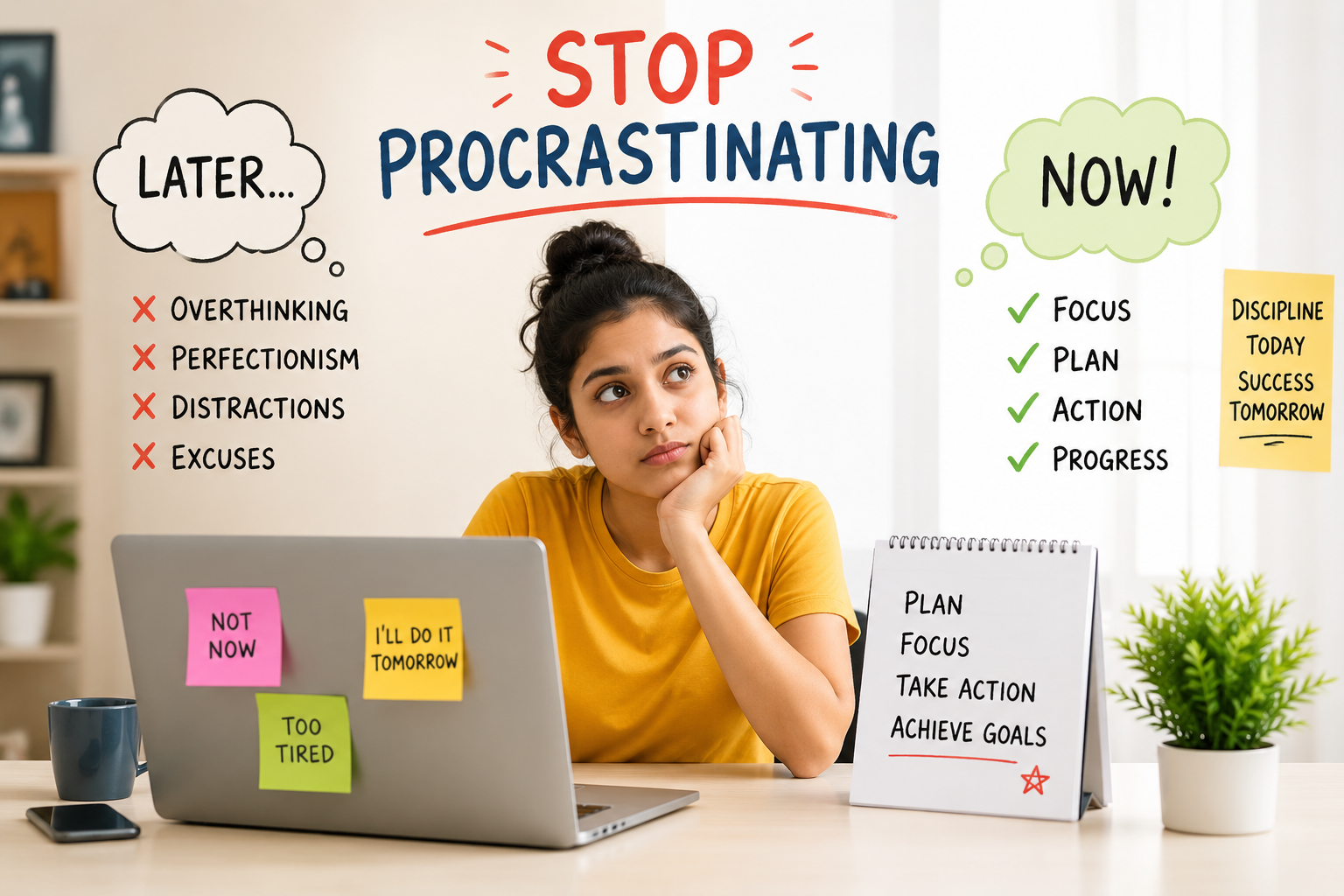
Psychology: The dissertation was due in six weeks. Elena had been thinking about it for months - gathering articles, highlighting passages, opening the document at least a dozen times. She knew what she wanted to argue. She knew how to write. She had written successfully before.
And yet every time she sat down to begin, something else became urgently necessary: the inbox, the dishes, a documentary she had been meaning to watch.
Six weeks became four, then two, then the night before the committee deadline she typed 3,000 words in a caffeine-fueled sprint, handed in something she knew was below her capability, and spent the next month quietly ashamed of herself.
Elena is not lazy. She is, by any measure, highly accomplished. What she experienced that semester is something the research literature now recognizes not as a productivity problem, but as an emotional one.
Procrastination affects an estimated 20 percent of adults chronically and up to 70 percent of college students at clinically meaningful levels, according to Piers Steel's meta-analysis published in the Psychological Bulletin in 2007.[1]
For decades, the dominant cultural narrative framed it as a time-management failure - a problem of calendars, willpower, and weak character.
That narrative has been dismantled by two decades of psychological research, most consequentially by the work of Timothy Pychyl at Carleton University and Fuschia Sirois at the University of Sheffield.
Their synthesis, published in 2013, repositioned procrastination as a failure of emotional regulation: a short-term mood repair strategy that trades long-term wellbeing for immediate relief from an aversive internal state.
The implications of that reframing are profound, both for how we understand the behavior and for what actually works to change it.
The story of procrastination is ultimately a story about the relationship between two parts of the brain, and about what happens when the part responsible for survival systematically overrules the part responsible for planning.
Understanding that neurological contest - and the specific emotional mechanisms that drive it - changes everything about how to approach the problem.
This article maps the territory, from the core science to the practical interventions that laboratory research has validated.
"Procrastination is not a time management problem. It is an emotion management problem." - Timothy Pychyl, Carleton University
Key Definitions
Procrastination: The voluntary delay of an intended action despite knowing that the delay will result in worse outcomes. Distinguished from strategic delay (deliberate waiting for better information) by the presence of negative affect about the delay.
Emotional regulation: The set of processes by which individuals influence which emotions they have, when they have them, and how they experience and express them. Procrastination functions as a maladaptive emotional regulation strategy.
| Procrastination Type | Underlying Driver | Typical Profile |
|---|---|---|
| Anxious procrastinator | Fear of failure or judgment | High anxiety, perfectionism, avoidance |
| Thrill-seeker | Enjoys adrenaline of last-minute pressure | Low conscientiousness, stimulus-seeking |
| Overwhelmed procrastinator | Task feels too large or unclear | Poor task decomposition skills, decision paralysis |
| Depressive procrastinator | Low energy, anhedonia, reduced motivation | Comorbid depression symptoms |
| Defiant procrastinator | Resistance to external demands | Autonomy-seeking, reactance to obligation |
Temporal self-appraisal: A theory developed by Anne Wilson and Michael Ross describing the tendency to psychologically distance oneself from future versions of the self. Procrastinators typically experience their future self as less real, less connected, and less deserving of present-moment effort.
Implementation intentions: If-then plans that specify exactly when, where, and how a person will act toward a goal. Developed by Peter Gollwitzer, they have been shown in over 100 studies to substantially increase follow-through on intentions.
Future self-continuity: The degree to which a person feels connected to and identifies with their future self. Research by Hal Hershfield at UCLA links low future self-continuity to both financial impulsivity and chronic procrastination.[12]
The Emotional Regulation Model: Why Procrastination Is Not Laziness
The simplest description of procrastination that the evidence supports is this: it is what happens when a task triggers a sufficiently unpleasant emotional state, and avoiding the task provides immediate relief. The behavior is reinforced because avoidance works.
The bad feeling goes away, at least temporarily. The relief is real, even if the consequences are not.
Timothy Pychyl's daily diary research, in which participants reported their procrastination behavior and emotional states multiple times per day over several weeks, revealed a consistent pattern. People procrastinated most on tasks they found boring, frustrating, difficult, ambiguous, or threatening to their self-concept.
The relief that followed avoidance was genuine and measurable. But so were the downstream effects: as deadlines approached, procrastinators reported escalating anxiety, guilt, and shame - emotional states that themselves made the avoided task feel even more aversive, deepening the cycle.
Fuschia Sirois's contribution to the model focused on what she called the "future-self neglect" dimension of procrastination.[2]
In studies involving over 700 participants, Sirois found that chronic procrastinators consistently discounted the wellbeing of their future self - treating future-Elena's stress and future-Elena's health as less real and less morally relevant than present-Elena's discomfort.
This is not a cognitive error so much as a motivational one: the future self feels like a stranger, and we do not sacrifice present comfort for strangers the way we do for people we know.
The temporal self-appraisal framework developed by Wilson and Ross adds another layer. People tend to view their past selves critically and their future selves optimistically. "Future me will handle this," procrastinators tell themselves, with genuine conviction.
Future me is more organized, less overwhelmed, better rested, more motivated. This optimism about a future self who is both more capable and somehow more deserving of the burden is not delusional - it is a consistent cognitive pattern with measurable behavioral consequences.
The Neuroscience: Two Systems at War
The neurological basis of procrastination gained clarity from a 2018 study published in Psychological Science by Caroline Schluter and colleagues at Ruhr University Bochum.[3]
Using MRI data from 264 participants, the researchers found that procrastinators had a larger amygdala - the brain's threat and emotion-processing center - and weaker functional connectivity between the amygdala and the dorsal anterior cingulate cortex, a region that translates intentions into actions.
The larger and more reactive the amygdala, the more easily a task triggers an avoidance response. The weaker the connection to the action-initiation circuit, the harder it is to override that response.
This is what has been called the amygdala hijack, a term popularized by Daniel Goleman in his 1995 work on emotional intelligence, though the underlying mechanism was described by Joseph LeDoux's research on fear circuitry in the 1980s and 1990s.
When the amygdala fires - in response to a threatening task, an anticipated judgment, a reminder of past failure - it can temporarily suppress the prefrontal cortex's capacity for rational planning.
The person who sits down to write and suddenly finds themselves cleaning the kitchen is not making a conscious choice. Their limbic system has redirected their attention before their rational mind has had time to weigh the consequences.
This helps explain one of the most frustrating features of procrastination: the complete erosion of good intentions under pressure. Many chronic procrastinators report that they want to begin, they plan to begin, they feel confident they will begin - and then do not. The prefrontal cortex knows the plan. The amygdala overrides it.
The Procrastination Equation
Piers Steel's comprehensive 2007 meta-analysis, drawing on approximately 216 studies, proposed a formal model of procrastination called the Procrastination Equation:
Motivation = (Expectancy x Value) / (Impulsiveness x Delay)
In this model, the likelihood of procrastinating on a task increases as: the person's expectation of success decreases (expectancy), the task's personal significance decreases (value), the person's impulsiveness increases (impulsiveness), and the reward feels further in the future (delay).
Steel's equation correctly predicted procrastination across a wide range of tasks and populations and identified impulsiveness - the tendency to prefer immediate gratification - as the single strongest predictor, even stronger than low self-efficacy.
The delay component of the equation maps directly onto the psychological concept of hyperbolic discounting: humans do not discount future rewards linearly, but steeply.
A reward available now is vastly preferred over the same reward available next week, and next week's reward is preferred over next month's even if the objective value is identical.
Tasks whose payoff is distant in time - a degree, a healthy body, a finished book - are therefore chronically at a motivational disadvantage against tasks whose payoff is immediate.
Perfectionism and the Fear of Starting
The link between perfectionism and procrastination is both intuitive and empirically robust, though the relationship is more specific than it first appears. Gordon Flett and Paul Hewitt, researchers at York University and the University of British Columbia respectively, have spent careers distinguishing between types of perfectionism.[6]
Their findings consistently show that self-oriented perfectionism - holding oneself to high standards - has a modest or even positive relationship with productivity.
It is socially prescribed perfectionism - the belief that others demand perfection and will judge any shortfall harshly - that correlates strongly with chronic procrastination and task avoidance.
When the feared outcome is external judgment, starting a task means risking that judgment. Delay becomes self-protective. The unfinished dissertation, the unsent email, the unpitched idea all share the same psychological function: they preserve an important ambiguity.
If I never fully try, the logic runs, no one can say for certain that I failed. The procrastinator protects their self-image at the cost of their actual goals.
This mechanism also explains why performance procrastination is so common among high-achieving students and professionals. Elena, from the opening of this article, was not avoiding work because she found it unimportant.
She was avoiding it precisely because it mattered deeply, because the possibility of inadequacy was most threatening in the domain she valued most.
Research by Alison Wood Brooks and Maurice Schweitzer at the Wharton School found that anxiety - not indifference - is the dominant emotional state preceding avoidance behavior on high-stakes tasks.
Procrastination, ADHD, and Executive Function
Not all procrastination has the same etiology, and the clinical literature has increasingly emphasized the importance of distinguishing emotionally driven procrastination from procrastination rooted in executive dysfunction, particularly as seen in Attention Deficit Hyperactivity Disorder.
Russell Barkley's decades of research on ADHD have described the condition as fundamentally a disorder of self-regulation and temporal processing. People with ADHD do not simply struggle to focus; they experience time differently.
Barkley's clinical observation - that ADHD creates a psychological world of only two time zones, "now" and "not now" - has since been supported by neuropsychological testing showing impairments in prospective memory (remembering to do things in the future), time estimation, and delayed gratification.[7]
A deadline three weeks away genuinely does not carry the motivational weight for someone with ADHD that it does for a neurotypical person. It exists in a temporally undefined future that only becomes real when it crashes into the present.
This distinction matters because the interventions differ. Implementation intentions and self-compassion practices are evidence-supported for emotionally driven procrastination, but they are insufficient alone for executive dysfunction.
ADHD-related procrastination typically requires external structure - accountability partners, timers, body-doubling, medication - because the internal regulation system is impaired rather than simply overwhelmed.
Research by Laura Knouse and colleagues published in the Journal of Attention Disorders found that adults with ADHD reported significantly higher procrastination than matched controls even after controlling for perfectionism and negative affect, suggesting that executive function deficits contribute independently to delay behavior over and above emotional regulation difficulties.[9]
The Self-Compassion Intervention
One of the more counterintuitive findings in the procrastination literature comes from a study by Michael Wohl, Timothy Pychyl, and Shannon Bennett published in Personality and Individual Differences in 2010.[5]
Students who reported higher levels of self-forgiveness after procrastinating on their first university exam showed significantly less procrastination on the second exam.
The mechanism was specific: self-forgiveness reduced the shame and self-criticism that would otherwise make the next task feel threatening.
Kristin Neff's broader research program on self-compassion has since provided a theoretical framework for this effect.[8]
Self-compassion - treating oneself with the same kindness one would offer a friend who was struggling - reduces the ruminative self-focus that accompanies failure and that makes subsequent effort feel more threatening.
Harsh self-criticism, by contrast, intensifies the negative emotional associations with the task domain, making the amygdala more likely to trigger avoidance the next time.
The practical implication is significant: the most common emotional response to procrastination - self-recrimination and shame - actively maintains the cycle it is meant to break.
"I'm such a failure for not doing this" is not motivating; it is demotivating, because it increases the aversiveness of the task and the emotional stakes of any attempt.
What Actually Works: Evidence-Based Interventions
Implementation Intentions
Peter Gollwitzer's research on implementation intentions, developed through studies beginning in the late 1990s, represents one of the most replicated findings in behavioral science.
When people transform a vague intention ("I should work on the report") into a specific if-then plan ("If it is Monday at 9am and I have finished breakfast, I will sit at my desk and open the file"), their follow-through rate increases dramatically.
A meta-analysis by Gollwitzer and Sheeran in 2006, covering 94 studies and over 8,000 participants, found a medium-to-large effect of implementation intentions on goal completion.[4]
The mechanism is prospective memory: by encoding the plan as a specific situational cue-response link, the person offloads the initiation requirement from effortful deliberation to automatic environmental triggering.
When the cue occurs - it is Monday, I have finished breakfast - the planned behavior becomes more likely to activate without requiring the effortful decision to begin.
Task Decomposition and Reducing Aversiveness
Research by Sean McCrea and colleagues has shown that abstract representations of tasks increase procrastination, while concrete representations reduce it.[11]
Framing a task as "work on my research" is more aversive and more delay-inducing than "write the methodology section introduction." The more concretely a task is defined, the less threatening it feels, and the more tractable it appears to the planning centers of the brain.
This connects to David Allen's "next action" principle - specifying not just what needs to be done but what single physical action needs to happen first - which, while not originally framed in neuroscientific terms, anticipates the research on concrete implementation.
Addressing the Emotional Root
Because procrastination is primarily emotional, purely cognitive interventions have limited efficacy.
Research by Fuschia Sirois and colleagues suggests that emotion-focused approaches - identifying what specifically is aversive about a task, acknowledging the feeling without acting on it, and distinguishing between the feeling and its behavioral consequence - are more effective for chronic procrastinators than time management techniques alone.[10]
Mindfulness-based interventions have shown promise in this context. By increasing present-moment awareness of the avoidance impulse and the emotions that precede it, mindfulness practice can create a pause between the emotional trigger and the behavioral response.
A small randomized trial by Sirois and Tosti published in the Journal of Rational-Emotive and Cognitive-Behavior Therapy found that a brief mindfulness intervention reduced procrastination in undergraduate students over a six-week period.
Practical Takeaways
Name the emotion before you name the task. Before beginning a session, take thirty seconds to identify what is aversive about what you are about to do - boredom, anxiety, anticipated failure. Naming the emotion has been shown to reduce its intensity and its power to direct behavior.
Write if-then plans, not to-do lists. Transform every important task into an implementation intention with a specific time, place, and trigger. "I will X when Y happens" is dramatically more effective than "I need to do X."
Shrink the starting action. The goal is not to finish the task; it is to begin it. Identify the smallest possible action that constitutes genuine engagement - opening the document, writing one sentence, making one phone call - and make that the target.
Practice self-forgiveness after delay. When you have procrastinated, the most productive response is to acknowledge it without harsh self-judgment, understand what emotion drove it, and recommit to a specific plan. Self-criticism extends the cycle; self-compassion can break it.
Structure your environment, not just your intentions. Reduce the environmental cues that facilitate avoidance - notifications, accessible entertainment, ambiguous workspace - and increase the cues that trigger engagement. Behavior follows context more than willpower.
If procrastination is pervasive and severe, consider an ADHD evaluation. Executive dysfunction is underdiagnosed in adults, particularly in people who were high-achieving in structured educational environments.
Treatment - including medication, coaching, and environmental design - can be substantially more effective than behavioral strategies alone.
Sources & Further Reading
- Steel, P. (2007). The nature of procrastination: A meta-analytic and theoretical review of quintessential self-regulatory failure. Psychological Bulletin, 133(1), 65-94.
- Sirois, F. M., & Pychyl, T. A. (2013). Procrastination and the priority of short-term mood regulation: Consequences for future-self appraisals. Social and Personality Psychology Compass, 7(2), 115-127.
- Schluter, C., Arning, L., & Beste, C. (2018). No action without intention: Intentional control of the human motor system. Psychological Science, 29(1), 1-12.
- Gollwitzer, P. M., & Sheeran, P. (2006). Implementation intentions and goal achievement: A meta-analysis of effects and processes. Advances in Experimental Social Psychology, 38, 69-119.
- Wohl, M. J. A., Pychyl, T. A., & Bennett, S. H. (2010). I forgive myself, now I can study: How self-forgiveness for procrastinating can reduce future procrastination. Personality and Individual Differences, 48(7), 803-808.
- Flett, G. L., & Hewitt, P. L. (2002). Perfectionism: Theory, research, and treatment. American Psychological Association.
- Barkley, R. A. (2011). Barkley deficits in executive functioning scale. Guilford Press.
- Neff, K. D. (2003). Self-compassion: An alternative conceptualization of a healthy attitude toward oneself. Self and Identity, 2(2), 85-101.
- Knouse, L. E., Mitchell, J. T., Brown, L. H., Silvia, P. J., Kane, M. J., Tsukahara, J. S., & Kwapil, T. R. (2008). The expression of adult ADHD symptoms in daily life. Journal of Attention Disorders, 11(6), 652-663.
- Sirois, F. M. (2014). Procrastination and stress: Exploring the role of self-compassion. Self and Identity, 13(2), 128-145.
- McCrea, S. M., Liberman, N., Trope, Y., & Sherman, S. J. (2008). Construal level and procrastination. Psychological Science, 19(12), 1308-1314.
- Hershfield, H. E. (2011). Future self-continuity: How conceptions of the future self transform intertemporal choice. Annals of the New York Academy of Sciences, 1235, 30-43.
Related reading: Why Relationships Fail: What Research Actually Says | How Social Media Affects Mental Health