
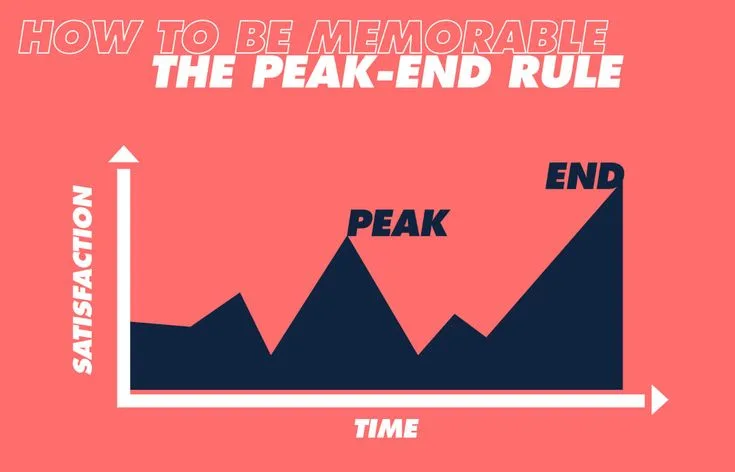
The answer to what is the peak-end rule is that remembered experiences are judged mainly by their most intense moment and their ending, not by their average or total duration. This divergence between the experiencing and remembering selves can make a longer, more uncomfortable event seem preferable if it ends better. It affects satisfaction, future choices, and even willingness to repeat medical procedures.
If you want to understand how people remember and evaluate experiences, the average moment means almost nothing. What matters is the best or worst moment - the peak - and what happened at the very end. This is the peak-end rule, one of the most rigorously documented and practically consequential findings in behavioral science.
It was established through a series of experiments involving cold water, colonoscopies, and the quiet realization that the human memory system does not keep running tallies the way we assume it does.
The Cold Water Experiments
The foundational research came from Daniel Kahneman, Barbara Fredrickson, Charles Schreiber, and Donald Redelmeier. In a 1993 study published in Psychological Science, participants submerged their hands in uncomfortably cold water under two conditions.
The short trial: One hand in 14-degree Celsius water for 60 seconds. Genuinely uncomfortable, but brief and fixed.
The long trial: One hand in 14-degree water for 60 seconds, then the temperature was slowly raised to 15 degrees over an additional 30 seconds before withdrawal. The long trial involved strictly more total discomfort - it lasted longer and no moment in it was less painful than the short trial.
When participants were asked which trial they would prefer to repeat, a striking 69% chose the long trial.[1] The objectively worse experience was preferred because it ended on a slightly less terrible note.
This result inverted the assumption that people try to minimize total pain. They do not minimize totals. They evaluate experiences based on how the peak felt and how the experience concluded.
Kahneman and colleagues described this as a fundamental violation of standard utility theory, which predicts that rational actors should prefer the experience with less total discomfort. The finding suggested that the "utility monster" of accumulated moments is largely invisible to the evaluating mind.
What the remembering self counts is not a sum but a summary - and that summary is built from two data points, not many.
The Colonoscopy Study
The cold water findings were extended to real clinical settings in a 1996 study by Redelmeier and Kahneman, published in Pain.[2] Patients undergoing colonoscopies - a procedure that varies considerably in discomfort depending on duration and anatomy - were randomly assigned to one of two conditions.
In the control condition, the colonoscope was removed at the standard time, when the physician had completed the examination.
In the experimental condition, the colonoscope was held stationary for an additional minute at the end of the examination, producing mild discomfort - but less discomfort than the most painful moments earlier in the procedure.
The experimental group experienced a longer, technically more uncomfortable procedure. Yet they rated their overall experience as less unpleasant than the control group. More significantly, when followed up later, patients in the experimental group were more likely to schedule and actually complete recommended follow-up procedures.
"The colonoscopy study showed that the peak-end rule is not merely a laboratory curiosity. It shapes real-world decisions with genuine health consequences. Patients who had a better-ending procedure were more willing to come back for another one." - Redelmeier & Kahneman (1996), summarized
The end experience changed not just reported satisfaction but actual future behavior.
This finding has significant public health implications. Colonoscopy screening is one of the most effective tools for colorectal cancer prevention, yet patient avoidance of repeat screenings is a persistent clinical problem.
A simple procedural modification - extending the procedure by 60-90 seconds to allow discomfort to reduce before withdrawal - improved follow-through with recommended follow-up care. The intervention costs almost nothing and carries no medical risk.
The Experiencing Self and the Remembering Self
Kahneman formalized these findings within a larger theoretical framework distinguishing between two modes of experiencing life, most fully developed in his 2011 book Thinking, Fast and Slow:[4]
The experiencing self is the you that lives in real time - the you that registers moment-to-moment pleasure and pain as they occur. This self asks "Does it hurt right now?"
The remembering self is the you that evaluates experiences after they end, constructs narratives about the past, and makes decisions about the future. This self asks "How was it, overall?"
The key insight is that the remembering self does not accurately summarize what the experiencing self reported. It does not calculate an average or a total. It takes two snapshots - the peak moment and the final moment - and uses those to evaluate the whole.
This creates a systematic divergence between what is good for you as you live through an experience and what you will remember as good or bad about it afterward. The two selves can have genuinely different interests.
Kahneman uses the example of a concert: imagine two identical performances except that the second ends with a sudden burst of feedback from a malfunctioning speaker. The experiencing self registered roughly equal pleasure through both performances.
The remembering self rates the second concert as ruined. The experienced moments were the same; the evaluated experience is not.
This divergence has implications that extend beyond experience design into deeper questions about how we make choices.
If decisions are driven by anticipated memories rather than anticipated experiences - if we are choosing for the remembering self rather than the experiencing self - we may systematically choose experiences that look good in retrospect at the cost of actually living them well.
Duration Neglect
The companion finding to the peak-end rule is duration neglect: the length of an experience has surprisingly little effect on how it is evaluated in retrospect.
This was demonstrated across multiple experiments. Subjects experiencing a few minutes of painful noise rated it similarly to subjects experiencing many minutes of the same noise at the same intensity, when the peak and ending were similar. The total amount of discomfort, integrated over time, did not drive the evaluation.
Fredrickson and Kahneman (1993) verified duration neglect using video clips eliciting positive and negative emotions: the duration of the emotional film had minimal effect on overall ratings when the peak and ending were controlled.[5]
The finding held for both positive and negative experiences, suggesting it reflects a general feature of retrospective evaluation rather than a property specific to pain.
This has counterintuitive implications. A short pleasant vacation remembered with a terrific peak and ending may be evaluated as better than a long vacation that ended in frustration and travel delays. The accumulated pleasant days in the middle are largely discounted.
| Experience Characteristic | Effect on Remembered Evaluation |
|---|---|
| Peak intensity (most positive or negative moment) | High - one of the two primary drivers |
| Final moment quality | High - the other primary driver |
| Total duration | Low - duration is largely neglected |
| Average moment quality | Low - averaging is not how memory works |
| Number of positive moments | Moderate - matters if it influences peak or end |
| Trajectory (improving vs. declining) | Moderate - people prefer experiences that improve over time |
Why Memory Works This Way
The peak-end rule is not a bug in human cognition. It is likely a reasonable heuristic given the constraints of memory and the needs of decision-making.
Adaptive Summary
Experiences are too complex and too long to remember in full detail. Memory needs summary statistics to function practically.
The peak and the end are particularly informative summaries: the peak indicates the highest stakes the experience involved; the end indicates the final state of affairs, which is most relevant to whether you want to return to or repeat the experience.
A system that weights these two moments heavily is not irrational - it just has different priorities than a utility-maximizing calculator.
From an evolutionary perspective, what mattered most about past experiences was: how intense was the most salient moment (high intensity indicates high relevance to survival or reproduction), and where did things stand when it was over (the final state predicts the starting conditions for future encounters of the same type)?
Narrative Closure
The ending of an experience has special psychological status because it is the last chapter of a story. Research on narrative comprehension shows that people give endings disproportionate weight in their interpretations of stories - the same principle appears to operate for lived experiences.
This "finale effect," documented by O'Brien and Ellsworth (2012), showed that people evaluate ordinary experiences more positively when they know they are the last occurrence. The ending frame changes meaning.
When participants ate the last piece of candy they would receive from a series, they rated it as significantly more enjoyable than identical candies experienced without the "last one" framing.[6]
The narrative psychology tradition (Bruner, 1986; McAdams, 1993) emphasizes that humans are fundamentally story-processing creatures who organize experience into narrative form. Stories have arc - they go somewhere and mean something based on where they end up.
The peak-end rule may reflect this general narrative processing: experiences are stories, and stories are evaluated by their climax and resolution.
The Recency Effect in Memory
Cognitive psychology has long documented that recency is one of the strongest forces in memory. Information encountered most recently is both most available and most influential in subsequent judgments.
The peak-end rule can be understood partly as an application of recency: the ending is what was last experienced before the evaluation, and recency makes it disproportionately available when memory reconstructs the overall experience.
Primacy effects (the first moments of an experience) are somewhat less consistently documented in peak-end research, but they do emerge in some studies. First impressions have their own disproportionate weight - the opening of an experience shapes expectations that frame everything that follows.
The peak-end rule focuses on the peak and the end, but a fuller account of experiential memory includes the beginning as well.
The Research in Context: How Robust Is the Peak-End Rule?
The peak-end rule emerged from specific experimental paradigms, and researchers have worked to establish how widely it generalizes. The evidence is broadly supportive but with important qualifications.
Ariely (1998) replicated the colonoscopy finding experimentally using aversive noise, adding real-time hedonic ratings.[7] The analysis confirmed that final ratings were better predicted by peak and end intensity than by the average or integral of rated discomfort over the experience.
Redelmeier, Katz, and Kahneman (2003) extended the colonoscopy finding in a larger randomized controlled trial with 682 patients, again finding that patients assigned to the gradual-withdrawal condition rated their experience as less unpleasant and were more adherent to follow-up colonoscopy recommendations.[3]
However, Miron-Shatz (2009) found that peak-end effects were weaker in evaluations of daily life experiences compared to discrete experiments, partly because peaks are harder to identify in the flow of daily life.
Kemp, Burt, and Furneaux (2008) conducted a large meta-analysis of duration neglect and found that while the effect was reliable, duration was not entirely neglected in all contexts - very long experiences did accumulate some additional negative weight.
The rule describes dominant factors, not exclusive ones.
Applications in Experience Design
The peak-end rule has become one of the most applied findings in UX, customer experience, healthcare, and hospitality design. Its practical implications are concrete and actionable.
Customer Service and Retail
Customer service operations that understand the peak-end rule invest disproportionately in two aspects: the resolution of the customer's core problem (the potential positive peak) and the final interaction before the customer leaves (the ending).
A customer who waited 30 minutes but had a friendly, efficient final exchange and left with their problem solved will often rate the experience more positively than a customer who waited 10 minutes but was left with a perfunctory or unresolved conclusion.
The implication for call center and service design: the final 90 seconds of any interaction carry more memory weight than the 20 minutes preceding them. Training call center agents to close conversations warmly and to resolve any outstanding issues in the final moments of a call is among the highest-leverage improvements in customer experience design.
Nordstrom's reputation for exceptional customer service is built significantly on a culture of memorable closing interactions - the extra effort at the end (walking a customer to the correct department, carrying a purchase to their car) that creates a positive ending regardless of what happened before.
Theme Park and Hospitality Design
Disney theme parks have long been cited as implicit practitioners of peak-end principles. Queue design at attractions tends to place the most engaging elements - interactive displays, character appearances, themed environments - near the boarding area rather than the entrance, so the wait ends on a high note.
Hotel check-out processes and restaurant bill presentations are engineered with similar logic: the final interaction with the property should be smooth, warm, and positive, regardless of any friction earlier in the stay.
The "chocolates on the pillow" phenomenon - small gifts or gestures at the end of a hotel stay - is not merely a courtesy. It is a peak-end intervention: creating a small but genuine positive moment that influences the final evaluation.
Research by Sundaram, Bhargava, and Kumar (1996) on hotel service recovery found that successful resolution of a service failure created stronger positive loyalty than if no failure had occurred at all - the peak created by exceptionally good recovery dominated the memory of the failure.
Healthcare Experience Design
The colonoscopy study's findings have influenced discussions in medical procedure design. Researchers have proposed modified protocols for inherently uncomfortable procedures that prioritize the ending experience - brief comfort periods at procedure conclusion - as a means of improving patient compliance with follow-up care.
Given that patient avoidance of recommended screenings is a significant public health problem, and given that avoidance is partly driven by negative memories of prior experiences, improving the remembered experience of medical procedures has practical consequences for health outcomes.
Some anesthesiologists now consider the peak-end principle when designing sedation protocols for unpleasant procedures, timing the reduction of discomfort before withdrawal of instruments to improve the remembered end of the experience.
Pain management research has applied peak-end thinking to chronic pain treatment. Patients' adherence to painful physical therapy protocols is influenced by how those sessions end.
Physical therapists who ensure the last few exercises in a session are within comfortable range - even if earlier exercises pushed tolerance - improve patient-reported satisfaction and follow-through (Tsigos & Chrousos, 2002).
App and Product Onboarding
Digital product designers use peak-end principles to structure onboarding flows. The first significant moment of success - the "aha moment" when the user first experiences the product's core value - should be as early and as clear as possible to create a positive peak.
The conclusion of onboarding should feel accomplished and celebratory rather than trailing off into incomplete setup tasks.
The same logic applies to checkout flows, cancellation flows, and offboarding processes: the last screen, the last confirmation message, the last email in a sequence - all carry disproportionate memory weight.
Samuel Hulick, whose work on user onboarding has been widely cited in product design communities, argues that the most costly mistake in digital products is treating onboarding as a technical setup process rather than an emotional journey.
The user's first peak of genuine value and their final impression of the sign-up process together determine whether the product is remembered fondly or forgotten - a direct application of peak-end thinking.
Education and Training Design
Course and training designers can apply the peak-end rule by ensuring that:
- The most memorable, high-engagement learning activity (the peak) is genuinely excellent rather than just the busiest point in the schedule
- The course concludes with a strong final session, reflection activity, or celebration rather than logistics and housekeeping
- Assessments that occur at the end of a learning experience are designed to leave students feeling capable and accomplished, not defeated
Research on educational experience has found that students' evaluations of courses are disproportionately influenced by the last few sessions and the final exam experience - consistent with peak-end predictions.
Kahneman (2011) notes that students routinely underestimate how much a poor final exam influences their overall course evaluation relative to their moment-to-moment enjoyment of the lectures.
The Peak-End Rule and Negative Experiences
The rule operates with particular clarity for negative or mixed experiences, which is why most of the seminal research used painful or unpleasant stimuli. For purely positive experiences, the dynamics are somewhat more complex.[8]
Vacation and Holiday Memories
Research on vacation memory (Do, Rupert, and Wolford, 2008) found that people's memories of vacations were better predicted by their peak and final days than by the average quality of all days. The finding held even for generally positive experiences.
However, for highly positive experiences, the interaction is more complex: people also show some preference for experiences that improve over time ("getting better"), which tends to put positive peaks near the end, thereby aligning the peak-end heuristic with a preference for upward trajectories.
Loewenstein and Prelec (1993) found that when people choose sequences of outcomes, they tend to prefer improvement even when it means accepting a worse outcome early on - consistent with the ending having special weight.[9]
Given a choice between a sequence of events getting better over time or getting worse, people choose the improving sequence even when the total utility integrated over time is identical.
The Anticlimactic Problem
One practical implication of the peak-end rule that organizations often miss: a strong positive peak followed by a weak or neutral ending is worse than a moderate-but-consistent experience with a positive conclusion.
A restaurant that delivers exceptional food but ends with slow, indifferent service for the bill presentation has created a memorable peak and a poor ending - a combination that produces mixed or negative memories despite the quality of the meal itself.
Many high-quality restaurants explicitly invest in the end of the meal (complimentary desserts, warm farewells, ease of payment) for exactly this reason.
This "anticlimactic problem" is common in entertainment: films that build to impressive dramatic peaks but then provide unsatisfying resolutions are consistently rated more negatively than their peak quality might suggest.
Audiences' emotional investment in the ending is disproportionate - a well-documented finding in film audience research.
Designing for Bad News
Healthcare settings sometimes need to deliver difficult information. Research on how people process distressing medical conversations suggests that structuring the delivery of bad news with a clear, compassionate, and hopeful final statement - even when the overall news is grim - produces better retention of subsequent health information, better patient relationship quality, and lower post-consultation distress.
The ending of the consultation matters more than its middle phases.
The "SPIKES protocol" (Buckman, 1992) for breaking bad news in oncology explicitly incorporates this principle: after delivering the diagnosis, the physician should always end by summarizing next steps and affirming ongoing support, ensuring the consultation ends with forward momentum rather than the shock of the news itself.[11]
Limits and Criticisms
The peak-end rule is a reliable finding but not an invariant law. Several important qualifications apply:
It is not the only factor. Duration is not completely irrelevant - very long negative experiences do eventually accumulate more negative weight. The rule describes dominant factors, not exclusive ones.
Individual differences matter. People vary in how strongly they show peak-end effects. Those with higher need for cognitive closure, for instance, may weight endings more heavily. Cultural factors affecting memory and narrative may also moderate the effect.
Repeated experiences attenuate the effect. For highly familiar experiences where the individual has extensive prior history, memory may be more distributed and the peak-end weighting less dominant. Regular commuters who have taken the same route hundreds of times have a richer memory distribution than first-time travelers.
Positive peaks vs. negative peaks differ. The cold water and colonoscopy research focused on negative peaks. Research on positive peak experiences suggests similar dynamics, but the effect sizes and patterns can differ when overall valence is positive.
Context can shift which moment counts as the end. If a customer mentally ends their experience with the in-store transaction but then has a problem with the product at home, the "end" of the functional experience - when the problem emerged - may dominate memory regardless of how the store interaction concluded.
The rule reflects group averages. Kahneman and colleagues' data represent averages across many participants. Individual preferences in any given study showed substantial variation, and individuals may differ meaningfully in how heavily they weight peaks versus endings.
Designing Better Endings
The practical implication of the peak-end rule is simple to state and hard to execute: the last thing that happens matters most.
For anyone designing or managing experiences - customer service, healthcare, education, entertainment, product design - the questions to ask are:
- What is the most emotionally intense moment in this experience, and is it as positive as possible?
- What is the very last thing that happens, and does it leave people in a good state?
- Are we investing resources proportional to the memory impact of different moments - or are we optimizing for moments in the middle that will largely be forgotten?
- When people leave our product, service, or event, what is the final sensation, screen, or interaction they carry with them?
The cold water experiments and the colonoscopy study pointed toward a conclusion that is simultaneously humbling and empowering: the experience people will remember and base their future behavior on is not the experience they actually had. It is a constructed summary of two moments.
Designing those moments well is one of the highest-leverage activities in any service, product, or interaction.
Designing for Positive Peaks
Most organizations focus on eliminating negative moments - reducing friction, preventing errors, shortening wait times. The peak-end rule suggests that designing for positive peaks may be equally or more valuable than eliminating negative ones.
A positive peak is a moment that exceeds expectations in a memorable way: the unexpected upgrade, the handwritten note, the moment when a customer service representative goes obviously beyond what they were required to do.
These moments are disproportionately valuable in the final evaluation precisely because they become the peak memory that anchors the overall assessment.
This has resource allocation implications. If a business has discretionary budget for service improvement, the question should not only be "where do most problems occur?" but also "where could we create a moment of genuine delight that will dominate the memory?" These are often different locations in the customer journey.
Research on "wow moments" in customer service finds that experiences containing a single extraordinary positive moment are rated more highly overall than experiences that are uniformly good but contain no particular highlight - consistent with the peak-end prediction that peaks disproportionately shape summary evaluations.
The principle extends to personal relationships: research by Gottman (1994) on marital satisfaction found that positive peaks - memorable positive interactions that stand out from the ordinary - contribute disproportionately to long-term relationship satisfaction.[10]
Creating moments of genuine extraordinary positive experience is not trivial even in intimate relationships, and its disproportionate memory weight gives it exceptional return on investment.
Summary
The peak-end rule establishes that memory evaluates experiences through two windows: the most intense moment and the final moment. Duration neglect - the surprising finding that length barely affects evaluation - accompanies it.
The colonoscopy study showed that these effects extend from laboratory pain research to real clinical outcomes, including actual patient follow-through on healthcare.
For designers, managers, and service professionals, the rule provides a clear priority hierarchy: invest in the peak and protect the ending.
For individuals, it offers a useful reminder that the experiences we choose to repeat or avoid are being evaluated by a remembering self that does not keep accurate tallies - and that the last few moments of any experience carry far more weight in shaping future choices than their brief duration might suggest.
Understanding this asymmetry gives you a practical lever. Whether you are designing a product, managing a team, delivering medical care, or simply trying to end a difficult conversation on the right note - the question to keep foremost is not "how was the middle?" but "how did it end?"
Sources & Further Reading
- Kahneman, D., Fredrickson, B. L., Schreiber, C. A., & Redelmeier, D. A. (1993). When more pain is preferred to less: Adding a better end. Psychological Science, 4(6), 401-405. DOI: 10.1111/j.1467-9280.1993.tb00589.x
- Redelmeier, D. A., & Kahneman, D. (1996). Patients' memories of painful medical treatments: Real-time and retrospective evaluations of two minimally invasive procedures. Pain, 66(1), 3-8. DOI: 10.1016/0304-3959(96)02994-6
- Redelmeier, D. A., Katz, J., & Kahneman, D. (2003). Memories of colonoscopy: A randomized trial. Pain, 104(1-2), 187-194. DOI: 10.1016/S0304-3959(03)00003-4
- Kahneman, D. (2011). Thinking, Fast and Slow. Farrar, Straus and Giroux.
- Fredrickson, B. L., & Kahneman, D. (1993). Duration neglect in retrospective evaluations of affective episodes. Journal of Personality and Social Psychology, 65(1), 45-55. DOI: 10.1037/0022-3514.65.1.45
- O'Brien, E., & Ellsworth, P. C. (2012). Saving the last for best: A positivity bias for end experiences. Psychological Science, 23(2), 163-165. DOI: 10.1177/0956797611427408
- Ariely, D. (1998). Combining experiences over time: The effects of duration, intensity changes and on-line measurements on retrospective pain evaluations. Journal of Behavioral Decision Making, 11(1), 19-45. DOI: 10.1002/(SICI)1099-0771(199803)11:1<19::AID-BDM277>3.0.CO;2-B
- Do, A. M., Rupert, A. V., & Wolford, G. (2008). Evaluations of pleasurable experiences: The peak-end rule. Psychonomic Bulletin & Review, 15(1), 96-98. DOI: 10.3758/PBR.15.1.96
- Loewenstein, G., & Prelec, D. (1993). Preferences for sequences of outcomes. Psychological Review, 100(1), 91-108. DOI: 10.1037/0033-295X.100.1.91
- Gottman, J. M. (1994). What Predicts Divorce? The Relationship Between Marital Processes and Marital Outcomes. Lawrence Erlbaum Associates.
- Buckman, R. (1992). How to Break Bad News: A Guide for Health Care Professionals. University of Toronto Press.