
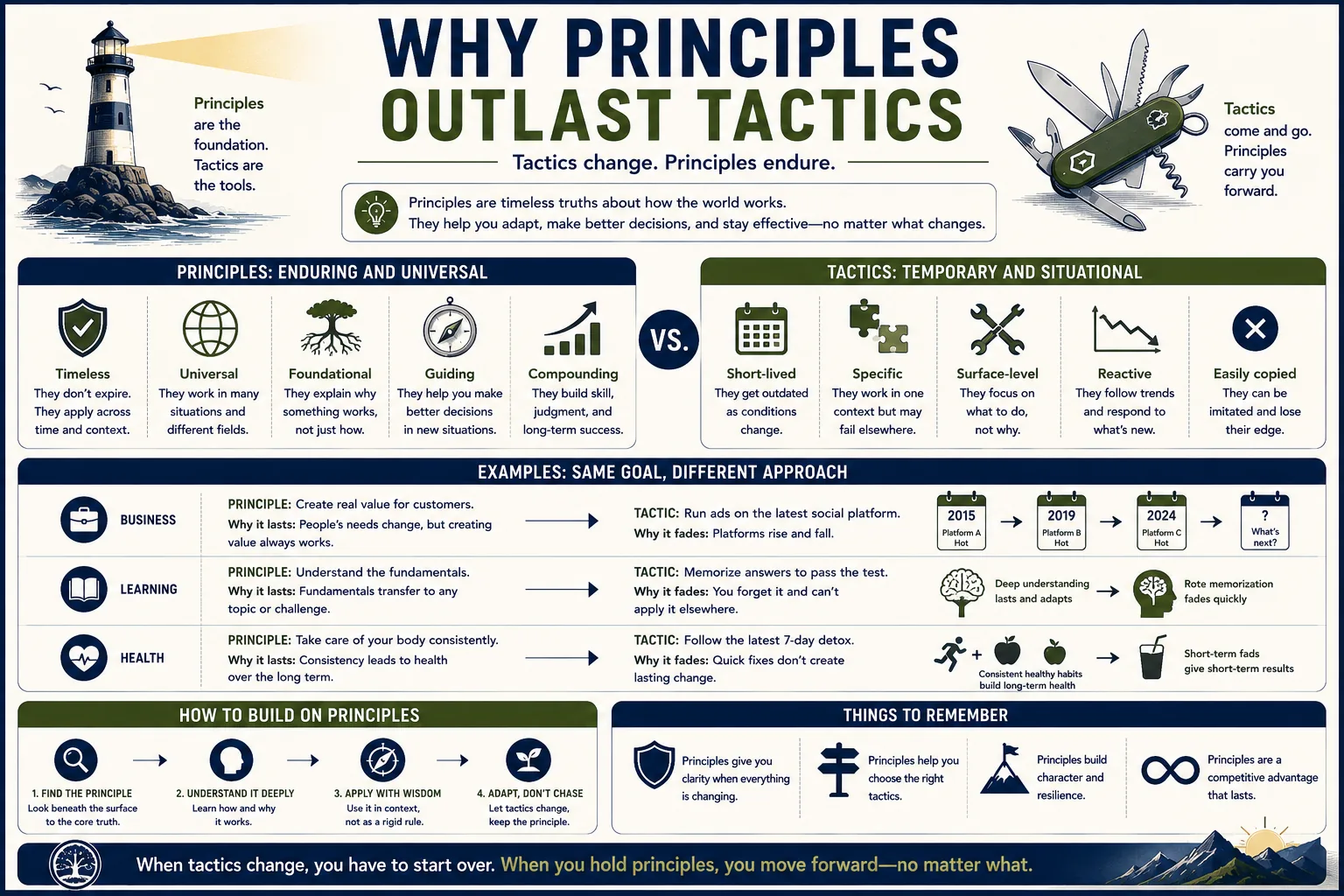
Why principles outlast tactics is that tactics are specific actions optimized for a changing context, whereas principles explain the underlying mechanisms that make actions work. Stable forces such as attention, incentives, supply and demand, feedback, and human bias let people adapt their methods when technology, markets, regulation, or culture changes. Learning principles therefore builds transferable knowledge instead of constantly obsolete recipes.
It's 2010. You learn Facebook ads. Master the tactics: demographic targeting, image specs, bid strategies, landing page formulas. You're an expert. Revenue flows. Then Facebook changes the algorithm. Your tactics stop working. You scramble to learn new tactics.
Meanwhile, someone else learned the underlying principles: attention is scarce, relevance beats interruption, trust precedes purchase, testing reveals what works. When Facebook changes, they adapt their tactics based on unchanged principles. They stay effective while tactics-focused marketers struggle.
It's 2024. The tactics expert has relearned their approach five times (Facebook algorithm changes, iOS privacy updates, TikTok rise, AI content tools). The principles thinker adapted each time without starting over.
This pattern repeats everywhere. Tactics are specific actions that work in particular contexts. Principles are underlying truths about why things work. Contexts change constantly-technology, markets, culture, competition. Tactics optimized for yesterday's context become obsolete.
Principles that explain why things work remain valuable because they transfer to new contexts. Understanding what a principle actually is - and why this distinction between principle and rule matters - is the foundation for everything else in this article.
Understanding why principles outlast tactics-and how to extract principles from tactics-transforms learning from memorizing constantly-obsoleting recipes to building durable knowledge that compounds over time.
"The best thing a human being can do is to help another human being know more. And the best way to do that is through principles-because principles are what endure." - Charlie Munger[1]
The Fundamental Difference
Tactics: What to Do
Definition: Specific actions that work in particular situations.
Characteristics:
| Characteristic | Description |
|---|---|
| Concrete | Specific, detailed instructions |
| Context-bound | Optimized for particular situations |
| Immediate | Actionable right now |
| Narrow | Solves specific problem |
| Surface-level | Describes what without explaining why |
Examples:
Marketing: "Post on Instagram at 9am and 7pm for maximum engagement"
Coding: "Use Array.map() instead of for loops in JavaScript"
Negotiation: "Make the first offer to anchor the discussion"
Sales: "Ask three questions before presenting solution"
Fitness: "Do 3 sets of 10 reps with 60-second rest"
Principles: Why Things Work
Definition: Underlying truths that explain how and why things work.
Characteristics:
| Characteristic | Description |
|---|---|
| Abstract | General understanding, not specific instructions |
| Context-flexible | Applies across varied situations |
| Foundational | Requires interpretation to act on |
| Broad | Explains many phenomena |
| Deep | Reveals why things work |
Examples (corresponding to tactics above):
Marketing principle: "People engage when content matches their context (time, mindset, platform behavior patterns)"
Coding principle: "Declarative code (what to achieve) is clearer than imperative code (how to achieve it) when abstraction is appropriate"
Negotiation principle: "Anchoring effect-initial numbers disproportionately influence final outcomes by setting reference points"
Sales principle: "Understanding before proposing-diagnose the problem before prescribing solutions builds trust and relevance"
Fitness principle: "Progressive overload-muscles adapt to increasing stress, requiring systematically increasing demands for continued growth"
The Critical Distinction
Tactics answer: "What should I do right now?"
Principles answer: "Why does this work, and how can I apply this understanding elsewhere?"
"True principles are like bedrock. Tactics are the shifting sand on top. Build on sand and every storm forces you to rebuild. Build on bedrock and you adapt with the terrain." - Ray Dalio[15]
Example: Email marketing
Tactic (2010): "Subject line under 50 characters, send Tuesdays at 10am, include one call-to-action button"
Principle: "Attention is scarce, clarity beats cleverness, reducing friction increases action"
What happened:
- 2015: Mobile dominates. Different screen sizes. Tactic (50 characters) becomes obsolete.
- 2020: AI filters prioritize relevance. Send timing matters less. Tactic obsolete.
- 2024: Inbox overload extreme. Personalization essential. Generic tactics fail.
Principle-based approach: Still works because principles didn't change
- Attention still scarce (maybe more so)
- Clarity still beats cleverness
- Reducing friction still increases action
Adapt tactics to new context: Shorter subject lines for mobile, hyper-personalization for filters, one-click actions for friction reduction.
Tactics expert: Relearns tactics every few years
Principles thinker: Adapts tactics continuously based on stable principles
Why Principles Outlast Tactics
Why principles outlast tactics comes down to five reasons: contexts change but the underlying mechanisms stay stable, principles transfer across domains while tactics stay domain-specific, principles let you generate new tactics instead of memorizing old ones, principles explain why tactics fail, and real expertise is principles combined with judgment rather than a list of steps.
Reason 1: Contexts Change, Fundamentals Don't
Surface conditions shift constantly:
- Technology evolves
- Markets mature
- Competitors adapt
- Regulations change
- Culture shifts
Underlying mechanisms remain stable:
- Human psychology (attention, motivation, bias)
- Economic forces (supply/demand, incentives)
- Physical constraints (time, energy, resources)
- Systems dynamics (feedback loops, leverage, inertia)
Example: Advertising
Tactics (changed):
- 1960s: TV commercials
- 1990s: Banner ads
- 2000s: Google AdWords
- 2010s: Social media ads
- 2020s: Influencer marketing, TikTok
Principles (unchanged):
- Attention is scarce and valuable
- Relevance beats interruption
- Trust precedes purchase
- Distribution determines reach
- Frequency builds familiarity
Every decade, tactics expert relearns everything.
Principles thinker adapts same understanding to new channels.
"I very frequently get the question: 'What's going to change in the next 10 years?' And that is a very interesting question; it's a very common one.
I almost never get the question: 'What's not going to change in the next 10 years?' And I submit to you that that second question is actually the more important of the two-because you can build a business strategy around the things that are stable in time." - Jeff Bezos
Reason 2: Principles Transfer, Tactics Don't
Tactics are domain-specific.
Principles work across domains.
Example: "Spacing effect" principle
Principle: Distributed practice beats massed practice for long-term retention.
Applies to:
| Domain | Tactical Application |
|---|---|
| Education | Space study sessions over days/weeks, not all-night cramming |
| Fitness | Train muscle groups with rest days, not same muscles daily |
| Marketing | Spread ad exposures over time, not all at once |
| Product launches | Stagger feature releases, not big-bang approach |
| Learning instruments | Practice 30 min daily beats 3.5 hours once a week |
Learn principle once. Apply everywhere.
Learn tactic: Only works in original domain.
Reason 3: Principles Enable Generation of Tactics
Tactics are finite (memorize existing ones).
Principles are generative (create new tactics).
Example: "Scarcity increases perceived value" principle
Classic tactics derived from this:
- Limited-time offers
- Limited quantity (only 10 left!)
- Exclusive access (members only)
Novel tactics you can generate from principle:
- Limited attention (one topic per email)
- Limited availability (calendar booking system showing few slots left)
- Limited access to you (office hours, not always available)
- Seasonal offerings (only available certain times)
- Waitlists (demand exceeds supply)
If you know principle, you can invent tactics fitting your specific context.
If you only know tactics, you're limited to what you've memorized.
Reason 4: Principles Explain Failures
When tactics fail, tactics-only knowledge leaves you blind.
Principles explain why failures happened.
Example: Growth tactic failure
Tactic: "Guest posting on high-traffic sites drives traffic to your site"
Attempt: Write excellent guest posts on major sites.
Result: Some traffic spike, but doesn't convert. Minimal lasting impact.
Tactics-only analysis: "Guest posting doesn't work. Try something else."
Principle-based analysis:
Principle 1: "Attention is easy, relevant attention is hard" Random traffic isn't valuable
Principle 2: "Trust takes time and repeated exposure" One-time touch insufficient
Principle 3: "Conversion requires clear next step and motivation" Guest post reader doesn't know you, no strong motivation to engage
Insight: Tactic failed because you got attention without relevance or trust. Need different approach: guest post on highly relevant niche sites (relevance), do it repeatedly (repeated exposure builds trust), offer valuable next step (lead magnet, not just homepage).
Principles explain what went wrong and how to fix it.
Tactics just say "worked" or "didn't work."
Reason 5: Expertise = Principles + Judgment
Novices memorize tactics.
Experts understand principles and apply judgment.
"Efficiency is doing things right; effectiveness is doing the right things. The expert's advantage is knowing-from principles, not from a checklist-which things are worth doing at all." - Peter Drucker
Research (Dreyfus model of skill acquisition):[2]
Stages:
- Novice: Follow rules rigidly (tactics only)
- Advanced beginner: Recognize patterns (tactics + some context)
- Competent: Conscious deliberate planning (starting to see principles)
- Proficient: Intuitive grasp of situations (principles integrated)
- Expert: Fluid, intuitive performance (principles so deep they're automatic)
Experts don't follow cookbook tactics. They understand principles deeply enough to adapt fluidly.
Example: Expert chess players
Novices: Memorize opening moves (tactics)
Experts: Understand positional principles (control center, develop pieces, king safety, pawn structure)
Result: Experts adapt to novel positions. Novices lost when position doesn't match memorized patterns.
The Limitations of Tactics
Limitation 1: Tactics Become Obsolete
Contexts change. Tactics optimized for old context fail in new one.
Example: SEO tactics
2005: Keyword stuffing, hidden text, link farms → Worked (Google algorithm naive)
2010: Made obsolete by Google updates → Penalized
2015: Content length, backlinks → Worked
2020: E-A-T (expertise, authoritativeness, trustworthiness), user experience → Updated priorities
2024: AI-generated content detection, helpful content updates → New challenges
Every few years, tactics obsolete.
Principles (provide value, build authority, match search intent) remain stable.
Limitation 2: Tactics Don't Explain Why
Following tactics without understanding is fragile.
When conditions change slightly, you don't know how to adapt.
Example: Recipe vs. Cooking principles
Recipe (tactic): "Bake at 350F for 25 minutes"
Problem: Your oven runs hot. Recipe fails. You don't know why or how to adjust.
Principle: "Baking transforms proteins and evaporates moisture. Temperature and time must balance: too hot = burnt outside, raw inside; too cool = dry, tough"
With principle: You understand 350F is conventional guideline. Your hot oven → reduce to 325F or reduce time. You can adapt.
Limitation 3: Tactics Create Dependency
Always need someone to tell you what to do.
Can't think independently.
Pattern:
- Find tactic that works
- Memorize and apply
- Context changes
- Tactic stops working
- Search for new tactic
- Repeat
Never develop independent capability.
Alternative:
- Find tactic that works
- Ask why it works (extract principle)
- Context changes
- Principle still applies
- Derive new tactic from principle
- Build independent capability
How to Extract Principles from Tactics
You extract principles from tactics by asking why a tactic works instead of just copying it, then looking for patterns across similar tactics that succeed for the same underlying reason. Test the suspected principle across different contexts: if it holds outside its original domain, it is a principle, not a tactic. Finally, identify the specific mechanism driving the result, since naming the mechanism is what makes the principle transferable and useful.
Method 1: Ask "Why" Repeatedly
Don't stop at surface explanation.
Example: "Send emails on Tuesday mornings" tactic
Q1: Why Tuesday mornings?
A1: Data shows higher open rates then.
Q2: Why higher open rates then?
A2: Monday is catch-up day, people swamped. Later in week, people focused on wrapping up.
Q3: Why does timing of being in inbox matter?
A3: Attention is scarce. People check email in bursts. Being in inbox during check increases chance of being seen.
Principle: "Timing delivery to match attention patterns increases visibility"
Now transferable: Not just email timing, but social post timing, sales call timing, meeting scheduling, etc.
Method 2: Look for Patterns Across Similar Tactics
Multiple tactics that work → Common underlying principle
Example: Marketing tactics that work
Tactics:
- Influencer endorsements
- Customer testimonials
- Case studies
- Expert credentials
- Social proof (X people bought this)
- Press mentions
Pattern: All involve third-party validation.
Principle: "People trust claims more when verified by credible third parties" (social proof principle, Cialdini)[5]
Now you can generate new tactics: User reviews, industry awards, partnerships with respected brands, media appearances, data from reputable sources.
Method 3: Test Across Contexts
If something is truly a principle, it should work across different domains.
If it only works in original domain, it's a tactic.
Example: "Commit publicly" tactic
Context 1 (fitness): Announce workout goals publicly → Higher follow-through
Context 2 (work): Share project timelines publicly → Higher completion rates
Context 3 (habits): Tell friends about new habit → Increased adherence
Works across contexts → It's a principle.
Principle: "Public commitments create accountability through reputation concern and social pressure"
Verified as principle.
Method 4: Find Mechanisms
Tactics describe what. Principles explain mechanism (how/why it works).
Understanding mechanism is understanding the principle.
Example: "Use odd prices ($19.99 instead of $20)" tactic
Mechanism research:
- Left-digit bias: People focus on leftmost digit ($19.99 processed as "19", not "almost 20")
- Precision signaling: Odd prices suggest calculated value, not round markup
- Anchoring: Initial perception ($19) influences value judgment
Principle: "Perception of value is influenced by presentation; numerical salience affects mental categorization"
Application beyond pricing: Round numbers for big picture ("About $1M revenue"), precise numbers for credibility ("1,247 customers" feels more real than "over 1,000")
When to Use Tactics vs. Principles
Use Tactics When:
1. You're starting out (novice stage)
- Need immediate action
- Don't yet have judgment
- Following proven patterns builds experience
2. Situation is well-understood and stable
- Best practices are established
- Context isn't changing
- Efficiency matters more than adaptation
3. Stakes are low
- Cost of following outdated tactic is small
- Speed of action matters more than optimal approach
Use Principles When:
1. Context is changing or unfamiliar
- Existing tactics may not apply
- Need to adapt to new situation
- Judgment required
2. You're developing expertise
- Want durable knowledge
- Building capability, not just executing
- Long-term thinking
3. Stakes are high
- Need to understand deeply
- Must adapt to specific situation
- Can't afford blindly following playbook
The Optimal Path: Both
Learn tactics. Extract principles. Apply judgment.
Stages:
1. Start with tactics (get moving, build experience)
2. Question tactics (why do these work?)
3. Extract principles (underlying mechanisms)
4. Test principles (do they transfer?)
5. Generate new tactics (from principles)
6. Build judgment (when to apply which)
Result: Tactics give you starting point. Principles give you durability. Judgment gives you wisdom.
Principle-Based Learning
Strategy 1: Learn Frameworks, Not Formulas
Formulas (tactics): Specific step-by-step instructions
Frameworks (principles):Mental models for understanding situations
Example: Sales
Formula approach (tactics):
- Step 1: Opening line
- Step 2: Three discovery questions
- Step 3: Present solution
- Step 4: Handle objections (use these scripts)
- Step 5: Close (use this line)
Framework approach (principles):
- Understand before proposing (diagnosis precedes prescription)
- Value must exceed price and switching cost
- Trust enables purchase (build credibility)
- Objections reveal concerns (address underlying worry, not surface objection)
- Timing matters (push when ready, not before)
Formula breaks when customer doesn't follow expected script.
Framework adapts to unique situations.
Strategy 2: Study Across Domains
Learning same principle in multiple contexts:
- Reinforces understanding
- Reveals generalizability
- Shows variations
Example: "Feedback loops" principle
Study in:
- Biology: Homeostasis (body temperature regulation)
- Economics: Supply and demand cycles
- Psychology: Habit formation (cue → action → reward → reinforcement)
- Business: Viral growth (user → invites → more users)
- Climate: Ice-albedo feedback
Understanding across domains makes principle concrete and transferable.
Strategy 3: Focus on Mechanism
When learning anything, ask: "What's the mechanism that makes this work?"
Example: Spaced repetition
Surface: Spacing practice improves retention.
Mechanism:
- Retrieval effort strengthens memory traces
- Forgetting slightly → retrieval harder → stronger encoding
- Spacing optimizes forgetting/retrieval cycle
- Massing provides no retrieval practice (still in short-term memory)
Understanding mechanism enables:
- Optimal spacing intervals (when forgetting begins)
- Application to other domains (skill practice, habit formation)
- Troubleshooting (if not working, is retrieval effort sufficient?)
Conclusion: Durability Through Depth
Tactics are the surface.
Principles are the foundation.
The tactics approach:
- Learn what works now
- Memorize and apply
- When context changes, relearn everything
- Always dependent on external guidance
- Knowledge obsoletes quickly
The principles approach:
- Learn why things work
- Understand mechanisms
- When context changes, adapt tactics based on stable principles
- Develop independent judgment
- Knowledge compounds over time
Why principles outlast tactics:
- Fundamentals are stable (contexts change, underlying mechanisms don't)
- Principles transfer (work across domains)
- Principles are generative (create new tactics from understanding)
- Principles explain failures (understand what went wrong)
- Principles enable expertise (judgment requires understanding)
Key insights:
- Tactics describe what; principles explain why
- Tactics are context-bound; principles transfer
- Tactics obsolete; principles endure
- Tactics create dependency; principles enable independence
- Extract principles by asking "why," finding patterns, testing across contexts, understanding mechanisms
The path forward:
As learner:
- Start with tactics (need action)
- Extract principles (ask why)
- Build principle library (across domains)
- Develop judgment (when/how to apply)
As teacher:
- Teach tactics for immediate action
- Explain principles for deep understanding
- Show connections across domains
- Develop independent thinking
As expert:
- Operate from principles (fluid adaptation)
- Generate novel tactics (from understanding)
- Transfer knowledge (principles across domains)
- Build judgment (principles + experience)
The ultimate goal isn't to avoid tactics.
It's to understand the principles underlying tactics, so you can:
- Adapt when contexts change
- Transfer across domains
- Generate novel approaches
- Develop independent judgment
- Build knowledge that compounds
Tactics are tools.
Principles are wisdom.
Master principles, and you'll always know which tools to use-even when the specific tools keep changing.
"It's not what we don't know that gets us into trouble. It's what we know for sure that just ain't so. The decision-making that endures is rooted in principles and honest values-not in the clever tactics of the moment." - Warren Buffett
Research on Principle Durability: Studies in Medicine, Law, and Science
The relative durability of principles versus tactical knowledge has been studied most rigorously in medicine, where the stakes of knowledge obsolescence are directly measurable in patient outcomes.
John Ioannidis (Stanford) published a landmark 2005 paper in PLOS Medicine arguing that "most published research findings are false," based on statistical analysis of how sample sizes, bias rates, and prior probability interact to produce high false discovery rates.
Subsequent research has confirmed that specific medical recommendations - particular drug dosages, dietary guidelines, screening protocols - have a half-life of approximately 5-10 years before being substantially revised.
A 2013 study by Vinay Prasad and colleagues in Mayo Clinic Proceedings examined 2,044 original articles published in the New England Journal of Medicine from 2001-2010, of which 363 tested an established practice, and found that 146 (40.2%) were reversals: no better than or inferior to alternatives.
Specific medical tactics are unstable.
What remains stable are the methodological principles underlying good medical research: controlled comparison, pre-registration of hypotheses, randomization to reduce confounding, systematic meta-analysis of cumulative evidence.
These principles, formalized by Austin Bradford Hill in his 1965 criteria for establishing causation in epidemiology, remain the foundation of evidence-based medicine precisely because they describe how to generate reliable knowledge rather than specifying what that knowledge is.
Practitioners who understand the principles can evaluate new evidence correctly; practitioners who learned only the current recommendations must wait to be told what the new recommendations are.
In legal systems, the distinction between principle and rule is formally embedded in constitutional design. The United States Constitution's First Amendment - "Congress shall make no law... abridging the freedom of speech" - is a principle.
The specific rules about obscenity, defamation, commercial speech, and true threats are judicial interpretations developed over 200 years of applying the principle to specific cases. When new communication technologies appeared (telegraph, radio, television, internet, social media), existing tactical rules did not directly apply.
Courts returned to the underlying principle - why does free speech matter, what harms does its protection prevent - and derived new applications.
Geoffrey Stone (University of Chicago Law School) documented in Perilous Times (2004) that the principle consistently outlasted every specific doctrinal rule, generating new rules as contexts changed while remaining itself stable.
In science more broadly, Derek de Solla Price's 1963 analysis (Little Science, Big Science) of the exponential growth of scientific publication found that the scientific literature doubles approximately every 15 years - meaning that a substantial share of what is known in any given scientific field was discovered relatively recently.
Tactical knowledge (specific facts, measurements, protocols) turns over rapidly. Foundational principles - conservation laws, evolutionary theory, quantum mechanics, natural selection - have remained stable for decades to a century because they describe mechanisms rather than observations.
Richard Feynman's lectures on physics (1961-1963) remain required reading in physics education not because the facts are current (many have been refined) but because the explanatory principles and modes of reasoning they exemplify are timeless.
Industries Where Principle-Based Practitioners Outperformed Tactic-Followers
The competitive advantage of principle-based knowledge over tactical knowledge has been documented in several industries where both types of practitioners operate and their outcomes can be compared.
In value investing, Ben Graham's foundational principles - buy businesses trading below their intrinsic value, maintain a margin of safety, distinguish between price and value - have generated documented long-term outperformance across radically different market environments since Graham formalized them in Security Analysis (1934) and The Intelligent Investor (1949).
Specific tactical implementations of Graham's principles have varied enormously: Graham himself bought net-net stocks (trading below liquidation value); Warren Buffett evolved to buying high-quality businesses at fair prices; Seth Klarman (Baupost Group) applied the principles to distressed debt and real estate.
The tactics changed with market conditions and opportunity sets; the principles remained constant.
Value investing, as formalized by Benjamin Graham, has been associated with long-term outperformance in academic studies.
In software architecture, Robert Martin (author of Clean Code, 2008) documented the longevity of SOLID principles (Single Responsibility, Open-Closed, Liskov Substitution, Interface Segregation, Dependency Inversion) versus specific tactical patterns and frameworks.
Martin's consulting practice found that codebases organized around the underlying principles maintained productivity over time even as frameworks and languages changed, while codebases organized around tactical patterns tied to specific frameworks (Rails conventions, Spring idioms, React lifecycle) experienced sharp productivity declines when frameworks were updated or replaced.
Adam Tornhill (Empear) has argued, in Your Code as a Crime Scene (2015), that files with high change frequency tend to be hotspots with higher defect rates.
The measurement confirmed what principle-advocates claimed: architectures grounded in stable principles resisted tactical obsolescence.
Phil Jackson, who coached the Chicago Bulls to six NBA championships and the Los Angeles Lakers to five, explicitly attributed his success to principles-based coaching rather than tactic-based coaching in Sacred Hoops (1995) and Eleven Rings (2013).
Jackson's triangle offense was not a set of plays (tactics) but a set of principles: read the defense, share the ball, exploit mismatches, create movement. Players who internalized the principles could execute the offense against defenses they had never practiced against.
Jackson noted that he delegated tactical detail to assistant coaches and focused his own energy on the principles governing player decision-making and team culture.
The durability of his coaching success across two franchises, a decade and a half, and roster changes that replaced nearly every original player is consistent with the hypothesis that principle-based approaches outperform tactic-based approaches when environments change - which competitive sports, like markets, do continuously.
Sources & Further Reading
Munger, C. (1994). A Lesson on Elementary Worldly Wisdom. USC Business School speech.
Dreyfus, H. L., & Dreyfus, S. E. (1986). Mind Over Machine: The Power of Human Intuition and Expertise in the Era of the Computer. Free Press.
Ericsson, K. A., Krampe, R. T., & Tesch-Römer, C. (1993). "The Role of Deliberate Practice in the Acquisition of Expert Performance." Psychological Review, 100(3), 363-406.
Kahneman, D. (2011). "Thinking, Fast and Slow." Farrar, Straus and Giroux.
Cialdini, R. B. (2006). "Influence: The Psychology of Persuasion" (Rev. ed.). Harper Business.
Dweck, C. S. (2006). "Mindset: The New Psychology of Success." Random House.
Brown, P. C., Roediger, H. L., & McDaniel, M. A. (2014). Make It Stick: The Science of Successful Learning. Harvard University Press.
Bjork, R. A., & Bjork, E. L. (1992). "A New Theory of Disuse and an Old Theory of Stimulus Fluctuation." In A. Healy, S. Kosslyn, & R. Shiffrin (Eds.), From Learning Processes to Cognitive Processes: Essays in Honor of William K. Estes (Vol. 2, pp. 35-67). Erlbaum.
Senge, P. M. (1990). "The Fifth Discipline: The Art and Practice of the Learning Organization." Doubleday.
Schön, D. A. (1983). The Reflective Practitioner: How Professionals Think in Action. Basic Books.
Christensen, C. M. (1997). "The Innovator's Dilemma: When New Technologies Cause Great Firms to Fail." Harvard Business Review Press.
Taleb, N. N. (2012). "Antifragile: Things That Gain from Disorder." Random House.
Tetlock, P. E., & Gardner, D. (2015). "Superforecasting: The Art and Science of Prediction." Crown Publishers.
Simon, H. A. (1996). "The Sciences of the Artificial" (3rd ed.). MIT Press.
Dalio, R. (2017). Principles: Life and Work. Simon & Schuster.
About This Series: This article is part of a larger exploration of principles and laws. For related concepts, see What Is a Principle and Why It Matters, Universal Principles That Apply Across Domains, Why Laws Break When Context Changes, and First-Order vs Second-Order Effects.