
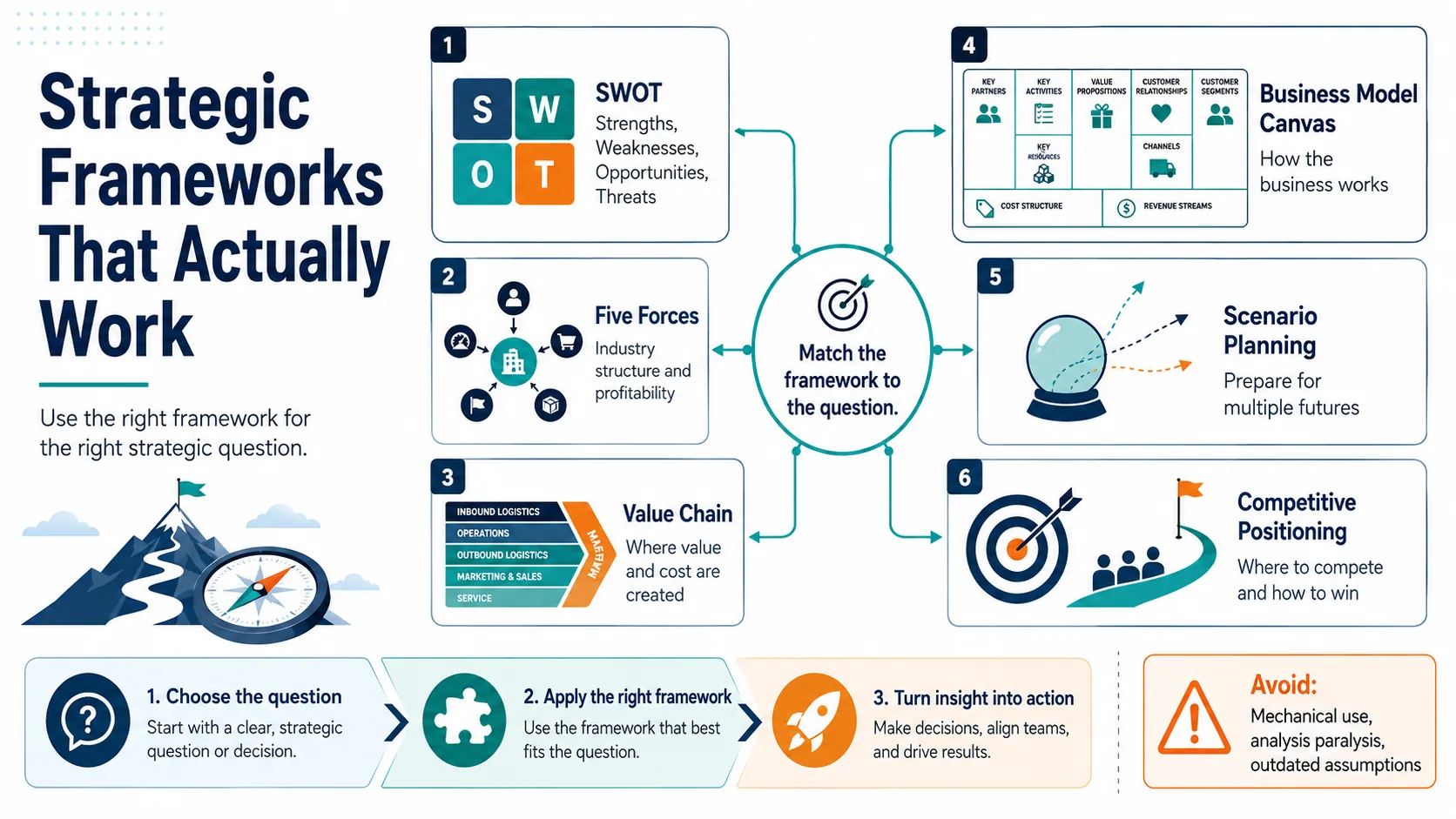
Strategic frameworks promise to clarify complex business decisions. Many deliver: SWOT analysis, Porter's Five Forces, and value chain analysis have guided successful strategy for decades. Others feel dated, disconnected from digital-age realities, or produce generic insights.
The difference isn't the frameworks themselves-it's understanding when each applies, what questions each answers, and how to use them without mechanical thinking.
This article examines proven strategic frameworks: what they do well, where they fail, and how to choose the right tool for your strategic challenge.
A strategic framework is a structured model that organizes information about a competitive situation, business environment, or organizational decision into categories designed to surface strategic insights.
What distinguishes a framework from a simple checklist is that it embeds a theory: assumptions about which factors matter most and how they relate to each other.
Frameworks matter because unstructured analysis tends to focus on whatever information is most salient or readily available, rather than what is most strategically relevant; a good framework forces systematic attention to the right questions before any conclusions are drawn.
Framework 1: SWOT Analysis
Structure
SWOT examines four dimensions:
| Internal (Organization) | External (Environment) |
|---|---|
| Strengths (advantages you have) | Opportunities (favorable external conditions) |
| Weaknesses (disadvantages you have) | Threats (unfavorable external conditions) |
Purpose: Map strategic position to inform decisions about where to compete and how to win.
How to Use SWOT
Step 1: List factors in each quadrant
Strengths:
- Strong brand recognition
- Proprietary technology
- Efficient operations
- Talented team
- Financial resources
Weaknesses:
- Limited distribution
- High cost structure
- Weak customer data
- Aging product line
Opportunities:
- Growing market segment
- Competitor exit
- Regulatory changes favoring your model
- New distribution channels
Threats:
- New entrants with better technology
- Changing customer preferences
- Economic downturn
- Supply chain disruption
Step 2: Strategic implications
| Combination | Strategy |
|---|---|
| Strength + Opportunity | Aggressive expansion (leverage strength to capture opportunity) |
| Strength + Threat | Defensive positioning (use strength to mitigate threat) |
| Weakness + Opportunity | Selective pursuit (address weakness to capture opportunity) |
| Weakness + Threat | Withdraw or transform (avoid areas where weakness meets threat) |
Example: Netflix (circa 2007)
Strengths: DVD-by-mail infrastructure, customer data, brand
Weakness: Physical distribution (slow, costly)
Opportunity: Broadband internet adoption
Threat: Blockbuster, cable companies
Strategic move: Strength (customer data, brand) + Opportunity (broadband) = Launch streaming service
When SWOT Fails
Problem 1: Becomes list-making exercise
Symptom: Teams brainstorm 50 factors across quadrants, then... nothing.
Why it fails: No prioritization, no action, no strategic choice.
As Richard Rumelt wrote, "Good strategy is not a goal. It's a coherent set of analyses, concepts, policies, arguments, and actions that respond to a high-stakes challenge." A SWOT that produces only lists never rises to that level.
Fix: After listing, force-rank top 3 in each quadrant. Strategic decisions focus on these 12 factors.
Problem 2: Confuses internal vs. external
Common mistake: "Threat: We lack distribution" That's internal weakness, not external threat
Why it matters: Strategic responses differ.
- External threat Adapt positioning, timing, partnerships
- Internal weakness Build capability, acquire, outsource
Fix: Strict definition. If it's about you, it's internal. If it's about the world, it's external.
Problem 3: Static snapshot in dynamic world
Issue: SWOT captures moment in time. Strategy requires anticipating change.
Example:
- "Strength: Dominant market share"
- Six months later: Disrupted by new entrant
- SWOT didn't reveal vulnerability
Fix: Add temporal dimension:
- Which strengths are eroding?
- Which weaknesses are improving?
- Which opportunities are fleeting?
- Which threats are accelerating?
Framework 2: Porter's Five Forces
Structure
Analyzes industry structure through five competitive forces that determine profitability:
| Force | Description | Impact on Profitability |
|---|---|---|
| Rivalry among competitors | Intensity of competition | High rivalry Lower margins |
| Threat of new entrants | Ease of market entry | Low barriers Lower margins |
| Bargaining power of suppliers | Supplier leverage | High power Higher input costs |
| Bargaining power of buyers | Customer leverage | High power Lower prices |
| Threat of substitutes | Alternative solutions | Strong substitutes Price pressure |
Purpose: Assess industry attractiveness and identify positioning opportunities.
"The essence of strategy formulation is coping with competition." - Michael Porter, Competitive Strategy (1980)
Applying Five Forces
Example: Airline industry analysis
1. Rivalry:
- High: Many competitors, low differentiation, high fixed costs
- Result: Price wars, slim margins
2. Threat of new entrants:
- Moderate: Capital requirements high, but not impossible (Southwest, JetBlue entered)
- Result: Periodic new competition
3. Supplier power:
- High: Boeing/Airbus duopoly, unionized labor
- Result: Limited negotiating leverage
4. Buyer power:
- High: Easy price comparison, low switching costs
- Result: Pressure on fares
5. Substitutes:
- Moderate: Cars, trains, video conferencing
- Result: Some demand elasticity
Conclusion: Industry structure is unattractive (explains historically low airline profitability).
Strategic implications:
- Don't enter unless you have structural advantage
- If in industry, seek defensible niches (business travel, hubs)
- Consolidation may improve structure (reduce rivalry)
When Five Forces Works Best
Ideal conditions:
| Condition | Why It Matters |
|---|---|
| Stable industry structure | Forces change slowly; analysis remains valid |
| Clear boundaries | Can identify who's in industry, who's substitute |
| Tangible products | Easier to analyze than digital/platform markets |
| Mature markets | Established players, known dynamics |
Industries where Five Forces excels:
- Airlines, steel, cement, restaurants, retail banking
When Five Forces Falls Short
Problem 1: Network effects and platforms
Issue: Five Forces designed for pipeline businesses (buy inputs, add value, sell outputs). Platforms operate differently.
Example: Uber
- Traditional view: Rivalry = other taxi companies
- Reality: Two-sided market (drivers + riders); network effects dominate[10]
- Five Forces misses core dynamics
Adaptation needed: Consider platform-specific forces (same-side effects, cross-side effects, multi-homing costs)
Problem 2: Rapid technological change
Issue: Analysis assumes relatively stable industry structure. Tech disruption violates this.
Example: Retail (2010)
- Five Forces might show brick-and-mortar retail as moderately attractive
- Missed: Amazon fundamentally altering structure (e-commerce substitution)
- Analysis becomes obsolete quickly
As Clayton Christensen observed, "The reason why it is so difficult for existing firms to capitalize on disruptive innovations is that their processes and their business model that make them good at the existing business actually make them bad at competing for the disruption." Five Forces, designed for stable markets, can mask this kind of structural shift entirely.[11]
Solution: Combine with scenario planning for uncertainty
Problem 3: Ignores complementary products
Issue: Five Forces focuses on competitive dynamics, misses cooperative dynamics.
Example: Smartphone ecosystem
- Traditional analysis: Apple vs. Samsung rivalry
- Misses: App developers, accessory makers, content providers
- Complementors create value, not just competitors extracting it
Fix: Add "sixth force"-power of complementors
Framework 3: Value Chain Analysis
Structure
Maps activities that create value, identifying where competitive advantage emerges.[2]
Primary activities:
| Activity | Description | Value Creation |
|---|---|---|
| Inbound logistics | Receiving, storing inputs | Cost efficiency, quality |
| Operations | Transforming inputs to product | Efficiency, quality, features |
| Outbound logistics | Delivering product | Speed, reliability, cost |
| Marketing & sales | Getting customers to buy | Reach, persuasion, positioning |
| Service | Post-purchase support | Retention, satisfaction, upsell |
Support activities:
- Infrastructure (finance, legal, management)
- HR management
- Technology development
- Procurement
Strategic Application
Question: Where can we create competitive advantage?
"Competitive advantage cannot be understood by looking at a firm as a whole. It stems from the many discrete activities a firm performs in designing, producing, marketing, delivering, and supporting its product." - Michael Porter, Competitive Advantage (1985)
Process:
- Map your value chain (list all activities)
- Analyze each activity: Cost position? Differentiation potential?
- Identify linkages: How do activities interact?
- Benchmark competitors: Where are we better/worse?
- Strategic focus: Double down on advantages, fix critical weaknesses
Example: Walmart
| Activity | Walmart's Approach | Competitive Advantage |
|---|---|---|
| Inbound logistics | Cross-docking, vendor integration | Lower inventory costs |
| Operations | Standardized stores, efficient layouts | Lower labor costs |
| Outbound logistics | Own distribution centers, route optimization | Lower distribution costs |
| Marketing | Everyday low prices, minimal advertising | Lower marketing costs |
| Technology | Advanced inventory systems, data analytics | Better forecasting, lower stockouts |
Result: Low-cost position across entire value chain sustainable cost leadership
Example: Differentiation (Ritz-Carlton)
| Activity | Ritz-Carlton's Approach | Differentiation |
|---|---|---|
| Service | Anticipatory service, empowered staff | Exceptional customer experience |
| HR | Extensive training, "ladies and gentlemen serving ladies and gentlemen" | Service culture |
| Operations | Customization, flexibility | Personalized experiences |
Result: Differentiation through service premium pricing
When Value Chain Works
Best for:
- Operational strategy: Where to improve efficiency or differentiation
- Benchmarking: Compare activities to competitors
- Outsourcing decisions: Which activities are core vs. non-core?
- Integration decisions: Should we vertically integrate?
Limitations
Digital businesses:
- Software/platforms don't fit clean value chain (physical logistics irrelevant)
- Need adapted framework (e.g., data chain, user acquisition funnel)
Service businesses:
- Simultaneous production and consumption blurs boundaries
- Customer is part of value creation process
Framework 4: Business Model Canvas
Structure
Visual framework with nine building blocks:
| Element | Question |
|---|---|
| Customer segments | Who are we serving? |
| Value propositions | What value do we deliver? |
| Channels | How do we reach customers? |
| Customer relationships | How do we interact with customers? |
| Revenue streams | How do we make money? |
| Key resources | What assets do we need? |
| Key activities | What do we do? |
| Key partnerships | Who do we work with? |
| Cost structure | What are our costs? |
Purpose: Describe, design, and innovate business models.
Using the Canvas
Best practice: Sketch on whiteboard, iterate rapidly
Example: Airbnb
Customer segments:
- Travelers seeking local, authentic, affordable stays
- Hosts with spare rooms/properties
Value propositions:
- Travelers: Unique stays, local experience, value
- Hosts: Income from underutilized space
Channels:
- Website, mobile app
Customer relationships:
- Platform-mediated, community-driven, reviews build trust
Revenue streams:
- Commission on bookings (3% guests, 3-15% hosts)
Key resources:
- Platform technology, brand, network effects
Key activities:
- Platform development, trust/safety, marketing
Key partnerships:
- Payment processors, insurance providers
Cost structure:
- Technology development, customer support, marketing
Strategic insight: Two-sided marketplace model; value grows with network size.[15]
When Canvas Works
Ideal for:
- Startup design: Rapid iteration on business model
- Innovation projects: Exploring new models
- Communication: Align team on model
- Comparison: Evaluate multiple model options
Weakness: Less useful for operational execution or competitive analysis (use other frameworks for those)[5]
Framework 5: Scenario Planning
Structure
Method for strategic decision-making under uncertainty:
- Identify critical uncertainties (factors that matter but you can't predict)[7]
- Select two key uncertainties (create 22 matrix)
- Develop four scenarios (combinations of uncertainty outcomes)
- Analyze implications of each scenario
- Identify robust strategies (work across multiple scenarios)
"The scenario planning approach... is not about predicting the future. It is about understanding the forces that will shape the future, and making robust decisions today in light of possible futures." - Peter Schwartz, The Art of the Long View (1991)
Example: Energy company (2010)
Critical uncertainties:
- Oil price (high vs. low)
- Climate regulation (strict vs. loose)
Four scenarios:
| Strict climate regulation | Loose climate regulation | |
|---|---|---|
| High oil price | Scenario A: "Green Boom" (renewables win; fossil fuels expensive and regulated) | Scenario B: "Black Gold" (fossil fuels profitable but facing regulatory risk) |
| Low oil price | Scenario C: "Forced Transition" (regulation drives change despite cheap oil) | Scenario D: "Fossil Dominance" (cheap oil, minimal regulation) |
Strategic implications:
| Strategy | Works in Scenarios | Risk |
|---|---|---|
| Double down on oil | B, D | Fails in A, C |
| Pivot to renewables | A, C | Costly if B or D occurs |
| Diversified portfolio | All (robust) | Doesn't maximize in any |
| Wait and see | None | Loses first-mover advantage |
Choice depends on: Risk tolerance, resources, ability to pivot
When Scenario Planning Works
Best for:
- High uncertainty: Multiple plausible futures
- Long time horizons: 5-20 years
- Strategic investment decisions: Irreversible, high-stakes
- Challenging assumptions: Forces consideration of uncomfortable futures
Not useful for:
- Short-term decisions: Too much overhead
- Operational planning: Need specific forecasts
- Low uncertainty: If future is clear, just plan for it
Framework 6: Competitive Positioning
Generic Strategies (Porter)
Three strategic positions:
| Strategy | Approach | Example |
|---|---|---|
| Cost leadership | Lowest cost in industry | Walmart, Southwest Airlines |
| Differentiation | Unique value customers pay premium for | Apple, Ritz-Carlton |
| Focus | Serve narrow segment exceptionally well | Ferrari (luxury sports cars) |
Core insight: "Stuck in the middle" (neither cost leader nor differentiated) usually fails.
Blue Ocean Strategy
Alternative framing:
| Strategy | Approach |
|---|---|
| Red ocean | Compete in existing market space (bloody competition) |
| Blue ocean | Create new market space (uncontested) |
"The only way to beat the competition is to stop trying to beat the competition." - W. Chan Kim & Renee Mauborgne, Blue Ocean Strategy (2005)[4]
How to find blue oceans:
- Eliminate: Remove factors industry takes for granted
- Reduce: Cut factors below industry standard
- Raise: Increase factors above industry standard
- Create: Add factors industry never offered
Example: Cirque du Soleil
- Eliminated: Animals, star performers, multiple rings (traditional circus)
- Reduced: Humor, thrill/danger
- Raised: Unique venues, artistic music/dance
- Created: Theme, refined environment, multiple productions
Result: New category (not circus, not theater-something new) with premium pricing
Choosing the Right Framework
Match framework to strategic question:
| Question | Best Framework(s) |
|---|---|
| Is this industry attractive? | Five Forces |
| What's our strategic position? | SWOT, Competitive Positioning |
| Where should we compete? | SWOT, Five Forces, Blue Ocean |
| How do we create value? | Value Chain, Business Model Canvas |
| How should we respond to uncertainty? | Scenario Planning |
| Should we enter/exit market? | Five Forces, SWOT, Scenario Planning |
| How do we build advantage? | Value Chain, Competitive Positioning |
| What's our business model? | Business Model Canvas |
Combining Frameworks
Most strategic decisions benefit from multiple frameworks.
Example: Market entry decision
Step 1: Five Forces Assess industry attractiveness
- Result: Moderately attractive
Step 2: SWOT Assess our position
- Result: Strong capabilities match opportunity
Step 3: Scenario Planning Map uncertainty
- Result: Multiple plausible futures
Step 4: Business Model Canvas Design operating model
- Result: Clear model for value creation
Step 5: Value Chain Identify competitive advantage
- Result: Focus differentiation on service
Synthesis: Enter market with differentiated service model, hedged for uncertainty.
Common Mistakes
Mistake 1: Mechanical Application
Problem: Fill in templates without thinking.
Example:
- Run SWOT workshop
- Team lists 20 items per quadrant
- Nothing happens
Why it fails: Framework becomes bureaucracy, not insight generator.
As Roger Martin has argued, strategy is fundamentally about making choices-not filling in templates. The mental models behind frameworks matter more than the frameworks themselves.
Fix: Use frameworks as thinking tools, not compliance exercises. Focus on "so what?" implications.
Mistake 2: Analysis Paralysis
Problem: More analysis, no decision.
Symptom: "Let's also run this other framework..." infinitely
Fix:
- Set decision deadline
- Define "sufficient" analysis threshold
- Frameworks inform judgment; they don't make decisions
Mistake 3: Ignoring Implementation
Problem: Brilliant strategy, zero execution.
Reality: Strategy is 10% formulation, 90% execution.
Fix:
- Every framework insight needs action plan
- Assign owners, timelines, resources
- Monitor performance against strategy, not just execution steps
Mistake 4: Outdated Frameworks for New Realities
Problem: Using 1980s frameworks for 2020s problems.
Example:
- Platform business
- Analyzed with traditional Five Forces
- Misses network effects, two-sided markets, data advantages
Fix: Adapt frameworks to context. Borrow core logic, update for new realities.
Modern Adaptations
Five Forces for Platform Markets
Traditional forces +:
- Network effects: Same-side and cross-side
- Multi-homing costs: How easily users use multiple platforms?
- Platform governance: Control over ecosystem
- Data advantages: Learning effects from usage
SWOT for Digital Business
Add dimensions:
- Digital assets: Data, algorithms, user base
- Speed: Iteration velocity, experimentation capability
- Ecosystem: Partners, developers, integrations
- Agility: Ability to pivot, redeploy resources
Framework Fluency
Knowing frameworks does not equal using them well.
Levels of mastery:
| Level | Characteristic |
|---|---|
| Novice | Can describe framework, fill in template |
| Competent | Chooses appropriate framework for context |
| Proficient | Adapts frameworks to situation, sees connections |
| Expert | Synthesizes multiple systems of frameworks fluidly; creates new frameworks as needed |
Path to fluency:
- Learn framework deeply (not just name and structure)
- Apply to 5+ cases (practice builds intuition)
- Reflect on what worked/didn't (meta-learning)
- Compare to alternative frameworks (understand trade-offs)
- Adapt to your context (customize, don't just copy)
For a deeper look at how frameworks can mislead as much as they guide, see When Frameworks Fail.
What Research Shows About Strategic Framework Effectiveness
Systematic empirical research on whether strategic frameworks actually improve outcomes - rather than merely providing vocabulary for discussing strategy - produces qualified but directional conclusions.
Richard Rumelt's research on strategy quality: Rumelt, a professor at UCLA Anderson School of Management and one of the most influential strategy researchers of the past 40 years, spent decades studying what distinguishes good strategy from bad strategy.
His 2011 book Good Strategy Bad Strategy documented a core finding: most strategy documents in large organizations are not strategies at all but collections of goals, values, and aspirations dressed in strategic language.
The frameworks - SWOT, Five Forces, balanced scorecards - were being used to organize strategic-sounding language without producing strategic choices. Rumelt's research identified "the kernel" of genuine strategy: a diagnosis of the challenge, a guiding policy, and coherent actions.[6]
Frameworks that produced the kernel improved outcomes; frameworks that produced lists without the kernel did not.
The Ansoff Matrix and diversification research: Igor Ansoff's growth matrix (1957) - organizing growth options across market penetration, product development, market development, and diversification - was one of the first formal strategic frameworks.
Subsequent research by Philip Berger and Eli Ofek (1995) and Larry Lang and Rene Stulz (1994) documented what became known as the "diversification discount": companies that pursued diversification strategies (the matrix's highest-risk quadrant) traded at systematic discounts relative to focused competitors.
The research suggested that the Ansoff Matrix was a useful organizing framework but that practitioners were systematically under-weighting the risks in the diversification quadrant. The framework worked as a taxonomy; the empirical evidence needed to weight the quadrants was largely absent from early applications.
Porter's Five Forces empirical validation: The empirical relationship between industry structure (as analyzed by Porter's Five Forces) and profitability has been extensively studied.[3]
Richard Schmalensee's analysis (1985) of industry effects on profitability found that industry membership explained approximately 20% of variance in business unit profitability - suggesting structural forces matter but are not deterministic.
Anita McGahan and Michael Porter themselves (1997) found that industry effects explained 19% of profitability variance while business unit factors explained 32% - meaning firm-specific factors (what value chain analysis captures) matter more than industry structure.[12]
This empirical pattern implies that Five Forces analysis should precede value chain analysis in strategic planning, not replace it.
McKinsey's 7-S framework organizational research: Tom Peters and Robert Waterman's research for In Search of Excellence (1982) involved studying 43 "excellent" companies and identifying common organizational features, using the 7-S framework that Peters, Waterman, Richard Pascale, and Anthony Athos had developed a few years earlier (first publicized in a 1980 Business Horizons article) as an organizing lens for the findings.
The research was criticized for selection bias and for the subsequent underperformance of many "excellent" companies. Michael Raynor and Mumtaz Ahmed revisited this research in 2013 (The Three Rules), examining 25,000 company-years of data and applying more rigorous statistical methods.
They found that truly exceptional companies - those with sustained above-average returns - shared two characteristics: they prioritized non-price value over price competition and they prioritized revenue over cost reduction.
These findings partially validated Peters and Waterman's emphasis on organizational culture and capabilities (7-S elements) while providing more precise empirical grounding.
Real-World Case Studies: Strategic Frameworks Applied
Apple's competitive positioning (1997-2010): When Steve Jobs returned to Apple in 1997, the company was 90 days from bankruptcy.
The strategic analysis of Apple's position using Porter's Generic Strategies would have shown a company stuck in the middle - neither a cost leader (Macs cost significantly more than Windows PCs) nor clearly differentiated in ways customers were paying for.
Jobs's strategic response was a textbook differentiation move: eliminate most of Apple's product line (from 15 product families to 4), invest in industrial design as a competitive dimension customers would pay premium prices for, and establish product-price coherence across the line.
The iPod (2001), iTunes Store (2003), iPhone (2007), and iPad (2010) each applied the same framework: create a product with genuinely superior user experience, integrate hardware-software-services into a system competitors cannot easily replicate, and price for premium.
By 2011, Apple was the most valuable company in the world. The strategic moves were not novel - differentiation strategy was Porter (1980) - but the execution was extraordinary.[1]
Intel's competitive response to AMD using Five Forces (2000s): Intel's strategic planning in the mid-2000s faced a classic Five Forces problem: AMD had entered the microprocessor market with competitive products at lower prices, increasing buyer power (computer manufacturers could credibly threaten to switch) and intensifying rivalry.
Intel's internal Five Forces analysis of the microprocessor industry, documented in subsequent academic case studies, identified that Intel's sustainable competitive advantages were in manufacturing process technology (which AMD could not match) and in relationships with OEM partners (switching costs and service levels).
This analysis pointed toward Intel's response: accelerate manufacturing process transitions (which AMD could not follow as quickly) rather than competing on processor clock speed (which was becoming irrelevant) or price (which would destroy margins).
Intel's "Tick-Tock" cadence of alternating manufacturing process improvements with microarchitecture enhancements - announced in 2007 - reflected the Five Forces analysis directly. Intel maintained approximately 80% market share through 2015.
Boston Consulting Group matrix and GE's portfolio restructuring (1981-2001): When Jack Welch became CEO of General Electric in 1981, he applied a modified BCG Matrix logic - eliminating businesses that were not first or second in their markets - to restructure a conglomerate that had grown unwieldy.
The BCG Matrix's prescription to harvest cash cows and divest dogs translated directly into Welch's "fix, close, or sell" framework.
Over 20 years, GE divested more than 200 businesses and acquired more than 370, reshaping the company from an industrial manufacturer into a diversified financial-industrial conglomerate. GE's stock price increased 40-fold under Welch, making it the most valuable company in the world by market capitalization in 2000.
The BCG logic - focusing on relative market share and market growth as proxies for competitive position and future potential - provided a coherent decision framework for portfolio decisions that would otherwise have required case-by-case analysis of hundreds of businesses.
The subsequent decline of GE under Welch's successors raised questions about whether the portfolio framework had obscured underlying weaknesses in organizational capability, but the restructuring's short-term effectiveness is well-documented.
Scenario planning at Royal Dutch Shell (1995-2005): Shell's ongoing application of scenario planning illustrates both its strengths and the difficulties of implementation at scale.[8]
Shell's scenario team developed "Just Do It" and "Da Wo" scenarios in 1995, exploring different possible futures for globalization and governance.
The scenarios were presented to senior leadership but did not drive significant strategic differentiation because the "Just Do It" scenario (liberal globalization wins) was so much more comfortable for management that scenario-specific strategies for "Da Wo" (fragmentation and nationalism) were not developed.
When subsequent geopolitical events included significant nationalist and protectionist elements, Shell found itself without prepared responses - the same failure mode that scenario planning is designed to prevent.
Shell's post-mortem of this episode shaped their subsequent methodology: scenarios must be accompanied by specific strategic options, not just narrative descriptions, and multiple scenarios must drive investments in optionality, not just discussion.
The Science Behind Why Some Frameworks Work Better Than Others
The variation in strategic framework effectiveness is not random. Research in cognitive science and organizational behavior suggests specific mechanisms that determine when frameworks improve decisions and when they substitute for thinking.
Cognitive load and decision quality: Research by John Sweller (1988) on cognitive load theory established that complex problem-solving degrades when working memory is overloaded.
Strategic frameworks work partly by reducing cognitive load: they provide structure that allows decision-makers to direct cognitive resources toward analysis rather than toward organizing the analysis.
But frameworks that are themselves complex - requiring substantial effort to apply correctly - consume cognitive resources rather than freeing them.
The most effective strategic frameworks are those that impose minimal structural complexity while forcing attention to the most decision-relevant factors. Porter's Five Forces is structurally simple (five categories); its power comes from the analytical depth required within each category.
The role of feedback in framework calibration: Frameworks improve with use when there is feedback linking framework outputs to decision outcomes.
Research by Robin Hogarth (2001) on "learning environments" distinguished "kind" environments - where feedback is immediate, accurate, and directly linked to decisions - from "wicked" environments, where feedback is delayed, ambiguous, or decoupled from specific decisions.
Strategic frameworks applied in wicked environments (which describe most high-stakes organizational decisions) tend not to self-correct because practitioners cannot easily determine whether the framework guided them toward or away from good outcomes.
This creates a selection problem: the frameworks that persist are those that feel useful, not necessarily those that are most accurate.
Structured analytic techniques and intelligence analysis: The intelligence community has conducted extensive applied research on which analytic frameworks improve forecast accuracy.
In response to intelligence failures (9/11, Iraq WMD assessments), the Office of the Director of National Intelligence promoted structured analytic techniques (SATs) - frameworks including Analysis of Competing Hypotheses, Team A/Team B analysis, and Red Team analysis - as antidotes to groupthink and confirmation bias.
Richards Heuer's Psychology of Intelligence Analysis (1999) documented the cognitive foundations of these techniques.
Subsequent evaluation by the RAND Corporation found that SATs, when used with genuine commitment rather than as compliance exercises, did improve the quality of analytical products - primarily by forcing explicit consideration of alternative hypotheses that confirmation bias would otherwise suppress.
Longitudinal Studies on Strategic Framework Outcomes
Several research teams have followed companies over multi-year periods specifically to assess whether strategic framework use improves measured outcomes, producing a more nuanced empirical picture than cross-sectional studies allow.
Donald Hambrick and James Fredrickson at Columbia Business School published a landmark critique in 2001 titled "Are You Sure You Have a Strategy?" in the Academy of Management Executive.
Examining strategic plans from 50 major companies over a 10-year period, they found that fewer than 20% contained what they classified as genuine strategies - coherent configurations of five elements (arenas, vehicles, differentiators, staging, and economic logic).
The remainder contained mission statements, lists of objectives, or framework outputs (SWOT analyses, Five Forces assessments) that had not been converted into choices. The companies with genuine strategies, by their classification, showed significantly higher returns on invested capital over the subsequent five years (average 14.2% vs.
7.8% for the non-strategy group). The finding is not that frameworks improve performance, but that frameworks misused as ends rather than means - generating output rather than informing choices - do not. Strategic frameworks that produced coherent choice sets outperformed those that produced analytical documents.
Constantinos Markides at London Business School, in All the Right Moves (1999), examined how companies successfully disrupted established markets compared to those that attempted disruption and failed, drawing on case interviews across a range of industries.
The successful disruptors shared a specific pattern of framework use: they used standard strategic analysis frameworks (Five Forces, value chain) to identify where industry conventions were vulnerable, then discarded those frameworks in designing their own models.
They used conventional frameworks diagnostically (to find where the existing model was weak) rather than prescriptively (to determine what they should do). The failed disruptors, by contrast, either used frameworks to confirm existing strategy or attempted wholesale disruption without the diagnostic foundation.
Markides concluded that the most valuable use of strategic frameworks was negative - eliminating strategies that conventional analysis showed were not viable - rather than positive.
Anita McGahan, then at Harvard Business School, and Michael Porter's 1997 joint research addressed the empirical question of whether industry structure (what Five Forces captures) or firm-specific factors (what value chain analysis captures) explained more variance in business performance.[13]
Using Compustat business-segment data spanning 1981 to 1994, they found that firm-specific (business-unit) effects (32% of variance) dominated industry effects (19%), with corporate parent effects explaining an additional 4% and year effects explaining 2%.
The implication: value chain analysis and resource-based view frameworks, which focus on firm-specific capabilities and activities, predict performance better than industry-level frameworks like Five Forces.[9]
This does not mean Five Forces is useless - the 19% of variance it explains is substantial - but it suggests a sequencing priority: understand your firm's specific position and capabilities before analyzing industry structure.
Most strategy textbooks and consulting practices present Five Forces first; the empirical evidence supports value chain analysis as the higher-leverage starting point.
Strategic Framework Failures: Documented Cases
The failures of strategic frameworks are as instructive as their successes, and the documented cases follow patterns that illuminate the limits described throughout this article.
Kodak's strategic failure despite sophisticated analysis represents one of the most studied framework-failure cases in business history. Kodak's internal research laboratory had invented the digital camera in 1975.
The company's strategic planning function conducted extensive Five Forces analysis and market research through the 1980s and 1990s that correctly identified digital as the dominant technology trajectory.
Kodak's scenario planning exercises - documented in Rosabeth Moss Kanter's Harvard Business School case studies - modeled multiple futures including rapid digital adoption.
The frameworks identified the threat accurately. What they failed to do was support decision-making in the face of the identified threat: the strategic analysis consistently showed that digital cameras would cannibalize Kodak's high-margin film business before the digital business could generate equivalent margins, and the frameworks used to evaluate strategic investment options (NPV models, portfolio matrices) consistently favored defending the film business rather than accelerating the cannibalization.
The strategic frameworks were not wrong in their analysis; they were structured in a way that made the correct strategic response appear economically irrational. Kodak filed for bankruptcy in 2012.
Sears Holdings' strategic decline through the 2000s illustrates a different framework failure: the application of financial portfolio frameworks to a business that required operational investment.
Eddie Lampert, who took control of Sears and Kmart through their merger in 2005, applied a portfolio management framework drawn from his hedge fund background - treating the merged company as a collection of assets to be optimized rather than an operating business to be managed.
The framework logic (identify underperforming assets, reallocate capital to higher-return uses, return excess capital to shareholders) was coherent within its own terms but incompatible with retail operations, where store maintenance, inventory levels, and employee training are not discretionary costs but enablers of revenue generation.
A 2019 case study by Robin Greenwood and Samuel Hanson at Harvard Business School documented that the financial metrics Lampert's framework optimized (return on invested capital, free cash flow) improved in the short term while the operational metrics that predicted long-term performance (store condition ratings, customer satisfaction, employee turnover) deteriorated systematically.
The framework produced analytically correct outputs that drove strategically incorrect decisions because it excluded variables that were critical to the actual value-creation mechanism.
Nokia's loss of smartphone leadership to Apple and Google between 2007 and 2012 illustrates the failure mode of frameworks that work well until the rules change.
Nokia's strategic planning through the early 2000s used a modified Five Forces analysis that correctly identified handset rivalry, operator bargaining power, and the threat of substitutes as the key competitive dynamics.
These were the right variables for the pre-smartphone era. When Apple introduced the iPhone in 2007, it changed the relevant industry from handsets to mobile computing platforms - a shift that made Nokia's existing Five Forces analysis correct but irrelevant, because the question was no longer "who wins in handsets?" but "who wins in platform ecosystems?" Nokia's strategic response was slow in part because its frameworks were not designed to recognize when a fundamentally different type of competition had emerged.
A 2018 case study by Risto Siilasmaa, Nokia's chairman through the crisis, documented that Nokia's strategic planning systems included no formal mechanism for identifying when the problem structure had changed enough that existing frameworks needed to be replaced rather than updated.[14]
About This Series: This article is part of a larger exploration of strategic thinking, mental models, and decision-making frameworks. For related concepts, see [Problem-Solving Frameworks Used by Experts], [How to Choose the Right Mental Model], [When Frameworks Fail], and [Systems Thinking Models Explained].
Sources & Further Reading
Porter, M. E. (1980). "Competitive Strategy: Techniques for Analyzing Industries and Competitors." Free Press.
Porter, M. E. (1985). Competitive Advantage: Creating and Sustaining Superior Performance. Free Press.
Porter, M. E. (2008). "The Five Competitive Forces That Shape Strategy." Harvard Business Review, 86(1), 78-93.
Kim, W. C., & Mauborgne, R. (2005). "Blue Ocean Strategy: How to Create Uncontested Market Space and Make the Competition Irrelevant." Harvard Business Press.
Osterwalder, A., & Pigneur, Y. (2010). "Business Model Generation: A Handbook for Visionaries, Game Changers, and Challengers." Wiley.
Rumelt, R. (2011). Good Strategy Bad Strategy: The Difference and Why It Matters. Crown Business.
Schoemaker, P. J. H. (1995). "Scenario Planning: A Tool for Strategic Thinking." Sloan Management Review, 36(2), 25-40.
Wack, P. (1985). "Scenarios: Uncharted Waters Ahead." Harvard Business Review, 63(5), 73-89.
Teece, D. J., Pisano, G., & Shuen, A. (1997). "Dynamic Capabilities and Strategic Management." Strategic Management Journal, 18(7), 509-533.
Eisenmann, T., Parker, G., & Van Alstyne, M. (2006). "Strategies for Two-Sided Markets." Harvard Business Review, 84(10), 92-101.
Christensen, C. M. (1997). "The Innovator's Dilemma: When New Technologies Cause Great Firms to Fail." Harvard Business School Press.
Grant, R. M. (1991). "The Resource-Based Theory of Competitive Advantage: Implications for Strategy Formulation." California Management Review, 33(3), 114-135.
Barney, J. B. (1991). "Firm Resources and Sustained Competitive Advantage." Journal of Management, 17(1), 99-120.
McGrath, R. G. (2013). The End of Competitive Advantage: How to Keep Your Strategy Moving as Fast as Your Business. Harvard Business Review Press.
Casadesus-Masanell, R., & Ricart, J. E. (2010). "From Strategy to Business Models and onto Tactics." Long Range Planning, 43(2-3), 195-215.