
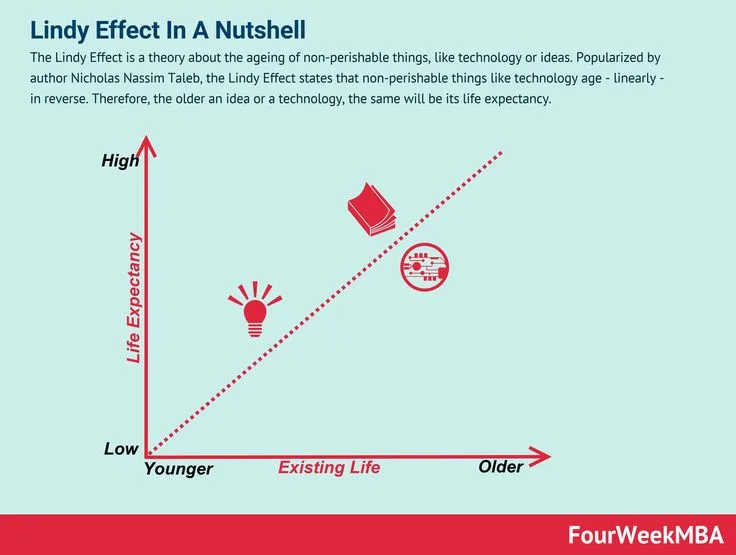
Age has different meaning for ideas than for physical things. The lindy effect holds that a non-perishable book, practice, institution, or technology that has survived for a long time has accumulated evidence of durability, so its expected remaining life may grow with its age. It does not apply to people, food, or other entities limited by physical decay.
In the mid-twentieth century, a group of comedians, actors, and show business figures gathered regularly at Lindy's deli on Broadway in New York City. Between performances and casting calls, they talked - and one recurring topic was the longevity of shows.
They noticed a pattern: the longer a Broadway show had been running, the longer it was likely to keep running.[5] Not because old shows were better, but because survival itself was evidence of something.
A show that had been running for five years had already survived competition, changing audiences, and the test of time. It would probably keep running.
Benoit Mandelbrot mentioned this observation in discussions in the 1960s and referenced it in his work on fractal geometry.[4]Nassim Nicholas Taleb formalized and named the principle in Antifragile (2012), calling it the Lindy Effect after the deli where it was first discussed informally.
"If a book has been in print for forty years, I can expect it to be in print for another forty years. But, and this is the key, if it survives another decade, then it will be expected to be in print another fifty years. This, simply, is the Lindy Effect." - Nassim Nicholas Taleb, Antifragile (2012)
The Lindy Effect is counterintuitive because it inverts our default assumption about age. For human beings and physical objects, age signals decline - the older something is, the less time it has left. For non-perishable things - ideas, technologies, institutions, art forms, religions - the reverse is true.
Age is not a countdown toward obsolescence; it is accumulated evidence of robustness. The longer something has survived, the more it has proven its capacity to survive.
This single insight, applied consistently, has substantial practical implications for how we evaluate information, choose what to read, assess technologies, and think about the durability of ideas.
Key Definitions
The Lindy Effect - The principle that for non-perishable entities, the expected remaining lifespan is proportional to the current age. Doubling the age doubles the expected remaining lifespan. Named after Lindy's deli in New York. Formalized by Nassim Nicholas Taleb in Antifragile (2012).[1]
Non-perishable - In the Lindy context, anything that does not have a physical decay mechanism that limits its lifespan. Ideas, books, art forms, languages, technologies, religions, business models, and institutional arrangements are non-perishable in this sense. They can be made obsolete, but they do not physically deteriorate.
Perishable - Anything with a lifespan set by physical processes: humans, animals, food, physical products, electronics. For perishable things, age is a negative signal about remaining lifespan. The Lindy Effect does not apply.
Survival as a filter - The mechanism behind the Lindy Effect: things that survive have already passed through numerous tests. Survival is evidence that the surviving thing has properties enabling it to withstand competition, change, and challenge. Older survivors carry more of this evidence than younger ones.
Lindy-compatible - A term Taleb uses for ideas, practices, or technologies that have a long track record and are therefore expected to remain relevant. Lindy-compatible thinking is thinking that has proven durable across centuries: empiricism, probability theory, Stoic philosophy, natural selection.
Antifragility - Taleb's broader concept: systems or entities that gain from disorder, stress, and uncertainty, growing stronger when exposed to adversity. The Lindy Effect is a property of antifragile entities - those that have survived because they were strengthened by past challenges.
Fat-tailed distribution - A probability distribution in which extreme events are far more common than a normal distribution would predict.[9] The lifespan of non-perishable things follows fat-tailed distributions: most ideas are forgotten quickly, but some persist for centuries or millennia.[12]
The Lindy Effect applies specifically to the fat-tailed domain.
Chesterton's Fence - A related principle from G.K. Chesterton: never remove a fence without first understanding why it was built.[6] The principle applies Lindy reasoning to institutional change - age implies purpose, and purpose implies caution before removal.
The Statistical Foundation
The Lindy Effect is grounded in a specific statistical property of certain distributions.[13] For things with lifespans following a power-law or Pareto distribution, the expected remaining lifespan is proportional to the current age.
This property does not hold for exponential or normal distributions - which is why it does not apply to perishable things.
Consider a population of ideas. Most new ideas are quickly forgotten: they fail to gain traction, are superseded by better ideas, or simply do not find the contexts where they are useful. The minority of ideas that survive the first year have already demonstrated some degree of robustness.
The minority that survive the first decade have demonstrated more. The minority that survive the first century have demonstrated substantially more. Each additional year of survival provides additional evidence of durability.
This is not circular reasoning. Survival is informative because the filter - competition, changing contexts, the emergence of alternatives - is genuinely selective.
Ideas, technologies, and institutions that survive for long periods have done so because they have properties that enable survival: generality, adaptability, robustness to context changes, continued usefulness across changing environments.
The mathematical formulation: if the lifespan distribution has no characteristic scale (as power-law distributions do not), then the residual expected life of something that has survived to age t is proportional to t. Each year of survival extends the expected future lifespan by approximately one year.
The Pareto Lifespan Distribution
The formal statistical foundation of the Lindy Effect involves the Pareto distribution and its relationship to what statisticians call the memoryless property in reverse. For exponentially distributed lifespans (like radioactive decay), the expected remaining life is constant regardless of age - the future is independent of the past.
For Pareto-distributed lifespans, the expected remaining life is proportional to current age - the future grows with the past.
Statistician Albert-Laszlo Barabasi and colleagues demonstrated that human career success - a non-perishable quality - follows a Lindy-like pattern. A scientist who has published influential work for ten years has a better-than-average probability of publishing influential work for another ten years, controlling for other factors.
The pattern extends across creative fields: novelists who have published for twenty years are more likely to publish for another twenty than novelists who have published for two years (Sinatra et al., 2016).[10]
The key empirical test of the Lindy Effect is whether the conditional remaining lifespan grows linearly with current age. This has been formally tested for technologies, art forms, and cultural productions, with consistent results: for non-perishable entities in stable or slowly changing environments, the linear relationship holds.
The effect is most pronounced in domains with long history, least pronounced in domains with rapid technological change.
Why the Lindy Effect Works: The Filtering Mechanism
Time as Selective Pressure
The reason old things predict future survival is that time is a relentless selective pressure. An idea, technology, or institution that survives for a century has been tested against:
- Competing alternatives: Better alternatives emerged, and the thing survived alongside or despite them
- Changing contexts: Social, economic, technological, and cultural environments changed, and the thing remained relevant
- Active challenges: Adversaries, critics, and competitors tried to displace it, and it persisted
- Random shocks: Crises, disruptions, and upheavals occurred, and the thing recovered
Each of these tests is independent in the sense that success in one does not guarantee success in another. A thing that has passed many such tests has demonstrated a form of multi-domain robustness that a new thing has not yet had the opportunity to demonstrate.
"Time is the ultimate arbiter. What has survived for centuries was worth keeping." - Marcus Aurelius (paraphrase from Meditations, 2nd century AD)[7]
What Has Not Survived: The Invisible Graveyard
The Lindy Effect is understood best against the backdrop of what has not survived. The overwhelming majority of books ever written are gone. The overwhelming majority of technologies ever developed are obsolete.
The overwhelming majority of religious movements, philosophical schools, political institutions, and business models that once existed have ceased to exist.
What remains is a tiny fraction of what was created - selected by the most stringent filter imaginable: continued relevance across centuries. The books we still read from ancient Greece are not a random sample of what Greeks wrote. They are the survivors of continuous selective pressure over two thousand years.
Nassim Taleb's insight is that this selection should make us far more confident in old survivors than in new entrants. A book published last week has not yet passed any meaningful time-based selection.
Aristotle's Nicomachean Ethics has passed two thousand years of continuous filtering and is still read. The asymmetry in what we should expect from these two things is substantial.
This graveyard is sometimes visible in technology: the number of programming languages invented since the 1950s numbers in the thousands; the number in active use today numbers in the dozens.
The surviving languages - C, Lisp, Python, SQL - have demonstrated multi-decade robustness across enormous changes in hardware, software paradigms, and use cases.
Their survival is not coincidental; it reflects properties of generality, adaptability, and continued fitness that the languages in the graveyard did not demonstrate in sufficient measure.
The Robustness Hypothesis
Why do long-surviving things tend to keep surviving? The most compelling explanation is what might be called the robustness hypothesis: long survivors have properties that make them robust across a wide range of conditions, while short-lived things are typically narrowly adapted to specific conditions that change.
A philosophy that has remained relevant across two thousand years of human history - Stoicism, Buddhism, Confucianism - has done so because it addresses conditions that are relatively constant in human life: the management of desire, the acceptance of mortality, the practice of attention and self-regulation.
These conditions exist in first-century Rome, eighteenth-century Japan, and twenty-first-century America. The philosophy that was designed specifically for a narrow historical context disappears when that context changes.
This robustness is not the same as rigidity. The Lindy-compatible entities that survive longest are often those that have demonstrated the greatest capacity for internal evolution while maintaining their core structure.
The Catholic Church has existed for two millennia through enormous internal reformation, doctrinal development, and geographic expansion.
English common law has evolved continuously since the twelfth century. Mathematics has expanded into entirely new domains while its foundations from Euclid remain valid. Longevity and adaptability are correlated, not opposed.
Applications of the Lindy Effect
What to Read
The most direct practical application of the Lindy Effect is in reading choices. Taleb is explicit:
"The classics tell us things with an independent confirmation by time, so they are more informative about the durable than the contemporary. If a book has been read for two thousand years, it will be read for another two thousand years.
If a book was published last year, odds are it will not be read in ten years." - Nassim Taleb, Antifragile (2012)
The implication is that new books and new ideas deserve significant skepticism, and old books and ideas deserve significant respect, not because of intellectual conservatism but because of the information contained in survival itself.
This does not mean recent publications are worthless - it means their durability has not yet been tested. Reading them with awareness that most will be forgotten is different from assuming they contain lasting wisdom.
The practical reading strategy implied by Lindy reasoning: prioritize books that have survived at least one generation (twenty-five years), consider with moderate confidence books that have survived a generation's career (forty to fifty years), and assign very high confidence to books that have survived a century or more.
New books earn their place on the list by surviving the filter - until they do, their claim on attention is provisional.
Investor Charlie Munger's famous reading practice - continuously re-reading the works of thinkers who have stood the test of time (Adam Smith, Charles Darwin, Benjamin Franklin, Epictetus) rather than chasing contemporary business books - is an implicit application of Lindy reasoning applied to intellectual investment.
Technology Adoption
The Lindy Effect implies a specific posture toward new technologies: caution. Most new technologies will not survive their decade. The technologies that have survived centuries - writing, the wheel, mathematics, double-entry bookkeeping, the contract - are likely to continue surviving.
Technologies that emerged in the last decade have not yet been through enough filtering to warrant the same confidence.
Taleb's prescriptive corollary: use old technologies when available, adopt new technologies slowly, and be especially skeptical of complex new technologies replacing simpler old ones when the simpler old ones work.
This heuristic applies differently in different domains. In rapidly evolving fields where old technologies are genuinely superseded, the Lindy Effect is less applicable. In fields where old approaches remain viable alternatives, Lindy reasoning supports preferring them.
A particularly striking illustration: in financial risk management, complex quantitative models built on modern portfolio theory dominated practice from the 1990s through 2008.
The financial crisis demonstrated that these models, which had been in use for less than two decades, failed catastrophically under conditions they had never been tested against.
Meanwhile, simple diversification heuristics - don't put all your eggs in one basket, maintain reserves for emergencies - which are centuries old, continued to perform robustly.
The Lindy argument for simple, old financial heuristics over complex new models was validated by the crisis (Taleb, 2010).[3]
Evaluating Ideas and Advice
Quality of advice scales with age. Advice that has been tested by millions of people over centuries - Stoic philosophy, the Sermon on the Mount, basic financial prudence - has passed more tests than advice that emerged from a bestselling business book last year.
This does not make all old advice correct, but it provides a Lindy-based prior for durability.
Conversely, new management theories, new productivity systems, and new social norms should be held lightly. Most will not survive their decade. The minority that contain durable insight will eventually be incorporated into the canon that survives.
The management consulting industry produces management frameworks at high velocity.
Management by Objectives (MBO, Drucker, 1954), Six Sigma (Motorola, 1986), Business Process Reengineering (Hammer and Champy, 1993), Blue Ocean Strategy (Kim and Mauborgne, 2005), Agile (2001), Lean Startup (Ries, 2011) - each has been the dominant framework of its moment.
Lindy reasoning suggests that none of these frameworks, regardless of their current popularity, should be assumed to have lasting value until they have survived substantial time and diverse application.
The frameworks that will be taught in business schools in 2050 are probably already known to us; most of what is currently in vogue will not survive.
Institutional Assessment
Institutions that have survived for centuries - universities, legal systems, churches, central banks - have demonstrated robustness across enormous ranges of contextual change. This is not an argument that old institutions are good or that they should not be reformed.
It is an argument that their survival is evidence of properties worth understanding before attempting to replace them with newer alternatives.
G.K. Chesterton's related principle - that you should never remove a fence without first understanding why it was built - is a specific application of Lindy reasoning to institutional change:
"In the matter of reforming things, as distinct from deforming them, there is one plain and simple principle; a principle which will probably be called a paradox. There exists in such a case a certain institution or law; let us say, for the sake of simplicity, a fence or law erected across a road.
The more modern type of reformer goes gaily up to it and says, 'I don't see the use of this; let us clear it away.' To which the more intelligent type of reformer will do well to answer: 'If you don't see the use of it, I certainly won't let you clear it away.
Go away and think. Then, when you can come back and tell me that you do see the use of it, I may allow you to destroy it.'" - G.K. Chesterton, The Thing (1929)
The practical institutional application: reform old institutions by first understanding the functional role their age-old features play, then proposing changes that preserve those functions while improving other aspects.
Institutions that violate this principle - that attempt wholesale replacement of old institutional arrangements with new designs - disproportionately fail, because the new designs have not passed the filtering that revealed the functions the old arrangements served.
The Soviet Union's attempt to replace centuries-old market institutions with central planning is among the most dramatic historical examples. The market mechanisms being replaced had been refined over centuries of adaptation to human behavior and information problems.
The replacement, however theoretically appealing, had not been tested and failed in ways that gradually became apparent. The Lindy argument was not that markets were perfect - they obviously were not - but that their age implied functional properties that a new untested system could not be assumed to replicate.
The Lindy Effect in Forecasting
Beyond technology and reading choices, the Lindy Effect has applications in forecasting. The Copernicus Principle, formalized by astrophysicist J.
Richard Gott in a 1993 paper in Nature, independently derived a related insight: if you observe something at a random point in its existence, you can estimate its future duration from its current age.
Gott used this to make surprisingly accurate predictions about the lifespans of Broadway shows, the Berlin Wall, and human civilization.[8]
The Copernicus Principle assumes that your observation time is not special - that you are equally likely to be observing something at any point in its existence. Given this assumption, the expected remaining lifetime equals the current age.
Gott predicted, in 1969, that the Berlin Wall (which had stood since 1961) would fall within 24 years - and it had already fallen in 1989. Applied prospectively, he predicted that the United Nations (founded in 1945) would survive at least until the twenty-second century with high probability.
The Lindy Effect and Gott's formulation converge on the same underlying statistical logic: for entities with no characteristic timescale, past duration predicts future duration.
The practical implication for forecasters is to treat the current age of an institution, technology, or idea as a meaningful prior for its future survival - not a certainty, but a calibrated expectation.
Superforecasting research by Philip Tetlock and colleagues, documented in Superforecasting (2015), found that reference class forecasting - asking "what is the base rate outcome for things in this category?" - is among the most reliable forecasting approaches.[11]
The Lindy Effect is a specific instance of reference class forecasting applied to lifespan: the reference class is "non-perishable things of age t," and the base rate prediction is "remaining life proportional to t." Superforecasters who incorporate base rate thinking systematically outperform those who rely primarily on inside-view analysis of specific cases.
The Lindy Effect and Innovation
A subtle but important application of the Lindy Effect concerns how to evaluate innovations and new approaches in established domains. Lindy reasoning does not say "never innovate." It says "hold new things to a higher burden of proof than old things, proportional to the stakes."
In low-stakes domains - new foods, new apps, new entertainment - the cost of a Lindy-incompatible thing failing is low, and experimentation is appropriate. In high-stakes domains - medicine, infrastructure, financial systems - the cost of failure is high, and the Lindy-based preference for proven approaches is proportionally stronger.
Medical research provides a particularly important application. The vast majority of promising drug candidates fail in clinical trials. Of those that succeed in clinical trials, a substantial fraction show reduced effectiveness or unexpected side effects when deployed at scale and over longer time horizons.
The history of medicine is littered with treatments that were standard of care for decades and are now known to have been ineffective or harmful.[14]
The Lindy-compatible response to this record is not to reject medical progress but to maintain appropriate skepticism toward new treatments relative to their time in use.
A drug that has been safely used in hundreds of millions of patients over fifty years carries substantially more evidence of safety and effectiveness than a drug that has been used in thousands of patients over two years, even if the clinical trial results are comparable.
The time in use is a filter that has detected problems the trial could not.
This reasoning underlies the evidence-based medicine preference for systematic reviews and meta-analyses over individual clinical trials.
A meta-analysis aggregates evidence from many studies conducted over many years - it is a Lindy device for medical evidence, weighting the accumulated track record rather than any single moment's findings.
The Lindy Effect vs. Status Quo Bias
An important caveat: the Lindy Effect should not be confused with status quo bias - the tendency to prefer the current state of affairs simply because it is current. The Lindy Effect is a statistical argument about information content in survival history. Status quo bias is an emotional preference for the familiar.
The distinction matters practically:
| Lindy Effect | Status Quo Bias |
|---|---|
| Statistical argument: survival provides evidence of robustness | Emotional preference: familiar things feel safer |
| Applies to non-perishable things specifically | Applies indiscriminately to anything familiar |
| Stronger for older things; proportional to age | Not proportional to age; applies to any status quo |
| Supports updating when evidence shows old thing is failing | Resists updating regardless of evidence |
| A tool for calibrating priors | A cognitive bias to overcome |
| Based on information theory | Based on loss aversion and familiarity preference |
The Lindy Effect supports preferring Aristotle to a recent self-help book because of the evidence contained in 2,400 years of survival. It does not support preferring traditional medical practices over modern medicine when modern medicine demonstrably outperforms them.
Where new alternatives have proven themselves against the old across relevant tests, Lindy reasoning applies to the new things that are surviving, not to the old ones that aren't.
The test is not age per se but the quality of the filter that the age represents.
A forty-year-old idea that was never seriously tested - that circulated only in a small community of believers, was never subject to competitive challenge, and never had to demonstrate usefulness in diverse contexts - is not Lindy-validated.
The Lindy Effect requires genuine exposure to selective pressure, not mere passage of time in protected circumstances.
Limits and Criticisms
Non-Stationarity
The Lindy Effect assumes that the environment is sufficiently stable that past survival is informative about future survival. In highly non-stationary environments - where the context changes faster than the filtering can operate - survival history provides less information about future survival.
Technologies in rapidly evolving domains (consumer electronics, social media platforms, programming languages) exist in non-stationary environments where Lindy reasoning is less reliable. The printing press is Lindy. The specific form of the smartphone may not be.
The general principle: Lindy reasoning is most reliable in domains where the environment changes slowly relative to the lifespans of the things being evaluated. Ancient philosophy and mathematics exist in this domain; consumer technology does not.
Financial instruments occupy a middle ground - the mathematics of finance is Lindy; specific financial products are not.
Survivorship Bias Risk
Applied carelessly, the Lindy Effect can reinforce survivorship bias: because we observe only what has survived, we may overestimate the quality of old survivors and underestimate the losses in the graveyard of forgotten things.[2]
The ancient medical texts that survive are not a random sample of ancient medicine - they were selected by scribes who thought they were worth copying and by libraries that thought they were worth preserving, introducing selection biases beyond simple survival.
This means that the Lindy Effect tells us the surviving things are robust - but it does not tell us how much was lost. We do not know how many brilliant ideas, useful technologies, and important institutions disappeared through bad luck rather than inadequacy. The graveyard of good-but-unlucky things is invisible to Lindy analysis.
Does Not Apply to Improvements Within a Domain
The Lindy Effect argues for preferring old ideas over new ones in general, but within a domain where genuine cumulative progress occurs - science, engineering, medicine - it does not argue against new knowledge.
The accumulated scientific literature is itself Lindy-compatible: it is a set of ideas that have survived peer review, replication attempts, and experimental test.
Individual new findings in mature scientific fields benefit from the Lindy-compatibility of the methodology, even if the specific findings are recent.
This distinction - between the methodology (old, tested, Lindy-compatible) and specific findings (new, provisional, not yet Lindy-validated) - is important for applying the effect correctly to scientific knowledge.
Trust the scientific method; be appropriately skeptical of specific results until they are replicated and incorporated into the broader canon.
Lindy Reasoning Requires Domain-Specific Application
Different domains have different effective timescales. In fashion, a design that has survived ten years is remarkably durable - fashion cycles are short, and ten-year survival represents substantial filtering. In philosophy, ten years is nothing - the relevant filtering operates over centuries.
In software engineering, a framework that has been in active use for fifteen years is mature; the same period in law barely registers.
The Lindy Effect's quantitative prediction - remaining life proportional to current age - is most useful as a comparative tool within domains rather than across them. Aristotle is more Lindy-validated than a five-year-old business book; a five-year-old programming language is more Lindy-validated than a six-month-old framework.
The comparison is most informative when the things being compared exist in the same competitive environment and have been subject to similar selective pressures.
Practical Summary: Using Lindy Reasoning
The Lindy Effect is most practically valuable as a calibration tool - a way of adjusting priors about the durability of non-perishable things before engaging with their content.
When encountering a new idea or book: How old is it? How diverse are the contexts in which it has remained relevant? Age and diversity of context are the key indicators of Lindy validation.
A twenty-five-year-old idea that has been applied in many different industries and cultures is more Lindy-validated than a twenty-five-year-old idea that circulated only in one narrow community.
When evaluating a technology: How long has it been in production use, across how many different contexts? Proof-of-concept longevity and production longevity are different. SQL has been in production use for decades across millions of applications - it is strongly Lindy-validated.
A new database technology with impressive benchmarks but only two years of production deployment is not.
When assessing an institution: What functions has it served over its lifespan? Has it demonstrated the capacity to adapt while maintaining core functions?
The age alone does not validate an institution - an institution that has merely persisted through inertia, without demonstrating usefulness, is not Lindy-validated in the relevant sense.
When making a high-stakes, irreversible decision: Give extra weight to old, proven approaches. The cost of being wrong about the durability of a new approach is high, and the Lindy-based prior argues for caution. Save experimentation for reversible, low-stakes decisions where the cost of a Lindy-incompatible failure is manageable.
For related concepts, see Chesterton's Fence explained, survivorship bias explained, and antifragility and robustness.
Sources & Further Reading
- Taleb, N. N. (2012). Antifragile: Things That Gain from Disorder. Random House.
- Taleb, N. N. (2001). Fooled by Randomness: The Hidden Role of Chance in Life and in the Markets. Texere.
- Taleb, N. N. (2010). The Black Swan: The Impact of the Highly Improbable (2nd ed.). Random House.
- Mandelbrot, B. B. (1982). The Fractal Geometry of Nature. W. H. Freeman.
- Goldman, A. (1964). Lindy's Law. The New Republic, 1964. (Origin of the Lindy observation in show business.)
- Chesterton, G. K. (1929). The Thing: Why I Am a Catholic. Sheed & Ward.
- Aurelius, M. (2nd century AD). Meditations. (Gregory Hays translation, 2002, Modern Library.)
- Gott, J. R. (1993). Implications of the Copernicus Principle for Our Future Prospects. Nature, 363(6427), 315-319. DOI: 10.1038/363315a0
- Cirillo, P., & Taleb, N. N. (2016). On the Statistical Properties and Tail Risk of Violent Conflicts. Physica A: Statistical Mechanics and its Applications, 452, 29-45.
- Sinatra, R., Wang, D., Deville, P., Song, C., & Barabasi, A.-L. (2016). Quantifying the Evolution of Individual Scientific Impact. Science, 354(6312). DOI: 10.1126/science.aaf5239
- Tetlock, P. E., & Gardner, D. (2015). Superforecasting: The Art and Science of Prediction. Crown.
- Barabasi, A.-L., & Albert, R. (1999). Emergence of Scaling in Random Networks. Science, 286(5439), 509-512.
- Gibrat, R. (1931). Les Inegalites Economiques. Librairie du Recueil Sirey.
- Wennberg, J., & Cooper, M. M. (Eds.). (1999). The Dartmouth Atlas of Health Care. American Hospital Publishing.