
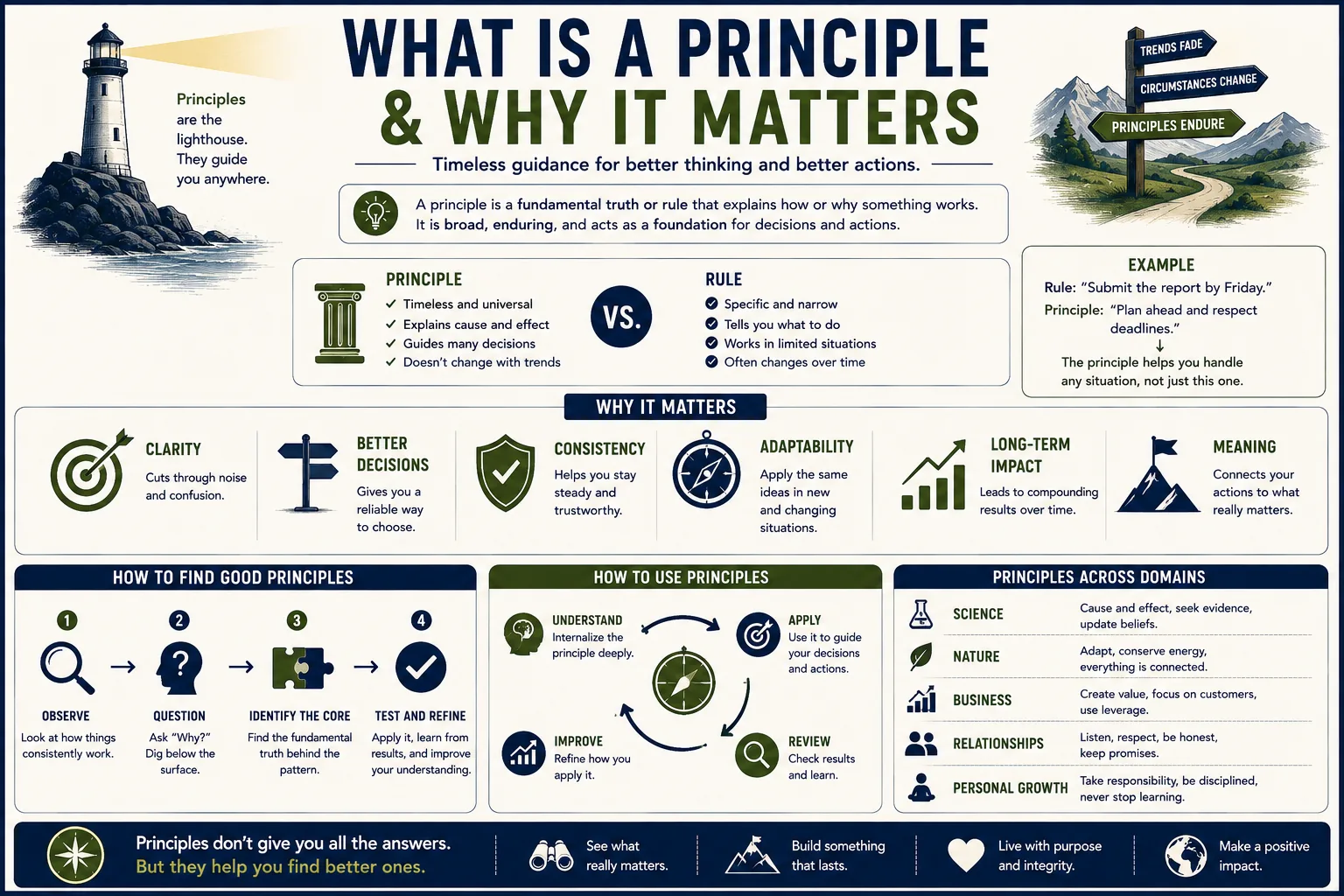
Principle: You join a new company. Day one: Here's the 200-page employee handbook. Read the rules. Follow the procedures. Everything is specified-expense reporting (page 47), email etiquette (page 83), meeting protocols (page 112).
Then you encounter a situation not in the handbook. The rules don't cover it. Now what?
Option 1 (rules-based thinking): Panic. There's no rule. You don't know what to do. Escalate to manager. Wait for new rule to be created.
Option 2 (principle-based thinking): Understand the underlying principles (what are we trying to achieve? fairness? efficiency? transparency?). Apply principles to this specific situation. Make judgment call. Move forward.
The difference between these approaches is the difference between fragile and robust decision-making.[3] Rules tell you what to do in anticipated situations. Principles tell you why things work, enabling judgment in unanticipated situations.
Understanding what principles are, how they differ from rules and tactics, and why principle-based thinking creates more robust decisions is foundational to effective thinking.
"Principles are ways of successfully dealing with reality to get what you want out of life." - Ray Dalio, Principles: Life and Work[4]
What Is a Principle?
A principle is a fundamental truth or rule that explains how things work and guides decisions across varied situations. Principles are fundamental (not derived from simpler truths), general (applying across many situations rather than one), explanatory (telling you why things work, not just what to do), stable (remaining valid despite changing surface conditions), and actionable (able to guide real decisions).
Definition
Principle: A fundamental truth or rule that explains how things work and guides decisions across varied situations.
Key characteristics:
| Characteristic | Explanation |
|---|---|
| Fundamental | Basic, not derived from simpler truths |
| General | Applies across many situations, not just one |
| Explanatory | Tells why things work, not just what to do |
| Stable | Remains valid despite changing surface conditions |
| Actionable | Can guide decisions and actions |
Examples of Principles
Physics:
- Conservation of energy: Energy cannot be created or destroyed, only transformed
- Inertia: Objects in motion stay in motion unless force is applied
Economics:
- Incentives matter: People respond to rewards and punishments
- Opportunity cost: Choosing one option means giving up another
- Retrieval practice: Actively recalling information strengthens memory more than passive review
- Spacing effect: Distributed practice beats massed practice
Design:
- Less is more: Simplicity often improves usability
- Form follows function: Design should serve purpose
Principles vs. Rules
The Critical Difference
| Aspect | Principles | Rules |
|---|---|---|
| Nature | Explain why | Specify what |
| Form | General guidelines | Specific instructions |
| Application | Require judgment | Require compliance |
| Coverage | Transfer to new situations | Only cover anticipated situations |
| Complexity | Few, stable | Multiply endlessly |
| Flexibility | Adapt to context | Rigid |
| Learning | Understand | Memorize |
Example: Expense policy
Rule-based approach:
- Meals up to $50 require no approval
- Meals $50-$100 require manager approval
- Meals >$100 require director approval
- Client meals different category (see page 73)
- Conference meals (see page 81)
- International meals (convert using rate from page 94)
- ...200 pages of rules for every scenario
Principle-based approach:
- Principle: "Spend company money as you would your own"
- Principle: "Choose reasonable options that enable good work"
- Principle: "Be transparent and documentable"
Novel situation (not in rulebook): Use judgment guided by principles.[11] Did you spend responsibly? Can you justify it? Is it transparent? If yes, you're fine.[9]
Why rules fail: Can't anticipate every situation. Rules multiply trying to cover edge cases, creating complexity. People game rules (letter vs. spirit).
Why principles work: Transfer to unanticipated situations. Remain few and stable. Enable good judgment. Harder to game (spirit matters).
Principles vs. Tactics
Different Levels
| Aspect | Principles | Tactics |
|---|---|---|
| Abstraction | Why things work | Specific actions |
| Durability | Stable over time | Context-dependent |
| Transfer | Apply across domains | Tied to specific situations |
| Depth | Underlying mechanisms | Surface actions |
Example: Negotiation
Tactic: "Make first offer to anchor the negotiation"
Underlying principle: "Anchoring effect-initial numbers disproportionately influence final outcome"[6]
Why principle is better:
- Explains why tactic works (cognitive bias)
- Transfers beyond negotiation (pricing, expectations, proposals)
- Enables you to defend against it (recognize anchoring when others use it)
- Generates new tactics (can anchor with context clues, not just explicit numbers)
Tactic knowledge: Know what to do in specific situation
Principle knowledge: Understand why, transfer to new situations, generate new tactics
Principles vs. Values
Easy to Confuse, Important to Distinguish
| Aspect | Principles | Values |
|---|---|---|
| Nature | Truths about how things work | What we care about |
| Type | Descriptive (is) | Normative (should) |
| Validity | Testable, objective | Personal, subjective |
| Function | Guide understanding | Guide priorities |
Examples:
Values (what you care about):
- Honesty
- Family
- Achievement
- Fairness
- Creativity
Principles (how things work):
- Trust enables cooperation
- Compound effects dominate over time
- Feedback loops amplify or stabilize
- Incentives shape behavior
Relationship:
- Values tell you what goals matter
- Principles tell you how to achieve them
Example:
- Value: "I care about my health"
- Principle: "Consistency beats intensity" (regular moderate exercise > sporadic intense workouts)
- Action: Apply principle to achieve value (regular daily walks rather than monthly marathons)
Why Principles Matter
Principles matter because they transfer across contexts instead of being tied to one situation, they survive changing circumstances that make specific tactics obsolete, they enable independent judgment so people are not paralyzed without explicit instructions, they explain why rules exist rather than leaving rules arbitrary, and they generate novel solutions that tactic knowledge alone cannot produce.
Advantage 1: Transfer Across Contexts
Rules and tactics are context-specific.
Principles transfer.
Example: "Compounding" principle
Applies to:
- Finance (compound interest)
- Learning (knowledge builds on knowledge)
- Relationships (small consistent investments build deep bonds)
- Habits (daily improvements compound)
- Business (network effects)
- Biology (population growth)
Learn principle once, apply everywhere.
Advantage 2: Survive Changing Circumstances
The world changes. Surface conditions shift. Specific tactics become obsolete.
Underlying principles remain stable.
Example: Marketing
Tactics (changing):
- 1990s: Yellow Pages ads
- 2000s: Google AdWords
- 2010s: Facebook ads
- 2020s: TikTok influencers
Principles (stable):
- Attention is scarce and valuable
- Relevance beats interruption
- Trust precedes purchase
- Distribution determines success
Tactic knowledge becomes obsolete. Principle knowledge remains valuable.
"You do not rise to the level of your goals. You fall to the level of your systems." - James Clear, Atomic Habits (principles are the architecture beneath the system)
Advantage 3: Enable Independent Judgment
Without principles: Need someone to tell you what to do for every situation.
With principles: Can figure it out yourself using first principles.
Example: New employee
Rule-follower: Constantly asks "What should I do?" Paralyzed without explicit instruction.
Principle-thinker: Understands underlying goals and constraints. Makes judgment calls. Acts independently.
Organizations scale when employees can use principles to make good decisions without constant oversight.
"Principles are not values, though values are the foundation of principles. Principles are the territory; values are the compass." - Stephen R.[2] Covey, Principle-Centered Leadership
Advantage 4: Explain Why Rules Exist
Rules without principles are arbitrary.
Principles explain why rules make sense (or don't).
Example: "No meetings on Fridays" rule
Without principle: Arbitrary rule. Followed blindly or resented.
With principle: "People need uninterrupted time for deep work. Meetings fragment attention. Reserve one day for focus."
Understanding principle enables:
- Knowing when to break rule (important Friday client meeting is fine)
- Creating similar rules (maybe also protect mornings for deep work)
- Explaining rule to new people (makes sense, not arbitrary)
Advantage 5: Generate Novel Solutions
Principles enable creativity.
Understanding why things work lets you invent new what that works.
Example: Learning principle
Principle: "Retrieval practice (actively recalling information) strengthens memory more than passive review"
Standard tactic: Flashcards
Novel applications generated from principle:
- Close-book quizzing yourself
- Explaining concepts without notes
- Writing from memory then checking
- Anticipating questions during reading
- Teaching others (forced retrieval)
Principle knowledge generates infinite tactics. Tactic knowledge is finite.
Types of Principles
Universal Principles
Apply across all domains.
Examples:
- Compound effects (exponential growth)
- Feedback loops (reinforcing and balancing)
- Leverage (disproportionate input/output)
- Conservation laws (fixed total, redistributed)
Characteristics:
- Work in physics, biology, psychology, economics, etc.
- Fundamental to how reality works
- Most powerful (transfer maximally)
"You've got to have models in your head. And you've got to array your experience - both vicarious and direct - on this latticework of models." - Charlie Munger, Poor Charlie's Almanack
Domain Principles
Apply within specific domains, but still general within that domain.
Examples:
Software development:
- DRY (Don't Repeat Yourself)
- Separation of concerns
- Fail fast
Biology:
- Natural selection
- Homeostasis
- Energy flows from sun through ecosystems
Economics:
- Supply and demand
- Comparative advantage
- Marginal thinking
Still principles (explain why within domain), but don't necessarily transfer outside domain.
Contextual Principles
Apply in specific contexts.
Example: "In software startups, speed often beats quality in early stages"
Why it's a principle: Explains why (learning from market feedback more valuable than perfecting features no one wants)
Why it's contextual: Doesn't apply to medical devices, bridge engineering, etc.
Still valuable: Guides decisions in that context.
Can Principles Conflict?
Yes, real situations often involve competing principles, and this requires judgment about which one applies more strongly in context. Security versus usability is a common example: one principle says security requires friction while another says usability requires minimizing friction, and no rule resolves the tension. The same pattern shows up in moving fast versus getting it right, where context, not a fixed formula, determines the balance.
Yes. Real Situations Often Involve Competing Principles.
This requires judgment about which applies more strongly.
"It is the mark of an educated mind to be able to entertain a thought without accepting it." - Aristotle, Nicomachean Ethics[13]
Example: Security vs. Usability
Principle 1: "Security requires friction" (passwords, authentication, verification)
Principle 2: "Usability requires minimizing friction" (easy, fast, simple)
Conflict: Both valid principles pulling in opposite directions.
Resolution: Judgment call based on context
- Banking app: Emphasize security (high stakes)
- Social app: Emphasize usability (low stakes)
- Balanced approach: Security where it matters, ease where it doesn't
No rule resolves this. Requires understanding both principles and using judgment.
Example: "Move fast" vs. "Get it right"
Principle 1: "Speed enables learning from reality" (fast iteration, quick feedback)
Principle 2: "Quality prevents costly failures" (careful planning, thorough testing)
Both true. Often conflict.
Context determines balance:
- Reversible decisions: Favor speed
- Irreversible decisions: Favor careful thought
- Unknown territory: Favor experimentation
- Well-understood domain: Favor best practices
How to Identify True Principles
True principles pass four tests: they apply broadly across many situations rather than narrow contexts, they withstand scrutiny when examined deeply instead of collapsing under questioning, they explain the causal mechanism behind observable patterns rather than merely describing them, and they generate accurate predictions about unfamiliar situations. Something that fails these tests is a tactic or stylistic convention, not a genuine principle.
Test 1: Broad Applicability
True principles apply across many situations.
False principles (actually tactics/rules): Only work in narrow contexts.
Example:
Claimed principle: "Always use passive voice in scientific writing"
Test: Does this apply broadly?
- No. It's a style convention, not fundamental truth
- Violated regularly in good science writing
Verdict: Not a principle. It's a contested stylistic rule.
True principle: "Clear communication requires matching language to audience"
Test: Does this apply broadly?
- Yes. Scientific writing, business, teaching, casual conversation
- Explains why some style choices work in some contexts
Verdict: Principle.
Test 2: Withstands Scrutiny
True principles hold up when examined deeply.
False principles collapse under questioning.
Example:
Claimed principle: "Multitasking increases productivity"
Scrutiny:
- Research: Task-switching has cognitive cost
- Observation: Simultaneous attention degrades both tasks
- Mechanism: Working memory is limited
Verdict: False. Contradicted by evidence and mechanism.
True principle: "Focused attention enables deep work"
Scrutiny:
- Research: Confirms concentration improves output quality
- Observation: Best work happens in uninterrupted blocks
- Mechanism: Complex cognition requires sustained mental state
Verdict: True principle.
Test 3: Explains Patterns
True principles provide causal explanations for observable patterns.[12]
False principles may describe patterns but don't explain why.
Example:
Observation: Successful companies often have strong cultures
Not a principle: "Strong culture causes success"
- Doesn't explain mechanism
- Could be reverse causation (success resources culture investment)
- Could be correlation without causation
Principle: "Shared understanding enables coordination without overhead"
- Explains mechanism (culture = shared mental models less communication needed)[8]
- Testable (predict coordination quality from cultural alignment)
- Applies beyond businesses (teams, communities, etc.)
Test 4: Predictive Power
True principles enable predictions about unfamiliar situations.
Example:
Principle: "Feedback loops amplify (reinforcing) or stabilize (balancing)"[5]
Prediction: In new domain (e.g., social media), expect:
- Reinforcing loops: Viral content (attention more attention)
- Balancing loops: Scandals correct (bad behavior backlash correction)
Test: Do predictions hold in reality? If yes, principle is valid.
How to Learn to Think in Principles
You learn to think in principles through four practices: asking "why" repeatedly instead of stopping at the surface rule or tactic, looking for the same pattern appearing across different domains, testing principles against reality rather than accepting them on authority, and deriving actions from first principles instead of copying tactics wholesale. Repeating these practices turns tactic knowledge into transferable understanding.
Practice 1: Ask "Why" Repeatedly
Don't stop at surface rule or tactic. Ask why it works.
Example:
Tactic: "Use headlines with numbers in articles"
Why? People find specific numbers credible and clickable
Why? Specificity signals substance; numbers suggest concrete value
Why? Human psychology: concrete > vague; measurable > unmeasurable
Principle: "Specificity and concreteness attract attention and build trust"
Now transferable: Numbers in headlines, specific examples in teaching, concrete details in storytelling
Practice 2: Look for Patterns Across Domains
Same principle appears in different contexts.
Recognizing the pattern helps abstract the principle.
Example: Noticing compounding
- Finance: Compound interest grows wealth
- Learning: Knowledge builds on knowledge
- Fitness: Consistent training compounds strength
- Relationships: Small investments compound into deep bonds
Pattern: Small consistent inputs + time = dramatic results
Abstraction: Compound effects principle
Practice 3: Test Principles Against Reality
Don't accept principles on authority. Verify.
Process:
- State principle clearly: What does it claim?
- Derive prediction: What should we observe if principle is true?
- Observe reality: What actually happens?
- Compare: Match or mismatch?
- Refine: If mismatch, is principle wrong, or are contextual factors involved?
Example:
Principle: "Incentives shape behavior"
Prediction: Changing incentives should change behavior
Observation: Sales commissions salespeople focus on commissioned products[7]
Result: Principle confirmed in this instance
Further test: Try in different contexts. Keep testing. If consistently works, confidence in principle increases.
Practice 4: Derive Actions from First Principles
Instead of copying tactics, derive from principles.
Process:
- Understand goal: What are we trying to achieve?
- Identify relevant principles: What fundamental truths apply here?
- Derive approach: Given these principles, what should we do?
- Test: Did it work? Refine understanding.
Example: Growing email list
Traditional tactic: "Use pop-up with 10% discount"
First principles approach:
Goal: Get permission to communicate
Principle 1: People give email when value exceeds friction
Principle 2: Trust precedes permission
Principle 3: Context affects receptiveness
Derivation:
- Need to provide immediate value (principle 1)
- Need to build trust before asking (principle 2)
- Timing matters (principle 3)
Novel tactics from principles:
- Provide valuable content freely first (build trust)
- Ask for email when they're engaged (context)
- Offer specific valuable resource (not generic discount)
- Progressive disclosure (name first, email later-lower friction)
Result: Tactics derived from principles rather than copied.
Principle-Based Organizations
Characteristics
Organizations that embrace principles over rules:
1. Clarity of principles
- Core principles explicitly stated
- Understood by everyone
- Used in decision-making
2. Judgment trusted
- People empowered to apply principles
- Not every decision needs approval
- Mistakes seen as learning (within principles)
3. Context-appropriate responses
- Flexibility to adapt to specific situations
- Same principle, different applications
4. Fewer rules
- Rules only where truly necessary
- Most guidance through principles
Example: Netflix culture
Principles:
- "Act in Netflix's best interests"
- "Seek what's best for Netflix, not yourself"
- "Be extraordinarily candid with each other"
Result:
- Minimal vacation policy ("Take time off when appropriate")
- No expense policy ("Spend money as if it's your own")
- High trust, high performance culture
Works because: People understand principles, have judgment, and context-appropriate decision-making is possible.
Principles in Practice: Three Historical Examples
Abstract definitions of principles become tangible when examined through concrete historical cases where principle-based thinking produced outcomes that rule-based or tactics-based approaches could not have achieved.
Warren Buffett and the Single Investment Principle
Warren Buffett built one of the largest fortunes in history by applying a small number of investment principles with extraordinary consistency across six decades of changing markets, technologies, and economic conditions.
His core principle - "never lose money" (meaning: protect capital above all, and superior returns follow from avoiding losses rather than chasing gains) - determined every specific investment decision.
This principle transferred across wildly different contexts. It applied to consumer brands in the 1970s, insurance companies in the 1980s, technology-adjacent businesses in the 1990s, and railroad companies in the 2000s. The specific companies and sectors changed constantly; the underlying principle never did.
Buffett's partner Charlie Munger articulated the mechanism: "All I want to know is where I'm going to die, so I'll never go there." The inversion of the investment question - starting from what destroys value rather than what creates it - is a direct application of principle-based thinking to a domain where most practitioners rely on tactics (models, screens, heuristics specific to current market conditions).[1]
Florence Nightingale and the Sanitation Principle
When Florence Nightingale arrived at the military hospital at Scutari during the Crimean War in 1854, soldiers were dying in large numbers - not from battle wounds but from preventable infections. The medical establishment had specific rules and practices for military hospitals, none of which were working.
Nightingale returned to first principles. She identified the fundamental mechanism: infection travels through contaminated environments. The corollary principle: clean environments prevent infection.
This single principle, applied systematically, drove all her specific interventions - improved drainage, ventilation, handwashing protocols, clean bedding - rather than the protocols being a collection of unrelated rules.
Mortality fell dramatically over the following months, though the largest improvements followed broader sanitary reforms at the hospital.
The principle transferred to civilian nursing, hospital design, and eventually public health policy in ways that no set of specific Crimean War hospital rules ever could have.
Nightingale understood the underlying mechanism, which allowed her to generate new interventions as contexts changed, long after the original war-era tactics had become irrelevant.
Toyota and the Andon Cord Principle
Toyota's manufacturing system is often described through its specific practices: kanban cards, just-in-time inventory, 5S workplace organization.
But Toyota's sustained competitive advantage came from a deeper principle that generated those practices: problems should be made visible and stopped immediately, not disguised and worked around.
The most vivid expression of this principle is the andon cord - a pull cord running along every assembly line that any worker can pull to stop the entire production line when they detect a defect. In most manufacturing systems, line stoppages are avoided at all costs because they're expensive.
Toyota inverted this logic: a stopped line that surfaces a problem is cheaper than a running line that embeds defects into hundreds of cars that must later be recalled or reworked.
This principle applied beyond the factory floor. It drove Toyota's approach to supplier relationships (make supply chain problems visible early rather than absorbing them silently), product development (surface engineering conflicts early rather than resolving them at manufacturing launch), and organizational management (create environments where bad news travels up quickly).
The specific rules varied by context; the principle that made those rules coherent remained constant.
Competitors who copied Toyota's specific practices without understanding the underlying principle found the practices ineffective because they could not replicate the principle's logic in their own organizational contexts.[10]
Conclusion: Foundations of Robust Thinking
Principles are intellectual infrastructure.
Rules tell you what to do in known situations.
Principles tell you why things work, enabling you to figure out what to do in unknown situations.
Key insights:
- Principles explain why (rules just specify what)
- Principles transfer (work across contexts)
- Principles endure (survive changing conditions)
- Principles enable judgment (don't need rules for everything)
- Principles can conflict (requiring judgment about which applies more strongly)
The path forward:
Build your principle library:
- Identify principles in domains you know
- Test them across other domains
- Abstract underlying patterns
- Verify through application
Practice principle-based thinking:
- Ask "why" repeatedly
- Look for patterns across contexts
- Derive actions from principles, don't just copy tactics
- Test predictions against reality
Use principles to guide:
- Learning (understand why, not just what)
- Decisions (apply principles to novel situations)
- Creativity (generate new tactics from principles)
- Communication (explain reasoning, not just conclusions)
Master principles, and you have:
- Robust understanding (survives changing conditions)
- Independent judgment (don't need rules for everything)
- Transfer ability (learn once, apply everywhere)
- Creative capacity (generate novel solutions)
You become less dependent on rules, more capable of thinking for yourself, and better equipped to handle situations no one has encountered before.
That is the power of principles.
Sources & Further Reading
Munger, C. (1994). A Lesson on Elementary Worldly Wisdom. USC Business School speech.
Covey, S. R. (1989). "The 7 Habits of Highly Effective People: Powerful Lessons in Personal Change." Free Press.
Taleb, N. N. (2012). Antifragile: Things That Gain from Disorder. Random House.
Ray, D. (2017). Principles: Life and Work. Simon & Schuster.
Meadows, D. H. (2008). Thinking in Systems: A Primer. Chelsea Green Publishing.
Kahneman, D. (2011). Thinking, Fast and Slow. Farrar, Straus and Giroux.
Pink, D. H. (2009). Drive: The Surprising Truth About What Motivates Us. Riverhead Books.
Senge, P. M. (1990). The Fifth Discipline: The Art and Practice of the Learning Organization. Doubleday.
Hastings, R., & Meyer, E. (2020). No Rules Rules: Netflix and the Culture of Reinvention. Penguin Press.
Polanyi, M. (1966). The Tacit Dimension. University of Chicago Press.
Schön, D. A. (1983). The Reflective Practitioner: How Professionals Think in Action. Basic Books.
Deutsch, D. (2011). "The Beginning of Infinity: Explanations That Transform the World." Viking.
Aristotle. (ca. 350 BCE). "Nicomachean Ethics."
Further Reading
Simon, H. A. (1996). The Sciences of the Artificial (3rd ed.). MIT Press.
Dennett, D. C. (1995). "Darwin's Dangerous Idea: Evolution and the Meanings of Life." Simon & Schuster.
About This Series: This article is part of a larger exploration of principles and laws. For related concepts, see [Universal Principles That Apply Across Domains], [Why Principles Outlast Tactics], [The Limits of Rules], and [First-Order vs Second-Order Effects].
The Cognitive Science of Principle-Based Reasoning
Research on expert cognition has progressively clarified what principle-based thinking actually consists of at the neural and behavioral level.
Anders Ericsson (Florida State University), whose study of deliberate practice dominated expertise research for three decades, found that expert performance was distinguished not by more practice time per se but by the depth of mental representations practitioners built during practice.
In Peak: Secrets from the New Science of Expertise (2016), Ericsson described these representations as internalized models of underlying principles - structures that allowed experts to perceive meaningful patterns where novices saw noise and to generate appropriate responses to novel situations without matching them to memorized templates.
Research on physics education has generally found that students taught to reason from conceptual principles (why phenomena occur) rather than from memorized equations perform better on novel problems requiring transfer - problems whose surface features differ from the examples used in instruction - while performing comparably on standard, familiar problems. This pattern supports the idea that principles function as transfer mechanisms in a way that procedural knowledge does not: you can apply a principle to a situation you have never encountered because the principle describes a category of situations, not a specific instance.
Chi, Feltovich, and Glaser's landmark 1981 study, conducted at the University of Pittsburgh's Learning Research and Development Center, compared how physics novices and experts categorized physics problems. Novices grouped problems by surface features (inclined planes together, springs together, pulleys together).
Experts grouped problems by underlying physical principles (conservation of energy together, Newton's second law together, regardless of surface features). The same surface situation was interpreted through different conceptual structures.
This finding - that expertise consists substantially of organizing knowledge around principles rather than examples - has been replicated across chess, bridge, mathematics, and medicine. The principle is the unit of expert cognition; the example is the unit of novice cognition.
Jonathan Haidt (NYU Stern) and Craig Joseph's Moral Foundations Theory (2004) applies principle-based analysis to moral reasoning, arguing that cross-cultural variation in ethical judgment is best understood through a small number of foundational moral principles (care/harm, fairness/reciprocity, authority/subversion, purity/degradation, loyalty/betrayal) rather than through universal rules.
Cross-cultural research across dozens of countries has found that these foundations appear widely across cultures, though weighted differently, supporting their status as principles - general explanatory structures that generate specific moral judgments - rather than rules that specify what is permitted in particular situations.
Organizational Case Studies: When Principles Replaced Rulebooks
The shift from rule-based to principle-based governance in organizations has been documented in several well-studied cases that allow comparison of outcomes.
Valve Corporation, the video game publisher, published its employee handbook in 2012, which became widely cited in management literature because it contained almost no rules. Instead, it articulated principles: "Hire people who make your teammates better," "The customer is always right...
eventually," and "Work on what matters, not what you're told to." Valve operates with no managers and no formal reporting structure, with decisions made by self-organizing teams following shared principles.
Economist Yanis Varoufakis, an Athens-affiliated academic who later served as Greece's finance minister, spent time at Valve as its economist in residence in 2012, studying how the company's internal resource-allocation and hiring processes functioned without formal managers or hierarchy - an unusually direct academic look inside a principle-based organization operating at real scale.
Valve is private and does not disclose detailed financials, but by most public estimates its revenue per employee is exceptionally high for its industry given its small headcount relative to the scale of platforms like Steam, illustrating that a small, principle-coordinated team can support an enormous amount of leverage when the coordination actually works.
The British Army's "Mission Command" doctrine, formalized in the 1980s and influenced by German Auftragstaktik principles, explicitly replaced rule-following with principle-following at the unit command level.
Rather than specifying how to achieve objectives, Mission Command specifies what to achieve and why, leaving the how to the judgment of the officer on the ground.
Military historians and doctrine analysts have generally argued that Mission Command's principle-based approach performs better than rigid, prescriptive command structures specifically in high-uncertainty, rapidly changing environments like counterinsurgency operations, where the situation actually encountered on the ground rarely matches the situation anticipated during planning - a structural advantage that comes precisely from delegating judgment about the "how" to the people closest to the changing situation.
W.L. Gore and Associates (makers of Gore-Tex) has operated since 1958 on a principle Bill Gore called "lattice organization": no hierarchy, no titles, no bosses, with coordination achieved through direct person-to-person communication guided by principles of fairness, freedom to encourage, commitment, and waterline (don't make a decision that could sink the ship without consulting others).
Gary Hamel (London Business School) analyzed Gore's organizational model in The Future of Management (2007), finding that Gore consistently ranked among Fortune's Best Companies to Work For and maintained innovation rates far above industry peers despite operating in mature, commoditized materials markets.
Hamel attributed the sustained performance to the stability of the underlying principles, which allowed the organization to adapt tactics and structure without losing coherence.