
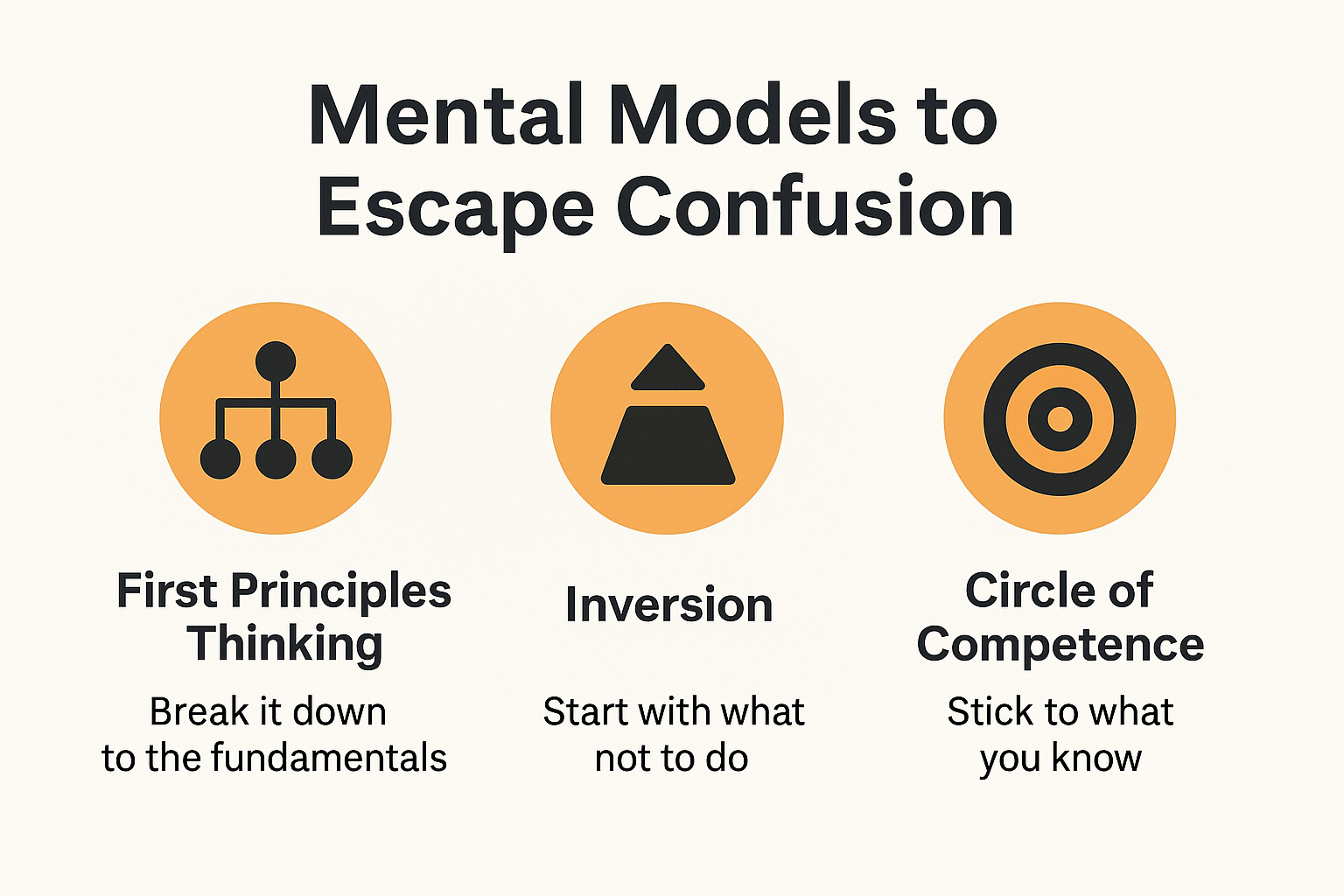
Inversion thinking tackles a problem from the opposite direction, asking what would guarantee failure or create the worst outcome before deciding how to succeed. The method draws on mathematical inversion, proof by contradiction, Stoic negative visualization, and practical risk analysis. It can surface failure modes, perverse incentives, downside risks, and avoidable habits that optimistic forward reasoning tends to miss.
A 19th-century German mathematician named Carl Gustav Jacob Jacobi had a maxim he applied to every hard problem in pure mathematics: man muss immer umkehren - one must always invert. When Jacobi could not solve a mathematical problem forward, he would flip it and ask what the inverse problem looked like.
This habit of mind, combined with extraordinary technical skill, produced some of the most significant results in the history of algebra, number theory, and elliptic functions.
Jacobi did not invent inversion thinking, but he embodied it so completely that the principle has become permanently associated with his name.
Two centuries later, Charlie Munger - the longtime vice chairman of Berkshire Hathaway and intellectual partner of Warren Buffett - elevated Jacobi's mathematical principle into a general mental model for navigating business, investing, and life.[1]
"Invert, always invert," Munger would tell audiences at the University of Southern California's business school and in Berkshire's shareholder meetings. When Munger wanted to understand how to make Berkshire successful, he also asked: what would guarantee that we fail?
When he wanted to understand how to live a good life, he asked: what would make life miserable and then avoided those things? The results across six decades of partnership with Buffett speak to the practical power of the approach.
Inversion thinking is the mental model of approaching a problem from its opposite direction - asking "what would cause failure?" instead of "how do I succeed?", or "what would create the worst outcome?" instead of "what creates the best outcome?", and then using the answers to guide action.
It is a systematic reversal of the direction of reasoning, applied deliberately to surface insights that forward thinking consistently misses.
"Invert, always invert. Many difficult problems are best solved when they are addressed backwards." - Charlie Munger, paraphrasing Carl Jacobi
Inversion Applications Across Domains
| Domain | Forward Question | Inverted Question | What Inversion Reveals |
|---|---|---|---|
| Business strategy | How do we grow revenue? | What would guarantee we lose customers? | Retention risks that offense-focused thinking misses |
| Personal development | How do I become successful? | What habits would guarantee failure? | Avoidable vices and failure patterns |
| Project planning | What needs to go right? | What would cause this project to fail? | Risk pre-mortems surface suppressed concerns |
| Investment | What will make this investment return well? | What could make this investment go to zero? | Downside risks minimized by optimistic forward reasoning |
| Safety engineering | How do we build a safe system? | How could someone cause this system to fail? | Adversarial failure modes; edge cases |
| Policy design | What outcome do we want? | What unintended consequences would undermine the goal? | Cobra effects; perverse incentives; adaptation |
Where Inversion Thinking Comes From
The Mathematical Roots
The formal use of inversion as a problem-solving technique in mathematics predates Jacobi. Euclid employed a form of it through reductio ad absurdum - assuming the opposite of what you want to prove, showing that assumption leads to a contradiction, and concluding that the original proposition must therefore be true.
This form of inversion, sometimes called proof by contradiction or indirect proof, appears throughout The Elements and remains one of the fundamental tools of mathematical reasoning.
But Jacobi's contribution was to generalize the principle beyond proof technique into a general heuristic for mathematical discovery. When confronting a problem you cannot see through, he argued, transform it into a related inverse problem, solve that, and use the solution to illuminate the original.
This technique, formalized as the Jacobi inversion problem in the theory of elliptic functions, produced new mathematical territory rather than just cleaner proofs of existing results.
Johann Carl Friedrich Gauss, Jacobi's contemporary and the most dominant mathematician of the early 19th century, employed similar logic in his work on number theory.
His quadratic reciprocity theorem - which he called the "golden theorem" and proved in multiple different ways - emerged partly from examining reciprocal relationships between prime numbers, an inherently inversive approach.
Stoic Philosophy and Negative Visualization
The philosophical tradition that most closely parallels inversion thinking is Stoic negative visualization, which the ancient Greeks called premeditatio malorum - the premeditation of evils. The Stoic philosopher Seneca wrote explicitly about the practice: "Rehearse in your mind the obstacles and hardships you might face.
Whatever hardship happens to be the thing you fear most, say to yourself: 'this can be overcome, this can be endured.'"
Marcus Aurelius extended the practice in his Meditations, written as private notes to himself while governing the Roman Empire.
Rather than simply visualizing success, Marcus repeatedly considered the impermanence of everything he valued - power, reputation, the lives of people he loved - and used those reflections to clarify what actually mattered.
The Stoic version of inversion differs slightly from the decision-making version. The Stoics used negative visualization primarily to manage emotional attachment and build resilience. The decision-making version uses inversion primarily to reveal failure modes and improve choices.
But the underlying cognitive operation is the same: deliberately generating the negative case in order to inform present action.
Munger's Formulation
What Munger contributed was the explicit formulation of inversion as a first-step thinking tool rather than a supplementary one.
In his 1986 Harvard School commencement speech, later published in Poor Charlie's Almanack, he told graduates to approach the problem of leading a good life by first cataloguing all the ways to guarantee a bad one - bad habits, bad thinking patterns, bad associates - and then simply not doing those things.
The simplicity of the technique masks the depth of the cognitive shift it produces.
Munger has identified two variants of inversion in decision-making contexts:
Failure pre-mortem: Before beginning a project or investment, assume it has already failed catastrophically and ask what caused the failure. The exercise surfaces risks that optimistic forward-planning systematically suppresses.
Desired state inversion: Instead of asking "how do I achieve X?", ask "what would prevent X?" or "what would guarantee the opposite of X?" The answers often reveal constraints and failure conditions that must be addressed before positive actions can work.
How to Apply Inversion Thinking
Inversion thinking is not a single technique but a set of related practices. Understanding how to apply each one is more useful than treating inversion as a general philosophical posture.
Step 1: State the Forward Problem Clearly
Before inverting, articulate the original problem as precisely as possible. "How do I build a successful business?" is too vague to invert productively.
"How do I build a business in the direct-to-consumer supplement market that generates $10M in annual revenue within three years?" is specific enough to generate useful inverted questions.
The quality of the inversion is limited by the quality of the original question.
Step 2: Generate the Inverse Question
The standard inversion moves are:
- "How do I achieve X?" becomes "What would make X impossible?" and "What would guarantee I fail to achieve X?"
- "What should I do to produce outcome Y?" becomes "What actions would most reliably prevent or destroy Y?"
- "How do I make customers happy?" becomes "What would make customers absolutely miserable?"
Apply each of these to the specific problem you identified in step 1.
Step 3: Answer the Inverse Question Thoroughly
This is where most of the value is generated. Answer the inverse question without softening or minimizing.
If the question is "what would guarantee our product fails?", generate the full list: poor distribution, confusing messaging, pricing customers out of the market, building for a customer segment that doesn't actually exist, running out of cash before finding product-market fit, ignoring competitor moves, losing key talent, regulatory non-compliance.
The more thorough and honest this list, the more useful the inversion.
Step 4: Convert Insights Back to Forward Action
The inverted analysis now informs the forward problem. Each item on the failure list becomes a risk to be addressed or a constraint to be respected. The action plan now incorporates avoidance of identified failure modes alongside positive steps toward success.
This is the point where many practitioners underuse inversion. Generating the failure list is only valuable if it changes what you actually do.
Examples of Inversion Thinking in Practice
Amazon's Working Backwards Process
Amazon institutionalized a version of inversion in its product development process. Rather than starting product development with capabilities and features the company could build, Amazon teams begin by writing a fictional press release announcing the product's launch - as if it had already succeeded.
The team then evaluates whether that press release describes something customers would actually want. If the press release is not compelling, the product development stops before significant resources are committed.
This is inversion applied to product strategy. Instead of asking "what features should we build?", Amazon asks "what would the success story look like, and does that success story actually matter to anyone?" The approach has produced products including the Kindle, Amazon Prime, and AWS - and has prevented many more projects that sounded promising internally but would have failed in the market.
The WWII Bullet Hole Problem
During the Second World War, the U.S. military commissioned a study of returning bomber aircraft to determine where armor should be added. The initial analysis focused on where the returning planes had been hit - which showed clustering of bullet holes in the wings and fuselage, but relatively few holes in the engines and cockpit.
Abraham Wald, a statistician with the Statistical Research Group at Columbia University, inverted the analysis. The question was not "where do returning planes get hit?" but "where do we have no data?" The planes that were hit in the engines and cockpit were not returning at all.
The data from returning planes was systematically biased by survivorship - it showed exactly where planes could absorb damage and survive. The places without holes were the places where a single hit proved fatal.
The military added armor to engines and cockpits rather than wings and fuselage. Wald's inverted reading of the same data that others had read forward produced the opposite and correct conclusion.
Munger and the Removal of Stupidity
In describing Berkshire Hathaway's approach to investment, Munger has repeatedly emphasized that much of the firm's performance can be attributed not to brilliant insight about where to invest, but to systematic avoidance of obvious stupidities.
"It is remarkable how much long-run advantage people like us have gotten by trying to be consistently not stupid, instead of trying to be very intelligent."
This is inversion operationalized as an investing philosophy. The forward question "what should we invest in?" is supplemented and often replaced by the inverted question "what investments should we avoid at all costs?" The Berkshire checklist of investment disqualifiers - businesses they don't understand, businesses with poor economics, businesses led by executives whose integrity is questionable - is an inverted approach to building the portfolio.
Flip Thinking in Education
Sal Khan, founder of Khan Academy, applied inversion to the traditional classroom model.
The forward question in education is "how do teachers deliver instruction effectively?" The inverted question is "what is preventing students from learning?" The answer, for many students, was that they did not have time to absorb new material in class and had no support when attempting practice at home - the opposite of what would be most effective.
Khan's inversion produced the "flipped classroom" model: deliver instruction via video at home, where students can pause, rewind, and repeat at their own pace; use classroom time for practice and one-on-one help from the teacher.
The same educational inputs - teacher, student, content, time - produced dramatically different outcomes when arranged according to what would remove barriers to learning rather than what was administratively convenient for schools.
Why Inversion Thinking Works Cognitively
Several well-documented features of human cognition explain why inversion works as a corrective thinking tool.
Optimism Bias and Loss Aversion
Research by Daniel Kahneman and Amos Tversky at the Hebrew University of Jerusalem in the 1970s and 1980s established that humans are systematically loss-averse - we feel losses approximately twice as intensely as equivalent gains.[2]
But paradoxically, we are also optimistic about the probability of our own success relative to statistical baselines.
This combination creates a cognitive trap: we are emotionally sensitive to losses but intellectually underestimate their probability.
Inversion directly addresses this trap. By deliberately generating failure scenarios before beginning a project, we activate the loss-aversion system productively - using our sensitivity to negative outcomes to anticipate and mitigate them, rather than experiencing them after the fact.
Planning Fallacy and the Outside View
The planning fallacy, first described by Kahneman and Tversky and later extended by researcher Roger Buehler at Wilfrid Laurier University in studies published in the Journal of Personality and Social Psychology (1994), describes the systematic tendency of people to underestimate how long tasks will take and how much they will cost, even when they know from prior experience that such underestimates are common.[8]
The fallacy is driven by an "inside view" that focuses on the specific project's optimistic scenario rather than the distribution of outcomes for similar projects.
Inversion provides an alternative entry point to what Kahneman calls the "outside view" - considering the reference class of similar projects, including the ones that failed, rather than attending exclusively to the unique features of the project under consideration.
When you ask "what would make this fail?", you implicitly draw on the outside view, since most failure modes are common across projects rather than unique to any specific one.
Confirmation Bias
Peter Wason's 1960 paper "On the Failure to Eliminate Hypotheses in a Conceptual Task," published in the Quarterly Journal of Experimental Psychology, introduced the concept now known as confirmation bias - the tendency to seek information that confirms existing beliefs rather than information that would disconfirm them.
Wason's card-selection task demonstrated that even well-educated people systematically neglect disconfirming evidence.[4]
Inversion thinking is structurally designed to generate disconfirming evidence. By deliberately constructing the case for failure or the case against your preferred position, you force engagement with the information that forward thinking systematically overlooks.
Inversion in Research and Science
The scientific method incorporates inversion at its core through Karl Popper's principle of falsifiability.
Popper, writing in The Logic of Scientific Discovery (1934), argued that what distinguishes scientific hypotheses from non-scientific ones is not their ability to be confirmed by evidence, but their ability to be falsified by evidence.[7]
A good scientific hypothesis makes specific predictions about what we would observe if the hypothesis were false, not merely what we would expect to observe if it were true.
This is inversion applied to epistemology: rather than asking "what evidence would confirm my theory?", ask "what evidence would refute my theory?" The search for refuting evidence is more epistemically productive than the search for confirming evidence, because disconfirmation rules out hypotheses while confirmation merely adds compatible evidence to an already-consistent hypothesis.
Richard Feynman, the Nobel Prize-winning physicist, described this principle in lay terms: "The first principle is that you must not fool yourself, and you are the easiest person to fool." Feynman's approach to physics combined extraordinary creative imagination with a systematic suspicion of his own conclusions - a scientific version of inversion that was central to his ability to produce correct results in areas where other physicists produced beautiful theories that turned out to be wrong.
Pre-registration of hypotheses in clinical research represents a recent institutional application of inversion thinking.
By requiring researchers to specify in advance what results would confirm and what would disconfirm their hypotheses, pre-registration combats the post-hoc rationalization that produces the replication crisis in psychology and medical research.
Limits and Misapplications of Inversion
Inversion thinking is a powerful tool, but it is not universally applicable, and there are specific ways it can be misused.
The paralysis trap: If inversion is applied too early or too thoroughly, the failure analysis can generate so many risks that no action seems safe. The result is analysis paralysis - a failure mode that inversion itself would identify.
The resolution is to treat inversion as a risk-surfacing tool that informs action, not as a veto mechanism that prevents it.
Scope inflation: When asked "what would cause failure?", people sometimes expand scope to include risks so remote or systemic that no individual decision-maker can address them.
A market researcher asking what would cause their research to fail should focus on research-process risks, not on the possibility of civilizational collapse. Useful inversion is bounded to the domain of the decision at hand.
Asymmetric application: Inversion is most powerful when applied symmetrically - generating both the failure case and the success case, and comparing what each reveals.
Applying inversion only to the negative case can produce an artificially gloomy analysis; applying it only to evaluate how to achieve the maximum positive outcome can produce overconfidence. The full power of inversion comes from using both directions.
Mistaking the negative list for the complete strategy: A list of things to avoid is not, by itself, a plan. Munger is explicit that avoiding stupidity is necessary but not sufficient for success - you still need to identify good opportunities and execute them well.
Inversion reduces downside; it does not replace the forward work of building upside.
For related reasoning tools that complement inversion thinking, see second-order thinking, first-principles thinking, and how decision-making works for beginners.
Research Evidence: Inversion's Effect on Decision Quality
The most robust experimental support for inversion thinking as a decision-improvement tool comes from the pre-mortem literature.
In a 1989 paper, Deborah Mitchell, Jay Russo, and Nancy Pennington at the University of Colorado studied whether prospective hindsight - imagining that an event had already occurred and asking why - improved forecasting accuracy.[5]
They found that participants who were instructed to assume a specific outcome had occurred generated significantly more causal explanations than those asked to speculate about future possibilities.
The mechanism appears to be that prospective hindsight shifts cognitive mode from uncertain speculation to causal explanation, a mode in which human cognition is substantially stronger.
Gary Klein, a research psychologist who has studied expert decision-making in military, firefighting, and medical contexts, formalized the pre-mortem as a team decision-making practice in research published in Harvard Business Review in 2007.[3]
Klein's procedure: at the beginning of a project, gather the team, announce that the project has just failed spectacularly, and ask each person to write down their explanation of why. The exercise takes fifteen minutes and consistently surfaces failure modes that thorough forward planning had not identified.
A 2018 study by Carey Morewedge and colleagues at Boston University, published in Nature Human Behaviour, examined interventions designed to reduce cognitive bias in decision-making.[6]
The study tested nine debiasing approaches and found that simulation-based approaches - including both mental simulation of failure and mental simulation of alternative outcomes - produced among the most robust and durable reductions in decision-making bias.
The authors noted that these approaches work partly because they operationalize perspective-taking, forcing decision-makers to generate information from viewpoints other than their optimistic default.
Applying Inversion to Personal Decisions
Beyond organizational and strategic contexts, inversion thinking has practical application in individual decision-making across all domains.
Career decisions: Instead of asking "which job offer is best?", ask "which job offer has the features most likely to make me miserable two years in?" The answers often surface factors - a poor cultural fit, a disorganized team, an unclear path to promotion - that are underweighted in the positive evaluation.
Relationship decisions: Instead of asking "does this relationship make me happy?", ask "what are the features of this relationship that would cause serious problems over a five-year horizon?" Forward-looking happiness assessments are dominated by present emotional state; inverted failure analysis surfaces structural factors that present emotions obscure.
Financial decisions: Instead of asking "what investments would maximize my returns?", ask "what behaviors would guarantee financial failure?" The answers - excessive fees, under-diversification, panic selling, leverage on volatile assets, ignoring inflation - form a constraint set that dramatically narrows the universe of acceptable choices.
Health decisions: Instead of asking "what should I do to be healthier?", ask "what are the behaviors that most reliably destroy health over decades?" Smoking, sleep deprivation, physical inactivity, processed food, chronic stress, social isolation - the list of reliable health destroyers is better established than the list of reliable health builders, and avoiding it is sufficient to produce substantially better outcomes than average.
In each case, the inversion does not replace positive action. It provides a constraint set within which positive action is more likely to succeed.
Sources & Further Reading
- Munger, C. T. (2005). Poor Charlie's Almanack: The Wit and Wisdom of Charles T. Munger. Donning Company Publishers. View source
- Kahneman, D. (2011). Thinking, Fast and Slow. Farrar, Straus and Giroux. View source
- Klein, G. (2007). Performing a Project Premortem. Harvard Business Review, September 2007. View source
- Wason, P. C. (1960). On the Failure to Eliminate Hypotheses in a Conceptual Task. Quarterly Journal of Experimental Psychology, 12(3), 129-140. DOI: 10.1080/17470216008416717
- Mitchell, D. J., Russo, J. E., & Pennington, N. (1989). Back to the Future: Temporal Perspective in the Explanation of Events. Journal of Behavioral Decision Making, 2(1), 25-38. DOI: 10.1002/bdm.3960020103
- Morewedge, C. K., et al. (2015). Debiasing Decisions: Improved Decision Making with a Single Training Intervention. Policy Insights from the Behavioral and Brain Sciences, 2(1), 129-140. DOI: 10.1177/2372732215600886
- Popper, K. R. (1934/1959). The Logic of Scientific Discovery. Hutchinson. View source
- Buehler, R., Griffin, D., & Ross, M. (1994). Exploring the Planning Fallacy. Journal of Personality and Social Psychology, 67(3), 366-381. DOI: 10.1037/0022-3514.67.3.366