
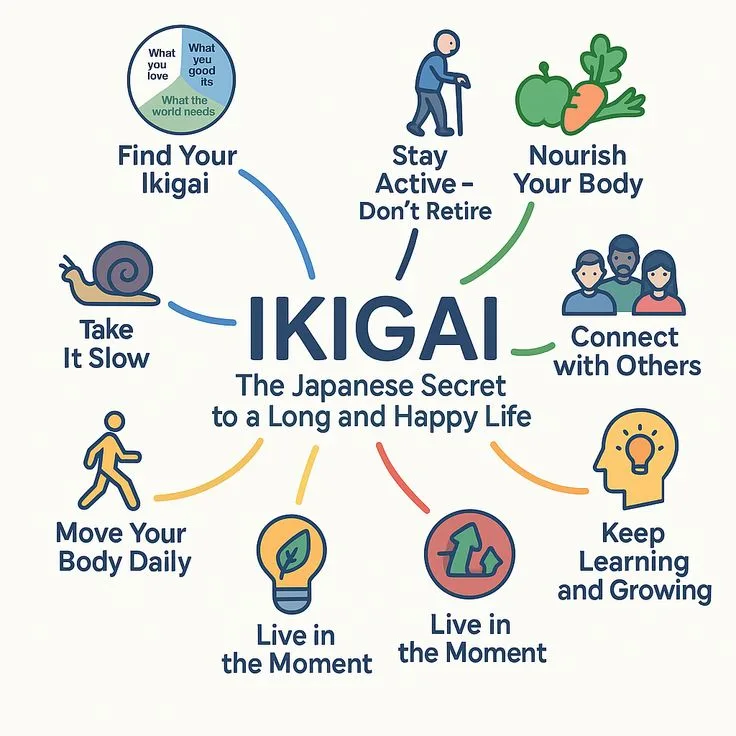
The ikigai framework is often misrepresented in Western self-help as a career Venn diagram about passion, skill, need, and pay. In Japanese usage, ikigai means a reason life feels worth living and can arise from small joys, relationships, craft, and present-moment engagement. Research links a sense of ikigai or purpose with better longevity outcomes, without making it a productivity formula.
Few ideas from Japanese culture have traveled as far into Western self-help as ikigai. Books about it regularly appear on bestseller lists. Career coaches build programs around it. The famous four-circle Venn diagram has been shared millions of times on LinkedIn and Pinterest.
And yet most of what circulates in Western contexts under the ikigai label misrepresents what the original concept actually means.
Understanding the genuine concept, and what research on it shows, is more useful than the cleaned-up Western version, and arguably more accessible too.
The Word and Its Meaning
Ikigai (生き甲斐) is a Japanese compound. The first element, iki (生き), means life or living. The second, gai (甲斐), means worth, benefit, or result: the sense of something that has made effort worthwhile.
Together, the word means something like "that which makes life worth living" or simply "a reason to get up in the morning."
The concept does not originate with a philosopher or a single text. It is embedded in Japanese everyday language and has been used for centuries. It appears in literature, in conversations about aging, in reflections on work and relationships. It describes a felt sense of aliveness and meaning, not a strategic framework.
What might count as someone's ikigai? For one person, it could be their grandchildren. For another, a craft they have practiced for decades. For a third, their garden, or their local community, or the first cup of tea in the morning. The concept deliberately covers both the grand and the small.
The Venn Diagram Version: Where It Comes From
Most Westerners encounter ikigai through a diagram showing four overlapping circles:
- What you love
- What you are good at
- What the world needs
- What you can be paid for
The intersections of these circles are labeled: passion (love + skill), mission (love + world need), vocation (world need + pay), and profession (skill + pay). The dead center, where all four overlap, is labeled "ikigai."
This diagram is not Japanese in origin. It was popularized in English-language publications around 2014, particularly through a viral blog post by author Marc Winn, who overlaid the word "ikigai" onto a diagram originally drawn by Spanish author Andrés Zuzunaga about the meaning of life.
Winn himself has since acknowledged that his mashup was not an accurate representation of the Japanese concept.
The diagram draws on some real wisdom: the intersection of skill, engagement, and purpose is worth thinking about. But it reframes ikigai as a career optimization exercise and attaches the Japanese label to a framework that Japanese culture would recognize as something quite different.
"Ikigai does not need to have any social utility, economic justification, or grand narrative. It can be as simple as the pleasure of waking up to do something you care about." (Ken Mogi, neuroscientist and ikigai researcher)
What Japanese Sources Actually Say
Ken Mogi, a Japanese neuroscientist and author of "The Little Book of Ikigai" (2017), describes five pillars underlying the concept as it is actually lived and expressed in Japan:
- Starting small: ikigai is often rooted in small, specific acts rather than large ambitions
- Accepting yourself: your current state, flaws and all, as a valid starting point
- Connecting with others and the world: ikigai is rarely purely solitary
- Seeking out small joys: sensory pleasures, daily rituals, aesthetic appreciation
- Being in the here and now: present-moment engagement with what you are doing
This is notably different from the Venn diagram approach. There is no requirement that your ikigai be monetizable, scalable, or world-improving. A retired craftsperson who spends their days perfecting woodwork, with no social media presence and no customers, can have profound ikigai.
A grandmother whose reason to live is watching her grandchildren grow has ikigai regardless of whether this shows up in any productivity framework.
The Japanese psychiatrist Mieko Kamiya, who published the first systematic study of ikigai in 1966, described it as providing seven kinds of psychological satisfaction: life worth, purpose, efficacy, satisfaction, freedom, self-actualization, and meaning.
Her framework is psychological rather than vocational: it is about what internal states are available to a person, not what external functions they perform.
Kamiya's work predates the Western popularization of the concept by nearly 50 years and represents the most rigorous attempt in the Japanese literature to give ikigai a clinical and psychological structure.
Her emphasis on subjective well-being rather than external purpose or productivity marks a fundamental difference from the Venn diagram framework that came later.
Ikigai and Longevity: What the Research Shows
Okinawa is often cited in longevity research as one of the world's "Blue Zones," regions where people live unusually long lives. Ikigai has been invoked as a possible explanation. The claim deserves some scrutiny.
What the Data Shows
A landmark 2008 study by Sone and colleagues, published in Psychosomatic Medicine, followed 43,391 Japanese adults over seven years. Those who reported having ikigai had significantly lower all-cause mortality than those who did not.
The effect persisted after adjusting for age, sex, smoking, alcohol, exercise, employment, and perceived stress. Those with ikigai were 19% less likely to die during the follow-up period.
A 2009 study by Tanno and colleagues in Journal of Psychosomatic Research followed 73,734 Japanese adults and found similar results, with ikigai associated with lower cardiovascular mortality over a six-year period.
A 2019 study in JAMA Network Open followed over 6,000 English-speaking adults (using a related measure of "life purpose") and found that higher purpose scores predicted lower all-cause mortality and fewer cardiac events over a 4.6-year follow-up.
| Study | Sample | Follow-up | Key Finding |
|---|---|---|---|
| Sone et al. (2008) | 43,391 Japanese adults | 7 years | 19% lower all-cause mortality with ikigai |
| Tanno et al. (2009) | 73,734 Japanese adults | 6 years | Lower cardiovascular mortality |
| Alimujiang et al. (2019) | 6,985 US adults | 4.6 years | Lower all-cause mortality, fewer cardiac events |
| Hill and Turiano (2014) | 6,163 US adults | 14 years | Higher purpose predicted lower mortality |
What the Data Does Not Show
The association between purpose and longevity is robust, but its causal mechanisms are not fully established.
Several plausible pathways have been proposed: people with strong ikigai may engage in more health-protective behaviors, manage stress more effectively, maintain stronger social connections, or show different neuroendocrine profiles.
The research does not establish which of these mediates the effect, or whether all contribute.
One proposed mechanism is through the hypothalamic-pituitary-adrenal (HPA) axis: people with higher purpose may show lower chronic cortisol levels, which reduces the cumulative physiological damage associated with chronic stress.
A 2013 study by Boyle and colleagues found that higher purpose scores predicted lower markers of inflammatory activity, suggesting a potential biological pathway.
The specific role of Okinawa's diet, social structure, and physical activity patterns makes it difficult to isolate ikigai as the active ingredient in Okinawan longevity. Blue Zone research is observational and subject to the usual confounds.
The most defensible claim is that having a sense of purpose, meaning reasons to continue engaging with life, is associated with longevity, and that ikigai is one culturally specific form that this sense of purpose takes.
Ikigai Across the Life Span
One of the most important features of the genuine ikigai concept is that it changes across life stages. Research by Japanese scholars suggests that the sources of ikigai shift substantially with age.
In youth and early adulthood, ikigai tends to cluster around ambition, skill development, and social belonging. In middle adulthood, work, family, and community roles predominate.
In later life, where much of the Japanese research has focused, ikigai increasingly involves relationships, accumulated roles, and deeply practiced activities.
A 2012 study by Fukukawa and colleagues in Psychogeriatrics found that older Japanese adults most commonly cited family relationships, social roles, and specific personal practices as their sources of ikigai, with professional achievement becoming less central with age.
This finding is consistent with the general pattern in life-span developmental psychology showing a shift from achievement orientation to relationship and engagement orientation in later adulthood.
This life-span perspective stands in tension with the Western Venn diagram model, which implies a single fixed answer to be discovered and pursued.
The Japanese conception is more dynamic: your ikigai now is not necessarily your ikigai in twenty years, and this is not a problem to be solved but a feature of a life that continues to develop.
The resilience implications are significant. Research on bereavement and loss suggests that people whose sense of meaning and purpose is distributed across multiple domains (work, family, practice, community) recover better from the loss of any one domain than those whose purpose is concentrated in a single source.
The pluralistic character of genuine ikigai, allowing for multiple simultaneous sources, may partly explain its observed protective effects.
Ikigai and Mental Health
The psychological literature on ikigai overlaps substantially with research on eudaimonic well-being, the sense of living in accordance with your values and potential, as distinct from hedonic well-being (pleasure and positive affect).
Carol Ryff's six-component model of psychological well-being, which includes purpose in life, personal growth, autonomy, environmental mastery, positive relations, and self-acceptance, aligns closely with the content of Kamiya's ikigai framework, developed independently from a clinical context.
The convergence suggests that the concept captures something real about the psychological conditions for flourishing.
Studies have found ikigai to be positively associated with:
- Lower rates of depression and anxiety
- Higher cognitive function in older adults
- Greater social participation
- Lower incidence of functional decline
- Better recovery from illness and surgery
- Higher self-rated health
A study in Psychiatry and Clinical Neurosciences (2017) found that among older adults in Japan, having ikigai was associated with larger hippocampal volume (a brain region involved in memory and stress regulation), independent of age, education, and other factors.
While preliminary and requiring replication, this finding suggests biological correlates of the purpose-health relationship that go beyond the behavioral pathways (health behaviors, social connection) typically proposed.
The Practical Question: How Do You Find Your Ikigai?
Given that the genuine concept is pluralistic and present-focused, the practical approach differs from the Venn diagram exercise.
Start With What Already Moves You
Rather than beginning with abstract questions about your unique gifts and world-changing mission, begin with observation. What activities cause you to lose track of time? What do you do voluntarily when no one is watching? What would you continue even if you were never paid or recognized for it?
These observations point toward genuine sources of engagement rather than socially constructed notions of what your purpose should be.
The Japanese concept of fudoki, attending carefully to the texture of daily experience, is related: paying attention to what your behavior reveals about your values is more reliable than asking yourself what you think your values should be.
Take Small Things Seriously
The Japanese concept takes everyday pleasures and routines seriously as potential sources of ikigai. The concept of kodawari, the meticulous attention to detail and commitment to craft, however small the craft, is deeply connected to ikigai.
A meticulous home cook, a careful reader of poetry, a devoted walker of a particular route through their neighborhood: these are not consolation prizes for people who failed to find their grand mission. They are legitimate and important sources of meaning.
Research on the psychology of everyday meaning supports this. Studies by Steger and colleagues using the Experience Sampling Method, where participants record what they are doing and how meaningful it feels at random intervals throughout the day, find that meaning is most commonly experienced in ordinary activities (conversations, meals, routine tasks) rather than in exceptional or dramatic events.
Waiting for transcendence misses most of the meaning available in ordinary life.
Consider Relationships as Central
Much of the Western purpose literature treats purpose as an individual achievement, something you discover about yourself. Japanese ikigai places relationships at the center. Bonds with family, friends, community, and even animals are commonly cited as primary sources of ikigai.
This social dimension is not incidental to the concept; it is constitutive of it.
Research on social connection and wellbeing strongly supports this prioritization.
The Harvard Study of Adult Development, which followed 724 men for 80 years, found that the quality of relationships was the strongest predictor of wellbeing and health in later life, stronger than career achievement, educational attainment, or initial health status.
The relational emphasis in genuine ikigai aligns with this finding in ways the vocational Venn diagram does not.
Allow for Multiple Sources
Resist the temptation to find the single answer. Research suggests that having multiple sources of ikigai (work, relationships, hobbies, community) provides greater psychological resilience than having one dominant source, because the loss of one source does not collapse the entire system.
This is directly analogous to the concept of identity complexity in social psychology: people whose self-concept draws on multiple distinct domains (not just "I am a professional" but "I am a parent, a musician, a neighbor") show greater resilience in the face of threats to any single identity.
Ikigai pluralism serves the same function at the level of meaning rather than identity.
Revisit Across Life Stages
Because ikigai shifts with life circumstances, the question "what is my ikigai?" is not a one-time inquiry. It benefits from regular revisitation, particularly at transitions: changing jobs, entering or leaving relationships, retiring, experiencing loss, or recovering from illness.
Retirement is a particularly critical transition. Research consistently finds that retirement is associated with elevated depression risk when work was the primary source of purpose and identity. People who maintain diverse sources of ikigai beyond work show significantly better adjustment to retirement.
Planning for retirement is partly planning for how you will sustain reasons to engage with life when the occupational structure of daily routine is removed.
Ikigai vs. Related Concepts
| Concept | Origin | Key Emphasis | Relationship to Ikigai |
|---|---|---|---|
| Purpose in life (Western) | Psychology | Singular, central life aim | More grand and singular than genuine ikigai |
| Flow | Csikszentmihalyi | Absorption in challenging activity | Overlaps with engagement aspect; lacks relational dimension |
| Meaning in life | Frankl/logotherapy | Finding meaning in suffering | Shares pluralism; heavier philosophical weight |
| Dharma | Hindu/Buddhist | Cosmic duty or path | Less personal, less flexible |
| Calling | Western vocational | Work-linked mission | Narrower, often career-focused |
| Eudaimonia | Aristotle | Living in accordance with virtue | Closest philosophical parallel |
Purpose in life (Western psychology) is typically defined as a central, self-organizing life aim. It is more singular and grand than the Japanese ikigai, though the research literatures overlap substantially.
Flow (Csikszentmihalyi) is the state of complete absorption in a challenging activity. It overlaps with the engagement aspect of ikigai but does not encompass the relational or values dimensions.
Meaning in life (Frankl/logotherapy) emphasizes finding meaning in suffering and through work, love, and suffering itself. It shares ikigai's pluralism and present-moment quality but carries a heavier philosophical weight and emerged from a context (Holocaust survival) that gives it a different emotional register.
Common Misconceptions
Misconception 1: Ikigai is only for people who love their jobs. The concept is not primarily vocational. It can be found entirely outside of work, and many Japanese people whose ikigai descriptions have been studied locate meaning primarily in family, community, and personal practice.
Misconception 2: If you have not found your ikigai, something is wrong. This framing creates the very anxiety that ikigai is supposed to alleviate. The research suggests that small, present, accessible sources of meaning are more reliably beneficial than the pursuit of a grand singular purpose.
Misconception 3: The Venn diagram is a useful tool even if not authentic. The diagram's emphasis on monetization and world impact can actually narrow people's sense of what is permissible as a source of meaning, excluding the domestic, the relational, and the quietly pleasurable.
It also creates unrealistic expectations about the convergence of passion, skill, social need, and income, conditions that, in practice, rarely align perfectly.
Misconception 4: You need to know your ikigai to have it. Many people whose ikigai is richest have never analyzed it. The concept describes a quality of engagement with life, not a conclusion reached through self-analysis. You can live ikigai without naming it.
What Is Worth Taking From the Concept
The genuine ikigai concept, properly understood, offers something more modest and more accessible than the Western brand version. It suggests that meaning is not something you find at the end of a lengthy self-discovery process.
It is present in the texture of ordinary days, in the specific activities, relationships, and small rituals that make getting up worthwhile.
Research on purpose and longevity supports taking this seriously. The psychological and biological mechanisms connecting meaning to health outcomes are increasingly well-documented.
The practical implication is not to redesign your career but to attend more carefully to what is already working in your life, to protect it, and to cultivate more of it.
This is, ultimately, a more democratic theory of purpose than the Western alternatives. It does not require extraordinary talent, a global platform, or a career that elegantly combines passion and profit.
It requires attention to your own life, the relationships that sustain it, and the willingness to take seriously the small things that make it worth living.