
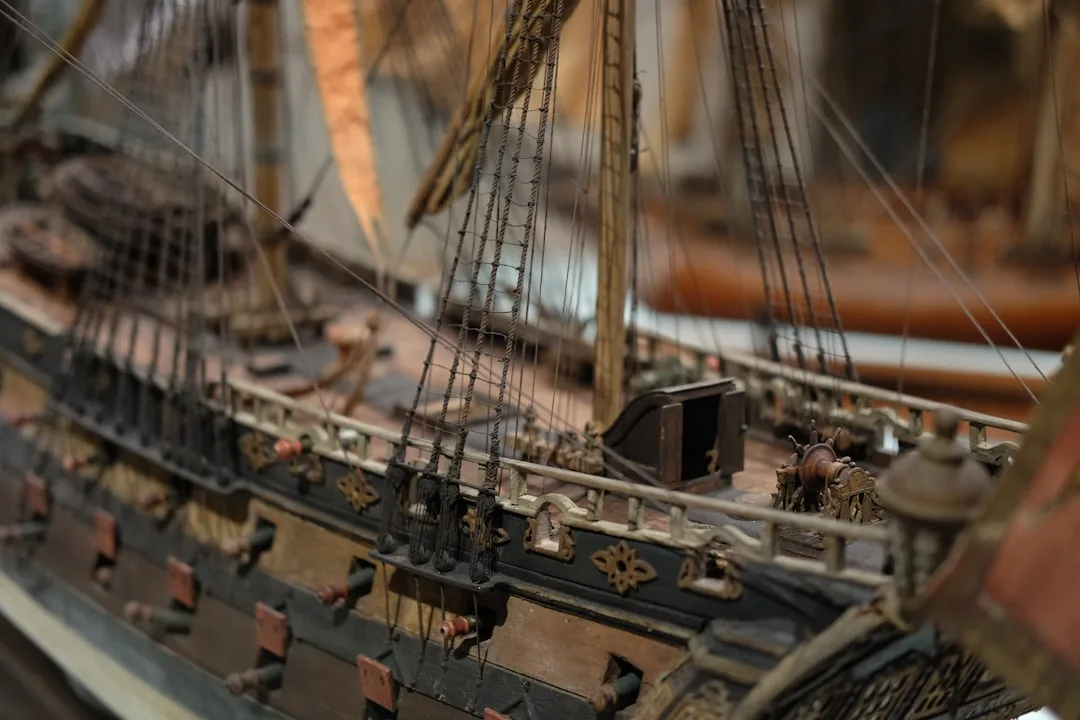
The Ship of Theseus explained through its original setting: somewhere in the harbor of ancient Athens, a wooden ship sat as a monument.
According to Plutarch, the Athenians preserved the vessel that Theseus and his crew had sailed back from Crete after slaying the Minotaur, removing the rotten planks and replacing them with sound new timber as the wood decayed.
Plank by plank, over what Plutarch describes as generations, every original piece of the ship was eventually replaced.
The ship that stood in the harbor at the end of this process contained not a single splinter of the vessel Theseus had actually sailed.
And yet Athenians called it the same ship, docked in the same place, honored for the same voyage.
This is the puzzle now known as the Ship of Theseus, one of the oldest and most durable problems in the philosophy of identity.
It asks a question that sounds almost childish until you try to answer it precisely: if you replace every part of an object over time, is it still the same object?
The Original Account
The earliest surviving version of the puzzle comes from Plutarch's Life of Theseus, written in the late first century CE.
Plutarch was not primarily interested in metaphysics. He was writing a biography, and he mentioned the ship as a historical curiosity, a real artifact the Athenians maintained as a civic relic.
He noted, almost in passing, that the ship had become "a standing example among the philosophers, for the logical question of things that grow" - some arguing it remained the same ship, others that it did not.
That single sentence is the entire ancient source for a debate that has run for roughly two thousand years.
Plutarch did not resolve the question. He simply recorded that Athenian thinkers of his era were already arguing about it, which tells us the puzzle is likely older than his account, even though no earlier surviving text states it explicitly.
Hobbes Adds a Complication
The puzzle sat relatively quietly for over a thousand years until the English philosopher Thomas Hobbes sharpened it considerably in his 1655 work De Corpore.
Hobbes proposed a second scenario layered on top of the first.
Suppose, he suggested, that someone collected every original plank as it was removed from the ship, and used those discarded planks to reassemble a second vessel, built in secret, using only the original materials.
Now there are two ships. One stands in the harbor, continuously repaired, having existed the entire time as a single continuous object with a fixed location and unbroken history. The other is built later, but from every original material component.
Hobbes's question was blunt: which one, if either, is the real Ship of Theseus?
This version of the puzzle is harder than Plutarch's, because it forces a choice between two different intuitions about identity that usually point the same direction but here point in opposite directions.
One intuition says identity tracks continuity: the ship in the harbor never stopped existing, never lost its form, never lost its function. It has a continuous history.
The other intuition says identity tracks material composition: the ship is, at bottom, its physical parts, and the reassembled vessel has all of the original parts.
Hobbes's addition exposes that these two intuitions are not the same criterion wearing different clothes. They are genuinely different theories of what makes something the same thing over time, and ordinary language does not settle which one is correct.
Why This Is Not Just Wordplay
It is tempting to dismiss the puzzle as a semantic trick, a dispute over how we choose to use the word "same" rather than a real question about the world.
Philosophers who work on personal identity and material objects generally reject that dismissal, because the same structural problem shows up in cases that are not merely verbal.
Every cell in the human body is replaced on a rolling basis over the course of years, through ordinary biological turnover. Skin cells, blood cells, and most other tissues are continuously broken down and rebuilt from new material drawn from food and water.
A person at fifty shares very little of the actual physical matter they were made of at twenty, and shares almost none of the matter they were made of as an infant.
If the Ship of Theseus is not "the same ship" once its planks are replaced, the same logic threatens to say a fifty-year-old is not "the same person" as the child they once were, at least not in the sense of being composed of the same stuff.
Most people resist that conclusion strongly, which suggests that whatever criterion we actually use for personal identity, it cannot be pure material continuity - and that points back at the ship as a genuinely useful test case, not an idle riddle.
Four Philosophical Positions
Contemporary philosophy of identity offers several distinct frameworks for resolving the puzzle, each with real costs and real defenders.
Mereological Essentialism
The philosopher Roderick Chisholm defended a strict position sometimes called mereological essentialism: an object is identical to the exact sum of its parts, and if any part changes, strictly speaking a new object exists.
Under this view, the ship in the harbor stops being the original ship the moment the first plank is swapped. What persists is not the original ship but a series of numerically distinct objects that resemble each other closely enough that ordinary speech treats them as one.
This position has the virtue of being precise and consistent. Its cost is that it conflicts sharply with how everyone actually talks and thinks about persisting objects, including ships, tools, organizations, and bodies.
Four-Dimensionalism
Four-dimensionalism, associated with philosophers like David Lewis and Theodore Sider, treats objects as extended across time the way they are extended across space.
On this view, "the ship" is not a three-dimensional object that exists wholly at each moment, but a four-dimensional object - a "space-time worm" - made up of temporal parts, one for each moment of its existence.
The ship at year one and the ship at year fifty are different temporal parts of the same larger four-dimensional entity, the way your left hand and right hand are different spatial parts of the same body.
This dissolves some of the puzzle's force, because it does not require finding one privileged criterion for sameness at a time. It just requires the temporal parts to be connected in the right way - which pushes the real question back to what "the right way" means, and Hobbes's reassembled ship still causes trouble here.
Sortal-Relative Identity
The philosopher David Wiggins argued that identity claims are always relative to a sortal concept - a kind term like "ship," "person," or "oak tree" - and that the persistence conditions for an object depend on which kind it falls under.
A ship persists through plank replacement because "being the same ship" is governed by continuity of function, structure, and intentional maintenance, not by material constancy.
A pile of sand persists differently: add or remove a few grains and it is still "the same pile," in a way that has nothing to do with maintained function, because piles do not have functions.
Under Wiggins's framework, Hobbes's reassembled ship is a genuine rival claimant only because "ship" as a sortal is bound up with both continuous use and material origin, and the puzzle exposes that those two components can be pulled apart.
Conventionalism
A more deflationary position holds that there is no deep fact of the matter, and that identity over time for artifacts like ships is fixed by social convention rather than discovered by metaphysical analysis.
On this view, the Athenians were free to declare the continuously repaired ship "the same ship" as a matter of civic and religious practice, and nothing in the world other than that practice makes the claim true or false.
This view has fewer commitments than the others, but many philosophers find it unsatisfying because it seems to treat identity as arbitrary in cases - like personal identity - where the stakes feel far from arbitrary.
The Puzzle Beyond Philosophy
The Ship of Theseus is regularly invoked outside academic philosophy because the underlying structure - gradual, complete replacement of parts while some form of continuity is maintained - shows up constantly in ordinary life.
Organizations are a common example. A company can replace every employee, every piece of equipment, and even its physical offices over a few decades while still being treated, legally and socially, as the same company with the same founding date and the same obligations.
Software systems raise a version of the same question. A codebase that has had every original line rewritten through years of maintenance is still called "the same program" by its users, tracked under the same name and version history, even though no original code remains.
Legal identity often resolves these cases by convention in exactly the way conventionalist philosophers describe: a corporation's identity is fixed by registration and continuity of legal personhood, not by any claim about its physical parts, which sidesteps the metaphysical question entirely for practical purposes.
What the Puzzle Does Not Settle
Two thousand years of discussion have not produced a consensus answer, and that is worth taking seriously rather than treating as a failure of philosophy.
The puzzle is genuinely underdetermined by the facts of any individual case. Once you know exactly which planks were replaced, when, and what happened to the old ones, you know everything there is to know about the physical situation - and the question of whether it's "the same ship" is still open.
That gap between complete physical description and an unsettled identity question is the actual philosophical content of the puzzle. It shows that "sameness over time" is not simply read off from physical facts, but requires some additional criterion that has to be argued for, not just observed.
Different sortals plausibly warrant different criteria, which is why Wiggins's relative approach has remained influential: a ship, a river, a person, and a nation may each persist according to different rules, and treating "identity" as one single relation that all of them share may be part of what makes the puzzle feel intractable.
Cross-References
The Ship of Theseus connects closely to other identity and persistence puzzles covered elsewhere on this site, including the philosophy of free will and questions of personal continuity, and to frameworks for reasoning about hard problems where no single criterion cleanly resolves a dispute.
Sources & Further Reading
- Plutarch. Life of Theseus, in Parallel Lives, written circa 75 CE. The ship passage appears in the biography's opening account of Theseus's Cretan voyage and its Athenian commemoration.
- Hobbes, T. (1655). De Corpore (Part II, Chapter 11), in which Hobbes proposes the reassembled-ship variant of the puzzle.
- Chisholm, R. M. (1976). Person and Object: A Metaphysical Study. Open Court Publishing. Defends mereological essentialism about material objects.
- Wiggins, D. (2001). Sameness and Substance Renewed. Cambridge University Press. Develops the sortal-relative theory of identity.
- Sider, T. (2001). Four-Dimensionalism: An Ontology of Persistence and Time. Oxford University Press. A systematic defense of the temporal-parts view.