
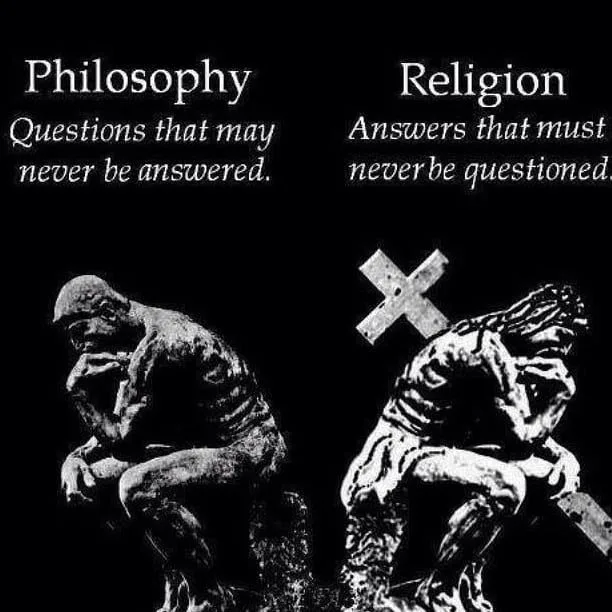
Philosophy of religion applies conceptual analysis, logical assessment, and evidence evaluation to religious claims without assuming they are true or false. It differs from theology, which works within a tradition, and religious studies, which describes traditions empirically. Its central questions include arguments for God, divine attributes, evil and suffering, religious experience, faith and reason, and the rational defensibility of belief.
There is something initially paradoxical about applying the tools of philosophy - conceptual analysis, logical validity assessment, evidential evaluation - to questions about God. If religious claims are matters of faith, the argument goes, they are not amenable to reason.
If they are amenable to reason, they are not really matters of faith. Philosophy of religion rejects this dichotomy.
From Anselm's eleventh-century attempt to prove God's existence from pure conceptual analysis, to Aquinas's integration of Aristotelian philosophy with Christian theology, to the twentieth-century debates between Alvin Plantinga and J.L.
Mackie over the logical problem of evil, philosophy of religion demonstrates that religious claims - their consistency, their evidential support, their meaning - are among the most rigorous and consequential questions philosophy can address.
Philosophy of religion is distinct from both theology and religious studies. Theology, in its classical form, proceeds from within a confessional tradition, treating scripture or revelation as authoritative.
Philosophy of religion treats the existence of God as a genuinely open question and evaluates arguments for and against it without presupposing the answer. Religious studies describes religious traditions empirically without evaluating their truth.
Philosophy of religion, drawing on the work of scholars including William Rowe, Alvin Plantinga, Richard Swinburne, and John Hick, is normative: it asks which religious claims are rationally defensible, what they mean, and how they relate to other things we know.
This article covers the main arguments for God's existence, the problem of evil and its responses, the epistemology of religious experience, the debate between faith and reason, the coherence of divine attributes, and how non-Western philosophical traditions approach questions about ultimate reality.
"I believe in order that I may understand." - Anselm of Canterbury, 'Proslogion' (1078), adapting Augustine
| Argument | Type | Key Figure |
|---|---|---|
| Cosmological argument | Existence of God | Aquinas, Leibniz; First Cause argument |
| Ontological argument | Existence of God | Anselm, Descartes; God as greatest conceivable being |
| Teleological argument | Design implies designer | Paley; modern intelligent design |
| Moral argument | Objective morality requires God | C.S. Lewis; Kant's practical postulate |
| Problem of evil | Against existence of God | Epicurus; Mackie; Rowe |
| Religious experience | Evidence for God | Swinburne; James |
Key Definitions
Natural theology: The attempt to establish truths about God through reason and observation alone, without appeal to revelation or scripture. Associated with Aquinas and the cosmological and teleological arguments.
Theodicy: A response to the problem of evil that attempts to justify God's permission of suffering by showing it serves some greater good. Derived from Greek theos (God) and dike (justice).
Properly basic belief: In Alvin Plantinga's Reformed epistemology, a belief that is rational to hold without inferring it from other beliefs - as perceptual and memory beliefs are held. Plantinga argues belief in God can be properly basic.[5]
The numinous: Rudolf Otto's term for the distinctive character of religious experience - the sense of encountering something wholly other, majestic, and awe-inspiring. The mysterium tremendum.
Fideism: The position that religious belief is not based on and should not be evaluated by rational standards. Associated with Tertullian, Kierkegaard, and some readings of Wittgenstein.
What Is Philosophy of Religion?
Philosophy of religion is the branch of philosophy that applies rigorous philosophical tools, logic, argument analysis, and epistemology, to questions arising from and about religion: whether God exists, what divine attributes mean, whether religious experience counts as evidence, and how faith relates to reason. It treats these questions as open to investigation rather than assuming religious claims are true or false.
Distinguishing the Discipline
Philosophy of religion is the branch of philosophy that applies rigorous philosophical tools, logic, argument analysis, and epistemology, to questions arising from and about religion: whether God exists, what divine attributes mean, whether religious experience counts as evidence, and how faith relates to reason. It neither assumes religious claims are true nor false, treating them as open to the same investigation as any other serious philosophical question.
William Rowe's 'Philosophy of Religion: An Introduction' captures the enterprise clearly: it applies standard philosophical tools to questions that arise from and about religion. Does God exist? What are the best arguments for and against?
If God exists, what is God's nature? Are divine attributes such as omnipotence, omniscience, and perfect goodness mutually consistent and consistent with the world we observe? Can religious experience serve as genuine evidence? What is the proper relationship between religious faith and secular reason?
These are not merely theoretical questions. How one answers them shapes views about the source of moral obligations, the meaning of suffering, the basis for hope, and the structure of rational inquiry.
Philosophy of religion does not presuppose that religious claims are false, as some forms of secularism assume, nor does it presuppose they are true, as confessional theology assumes.
It treats them as open to the same kind of rigorous investigation appropriate to any serious philosophical question.
The Scope of the Discipline
The field covers several interconnected areas: arguments for and against God's existence (natural theology and its critics); the coherence of divine attributes (does omnipotence have logical limits?
can omniscience be reconciled with human free will?); the epistemology of religious belief (what makes a religious belief rational, and is religious experience genuine evidence?); the problem of evil; the relationship between faith and reason; religious language (how do terms like 'God is good' function?); and the significance of religious diversity.
In recent decades, influenced by the revival of analytic philosophy of religion associated with Plantinga, Swinburne, and Alston, the field has become one of the most technically sophisticated areas of philosophy.
Arguments for God's Existence
The Ontological Argument: Anselm and Plantinga
Anselm of Canterbury's 'Proslogion' (1078) contains one of the most audacious arguments in the history of philosophy: the attempt to prove God's existence from the concept of God alone, without any empirical premises.
Anselm defined God as 'that than which nothing greater can be conceived.' Suppose such a being exists only in the mind (in intellectu) but not in reality (in re).[1] Then one could conceive of a greater being - one that exists in reality as well.
But this contradicts the hypothesis that we have conceived of the greatest conceivable being. Therefore, that than which nothing greater can be conceived must exist in reality.
Gaunilo of Marmoutiers replied immediately with a parody: by the same logic one could prove the existence of the greatest conceivable island. Anselm's response was that the argument applies only to an unlimited being, not to things like islands that are greatness-limited.
Kant's objection, developed in the 'Critique of Pure Reason' (1781), has been most influential: existence is not a predicate. To say that something exists is not to attribute an additional property to a concept but to affirm that the concept is instantiated.
The concept of a hundred thalers does not contain more in it when the thalers are real rather than imaginary; the difference is not in the concept but in its relationship to reality. Similarly, one cannot derive real existence from the concept of God by treating existence as one more superlative property.
Alvin Plantinga reformulated the argument in 'The Nature of Necessity' (1974) using possible worlds semantics. A maximally great being is one that is maximally excellent - omnipotent, omniscient, omnibenevolent - in every possible world.
If it is possible that such a being exists (if there is any possible world containing a maximally great being), then by the definition of maximal greatness, such a being exists in all possible worlds, including the actual world.
The argument is logically valid given its structure, but its soundness depends on whether the possibility premise is coherent - whether it is genuinely possible that a maximally great being exists.
Critics note that one could equally argue: if it is possible that a maximally great being does not exist, then it does not exist in any possible world, and the possibility premise for Plantinga's argument is false.
Cosmological Arguments
Cosmological arguments infer God from the existence or contingency of the universe.
Thomas Aquinas's Five Ways (Summa Theologica, thirteenth century) include three cosmological arguments: from motion (there must be an unmoved mover), from efficient causation (there must be an uncaused first cause), and from contingency (contingent beings must ultimately depend on a necessary being).[2]
Each terminates in what Aquinas said 'everyone understands to be God.' Aquinas was careful not to claim that these arguments prove the full Christian doctrine of God; they establish at most a first cause or necessary being, and further arguments are needed to identify this with the God of Christianity.
Leibniz's version appeals to the principle of sufficient reason: every fact has an explanation. The universe as a whole is a fact and must have an explanation; since anything within the universe is contingent, the explanation must lie outside it in a necessary being.
William Lane Craig's Kalam cosmological argument, revived from Islamic philosophy in his 1979 book, argues: everything that begins to exist has a cause; the universe began to exist (Craig appeals to both philosophical arguments against actual infinities and Big Bang cosmology); therefore the universe has a cause.[11]
Craig argues that this cause must be timeless, uncaused, immensely powerful, and personal - sufficiently characterized to deserve the name God.
Kant's critiques of cosmological arguments hold that they illicitly apply the category of causality beyond possible experience and that they tacitly presuppose the ontological argument (since they require that the first cause necessarily exist).
Bertrand Russell's position - that the universe is simply a brute fact requiring no further explanation - challenges the principle of sufficient reason on which many cosmological arguments depend.
Teleological and Fine-Tuning Arguments
William Paley's 'Natural Theology' (1802) argued from biological complexity to intelligent design by analogy with a watch: finding a watch on a heath, we would infer a watchmaker because of the evident purposive arrangement of its parts; the far greater complexity of the eye and other biological systems implies an even more powerful designer.
Charles Darwin's theory of natural selection, published in 'On the Origin of Species' (1859), provided an alternative explanation for biological complexity that does not require intentional design: natural selection acting on heritable variation can produce functional complexity without foresight.
Most philosophers of religion accept that Darwinian evolution adequately responds to Paley's biological argument.
The contemporary fine-tuning argument shifts the explanandum. The values of the fundamental physical constants - the cosmological constant, the strong nuclear force, the ratio of electromagnetism to gravity - are extraordinarily narrowly calibrated for the formation of stars, planets, and life.
Small variations in any of these values would have produced a universe incapable of supporting complex chemistry. Robin Collins and others argue that this fine-tuning is best explained by design.[12]
The anthropic principle offers a competing response: we necessarily find ourselves in a universe capable of supporting observers, because only such universes are observed, so the fine-tuning is not surprising given our existence.
Whether the multiverse hypothesis - that our universe is one of very many with varying constants - adequately explains fine-tuning without design is an active philosophical and cosmological debate.
The Problem of Evil
The Logical Problem
J.L. Mackie's 1955 paper 'Evil and Omnipotence' in 'Mind' presented the logical problem of evil with unusual precision.[3] An omnipotent God has no limits on what states of affairs it can bring about. An omniscient God knows how to eliminate evil.
An omnibenevolent God wants to eliminate evil. Yet evil exists. Mackie argued this conjunction is logically inconsistent and challenged theists to show which additional premise makes them compatible.
The Free Will Defense
Alvin Plantinga's response in 'God, Freedom, and Evil' (1974) is widely credited with defeating the logical problem for moral evil.[4] Plantinga's key claim is that it may not be within God's power to create free beings who always choose rightly.
A world with genuinely free moral agents who sometimes choose evil may be better than a world of deterministic automata who always 'choose' rightly in the sense that their behavior is entirely caused.
If there is what Plantinga calls 'transworld depravity' - if every possible person God could have created is such that, if created with free will, they would go wrong in at least some circumstances - then God could not have created a world with free beings and no moral evil.
This does not require that transworld depravity is actual, only that it is possible. And if it is possible, then there is no logical contradiction between God's existence and moral evil.
Natural evil - suffering caused by earthquakes, tsunamis, cancer, predation - cannot be attributed to human free choice. John Hick's soul-making theodicy, developed in 'Evil and the God of Love' (1966), draws on the Irenaeus tradition (emphasizing that humans are not created perfect but are created for perfection).[6]
Adversity, challenge, and suffering are necessary conditions for the development of moral and spiritual maturity. A world of frictionless comfort would produce people incapable of genuine courage, compassion, or perseverance.
Critics note that much natural suffering seems wildly disproportionate to any plausible character-formation purpose, and Hick's framework struggles with the suffering of animals in a world preceding human existence.
The Evidential Problem
William Rowe's evidential argument (1979) shifts the terrain from logical impossibility to evidential probability. Rowe's example: a fawn is trapped in a forest fire, burns to death in agony over several days, with no human awareness and no apparent greater good resulting.[10]
Rowe argues that this kind of gratuitous suffering - suffering that serves no greater purpose - is improbable on the hypothesis that God exists, even if it is not strictly impossible.
The large quantity of apparently gratuitous suffering in the world makes God's existence, on balance, unlikely.
Paul Draper's version compares the hypothesis that God exists to the 'hypothesis of indifference' (that no being cares about sentient welfare) and argues that the distribution of suffering in the world is much more probable on the latter hypothesis.
Stephen Wykstra and Michael Bergmann respond with 'skeptical theism': we should not expect to be able to identify God's reasons for permitting suffering, given the disproportion between divine and human cognitive capacities.
But critics worry that skeptical theism, if accepted, undermines our ability to make moral judgments generally.
Religious Experience
James, Otto, and the Phenomenology of the Sacred
William James's 'The Varieties of Religious Experience' (1902) remains the most influential philosophical and psychological account of religious experience.
James identified four marks of mystical states: ineffability (they resist verbal description), noetic quality (they seem to convey genuine knowledge about ultimate reality), transiency (they do not persist indefinitely), and passivity (the experiencer feels acted upon).[7]
James was cautious about metaphysical conclusions but argued that the practical fruits of religious experience - psychological integration, moral transformation, courage in the face of death - count in favor of taking it seriously as a cognitive phenomenon.
Rudolf Otto's 'The Idea of the Holy' (1917) described the experience of the numinous as the distinctive religious response to something wholly other and overpowering.[8]
The mysterium tremendum combines fascination and dread: the divine is encountered as radically transcending ordinary categories while also attracting irresistibly.
Otto argued that this experience is irreducible to any moral or aesthetic category and that it is the phenomenological heart of all religious traditions.
Alston's Doxastic Practice Argument
William Alston's 'Perceiving God' (1991) offered the most rigorous philosophical defense of religious experience as evidence. Alston argued by analogy with ordinary sense perception.[9]
Our rational entitlement to believe in the external physical world rests partly on the reliability of perceptual experience, but this reliability cannot be demonstrated without circularity - we cannot step outside our perceptual system to verify it independently.
We accept perceptual experience as a source of justified belief because it is a socially established doxastic practice that has proven useful and is not internally inconsistent.
Christian mystical practice, Alston argued, meets the same conditions: it is socially established, internally coherent, and its beliefs have proven practically fruitful. Therefore its deliverances have the same prima facie epistemic standing as ordinary perceptual beliefs.
The diversity objection holds that mystical experiences across traditions report incompatible things - personal God, impersonal Brahman, no-self - suggesting cultural shaping rather than contact with objective reality.
Alston's response is that perceptual experiences also vary across cultural and conceptual frameworks without undermining all perception.
Neurological explanations of religious experience (temporal lobe stimulation can produce religious-seeming states; psychedelic compounds produce mystical experiences) are countered by noting that this commits a genetic fallacy: neural correlates of an experience do not establish that it is hallucinatory.
Faith and Reason
The Range of Positions
The relationship between faith and reason has been contested from the earliest Christian philosophy. Tertullian's fideism - embracing the absurdity of Christian claims as a mark of faith - stands at one extreme.
Aquinas's natural theology stands at the other: reason can establish God's existence, unity, and some attributes, while revelation supplements what reason cannot reach. Between these poles lie many intermediate positions.
Kierkegaard's existential analysis argues that the move to religious faith involves a 'leap' that goes beyond rational justification, embracing uncertainty and risk as part of the authentic religious posture.
For Kierkegaard, objective uncertainty held with subjective passion is the highest truth available for an existing individual, and the demand for rational proof is a misunderstanding of what faith requires.
Reformed Epistemology
Alvin Plantinga, Nicholas Wolterstorff, and William Alston developed Reformed epistemology as a principled response to the evidentialist challenge. Evidentialism, associated with W.K. Clifford ('The Ethics of Belief,' 1877), holds that it is wrong to believe anything on insufficient evidence.
Reformed epistemologists challenge the premise: many of our most secure beliefs - in the external world, in other minds, in the reliability of memory - are not based on evidence but are foundational.
They are properly basic. Plantinga argues that belief in God can be properly basic in the same sense: formed directly through the sensus divinitatis (a natural capacity Calvin described as the seed of religion implanted in human beings), not inferred from evidence.
Plantinga's 'Warranted Christian Belief' (2000) argues that if the model of human cognitive design including the sensus divinitatis is correct, then Christian belief is warranted, regardless of whether the believer can produce philosophical arguments for it.
Wittgensteinian fideism, associated with Norman Malcolm and D.Z. Phillips, takes a different approach, drawing on Wittgenstein's concept of language-games and forms of life.
Religious discourse constitutes its own autonomous practice with its own internal criteria of sense and nonsense, and it cannot be evaluated by external philosophical or scientific standards.
Critics argue this position is self-defeating: if religion cannot be criticized by external standards, it also cannot be defended by them, making it rationally untouchable in both directions.
Divine Attributes
Omniscience and Freedom
The foreknowledge-freedom problem asks how God can have complete foreknowledge of human free actions if those actions are genuinely free. If God knew from eternity that you would choose X, it seems you could not have chosen otherwise, which threatens the freedom required for moral responsibility.
Boethius (sixth century) proposed that God is atemporal: God exists outside time and perceives all events in an eternal present, so there is no before and after from God's perspective.
God's knowledge of your choice does not precede your choice and cannot causally constrain it, any more than your observing someone choose constrains their choice. Open theism, associated with Gregory Boyd and Clark Pinnock, proposes that God is temporal and voluntarily limits foreknowledge of genuinely free future actions.
Molinism, associated with Luis de Molina (sixteenth century) and revived by Plantinga, proposes middle knowledge: God knows counterfactuals of creaturely freedom - what every possible free agent would freely choose in every possible circumstance - and uses this to plan providence without overriding freedom.
Omnipotence and Simplicity
The omnipotence paradox - can God create a stone so heavy that God cannot lift it? - has been analyzed extensively.
The standard response is that omnipotence should be understood as the ability to bring about any state of affairs that is logically possible; self-contradictory states of affairs are not failures of power to produce but simply not possible states.
Divine simplicity, the Thomistic doctrine that God has no composition of any kind and that God's existence, essence, and attributes are all literally identical, has been criticized by Plantinga as making it impossible for God to have distinct properties or to be a person in any recognizable sense.
Non-Western Philosophy of Religion
Buddhist metaphysics engages questions about ultimate reality through the doctrines of anatta (no permanent self), anicca (impermanence), and dependent origination (pratityasamutpada).
Nagarjuna's Madhyamaka philosophy (second century CE) analyzes the ultimate emptiness (sunyata) of all phenomena, including the self and the world, as lacking inherent existence.
This framework is non-theistic but engages deeply with questions about the nature of reality, consciousness, and liberation that parallel concerns in Western philosophy of religion.
Advaita Vedanta, associated with Adi Shankara (eighth century CE), holds that Brahman - undifferentiated consciousness - is ultimate reality and that the apparent multiplicity of the world is maya. The individual self (atman) is ultimately identical with Brahman: tat tvam asi (that thou art).
This non-dualist metaphysics generates a very different framework for questions about the divine and the human than Western theism.
Dvaita Vedanta, associated with Madhva (thirteenth century), maintains strict ontological distinctions between God (Vishnu), souls, and the world, producing a theistic framework structurally closer to Western monotheism.
Islamic Kalam produced rigorous debates about God's attributes and the rationality of faith. The Mutazilites emphasized reason's capacity to know God's justice and nature. The Asharites, following Al-Ashari, emphasized divine sovereignty and the limits of human reason in constraining what God could do.
These debates about the scope of natural theology and the relationship between divine will and rational standards for goodness parallel Western scholastic debates and in some cases directly influenced them.
Conclusion
Philosophy of religion demonstrates that questions about the divine, evil, faith, and religious experience are not closed by either the secularist assumption that religion is obviously irrational or the fideist assumption that it is beyond rational assessment.
The debates between Mackie and Plantinga, between Hick and his critics, between Alston and the diversity objectors, are genuine philosophical disputes conducted with high precision about matters of profound human importance.
Non-Western traditions add further depth, showing that questions about ultimate reality, consciousness, and liberation take forms quite different from Western theism and demand their own philosophical frameworks. The field remains one of the most intellectually demanding and existentially consequential in philosophy.
Sources & Further Reading
- Anselm of Canterbury. 'Proslogion.' Translated by M.J. Charlesworth. Oxford University Press, 1965 [1078].
- Aquinas, Thomas. 'Summa Theologica.' Translated by the Fathers of the English Dominican Province. Benziger Brothers, 1947 [1274].
- Mackie, J.L. 'Evil and Omnipotence.' Mind 64(254), 200-212, 1955.
- Plantinga, Alvin. 'God, Freedom, and Evil.' Harper and Row, 1974.
- Plantinga, Alvin. 'Warranted Christian Belief.' Oxford University Press, 2000.
- Hick, John. 'Evil and the God of Love.' Macmillan, 1966.
- James, William. 'The Varieties of Religious Experience.' Longmans, Green, 1902.
- Otto, Rudolf. 'The Idea of the Holy.' Translated by John W. Harvey. Oxford University Press, 1923 [1917].
- Alston, William P. 'Perceiving God: The Epistemology of Religious Experience.' Cornell University Press, 1991.
- Rowe, William L. 'The Problem of Evil and Some Varieties of Atheism.' American Philosophical Quarterly 16(4), 335-341, 1979.
- Craig, William Lane. 'The Kalam Cosmological Argument.' Macmillan, 1979.
- Collins, Robin. 'The Fine-Tuning Design Argument.' In M. Murray (ed.), 'Reason for the Hope Within.' Eerdmans, 1999.