
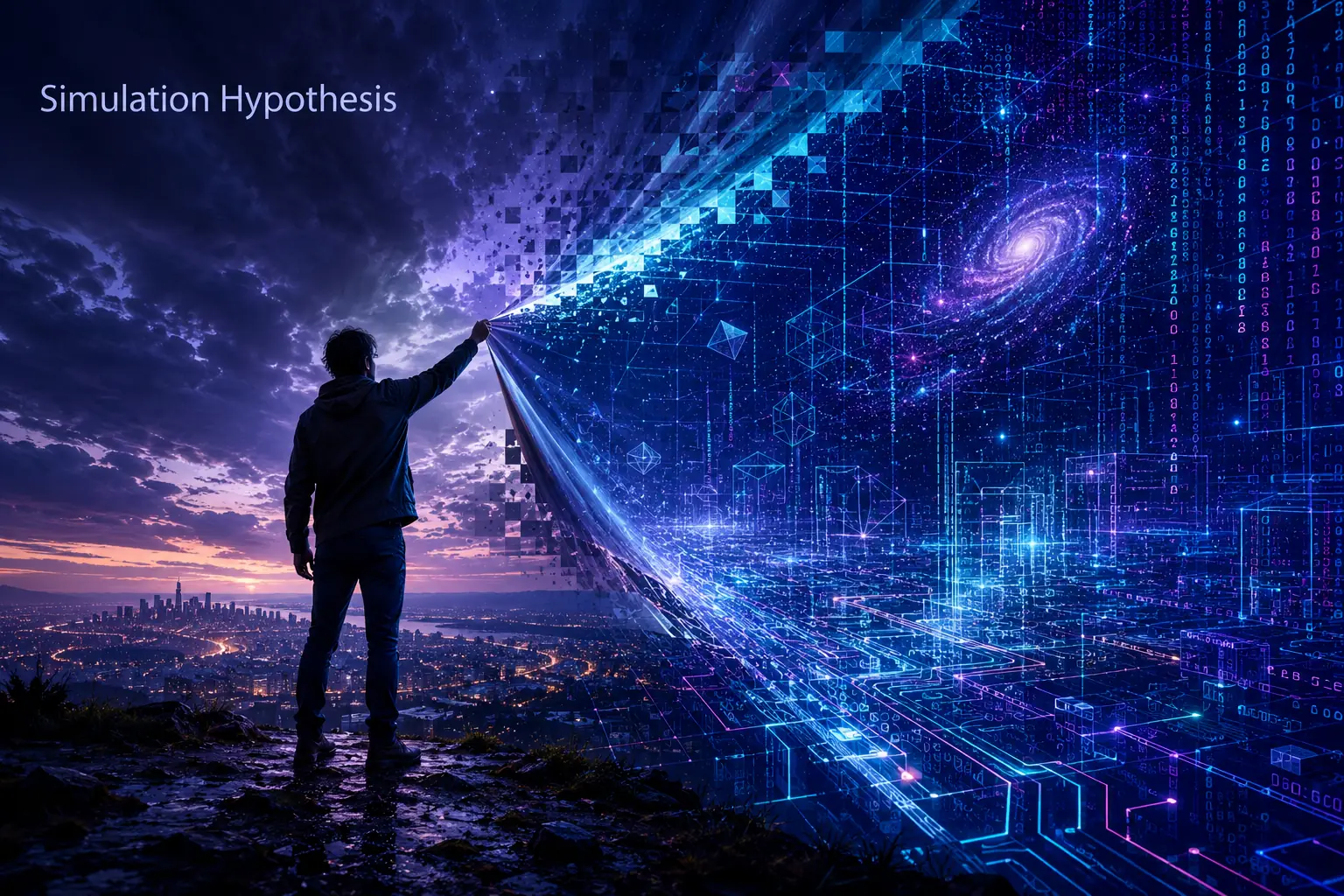
The simulation hypothesis proposes that experienced reality could be a computational simulation created by a technologically advanced civilization. Its best-known formulation is a trilemma: either civilizations fail before gaining immense computing power, they decline to run ancestor simulations, or simulated minds greatly outnumber biological ones.
The argument is philosophical rather than evidence of simulation, and depends on uncertain assumptions about consciousness, computation, and future behavior.
In the autumn of 2001, Nick Bostrom was a philosophy lecturer at Yale working through an idea that had been nagging him for years.
The problem was deceptively simple: if a civilization ever develops computing power vast enough to run detailed simulations of minds, and if it actually runs such simulations, then the number of simulated minds would eventually dwarf the number of biological minds by any plausible count.
There might be millions of simulated histories for every one real history.
And if that is so, the prior probability that any particular mind - yours, mine, anyone's - is biological rather than simulated drops to something close to zero. The argument was not science fiction. It was probability theory applied to the future of computation.
Bostrom polished the argument into a paper and submitted it to the Philosophical Quarterly, where it appeared in 2003 under the title "Are You Living in a Computer Simulation?" It became one of the most discussed philosophy papers of the twenty-first century, cited by physicists, computer scientists, and two prominent Silicon Valley billionaires who reportedly each hired philosophers to advise them on whether the hypothesis was true.
What made the paper land so hard was not that it proved anything. It did not. What it did was construct a logical structure so tight that the only escape routes were themselves radical claims: either almost every technological civilization destroys itself before acquiring sufficient computing power, or almost every sufficiently advanced civilization loses all interest in running simulations of its own past.
If neither of those things is true, then we are almost certainly in a simulation.
You cannot accept the premises and reject the conclusion without accepting one of the escape routes. The paper launched a thousand Silicon Valley obsessions, a cottage industry of academic responses, a feature film or two, and a genuine philosophical debate that has not been resolved.
It also reconnected contemporary analytic philosophy to one of its oldest problems: how do we know that what we perceive corresponds to anything real?
The roots of that question go back at least to Descartes, who in his Meditations of 1641 entertained the hypothesis that a supremely powerful evil demon might be systematically deceiving him about everything - the existence of the external world, the reliability of mathematics, even the evidence of his senses.
Descartes used this thought experiment to strip away every uncertain belief until he reached the one thing the demon could not deceive him about: the fact of his own thinking.[4]
The simulation hypothesis is the evil demon updated for the age of computation. Where Descartes imagined a supernatural deceiver, Bostrom imagines a posthuman civilization running software.
"It may be that simulated people are conscious, and if so, their experiences are as real as ours. Simulated or not, the question of how to live well remains." - David Chalmers, Reality+ (2022)
Key Definitions
The simulation hypothesis is the philosophical proposition that our experienced reality is a computational simulation created and run by a more technologically advanced civilization.
Substrate independence is the thesis that consciousness does not depend on being implemented in biological neurons - that any physical system of sufficient computational complexity could support conscious experience, whether built from silicon, carbon, or some other material.
The original position (in this context) refers to base reality - the non-simulated physical universe in which the simulators themselves exist, as opposed to the simulated universes they create.
Ancestor simulation is a simulation of beings similar to the simulators at an earlier stage of their civilization's development - the specific type of simulation Bostrom's argument focuses on, because it is the type most plausibly motivated by historical curiosity.
Post-human status refers to a civilization that has surpassed its current biological limitations through technology to a degree that gives it qualitatively new capabilities, including vast computational resources.
The Boltzmann brain is a hypothetical minimal conscious observer that arises through random quantum or thermodynamic fluctuation in a sufficiently large universe, rather than through biological evolution.
The Bekenstein bound is a theoretical upper limit on the information that can be contained within a given finite region of space with a given amount of energy, derived from black hole thermodynamics.
Responses to the Simulation Hypothesis
| Position | Core claim | Main argument | Key proponents | Main objection |
|---|---|---|---|---|
| Bostrom's trilemma (neutral) | At least one of three propositions must be true: extinction before simulation; no interest in simulating; we are simulated | Probability argument: if simulations are run, simulated minds dwarf biological ones | Nick Bostrom (2003) | All three disjuncts rest on deeply uncertain empirical premises |
| We probably are simulated | If even a fraction of civilizations simulate ancestors, probability of being biological is near zero | Accepts premises; concludes we are almost certainly simulated | Some interpretations of Bostrom; Elon Musk ("billions to one" claim) | No evidence; rests on contested assumptions about computational consciousness and civilizational behavior |
| We are almost certainly not simulated | Conscious experience may require biological implementation; or computational complexity for a full simulation may exceed any physical system | Limits on substrate independence; energy/physics arguments | Penrose (consciousness non-computational); Sabine Hossenfelder | Cannot rule out powerful enough substrate; consciousness requirements uncertain |
| Physical constraints refute it | A perfect simulation of a universe requires at least as many bits as the universe contains; no finite system can simulate itself | Bekenstein bound; information-theoretic arguments about physical computation limits | Several physicists including Seth Lloyd | Perfect simulation not required; approximate simulation of conscious experience much cheaper |
| Philosophical deflation | Even if true, the simulation hypothesis changes nothing about ethics, meaning, or how to live | If simulated experiences are real experiences, their moral weight is unchanged | David Chalmers, Reality+ (2022) | Does not address whether we can or should care about the question |
| Empirical test proposals | Find characteristic "glitches" or computational artifacts in physical laws | Cosmic ray spectrum anomalies; lattice QCD signatures | Silas Beane et al. (2012) | Artifacts would also be present in base reality if it too is simulated; unfalsifiable |
Bostrom's Trilemma: The Argument in Full
The 2003 paper argues that at least one of three propositions must be true. Bostrom calls them the three disjuncts, and the structure of the argument is that we cannot coherently deny all three simultaneously.
The first disjunct is that virtually all civilizations at our level of technological development go extinct before reaching post-human status.
This is the great filter hypothesis applied to computing power: perhaps every civilization that might build ancestor simulations first destroys itself through nuclear war, engineered pandemics, climate collapse, misaligned artificial intelligence, or some hazard we have not yet identified.
If this is true, the simulation question dissolves because the simulations never get built.
This disjunct is consistent with the apparent emptiness of the universe - the Fermi paradox - though it is a grim consistency.
The second disjunct is that virtually all post-human civilizations, even those with the computing resources to run ancestor simulations, choose not to do so. Perhaps their interests have diverged so radically from biological human concerns that curiosity about their evolutionary past holds no appeal.
Perhaps they have ethical scruples about creating simulated beings capable of suffering. Perhaps the economics of simulation - even for a post-human civilization - remain prohibitive relative to other uses of computational resources.
This disjunct is harder to assess because it requires predictions about the psychology and ethics of beings we cannot imagine.
The third disjunct is the one that grips the imagination: we are almost certainly living in a computer simulation.
If even a modest fraction of post-human civilizations runs ancestor simulations, and if each such civilization runs many simulations, then the total count of simulated minds vastly exceeds the count of biological originals.
Conditional on being a conscious being in this scenario, the prior probability of being biological approaches zero.
What "Simulation" Actually Means
It is worth being precise about what the hypothesis claims. It does not claim that our universe is a crude or impoverished imitation of something richer.
The simulation hypothesis is compatible with our universe being computed with perfect fidelity, quantum mechanics and all - or with it being computed only at the resolution needed to maintain coherent experience in the simulated minds, with deeper detail generated on demand (like lazy evaluation in programming, where computations are deferred until needed).
The hypothesis depends critically on substrate independence: the claim that a mind is constituted by its patterns of information processing, not by the specific material that implements those patterns.
If consciousness is purely physical and requires exactly the biochemical structure of biological neurons, the simulation hypothesis fails immediately, because digital computers cannot implement that specific substrate.
But if the patterns matter more than the medium - if what makes a mind is its functional organization rather than its material composition - then a sufficiently detailed digital simulation of a brain would be conscious in the same sense that a biological brain is conscious.
This is why the simulation hypothesis is deeply entangled with the philosophy of mind.
The most serious physical arguments against it concern quantum mechanics: Zohar Ringel and Dmitry Kovrizhin published a 2017 paper in Science Advances showing that classical simulation of quantum many-body systems requires computational resources that grow exponentially with system size, making a full quantum simulation of our universe on classical hardware essentially impossible.
Defenders of the hypothesis typically respond that the simulators might use quantum computers, or that the universe need not be simulated at the quantum level everywhere - only in regions where conscious observers are actually observing.
The Fine-Tuning Connection
One of the more striking features of our universe is that its physical constants appear exquisitely calibrated for the existence of complex structure.
The cosmological constant (the energy density of empty space) is approximately 10^120 times smaller than quantum field theory predicts it should be - a discrepancy so enormous it is called the worst prediction in the history of physics.
The strength of the strong nuclear force, the mass ratio of protons to electrons, the value of the electromagnetic coupling constant - change any of them by small amounts, and stars do not form, chemistry does not happen, or matter is unstable.
The universe looks, in physicist Freeman Dyson's phrase, like it somehow knew we were coming.
The mainstream scientific response to fine-tuning is the anthropic principle combined with the multiverse: if there are many universes with different physical constants, and we can only observe universes compatible with our existence, then naturally we find ourselves in a compatible one. No design is required; selection does the work.
The simulation argument offers a different response. If our universe was created by a posthuman civilization, the fine-tuning is easy to explain: the simulators set the constants to produce interesting complexity, including conscious observers.
This is a form of intelligent design argument, but with human-like simulators instead of divine ones.
Max Tegmark's Mathematical Universe Hypothesis takes yet a different approach, arguing that all mathematically consistent structures exist as physical realities - fine-tuning is not mysterious because every possible universe exists, and we are in one of the subset that allows for observers.
These responses are not mutually exclusive, and none of them is empirically testable in any direct sense, which is part of what makes the fine-tuning problem so philosophically rich.
The Consciousness Objection: Can Computation Think?
The simulation hypothesis stands or falls partly on whether computation can give rise to genuine consciousness. The philosopher John Searle famously argued in his 1980 Chinese Room thought experiment that it cannot.
Imagine a person locked in a room, receiving Chinese characters through a slot, consulting a rulebook that tells them which characters to write in response, and passing their responses back through the slot. From outside, the room appears to understand Chinese.
From inside, the person understands nothing - they are manipulating symbols according to syntactic rules with no semantic comprehension.
Searle argued that digital computers are the room, not the person inside it: they process symbols according to formal rules but do not understand what those symbols mean.[3] Syntax, in his view, is not sufficient for semantics.
Functionalists and most cognitive scientists reject Searle's argument, typically on the grounds that the relevant level of description is the whole system (the room plus its rules, operating as a whole), not the person inside it.
David Chalmers, who is sympathetic to the simulation hypothesis, distinguishes the easy problems of consciousness (explaining cognitive functions like attention, memory, and report) from the hard problem (explaining why there is subjective experience at all, why something is like something).
He argues that substrate independence is compatible with the hard problem remaining unsolved - a simulated brain might be conscious for precisely the same reasons a biological brain is, whatever those reasons turn out to be.
If Searle is right and computation does not produce genuine consciousness, then the simulation hypothesis is less worrying (simulated minds would not actually be experiencing anything) but also less coherent (there would be nothing it is like to be a simulated ancestor, making ancestor simulations pointless).
The hypothesis seems to require that computation can produce genuine experience.
Elon Musk, Silicon Valley, and the Popularization of a Thought Experiment
The simulation hypothesis migrated from academic philosophy into popular culture with unusual speed. Elon Musk stated at the 2016 Code Conference that the probability we are in base reality is "one in a billion" - a claim that attracted both ridicule and earnest amplification.
Musk's reasoning was essentially a restatement of Bostrom's third disjunct: given how rapidly video game graphics have improved, future civilizations will be able to run simulations indistinguishable from reality, and given how many such simulations might be run, the ratio of simulations to base reality is overwhelming.[1]
The philosopher David Chalmers took a more careful approach in his 2022 book Reality+, the most comprehensive philosophical treatment of the hypothesis to date.
Chalmers distinguishes between simulation skepticism (the view that a simulated reality is not real reality) and virtual realism (the view that simulated reality is fully real, just implemented differently).[5]
His argument for virtual realism: if you live in a simulated world and interact with simulated objects, those objects are real objects - they have real causal powers, they persist through time, they behave according to consistent laws. The substrate does not determine the ontology.
This connects to older philosophical debates about idealism (the view that reality is fundamentally mental) and phenomenology (the view that lived experience is the primary datum of philosophical investigation).
Whether the electrons in your brain are made of carbon or silicon is, on this view, irrelevant to the reality of your experience.
Descartes' Demon and the Limits of Skepticism
Ren Descartes' evil demon hypothesis was not intended as a serious metaphysical claim; it was a methodological device for radical doubt. By imagining a powerful deceiver, Descartes found the floor of certainty: his own existence as a thinking thing.
The simulation hypothesis is structurally identical but more technically specific. Like the evil demon, it posits that the entire apparent external world might be fabricated. Unlike the evil demon, it proposes a mechanism (computation) and a motivation (curiosity about one's own evolutionary past).
The philosophical lesson Descartes drew - that we can be certain of our own existence but not of much else - applies equally to the simulation hypothesis. Even granting that we might be simulated, we cannot doubt the phenomenal character of our experience.
We experience red as red, pain as pain, love as love. Whether these experiences are implemented in biological or digital substrate does not alter their character from the inside. This is Chalmers' point, and it provides a kind of existential insurance against the more nihilistic reading of the hypothesis.[2]
The nested simulation problem adds a further complication: if our universe is a simulation run by a posthuman civilization, what prevents that civilization's universe from being a simulation run by a civilization more advanced still? In principle, simulations can be nested arbitrarily deep.
This creates an infinite regress that some philosophers find suspicious (infinite regresses rarely lead to satisfying explanations) and others find perfectly acceptable (the regress simply means there is no bottom to reality).
The theological resonances are obvious: the nested simulation hypothesis looks structurally similar to the cosmological argument for God, with "the next level up" playing the role of the uncaused cause.
The Boltzmann Brain Problem and the Size of Simulations
One underappreciated challenge for the simulation hypothesis comes from statistical mechanics. In the late nineteenth century, Ludwig Boltzmann recognized that in a universe governed by probabilistic thermodynamic laws, rare fluctuations would occasionally assemble complex structures spontaneously.
A sufficiently large and old universe - or a universe in a high-entropy equilibrium state - would eventually fluctuate into producing a momentary brain, complete with false memories of a lifetime, before quickly dissolving back into disorder.
These are Boltzmann brains, and they pose a foundational problem for cosmology: if such brains are physically possible, do they outnumber evolved biological brains? And if so, what does that tell us about what we should expect ourselves to be?
For simulation theory, the Boltzmann brain problem takes a specific form. A simulator wanting to create conscious experience does not need to simulate an entire cosmos of 100 billion galaxies spanning 13.8 billion years of history.
They could simulate just enough to maintain coherent perceptual experience in the target minds - a few cubic meters of environment, rendered on demand. This would be astronomically cheaper than simulating everything we observe.
So if we are in a simulation, why is our observable universe so large? The most computationally parsimonious simulation would be much smaller and stranger.
Defenders of the hypothesis offer several responses. The simulators might have goals we cannot anticipate - perhaps running a large simulation is computationally cheap for them relative to their resources. Perhaps running a smaller simulation would produce detectable artifacts that a conscious observer could notice and investigate.
Or perhaps the apparent size of the universe is itself a simulated appearance, with only the locally relevant portions actually computed in detail.
Practical Implications: Does It Matter?
If the simulation hypothesis were confirmed tomorrow, what would change? Less than we might think, Chalmers argues. The laws of physics inside the simulation would still apply; the simulation would not suddenly become any less regular or predictable.
Other people would still have experiences; the moral obligations we have toward them would not be diminished. Our relationships, creative work, and suffering would all be equally real in the sense that matters: they would have real phenomenal character and real causal consequences within our world.
What would change is our cosmological picture. We would know that our universe had a creator - or rather, a programmer - and that creator had goals that may or may not align with our welfare. The simulation could be altered or terminated. The laws of physics could, in principle, be patched.
This is simultaneously alarming and, as Chalmers notes, theologically familiar: it is essentially the position of someone who believes in a creator god who could intervene in the world, constrained only by the god's interest in maintaining the simulation's coherence.
The practical irrelevance of the hypothesis for everyday life is actually one of the main arguments Chalmers marshals for not worrying about it.
If you cannot tell the difference, and if your values and relationships retain their significance regardless, then the metaphysical question of substrate becomes less pressing than the ethical question of how to live.
This returns to Descartes' original lesson: even in the midst of radical uncertainty about the nature of reality, the project of living well persists.
Related Articles
For more on the nature of consciousness and whether it can be substrate-independent, see how consciousness works. For background on quantum mechanics and why simulating it poses computational challenges, see what is quantum mechanics.
For the broader question of what makes a life meaningful regardless of its metaphysical status, see what is the meaning of life.
Sources & Further Reading
- Bostrom, N. (2003). Are you living in a computer simulation? Philosophical Quarterly, 53(211), 243-255. DOI: 10.1111/1467-9213.00309
- Chalmers, D. J. (2022). Reality+: Virtual Worlds and the Philosophy of Mind. W. W. Norton.
- Searle, J. R. (1980). Minds, brains, and programs. Behavioral and Brain Sciences, 3(3), 417-424. DOI: 10.1017/S0140525X00005756
- Descartes, R. (1641). Meditations on First Philosophy. (J. Cottingham, Trans., 1996). Cambridge University Press.
- Chalmers, D. J. (1996). The Conscious Mind: In Search of a Fundamental Theory. Oxford University Press.
Further Reading
- Ringel, Z., & Kovrizhin, D. L. (2017). Quantized gravitational responses, the sign problem, and quantum complexity. Science Advances, 3(9), e1701758. DOI: 10.1126/sciadv.1701758
- Tegmark, M. (2007). The mathematical universe. Foundations of Physics, 38(2), 101-150. DOI: 10.1007/s10701-007-9186-9
- Nozick, R. (1974). Anarchy, State, and Utopia. Basic Books.