
Design thinking is one of the most influential frameworks in business and product development, and one of the most frequently misunderstood. In some organizations it has become a buzzword applied indiscriminately to any collaborative workshop.
In others it has produced genuine breakthroughs. The difference lies in understanding what design thinking actually is, when it works, and when it does not.
What Is Design Thinking?
Design thinking is a human-centered approach to problem-solving that begins with deep understanding of the people a solution will affect, before generating or committing to ideas.
The key word is "before." Traditional problem-solving often starts from existing solutions, assumed constraints, or expert judgment.
Design thinking starts from observation: spending time with the people experiencing the problem to understand their actual behavior, frustrations, workarounds, and needs, many of which may be invisible to outside observers.
The approach was formalized by the Hasso Plattner Institute of Design at Stanford (known as the d.school), founded in 2004 by David Kelley, the founder of the design consultancy IDEO.
IDEO had been practicing a version of human-centered design since the 1970s under the influence of Kelley and Tim Brown, whose 2009 book Change by Design remains the most widely read articulation of the approach.
"Design thinking is a human-centered approach to innovation that draws from the designer's toolkit to integrate the needs of people, the possibilities of technology, and the requirements for business success." (Tim Brown, IDEO)
Design thinking is not exclusively for designers. Its practitioners include product managers, educators, healthcare administrators, engineers, urban planners, and policy makers. The framework is domain-agnostic; what it requires is a willingness to treat the problem as not yet fully understood.
The approach has spread substantially beyond product design. A 2015 survey by Forrester Research found that 59% of design-led companies had achieved above-average revenue growth in the prior three years.
McKinsey & Company's McKinsey Design Index (2018), tracking 300 companies over five years, found that the top quartile of design-oriented companies outperformed industry benchmarks by as much as 32% in revenue growth and 56% in total return to shareholders.
These correlations do not establish causation (companies with strong design practices may also have other advantages), but they suggest that the human-centered orientation of design thinking is not merely a process preference but a performance differentiator.
The Stanford d.school Five-Stage Model
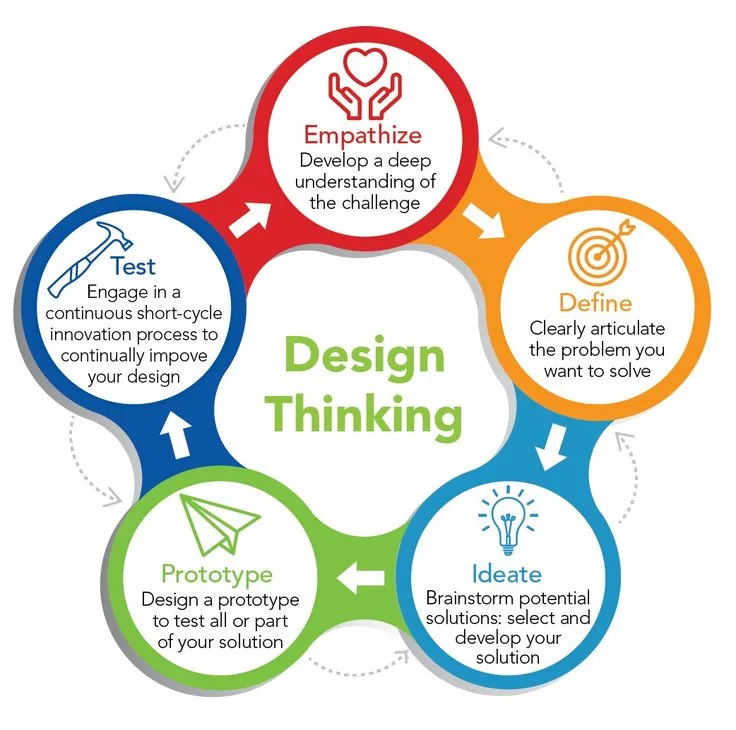
The most widely taught version of design thinking comes from Stanford's d.school and describes five iterative stages:
| Stage | Core Question | Key Activities |
|---|---|---|
| Empathize | Who are we designing for, and what do they actually experience? | Field observation, interviews, shadowing, immersion |
| Define | What is the real problem we are solving? | Affinity mapping, insight synthesis, "How might we..." framing |
| Ideate | What are all the possible solutions? | Brainstorming, SCAMPER, worst idea method, crazy eights |
| Prototype | What does this idea look like in tangible form? | Paper mockups, role-play, storyboards, low-fi models |
| Test | What do real users do with this? | User testing, feedback sessions, observation, iteration |
These stages are not a waterfall. They are described as iterative: insights from testing frequently send teams back to the empathize or define stage. The process is deliberately non-linear because problems rarely reveal their full complexity until partial solutions are tested.
The non-linearity is not a weakness: it is the point. Wicked problems, a term coined by design theorist Horst Rittel and urban planner Melvin Webber in a 1973 paper in Policy Sciences, are problems that cannot be fully defined without attempting solutions, where each attempted solution changes the understanding of the problem, and where there is no definitive stopping point.
Most meaningful human and organizational challenges are wicked problems. Design thinking's iterative structure is explicitly adapted to this class of challenge.
Stage 1: Empathize
The empathize stage is where design thinking most sharply departs from conventional problem-solving. Rather than starting with the known problem statement, practitioners spend time in the world of the people they are designing for.
Methods used in the empathize stage:
- Observation in context: Watching how people actually behave in the relevant setting, rather than how they report they behave when asked
- User interviews: Conversational interviews focused on stories and experiences rather than opinions and preferences
- Immersion: Living through the user's experience: healthcare designers spending time as patients, school designers spending a day as a student
- Empathy maps: Visual tools for capturing what a person says, thinks, feels, and does in a given situation
The distinction between what people say and what people do is central to this stage. Users reliably misreport their own behavior in surveys and interviews, not through deception but because the gap between conscious memory and actual behavior is well-documented in cognitive psychology. Direct observation is more reliable than self-report.
This gap was formalized in social psychology as the intention-behavior gap (Sheeran, 2002, European Review of Social Psychology), the finding that stated intentions to act predict actual behavior at a level far below what people assume.
In product design, this manifests as users who report they would pay for a feature they never actually use, or who say they find an interface easy while being observed struggling with it.
Design thinking's emphasis on ethnographic observation is a direct methodological response to this well-documented cognitive phenomenon.
Herbert Simon, the Nobel Prize-winning economist and cognitive scientist, argued in The Sciences of the Artificial (1969) that design is fundamentally about transforming existing situations into preferred ones, but that you cannot define the preferred situation without understanding the existing one from the inside.
The empathize stage operationalizes Simon's insight.
Stage 2: Define
The define stage synthesizes the observations from the empathize phase into a clear, actionable problem statement. In design thinking, this statement is typically framed as a "How might we..." (HMW) question, a formulation developed at Procter and Gamble in the 1970s and popularized by IDEO.
The HMW framing is deliberate: "How" implies the problem is solvable, "might" implies there are multiple possible approaches, and "we" positions the team as collaborators rather than individual experts.
Example transformation:
Observation: Patients in hospital waiting rooms consistently report feeling anxious and uninformed about how long they will wait and what will happen next.
Insight: Anxiety in waiting is less about the wait itself and more about the absence of information and a sense of control.
HMW statement: How might we give patients a sense of agency and information flow while they wait?
This is a meaningfully different problem to solve than "How might we shorten wait times?", and it opens up a different, broader solution space.
The define stage also typically produces a point of view (POV) statement, structured as: "[User] needs [need] because [insight]." The structure forces teams to specify who they are designing for, what fundamental need they are addressing, and what insight makes that need intelligible.
It is a check against the common failure mode of designing for a hypothetical average user who does not actually exist.
Stage 3: Ideate
Ideation is the phase most associated in popular culture with design thinking: the post-it-note-covered wall, the brainstorming session. But effective ideation is more structured than its image suggests.
Key principles of productive ideation:
Defer judgment. The purpose of ideation is to generate quantity and diversity of ideas before evaluation. Premature criticism of ideas, including self-criticism, reliably narrows the solution space toward the familiar.
Alex Osborn, the advertising executive who coined "brainstorming" in his 1953 book Applied Imagination, articulated deferred judgment as the foundational rule of effective group creativity.
Go for volume. Research on brainstorming supports the principle that large volumes of ideas produce a higher probability of excellent ones. Nobel laureate Linus Pauling reportedly said, "The best way to have a good idea is to have lots of ideas." The practical goal is generating dozens of ideas before evaluating any.
Encourage wild ideas. Ideas that initially seem absurd sometimes contain an insight that becomes practical when refined. The "worst idea" method (deliberately generating the most problematic possible solution) often surfaces assumptions and constraints that were previously invisible.
Build on others' ideas. In group ideation, the "yes, and..." principle from improvisational theater encourages participants to extend and develop each other's ideas rather than evaluating them.
Common ideation methods include traditional brainstorming, SCAMPER (Substitute, Combine, Adapt, Modify, Put to other uses, Eliminate, Reverse), Crazy Eights (sketching eight ideas in eight minutes), and analogous inspiration (looking at how similar problems are solved in entirely different domains).
The analogous inspiration approach, asking "how does a hospital solve the problem of moving people efficiently?" when designing a theme park queue, is particularly powerful for breaking out of domain-specific constraints.
Stage 4: Prototype
Prototyping is the act of making ideas tangible before investing in full development. The design thinking principle is to build early, often, and cheaply: to fail fast at low cost rather than fail slowly at high cost.
A prototype does not need to be functional. Its purpose is to make an idea concrete enough to test with real users. Prototypes can be:
- Paper mockups (interfaces drawn on paper)
- Storyboards (illustrated sequences showing how a service unfolds)
- Role-play simulations (acting out a service interaction)
- 3D printed or foam models (physical products)
- Wizard of Oz prototypes (simulated digital experiences backed by manual human processes)
The critical principle is low fidelity at early stages. High-fidelity prototypes invite evaluation of polish rather than concept; low-fidelity prototypes signal that feedback is welcome and expected.
Research by Bill Buxton (Sketching User Experiences, 2007) shows that hand-drawn interfaces generate more candid feedback than polished mockups because users are less reluctant to criticize something that obviously took no time to make.
IDEO co-founder Tom Kelley articulated this as the "fail early to succeed sooner" principle, an idea that has since spread widely into software development through the Lean Startup movement.
Eric Ries, in The Lean Startup (2011), described the minimum viable product (MVP) as essentially a prototype in the design thinking sense: the least-effort artifact that enables a genuine test of a product hypothesis with real users.
The cost calculus matters enormously here. McKinsey estimates that fixing a design flaw found during prototyping costs roughly 1/100th as much as fixing the same flaw after product launch.
IBM's data on software development (Fagan, 1976, IBM Systems Journal) showed that the cost of correcting errors grows exponentially the later in development they are caught.
Early-stage prototyping is not just a philosophical commitment to human-centeredness: it is straightforwardly economical.
Stage 5: Test
Testing in design thinking is not quality assurance. It is a learning activity: the goal is not to validate that a prototype works but to discover what is wrong with it, what is misunderstood by users, and what needs to change.
Effective testing involves observing users interacting with prototypes without providing instructions or correction. The natural tendencies of a user encountering a prototype (where they look first, what confuses them, what delights them) are more informative than their stated opinions.
Key principles:
- Observe more than ask. Watching what users do is more reliable than asking what they think.
- Test with the right people. Prototypes should be tested with people who represent the actual user population, not colleagues or other designers.
- Look for surprises. Unexpected behavior or confusion is high-value signal, not failure.
- Build feedback into the prototype process. A testing session should end with a clear identification of what to change in the next iteration.
Jakob Nielsen's foundational usability research (Nielsen, 1993, Usability Engineering) found that five test users uncover approximately 85% of usability problems, a finding that argues for frequent small-scale testing over occasional large-scale testing.
Five users discovering 85% of problems is dramatically more cost-effective than waiting to test with 100 users after the product is built.
Design Thinking in Practice: Real Examples
IDEO and the Shopping Cart (1999)
The most famous design thinking case study was filmed for ABC's Nightline in 1999. IDEO was given five days to redesign the shopping cart. Rather than beginning with the existing design, the team spent the first day observing shoppers and store workers with actual shopping carts.
They found: carts were stolen frequently; carts were hard to maneuver for one-handed shoppers; children fell out of seating; and store workers had persistent issues with cart retrieval.
These observations drove the eventual design: modular cart baskets that reduced theft incentive, improved maneuverability, dedicated child seating with safety features, and easier nesting for retrieval.
The process, and not just the product, became influential because it demonstrated that observable user behavior, not designer assumption, was the productive starting point.
Bank of America: Keep the Change (2005)
Bank of America partnered with IDEO to develop new financial products for mass market customers. Researchers observed that people naturally rounded up their spending when tracking expenses in notebooks, writing $20 for a $19.43 transaction, for example.
This behavioral insight became the basis for Keep the Change, a program that rounded every debit card purchase to the nearest dollar and transferred the difference to a linked savings account. The program required no behavioral change from users: it worked with existing habits rather than against them.
Within the first year, 2.5 million customers enrolled. By 2013, the program had enrolled 12 million customers and transferred over $2 billion in savings. It is a textbook example of design thinking generating insight that financial product developers working from assumptions would not have reached.
Healthcare: Mayo Clinic SPARC Lab
Mayo Clinic established the SPARC innovation lab (See, Plan, Act, Refine, Communicate) to apply design thinking to healthcare delivery. Early projects focused on the patient experience of hospital admission, an area where patient anxiety is high and dissatisfaction common.
Observation research revealed that patients' anxiety during admission was less about the medical procedures than about the absence of information and perceived agency.
The insights led to redesigned waiting spaces with better visual orientation, proactive information updates, and patient communication tools that gave people clearer expectations about next steps.
The outcomes were measured: patient satisfaction scores improved measurably, and the model was extended to outpatient and discharge processes.
The Mayo Clinic approach has since been adopted as a model by health systems globally, demonstrating that design thinking is applicable in domains, medicine and complex institutional services, where it might seem counterintuitively removed from product design.
IBM Design Thinking at Enterprise Scale
IBM's adoption of design thinking from 2012 onward represents the largest-scale organizational implementation of the framework in corporate history. By 2016, IBM had trained over 100,000 employees in design thinking principles and embedded designers in every product team.
Forrester Consulting's 2018 study of IBM's design thinking practice found that teams using it produced products twice as fast, required 75% fewer meetings, and saw a 301% return on investment compared to baseline.
The IBM case also illustrates how design thinking scales differently in large organizations.
IBM developed its own adaptation, IBM Enterprise Design Thinking, that added concepts of hills (ambitious user outcomes), playbacks (alignment checkpoints), and sponsor users (designated real users embedded in product development) to address the specific challenges of large-team coordination that the original d.school model did not address.
Design Thinking vs. Agile
A common question is how design thinking relates to Agile, the iterative software development methodology that has become dominant in technology companies.
They address different problems and are best understood as complementary, not competing.
| Dimension | Design Thinking | Agile |
|---|---|---|
| Primary question | What should we build? | How do we build it efficiently? |
| Phase | Upstream (discovery and validation) | Downstream (development and delivery) |
| Time unit | Days to weeks per sprint/phase | 2-week sprints |
| Failure mode addressed | Building the wrong thing | Building the right thing slowly or inconsistently |
| Key output | Validated problem statement and direction | Working software, delivered incrementally |
| User involvement | Intensive (observation, interviews, testing) | Periodic (sprint reviews, user stories) |
| Origin | IDEO, Stanford d.school, 1970s-2000s | Agile Manifesto, software industry, 2001 |
In practice, many effective product organizations run design sprints (a time-compressed version of design thinking developed by Jake Knapp at Google Ventures and described in his 2016 book Sprint) to validate product directions before entering Agile development.
The five-day design sprint compresses all five d.school stages into a single work week, producing a tested prototype rather than a specification document. Knapp's method has been used at Google, Slack, Airbnb, and hundreds of other organizations as a standard precursor to development sprints.
The integration has become standard enough that product design practices now routinely distinguish a "double diamond" model: discovery and definition (design thinking) followed by development and delivery (Agile), as the standard lifecycle for user-facing software products.
When Design Thinking Works (and When It Doesn't)
When Design Thinking Is Most Effective
- Problems that are poorly understood: When the real problem is hidden behind the stated one, empathetic observation consistently surfaces different and better problem definitions.
- User-facing products and services: Any context where human behavior, preference, and experience are central to the quality of the outcome.
- Organizational change initiatives: When employees are the "users" and their actual workflow and resistance needs to be understood before a change program is designed.
- Early-stage innovation: When the goal is to explore a solution space before committing to a direction.
- Cross-functional alignment: The process of working through empathy and definition together produces shared understanding that reduces later disagreement about priorities.
When Design Thinking Is Less Effective or Misapplied
- Well-defined technical problems: If the problem and solution space are already well understood, design thinking adds process overhead without insight.
- Highly regulated environments: Medical devices, pharmaceutical development, aviation safety: domains where rapid prototyping and failure tolerance are constrained by regulation and patient safety requirements.
- Complex systemic problems: Design thinking critic Natasha Iskander argued in the Harvard Business Review (2018) that design thinking, by framing problems as design challenges solvable by better user experience, can deflect attention from structural causes of social problems that require policy or institutional change rather than product redesign. A food desert is not primarily a design problem; it is a structural economic one.
- Organizations without implementation authority: Design thinking generates insights that require organizational action. When workshop participants cannot act on their findings, the process produces reports rather than change.
The "Empathy Theater" Problem
Perhaps the most commonly cited failure mode is what practitioners call empathy theater: conducting user research that goes through the motions of observation and interviewing but is structured in ways that confirm rather than challenge existing assumptions.
Signs of empathy theater include:
- Interviewing only users who represent the design team's image of the target user
- Stopping observation when contradictory evidence emerges
- Conducting interviews after the solution direction has already been decided
- Treating empathy as a one-time phase rather than an ongoing orientation
Rikke Friis Dam and Teo Yu Siang of the Interaction Design Foundation (2018) identify empathy theater as one of the three most common design thinking failures, alongside premature convergence (settling on a solution direction before adequate exploration) and prototype attachment (becoming emotionally invested in a specific prototype rather than treating it as a disposable learning artifact).
Why Design Thinking Has Endured
Despite criticisms, and there are legitimate ones, design thinking has proven durable because it addresses a genuine and persistent failure mode in how organizations solve problems: the assumption that the problem, as initially stated, is the real problem.
The insight that users know things about their own experiences that experts cannot assume, and that building things for people to react to is more productive than asking people to imagine things they have never seen, is well-supported by decades of research in cognitive psychology, human-computer interaction, and organizational behavior.
Don Norman, whose book The Design of Everyday Things (1988, revised 2013) is the foundational text of user-centered design, articulated the underlying principle with characteristic directness: "It is the duty of machines and those who design them to understand people.
It is not our duty to understand the arbitrary, meaningless dictates of machines." Norman's human-centered design principles, visibility, feedback, constraints, mappings, affordances, and conceptual models, inform the empathize and define stages of design thinking directly.
The framework is imperfect and often misapplied. But the underlying orientation, start with people, stay close to reality, fail cheap before failing expensively, has earned its place as a foundational approach to any problem where human behavior is central to the outcome.
As the range of domains where human-centered design is being applied expands, from physical products to software interfaces to healthcare delivery to public policy, the core discipline of observing before assuming, defining before ideating, and testing before launching becomes more rather than less relevant.