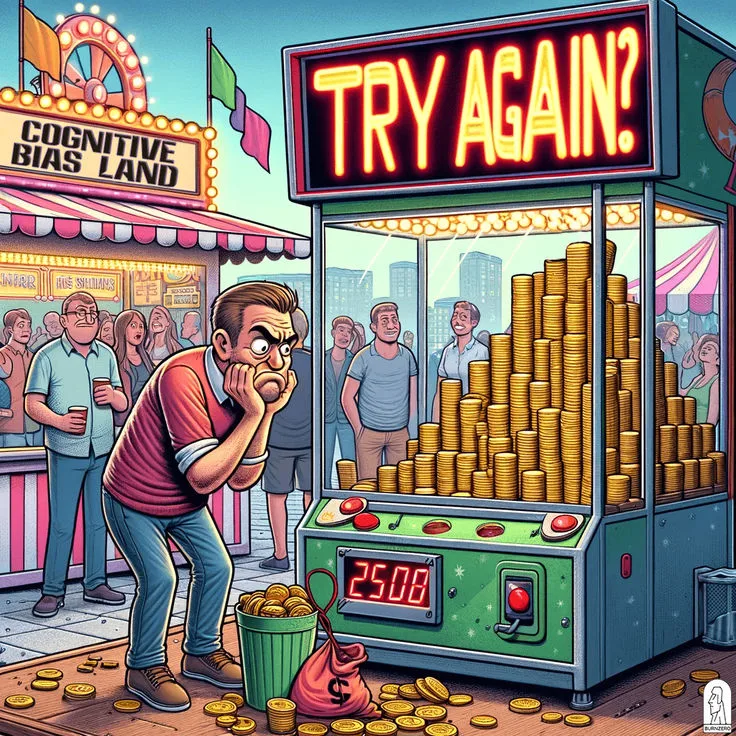
Past money, time, and effort cannot be recovered, so they should not determine whether a future course is worth continuing. The sunk cost fallacy instead treats further commitment as a way to redeem an earlier loss. Loss aversion, effort justification, and self-image can make withdrawal feel painful, even when the remaining costs outweigh the remaining benefits.
You have sat through a film for an hour, and it is plainly terrible. The rational thing is to leave; your evening is the only thing still in your power. Yet you stay, because you already paid for the ticket.
You keep a stock that is falling because you bought it higher. You finish a meal you stopped enjoying three bites ago because you ordered it.
In each case the logic is identical and identically broken: you are letting money, time, or effort that is already gone, and can never come back, dictate a decision that should be governed only by what happens next. This is the sunk cost fallacy, one of the most stubborn and expensive errors the human mind makes.
The peculiar thing is that the fallacy survives full knowledge of it. People who can define it perfectly still finish the bad book, stay in the dead relationship, and pour another year into the failing project. It is not ignorance; it is a deep feature of how we feel about loss, commitment, and our own past choices. Understanding why is a small act of mental self-defense.
“The economically correct way to think about previously incurred costs is to ignore them. But few people are able to do this in their everyday lives.”
Richard H. Thaler, Misbehaving: The Making of Behavioral Economics (2015)[4]
Key Definitions
A sunk cost is any cost that has already been incurred and cannot be recovered, regardless of what you do next. The money for the ticket is spent whether you watch the film or leave. The two years in the doomed PhD are gone whether you finish or quit. By definition, a sunk cost is the same under every future option, which is exactly why a rational decision-maker should treat it as irrelevant.
The sunk cost fallacy is the tendency to do the opposite: to let unrecoverable past investments influence present choices. Economists also call this escalation of commitment when the pattern involves continuing to pour resources into a failing course of action specifically because of what has already been spent. The fallacy is not about caring whether a project succeeds; it is about caring about the buried cost rather than the future return.
It is worth separating the fallacy from a legitimate sibling. Continuing a costly endeavor can be rational if the remaining benefits genuinely exceed the remaining costs. The fallacy occurs only when the past investment, and nothing about the future, does the persuading.
The Theatre Ticket Experiment
The classic demonstration comes from a 1985 paper by Hal Arkes and Catherine Blumer.[1] In one experiment, they intercepted people buying season tickets to a university theatre series and randomly assigned them to pay the full price, a small discount, or a large discount. Everyone received identical tickets to identical plays. The only difference was how much money was already sunk.
Over the first half of the season, the people who had paid full price attended significantly more plays than those who got a discount. The performances were the same; the future enjoyment available was the same. Only the size of the sunk cost varied, and it visibly drove behavior. People acted as if attending could somehow redeem the money they had spent, when of course the money was equally gone whether they sat in the seat or stayed home.
“The sunk cost effect is manifested in a greater tendency to continue an endeavor once an investment in money, effort, or time has been made.”
Hal R. Arkes and Catherine Blumer, “The Psychology of Sunk Cost” (1985)
In another scenario from the same work, Arkes and Blumer described two ski trips a person had accidentally double-booked: a more expensive trip to Michigan and a cheaper, more enjoyable trip to Wisconsin on the same weekend, both non-refundable. A majority chose the more expensive but less enjoyable Michigan trip, sacrificing a better weekend to honor a larger sunk cost.
Why It Happens: Loss Aversion
The deepest root of the fallacy lies in prospect theory, the framework Daniel Kahneman and Amos Tversky introduced in 1979 to describe how people actually evaluate gains and losses.[2] Their central finding was loss aversion: losses loom psychologically larger than equivalent gains, by roughly a factor of two. Losing a hundred dollars hurts about twice as much as gaining a hundred dollars feels good.
This asymmetry turns abandoning a sunk investment into a felt loss. Walking out of the bad film means converting an ambiguous, deferred loss (“I might still get value”) into a definite one (“I wasted that money”). Loss aversion makes that acknowledgment intolerable, so we keep going to avoid the sting of writing the loss off. We are not maximizing future enjoyment; we are postponing emotional pain by refusing to close the account.
| Decision frame | What you actually face | What the mind feels |
|---|---|---|
| Leave the bad film | Free evening, money already gone | “I admit I wasted the money” (felt loss) |
| Stay for the bad film | Wasted evening, money still gone | “Maybe it wasn’t a total waste” (loss deferred) |
| Quit the failing project | Resources freed for better use | “Everything I put in was for nothing” (felt loss) |
| Escalate the project | More resources at risk | “It can still be redeemed” (hope preserved) |
The table exposes the trick: in every row, the past cost is identical. Loss aversion does not change the arithmetic; it changes which column feels survivable, and steers us toward the one that quietly costs more.
Effort Justification and Self-Image
Money is not the only thing that gets sunk. Effort and identity do too, and they bind even tighter. Effort justification, a strand of cognitive dissonance theory developed from Leon Festinger’s work, holds that people value outcomes more when they have suffered to obtain them. The harder the initiation, the more the group is prized. The longer the struggle, the more unbearable it becomes to declare the struggle pointless.
This is why sunk costs of time and toil are so much harder to abandon than sunk money. Quitting does not just forfeit resources; it threatens the story you tell about yourself.
To leave a career you trained a decade for is to admit, on some level, that the decade was a mistake, and the mind defends its past choices the way it defends the body. Persisting becomes a way of protecting self-image, not of pursuing any future benefit.
The project is bad, but quitting would make you the kind of person who wastes ten years, and that is the loss you are truly fleeing.
Festinger’s insight in A Theory of Cognitive Dissonance (1957) is that holding two conflicting beliefs (“I am competent” and “I have poured years into a failing plan”) generates discomfort the mind is driven to reduce. The cheapest way to reduce it is rarely to admit error; it is to revalue the failing plan upward until persistence feels justified.[5]
The Concorde Fallacy
The fallacy has a famous nickname in Britain and France: the Concorde fallacy. The Anglo-French supersonic airliner was, by the late 1960s, clearly heading toward commercial difficulty; the projected operating economics did not work for a wide market.
Yet both governments continued funding it, in part because so much money and national prestige had already been committed that cancellation felt like an admission that the prior billions had been wasted. The plane flew, beautifully and unprofitably for its makers, until 2003.
Biologists borrowed the term. Richard Dawkins and Tamsin Carlisle, in a 1976 paper in Nature, used the “Concorde fallacy” label to criticize the idea that animals should invest in offspring according to past investment rather than future payoff.[6] The careful conclusion, which we return to below, is instructive: most animals turn out to be better economists than the people associated with the plane that gave the fallacy its name.
The Concorde case shows how the fallacy scales. The same loss aversion that keeps one person in a bad film can keep a government pouring public money into a doomed program, because at the institutional level the sunk cost is fused with reputation.
Escalation of Commitment in Organizations
Inside companies and governments, the sunk cost fallacy wears the suit of escalation of commitment, studied extensively by Barry Staw beginning in the 1970s. In his 1976 study “Knee-deep in the Big Muddy,” Staw showed that people who had personally authorized a failing investment subsequently allocated more resources to it than those who inherited the same situation.[3]
Responsibility for the original decision intensified the escalation. People throw good money after bad most fiercely when the bad money was their own idea.
The organizational version is especially dangerous because several biases stack on top of the basic fallacy: personal accountability (admitting failure has career costs), public commitment (you said this would work), and the diffusion of the original loss across a budget large enough to hide it. The result is the classic pattern of the project everyone privately knows is dead but no one will kill, consuming resources for years past the point of reason.
| Driver of escalation | Where it lives | Effect |
|---|---|---|
| Sunk cost / loss aversion | The individual | Reluctance to realize the loss |
| Personal responsibility | The decision-maker | Defending one’s own prior judgment |
| Public commitment | The team or market | Saving face after a stated promise |
| Diffuse accountability | The organization | No one owns the decision to stop |
The fix at the organizational level is structural rather than personal: separate the people who decide whether to continue from the people who launched the project, so that the continuation decision is made by someone who carries no sunk cost in their own self-image.
How the Fallacy Distorts Everyday Life
Most sunk costs never reach a balance sheet. They are the half-watched series, the relationship continued out of years rather than love, the degree finished in a field already abandoned in the heart, the gym membership clung to as proof the money was not wasted. Each follows the same shape: a backward-looking investment overriding a forward-looking judgment.
The everyday damage is subtle because it compounds. A bad film costs an evening. A career held only by its sunk cost can cost a decade. The fallacy is most expensive precisely where the stakes are highest and the investment largest, because the size of what is already spent is exactly what makes the loss feel unbearable to admit. The biggest commitments are the ones we are least able to evaluate honestly.
There is a useful diagnostic question that strips the sunk cost away: Knowing what I know now, if I were not already in this, would I choose to start it today? If the honest answer is no, then continuing is escalation, not strategy. The question forces the decision into the only frame that matters, the future.
The Animal Dimension
The animal kingdom offers a striking verdict on the sunk cost fallacy: many species appear not to commit it, and that fact tells us something about its nature. When biologists tested whether animals follow the “Concorde fallacy,” investing in young or territory according to past effort rather than future prospects, the careful studies generally found that they do not.
Parent birds and insects tend to adjust their investment based on the current and future value of offspring, not the energy already spent, which is precisely the rational rule that humans violate.
This was the core of Dawkins and Carlisle’s 1976 argument: a parent that deserts or stays should base the choice on what reproduction it can still salvage, not on the eggs already paid for.
Yet the picture is more nuanced than a clean species split, and recent neuroscience complicates the comforting story that only humans are foolish. In a 2018 study in Science, Brian Sweis and colleagues found that mice, rats, and humans all showed sensitivity to sunk costs in a foraging-style task.[7] Their framing of the puzzle is exact:
“Sunk costs are irrecoverable investments that should not influence decisions, because decisions should be made on the basis of expected future consequences.”
Sweis et al., Science (2018)
Their most surprising result was that sensitivity to time already invested emerged only after an initial decision to pursue a reward had been made, suggesting the bias is wired into a specific stage of choice rather than the deliberation that precedes it.
So why would humans seem worse than a digger wasp in the field studies, yet share the bias with a mouse in the lab? The likely answer is that the everyday human fallacy is amplified by distinctly human cognition: a rich self-narrative, the sense that past choices define who we are, and a culture that praises persistence and shames quitting.
The seed may be ancient and shared, but the species that scales it into supersonic jets is unmistakably our own.
Strategies to Beat It
Because the fallacy is powered by loss aversion and self-image, it is not defeated by simply knowing about it. The effective countermeasures all work by changing the frame of the decision rather than relying on willpower.
The first is the reframing question above: ask whether you would start today, from scratch, knowing what you now know. The second is to set decision rules in advance, before any cost is sunk and before emotion is engaged: define the conditions under which you will quit a project, exit a position, or abandon a plan, and commit to them while you are still neutral.
The third is to make the comparison explicitly forward-looking, listing only the future costs and benefits of continuing versus stopping, and crossing out everything already spent. The fourth, for organizations, is to assign the continue-or-kill decision to someone who did not make the original commitment.
| Countermeasure | What it neutralizes | Why it works |
|---|---|---|
| “Would I start today?” reframe | Backward-looking attachment | Forces a future-only comparison |
| Pre-committed quitting rules | In-the-moment loss aversion | Decides while emotionally neutral |
| Future-only cost-benefit list | Confusion of past and future | Makes the sunk cost literally invisible |
| Independent kill decision | Self-image and accountability | Removes the decider’s sunk identity |
None of these are about caring less. They are about caring about the right thing, the future, the only part of any situation you can still change.
When Persistence Is Not the Fallacy
It would be a mistake to read all of this as a license to quit whenever things get hard. The sunk cost fallacy is specifically about letting the past investment, rather than the future return, drive the decision. Plenty of worthwhile endeavors are difficult and discouraging in the middle, and abandoning them at the first pain would be its own error.
Mastery, deep relationships, and ambitious projects all require pushing through valleys where the future payoff is real but not yet visible.
The discipline lies in the distinction. Ask honestly whether you are continuing because the remaining benefits exceed the remaining costs, or merely because you cannot bear to write off what is already gone. Grit is forward-looking persistence toward a payoff you still believe in; the sunk cost fallacy is backward-looking persistence to avoid admitting a loss. They can look identical from the outside, and the only reliable way to tell them apart is the future-only test.
Practical Implications
The sunk cost fallacy reframes a familiar kind of regret. We tend to think our problem is that we quit too easily, and cultural messaging around perseverance reinforces it. But the more common and more expensive mistake runs the other way: we hold on far too long, to films and stocks and careers, not because the future justifies it but because the past demands it. The question is not only “am I giving up too soon?” but also “am I staying only because I already paid?”
The deepest implication is a kind of freedom. The past is fixed and unrecoverable; nothing you do now can change what you have already spent. Once that is fully absorbed, the spent money and lost years stop being a debt that must be honored and become simply information, often the information that it is time to stop. The most rational and the most liberating move is the same one: to let the dead cost stay dead, and to make every decision as if today were the first day.
Related Resources
- Loss Aversion: Why Losing Hurts Twice as Much as Winning Feels Good
- The Endowment Effect: Why We Overvalue What We Own
- Cognitive Dissonance: How the Mind Defends Its Own Choices
- Opportunity Cost: The Hidden Price of Every Decision
References
- Arkes, H. R., & Blumer, C. (1985). The psychology of sunk cost. Organizational Behavior and Human Decision Processes, 35(1), 124-140. https://doi.org/10.1016/0749-5978(85)90049-4
- Kahneman, D., & Tversky, A. (1979). Prospect theory: An analysis of decision under risk. Econometrica, 47(2), 263-291. https://doi.org/10.2307/1914185
- Staw, B. M. (1976). Knee-deep in the big muddy: A study of escalating commitment to a chosen course of action. Organizational Behavior and Human Performance, 16(1), 27-44. https://doi.org/10.1016/0030-5073(76)90005-2
- Thaler, R. H. (2015). Misbehaving: The Making of Behavioral Economics. W. W. Norton & Company.
- Festinger, L. (1957). A Theory of Cognitive Dissonance. Stanford University Press.
- Dawkins, R., & Carlisle, T. R. (1976). Parental investment, mate desertion and a fallacy. Nature, 262(5564), 131-133. https://doi.org/10.1038/262131a0
- Sweis, B. M., Abram, S. V., Schmidt, B. J., Seeland, K. D., MacDonald, A. W., Thomas, M. J., & Redish, A. D. (2018). Sensitivity to “sunk costs” in mice, rats, and humans. Science, 361(6398), 178-181. https://doi.org/10.1126/science.aar8644