
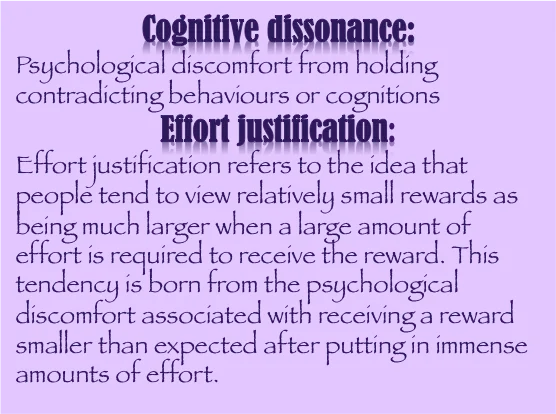
When evidence threatens a deeply held belief, people may respond by defending or reshaping the belief rather than abandoning it. Cognitive dissonance describes this tension between conflicting commitments, explaining why disconfirmation does not always produce the correction an outside observer expects.
On the evening of December 20, 1954, a small group of believers gathered in the home of Dorothy Martin - a Chicago housewife who claimed to receive messages from extraterrestrial beings - and waited for the end of the world. Martin had prophesied with precision: at midnight, a great flood would inundate the North American continent.
The faithful had prepared. Several had quit their jobs. Others had left families. A woman had removed the metal clasps from her bra, believing metal would be dangerous during the coming rescue by flying saucer.
Midnight came and went. No flood. No spaceship. No Guardians.
What happened next is one of the most cited events in the history of psychology - and the founding observation of a theory that explains a great deal about how humans think, behave, and defend their sense of self.
Leon Festinger and the Theory of Cognitive Dissonance
The man watching Martin's group that night was not a true believer. He was Leon Festinger, a social psychologist at the University of Minnesota, who had planted himself and several colleagues as undercover observers in Martin's circle.
Festinger had made a prediction of his own: when the prophecy failed, the cult members would not simply abandon their beliefs. They would double down.
He was right.
Within hours of the failed prophecy, Martin received a new "message" - the group's faith had been so powerful that God had spared the Earth from destruction. By morning, the group that had previously avoided publicity was calling newspaper reporters to spread the word.
The failed prophecy had not weakened their conviction. It had intensified it.
Festinger published his account of this observation in 1956 in When Prophecy Fails, co-authored with Henry Riecken and Stanley Schachter. A year later, he formalized his explanation in A Theory of Cognitive Dissonance (1957), one of the most influential books in 20th century psychology.
Festinger's intellectual background was significant. He had studied under Kurt Lewin, the social psychologist who pioneered field theory - the idea that behavior is a function of the person and their psychological environment.
Festinger extended Lewin's framework into the territory of belief and motivation, asking what forces maintain or change our internal representations of the world.
The answer, Festinger proposed, was that cognitive consistency was itself a motivating force - as fundamental to psychological functioning as hunger or the drive for social belonging.
What Cognitive Dissonance Is
Cognitive dissonance is the mental discomfort or tension that arises when a person simultaneously holds two or more cognitions - beliefs, values, knowledge, or attitudes - that are psychologically inconsistent with each other, or when their behavior conflicts with their stated beliefs.
The word "cognitive" refers to thoughts and beliefs. "Dissonance" is borrowed from music, where it describes notes that clash unpleasantly. Festinger's insight was that the mind treats logical contradiction much as the ear treats discord - as something uncomfortable that demands resolution.
Critically, Festinger proposed that this discomfort is motivating. People do not simply tolerate cognitive dissonance; they are driven to reduce it.
The theory predicts not just that people feel uncomfortable with contradictions but that they will actively work to eliminate the discomfort - and that the strategies they use often involve distorting their perception of reality.
The Magnitude of Dissonance
Not all contradictions produce the same level of dissonance. The amount of dissonance a person experiences depends on:
- The importance of the cognitions: Contradictions involving deeply held values or significant decisions produce more dissonance than trivial ones.
- The ratio of dissonant to consonant elements: A person who smokes but has one health concern experiences less dissonance than a person who smokes and holds many strong health beliefs.
- The degree of volition: Freely chosen behaviors produce more dissonance when they conflict with beliefs than behaviors that were forced or coerced.
The volition component has an important implication: people who feel they have freely chosen an action take more ownership of justifying it.
This is the basis of the induced compliance paradigm in dissonance research - when you can convince someone to act against their initial attitude without excessive external pressure, they are more likely to change the attitude to match the behavior.
Three Strategies for Reducing Dissonance
Festinger identified three primary routes by which people resolve cognitive dissonance:
1. Change the Behavior
The most straightforward resolution: if you believe smoking is harmful and you smoke, quit smoking. The behavior that conflicts with the belief is eliminated.
In practice, this is often the hardest path. Behaviors are frequently reinforced by habit, addiction, social pressure, or material interest. Changing them is costly.
This is precisely why most smokers who are aware of the health evidence do not quit: the behavior change route to dissonance reduction is blocked by the strength of the habit and the pleasant properties of the activity itself.
2. Change the Belief
Alternatively, update the belief to accommodate the behavior. A smoker might conclude that the health risks of smoking are exaggerated, that scientific consensus is uncertain, or that stress causes more harm than cigarettes. The behavior stays; the belief shifts to accommodate it.
This is psychologically cheaper than behavior change in many situations, which is why people engage in it so reliably. It is also the mechanism behind a great deal of what is commonly called rationalization.
3. Add New Cognitions
A third path is to add beliefs that reduce the apparent conflict without changing either the original belief or the behavior.
"I smoke, but I exercise regularly, which offsets the health risk." "I drive an inefficient car, but I recycle everything." "I voted for that candidate, but at least the alternative would have been worse."
These additions do not resolve the logical contradiction. They reduce the psychological weight of it by changing the ratio of consonant to dissonant elements - adding beliefs that are consistent with the behavior, making the dissonant belief feel less important.
Aronson (1969), building on Festinger's framework, argued that the most powerful source of cognitive dissonance is not simple logical inconsistency but violation of the self-concept.
People are most motivated to reduce dissonance when they have acted in ways that conflict with their sense of themselves as good, intelligent, or consistent people.
The drive to maintain a positive self-image powers dissonance reduction more reliably than the drive for abstract logical consistency.
The Classic Experiments
The Insufficient Justification Experiment
Festinger and J. Merrill Carlsmith conducted one of the most famous psychology experiments in 1959. Participants were asked to perform an excruciatingly boring task - turning pegs in a board, one quarter turn at a time, for an hour.
Afterward, they were asked to tell the next waiting participant that the task was interesting and enjoyable.
One group was paid $20 for this lie. Another was paid $1.
When later asked how enjoyable they actually found the task, the $1 group rated it as significantly more interesting than the $20 group.
The explanation from dissonance theory: the $20 group had sufficient external justification for telling the lie - they were paid well.
The $1 group could not justify the lie externally, so they reduced dissonance by changing their internal belief: "I told someone the task was interesting for almost nothing, so perhaps I actually found it somewhat interesting."
The less you are paid to do something that conflicts with your values, the more you will convince yourself you believed in it. This finding has been replicated many times and has profound implications for how we understand persuasion, self-deception, and behavior change.
The Fox and the Grapes: A Classic Illustration
Aesop's fable of the fox and the grapes captures the essence of dissonance reduction intuitively. The fox, unable to reach the grapes, concludes they were probably sour anyway. He cannot change the outcome (the grapes are out of reach), so he changes his desire for them.
The psychological mechanism is identical to the rationalization Festinger formalized two and a half millennia later.
The Free Choice Paradigm
Jack Brehm (1956) conducted the first free-choice dissonance experiment. Participants rated consumer products, then were given a choice between two products of similar attractiveness. After choosing, they re-rated the items.
The pattern was consistent: the chosen item was rated higher post-choice and the rejected item was rated lower - even though the objective properties of neither had changed.
This "spreading of alternatives" effect is the direct experiential analog of post-purchase rationalization. Having made a choice, people adjust their evaluations to justify it.
The closer the two alternatives were in initial attractiveness, the greater the post-choice spread - because a near-tie produces the most dissonance about whether the right choice was made.
Cognitive Dissonance in Everyday Life
The theory illuminates a wide range of ordinary human behaviors that might otherwise seem irrational.
Post-Purchase Rationalization
After making a significant purchase - a car, an expensive vacation, a house - most people experience some doubt. This is post-purchase dissonance, sometimes called buyer's remorse.
The resolution is predictable: people seek out positive information about their choice, avoid reading negative reviews, and discuss the purchase's merits with others. The goal is not to gather information; it is to reduce dissonance.
Marketers have long understood this. Post-purchase communication - congratulatory emails, owner magazines, loyalty programs, product quality messaging sent after the sale - is designed to help customers resolve dissonance in favor of the brand, building loyalty rather than regret.
Ehrlich and colleagues (1957) showed this experimentally: new car owners preferentially read advertisements for the car they had just purchased and avoided advertisements for cars they had considered but not bought - even though the decision was already made and the information could no longer affect it.
Political Belief and Motivated Reasoning
Political scientists have noted that voters rarely change their views in response to factual disconfirmation of their beliefs. When confronted with evidence that a policy they support had poor outcomes, people are more likely to question the evidence than to revise their view.
This is dissonance reduction through belief change - specifically, changing beliefs about the reliability of the evidence rather than beliefs about the policy.
Brendan Nyhan and Jason Reifler (2010) documented what they called the backfire effect: in some conditions, providing factual corrections to political misinformation actually strengthened belief in the original misinformation among people who held it strongly.
The correction, by threatening a deeply held belief, produced defensive dissonance reduction. (Subsequent replication attempts have found the backfire effect to be less robust and consistent than the original paper suggested, but motivated reasoning in response to political corrections is well-documented across many studies.)
Health Behavior and Rationalization
The gap between what people know about healthy behavior and what they actually do is one of the most consistent findings in public health. People who know smoking causes cancer continue to smoke. People who know they need more exercise continue to be sedentary.
Cognitive dissonance theory predicts that rather than changing behavior, many will reduce dissonance by downgrading the perceived risk, identifying exceptions, or focusing on other health behaviors they do maintain.
| Dissonant Situation | Common Rationalization |
|---|---|
| Knows smoking is harmful, continues to smoke | "My grandfather smoked until 90 and was fine." |
| Believes in environmental protection, takes frequent flights | "Individual actions don't matter; only policy does." |
| Values honesty, padded a resume | "Everyone exaggerates - it's expected." |
| Believes in fair wages, shops at low-cost retailers | "I can't afford alternatives; it's a systemic problem." |
| Supports animal welfare, eats factory-farmed meat | "One person's choices can't change anything." |
These rationalizations are not signs of dishonesty or hypocrisy in the simple sense. They are psychologically normal responses to dissonance - and understanding them is more useful than condemning them.
Hazing and Effort Justification
Aronson and Mills (1959) demonstrated a particularly striking implication of dissonance theory: people rate outcomes more favorably when they have suffered to attain them.
Participants who underwent a severe initiation to join a group subsequently rated that group as more attractive than participants who underwent a mild initiation or no initiation.
The mechanism is effort justification: having endured something unpleasant to join a group, the cognition "this group is mediocre" is dissonant with the cognition "I endured unpleasantness to join this group." The resolution is to upgrade the group's perceived value.
This explains why organizations that impose difficult entry requirements - fraternities, elite military units, competitive law firms - generate intense loyalty from members, even when objective outcomes do not justify it.
The Doomsday Cult: Why Disconfirmation Can Strengthen Belief
The most counterintuitive implication of dissonance theory is that the failure of a prediction can increase rather than decrease belief. Festinger identified the conditions under which this occurs:
- The belief must be deeply held
- The believer must have taken an irreversible action based on it
- The believer must have social support from other believers
When all three conditions are met, abandoning the belief would require a catastrophic reappraisal - not just of one belief, but of the entire decision to have acted on it, and of one's own judgment and identity.
The dissonance of accepting that you quit your job and alienated your family for a false prophecy is overwhelming. It is psychologically cheaper to find a way to maintain the belief.
This mechanism explains why members of groups that have taken costly public actions based on shared beliefs are exceptionally resistant to disconfirmation. It is also why cult recruitment often involves escalating commitment - each step taken increases the cost of leaving, making dissonance reduction through continued belief more likely.
"A man with a conviction is a hard man to change. Tell him you disagree and he turns away. Show him facts or figures and he questions your sources. Appeal to logic and he fails to see your point." - Leon Festinger, When Prophecy Fails (1956)
This dynamic extends well beyond cults. Staw (1976) documented what he called escalating commitment to a failing course of action in organizational decision-making: managers who had made an initial investment decision were more likely to continue investing in a failing project than managers brought in after the initial decision had been made.
Sunk costs - past investments of time, money, and reputation - create dissonance with the prospect of stopping, and managers reduce that dissonance by doubling down rather than cutting losses.
Self-Perception Theory: An Alternative Explanation
In 1967, psychologist Daryl Bem proposed self-perception theory as an alternative to dissonance theory. Bem argued that the results of dissonance experiments did not require an internal tension mechanism at all.
Instead, people simply observe their own behavior and infer their attitudes from it - the same process they use to infer others' attitudes from their behavior.
In Bem's account, the participant who was paid $1 to call a boring task interesting does not experience an uncomfortable tension.
He simply observes: "I said the task was interesting for almost no money, so I must have found it somewhat interesting." No dissonance, no drive to reduce it - just ordinary inference from observation.
Bem's theory generates many of the same predictions as Festinger's, making them difficult to distinguish experimentally. The key distinguishing question is whether a genuine aversive arousal state - the discomfort Festinger described - is necessary for attitude change to occur.
Research by Joel Cooper, Mark Zanna, and others in the 1970s and 1980s provided evidence that arousal does play a role: when participants' arousal was misattributed to an irrelevant source (such as a pill they had taken), the attitude change typical of dissonance experiments was reduced.
This suggests that an internal state of discomfort, not just behavioral inference, is part of the mechanism.
The current consensus among psychologists is that both theories capture something real. For many attitude-change situations, self-perception provides an adequate explanation.
For situations involving deeply held beliefs, significant behavioral commitments, and clear violations of self-concept, dissonance theory's emotional mechanism appears to add explanatory power.
Cooper (2007), reviewing fifty years of dissonance research in Cognitive Dissonance: 50 Years of a Classic Theory, concluded that the core phenomena are robust and replicable, that arousal is a genuine component of the mechanism, and that the theory's emphasis on self-concept threat (rather than mere logical inconsistency) best explains the pattern of results.
Cognitive Dissonance and the Brain
Neuroscience research in the 2000s provided direct evidence for dissonance as a physiological state.
van Veen and colleagues (2009), using fMRI, found that participants who were induced to advocate positions contrary to their beliefs showed activation in the dorsal anterior cingulate cortex (dACC) - a region associated with the detection of conflict between competing cognitive representations.
The greater the dACC activation, the more attitude change the participant subsequently showed, directly supporting the neural reality of the dissonance state Festinger had described in purely psychological terms.
This finding positioned cognitive dissonance within a broader neuroscientific framework of conflict monitoring: the brain's systems for detecting when competing representations are simultaneously active and cannot both be correct.
The dACC appears to be part of a broader alarm system that flags inconsistency and motivates resolution - a neurological implementation of Festinger's motivational hypothesis.
Applications in Behavior Change
Understanding cognitive dissonance has practical implications for anyone trying to change their own behavior or influence others'.
For behavior change programs: Lecturing people about the gap between their beliefs and their behavior tends to increase defensiveness (and dissonance reduction) rather than change.
More effective approaches involve helping people identify their own values and acknowledge the gap themselves - a process sometimes called motivational interviewing (Miller and Rollnick, 2013) - before working on behavior.
By making the dissonance felt (rather than imposed), these approaches use it productively.
For persuasion: Asking people to publicly commit to a position they already moderately hold tends to strengthen that position through the self-perception and dissonance mechanisms. This is the basis of foot-in-the-door persuasion techniques.
For education: When students are asked to explain or teach concepts, the act of taking a public position often strengthens their belief and understanding - using dissonance processes productively.
For policy design: Nudges that make healthy or prosocial choices the default leverage the fact that people will rationalize their default choices.
Someone who finds themselves enrolled in a pension plan tends to develop beliefs supporting saving; someone who finds themselves organ donors tends to develop more favorable attitudes toward donation.
The hypocrisy induction technique: Aronson and colleagues (1991) developed an applied dissonance technique specifically for health behavior change. Participants were first asked to advocate for safe sex publicly (increasing their commitment to the value), then reminded of times they had personally not practiced safe sex.
This induced state - "I advocate something I don't consistently do" - produced significantly more actual condom purchases compared to control conditions. The technique uses dissonance as a lever for genuine behavior change rather than rationalization.
Why Cognitive Dissonance Matters
More than sixty years after Festinger published his theory, cognitive dissonance remains one of the most replicated and practically significant findings in psychology.
It explains why smart people believe false things, why bad decisions are often defended rather than corrected, why cults become more devoted after their prophecies fail, and why the most effective path to attitude change often runs through behavior rather than argument.
The uncomfortable truth the theory reveals is that humans are not primarily truth-seeking machines who change their beliefs when confronted with contradicting evidence. We are, to a significant degree, consistency-seeking machines who find ways to make our beliefs cohere with our actions, our identities, and our social commitments.
This has implications for how we interpret our own thinking. When you find yourself developing arguments for why a decision you made was correct, it is worth asking: are you reasoning toward truth, or reducing dissonance?
When you dismiss evidence that your position is wrong, are you applying appropriate critical scrutiny, or protecting consistency?
When you feel compelled to justify an action you are ambivalent about, are you working toward honesty or toward comfort?
Understanding this tendency is the first step toward recognizing it in ourselves - and occasionally, choosing the harder path of genuine revision over the easier path of comfortable rationalization.