
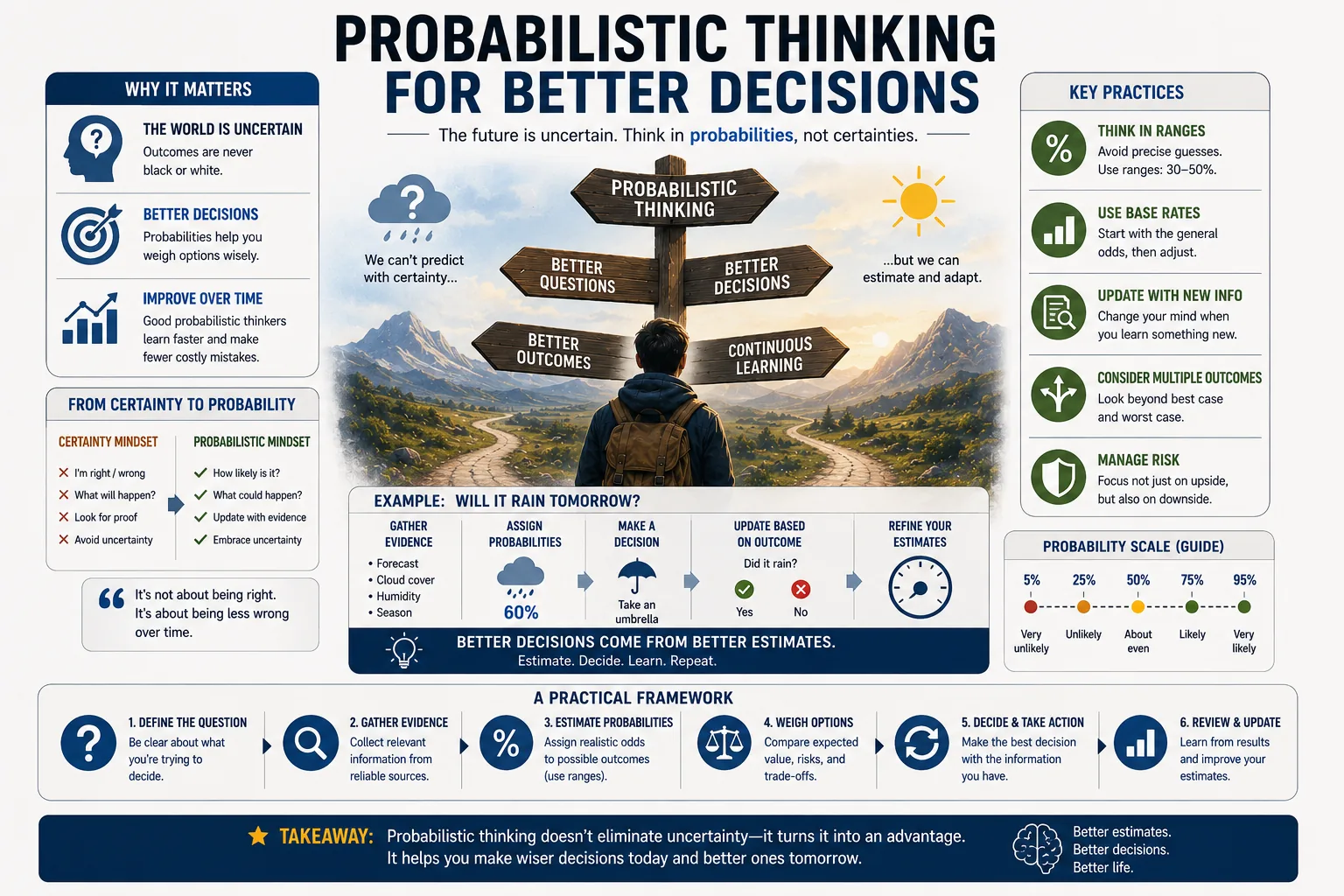
The Illusion of Certainty
Probabilistic: A product manager announces: "This feature will increase conversions." An investor declares: "This startup will succeed." A consultant promises: "This strategy will work."
Each statement sounds confident. Each is almost certainly wrong-not because the speaker is incompetent, but because they're expressing false certainty about inherently uncertain outcomes.
Reality doesn't deal in guarantees. Features sometimes increase conversions and sometimes don't. Startups succeed at roughly 10% base rates. Strategies work in some contexts and fail in others. The world is probabilistic, yet most people think and communicate in absolutes.
This mismatch between probabilistic reality and binary thinking-produces systematic errors:
- Overconfidence in predictions (because you didn't quantify uncertainty)
- Inability to learn from outcomes (because you framed decisions as right/wrong rather than good-process/bad-process)
- Poor risk assessment (because you ignored the full distribution of possible outcomes)
- Missed opportunities (because something with 40% success odds looks like "failure" in binary framing)
Probabilistic thinking means reasoning in likelihoods and distributions rather than certainties. It's not just for statisticians or gamblers-it's how reality works, and matching your thinking to reality produces better decisions.
"Probability is not a mere computation of odds on the dice or more complicated variants; it is the acceptance of the lack of certainty in our knowledge." - Nassim Nicholas Taleb
Why Binary Thinking Fails
The Certainty Trap
Binary thinking forces every uncertain situation into false categories:
- "This will work" vs. "This won't work"
- "This is true" vs. "This is false"
- "This person is competent" vs. "This person is incompetent"
Reality offers no such clean divisions. That feature has maybe a 60% chance of increasing conversions. That claim is probably true with some important caveats. That person is highly competent in domain X and moderately competent in domain Y.
The damage: When you compress uncertainty into false certainty, you:
- Lose calibration → Can't distinguish 60% confidence from 90% confidence
- Can't learn properly → Good decisions that produced bad outcomes look like "mistakes"
- Misallocate resources → Treat 55% opportunities the same as 95% opportunities
- Become overconfident → Every prediction feels equally certain
The Outcome Bias Trap
Annie Duke (professional poker player, decision strategist) calls this "resulting"-judging decision quality by outcomes rather than process.[6]
Binary logic: "I chose X. X failed. Therefore I made a bad decision."
Probabilistic logic: "I chose X because it had 70% success odds and highest expected value. It failed (30% outcome). The decision quality was still correct."
Poker players understand this deeply. You can make the mathematically optimal bet and lose the hand. That doesn't mean the bet was wrong-it means you encountered the 30% outcome.
In most domains, people lack this clarity. A hiring decision that doesn't work out gets labeled "bad hire" rather than "reasonable bet that didn't pan out." This destroys your ability to learn from experience because you're evaluating process by irrelevant data (single outcomes).
Example: The Interview Problem
Binary thinking:
Candidate seems strong → Hire
Candidate seems weak → Don't hire
Result: You're making decisions as if interviews perfectly predict performance. They don't. Even great interviews have maybe 65-70% predictive validity.
Probabilistic thinking:
Strong interview → 70% confidence this person succeeds
Weak interview → 30% confidence this person succeeds
Also consider: base rate of success for this role, reference data, work samples, trial projects
Result: You're explicitly accounting for uncertainty. You might still hire the strong-interview candidate, but you also plan for the 30% chance they don't work out (shorter initial commitment, clearer success metrics, backup plans).
Core Principles of Probabilistic Thinking
1. Express Uncertainty Numerically
Replace vague language with numbers:
| Vague Expression | Probabilistic Expression | Decision Implication |
|---|---|---|
| "Probably will work" | 60-70% likely to work | Moderate confidence-have backup plan |
| "Very likely to work" | 85-95% likely to work | High confidence-commit resources |
| "Might work" | 35-50% likely to work | Low confidence-cheap test first |
| "Almost certain" | 95%+ likely | Near-certainty-plan as if it will happen |
Why numbers matter: "Probably" means different things to different people (anywhere from 50% to 90% in studies). Numerical probability forces precision.
Practice technique: Before important decisions, write down your confidence level as a percentage. Just the act of quantifying forces clarity.
2. Think in Distributions, Not Point Estimates
Most predictions are point estimates: "This will take 3 weeks." "Revenue will be $500K."
Probabilistic approach: Estimate the distribution of outcomes.
| Point Estimate | Probabilistic Distribution |
|---|---|
| "Project takes 3 weeks" | P10: 2 weeks, P50: 3.5 weeks, P90: 6 weeks |
| "Revenue is $500K" | P10: $350K, P50: $500K, P90: $750K |
| "Candidate rating: 8/10" | P10: Works out poorly (5/10), P50: 8/10, P90: Exceptional (9.5/10) |
P10/P50/P90 represents the 10th, 50th, and 90th percentiles-giving you a sense of the range and asymmetry of outcomes.[9]
Key insight: Most distributions are asymmetric. Projects usually overrun more than they underrun. Revenue upside often exceeds downside. Recognizing this asymmetry changes planning.
Application: When someone gives you a confident point estimate, ask: "What's the range? What's the 10th percentile worst case and 90th percentile best case?" This forces acknowledgment of uncertainty.
3. Update Beliefs from Evidence (Bayesian Updating)
Thomas Bayes provided the mathematical framework. The intuition: Start with a prior belief. Encounter evidence. Update your belief proportionally to how diagnostic that evidence is.[4]
Formula intuition (not full math):
Posterior probability = Prior probability (Evidence strength / Base rate)[7]
Example - Evaluating a new hire's performance after Month 1:
Prior: Based on interview/references, 70% confident they'll succeed
Evidence observed: Strong Month 1 performance (completes projects, positive feedback)
Question: How much should this update your confidence?
Key factor: How diagnostic is "strong Month 1"?
- If 90% of eventual high-performers have strong Month 1, but also 40% of eventual low-performers have strong Month 1 (honeymoon effect), then strong Month 1 is only moderately diagnostic
- Your confidence might update to 80% (not 95%)
Contrast - Wrong update pattern:
- Binary thinker: "Strong Month 1! I was right, they're definitely great" (jumps to 100%)
- Bayesian thinker: "Strong Month 1 is evidence, but not overwhelming evidence given base rates" (updates to 80%)
General principle: Update incrementally based on evidence strength. Don't swing from 50% to 95% on weak evidence. Don't stay at 50% when strong evidence arrives.
"When the facts change, I change my mind. What do you do, sir?" - John Maynard Keynes
4. Track Calibration
Calibration means your confidence levels match reality. If you say "70% confident" across 100 predictions, roughly 70 should occur.
Philip Tetlock's superforecasters excel at calibration. They don't have secret information-they're just better at assessing their own uncertainty.
"The best forecasters are not the ones who are never wrong. They're the ones who know how wrong they might be." - Philip Tetlock
How to build calibration:
- Make probability estimates (not just predictions)
- Record them (you can't improve without data)
- Check outcomes
- Calculate calibration error
Example tracking:
| Prediction | Your Confidence | Outcome | Result |
|---|---|---|---|
| Candidate A succeeds | 80% | Success | Correct |
| Feature increases conversions | 60% | No increase | Correct (you said 60%, not certain) |
| Project finishes in 3 weeks | 90% | Took 5 weeks | Overconfident |
| Partnership succeeds | 50% | Success | Correct (coin flip) |
After 50-100 tracked predictions, patterns emerge:
- Are your 70% predictions actually 70%? Or more like 50%?
- Are you systematically overconfident? Underconfident?
- Which domains are you well-calibrated in vs. poorly calibrated?
Result: Your probability estimates become increasingly accurate, which directly improves decision quality.
5. Consider Base Rates
Base rate: The general frequency of an event in the reference class.
Most people ignore base rates (called the base rate fallacy).[5] They focus on specific details while ignoring the statistical foundation. This is one of many cognitive biases that distort probabilistic judgment.[1]
Classic example: Startup success rates
Specific thinking: "This founder is smart, the idea is good, the market is large → high chance of success"
Probabilistic thinking: "Base rate: ~10% of VC-backed startups return capital. Even with positive signals, maybe 20-30% chance of success."
Why base rates matter: They're your prior probability before considering specific evidence. Specific evidence adjusts this prior, but rarely by as much as people think.
| Scenario | Base Rate | Specific Evidence | Reasonable Posterior |
|---|---|---|---|
| Startup success | 10% | Strong team, validated problem | 25-35% |
| New product success | 40% (industry average) | Extensive testing, pilot success | 60-70% |
| Candidate success | 50% (historical rate for role) | Great interview, strong references | 70-80% |
| Medical diagnosis | 1% prevalence | Positive test (90% accurate) | ~10% (not 90%!) |
Notice the medical diagnosis case: Even with a highly accurate test, a positive result only raises probability from 1% to ~10% because the base rate is so low. This is why probabilistic thinking matters-intuition fails here.
Application: Before evaluating specific evidence, ask: "What's the base rate for this reference class?" Use that as your starting point.
"Never mistake a clear view for a short distance." - Paul Saffo
Practical Applications
Decision Making Under Uncertainty
Standard approach: Analyze situation → Pick best option → Hope it works
Probabilistic approach:
- Generate options
- Estimate outcome distributions for each (P10/P50/P90)
- Assign probabilities to different scenarios
- Calculate expected value
- Consider variance/risk (not just average outcome)
- Choose best distribution (not necessarily highest average)
Example - Hiring decision:
Option A: Senior hire ($200K salary)
- P10: Moderate contributor ($300K value)
- P50: Strong contributor ($600K value)
- P90: Exceptional contributor ($1M+ value)
- Probability distribution: 20% low, 60% middle, 20% high
Option B: Junior hire + training ($100K total)
- P10: Doesn't work out ($50K value)
- P50: Solid contributor after 6 months ($300K value)
- P90: Develops into senior in 18 months ($500K value)
- Probability distribution: 30% low, 50% middle, 20% high
Expected value calculation:
- Option A: 0.2($300K) + 0.6($600K) + 0.2($1M) = $620K expected value
- Option B: 0.3($50K) + 0.5($300K) + 0.2($500K) = $265K expected value
But also consider:
- Downside risk: Option B has higher risk of near-zero value
- Opportunity cost: Option A costs $200K vs. $100K (that $100K difference has alternative uses)
- Option value: Option B preserves flexibility (can still hire senior later if junior doesn't work)
Result: Not a formulaic answer, but a structured way to think about trade-offs using probability.
Forecasting and Planning
Planning fallacy: People systematically underestimate time/cost and overestimate benefits.
Probabilistic antidote:
Instead of: "This project takes 8 weeks"
Use:
- Best case (P10): 6 weeks (everything goes right)
- Likely case (P50): 10 weeks (typical issues)
- Worst case (P90): 16 weeks (significant problems)
Then plan for the P70-P80 outcome, not the P50. Most organizations plan for median case, then act surprised when things take longer.
Why P70-P80? It's realistic without being paranoid. You hit your target 70-80% of the time, which builds trust and allows for realistic roadmapping.
Risk Assessment
Binary thinking: "Is this risky?" → Yes/No
Probabilistic thinking: "What's the distribution of outcomes? What's the downside risk? What's the upside potential?"
Risk assessment framework:
| Factor | Assessment Method |
|---|---|
| Downside risk | What's the P10 outcome? Can we absorb it? |
| Upside potential | What's the P90 outcome? Is it transformative? |
| Expected value | Probability-weighted average outcome |
| Variance | How wide is the outcome distribution? |
| Skew | Is distribution symmetric or asymmetric? |
| Tail risk | What are the extreme (<P5) scenarios? |
Example - Asymmetric risk assessment:
Opportunity A:
- Expected value: $100K
- Distribution: Narrow (very predictable)
- P10: $80K, P90: $120K
Opportunity B:
- Expected value: $100K
- Distribution: Wide (highly uncertain)
- P10: -$50K, P90: $400K
Same expected value, completely different risk profiles.
- Choose A if you need predictability and can't absorb downside
- Choose B if you have asymmetric upside (small downside, massive upside) and can tolerate variance
Key insight: Expected value is necessary but insufficient. You also need to evaluate the shape of the distribution.
Strategic Decisions
Example - Market entry decision:
Binary thinking: "Should we enter Market X?" → Analyze, decide, commit
Probabilistic thinking:
Scenario modeling:
| Scenario | Probability | Outcome | Expected Value |
|---|---|---|---|
| Market grows rapidly | 25% | Dominate early, $50M value | $12.5M |
| Market grows slowly | 40% | Modest success, $10M value | $4M |
| Market stagnates | 25% | Breakeven, $0 value | $0 |
| Market contracts | 10% | Failure, -$5M value | -$0.5M |
| Total expected value | - | - | $16M |
But also consider:
- What's the variance? (25% chance of $50M vs. 10% chance of -$5M)
- What's the option value of waiting for more information?
- What's the opportunity cost of capital and attention?
- What's the irreversibility of the decision? (Can we exit easily if wrong?)
Result: Not just "yes/no" but "yes at what scale, with what staging, and what exit triggers."
Advanced Techniques
Expected Value Thinking
Expected Value (EV) = Σ (Probability × Outcome)
Why it matters: Intuition fails at comparing options with different probability/outcome structures.
Example - Venture investment:
Investment A:
- 80% chance of 1.5 return → EV = 0.8 × 1.5 = 1.2
- 20% chance of 0 return → EV = 0.2 × 0 = 0
- Total EV: 1.2 return
Investment B:
- 10% chance of 20 return → EV = 0.1 × 20 = 2.0
- 90% chance of 0 return → EV = 0.9 × 0 = 0
- Total EV: 2.0 return
Counterintuitive result: Investment B is better in expectation despite 90% failure rate, because the upside is asymmetric.
This is how venture capital works: Most investments fail, but the few successes return enough to more than compensate.
When to use EV thinking:
- ? Repeated decisions (law of large numbers applies)
- ? You can afford downside of individual bets
- ? Outcomes are quantifiable
- ? One-shot decisions with catastrophic downside (survival matters more than EV)
- ? Outcomes aren't independent (correlated risks)
Kelly Criterion: Optimal Bet Sizing
Question: You have an edge (positive expected value bet). How much should you risk?
Too little: You don't capitalize on your edge
Too much: Variance kills you even if EV is positive
Kelly Criterion provides the mathematically optimal bet size:[8]
f = (bp - q) / b
Where:
- f = fraction of capital to bet
- b = odds received (if you win)
- p = probability of winning
- q = probability of losing (1-p)
Example: 60% chance of doubling money (b=1, p=0.6, q=0.4)
f = (10.6 - 0.4) / 1 = 0.2 → Bet 20% of capital
Key insight: Even with 60% win rate and 2:1 payoff, optimal bet is only 20%. Betting more increases variance to dangerous levels.
Practical application (not literal betting):
- Hiring: How much of your team capacity should this role consume?
- Product bets: How many resources to allocate to uncertain new feature?
- Career moves: How much career capital to risk on uncertain opportunity?
Modified Kelly: Most practitioners use fractional Kelly (½ Kelly or ¼ Kelly) to reduce variance while still capturing most of the edge.
Scenario Planning
When facing high uncertainty, don't predict the future-model multiple plausible futures and prepare for each.
Process:
- Identify key uncertainties (factors that strongly affect outcomes but are highly uncertain)
- Generate 3-5 distinct scenarios (not best/worst/likely-use independent drivers)
- For each scenario, define implications
- Identify robust strategies (work across multiple scenarios)
- Define triggers (early signals indicating which scenario is unfolding)
Example - Tech company strategic planning:
Uncertainties: AI development pace, regulation, competition
Scenarios:
| Scenario | Description | Probability | Implication |
|---|---|---|---|
| "AI Boom" | Rapid AI capabilities, light regulation | 30% | Aggressive AI investment, talent competition |
| "Regulated AI" | Moderate AI growth, heavy regulation | 25% | Compliance focus, partnership with regulators |
| "AI Winter" | Hype exceeds reality, stagnation | 20% | Focus on non-AI core, cost efficiency |
| "Winner-Take-All" | One player dominates (not us) | 25% | Niche specialization or pivot |
Robust strategies (work across multiple scenarios):
- Build flexible architecture (not locked into one AI paradigm)
- Develop proprietary data assets (valuable in most scenarios)
- Maintain strong financial position (survive any scenario)
Triggers (indicate which scenario is unfolding):
- Regulatory proposals (? Regulated AI)
- Breakthrough announcements (? AI Boom)
- Funding rounds drying up (? AI Winter)
- Market consolidation (? Winner-Take-All)
Result: You're not trying to predict which scenario happens-you're prepared for any of them.
Common Pitfalls
False Precision
Mistake: Treating probability estimates as exact when they're inherently uncertain.
"There's a 67.3% chance this succeeds" (false precision-you can't estimate that accurately)
Better: "Somewhere between 60-75% likely to succeed" (acknowledging estimation uncertainty)
Rule of thumb: For most business/personal decisions, round to 10% increments (30%, 40%, 50%, etc.). Finer precision is usually false confidence.
Ignoring Correlation
Mistake: Treating independent probabilities as if events are unrelated when they're actually correlated.
Example: "Each of our 10 product bets has 60% success rate, so we expect 6 to succeed"
Reality: If they're all in the same market facing the same macro conditions, they're positively correlated. Either most succeed (favorable environment) or most fail (unfavorable environment).
Implication: Diversification provides less protection than simple probability suggests when risks are correlated.
Over-Optimizing for EV
Mistake: Maximizing expected value while ignoring risk of ruin.
Example: Even if a bet has positive EV, if the downside is bankruptcy, you shouldn't take it (no matter how good the odds).
Taleb's point: Ergodicity matters. Expected value assumes you can repeat the bet many times. Some decisions are one-shot with absorbing barriers (once you lose, you can't play again).
Practical rule: Never risk more than you can afford to lose, even on positive-EV bets, if losing means permanent damage.
Probability Without Consequences
Mistake: Focusing on likelihood while ignoring magnitude of outcomes.
"There's only a 5% chance of this disaster scenario" (sounds low, but if disaster = company failure, 5% is enormous)
Better framing: Combine probability × magnitude
- 5% chance of losing $10 = Expected loss of $0.50 (trivial)
- 5% chance of losing $10M = Expected loss of $500K (major concern)
- 5% chance of company failure = Unacceptable risk requiring mitigation
Principle: Low-probability, high-impact events often dominate expected value calculations.[3]
Updating on Noise
Mistake: Adjusting probability estimates based on non-diagnostic information.
Example: You estimate 60% chance a hire succeeds. After one day, they make a good comment in a meeting. You update to 75%.
Problem: One comment is extremely weak evidence (high noise-to-signal ratio). Updating significantly on weak evidence produces volatility without accuracy.
Better approach: Update proportionally to evidence strength. One positive signal might move you from 60% → 62% (not 60% → 75%).
Tetlock's finding: Superforecasters update frequently but incrementally.[2] Amateurs update infrequently but dramatically.
Building Probabilistic Intuition
Daily Micro-Calibration
Most people lack intuition for probability because they never practice.
Solution: Make small predictions daily and track outcomes.
Examples:
- "Will this meeting start on time?" (estimate probability)
- "Will this email get a response within 2 hours?" (estimate probability)
- "Will this PR be approved without changes?" (estimate probability)
After 100-200 micro-predictions, your calibration improves dramatically because you get immediate feedback.
Key: Actually write down your estimates (even in a simple note). Memory is unreliable-you'll convince yourself you "knew it all along" without a record.
Reference Class Forecasting
When estimating probability, don't just evaluate the specific situation-find comparable reference classes and use their base rates.
Example - Estimating project timeline:
Inside view: "This project is unique, we have great people, we're motivated → 3 months"
Reference class view: "Our last 10 projects of similar scope took: 2, 4, 5, 3, 6, 4, 7, 5, 4, 8 months → median is 4.5 months"
Better estimate: Start with reference class (4.5 months), then adjust based on specific differences (but modestly-most "this time is different" thinking is overconfident).
Why reference classes work: They incorporate all the complexity and surprises you can't anticipate. Your inside view is inherently overconfident because it only considers factors you can see.
Probability Calibration Games
Websites for practice:
- PredictionBook.com: Make predictions, track accuracy
- Metaculus.com: Forecasting tournaments with community scoring
- Manifold Markets: Play-money prediction markets
Why games work: Immediate feedback on calibration errors. You quickly learn whether your "70% confident" matches reality.
Alternative - Peer calibration:
With colleagues, make monthly predictions about business outcomes. Track who's best calibrated. This creates accountability and competitive motivation to improve.
The "Bet Test"
Calibration check: Would you actually bet money at the odds your probability implies?
"I'm 80% confident this feature increases conversions"
Translation: You'd bet $80 to win $100 if feature works (and lose $80 if it doesn't). Would you actually take that bet?
If not, you're not really 80% confident-maybe 60-65%.
This doesn't mean literally betting on decisions. It means using betting odds as a calibration tool to force intellectual honesty.
From Probability to Action
Decision Rules Under Uncertainty
When to act despite uncertainty:
| Condition | Action Threshold |
|---|---|
| High reversibility | Act at 50-60% confidence (easy to undo) |
| Low cost of error | Act at 60-70% confidence |
| High opportunity cost of delay | Act at 65-75% confidence |
| Irreversible, high stakes | Wait for 80-90% confidence |
| Existential risk | Require 95%+ confidence or don't act |
Example - Product launch:
- Beta launch (reversible): 60% confidence sufficient
- Full marketing push (expensive): 75% confidence required
- Enterprise commitment (contracts, SLAs): 85%+ confidence required
Key principle: Confidence threshold should match stakes and reversibility, not be uniform across decisions.
Communicating Probabilistically
Challenge: Most people aren't trained in probabilistic thinking. How do you communicate uncertainty without losing credibility?
Bad approach: "Maybe this works, maybe it doesn't" (sounds like you don't know)
Good approach: "Based on reference classes and available evidence, I estimate 70% confidence this succeeds, 20% it produces modest results, 10% it fails. Here's why..."
What this signals:
- You've thought deeply (not guessing)
- You've considered alternatives (not anchored)
- You've acknowledged uncertainty (not overconfident)
- You've quantified your belief (not vague)
For executive communication, translate probabilities to risk language:
- 90%+ → "High confidence, proceed"
- 70-90% → "Moderate confidence, manageable risk"
- 50-70% → "Uncertain outcome, requires careful monitoring"
- <50% → "Low confidence, recommend not proceeding OR cheap test first"
Probabilistic Organizations
Companies that build probabilistic culture:
Intel (under Andy Grove): "Only the paranoid survive"-always modeled multiple scenarios, never assumed one future
Amazon: Two-way door vs. one-way door decisions (reversibility determines confidence threshold)
Bridgewater (Ray Dalio): Expected value calculations required for major decisions, systematic tracking of prediction accuracy
Building probabilistic culture:
- Require probability estimates (not just yes/no recommendations)
- Track prediction accuracy (public calibration scores)
- Reward good process, not just good outcomes (don't punish 70% bets that fail)
- Model multiple scenarios (not just base case)
- Post-mortems analyze process (not just outcome)
Result: Decisions become better calibrated, organizations learn faster, risk assessment becomes more sophisticated.
Philip Tetlock's Superforecaster Research: What Separates Good Probabilistic Thinkers
The most rigorous study of probabilistic thinking in practice is Philip Tetlock's Good Judgment Project, which ran from 2011 to 2015 as part of an IARPA-funded forecasting tournament.
Tetlock recruited approximately 2,800 volunteer forecasters and asked them to make probability estimates on geopolitical and economic questions - events with verifiable outcomes within a defined timeframe.
The questions were concrete: Would the Eurozone lose a member within the next year? Would the Syrian government use chemical weapons? Would the unemployment rate in Spain exceed a specified level?
The forecasters received no special information advantages. They had access to the same news, databases, and analyses as anyone following current events.
Yet the top performers - roughly the top 2%, eventually selected and grouped as "superforecasters" - consistently outperformed not just average forecasters but also professional intelligence analysts with access to classified information.
The CIA and other intelligence agencies participated in the tournament as comparators.
What distinguished the superforecasters was not domain expertise. The top performers came from diverse backgrounds: accountants, retired nurses, engineers, and hobbyists alongside economists and political scientists. The distinguishing characteristics were cognitive and methodological. Tetlock identified several consistent patterns:
Superforecasters made initial probability estimates based explicitly on base rates - the reference class of similar historical events.
Before considering any specific details of a geopolitical situation, they would ask: "In how many of the last 50 similar situations did the event occur?" This outside view established the anchor from which specific evidence would adjust the estimate, rather than specific details driving the estimate with no reference to historical frequency.
They updated frequently and incrementally. Tetlock found that superforecasters revised their estimates roughly twice as often as average forecasters, but each revision was small - typically 5 to 10 percentage points in response to new information.
Average forecasters updated rarely but dramatically, swinging from 40% to 80% on single news events.
The superforecasters' incremental updating reflected appropriate weighting of evidence strength: most individual pieces of news are not highly diagnostic, and updating heavily on them produces probability estimates that track the news cycle rather than underlying reality.
They also distinguished between questions where their estimates were reliable and questions where they were not. Superforecasters showed worse calibration and lower confidence on questions outside their genuine domain knowledge, and they explicitly flagged this uncertainty rather than projecting uniform confidence across domains.
Bayesian Updating in Medical Diagnosis: The Base Rate Problem at Scale
The base rate neglect problem has been studied most carefully in medical diagnosis, where the stakes make calibration failures directly costly. The classic demonstration involves medical screening tests, but the underlying structure appears wherever rare events are detected with imperfect instruments.
Consider a disease with 1% prevalence in the tested population. A test for the disease has 90% sensitivity (correctly identifies 90% of people who have the disease) and 90% specificity (correctly identifies 90% of people who do not have the disease). A patient tests positive. What is the probability they have the disease?
The intuitive answer is 90%, matching the test's accuracy. The correct Bayesian calculation gives approximately 8%. The discrepancy follows directly from base rate neglect. Of 1,000 tested patients, 10 actually have the disease; the test correctly identifies 9 of them (90% sensitivity).
Of the 990 patients without the disease, the test incorrectly identifies 99 as positive (10% false positive rate on 990 people). So among the 108 positive results (9 true positives plus 99 false positives), only 9 actually have the disease: roughly 8%.
Gerd Gigerenzer at the Max Planck Institute for Human Development has studied this problem extensively in medical contexts. He found that physicians, when given the problem in the standard probability format, typically gave estimates near 90% - dramatically overestimating the posterior probability.
When he reframed the same problem in terms of natural frequencies ("Out of every 1,000 people, 10 have the disease; of those 10, 9 will test positive; of the 990 without the disease, 99 will also test positive"), accuracy improved substantially. The information content was identical; the format made the base rate salient.
The implication for probabilistic thinking is direct: whenever a test, signal, or indicator is rare-event detection, the base rate of the event must anchor the interpretation. High test accuracy does not mean high posterior probability when the event being detected is rare.
This structure applies beyond medicine: investment analysts evaluating whether a firm will outperform the market, HR teams evaluating whether an interview predicts job success, and security analysts evaluating whether unusual network behavior signals an intrusion all operate in exactly this structure - where the base rate of the target event must anchor interpretation of imperfect detection signals.
The Meta-Skill
Probabilistic thinking isn't just about numbers. It's a fundamental epistemological shift: from believing the world is knowable with certainty to accepting it's knowable only in probabilities. It works best when combined with other mental models that sharpen how we interpret evidence and make decisions.
This shift produces:
Better predictions: By acknowledging uncertainty rather than pretending it doesn't exist
Better learning: By evaluating decision quality separately from outcome quality
Better risk management: By modeling distributions rather than single scenarios
Better communication: By quantifying confidence rather than projecting false certainty
Better humility: By recognizing how much you don't know
The world is probabilistic. Binary thinking-certain/not certain, true/false, success/failure-is a comfortable illusion that doesn't match reality.
Embrace the uncertainty. Model it. Quantify it. Update from evidence. Track your calibration.
Your decisions will improve not because you gain certainty, but because you stop pretending uncertainty doesn't exist.
"I skate to where the puck is going, not where it has been." - Wayne Gretzky
Probabilistic Thinking in Business Strategy: Case Studies from Amazon, Google, and Renaissance Technologies
The practical gap between probabilistic and binary thinking is most clearly visible in organizations that have institutionalized one approach or the other and whose long-term performance can be compared.
Amazon's documented approach to capital allocation under uncertainty illustrates probabilistic thinking at institutional scale.
Jeff Bezos's 1997 shareholder letter introduced the concept of making decisions under uncertainty with the explicit acknowledgment that most would fail: "We will make bold rather than timid investment decisions where we see a sufficient probability of gaining market leadership advantages...
Some of these investments will pay off, others will not, and we will have learned another valuable lesson in either case." This is not motivational rhetoric - it is a statement of decision process.
Amazon tracks its experiments explicitly as a probability portfolio. A 2018 analysis by Recode estimated that Amazon had launched and discontinued over 30 major product lines and services, including Fire Phone, Destinations, and Amazon Restaurants, while maintaining its investment rate.
The discontinued projects represent approximately 30 percent of major initiatives - a base rate consistent with a deliberate probabilistic bet portfolio, not an accident.
The contrast with companies using binary (succeed/fail) decision framing is instructive.
Post-mortems of failed retail initiatives - including Sears's digital transformation attempt and Barnes & Noble's e-reader investment - document a common pattern: management teams committed heavily to single bets rather than maintaining portfolios of probabilistic experiments.
When the bet failed, the entire strategic direction failed with it. Amazon's probabilistic portfolio approach created a fundamentally different failure mode: individual experiments fail, the portfolio continues, and learning from failures informs the next generation of experiments.
Google's approach to R&D allocation at Google X (now X, the Moonshot Factory) explicitly uses probability language in its project selection and continuation criteria.
Astro Teller, who leads X, has described the project evaluation process as requiring teams to identify and attempt to prove fatal flaws in their own project before the project receives continued funding.
This is the pre-mortem principle operationalized as a budget gate: a project must demonstrate that it has actively sought disconfirming evidence and survived the attempt.
The stated rationale is probabilistic: projects that have been actively stress-tested against their most likely failure modes have higher probability-weighted expected value than projects that have only been evaluated on their best-case scenarios.
Teller has cited the failure rate at X as roughly one project abandoned per ten initiated - about a 10 percent attrition rate for initiated projects, reflecting how many ideas X screens out well before reaching that stage that he describes as a feature rather than a bug, because it reflects genuine probabilistic filtering rather than organizational reluctance to kill projects.
Renaissance Technologies, the quantitative hedge fund founded by mathematician James Simons, represents the most successful documented application of probabilistic thinking to investment management.
Renaissance's Medallion Fund returned approximately 66 percent per year before fees from 1988 to 2018 - a performance record that no conventional fundamental analyst has matched over a comparable period.
Gregory Zuckerman's account in The Man Who Solved the Market (2019) describes Renaissance's approach as explicitly probabilistic: the fund's models generate probability distributions over expected returns, and positions are sized in proportion to the probability-weighted edge, implementing a version of the Kelly Criterion.
Renaissance does not predict whether individual securities will rise or fall - it estimates the probabilities and sizes positions accordingly. The 30-year track record provides the strongest available empirical evidence that calibrated probabilistic thinking, consistently applied, compounds into extraordinary performance.
Calibration Research: What Separates Well-Calibrated from Poorly-Calibrated Thinkers
The most actionable findings in probabilistic thinking research concern calibration - the alignment between expressed confidence and actual accuracy. The research consistently identifies both the sources of miscalibration and the interventions that correct it.
Sarah Lichtenstein and Baruch Fischhoff conducted the foundational calibration experiments in the 1970s and 1980s.
Their 1977 paper in Journal of Experimental Psychology: Human Perception and Performance established the overconfidence benchmark: across thousands of general knowledge questions, people who said they were 100 percent confident were correct only about 73 percent of the time.
People who said they were 70 percent confident were correct about 57 percent of the time.
The gap between expressed confidence and actual accuracy was positive across virtually all confidence levels - people were systematically overconfident. The pattern was robust across geographic and cultural contexts, though the magnitude varied.
Crucially, Fischhoff and colleagues found that simply informing subjects of their overconfidence did not improve calibration.
Telling someone "you tend to be overconfident" reduces expressed confidence temporarily but does not improve its accuracy, because the underlying information-processing habits that produce overconfidence are unchanged.
What does work is outcome feedback - receiving specific, rapid, unambiguous information about whether individual probability estimates were correct.
This is why weather forecasters, who receive daily feedback on their probability estimates, are among the best-calibrated professional forecasters; and why clinical physicians, who rarely receive systematic feedback on their diagnostic probability estimates, show consistent overconfidence in diagnostic certainty.
Tetlock and Mellers's research on superforecasters identified additional moderators of calibration quality. Superforecasters showed significantly better calibration than control groups and professional experts on geopolitical forecasting questions.
Their calibration advantage came from three sources: they expressed probabilities in specific numerical form rather than verbal qualifiers (forcing precision), they tracked their predictions systematically and reviewed their performance, and they engaged in active belief updating when new information arrived.
The key finding is that calibration is learnable: participants who received training in probability expression, reference class forecasting, and systematic outcome review showed measurably better calibration after six months of practice, with improvements persisting in follow-up assessment one year later.
Gerd Gigerenzer's research at the Max Planck Institute added an important nuance. He found that the format in which probability problems are presented dramatically affects calibration performance.
People who were systematically overconfident when questions were framed in probability terms showed near-perfect calibration when the same information was presented as natural frequencies.
A question framed as "If a test has 90 percent sensitivity and 10 percent false positive rate, and the disease has 1 percent prevalence, what is the probability a positive test indicates the disease?" generates wildly incorrect answers (most people say 90 percent; the correct answer is approximately 8 percent).
The same question framed as "Out of 1,000 people, 10 have the disease, 9 of whom will test positive. Of the 990 without the disease, 99 will test positive. Of all positive tests, what fraction indicates disease?" generates substantially more accurate answers.
The practical implication: when using probabilistic thinking in communication, presenting frequencies rather than probabilities dramatically improves both your own accuracy and your audience's comprehension.
Further Reading
Bayesian Reasoning:
- Pearl, J., & Mackenzie, D. (2018). The Book of Why: The New Science of Cause and Effect. New York: Basic Books.
- McGrayne, S. B. (2011). The Theory That Would Not Die. New Haven: Yale University Press.
Forecasting and Calibration:
- Armstrong, J. S. (2001). Principles of Forecasting: A Handbook for Researchers and Practitioners. New York: Springer.
- Kahneman, D., Sibony, O., & Sunstein, C. R. (2021). Noise: A Flaw in Human Judgment. New York: Little, Brown.
Scenario Planning:
- Schwartz, P. (1996). The Art of the Long View: Planning for the Future in an Uncertain World. New York: Currency.
- Mlodinow, L. (2008). The Drunkard's Walk: How Randomness Rules Our Lives. New York: Pantheon.
Online Resources:
- LessWrong (lesswrong.com) - Rationality community, Bayesian thinking
- Metaculus (metaculus.com) - Forecasting tournaments with calibration scoring
- 80,000 Hours (80000hours.org) - Expected value in career decisions
This article is part of Better Decisions Under Uncertainty - our practical guide and toolkit for making better choices with incomplete information.
Sources & Further Reading
Kahneman, D. (2011). Thinking, Fast and Slow. New York: Farrar, Straus and Giroux. The foundational text on heuristics, cognitive biases, and the systematic ways probability judgment goes wrong under System 1 thinking.
Tetlock, P. E., & Gardner, D. (2015). Superforecasting: The Art and Science of Prediction. New York: Crown. Research across thousands of forecasters establishing that calibration - knowing how wrong you might be - is the defining skill that separates expert from superexpert prediction.
Taleb, N. N. (2007). The Black Swan: The Impact of the Highly Improbable. New York: Random House. Argues that fat-tailed distributions dominate real-world outcomes, that extreme events are systematically underweighted, and that expected value calculations can mask catastrophic tail risk.
Silver, N. (2012). The Signal and the Noise: Why So Many Predictions Fail-But Some Don't. New York: Penguin. Applied Bayesian probabilistic thinking across meteorology, politics, baseball, and finance; shows how distinguishing signal from noise is the practical core of forecasting.
Tversky, A., & Kahneman, D. (1974). "Judgment under uncertainty: Heuristics and biases." Science, 185(4157), 1124-1131. The landmark paper documenting representativeness, availability, and anchoring - the heuristics that cause systematic base rate neglect and probability misjudgment.
Duke, A. (2018). Thinking in Bets: Making Smarter Decisions When You Don't Have All the Facts. New York: Portfolio. Translates poker probability discipline into general decision-making, especially the separation of decision quality from outcome quality.
Jaynes, E. T. (2003). Probability Theory: The Logic of Science. Cambridge: Cambridge University Press. The rigorous mathematical and philosophical foundation for Bayesian probability as a theory of rational belief updating from evidence.
Thorp, E. O. (2017). A Man for All Markets: From Las Vegas to Wall Street. New York: Random House. Practical application of expected value and the Kelly Criterion to bet sizing, showing how probabilistic edge compounds only when position sizing matches confidence.
Hubbard, D. W. (2014). How to Measure Anything: Finding the Value of Intangibles in Business (3rd ed.). New York: Wiley. Demonstrates that uncertainty can always be quantified and reduced, and that calibrated probability estimation improves measurably with practice and feedback.
Further Reading
Kahneman, D., & Tversky, A. (1979). "Prospect theory: An analysis of decision under risk." Econometrica, 47(2), 263-291. Establishes that people weight losses more heavily than equivalent gains, producing systematic deviations from expected value maximization.