
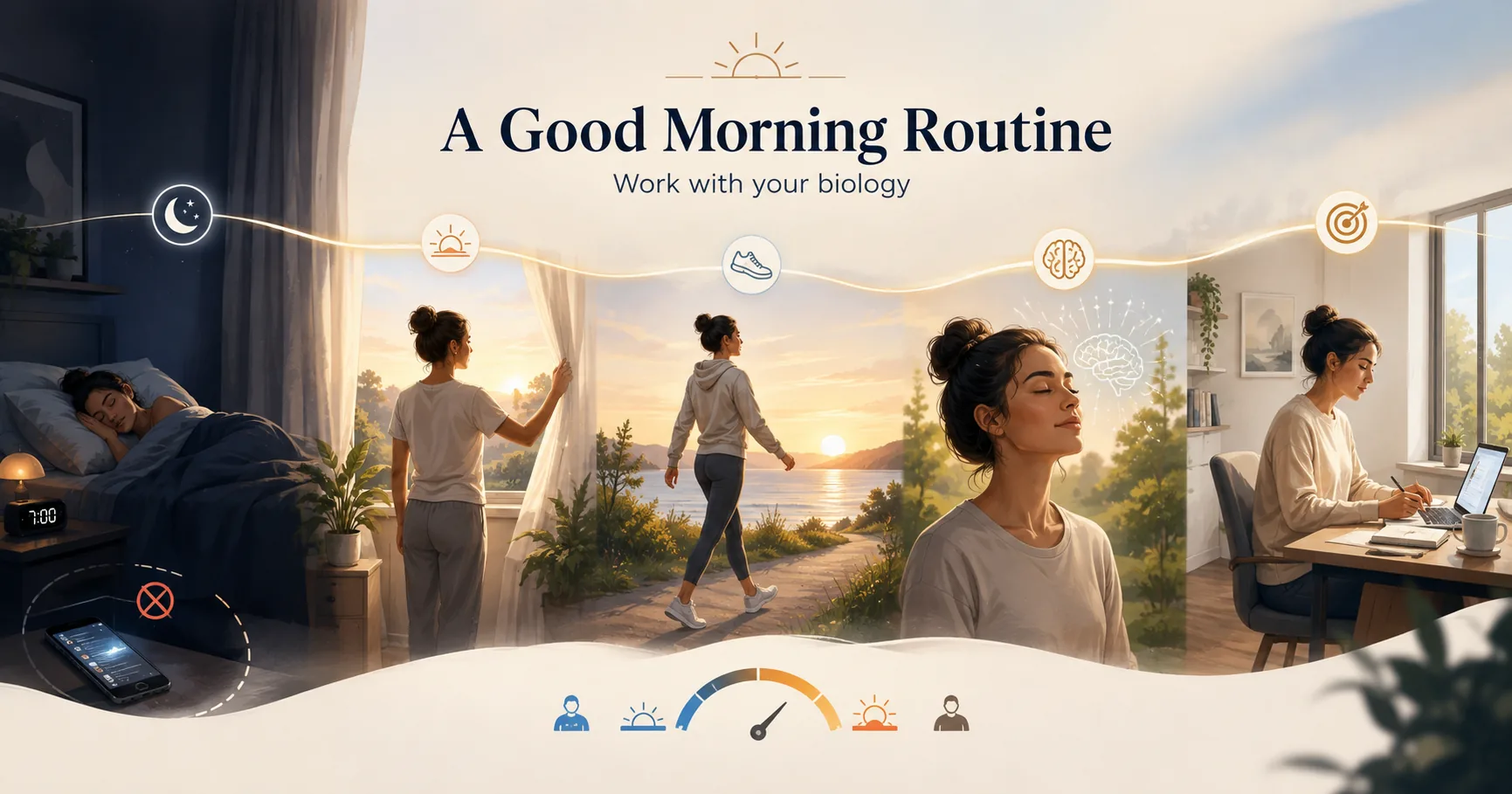
The internet is saturated with morning routine content. A certain genre of productivity writing insists that waking at 5am, journaling for thirty minutes, meditating, exercising, reviewing goals, and eating a nutritious breakfast - all before most of the world has opened its eyes - is the secret to high performance.[9]
Books have been written on this premise. Podcasts are dedicated to it. The CEOs and athletes who follow early-morning rituals are presented as evidence that the morning is the most important part of the day, and that mastery of it is, effectively, mastery of life.
The research tells a more complicated story. Some elements of popular morning routine advice are genuinely supported by biology. Others are either untested, applicable only to a subset of people, or actively counterproductive for those whose biology does not align with the early-rising template.
The most important variable in morning routine research is not any specific activity but individual variation - in chronotype, in sleep timing, in what kind of start actually produces alertness and engagement for a given person.
What research does support is a set of principles from which an effective morning can be constructed. What it does not support is a one-size-fits-all prescription.
Understanding the biology of morning - the cortisol awakening response, sleep inertia, circadian entrainment, and chronotype distribution - makes it possible to design a morning that works with your physiology rather than against it. For some people, this will look like 5am routines. For many others, it will look quite different.
"The body's internal clock does not care what time the alarm says. It cares about light, temperature, and the accumulated timing of your prior sleep." - adapted from Till Roenneberg[1]
Key Definitions
Cortisol awakening response (CAR): The natural spike in cortisol levels that occurs in the 30 to 45 minutes following waking. Cortisol is a glucocorticoid hormone that mobilizes energy, heightens alertness, and primes immune function. The CAR is a normal, healthy biological event that helps prepare the body for the demands of the day.
Sleep inertia: The transitional impairment of cognitive and motor function that occurs immediately after waking, as the brain shifts from sleep to wakefulness. Characterized by grogginess, slowed reaction time, impaired decision-making, and reduced memory encoding. Duration varies by individual and sleep stage.
Chronotype: An individual's biologically driven preference for the timing of sleep and wakefulness, and the phase of the circadian cycle at which they experience peak alertness. Determined partly by genetics, partly by age, and modifiable to some degree by light exposure and sleep scheduling.
Circadian rhythm: The approximately 24-hour biological cycle that regulates sleep-wake timing, hormone release, body temperature, metabolism, and many other physiological processes. Anchored primarily by light exposure and maintained by an internal pacemaker in the suprachiasmatic nucleus of the hypothalamus.
Zeitgeber: A German word meaning "time-giver," used in chronobiology to describe external cues that synchronize the internal circadian clock with the external environment. Light is the primary zeitgeber; temperature, meal timing, and social activity are secondary zeitgebers.[7]
| Morning Practice | Biological or Psychological Effect | Evidence Quality | Caveat |
|---|---|---|---|
| Bright light exposure (within 30 min of waking) | Anchors circadian clock; accelerates cortisol peak | Strong | Must be natural light or specific wavelength; indoor lighting is insufficient |
| Delay caffeine 90-120 min after waking | Avoids adenosine rebound; improves afternoon alertness | Moderate | Individual variation; experiment with timing |
| Light exercise | Clears sleep inertia; boosts mood-regulating neurotransmitters | Strong | Even 10-20 min walking has measurable effect |
| Consistent wake time (including weekends) | Strengthens circadian rhythm; most important sleep-quality variable | Very strong | More important than any other single routine element |
| Cold exposure (shower, air) | Increases alertness; reduces cortisol over time | Moderate | Not appropriate for everyone; voluntary only |
The Cortisol Awakening Response
What It Is and What It Does
In the 30 to 45 minutes following waking, cortisol levels rise sharply - typically by 50 to 100% above the pre-waking baseline.[5] This cortisol awakening response (CAR) is not a sign of stress.
It is a coordinated physiological event that mobilizes energy stores, sharpens cognitive alertness, activates immune function, and prepares the cardiovascular system for the demands of the day.
Research by Angela Clow and colleagues has established the CAR as one of the most reliably measurable outputs of the hypothalamic-pituitary-adrenal axis in healthy individuals.
The magnitude of the CAR varies by individual and is influenced by sleep quality, perceived stress, and the consistency of waking time. People who wake at consistent times show more pronounced CARs, which is one biological mechanism through which a regular wake schedule supports morning alertness.
People who are chronically sleep-deprived or under high psychological stress often show a blunted CAR, which may partly explain the chronic morning grogginess associated with these states.
The practical implication is that the period immediately following waking is not a peak alertness window - it is a ramp toward one. The cortisol rise supports alertness, but that alertness only arrives after sleep inertia clears and the CAR fully develops.
Trying to perform demanding cognitive work in the first 20 minutes after waking is working against the biology, not with it.
The Relationship Between CAR and Task Performance
Some research has suggested that the post-CAR window (roughly 30 to 60 minutes after waking for most people) represents a period of relatively high cortisol and emerging alertness that is well-suited to cognitively demanding work.
This is not universal - the timing varies by chronotype and individual physiology - but it provides a biological rationale for the common experience that focused work feels more accessible in the mid-morning than in the immediate post-waking period.
Sleep Inertia: Why the First Minutes Are Not Your Best
Trotti's 2017 Review
Lisa Trotti at Emory University School of Medicine published a comprehensive 2017 review of sleep inertia research in the journal Sleep Medicine Reviews. Sleep inertia describes the transitional impairment that occurs as the brain shifts from sleep to wakefulness.
It is not merely feeling tired - it involves measurable decrements in reaction time, working memory, executive function, and decision-making that persist for a variable period after the alarm sounds.
For most people in most conditions, sleep inertia clears within 15 to 60 minutes. In people with sleep disorders, after very deep slow-wave sleep, or when waking occurs during certain phases of the sleep cycle, sleep inertia can persist longer.
Trotti's review noted that the impairment during severe sleep inertia can rival that seen in moderate sleep deprivation or mild intoxication.[4]
The relevance to morning routine design is direct: the advice to immediately tackle your most important work upon waking - common in productivity content - is biologically poorly timed. The brain during sleep inertia is not operating at the capacity required for complex, focused work.
Activities that accommodate impaired function (light movement, hydration, simple habitual tasks, exposure to morning light) are better suited to the immediate post-waking period than cognitively demanding priorities.
What Accelerates Sleep Inertia Clearance
Light exposure is the most potent physiological accelerator of sleep inertia clearance. Bright light, particularly in the short-wavelength blue range abundant in morning sunlight, suppresses residual melatonin, activates wakefulness-promoting neural circuits, and advances circadian phase.
Physical movement - even gentle walking - increases cerebral blood flow and body temperature, both of which promote alertness. Cold water exposure (washing the face, a brief cold shower) activates the sympathetic nervous system. Hydration compensates for the fluid loss that occurs during sleep through respiration and sweating.
These interventions can meaningfully shorten the transition to functional wakefulness. They are also consistent with the commonly reported experience that people who exercise in the morning feel more alert afterward than before - a subjective report that aligns with the physiology of sleep inertia clearance.
Chronotypes: Not Everyone Is a Morning Person
Roenneberg's Large-Scale Research
Till Roenneberg at Ludwig Maximilian University of Munich has conducted some of the most extensive chronotype research in the field, studying over 500,000 people across multiple countries using questionnaires measuring sleep timing preferences and actual sleep behavior.
His work, summarized in Internal Time (2012), established that chronotypes fall along a continuous distribution from extreme early types (sometimes called larks, who naturally wake early and feel most alert in the morning) through intermediate types to extreme late types (sometimes called owls, who naturally wake late and feel most alert in the late morning, afternoon, or evening).
Roenneberg estimated that approximately 40% of the population has a late chronotype - meaning their natural biological peak alertness occurs significantly later than the typical morning-oriented schedule of most institutions. The remainder is distributed across intermediate and early types, with a smaller fraction at each extreme.
Chronotype is not simply a preference or a habit. It is biologically grounded: late chronotypes show different patterns of melatonin onset, different cortisol rhythms, and different sleep architecture timing than early types.
These differences are partly genetic: genes involved in circadian clock function account for a significant portion of chronotype variance.
Age also matters: teenagers shift significantly toward late chronotypes (a biological shift that peaks around 19 to 21 years of age) before gradually moving earlier through adulthood and into older age.
Social Jetlag
When late chronotypes are required to operate on early-morning schedules (school, conventional work hours), they experience what Roenneberg termed "social jetlag" - a chronic misalignment between biological time and social time.
Social jetlag is associated with increased cardiovascular risk, metabolic impairment, worse cognitive performance, higher rates of depression, and greater reliance on caffeine to compensate for chronic biological misalignment.[10]
The research implication is direct: a 5am morning routine is not inherently superior. For a late chronotype waking at 5am, the likely outcome is chronic partial sleep deprivation and impaired biological function - the opposite of what a good morning routine should achieve.
An effective morning routine for a late chronotype looks structurally different from one for an early chronotype, even if the underlying principles (consistency, light exposure, physical movement, limited screen time) are the same.
Daylight Exposure and Circadian Entrainment
Wright et al. (2013)
Kenneth Wright and colleagues at the University of Colorado published a 2013 study in Current Biology examining the effects of natural light exposure on circadian timing.
Participants who spent a week camping outdoors without artificial light shifted their circadian phase significantly earlier: melatonin onset moved approximately 1.4 hours earlier, and participants naturally began waking earlier and feeling sleepy earlier than before.[3]
The internal clock had entrained to the solar day.
This study underscored a point that chronobiologists have established across decades of research: the primary driver of circadian timing is light exposure, particularly morning light.
For people living primarily indoors, morning exposure to natural daylight (or a high-intensity light therapy lamp producing 10,000 lux) provides the signal the circadian clock needs to anchor its timing to the external day.
The practical implication for morning routines: early outdoor time, or positioning oneself near a window or using a daylight lamp in the morning, is one of the most physiologically significant things one can do. It is not a mindfulness practice or a wellness ritual - it is a circadian calibration signal.
For late chronotypes particularly, consistent morning light exposure can gradually shift biological timing earlier, reducing social jetlag without requiring the brute force of an earlier alarm.
The 5am Culture: What the Evidence Actually Supports
The Mythology of Early Rising
The popular association between 5am rising and success is built primarily on selected examples - prominent CEOs, athletes, and authors who wake early and attribute their success partly to this habit.
This is survivorship and selection bias: we hear from the early-rising successful people, not from the early-rising people whose performance was impaired by insufficient sleep, nor from the late-rising successful people whose productivity was enabled by working according to their biology.
Christoph Randler at the University of Education Heidelberg published research (2010) showing that self-reported morning people scored slightly higher on proactivity scales.
However, this likely reflects that morning types face less social jetlag in a society built around morning schedules - their biology aligns with institutional expectations, giving them an advantage independent of any intrinsic superiority of early waking.
The most important variable is not what time you wake but whether that time allows adequate sleep. Matthew Walker's research at UC Berkeley has consistently shown that the cognitive, metabolic, and health consequences of chronic sleep restriction (getting six or fewer hours when you need seven to nine) are severe and cumulative.
Waking at 5am while sleeping at midnight does not produce a high-performance morning - it produces sleep deprivation, impaired cognition, elevated cortisol, and increased metabolic risk.
Avoiding the Phone: The Attention Priming Problem
Why the First Hour Matters for Cognitive Set
There is no single definitive study establishing that phone avoidance in the morning improves the rest of the day. The evidence is convergent rather than direct.
Research on attentional priming shows that the first stimuli encountered shape the cognitive set - the framework of expectations, concerns, and goals - that influences how subsequent information is processed.
Beginning the day in a reactive mode, responding to notifications, news headlines, and other people's demands, establishes a cognitively reactive orientation that may persist into the hours that follow.
Research on attention and anxiety suggests that early morning exposure to stressful news or social media content elevates physiological stress markers (cortisol, heart rate) that can persist for hours.
The combination of residual sleep inertia, an activating cortisol awakening response, and incoming stress-inducing content may create a state that is suboptimal for the self-directed, focused work that most morning routine advice is trying to promote.
The alternative - using the first 30 to 60 minutes for physical movement, outdoor light exposure, and self-directed reflection or preparation - is consistent with the research on sleep inertia clearance, circadian entrainment, and attentional priming.
Whether this produces measurable productivity benefits across the day has not been rigorously tested, but the mechanistic rationale is coherent and the downside risk is low.
What Actually Makes a Morning Routine Effective
The Evidence-Based Principles
Distilling the chronobiology, sleep science, and cognitive research into practical principles:
Consistency of wake time is the single most important structural variable. Irregular wake times disrupt circadian rhythm, impair the cortisol awakening response, and degrade sleep quality. A consistent wake time (within 30 minutes, seven days a week) anchors the biological clock.
This is a stronger evidence base than any specific morning activity.
Adequate total sleep determines what is possible in the morning.[6] A routine built on insufficient sleep produces impaired cognition, elevated stress reactivity, and the very grogginess that morning routines are supposed to overcome.[8] The effective morning begins the night before.
The article on how to wind down in the evening covers the practices that protect sleep quality.
Morning light exposure provides the primary circadian entrainment signal. Even 10 to 15 minutes of outdoor light exposure, or use of a daylight lamp, meaningfully anchors the circadian clock and accelerates sleep inertia clearance.
Physical movement of any intensity accelerates sleep inertia clearance, increases alertness through catecholamine release, and contributes to BDNF-mediated cognitive readiness. This does not require an intense workout; a 20-minute walk achieves meaningful benefit.
Alignment with chronotype determines when focused work is most accessible. Late chronotypes who force early-morning deep work sessions are scheduling cognitively demanding tasks when their biology is least prepared for them.
Honest assessment of personal peak alertness, and scheduling accordingly, often matters more than specific morning activities. For more on the relationship between morning structure and cognitive performance, see how to improve focus.
Practical Takeaways
Set a consistent wake time, seven days a week. Vary it by no more than 30 minutes. Sleeping in significantly on weekends creates social jetlag that degrades Monday morning performance.[2] This consistency is the foundation everything else builds on.
Get outdoor light within 30 to 60 minutes of waking. Even on cloudy days, outdoor light is dramatically brighter than typical indoor light. A brief morning walk provides both light and movement.
Do not demand focused cognitive work before sleep inertia clears. Give yourself 20 to 40 minutes after waking before attempting important analytical tasks. Use this time for hydration, movement, and light.
Know your chronotype. If you consistently feel your best cognitive performance in the late morning or afternoon, that is biologically meaningful information. Schedule your most important work accordingly rather than fighting your biology with 5am ambition.
Delay phone engagement. There is no replicated study proving this, but the convergent evidence on attentional priming and stress reactivity supports starting the morning with self-directed activity rather than reactive media consumption.
Prioritize total sleep over wake time. Waking earlier while sleeping later does not create a better morning. It creates sleep deprivation. The most important morning routine decision you make is often the previous evening's bedtime.
Build the routine around principles, not rituals. The specifics (journaling, meditation, exercise, cold showers) matter less than whether they serve the underlying biological objectives: sleep inertia clearance, circadian anchoring, and transition into a cognitively ready state.
Reducing decision fatigue through a consistent routine also means fewer choices to navigate before you have started the day.
Sources & Further Reading
- Roenneberg, T. Internal Time: Chronotypes, Social Jet Lag, and Why You're So Tired. Harvard University Press, 2012.
- Roenneberg, T., Allebrandt, K. V., Merrow, M., and Vetter, C. "Social Jetlag and Obesity." Current Biology, 2012.
- Wright, K. P., McHill, A. W., Birks, B. R., Griffin, B. R., Rusterholz, T., and Chinoy, E. D. "Entrainment of the Human Circadian Clock to the Natural Light-Dark Cycle." Current Biology, 2013.
- Trotti, L. M. "Waking Up Is the Hardest Thing I Do All Day: Sleep Inertia and Sleep Drunkenness." Sleep Medicine Reviews, 2017.
- Clow, A., Thorn, L., Evans, P., and Hucklebridge, F. "The Awakening Cortisol Response: Methodological Issues and Significance." Stress, 2004.
- Walker, M. Why We Sleep: Unlocking the Power of Sleep and Dreams. Scribner, 2017.
- Czeisler, C. A., et al. "Stability, Precision, and Near-24-Hour Period of the Human Circadian Pacemaker." Science, 1999.
- Lim, J., and Dinges, D. F. "A Meta-Analysis of the Impact of Short-Term Sleep Deprivation on Cognitive Variables." Psychological Bulletin, 2010.
- Sharma, R. The 5AM Club: Own Your Morning, Elevate Your Life. HarperCollins, 2018.
- van Cauter, E., Leproult, R., and Plat, L. "Age-Related Changes in Slow Wave Sleep and REM Sleep and Relationship with Growth Hormone and Cortisol Levels in Healthy Men." JAMA, 2000.
Further Reading
- Randler, C. "Proactivity, Morningness, and Conscientiousness." Basic and Applied Social Psychology, 2010.
- Roenneberg, T., and Merrow, M. "The Circadian Clock and Human Health." Current Biology, 2016.
Article Word Count: 2,963