
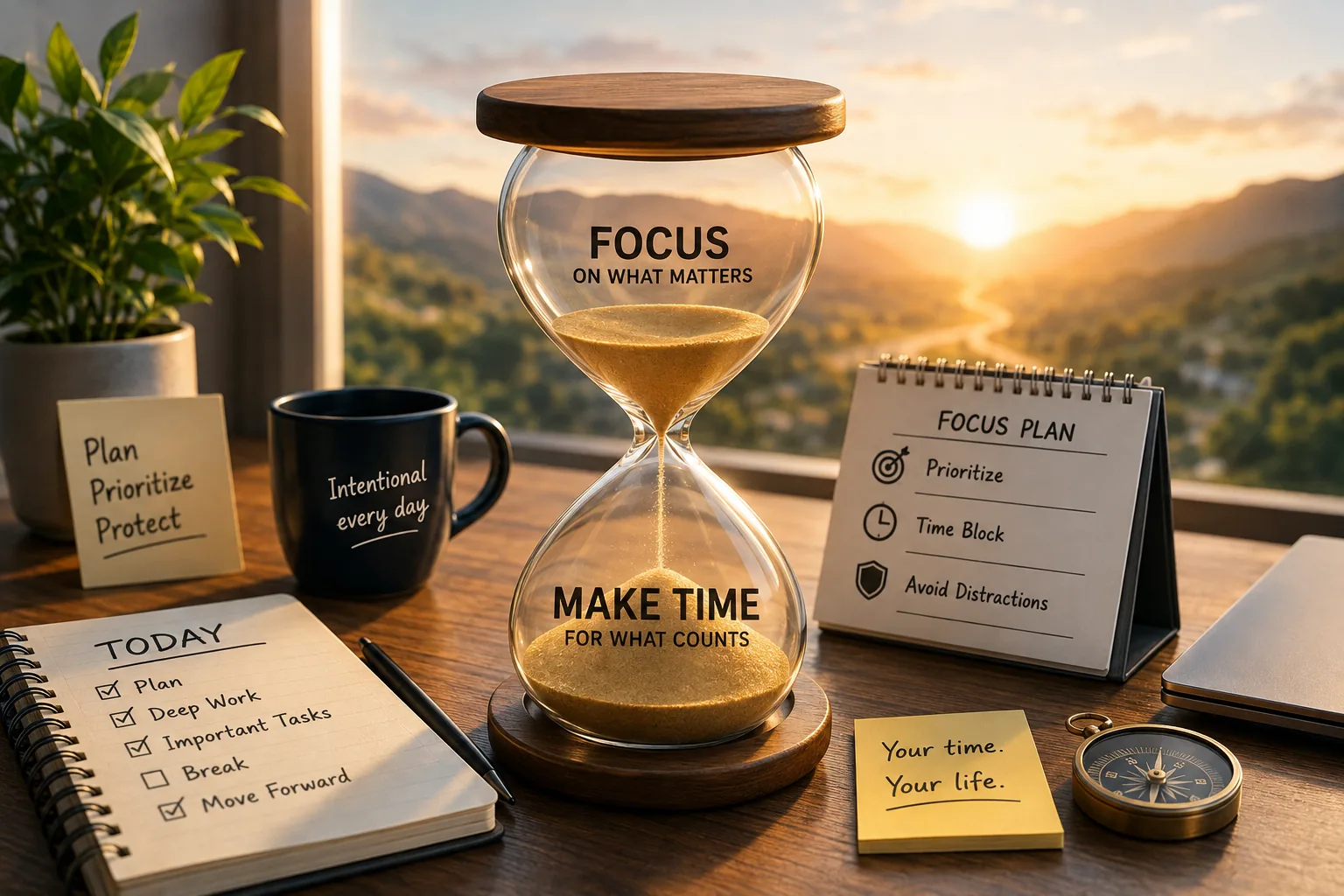
Effective time management is chiefly attention management: time is fixed, but focus is fragmented by reactive communication, meetings, and digital cues. A time audit reveals actual patterns, high-energy windows, and work that does not advance priorities. Protecting deep-work periods, distinguishing urgency from importance, and redesigning the environment work better than relying on willpower or multitasking.
"Time is the scarcest resource, and unless it is managed, nothing else can be managed." - Peter Drucker
A researcher (then a consultant at Microsoft) named Linda Stone coined the phrase "continuous partial attention" in 1998 to describe something she observed spreading through knowledge work culture: the constant, low-grade monitoring of multiple streams of information at once, not for fun, but out of a sense that something important might be missed.
Two decades later, that condition has become so normalized that most professionals no longer notice it. They sit in meetings while monitoring Slack.
They answer emails during conversations. They read while listening. They call it multitasking. What they are actually doing is managing their time extremely poorly - not because they lack systems, but because they have never correctly identified the actual problem.
The problem is not time. Time is fixed. Every person on earth receives exactly 168 hours per week, and no technique changes that. The real problem is attention: where it goes, how long it stays, how much of it remains after constant fragmentation.
Effective time management, when practiced by people who actually get important things done, is overwhelmingly a practice of attention management. The hours exist. The question is what you point your cognitive capacity at during them.
This guide covers what the research and the best practitioners actually know about doing that well.
"Lost time is never found again." - Benjamin Franklin
The Time Audit: Finding Where Your Time Actually Goes
Before any system or framework, there is one foundational practice: the time audit. And virtually everyone who does it for the first time is surprised by the results.
The premise is simple. For one to two weeks, track every activity in thirty-minute blocks throughout the day. Write it down in real time, not from memory at the end of the day. Do not change your behavior during the tracking period.
At the end, categorize every block: deep focused work, meetings, reactive communication (email, Slack, phone), administrative tasks, breaks, and non-work.
Most knowledge workers believe they spend the majority of their time on high-priority, cognitively demanding work. The audit almost always reveals something different.
A typical pattern: three to five hours of genuine deep work per week, twelve to fifteen hours of meetings (many of which are optional or ineffective), eight to twelve hours of reactive communication, and a surprising quantity of time that simply cannot be categorized because it was spent in a diffuse, neither-here-nor-there mode of half-attending to multiple things.
Laura Vanderkam, who has studied how people actually use their time through time-diary research for over a decade, has documented this gap between perceived and actual time use across thousands of subjects.
Her findings consistently show that people dramatically underestimate time spent on low-priority activities and dramatically overestimate time spent on high-priority ones.
The audit does not fix anything by itself, but it creates the honest foundation without which every other intervention is aimed at the wrong target.
The audit also reveals your natural rhythm. Most people have a two-to-four-hour window each day, usually in the morning but sometimes in the afternoon, when their cognitive capacity is highest. The audit, tracked over two weeks, makes that pattern visible. This matters enormously for what comes next.
Why Time Management Is Actually Hard
"It is not that we have a short time to live, but that we waste a good deal of it." - Seneca
It is worth pausing on why this is difficult, because the gap between knowing and doing in time management is unusually large. Most people who read about the Eisenhower matrix understand it immediately. Almost none of them apply it consistently.
The forces working against good time management are structural, not motivational.
Organizational cultures overwhelmingly reward responsiveness over focus - the person who answers emails within five minutes is perceived as a better employee than the person who batches communication to protect their deep work time, regardless of which one produces more valuable output.
Digital environments are engineered by teams of behavioral scientists to capture and retain attention; every notification, every algorithmic feed, every red badge on an icon exists to pull focus away from deliberate work.
Social norms in many workplaces equate busyness with value, making visible industry the safer performance than quiet, protected concentration.
Against these structural forces, willpower and good intentions are almost always insufficient. Effective time management requires designing your environment so that prioritized work is the path of least resistance, not the path of maximum resistance.
This is why the systems and environmental design discussed in the sections that follow matter more than motivational frameworks.
Prioritization: Three Frameworks Worth Knowing
The Eisenhower Matrix
Dwight Eisenhower, as Supreme Allied Commander and later as President of the United States, was famous for distinguishing between the urgent and the important.
He reportedly said that the urgent is rarely important, and the important is rarely urgent - an observation that became the foundation of what Stephen Covey later systematized as the four-quadrant matrix.[6]
The matrix divides tasks along two dimensions: urgency (how soon does this need to be done?) and importance (how much does this contribute to meaningful goals?). The four resulting quadrants define a clear hierarchy of response.
| Quadrant | Description | Action | Example Task |
|---|---|---|---|
| Q1: Urgent + Important | Genuine crises, real deadlines, immediate consequences for inaction | Do it now | A client system is down; a deadline that cannot move |
| Q2: Important, Not Urgent | Strategic thinking, skill development, relationship building, prevention | Schedule it and protect it | Writing a business strategy; exercising; mentoring a team member |
| Q3: Urgent, Not Important | Requests that feel pressing but do not advance your goals | Delegate or defer | Most interruptions; many meeting invitations; others' low-stakes requests |
| Q4: Neither Urgent Nor Important | Activities with no value delivered to anyone | Eliminate | Mindless browsing; unproductive routines; meetings that serve no purpose |
Quadrant one - urgent and important - contains genuine crises, real deadlines, and consequences for inaction. These require immediate response. The goal is to minimize time here through better planning, but some Q1 work is unavoidable.
Quadrant two - important but not urgent - is where the highest-value work lives: strategic thinking, skill development, relationship building, long-range planning, prevention. Because Q2 work carries no deadline pressure, it is perpetually displaced by urgency from Q1 and Q3.
High performers deliberately schedule Q2 work and protect it from displacement. This is the most important habit in time management, and the most consistently neglected.
Quadrant three - urgent but not important - is the quadrant that masquerades as Q1. These are tasks that someone else wants done now but that do not contribute meaningfully to your goals: many interruptions, many emails, many requests that could be handled by someone else.
The right response to Q3 is delegation when possible and deferral when delegation is not available.
Quadrant four - neither urgent nor important - is pure waste: mindless browsing, unproductive routines, time in meetings that serve no one. It should be eliminated.
The discipline the Eisenhower matrix actually requires is honest categorization. Almost everything feels urgent when it arrives. The practice is evaluating each task against actual goal contribution rather than urgency signals.
Warren Buffett's 25/5 Rule
"The difference between successful people and really successful people is that really successful people say no to almost everything." - Warren Buffett
The story, which Buffett reportedly shared with his pilot Mike Flint, involves a simple three-step exercise. First, write down your top 25 goals or priorities. Second, circle the five most important. Third - and this is where the framework becomes unusual - avoid the remaining 20 with the same discipline you would apply to your five.
The insight embedded in the 25/5 rule is about the danger of the almost-most-important. The 20 items on the avoid list are not obviously worthless; they are compelling enough to have made a list of 25 priorities. That is precisely what makes them dangerous.
They consume time and attention in ways that feel legitimate while displacing the five things that would generate the most meaningful results.
For weekly and monthly planning, this framework translates into a simple discipline: identify your three to five most important deliverables for the period, design your time allocation around them first, and treat everything else as optional relative to those commitments.
The MIT Method
The Most Important Task method, popularized by productivity writer Leo Babauta, is the simplest of the three. Every day, before anything else, identify one to three tasks that would make the day a genuine success if they were the only things accomplished. Complete at least one of them before attending to any reactive communication.
The MIT method is specifically designed for days in which email, meetings, and reactive work would otherwise colonize the entire schedule.
By making a pre-commitment to the most important task before entering the reactive stream, practitioners give themselves a psychological anchor that resists displacement. The method is most powerful combined with time blocking.
Time Blocking: How the Best Practitioners Structure Their Days
Time blocking means assigning specific tasks to specific time slots on your calendar rather than working from an undifferentiated to-do list. The to-do list tells you what to do. The time block tells you when, for how long, and therefore whether it actually fits in the available hours.
Cal Newport, Georgetown professor and author of Deep Work, uses time blocking as his primary scheduling method, allocating every working hour to a specific task category in advance.[1]
His approach forces an honest reckoning with capacity: when the blocks fill up and tasks remain, something must move rather than accumulating on an ever-growing list.
Bill Gates is famous for his "Think Weeks" - twice-yearly retreats during which he disconnects entirely from operational demands to read, reflect, and think about long-horizon strategy.
The Think Week is time blocking at its most extreme: an entire week protected for the most important Q2 work, defended against every operational urgency.
Elon Musk reportedly schedules his day in five-minute increments, an approach that sounds counterproductive but reflects an underlying principle: every unit of time is pre-allocated rather than left to fill opportunistically with whatever feels most pressing.
The common thread is intentionality. Time blocking works because it moves decision-making about time use from in-the-moment (where cognitive depletion and social pressure distort judgment) to advance planning (where priorities can be evaluated clearly).
Implementing time blocking effectively requires three practices. First, block your most important work during your peak energy window identified by the time audit.
This is non-negotiable: cognitive capacity is not uniform throughout the day, and scheduling demanding work during low-energy periods means producing inferior output at higher cost.
Second, treat these blocks with the same commitment you give to external meetings. When a block says "product strategy document, 9-11 AM," that appointment is as binding as a board presentation.
Third, build buffer time between blocks, because work almost always takes longer than planned and the absence of transitions creates cascading disruptions when anything runs over.
The Multitasking Myth: What the Research Actually Shows
The research is unambiguous, has been so for two decades, and is routinely ignored.
David Meyer, a cognitive psychologist at the University of Michigan, has spent much of his career studying task-switching, the cognitive process that underlies what people call multitasking. His findings, replicated widely, show that genuine multitasking on cognitive tasks is neurologically impossible.
The brain does not process two demanding tasks simultaneously; it alternates between them, with each switch carrying a measurable reorientation cost.[2]
This cost - the time required to reload the context of the previous task after switching away and then back - accumulates to a productivity loss Meyer estimates at up to 40 percent for complex tasks.
The subjective experience of multitasking feels productive because of stimulation: the constant switching produces neurochemical responses associated with novelty and activity.
This feeling is independent of actual output quality or quantity, which is why people who multitask heavily consistently overestimate how much they have accomplished.
Meyer's research also found that people who habitually multitask show reduced ability to filter irrelevant information - they have degraded attentional control - and lower working memory performance. The habit of scattered attention changes cognition in ways that extend beyond the specific multitasking episode.
For practical time management, the implication is simple and has no exceptions: for any task that requires genuine cognitive engagement, do it exclusively until it is complete or until a natural stopping point, then switch. The to-do list is a sequential list, not a simultaneous one.
Managing Interruptions: The Hidden Time Tax
Gloria Mark, a researcher at UC Irvine, has studied workplace interruptions in field settings for over fifteen years.[3] One of her most striking findings: after being interrupted, it takes an average of 23 minutes to fully return to a state of focused engagement with the original task.
Not 23 minutes until you are back at your desk working on it - 23 minutes until you are cognitively back in the task at the level you were when the interruption occurred.
In a typical knowledge work environment with interruptions every three to five minutes from notifications, messages, and in-person requests, the implication is that many people spend their entire day never reaching genuine focus at all. They work in a permanent state of partial re-engagement.
Defending against interruptions requires both structural and social strategies. Structurally: turn off all non-urgent notifications during focused work periods. Close email and messaging applications when deep work is required.
Use the calendar to signal commitment - a blocked period on a visible calendar is both a personal commitment and a social signal to colleagues.
In physical office environments, physical signals like headphones or a closed door communicate availability status. In remote environments, calendar visibility and status indicators serve the same function.
Socially: communicate your availability windows proactively rather than reactively. Tell your team when you are in focused work time and when you are available, so that urgent needs can be assessed against a known framework rather than requiring constant interruption to test your accessibility.
With managers specifically, have an explicit conversation about what constitutes a genuine emergency versus what can wait for your next communication window.
Batching communication is one of the highest-leverage structural changes available. Rather than monitoring email and Slack continuously, process them in defined windows - three times per day is a common pattern - and be explicit with colleagues about this rhythm.
Most workplaces believe they require constant availability until someone demonstrates through practice that they do not.
Energy Management vs. Time Management
Every hour on the clock is not equivalent. An hour of work at 9 AM after a good night's sleep, with the most important task loaded and ready, is worth several hours of fragmented effort in the afternoon after five meetings and 80 emails.
Tony Schwartz and Jim Loehr, whose research on performance across domains from athletics to executive leadership informed their book The Power of Full Engagement, argue that energy - physical, emotional, mental, and spiritual - is the actual resource that determines what gets done well, and that managing time without managing energy is an incomplete strategy.[4]
The most immediately actionable element of energy management is working with ultradian rhythms rather than against them.
The ultradian rhythm is a roughly 90-to-120-minute oscillation in alertness and cognitive capacity that operates throughout the day, discovered by sleep researcher Nathaniel Kleitman and later applied to performance contexts.
Within each cycle, there is a period of higher capacity followed by a trough of lower capacity. The body signals the trough through yawning, loss of focus, physical restlessness, and the urge to distract.
Most people override these signals with caffeine and willpower, pushing through at reduced effectiveness. The alternative is to take the signals seriously: when the ultradian trough arrives, take a genuine break of ten to twenty minutes rather than forcing continued degraded output.
The break restores the cycle, and the subsequent period of higher capacity is more productive than the forced continuation through the trough would have been.
Matching task type to energy level is the other core energy management practice. High-energy periods should contain the most demanding, cognitively intensive work: writing, complex problem-solving, strategic thinking. Medium-energy periods work well for meetings, collaborative work, and tasks requiring social presence.
Low-energy periods are suited to administrative work, routine tasks, and anything that can be done on partial autopilot without quality loss.
Calendar Design Principles
A calendar is either a strategic tool or a passive record of what other people have scheduled for you. The distinction depends on whether you design it intentionally from priorities or allow it to fill from external demand.
Effective calendar design starts from goals rather than appointments. Identify your top two to three strategic priorities for the current quarter and the specific weekly activities that most directly advance them.
Block recurring time for those activities first, before any other commitments fill the calendar. These are the appointments with yourself that protect Q2 work from being perpetually displaced.
Then schedule communication and meeting time, keeping it batched where possible - a two-hour window in the morning and another in the afternoon, for example, rather than availability spread in fragments throughout the day. Fragmented availability prevents sustained focused work in the gaps.
Review your calendar at the start of each week. The review question is: do the activities scheduled this week actually advance the priorities I have identified?
When the answer is no - when a week is full of meetings that serve others' priorities but not yours, and your own important work has no protected time - something needs to move.
The weekly review is also where commitments should be stress-tested. A fully blocked calendar with no buffer creates a system that fails catastrophically when anything runs over or arrives unexpectedly.
Build slack: a realistic weekly schedule is at most 70 percent planned, with 30 percent available for emergence, overruns, and the genuine urgent-and-important that could not be anticipated.
Saying No: Frameworks for Declining Requests
No skill in time management has a higher return than the ability to decline requests that do not merit your time. And no skill is more consistently underdeveloped.
The first requirement for saying no effectively is clarity about what you are currently committed to.
Without a clear mental model of your priorities and obligations, every new request gets evaluated in isolation, and many things that sound good in isolation displace more important things already in progress. The weekly review and intentional calendar design create this mental model.
When declining, specificity outperforms vagueness. "My capacity is fully committed through end of month on the product launch" is more credible and less relationship-damaging than "I'm too busy." The specific reason communicates that the declination is situational rather than dismissive, and it implicitly communicates that you are the kind of person who takes commitments seriously.
Offering a concrete alternative - a different timeline, a scaled-down contribution, or a referral to someone better positioned to help - reduces the relational cost of declining.
So does acknowledging the importance of the request even while declining: "This sounds like genuinely valuable work, and I want to give it the attention it deserves rather than fit it into an already overcommitted schedule" is a more respectful no than a bare refusal.
The deeper habit is accepting that a reluctant yes followed by poor execution or resentment is far more damaging to relationships than a clean, honest no. People who deliver reliably on the commitments they take are respected far more than people who take everything and complete it partially.
Tools: What Helps and What Distracts
The productivity tool market is enormous, and a significant proportion of people who struggle with time management spend meaningful energy evaluating, adopting, and switching between tools. This is often a highly productive-feeling form of procrastination.
The core infrastructure for effective time management is simple. A reliable calendar for time blocking.
A single trusted system for capturing tasks and commitments - this can be a notebook, a text file, or a simple task manager - so that things do not live in working memory where they generate cognitive overhead.[5]
And a weekly review practice for ensuring nothing important is falling through the gaps.
Beyond this foundation, additional tools help only when they address a specific, identified problem rather than offering the appeal of a more sophisticated system. Toggl or Clockify for time tracking during a time audit.
A focus timer (any timer, or an app like Be Focused) for implementing time blocks. A note system for capturing thinking - Obsidian and Notion serve this purpose for many people.
The diagnostic question for any new tool is: does this solve a specific problem I am currently experiencing, and can I implement it in less than a day? If the tool requires significant configuration, has a steep learning curve, or takes significant time to evaluate, it is almost certainly adding complexity rather than reducing it.
The goal is a simple, reliable system that you actually use, not an optimized system that you are perpetually refining.
What the Research Actually Shows About Time Management Interventions
Field research on time management interventions reveals a more nuanced picture than the popular productivity literature suggests.
Therese Macan of the University of Missouri conducted one of the first rigorous empirical studies of time management behaviors in 1994, surveying 353 employees across organizations to identify which practices actually predicted outcomes.
Her research, published in the Journal of Applied Psychology, found that goal-setting and prioritization were the strongest predictors of job performance and reduced tension, while perceived control over time predicted both performance and stress reduction.
Notably, Macan found that the simple act of mechanics - using planners, creating lists - showed weaker independent effects than the underlying habits of deliberate goal-setting and prioritization that good tools support.
A 2021 meta-analysis by Brad Aeon and colleagues at Concordia University, reviewing 158 studies on time management published through 2019, found that time management was moderately associated with job performance (r = .259), academic achievement (r = .357), and wellbeing (r = .324).
Critically, the researchers found that the type of training mattered: programs focusing on planning and prioritization behaviors outperformed those focused on scheduling tools alone.
The analysis, published in PLOS ONE, is the most comprehensive synthesis of time management research to date and supports the emphasis on deliberate planning behaviors over tool adoption.
Microsoft's Workplace Analytics team studied the calendar patterns of 50,000 knowledge workers in 2019, finding that the average manager spent 85 percent of their time in meetings, email, and chat - leaving fewer than 11 hours per week for focused individual work.
Workers with more protected focus time showed higher performance ratings and lower attrition. The study also found that workers who batched email into two or three daily windows rather than monitoring continuously saved an average of 23 minutes per day and reported significantly lower stress.
This organizational-scale data validates the individual intervention recommendations that focus research suggests.
Laura Vanderkam, whose time-diary research has tracked how people actually use their time since 2003, found in her time-diary research that people who reported working 70-hour weeks overestimated their hours.
People reporting 70-hour workweeks actually worked closer to 56 hours on average.
The gap between perceived and actual time use has direct practical implications: the people most likely to feel they have no time for important work often have more discretionary time than they perceive, distributed across periods they fail to recognize as usable for focused work.
Case Studies: Organizations That Redesigned Time Management at Scale
Several organizations have produced well-documented experiments in time management redesign that offer evidence beyond individual practice.
Boston Consulting Group partnered with Leslie Perlow of Harvard Business School on a landmark study published in Harvard Business Review in 2012. Perlow and colleagues worked with BCG consulting teams to introduce predictable time off - one guaranteed uninterrupted evening per week per team member.
The experiment ran against BCG's high-intensity culture and was met with initial resistance.
Results were measured across multiple dimensions: teams with predictable time off reported higher job satisfaction (a 74 percent improvement on the satisfaction scale used), better communication and coordination within teams, and higher quality learning and development.
Crucially, client satisfaction scores did not decline. The research demonstrated that forced boundary-setting benefited both individuals and output, because the discipline of protecting time caused teams to prioritize and plan more deliberately.
LinkedIn restructured its meeting culture in 2020 based on an internal analysis showing that its engineers were losing an average of 4.7 hours per week to unnecessary meetings, calculated by surveying 3,000 employees on which meetings they attended that could have been an email or could have been skipped entirely without consequence.
The company introduced a firm policy of No Meeting Wednesdays for all engineering teams and required meeting organizers to submit an agenda in advance.
Engineering teams reported a 28 percent increase in self-reported focus time within three months.
Concurrently, LinkedIn's internal data showed that engineering output - measured by features shipped per sprint - held steady despite the reduction in coordination time, suggesting the meetings had not been load-bearing for actual work output.
Amplitude, a product analytics company, implemented Focus Fridays in 2021 - a company-wide policy banning internal meetings on Fridays and encouraging employees to use the day for deep work, learning, or creative projects.
The company tracked outcomes over two quarters and found that employees took fewer sick days (down 11 percent), rated their work more positively in monthly surveys (an 18-point improvement on engagement scores), and the Friday policy correlated with a measurable increase in employees completing internal learning and development courses (up 34 percent).
The Amplitude case is notable because it demonstrates measurable outcomes across wellbeing, engagement, and development simultaneously, suggesting that protected time pays dividends beyond immediate task output.
Practical Takeaways
The gap between understanding time management and practicing it effectively comes down to a small number of concrete habits executed consistently. Start with a two-week time audit, tracked in real time, without modifying behavior during the tracking period. The results will be uncomfortable and instructive.
From the audit, identify your peak energy window and protect it for your most cognitively demanding work. Design this protection structurally: block it on your calendar, turn off notifications during it, and communicate its existence to the people most likely to interrupt it.
Run your calendar from priorities rather than from demand. Every week, identify the two to three activities that would make the week genuinely successful if they were accomplished, and give those activities protected time before other commitments fill the available space.
Practice the Eisenhower categorization until it becomes automatic. When a task arrives, the first question should always be: is this genuinely important, or does it merely feel urgent?
That question, applied consistently, separates the small percentage of people who use their time with real intention from the large majority who are perpetually busy and perpetually behind.
Time is not the scarce resource. Attention is. Design your environment, habits, and systems to protect it, and the time problem largely solves itself.
Sources & Further Reading
- Newport, C. (2016). Deep Work: Rules for Focused Success in a Distracted World. Grand Central Publishing.
- Rubinstein, J.S., Meyer, D.E. & Evans, J.E. (2001). "Executive control of cognitive processes in task switching." Journal of Experimental Psychology: Human Perception and Performance, 27(4), 763-797.
- Mark, G., Gudith, D. & Klocke, U. (2008). "The cost of interrupted work: More speed and stress." Proceedings of the SIGCHI Conference on Human Factors in Computing Systems (CHI '08), 107-110. ACM.
- Loehr, J. & Schwartz, T. (2003). The Power of Full Engagement: Managing Energy, Not Time, Is the Key to High Performance and Personal Renewal. Free Press.
- Allen, D. (2001). Getting Things Done: The Art of Stress-Free Productivity. Viking.
- Covey, S.R. (1989). The 7 Habits of Highly Effective People: Powerful Lessons in Personal Change. Simon & Schuster.