
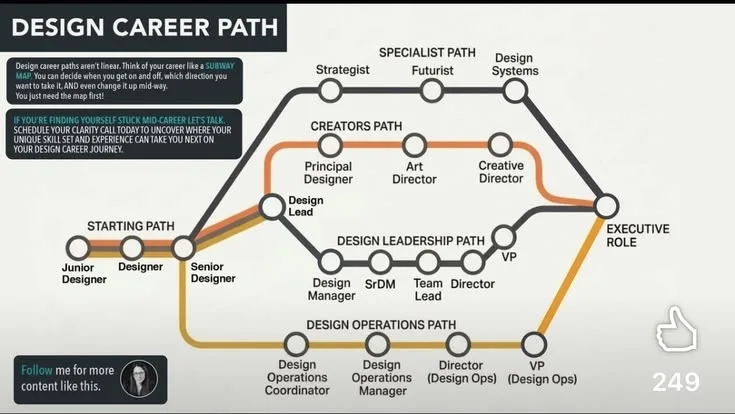
Most UX designers enter the profession with a clear short-term goal - get the first job, build a portfolio, survive the first sprint - and no coherent long-term plan. This is understandable. The field is young enough that there was, until recently, little consensus about what a senior UX designer does, let alone a principal or a director.
The career infrastructure that makes progression legible in engineering or law - standardized levels, defined competency frameworks, transparent promotion criteria - has only begun to mature in design over the last decade.
The absence of clear career maps has cost designers significantly. Talented practitioners have stagnated at mid-level for years because no one explicitly communicated what senior-level performance looked like.
Others have made the mistake of defaulting to management as the only visible path forward, discovering too late that they preferred craft to people leadership.
Still others have moved laterally into product management without understanding what they were trading away or gaining.
This article maps the full trajectory of a UX design career: the levels, what each requires, how long progression typically takes, the fork between individual contributor (IC) and management tracks, the main specializations, and the realistic paths out of design into adjacent roles.
'The most common career mistake I see in design is treating management as the destination. There is an entire craft progression above senior that most designers never pursue because they assume the only way up is to stop designing.'
- Peter Merholz, founding partner of Adaptive Path, co-author of 'Org Design for Design Orgs' (2016)[2]
Key Definitions
Individual Contributor (IC): A career track in which progression is based on increasing scope and impact of design work, without managing people directly.[9] The IC track in design parallels the staff/principal track in engineering.
Design Manager: A management role responsible for the development, performance, and wellbeing of a team of designers. Design managers are typically working designers who have taken on people leadership.
Principal Designer: The highest individual contributor design role in most organizations - operating with scope across multiple product areas, influencing design strategy, and establishing standards that other designers follow. Equivalent in seniority to a director-level manager.
Design Systems: A shared library of reusable components, patterns, and guidelines that enables teams to build consistent products at scale. Design systems work has become a distinct specialization within UX.
Design Operations (DesOps): The operational infrastructure of a design organization - process, tooling, talent development, workflow - managed by a dedicated function at larger companies.
Career Level Comparison
| Level | Title | Typical Experience | US Total Comp | Key Milestone |
|---|---|---|---|---|
| 1 | Junior UX Designer | 0-2 years | $65,000-$90,000 | Executes defined work |
| 2 | Mid-Level UX Designer | 2-5 years | $95,000-$140,000 | Owns problem space end-to-end |
| 3 | Senior UX Designer | 5-9 years | $130,000-$185,000 | Defines problem, mentors, strategic thinking |
| 4 | Staff / Lead Designer | 8-14 years | $170,000-$240,000 | Cross-team influence, practice standards |
| 5 | Principal Designer | 12+ years | $230,000-$350,000+ | Company-wide or BU scope |
| 4M | Design Manager | 5-10 years | $160,000-$260,000 | Manages 4-8 designers |
| 5M | Director of Design | 10-15 years | $220,000-$380,000+ | Manages managers, org-level strategy |
The Seniority Ladder: What Each Level Requires
Junior UX Designer (0-2 Years)
Junior designers execute defined work. They build wireframes and prototypes to briefs set by more senior team members, participate in research activities they did not design, and receive significant guidance on decisions.
Their primary growth area is developing the mechanics of design - fluency with Figma, understanding of research methods, and the ability to communicate design work clearly in a critique.
The most common pitfall at this level is overconfidence about readiness for more autonomous work before the foundations are solid. Junior designers who push for more ownership before demonstrating reliability in executing defined scope create friction with managers and can limit their own development.
According to the Nielsen Norman Group's 2024 UX Careers Report, junior designers who received structured mentorship and regular design critiques reached mid-level performance benchmarks approximately 40% faster than those without formalized feedback.[1]
This suggests that actively seeking critique - rather than avoiding the discomfort of it - is among the highest-leverage development activities available at this stage.
Key skills to develop as a junior designer include: mastery of a core design tool (Figma is the industry standard by a wide margin, used by 82% of design teams per Figma's 2024 State of Design Tools report), basic user research facilitation, the ability to receive design feedback without defensiveness, and enough understanding of front-end development constraints to design within them rather than against them.
Mid-Level UX Designer (2-5 Years)
Mid-level designers can own a defined problem space end-to-end: they can run their own research, generate solutions, make design decisions with appropriate consultation, and deliver work that meets production standards without close supervision.
This is the level where most designers plateau longest - sometimes indefinitely. The gap between mid-level and senior is fundamentally a gap in strategic thinking and communication, not technical skill.
Mid-level designers who are excellent in Figma but avoid the harder work of stakeholder communication and problem framing often find that their progression stalls despite strong execution quality.
The NN/g 2024 data reveals that the average time designers spend at mid-level before either reaching senior or leaving the organization is approximately 3.2 years.[4] Designers who received explicit coaching on stakeholder communication - not just design craft feedback - reached senior significantly faster than their peers.
The skills gap from mid to senior that most managers identify is not visual or interaction design skill. It is the shift from being given a problem to defining the right problem in the first place. Mid-level designers typically receive a brief from a product manager and execute it.
Senior designers push back on briefs, ask whether the stated problem is the actual problem, and conduct or propose research to validate the framing before building any artifacts.
Senior UX Designer (5-9 Years)
Senior is the terminal level for many practitioners and the benchmark level for experienced hires.
Senior designers are expected to define the problem as well as solve it, communicate effectively across functions including engineering and product leadership, mentor junior designers, and make design decisions defensible in terms of both user need and business impact.
The NN/g 2024 UX Careers Report finds that the median time from first job to first senior title is approximately six years, with significant variance by company size, feedback quality, and proactivity of the individual designer.
Designers at larger companies with formal promotion tracks averaged closer to seven years; designers at early-stage startups with rapid responsibility expansion averaged closer to four.
Senior designers who distinguish themselves for staff-level promotion typically demonstrate one or more of the following beyond solid execution: they have documented evidence of improving team-wide design quality (not just their own work), they have led at least one significant cross-functional initiative from research through delivery, and they have been sought out by peers and product managers for input on problems outside their direct area.
Total compensation at the senior level varies substantially by company type. At top-tier tech companies (FAANG-adjacent), senior UX designers command total compensation of $180,000 to $260,000 when equity is included. At mid-size SaaS companies, the same title typically yields $110,000 to $160,000 in total compensation.
Levels.fyi data from 2024 shows the 75th percentile senior UX designer at Figma, Stripe, and similar companies exceeds $220,000 total compensation.[14]
Staff / Lead Designer (8-14 Years)
Staff designer or design lead is the first level at which individual contributors are expected to have impact beyond their immediate product area.
Staff designers influence the design practice across teams - establishing critique standards, contributing to design system governance, mentoring multiple junior and mid-level designers, and representing design in senior product and engineering discussions.
The promotion criteria for staff-level roles are notoriously opaque. The most common definition involves demonstrated impact on multiple teams, not just excellent execution within one. Fewer than 20% of working designers ever hold a staff or lead title, according to NN/g 2024 survey data.
The bottleneck is not competence - it is the rarity of opportunities that allow cross-team impact to be demonstrated, which is itself partly a function of organizational structure.
Will Larson's framework from "Staff Engineer: Leadership Beyond the Management Track" (2021), while written for engineering, maps precisely to the staff designer challenge: staff-level ICs must identify their own scope, find the leverage points where their work multiplies others' effectiveness, and do so without direct authority.[3]
A staff designer who waits to be assigned cross-team projects will never reach staff level; the path requires proactively identifying and taking on the work.
Principal Designer (12+ Years)
Principal designers operate at the highest individual contributor scope - influencing design direction across entire companies or business units.
They typically spend significant time on establishing design standards and principles, working with engineering and product leadership on long-range strategy, mentoring staff and senior designers, and representing design externally.
Total compensation for principal designers at top-tier tech companies overlaps with director-level management roles, which is intentional.
Companies that created the IC track to staff and principal did so specifically to retain highly effective individual contributors who had no interest in management but needed a compensation ceiling that made staying worthwhile.
The most visible principal designers in the industry - figures like John Maeda (former Design Partner at Kleiner Perkins), Khoi Vinh (Principal Designer at Adobe), and the late Michael Bierut - are notable not merely for excellent craft but for having shaped how practitioners think about design as a discipline.
This is the work of a principal: shifting the field, not just executing within it.
The Fork: Individual Contributor vs Management
The IC-versus-management decision is one of the most significant in a UX design career, and it is often made for the wrong reasons.
Designers move into management because: there is no visible IC progression above senior at their company; they want a salary increase and management is the only labelled path to one; or they feel genuine pull toward developing other designers.
Only the last reason is sufficient. Design management is a distinct profession from design practice. It requires performance management, career development coaching, team process design, hiring, and organizational communication skills that are entirely separate from the ability to produce excellent design work.[17]
Industry anecdotal reports suggest that a significant share of designers who transition into management return to the IC track within a few years.
The most common reasons cited were: missing deep design work, discovering that people management was significantly more emotionally demanding than anticipated, and finding that management had degraded their design skills to a point where returning to senior IC work required a visible step backward.
The Management Track in Detail
Design Manager (typically 4-8 direct reports): The first management role. Primary responsibilities include one-on-ones with direct reports, performance reviews, participation in hiring, and bridging design work to product and engineering leadership.
At this level, many design managers still design part-time - typically contributing to 20-30% of their former design output.
Director of Design (manages managers or manages a larger team): At the director level, the work shifts from managing individual designers to managing the design organization itself: headcount planning, cross-functional executive relationships, setting design strategy for a product area, and representing design in senior leadership forums.
Hands-on design contribution largely ceases.
VP of Design / Chief Design Officer: Executive design leadership roles exist at companies large enough to have distinct design organizations. These roles involve setting the design vision for the entire company, participating in executive strategy discussions, and acting as the external face of the company's design philosophy.
Designers who want the management track should pursue explicit management experience - leading an intern or junior designer, running a hiring process, taking on a design lead title with direct reports - before formally moving into a management role.
Designers who want to stay on the IC track need to advocate explicitly for a visible IC progression path at their employer. Without it, they are likely to be pushed toward management by a career structure that assumes management is the goal.
Compensation by Track: IC vs Management
One of the persistent myths in design career planning is that management inevitably pays more than the IC track. At companies with mature dual-track progression, this is simply false.
| Role | Track | Typical US Total Comp |
|---|---|---|
| Senior Designer | IC | $130,000-$185,000 |
| Staff Designer | IC | $170,000-$240,000 |
| Principal Designer | IC | $230,000-$350,000+ |
| Design Manager | Management | $160,000-$260,000 |
| Director of Design | Management | $220,000-$380,000+ |
| VP of Design | Management | $300,000-$600,000+ |
The overlap between staff/principal IC and director management is substantial and deliberate. Companies like Google, Meta, Airbnb, and Figma have explicitly built their compensation bands to make the IC track viable as a career destination rather than a consolation prize for those who did not want to manage.
UX Design Specializations
UX Research
UX research is the most distinct specialization within the broader design field. Researchers focus exclusively on generating and synthesizing user insight, without producing UI design artifacts.
They design and run studies (usability tests, interviews, surveys, diary studies, ethnographic field research), analyze data both qualitative and quantitative, and present findings to product teams.
Research roles are increasingly valued at product companies. The Dovetail State of UX Research 2024 report found that 67% of product companies planned to maintain or grow their research headcount, compared to 41% who said the same for generalist product design roles.[6]
This divergence reflects both the growing recognition of research's value and the industry layoffs of 2022-2023, which hit generalist design roles harder than specialized research roles.
Senior researchers at top-tier tech companies earn total compensation comparable to senior product designers, with a well-defined IC progression through research lead and principal researcher levels.[7]
Research-only roles at Google, Meta, and Microsoft carry titles up to Director of Research, with total compensation at the principal level exceeding $300,000.
Content Design and UX Writing
Content designers (also called UX writers) focus on the language within interfaces: error messages, button labels, onboarding flows, empty states, and the conversational design of chatbots and voice assistants. The discipline requires both writing skill and UX thinking.
The field has grown substantially as organizations have recognized that interface copy is as consequential as visual design for user experience. A 2023 study by the Content Design London research team found that clear, well-designed error messages reduced user support contacts by an average of 31% across six case studies.
This kind of measurable impact has elevated content design from a niche specialization to a recognized discipline with dedicated career tracks at Google, Microsoft, Amazon, and Atlassian.
Andrea Anderton's research at Content Design London (2023) documented that content designers working in senior individual contributor roles commanded salaries in the United Kingdom ranging from GBP 55,000 to GBP 90,000, comparable to senior product designers - a convergence that would have been unusual five years earlier.[11]
Design Systems
Design systems work has become one of the most in-demand UX specializations. Design systems designers build and maintain shared component libraries, establish design tokens, document usage guidelines, and collaborate closely with engineering to implement components in code.
LinkedIn job posting data from 2024 consistently shows design systems roles as the most underserved relative to demand within the design job market - the scarcity of experienced practitioners commands premium rates and provides relatively strong insulation from job market compression.[5]
The value proposition of design systems is quantifiable in ways that general UX design work often is not. Airbnb's DLS team published findings showing that a mature design system reduced the time to build new product screens by approximately 50%, primarily by eliminating redundant design-and-build cycles for standard components.[18]
Shopify's Polaris team documented similar gains.[19] This measurable ROI has made design systems investment a consistent priority even during periods of design headcount reduction.
Figma's 2024 State of the Practice report on design systems found that 68% of companies with 100+ designers now have a dedicated design systems team, up from 43% in 2020.[8]
The role is no longer emerging - it is established, well-compensated, and has a clear career ladder from design systems designer through design systems lead to Director of Design Systems.
Motion and Interaction Design
Motion designers focus on animation and transition design within digital products - the micro-interactions, loading states, page transitions, and branded moments that differentiate polished from functional. These specializations are increasingly relevant as AI-generated interfaces introduce more dynamic, state-based behavior.
The tools overlap: motion designers in product settings typically work in Figma's Smart Animate, Principle, Rive, or After Effects, depending on the type and complexity of the animation. Engineers implement motion with CSS transitions, Framer Motion, or native platform animation libraries.
Accessibility Design
Accessibility has evolved from a compliance obligation to a recognized design specialization as regulatory pressure has increased and inclusive design principles have gained mainstream adoption.
The European Accessibility Act, which became enforceable on 28 June 2025, created significant demand for accessibility-specialized designers across European and multinational companies.
Accessibility specialists typically combine knowledge of WCAG guidelines, assistive technology testing, and inclusive design methodology. Compensation for senior accessibility designers overlaps with senior product designers, and demand has outpaced supply consistently since 2022.
The Move into Product Management
UX designers are well-positioned to transition into product management. The skills overlap is significant: designers understand user research, can communicate across engineering and business stakeholders, think in user journeys and systems, and are experienced with the product development cycle.
The main gaps are business metrics fluency and comfort with prioritization decisions that have no clear "right answer."
The transition is most successful when made from a senior design role, where the designer has already demonstrated strategic thinking and cross-functional influence. Many large companies - Google, Meta, Airbnb, Stripe - run Associate Product Manager programs explicitly open to design backgrounds.[10]
A 2023 survey by Reforge of 850 product managers who had previously worked as UX designers found that the average time from the transition to reaching senior PM level was 2.1 years shorter than for PMs who entered product from engineering backgrounds.[13]
Researchers attributed this to designers' existing fluency with user research and cross-functional collaboration - the skills that take engineers the longest to develop when transitioning to PM.
The main risk of the design-to-PM transition is underestimating how different the work is. Design produces artifacts; product management produces decisions.
Designers who miss the tangible output of design work - the prototype, the visual system, the craft - often find PM work less satisfying than anticipated, even when they perform it competently.
Building a Design Portfolio That Advances Your Career
A design portfolio is the primary hiring signal for most UX design roles, but it also serves as a career development tool beyond the hiring context. Portfolio work forces designers to articulate the reasoning behind decisions, which is exactly the kind of metacognitive exercise that improves future decision quality.
What Hiring Managers Actually Evaluate
Based on documented hiring rubrics from companies including Atlassian, Intercom, and Shopify, the factors that most consistently differentiate strong portfolios from adequate ones are:
Problem framing clarity: Can you explain what problem the design was solving, why that was the right problem to solve, and how you knew? Portfolios that jump immediately to solutions without establishing the problem context signal a designer who waits for problems to be handed to them rather than finding them.
Decision documentation: Did you consider multiple directions? What were the tradeoffs? Why did you choose the path you chose? The presence of rejected directions alongside the chosen one signals design thinking rather than design execution.
Outcome evidence: What happened after the design shipped? Usage data, user research follow-up, or qualitative feedback all count. Portfolios with no post-launch data suggest designers who do not close the learning loop.
Constraint acknowledgment: What was out of scope and why? What would you have done differently with more time or resources? Self-awareness about the limits of a project signals the judgment that distinguishes senior from mid-level work.
Portfolio Format
A case study format - 4 to 8 projects presented in depth rather than a gallery of screens - consistently outperforms screen galleries in designer hiring research.
The Interaction Design Foundation's 2024 hiring guide, based on interviews with 200 hiring managers, found that 78% of hiring managers preferred case studies over screen galleries, and that the average time spent on a portfolio before making an initial judgment was just 6 minutes.
This means the first screen of every portfolio case study is doing significant work. It needs to establish the problem, the scale of the project, and a preview of the outcome before the reader has to scroll.
The Impact of AI on UX Design Careers
The emergence of capable AI design tools - Figma AI, Adobe Firefly, Galileo AI, and others - has prompted genuine anxiety in the design community about job displacement. The anxiety is understandable but the threat is more precisely targeted than popular accounts suggest.
The work most vulnerable to AI assistance is the most mechanical: generating initial wireframes from text prompts, creating variations on a design direction, resizing assets, and translating designs between platforms.
This work is currently performed by junior and mid-level designers, which creates a real near-term pressure on entry-level hiring.
The work least vulnerable is what the upper IC and management tracks have always consisted of: problem definition, stakeholder alignment, research planning, and the judgment-intensive decisions about what to build and why.
Research by the Oxford Internet Institute (2023) found that UX design ranked in the bottom quartile of occupations for automation risk when the full job scope was analyzed, because the interpersonal, strategic, and research components remain highly resistant to automation.[15]
The practical implication for career planning: designers who invest in the skills that have always separated senior from junior work - problem framing, stakeholder communication, research design, systems thinking - are more durable in an AI-augmented environment than those who remain primarily execution-focused.
Navigating the Design Job Market
The design job market in 2024-2025 is more challenging than it was at its peak in 2021-2022.
The large-scale tech layoffs that began in late 2022 disproportionately affected design teams: according to Layoffs.fyi, design roles represented approximately 12% of tech layoffs despite comprising roughly 6% of the workforce, suggesting design was cut at roughly twice the rate of engineering.[16]
This compression has changed hiring norms in ways that matter for career planning:
Portfolios are examined more carefully. When hiring was competitive and supply was tight, many companies screened primarily on employment history and title. With more candidates available, portfolio quality has become a more significant differentiator.
Specialization commands a premium. The generalist "UX designer" role faces the most supply-demand compression. Research-only, design systems, and accessibility specializations continue to show strong demand relative to supply.
Internal moves have become more valuable. In a tighter market, internal promotion is often more reliable than external job change for career advancement.
Designers who have invested in visibility within their organizations - through design critiques, team-wide contributions, and cross-functional relationships - are better positioned than those who have focused exclusively on their own work.
The Role of Mentorship and Sponsorship in Design Careers
The distinction between mentorship and sponsorship is underappreciated in the design community but well-established in the broader career development research. Both matter for career advancement, but they operate through different mechanisms and the deficit in sponsorship is significantly more consequential than the deficit in mentorship.
Mentorship involves guidance, advice, and the transmission of knowledge and perspective. A mentor helps a designer understand how to navigate a specific challenge, develop a skill, or think about a career decision.
Mentorship is valuable but passive in its effect on career advancement - it improves the mentee's capability but does not directly change the organizational conditions that govern promotion.
Sponsorship involves active advocacy by someone with organizational influence for a specific designer's advancement. A sponsor nominates a designer for a stretch assignment, speaks for their readiness in a promotion committee, introduces them to a hiring manager at a target company, or publicly credits their work in leadership forums.
Research by Herminia Ibarra, Robin Ely, and Deborah Kolb (2013, Harvard Business Review) found that women in particular are over-mentored and under-sponsored relative to male peers in technical careers - receiving significant developmental guidance but significantly less active advocacy that produces concrete career advancement.[20]
The design community reflects this pattern. A 2023 survey by the Design Leadership Forum of 900 designers found that designers from underrepresented groups reported receiving 34% fewer sponsorship interactions (introductions, public advocacy, stretch assignment nominations) than their white male peers with equivalent seniority and performance ratings, despite equivalent rates of mentorship.[21]
The practical implication is that seeking mentorship, while valuable, is not the limiting constraint for most mid-level designers trying to advance.
Seeking sponsors - people with genuine organizational influence who will advocate publicly for them - is where the most meaningful gap exists.
How to Cultivate Sponsorship
Unlike mentorship, which is often solicited directly, sponsorship must typically be earned through demonstrated performance over time in the presence of the potential sponsor. The conditions that most reliably produce sponsors:
Work on high-visibility projects. Sponsors advocate for people whose work they have seen. Volunteering for cross-team initiatives, presenting at design all-hands events, and contributing to design practice improvements that are seen by design leadership are all mechanisms for gaining the visibility that precedes sponsorship.
Demonstrate reliability over time. Sponsors stake their own credibility on the people they advocate for. They are only willing to do this for people who have consistently followed through on commitments, handled difficult situations with judgment, and produced results that reflect well on the team.
Make the sponsor's job easy. When asking a potential sponsor for specific advocacy ("I'm interested in being considered for the staff designer opening - would you be willing to speak to my work?"), provide them with the specific evidence they need: the projects, the outcomes, the capabilities you want to have represented.
International and Remote Design Careers
The design job market has become meaningfully more global since 2020. Remote-first companies - Figma, Linear, Notion, Loom, and hundreds of SaaS companies that shifted permanently to remote during the pandemic - now hire design talent globally, opening opportunities that were previously geographically restricted to a handful of city markets.
Compensation Normalization Across Geographies
The normalization of remote work has created a bifurcated compensation structure in design: companies that pay location-adjusted salaries (reducing pay for designers in lower-cost markets) and companies that pay location-independent salaries (paying the same rate regardless of where the designer lives).
The location-independent model, adopted by companies including Basecamp, Buffer, and GitLab, allows designers in mid-cost or lower-cost markets to access compensation levels that local markets would not support.
A senior designer in Lisbon or Warsaw hired by a company paying US Bay Area rates at location-independent compensation receives effectively higher purchasing power than a designer in San Francisco at the same nominal salary.
Remote First Institute research (2024) found that among global remote-first technology companies, 43% used location-independent compensation, up from 22% in 2021.[22] The trend toward location-independence has slowed as companies have recalibrated post-pandemic, but the category is established and growing.
Visa and Contractor Pathways
Designers outside the US working with US companies commonly operate as international contractors rather than employees, which simplifies the organizational overhead for companies without established international payroll.
International contractor arrangements typically use platforms like Deel or Remote.com, which handle compliance, withholding, and currency conversion.
The limitations of contractor status include absence of employment benefits (health insurance, retirement contributions), potential classification risk if the arrangement resembles employment under local law, and the overhead of managing personal tax obligations across jurisdictions.
Designers considering international contractor arrangements should consult with an accountant familiar with cross-border freelance taxation in their specific country.
Design Education: Degrees, Bootcamps, and Self-Directed Learning
The formal education landscape for UX designers is more heterogeneous than for software engineering, and the credential value of different paths varies significantly by company culture and role type.
Degree Programs
Traditional HCI and interaction design degree programs at institutions including Carnegie Mellon's MHCI, Georgia Tech's MS in Human-Computer Interaction, and IIT's Institute of Design produce designers with deep research foundations, strong theoretical grounding, and CMU/Georgia Tech alumni network access.[25]
These programs are demanding, expensive ($40,000-$80,000 in tuition), and primarily valuable for roles at companies that deeply value research rigor - academic settings, healthcare, government services, and research-intensive tech companies.
For designers targeting product design roles at mid-size SaaS or consumer tech companies, a traditional design degree provides increasingly marginal advantage over a strong portfolio and demonstrated professional experience.
The NN/g 2024 survey found that only 22% of hiring managers at product companies considered degree type a significant factor in design hiring decisions, compared to 78% who rated portfolio quality as the primary factor.
Bootcamp Paths
Design bootcamps (General Assembly, Springboard, CareerFoundry, Designlab) have produced a meaningful proportion of working UX designers in the industry. These programs typically cover UX research methods, wireframing, prototyping, and portfolio development in 3-6 months for $10,000-$20,000.
The outcomes data for design bootcamps is more variable than for software engineering bootcamps. Course Report's 2024 survey found that design bootcamp graduates reported a median time to first design job of 14 months from graduation, with significant variance.[23]
Bootcamp designers entering the market in 2023-2024 have faced more challenging conditions than those in 2020-2022, reflecting the design job market compression documented earlier in this article.
The strongest predictor of bootcamp design outcomes is neither the specific program nor the curriculum quality - it is the graduate's portfolio quality and their ability to articulate design thinking in interviews.
Graduates who invest more post-graduation time building additional portfolio work and developing their design narrative outperform those who apply immediately on bootcamp graduation with the projects built during the program.
Self-Directed Learning Resources
For designers building skills without a formal program, the most consistently recommended resources include:
- Interaction Design Foundation: Structured courses covering the breadth of UX methods at a fraction of bootcamp cost ($22/month for full access)[12]
- Google UX Design Certificate (Coursera): A structured entry-level certificate developed in collaboration with Google, widely recognized by employers as a credible foundational credential
- Nielsen Norman Group courses: Higher-cost but professionally recognized credentials in specific UX specializations (research, design systems, UX strategy)
- Refactoring UI by Tailwind's Adam Wathan and Steve Schoger: The most practically useful resource for improving visual UI design judgment, widely recommended by both self-taught and formally trained designers[24]
Practical Takeaways
Map your company's actual progression criteria. If your organization does not have a written design competency framework, ask your manager to articulate what the difference between your current level and the next one looks like in concrete behavioral terms.
If they cannot do this clearly, that is important information about the quality of career support you are likely to receive.
The IC vs management decision is reversible, but each direction has costs. Managers who want to return to IC after two or three years often find their craft skills have atrophied and their seniority reset. Think deliberately about which path fits your values before the decision is made for you by organizational structure.
Specialize intentionally. Generalist UX designers face the most competition at every level. A defined specialization - particularly in research, design systems, or accessibility - opens a less crowded market and justifies compensation at the higher end of each band.
Invest in the ability to talk about business metrics. The designers who advance most reliably are those who can articulate the impact of their work in terms that CFOs and heads of revenue understand: conversion rate improvement, support ticket reduction, task completion rate, customer retention.
Design work that cannot be connected to measurable outcomes is the easiest to cut when budgets compress.
Actively seek sponsors, not just mentors. The practical career advancement constraint for most mid-level designers is not lack of guidance - it is lack of active organizational advocacy from someone with influence. Do the high-visibility work, build the track record, and explicitly ask for advocacy from people in a position to provide it.
Build relationships outside the design function. The designers who most consistently reach staff and principal levels are those who are trusted by product and engineering leadership, not just by their design managers.
Cross-functional credibility - earned through reliable execution, good judgment in disagreements, and genuine curiosity about the technical and business constraints of the work - is the substrate on which every significant career advancement in design is built.
Sources & Further Reading
- Nielsen Norman Group. (2024). UX Careers Report 2024. nngroup.com/reports
- Merholz, P., & Skinner, K. (2016). Org Design for Design Orgs. O'Reilly Media.
- Larson, W. (2021). Staff Engineer: Leadership Beyond the Management Track. Staffeng.com Press.
- UXPA International. (2024). UX Practitioner Survey 2024. uxpa.org
- LinkedIn. (2024). Design Jobs and Skills Report 2024. linkedin.com/business/talent/blog
- Dovetail. (2024). The State of UX Research 2024. dovetail.com/ux-research
- Steinhardt, S. (2022). Growing UX Research Teams. Rosenfeld Media.
- Figma. (2024). Design Systems: The State of the Practice 2024. figma.com/blog
- Laubheimer, P. (2023). UX Career Path: Your Options Beyond Senior Designer. nngroup.com/articles
- Google. (2024). Associate Product Manager Programme: Design Track. careers.google.com
- Anderton, A. (2023). Content Design: The Career Path. contentdesign.london
- Interaction Design Foundation. (2024). UX Designer Career Paths and Progression. interaction-design.org
- Reforge. (2023). PM Skills Benchmark Report 2023. reforge.com
- Levels.fyi. (2024). Design Compensation Data 2024. levels.fyi
- Oxford Internet Institute. (2023). The Future of Work: Automation Risk Across Occupations. oii.ox.ac.uk
- Layoffs.fyi. (2024). Tech Layoffs Tracker: Role Distribution. layoffs.fyi
- Hogan, L. (2020). Resilient Management. A Book Apart.
- Airbnb Design. (2022). Measuring the ROI of the Design Language System. airbnb.design
- Shopify. (2023). Polaris: Measuring Design System Impact. polaris.shopify.com/blog
- Ibarra, H., Ely, R., & Kolb, D. (2013). Women rising: The unseen barriers. Harvard Business Review, 91(9), 60-66.
- Design Leadership Forum. (2023). Diversity and Advancement in Design: 2023 Survey. designleadershipforum.com
- Remote First Institute. (2024). Global Remote Work Compensation Report 2024. remotefirst.institute
- Course Report. (2024). Design Bootcamp Outcomes Study 2024. coursereport.com
- Wathan, A., & Schoger, S. (2018). Refactoring UI. refactoringui.com
- Carnegie Mellon University. (2024). MHCI Program Outcomes. hcii.cmu.edu