
Understanding organizational learning dynamics means examining whether individual experience becomes shared, durable organizational capability. Insights must be encoded in processes, documentation, habits, tools, and collective mental models, rather than leaving with key employees. Practices such as reviews, post-mortems, and knowledge systems help, but only when the organization allocates time, tracks follow-through, and treats learning as real work.
Organizational learning is the process by which an organization improves its collective knowledge, capabilities, and decision-making over time - not through the accumulation of individual expertise alone, but through systems, cultures, and practices that capture insights, transfer them across teams, and embed them in how work gets done.
Unlike individual learning, which lives in one person's head and leaves when they do, organizational learning persists in processes, documentation, shared mental models, and institutional habits that outlast any single employee.
Every organization learns - in the minimal sense that its people accumulate experience. The harder question is whether the organization learns: whether insights move from individuals to teams, from incidents to processes, from this year's mistakes to next year's decisions.
Most organizations do not do this well. The same failures recur with depressing regularity. Institutional memory evaporates when key people leave. Best practices developed in one team never reach another.
Projects end without formal review. Post-mortems conclude with action items that are never tracked, never completed, and never referenced again.
This article covers the foundational theories of organizational learning - from Peter Senge's five disciplines to Chris Argyris's double-loop learning to Ikujiro Nonaka's knowledge creation model - and translates them into the practical tools (after-action reviews, blameless post-mortems, knowledge management systems) that organizations actually use to get smarter over time.
What Makes Organizational Learning Different from Individual Learning
When an individual learns, the knowledge lives in their head. They carry it with them, apply it to new contexts, refine it through experience, and take it with them when they leave.
When an organization learns, the knowledge becomes embedded in its collective patterns - its processes, culture, norms, tools, decision-making frameworks, and the shared mental models that shape how people interpret information and make choices.
Organizational knowledge persists even as individuals come and go. Toyota's production system works not because any single employee understands it completely, but because the system itself - its processes, its culture of continuous improvement, its mechanisms for surfacing and solving problems - embodies decades of accumulated learning.
This distinction matters for a practical reason that catches many organizations by surprise: high-performing teams often look like learning organizations but are actually dependent on a handful of unusually capable people. When those people leave, performance collapses.
The team had not been learning; it had been benefiting from individual expertise that was never transferred or institutionalized.
"The only sustainable competitive advantage is an organization's ability to learn faster than the competition." - Peter Senge, The Fifth Discipline, 1990
True organizational learning requires that insights become encoded - in documentation, in processes, in habits, in shared stories, in decision-making criteria - rather than remaining tacit knowledge held by individuals. The encoding is the hard part.
It requires deliberate effort, protected time, and organizational cultures that treat learning as real work rather than an indulgence.
Peter Senge and the Learning Organization
The most influential framework for organizational learning in business comes from Peter Senge, an organizational theorist at MIT's Sloan School of Management.
His 1990 book The Fifth Discipline: The Art and Practice of the Learning Organization argued that the primary source of competitive advantage for organizations in the decades ahead would be the capacity to learn faster than competitors.
The book sold over two million copies and fundamentally shaped how executives and consultants think about organizational capability.
The Five Disciplines
Senge identified five disciplines - each a developmental path requiring ongoing practice, not a technique to be implemented once - that together constitute a learning organization:
Personal mastery: The discipline of continually clarifying and deepening personal vision, focusing energy, developing patience, and seeing reality objectively. Organizations learn only through individuals who learn; personal mastery is the foundation on which everything else rests.
Senge observed that organizations rarely encourage personal mastery directly - they hire capable people and then constrain them with bureaucracy, politics, and cultures that punish risk-taking.
Mental models: Deeply ingrained assumptions, generalizations, and images that influence how we understand the world and how we take action. Making mental models explicit - subjecting them to inquiry rather than advocacy - is essential for learning because unexplored mental models prevent new information from being genuinely incorporated.
An executive who holds an unexamined mental model that "our customers value price above all" will unconsciously filter out evidence to the contrary, making organizational learning about customer preferences impossible.
Shared vision: A genuinely shared picture of the future that fosters real commitment rather than mere compliance. Shared vision is distinct from a vision statement hanging on a wall - it exists when members of an organization have internalized a common direction and care about it enough to change their behavior.
Senge distinguished between vision that generates compliance ("I'll do it because I'm told to") and vision that generates commitment ("I'll do it because I believe in it"). Only the latter sustains the effort required for genuine organizational learning.
Team learning: The capacity of teams to think and act together in ways that produce collective intelligence greater than the sum of individual contributions. Senge distinguished dialogue (genuinely thinking together, suspending assumptions, exploring collectively) from discussion (presenting and defending positions, seeking to win).
He argued that most organizational communication is discussion masquerading as dialogue - people sit in meetings labeled "brainstorming" or "collaboration" while actually advocating for predetermined positions.
Systems thinking: The fifth discipline, which integrates the others. Systems thinking is the capacity to see the patterns, structures, and feedback loops that produce events, rather than only the events themselves. Without systems thinking, the other four disciplines remain isolated techniques.
With it, they become an integrated practice for understanding and influencing complex organizational behavior.
Systems Thinking in Practice: Why It Is So Difficult
Senge's framework is intellectually compelling, and almost every executive who reads The Fifth Discipline recognizes its wisdom. Implementing it is another matter entirely.
Systems thinking requires holding complexity in mind - seeing feedback loops, delays, and non-linear effects - in environments optimized for fast, linear, action-oriented thinking.
Most organizational cultures reward decisiveness and punish the kind of slow, careful, systemic analysis that systems thinking demands.
The most common organizational failure in systems thinking is what Senge called "fixes that fail": solutions to immediate problems that generate secondary consequences, often creating larger versions of the original problem.
Consider a company that responds to declining sales by cutting the training budget to preserve short-term margins. The result: less skilled salespeople produce even lower sales the following quarter, triggering further budget cuts.
The fix addresses the symptom (low margins) while worsening the cause (inadequate capability). This pattern is visible everywhere - from organizations to public policy.
A 2008 study by Garvin, Edmondson, and Gino, published in the Harvard Business Review, found that while 90% of executives surveyed believed their organizations needed to become better at learning, only 10% believed their organizations were actually good at it.
The gap between aspiration and practice remains one of the defining challenges of organizational development.
Chris Argyris: Why Organizations Fail to Learn
While Senge describes what learning organizations aspire to, Chris Argyris - a Harvard Business School professor who spent four decades studying organizational behavior - explains why they so often fail.
His work is less optimistic and more diagnostically precise than Senge's, and it addresses the uncomfortable question: what is it about organizations and the people in them that actively prevents learning?
Espoused Theory vs. Theory-in-Use
Argyris drew a distinction between espoused theory (what people say they believe and value) and theory-in-use (the actual beliefs and values revealed by behavior). Most organizations espouse openness, learning from failure, and honest feedback.
Most organizations' actual behavior reveals the opposite: problems are minimized, failures are covered up, and honest feedback is discouraged because it threatens relationships and status.
The gap between espoused theory and theory-in-use is not hypocrisy in the usual sense. People genuinely believe they value learning and openness. They are simply unaware that their behavior contradicts their stated values - and the organizational culture they inhabit makes this unawareness invisible and self-reinforcing.
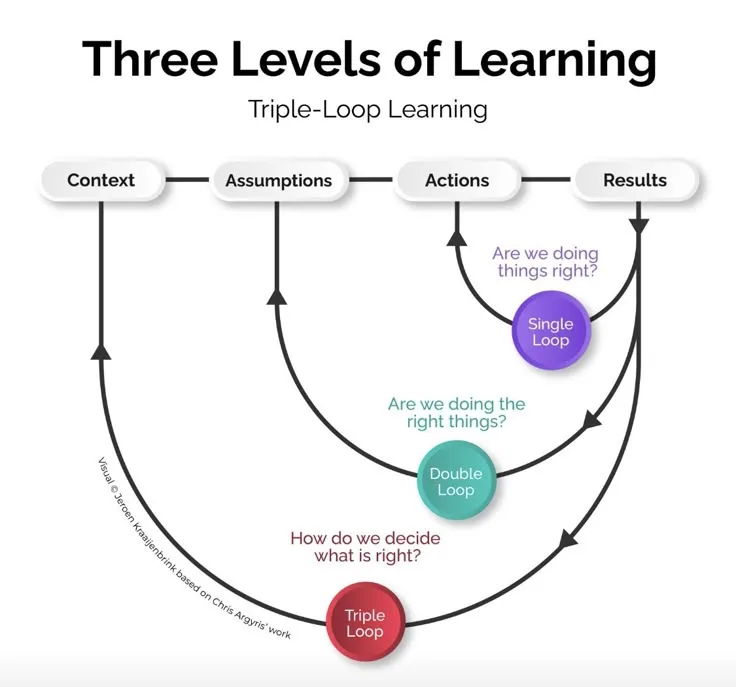
Single-Loop and Double-Loop Learning
Argyris's most enduring contribution is the distinction between two types of learning:
Single-loop learning detects and corrects errors while keeping underlying goals, values, and frameworks constant. The classic metaphor is a thermostat: it detects temperature deviations from the setpoint and adjusts the heating to correct them, but never questions whether the setpoint itself is correct.
Most organizational learning is single-loop. A project runs over budget, so the team adjusts the next project's budget estimate upward. The adjustment is useful but limited - it corrects within the existing frame without examining whether the frame itself is the problem.
Double-loop learning involves questioning the goals, assumptions, and framework themselves. It asks not just "how do we fix this?" but "why did we define the goal this way? Is the framework we are using appropriate?
Are we solving the right problem?" Double-loop learning is rarer and more threatening, because it challenges the authority and judgment of people who set the original direction.
When a team asks "should we be building this product at all?" rather than "how do we build this product more efficiently?" that is double-loop learning - and it is precisely the kind of question that organizational cultures tend to suppress.
Deutero-learning (or triple-loop learning), a concept Argyris borrowed from Gregory Bateson, goes one level further: it involves learning about the learning process itself.
When an organization asks "how well do we learn from our post-mortems, and what could we change about how we conduct them?" it is engaged in deutero-learning - the rarest and most sophisticated form of organizational learning.
| Type | What Is Questioned | Example | Organizational Challenge |
|---|---|---|---|
| Single-loop | Actions and methods | Adjusting project timeline after delay | Low - comfortable and routine |
| Double-loop | Assumptions, goals, frameworks | Questioning whether the project serves the strategy | High - threatens authority and identity |
| Deutero-learning | The learning process itself | Evaluating how effectively the organization learns from incidents | Very high - requires sophisticated self-awareness |
Defensive Routines: The Organizational Immune System Against Learning
Defensive routines are the organizational immune system working against learning. They are collective behaviors that protect individuals from embarrassment, threat, or vulnerability - at the cost of genuine inquiry and honest communication.
Argyris observed these routines in every organization he studied, from Fortune 500 companies to universities to government agencies. They are not the product of bad intentions; they are the product of normal human beings operating in systems that punish vulnerability:
- Making problems "undiscussable" - everyone knows the issue exists but raising it is implicitly forbidden. The CEO's pet project is failing, the VP's hire is underperforming, the strategy is not working - these are known facts that no one will name aloud.
- Presenting uncertain judgments as confident conclusions to protect credibility - because admitting uncertainty in most organizational cultures is perceived as weakness
- Attributing failures to individuals or external factors rather than examining system causes - because systemic explanations implicate the people who designed the system
- Punishing bearers of bad news, ensuring that bad news arrives late, sanitized, and stripped of actionable detail
- Agreeing in meetings and sabotaging in execution - the most corrosive defensive routine, in which surface alignment masks genuine disagreement that expresses itself through passive non-compliance
Argyris observed that defensive routines are typically "meta-covered" - not only are uncomfortable truths suppressed, but the fact that they are being suppressed is also suppressed.
People become what he called "skilled incompetent": very good at behaviors that prevent them from learning. The better they get at these behaviors, the less they learn - and the less they are aware of their own non-learning.
Nonaka's Knowledge Creation Model
While Senge and Argyris worked primarily from Western organizational traditions, the Japanese management theorist Ikujiro Nonaka developed a model of organizational learning focused on knowledge creation rather than error correction.
His work, based on observations of highly innovative Japanese manufacturers like Honda, Canon, and Matsushita, offered a fundamentally different lens.
Tacit and Explicit Knowledge
Nonaka built on the distinction made by philosopher Michael Polanyi (1966) between:
- Tacit knowledge: Knowledge embedded in skills, intuitions, and experience that is difficult to articulate or transfer. A master craftsman knows how to shape wood in a way that no manual can fully capture. A senior engineer has a "feel" for which system architectures will scale and which will not.
- Explicit knowledge: Knowledge that can be written down, codified, and communicated through language, numbers, or diagrams. A technical specification, a process document, a financial model.
The SECI Model
Nonaka proposed four modes of knowledge conversion, organized as the SECI model (published in The Knowledge-Creating Company, 1995, co-authored with Hirotaka Takeuchi):
- Socialization (Tacit to Tacit): Learning through shared experience, apprenticeship, and observation. A junior engineer learns debugging instincts by sitting next to a senior engineer and watching how they approach problems. The knowledge transfers without ever being made explicit.
- Externalization (Tacit to Explicit): The challenging process of articulating tacit knowledge in words, models, metaphors, or frameworks. This is where new organizational knowledge is most often created. When an experienced salesperson explains their intuitive approach to objection handling in a structured framework, tacit knowledge becomes explicit and transferable.
- Combination (Explicit to Explicit): Reconfiguring existing explicit knowledge through sorting, adding, categorizing, and synthesizing. Database queries, report generation, and literature reviews are forms of combination.
- Internalization (Explicit to Tacit): Embodying explicit knowledge through practice until it becomes tacit. A pilot who has memorized emergency procedures and practiced them in simulators has internalized explicit knowledge until it becomes instinctive response.
The spiral of knowledge creation involves cycling through these four modes repeatedly. Organizations that enable this cycling - through team collaboration, time for reflection, articulation of expertise, and practice - create and accumulate knowledge more rapidly than those that do not.
Nonaka's most important practical observation: tacit knowledge held by frontline workers and engineers is often the most valuable knowledge in an organization, but it is the hardest to transfer and the most neglected by management systems oriented toward explicit, codifiable information.
The factory worker who can hear when a machine is about to fail, the customer service representative who can sense when a caller is about to churn, the designer who knows intuitively that a layout "feels wrong" - these forms of knowing are enormously valuable and almost completely ignored by traditional knowledge management approaches.
After-Action Reviews: Learning from Experience in Real Time
The most widely deployed practical tool for organizational learning is the after-action review (AAR), developed by the U.S. Army in the 1970s following the institutional trauma of the Vietnam War and subsequently adopted across military, business, healthcare, and technology organizations worldwide.
An AAR is a structured debrief conducted after a significant operation or event. The Army's four standard questions are elegantly simple:
- What was supposed to happen? (Establishing the plan and intent)
- What actually happened? (Establishing facts without blame)
- Why was there a difference? (Identifying causes and contributing factors)
- What should we sustain or improve? (Generating actionable commitments)
The design of the AAR reflects hard-won knowledge about how to create genuine learning from experience:
Immediacy: AARs are conducted close to the event, while experience is fresh and memory is most reliable.
A 2011 study by Ellis, Mendel, and Nir in the Journal of Applied Psychology found that teams conducting immediate post-event reviews showed 25% greater performance improvement on subsequent tasks than teams that delayed review by even one week.
Non-evaluative: In the Army's formulation, AARs are explicitly not evaluation tools - they do not feed into performance reviews, promotions, or disciplinary actions. The separation of learning from judgment is essential.
If participants fear that what they say will be used against them, they will not say what they actually observed and experienced. They will say what makes them look good.
Participatory: Everyone involved in the event participates - not just leaders. The frontline perspective is often where the most important learning resides.
A study of Army AAR effectiveness found that the most valuable insights came disproportionately from junior personnel, whose proximity to events gave them observational data that senior leaders lacked.
Actionable: AARs produce specific commitments to change, not just observations. The difference between "we should communicate better" (observation) and "Sergeant Williams will provide a status update via radio at 15-minute intervals" (actionable commitment) is the difference between learning that stays in the room and learning that changes behavior.
Adaptations Across Industries
In healthcare, after-action reviews adapted as morbidity and mortality (M&M) conferences have been standard practice for over a century. These structured reviews of adverse patient outcomes have saved countless lives by identifying systemic patterns in medical errors.
In aviation, the Crew Resource Management (CRM) framework includes structured debriefing as a core component, contributing to commercial aviation's extraordinary safety record - a fatal accident rate of approximately 0.07 per million flights in 2023 (IATA, 2024).
In software engineering, the blameless post-mortem represents the same philosophy applied to system incidents, and has become one of the most refined implementations of organizational learning in any industry.
Blameless Post-Mortems in Technology
The software engineering community, particularly in the site reliability engineering (SRE) discipline pioneered at Google and described in the Site Reliability Engineering book (Beyer, Jones, Petoff, and Murphy, 2016), has developed blameless post-mortems into a highly refined practice.
The term "blameless" is somewhat misleading - it does not mean no one is accountable. It means the analysis is focused on system factors rather than individual fault.
The premise, drawn from decades of research in safety-critical systems by scholars like Sidney Dekker (The Field Guide to Understanding Human Error, 2014) and James Reason (Managing the Risks of Organizational Accidents, 1997), is that in complex systems, failures are almost never the result of a single person's error.
They are the result of conditions - inadequate tooling, ambiguous processes, missing monitoring, time pressure, knowledge gaps, poor interface design - that made errors easy to make and hard to catch.
A standard blameless post-mortem includes:
- Timeline of events: A precise reconstruction of what happened, when, and what actions were taken
- Root cause analysis: Often using the "Five Whys" method (originally from Toyota's production system) to trace surface symptoms to underlying causes
- Contributing factors: System, process, cultural, and communication factors that enabled the failure
- Action items: Specific, assigned, time-bounded improvements to prevent recurrence
- What went well: Recognizing effective responses alongside failures - because learning what works is as important as learning what does not
Etsy, the e-commerce platform, became an influential model for blameless post-mortem culture under the leadership of John Allspaw, who documented how the company's approach to incident learning contributed to both reliability improvements and engineering culture.
Allspaw's key insight: the post-mortem is not primarily a document - it is a conversation that builds shared understanding and collective ownership of system reliability.
Building a Learning Culture: The Essential Prerequisites
Tools and processes - AARs, post-mortems, knowledge bases, wikis, retrospectives - are necessary but not sufficient. They can only generate genuine organizational learning in a culture that supports it.
Without the right cultural conditions, these tools become bureaucratic rituals that produce documents no one reads and action items no one completes.
The Five Characteristics of Learning Cultures
Psychological safety: The belief that one can speak up, ask questions, admit mistakes, and raise concerns without being punished, humiliated, or marginalized. Amy Edmondson at Harvard Business School has produced the most influential research on this topic.
Google's Project Aristotle, a large internal study of team effectiveness published in 2015, identified psychological safety as the single most important factor differentiating high-performing teams from others - more important than team composition, resources, or individual talent.
Tolerance for productive failure: Organizations that treat every failure as a catastrophe to be punished will stop hearing about failures - they will not stop having them.
Learning cultures distinguish between reckless failure (cutting corners, ignoring known risks) and intelligent failure (genuine experimentation in the face of uncertainty).
Amy Edmondson's taxonomy in Right Kind of Wrong (2023) provides a useful framework: failures from inattention deserve correction; failures from experimentation deserve celebration; failures from complexity deserve investigation.
Normalization of "I don't know": In many organizational cultures, admitting uncertainty is perceived as weakness or incompetence. Learning cultures treat expressed uncertainty as honest and useful. Confident wrong is worse than openly uncertain - because the former closes inquiry while the latter opens it.
Leadership modeling: Organizational culture is shaped powerfully by what leaders do, not what they say.
Leaders who publicly admit mistakes, who ask genuine questions rather than making pronouncements, who visibly update their views in response to evidence, and who treat learning activities as priorities rather than luxuries create permission for others to do the same.
A leader who cancels the retrospective because "we're too busy" has communicated more about the organization's learning culture than any training program can counteract.
Protected time for reflection: Learning requires time that is not available in organizations running at 100% capacity. Sprint retrospectives, after-action reviews, learning reviews, and knowledge documentation only happen if they are protected on the calendar and treated as legitimate work.
Organizations that view reflection as a luxury to be cut when schedules tighten are organizations that optimize for short-term output at the cost of long-term capability. As the old saying goes: "We never have time to do it right, but we always have time to do it over."
Common Failure Modes
Even organizations that genuinely want to learn often stumble on predictable failure modes:
- Learning reviews that produce no action items - or action items that are never tracked, never assigned, and never completed
- Post-mortems that identify "human error" as root cause rather than investigating the conditions that made the error easy to make and hard to catch
- Knowledge management systems no one uses because they are too complex, too slow, too disconnected from daily work, or populated with outdated content no one maintains
- Expertise hoarding as a source of power and job security - individuals who make themselves indispensable by keeping critical knowledge in their heads
- Incentive systems that reward individual heroics over knowledge sharing, process improvement, and team learning
- Cargo cult learning: adopting the forms of learning practices (we do retrospectives! we have a wiki!) without the substance (the retrospectives produce nothing actionable, the wiki is a graveyard)
| Failure Mode | Surface Appearance | Actual Problem | Intervention |
|---|---|---|---|
| Empty post-mortems | Documents exist | No action items tracked | Assign owners and deadlines; review completion |
| Human error blame | Root cause identified | System causes uninvestigated | Train in systems thinking; use Five Whys |
| Knowledge hoarding | Experts exist | Knowledge not transferable | Pair programming, documentation sprints, rotation |
| Retrospective theater | Meetings held regularly | No changes result | Track action item completion rates; make visible |
| Tool worship | Software purchased | Culture unchanged | Invest in culture before tools |
The Competitive Value of Organizational Learning
The competitive implications of organizational learning are significant and compounding.
In industries where the cost of knowledge accumulates over time - technology, professional services, healthcare, research-intensive manufacturing - organizations that genuinely learn faster than their competitors build advantages that are very difficult to erode.
Arie de Geus, former head of strategic planning at Royal Dutch Shell and author of The Living Company (1997), studied corporations that had survived for more than a century. He found that the most important common characteristic was not size, market position, or financial reserves - it was the capacity to learn and adapt.
Companies that treated themselves as learning systems survived; companies that treated themselves as machines for producing profit eventually encountered a change they could not adapt to.
A 2019 study by Deloitte found that organizations identified as "high-impact learning organizations" were:
- 92% more likely to develop novel products and processes
- 52% more productive as measured by revenue per employee
- 17% more profitable than industry peers
- 56% more likely to be first to market with new products
These are not small differences. They represent the accumulated effect of thousands of small learning moments - post-mortems that actually changed processes, knowledge transfers that prevented repeated mistakes, feedback loops that caught problems early - compounding over years.
Conclusion
Organizational learning is one of the hardest things a human institution can do well. It requires psychological safety, time for reflection, tools for capture, systems for transfer, and leadership cultures that model the behaviors they espouse.
It requires confronting the uncomfortable reality that most organizations' actual learning behaviors contradict their stated learning values - and that the gap between the two is itself often undiscussable.
Most organizations manage fragments of genuine learning - a few high-performing teams, a good post-mortem culture in one department, a knowledge base that someone maintains with dedication - without achieving the integrated learning system Senge described or the knowledge-creating spiral Nonaka theorized.
Getting there requires treating learning not as a program to be launched, a tool to be purchased, or a consultant to be hired, but as a practice - something that requires discipline, structure, cultural support, and constant attention.
Like physical fitness, organizational learning cannot be achieved through a one-time initiative and then maintained on autopilot. It is an ongoing commitment that pays compound returns - but only if the investment is sustained.
The organizations that will thrive in the decades ahead are not necessarily the ones with the most capital, the best technology, or the smartest individuals.
They are the ones that learn fastest - that convert experience into insight, insight into action, and action into improved capability, faster and more reliably than their competitors. That capability, once built, is the most durable competitive advantage an organization can possess.
Sources & Further Reading
- Senge, P.M. The Fifth Discipline: The Art and Practice of the Learning Organization. Doubleday, 1990 (revised edition 2006).
- Argyris, C. & Schon, D.A. Organizational Learning II: Theory, Method, and Practice. Addison-Wesley, 1996.
- Nonaka, I. & Takeuchi, H. The Knowledge-Creating Company: How Japanese Companies Create the Dynamics of Innovation. Oxford University Press, 1995.
- Edmondson, A.C. The Fearless Organization: Creating Psychological Safety in the Workplace for Learning, Innovation, and Growth. Wiley, 2019.
- Edmondson, A.C. Right Kind of Wrong: The Science of Failing Well. Atria Books, 2023.
- Dekker, S. The Field Guide to Understanding Human Error. CRC Press, 2014 (3rd edition).
- Garvin, D.A., Edmondson, A.C., & Gino, F. "Is Yours a Learning Organization?" Harvard Business Review, March 2008.
- de Geus, A. The Living Company: Habits for Survival in a Turbulent Business Environment. Harvard Business School Press, 1997.
- Beyer, B., Jones, C., Petoff, J., & Murphy, N.R. Site Reliability Engineering: How Google Runs Production Systems. O'Reilly Media, 2016.
- Reason, J. Managing the Risks of Organizational Accidents. Ashgate, 1997.
- Polanyi, M. The Tacit Dimension. University of Chicago Press, 1966.
- Ellis, S., Mendel, R., & Nir, M. "Learning from Successful and Failed Experience: The Moderating Role of Kind of After-Event Review." Journal of Applied Psychology, 91(3), 2006.
- Deloitte. "Leading in Learning: Building Capabilities to Deliver on Your Business Strategy." Deloitte Development LLC, 2019.
- Allspaw, J. "Blameless PostMortems and a Just Culture." Etsy Code as Craft Blog, 2012.