
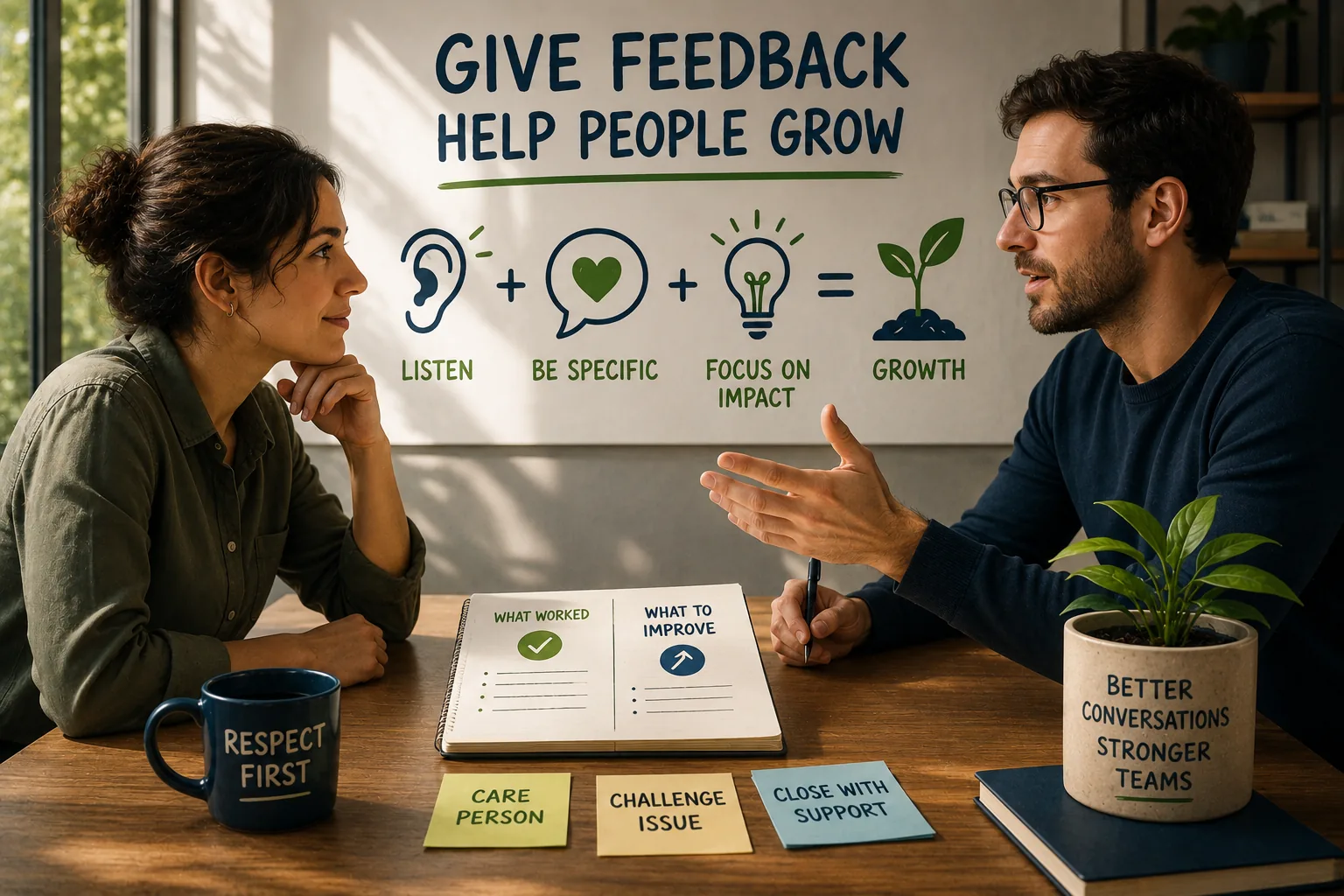
Feedback helps improvement when it describes observable work or behavior clearly enough for another person to act on it. Giving feedback effectively means being specific, timely, and actionable, with the purpose of enabling better performance rather than simply rendering judgment.
What Is Effective Feedback?
Effective feedback is specific, timely, and actionable information communicated to another person about their performance, behavior, or work product - with the explicit goal of enabling improvement rather than merely rendering judgment.
In professional contexts, it is a core management and collaboration competency because it is the primary mechanism through which individuals and teams learn from experience, correct course before small problems become large ones, and develop beyond their current performance level.[7]
The challenge is that feedback is inherently interpersonal: delivered poorly, it damages trust and triggers defensiveness; delivered well, it is one of the highest-leverage investments a manager or colleague can make.
In 2010, Ed Catmull faced a problem at Pixar. The studio had just finished Toy Story 3-massive success, $1 billion box office, critical acclaim. But the next film, Brave, was struggling. The director, Brenda Chapman, had a vision, but something wasn't working.
Dailies (daily footage reviews) showed disconnected scenes, unclear character motivations, pacing problems.
Catmull had to decide: Give Chapman direct feedback about the issues, potentially damaging the relationship and her confidence, or let the problems continue, risking a failed $200 million film.
Pixar had built its success on a culture of radical candor-direct, honest feedback given with care. They created the "Braintrust"-meetings where directors present work-in-progress and peers give unfiltered feedback. The rule: Problems must be made clear; solutions are the director's responsibility.
For Brave, the Braintrust delivered hard feedback: story structure wasn't working, mother-daughter relationship unclear, pacing dragged. Chapman initially resisted. Eventually, after multiple Braintrust sessions and continued struggles, Pixar made the difficult decision to replace her as director with Mark Andrews (Brave was released in 2012).
The film succeeded commercially but the human cost was real-Chapman felt hurt, the team felt the tension. Years later, reflecting on the experience, Catmull acknowledged: They got the feedback delivery wrong.[3] Too blunt. Not enough psychological safety. Feedback that could have strengthened the work instead created conflict.
This is the feedback paradox: It's essential for growth but incredibly easy to deliver poorly-either so harsh it damages relationships or so gentle it's ignored.
"Feedback is the breakfast of champions." - Ken Blanchard
Every high-performing team, manager, and individual contributor must master feedback: how to deliver critical feedback constructively, receive feedback without defensiveness, time feedback for maximum impact, build cultures where feedback flows naturally, and balance honesty with compassion.
This article explores effective feedback: frameworks that work, common failures and fixes, psychological dynamics, how to handle difficult feedback conversations, receiving feedback skillfully, and building feedback cultures that accelerate performance while preserving relationships.
Why Feedback Matters (And Why It's So Difficult)
The Performance Multiplier
Feedback is the mechanism for improvement:
Without feedback: People repeat mistakes unknowingly, work on wrong things, develop bad habits, and plateau in skills.
With feedback: People understand what's working and what isn't, adjust course quickly, develop skills faster, and build self-awareness.
Research on feedback: Teams with regular, specific feedback tend to outperform teams without.
The math: 1% improvement weekly through feedback = about 68% improvement annually (compound effect).
Why Feedback Is Hard
For the giver:
- Fear of conflict: Don't want to hurt feelings or damage relationships
- Uncertainty: Unsure if feedback will be received well
- Time cost: Requires preparation and follow-up
- Risk: Feedback might backfire, creating resentment
For the receiver:
- Ego threat: Criticism feels like personal attack
- Defensive instinct: Automatic response to protect self-image
- Ambiguity aversion: Prefer not knowing to knowing bad news
- Power dynamics: Feedback from authority figures more threatening[10]
"The single biggest problem in communication is the illusion that it has taken place." - George Bernard Shaw
Result: Most feedback either isn't given (to avoid discomfort) or given poorly (defensive reactions, damaged relationships, no improvement).
The SBI Framework: Making Feedback Specific and Actionable
SBI = Situation-Behavior-Impact
Developed by Center for Creative Leadership, widely used in professional settings.[6]
The Three Components
Situation: When and where the behavior occurred
- Provides context
- Makes feedback specific, not general
- Jogs their memory
- Example: "In yesterday's client meeting..."
Behavior: What you observed (facts, not interpretation)
- Observable actions
- Neutral description
- Not assumptions about intent
- Example: "When you interrupted Sarah three times..."
Impact: The effect of that behavior
- On you, on others, on work, on outcomes
- Connects behavior to consequences
- Makes it matter
- Example: "...it made it difficult for her to explain the proposal, and I noticed the client seemed confused about our approach."
Example: Bad Feedback vs. SBI Feedback
Bad (vague and judgmental):
"You're not a team player. You need to be more collaborative."
Problems: Attacks character ("you're not..."), no specific examples, no guidance on what to change.[8]
Good (SBI):
"Situation: In this morning's planning meeting.Behavior: When the team was discussing the timeline, you said 'I'll just do it myself' and started working on your laptop while others were still talking.Impact: The team felt shut down and stopped contributing ideas.
We missed input that could have improved the plan, and I sensed some tension afterward."
Clear, specific, factual. Shows what happened and why it matters.
Adding the Future Focus
SBI describes the problem. Complete feedback adds what to do differently:
"Future: In our next planning meeting, I'd like you to stay engaged in the discussion even if you disagree with the direction. If you have concerns, voice them directly: 'I'm worried about the timeline for these reasons...' That way we can address issues together rather than you having to work around the team."
Complete formula: SBI + Future focus + Invitation to dialogue
Delivering Critical Feedback: The Radical Candor Model
Radical Candor (Kim Scott, Google/Apple veteran): Balance of caring personally and challenging directly.[2]
The 2x2 Matrix
                    Challenge Directly

                            |
     Obnoxious           Radical
     Aggression          Candor
          Care Personally
     Ruinous            Manipulative
     Empathy            Insincerity
                            |
Radical Candor (high care + high challenge): "I care about your success, so I'm telling you directly what needs to change"
Ruinous Empathy (high care, low challenge): "I care about you, so I won't give you hard feedback" People don't grow
Obnoxious Aggression (low care, high challenge): "You're doing it wrong" Damages relationships
Manipulative Insincerity (low care, low challenge): Fake, political → Breeds distrust
"Most people don't give honest feedback because they're worried about hurting someone's feelings. What they don't realize is that they're actually being cruel - denying people the information they need to grow." - Kim Scott
Practical Application
Ruinous Empathy example:
"Hey, the presentation was great! I mean, there were a few small things, but overall really good job!"
Person leaves thinking they nailed it. Didn't learn what to improve.
Radical Candor example:
"I want to give you feedback because I think you have real potential to be an excellent presenter. The content was strong-your research was thorough and the recommendations well-reasoned. Where I think you can improve significantly is in delivery.
You spoke quickly and looked at your slides instead of the audience. This made it hard for executives to follow and ask questions. For your next presentation, I'd like you to practice with me beforehand, and we'll work on pacing and eye contact. Sound good?"
Specific, shows you care, gives actionable guidance.
The Feedback Conversation: Step-by-Step
Before the Conversation
1. Check your intent: Why are you giving this feedback?
- Good intent: To help them improve, support their success
- Bad intent: To vent frustration, punish, make yourself feel better
2. Gather specific examples: Not "you're always late"-have dates and times
3. Consider timing:
- Within 24-48 hours of significant issues (while fresh)
- Not when either of you is emotional
- Private setting, adequate time
4. Prepare your SBI: Write it down to clarify thinking
During the Conversation
Step 1: Ask permission and set context
"I have some feedback about yesterday's client meeting. Is now a good time? I'd need about 15 minutes."
Asking permission increases receptivity.
Step 2: State positive intent
"I'm sharing this because I care about your growth and I think you can be really effective in client meetings."
Establishes you're on their side.
Step 3: Deliver SBI + Future focus
"In yesterday's meeting [Situation], when the client raised concerns about pricing, you immediately defended our pricing without acknowledging their concern [Behavior]. The client became more frustrated, and we didn't get to explore what they actually value [Impact].
Next time, try acknowledging the concern first-'I understand pricing is important to you. Let's discuss what you're getting for that price...'-then address it [Future]."
Step 4: Invite their perspective
"What's your reaction to this feedback? Did you perceive the situation differently?"
Genuine question, not rhetorical. Listen to their response.
Step 5: Collaborative problem-solving
"How can I support you in developing this skill? Would role-playing client objections help?"
Offer support, not just criticism.
Step 6: Close with affirmation
"I have confidence in your ability to master this. You're doing great work overall, and improving this skill will make you even more effective."
End on positive note, but not fake positivity.
After the Conversation
Follow up:
- Check in within a week: "How are you feeling about our conversation?"
- Recognize progress: "I noticed you did X in today's meeting-much better"
- Provide additional support if needed
Common Feedback Failures and Fixes
Failure 1: The Compliment Sandwich
Pattern: Positive feedback → negative feedback → positive feedback
Example: "You're a great team member [+]. But you need to stop missing deadlines [-]. Keep up the good work! [+]"
Why it fails:
- Dilutes the important message
- People learn to ignore positives (just waiting for the "but")
- Feels manipulative
- Doesn't lead to change
Fix: Give feedback directly. If you have positive feedback, give it separately and genuinely.
Failure 2: Feedback Hoarding
Pattern: Saving up issues for annual review or until frustration boils over
Problems:
- Too late to change past behavior
- Overwhelming volume of criticism
- Feels like ambush
- Damages trust ("why didn't you tell me sooner?")
Fix: Give feedback promptly and regularly. Small, frequent course corrections better than annual dump.
Failure 3: Vague Feedback
Bad examples:
- "You need to show more leadership"
- "Your communication needs improvement"
- "Be more proactive"
Why it fails: Person has no idea what to do differently
Fix: Use SBI framework-specific behaviors and situations
Failure 4: Personalizing
Bad: "You're so disorganized. You're a procrastinator."
Attacks character, not behavior. Creates defensiveness.
Fix: "In the last three projects, the final deliverable was submitted after the deadline, which caused delays for dependent teams. Let's talk about project management strategies."
Focus on behavior and impact, not character traits.
Failure 5: Feedback as Punishment
Pattern: Using feedback conversation to vent frustration or show dominance
Signs:
- Delivered when angry
- Goal is to make them feel bad
- No genuine desire for improvement
- Public setting (humiliation)
Fix:
- Wait until emotions settle
- Check your intent
- Private setting always
- Focus on future improvement, not dwelling on past failures
Failure 6: Drive-By Feedback
Pattern: "Hey, you did great in that meeting!" while walking past their desk
Problems:
- Too brief to be meaningful
- No dialogue
- Unclear what specifically was good
- Feels like checkbox ("I gave feedback!")
Fix: Schedule brief but focused time. Be specific even with positive feedback.
Receiving Feedback: The Other Critical Skill
Most feedback training focuses on giving. But receiving feedback well is equally important.
The Defensive Response
Automatic reactions to criticism:
Denial: "That's not true" / "That didn't happen"
Justification: "But I had a good reason..." / "The situation was different..."
Deflection: "Well, you do it too" / "What about when they..."
Minimization: "It's not that big of a deal" / "You're overreacting"
These are normal defensive instincts. Our brains interpret criticism as threat. But they prevent growth.
The Growth Mindset Response
Framework for receiving feedback:
1. Pause and breathe
- Don't respond immediately
- Manage emotional reaction
- Count to 3 before speaking
2. Listen fully
- Don't interrupt
- Don't formulate your defense while they're talking
- Ask clarifying questions
3. Separate intent from impact
- Your intent might have been good
- Acknowledge the impact anyway
- "I hear that my actions had that effect, even though that wasn't my intent"
4. Look for the 5% truth
- Even if 95% seems unfair, find the kernel of truth
- "What can I learn from this?"
5. Express appreciation
- "Thank you for sharing this-I know it's not easy to give feedback"
- Even if you disagree with the feedback
6. Take time to reflect
- "I'd like some time to think about this. Can we follow up tomorrow?"
- Don't commit to changes in the moment
7. Follow up
- Show you took it seriously
- Report on changes you're making
- Ask for ongoing feedback
Example: Defensive vs. Growth Response
Feedback received: "In yesterday's presentation, you talked over several people's questions without letting them finish, and it came across as dismissive."
Defensive response:
"I wasn't trying to be dismissive! I was just excited about the content. And you know how short those presentations are-I had to keep it moving. Plus, John talks over people all the time and nobody says anything to him."
Growth response:
"Thank you for telling me. I wasn't aware I was doing that, and I definitely don't want to come across as dismissive. Can you help me understand-was it particular questions where this happened, or throughout the presentation?
I want to make sure I'm allowing space for questions going forward. What would good look like in the next presentation?"
Second response: acknowledges impact, seeks to understand, commits to improvement.
When Feedback Feels Unfair
Sometimes feedback genuinely is:
- Based on misunderstanding
- Delivered poorly
- Motivated by personal issues
- Factually incorrect
Still valuable to:
- Listen fully without getting defensive
- Ask questions to understand their perspective
- Thank them for sharing
- Later, provide your perspective calmly: "I hear your feedback. From my perspective, the situation was... I'm wondering if we had different information."
Look for patterns: If one person says something, it might be them. If multiple people say similar things, take it seriously.
Positive Feedback: Just as Important
Most feedback conversations focus on problems. But positive feedback is critical:
Why Positive Feedback Matters
Reinforces good behavior: People repeat what's recognized
Builds psychological safety: Creates reserve of goodwill for difficult conversations
Increases engagement: Gallup research-employees who receive regular recognition are more engaged, productive, and likely to stay[5]
Balances perspective: Humans have negativity bias-need 3-5 positive interactions to offset one negative
How to Give Good Positive Feedback
Bad positive feedback:
- "Good job!" (vague)
- "You're a rockstar!" (hyperbolic, meaningless)
- "Keep it up!" (what specifically should they keep up?)
Good positive feedback (also uses SBI):
"Situation: In this morning's team meeting.Behavior: When Sarah's idea was getting pushback, you asked clarifying questions that helped everyone understand her proposal better.Impact: Your questions shifted the conversation from criticism to constructive discussion, and we ended up adopting a version of her idea.
That's exactly the kind of team dynamics we need."
Why this works: Specific, explains what good looks like, reinforces behavior you want to see more of.[9]
The Recognition Ratio
Research suggests: 3-5 positive recognition moments for every constructive feedback conversation
Not: Compliment sandwiches (fake positives around negatives)
But: Genuine, frequent recognition of good work
Practical: Start meetings recognizing someone's contribution. Send weekly appreciation messages. Notice and name good work as it happens.
Timing and Frequency: The Feedback Rhythm
Timing Principles
For significant issues: Within 24-48 hours
- Fresh in both parties' minds
- Shows you take it seriously
- Prevents behavior from becoming pattern
But not: Immediately when angry
- Wait until emotions settle
- Feedback should be thoughtful, not reactive
For positive feedback: Immediately
- Reinforces behavior in the moment
- Shows attention and care
- No downside to prompt positive feedback
For complex issues: Schedule dedicated time
- Not in passing
- Not at end of busy meeting
- 30-60 minutes without interruption
Frequency Frameworks
The feedback cadence:
| Frequency | Type | Purpose |
|---|---|---|
| Daily | Informal positive recognition | Build psychological safety, reinforce good work |
| Weekly | 1:1 check-in with feedback | Consistent course correction, support development |
| Monthly | More structured feedback | Assess progress on goals, deeper skill development |
| Quarterly | Formal review | Comprehensive assessment, goal setting |
| Annually | Performance review | Big picture, compensation decisions |
Key insight: Don't save feedback for quarterly/annual reviews. Small, frequent adjustments better than big, infrequent corrections.
Context Matters
Good times for feedback:
- After specific observable behavior
- During scheduled 1:1s
- When person has mental space to process
- Private setting
Bad times for feedback:
- When person is overwhelmed, stressed, or dealing with crisis
- In public (constructive feedback should always be private)
- When either person is emotional
- In passing without time for discussion
Building a Feedback Culture
Individual feedback skills matter. But organizational culture determines whether feedback flows naturally or remains rare and uncomfortable.
"In great teams, conflict becomes productive. The free flow of conflicting ideas is crucial for creative thinking, for discovering and challenging assumptions, and for generating new solutions." - Ed Catmull
What Feedback Culture Looks Like
In low-feedback cultures:
- Feedback only at annual reviews
- People fear giving or receiving feedback
- Issues fester until they explode
- Political, avoiding difficult conversations
- High turnover (people leave rather than get feedback)
In high-feedback cultures:
- Feedback given regularly, not just annually
- Both positive and constructive feedback normalized
- People ask for feedback proactively
- Feedback seen as gift, not criticism
- Clear improvement and growth trajectories
Building Blocks of Feedback Culture
1. Leadership modeling
Leaders must visibly give, receive, and act on feedback.
Bad: Leader says "we value feedback" but never asks for it or gets defensive when receiving it
Good: Leader regularly asks "What's one thing I could do differently?" and publicly shares feedback received and changes made
2. Psychological safety
Amy Edmondson's research: Teams with psychological safety (safe to take risks, speak up, admit mistakes) outperform teams without.[4]
How to build:
- Explicitly welcome feedback
- Never punish or retaliate for honest feedback
- Thank people publicly for giving hard feedback
- Show that feedback leads to change, not just ignored
3. Training and frameworks
Don't assume people know how to give/receive feedback.
Provide:
- Training on SBI, Radical Candor frameworks
- Practice opportunities (role-playing)
- Written guides and examples
- Ongoing coaching
4. Make it routine
Embed feedback in processes:
- Every 1:1 includes feedback
- Project retrospectives include feedback
- 360 reviews once or twice annually
- Skip-level meetings (skip manager, talk to manager's manager) for upward feedback
5. Start with positive
Easier to build feedback muscle with positive feedback first:
- Weekly appreciation rounds in team meetings
- Recognition channels (Slack, email)
- Peer recognition programs
Once positive feedback is normalized, add constructive feedback.
6. Close the loop
Show feedback leads to change:
- Survey team for feedback
- Publicly share themes heard
- Announce changes made based on feedback
- Follow up: "We heard X, so we're doing Y"
If feedback disappears into void, people stop giving it.
The Roadmap
Phase 1 (Months 1-2): Leadership alignment-leaders trained, commit to modeling
Phase 2 (Months 3-4): Train team on positive feedback, launch recognition program
Phase 3 (Months 5-6): Train on constructive feedback, integrate into 1:1s
Phase 4 (Months 7-9): Measure (surveys), iterate based on feedback about feedback
Phase 5 (Ongoing): Sustain through systems, recognition, leader modeling
Conclusion: Feedback as Competitive Advantage
Return to Pixar. Ed Catmull reflected on the Brave experience: They had a feedback culture (the Braintrust), but they got the delivery wrong-too blunt, not enough psychological safety. The feedback was accurate but damaged the relationship.
The lesson: Culture of feedback isn't enough. Must master the delivery.
Key insights:
1. Feedback is performance multiplier-teams with regular specific feedback outperform those without by 15-30%
2. SBI framework makes feedback specific-Situation + Behavior + Impact + Future focus = actionable guidance
3. Radical Candor balances care and challenge-must care personally AND challenge directly
4. Most feedback fails through avoidance or poor delivery-either not given (ruinous empathy) or given harshly (obnoxious aggression)
5. Receiving feedback well is equally important-manage defensiveness, look for kernel of truth, express appreciation[1]
6. Positive feedback is critical-3-5 positive recognitions for every constructive feedback conversation
7. Timing matters-prompt (24-48 hours), frequent (weekly), but not impulsive (wait until emotions settle)
8. Culture beats individual skill-must have psychological safety, leader modeling, routine processes
As Kim Scott observed: "Caring personally while challenging directly is the key to being a good boss and building a team that does the best work of their careers."
The question isn't whether to give feedback-without it, people plateau and teams underperform. The question is: Will you develop the skill to deliver feedback that strengthens relationships while driving improvement?
Professional mastery requires continuous improvement. Continuous improvement requires feedback. Feedback requires courage-to give it honestly and receive it graciously.
The best teams make feedback so routine, specific, and supportive that it becomes not a dreaded event but an expected gift.
Research on Feedback Effectiveness: What the Studies Actually Show
The science of feedback has advanced considerably beyond the intuitions that shape most management practice. Several research findings directly contradict common assumptions.
Marcus Buckingham and Ashley Goodall's "Feedback Fallacy" (Harvard Business Review, 2019) challenged the foundational assumption that specific, critical feedback improves performance. Their argument draws on neuroscience: the brain best encodes information in neural pathways that are already strong.
Telling someone what they did wrong activates a threat response that interferes with learning. Showing someone what "excellent" looks like in their domain - and helping them recognize when they are approaching that standard - leverages the brain's pattern-matching strengths more effectively.
Buckingham and Goodall do not argue against all feedback, but they argue that developmental feedback works best when it is anchored in observed strengths rather than catalogued weaknesses.
Their recommendation: instead of "here is what you did wrong," try "here is what I noticed working well, and here is what it looked like specifically."
David Rock's SCARF model, based on his synthesis of neuroscience research (published in NeuroLeadership Journal, 2008), identifies five social domains that the brain monitors for threat: Status, Certainty, Autonomy, Relatedness, and Fairness.
Feedback threatens multiple dimensions simultaneously. It threatens status (others know you are being corrected), certainty (the situation is now ambiguous), autonomy (someone else is telling you what to do), and relatedness (the relationship feels less safe).
Rock's model predicts that feedback delivered without attention to these threat dimensions will trigger defensive responses that override learning - regardless of how accurate the feedback is or how good the giver's intentions are.
The practical implication is that effective feedback delivery must actively minimize SCARF threats: maintaining the recipient's status, creating certainty about the process, preserving their sense of autonomy over how to respond, affirming the relationship, and treating the feedback as information rather than judgment.
Zenger and Folkman's research on negative feedback receptivity (Harvard Business Review, 2014), based on a survey of 899 people, found that 57% preferred corrective feedback to praise, and 72% agreed their performance would improve if their supervisor provided corrective feedback.
Managers who feared giving negative feedback were overcorrecting: their reports often wanted the honest assessment more than the reassurance.
This finding runs counter to a common managerial assumption that employees mostly want to be reassured rather than corrected - and it is part of why Zenger and Folkman's broader body of research argues for more frequent, ongoing feedback rather than infrequent, high-stakes feedback conversations saved for formal review cycles.
Kim Scott's Radical Candor research, drawn from her experience at Google and Apple and formalized in Radical Candor (2017), is grounded in observations of thousands of management interactions. Scott's central finding is not just that managers give feedback incorrectly - it is that most managers do not give feedback at all.
In her surveys of managers, Scott found that the vast majority defaulted to "ruinous empathy": avoiding difficult feedback to preserve the relationship, at the cost of the information the recipient needed to grow.
The irony is that ruinous empathy, while feeling kind, is experienced by recipients as abandonment - they sense that something is wrong but cannot get honest information about what.
Scott's research found that people remembered "the feedback that helped them most" was almost always direct and specific rather than vague and affirming.
Case Studies: Feedback Cultures That Worked and Failed
Netflix's "Keeper Test" culture represents one of the most demanding feedback environments in corporate history.
Netflix's Culture Deck, developed by Reed Hastings and Patty McCord, explicitly stated that managers should regularly ask themselves: "Would I fight to keep this person if they told me they were leaving?" If the answer was no, the manager was expected to have an immediate, direct conversation with the employee and either work to change the answer or begin a transition.
This "adequate performance gets a generous severance" standard required managers to deliver continuous, honest assessments rather than saving up concerns for annual reviews.
The culture produced high performance - Netflix's revenue grew from $682 million in 2005 to over $31 billion by 2022 - but also significant turnover and a work environment that many employees described as stressful.
Netflix's approach illustrates both the performance-enhancing effects of consistent honest feedback and the cultural tradeoffs: the same transparency that drives performance improvement can reduce the psychological safety needed for risk-taking.
General Electric under Jack Welch built its feedback culture around the "vitality curve" - the practice of annually identifying the top 20%, middle 70%, and bottom 10% of performers, rewarding the top, developing the middle, and separating the bottom.
The system required managers to give very direct feedback: every employee knew their standing relative to peers. The approach produced genuine performance improvement during Welch's tenure (1981-2001) and was widely copied across American corporations.
But subsequent critiques from management researchers and journalists documented significant unintended consequences: the system created intense internal competition that undermined collaboration, incentivized managers to hoard talent rather than develop it across the organization, and produced ethical shortcuts as employees gamed the metrics that determined their standing.
When Jeff Immelt became CEO in 2001, he progressively dismantled the vitality curve.
Microsoft eliminated a similar stack-ranking system in 2013 under Steve Ballmer, explicitly citing its corrosive effect on feedback culture and collaboration.
Bridgewater Associates under Ray Dalio offers the most extreme real-world experiment in feedback transparency.
Dalio built the world's largest hedge fund in part through what he called "radical transparency" - a culture where anyone could give anyone else direct feedback at any time, and where meetings were recorded so feedback givers could be held accountable for the quality and accuracy of their assessments.
The firm's "Dot Collector" tool allowed employees to rate each other's arguments in real-time during meetings.
Dalio's 2017 book Principles documented the approach and its underlying rationale: that the best ideas should win, and that suppressing feedback to preserve relationships produces worse decisions.
Bridgewater's long-run investment performance, including some standout years alongside real, publicly documented periods of weak or negative returns (particularly around 2020), is held up by supporters as evidence the approach can work, though its track record has been more uneven in recent years than the firm's reputation for radical transparency might suggest.
However, former employees have documented the psychological cost of constant evaluation: the feedback culture that produced performance also produced anxiety, political gaming of the rating system, and significant turnover among employees who found the environment unsustainable.
Practical Frameworks from Research: Feedback That Actually Changes Behavior
The SBI-I extension (Situation-Behavior-Impact-Intent), developed as an enhancement to the Center for Creative Leadership's original SBI model, adds a fourth element that addresses the defensive response to negative feedback.
After stating the impact of a behavior, the feedback giver asks about the recipient's intent: "What were you trying to accomplish?" This question does two things simultaneously: it opens the possibility that the behavior made sense from the recipient's perspective (which it often does), and it creates genuine dialogue rather than one-directional judgment.
Research on the extension found that adding the intent question increased behavioral change rates and relationship satisfaction compared to the original three-part model.
Douglas Stone and Sheila Heen's "appreciation, coaching, and evaluation" framework from Thanks for the Feedback (2014) addresses a structural confusion that undermines most feedback conversations: givers and receivers are often having different conversations.
Appreciation ("I value what you do") serves a relational and motivational function. Coaching ("here is how to improve") serves a developmental function. Evaluation ("here is where you stand") serves an assessment function.
When these types are conflated - when a manager delivers evaluation while the employee is expecting coaching - the mismatch produces confusion and defensiveness.
Stone and Heen's research found that explicitly naming the type of feedback at the outset dramatically improved reception: "I want to give you some coaching on your presentation skills" lands differently than "I want to give you some feedback on your presentation," because the first sentence tells the recipient what kind of conversation they are in.
How Feedback Frequency and Timing Affect Learning Outcomes
The question of when and how often to deliver feedback has been studied extensively in both educational psychology and organizational behavior research, producing findings that challenge both the "more feedback is always better" assumption and the "annual review is sufficient" practice that dominated management for most of the twentieth century.
Robert Bjork at UCLA, one of the leading researchers on human learning and memory, has documented what he calls the "desirable difficulties" effect through decades of experimental studies.
Bjork's research shows that feedback delivered immediately after every performance attempt actually produces slower long-term skill development than feedback delivered less frequently, with delays between performance and correction.
The mechanism is counterintuitive: immediate feedback allows performers to self-correct based on the feedback signal rather than developing internal error-detection capabilities.
When feedback is delayed or intermittent, performers must develop their own judgment about what is working and what is not, which builds the metacognitive skills that produce durable performance improvement.
Bjork's finding is not that feedback should be withheld - it is that feedback should be designed to develop the recipient's self-assessment ability rather than substituting for it.
Ayelet Gneezy at UC San Diego and Nicholas Epley at Chicago Booth have studied how feedback framing affects motivation and performance.
The broader research literature on motivation and feedback framing suggests that framing critical feedback as information about a recipient's potential ("you have the capability to achieve a higher standard") tends to land better than identical feedback framed purely as an assessment of current shortfall ("your current performance is below standard").
The likely mechanism is self-efficacy: potential-framing maintains the recipient's belief that improvement is achievable, while performance-framing can be interpreted as a fixed assessment that reduces motivation to improve.
Their findings support the practice of beginning critical feedback conversations by establishing confidence in the recipient's ability to improve - not as a diplomatic cushion but as a direct performance intervention.
Teresa Amabile at Harvard Business School, in her study of creative professionals documented in The Progress Principle (2011), found that the most powerful driver of day-to-day motivation and performance was not compensation, not feedback, but a sense of progress toward meaningful work.
Amabile analyzed over 12,000 diary entries from 238 employees at seven companies and found that on days when workers reported making progress - even small progress - their intrinsic motivation, creative output, and positive affect were all significantly elevated.
Feedback that acknowledges progress toward a goal, even partial progress, has a motivational effect that feedback focused solely on current performance deficits does not.
The practical implication for managers: feedback conversations that explicitly name where the employee has already improved since the last conversation, before addressing what still needs development, leverage the progress principle and produce better subsequent performance.
Anders Ericsson at Florida State University, whose research on deliberate practice and expertise development is the scientific basis for the "10,000 hours" concept popularized by Malcolm Gladwell, identified immediate and specific feedback as one of the four essential elements of deliberate practice - the type of practice that actually produces expert performance.
Ericsson's research, published in Psychological Review (1993) and synthesized in Peak: Secrets from the New Science of Expertise (2016), found that the critical variable is not feedback frequency alone but feedback specificity: feedback that identifies precisely which component of performance needs adjustment, and provides a clear target state for that component, produces far greater improvement than feedback that identifies a general area for development.
"Your pitch voice rises at the end of declarative statements, making them sound like questions" is specific in Ericsson's sense; "your delivery needs work" is not.
Elite coaches in every performance domain - sports, music, chess, surgery - are distinguished by their ability to provide the specific, immediate, actionable feedback that matches Ericsson's criteria.
What High-Performing Organizations Do Differently With Feedback Systems
Beyond individual feedback skill, research on organizational performance has documented that the most effective organizations design feedback into their structural systems rather than relying on individual manager capability to deliver it effectively.
Deloitte's performance management transformation (2015-2017) represents one of the most carefully documented corporate feedback system redesigns.
Deloitte had operated a traditional annual performance review system for decades before its internal research found that the system consumed 2 million hours of manager time per year while and Deloitte's own internal research separately found that 58% of executives considered the traditional review process not to be an effective use of time.
The redesign replaced annual reviews with weekly "performance snapshots" - brief structured responses from project leaders to four specific questions about each team member's performance and trajectory.
Deloitte's HR research team, led by Marcus Buckingham in his role there, found that the weekly snapshots produced more accurate performance assessments than annual reviews (because they were closer in time to actual performance), higher employee engagement scores, and significantly reduced the racial and gender bias that had been documented in annual review scores.
The weekly snapshots also required substantially less cumulative manager time than the annual review cycle they replaced, even though each individual snapshot added a small recurring time cost.
Pixar Animation Studios' Braintrust feedback culture has been documented in detail by founder and former president Ed Catmull in Creativity, Inc. (2014). The Braintrust is a peer feedback meeting where directors show work in progress and receive direct, honest feedback from peers - not supervisors.
The structural design is deliberate: the Braintrust has no authority to make decisions, only to provide information. The director retains full creative control and decides what to do with the feedback.
Catmull documents that this design creates a feedback environment where givers can be maximally honest - there is no authority relationship distorting the feedback - and recipients can be genuinely receptive rather than defensive, because the feedback comes without the threat of organizational consequences.
Catmull describes a consistent pattern across Pixar's productions: films that received the most substantive, unflinching Braintrust feedback early in production tended to turn out better than films where early Braintrust sessions were relatively unchallenging.
It was a conclusion Catmull found uncomfortable to acknowledge: the harshest early feedback often produced the best outcomes, because it forced directors to confront and resolve fundamental story problems before they became expensive to fix.
Valve Corporation, the video game developer known for Half-Life and Steam, has operated without managers since its founding in 1996, replacing traditional performance feedback with a peer review system in which every employee rates every other employee they worked with directly during a project.
Valve's annual "Stack Ranking" (unrelated to Microsoft's discredited system) aggregates peer ratings across four dimensions - skill at their job, productivity, contribution to the product, and teamwork - and uses the aggregate scores to determine compensation, not employment status.
The company reports that the peer feedback system produces more accurate assessments of actual contribution than manager-led systems because it aggregates multiple informed perspectives.
Former Valve employees have noted that the system creates strong incentives to make your work visible and legible to peers, which has secondary effects on documentation quality and knowledge sharing.
Valve's revenue per employee - reportedly in the tens of millions of dollars annually, given its small headcount relative to the scale of Steam and its game catalog - is among the highest of any company in the software industry, though this reflects Valve's business model and product selectivity far more than its feedback system specifically.
The "feedforward" technique, developed by executive coach Marshall Goldsmith, addresses a specific failure of conventional feedback: its backward orientation. Feedback by definition refers to past behavior, which cannot be changed.
Goldsmith's feedforward approach asks people to describe specific behaviors they want to improve, then asks others to provide suggestions for the future rather than assessments of the past.
In Goldsmith's facilitated exercises across thousands of managers, feedforward consistently produced higher receptivity and behavioral change than equivalent feedback conversations.
The mechanism is straightforward: future-orientation bypasses the defensive response triggered by criticism of past behavior. Recipients experience feedforward as collaborative problem-solving rather than judgment, which is the psychological condition under which learning actually occurs.
Sources & Further Reading
Stone, D., & Heen, S. "Thanks for the Feedback: The Science and Art of Receiving Feedback Well." Viking, 2014.
Scott, K. "Radical Candor: Be a Kick-Ass Boss Without Losing Your Humanity." St. Martin's Press, 2017.
Catmull, E., & Wallace, A. "Creativity, Inc.: Overcoming the Unseen Forces That Stand in the Way of True Inspiration." Random House, 2014.
Edmondson, A. C. "The Fearless Organization: Creating Psychological Safety in the Workplace for Learning, Innovation, and Growth." Wiley, 2018.
Wigert, B., & Harter, J. "Re-Engineering Performance Management." Gallup Business Journal, 2017.
Center for Creative Leadership. "SBI Feedback Model." CCL, n.d.
Zenger, J., & Folkman, J. "Your Employees Want the Negative Feedback You Hate to Give." Harvard Business Review, 2014.
Dweck, C. S. "Mindset: The New Psychology of Success." Random House, 2006.
Buckingham, M., & Goodall, A. "The Feedback Fallacy." Harvard Business Review, 2019.
Rock, D. "Your Brain at Work: Strategies for Overcoming Distraction, Regaining Focus, and Working Smarter All Day Long." HarperBusiness, 2009.