
Most resumes fail before a human ever reads them. They fail ATS parsing because of formatting errors. They fail the initial recruiter scan because the most relevant information is buried or absent. They fail the hiring manager review because achievements are described in vague, unmeasurable terms that distinguish nothing.
And they fail self-assessment because job seekers optimize for completeness rather than impact, including everything, emphasizing everything equally, and therefore helping the reader distinguish nothing.
Writing a resume that generates interviews requires understanding how resumes are actually evaluated at each stage of the process, and designing every element with those evaluation criteria in mind. This guide explains what research and recruiter insight reveal about what works, and exactly how to implement it.
Understanding the Evaluation Pipeline
Before optimizing a resume, understand the stages it must pass through:
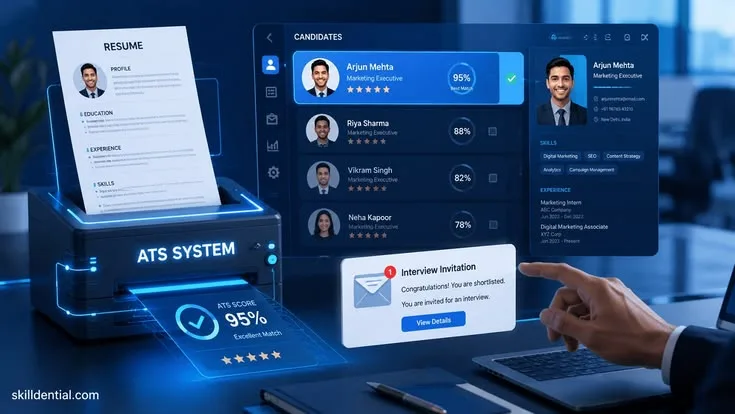
Stage 1: ATS parsing. Most mid-size and large employers (and many smaller ones) use Applicant Tracking Systems to collect and initially filter applications. The system parses resume text, extracts information, and scores candidates based on keyword matches to the job description.
Resumes that fail to parse correctly, or that score below the threshold for keywords, may never be seen by a human.
Stage 2: Recruiter initial screen. Recruiters reviewing a pile of applications spend a few seconds on an initial determination of whether to read further. Eye-tracking research by TheLadders found an average of 6 seconds for this initial pass, with attention focused on specific information zones.
Stage 3: Hiring manager review. If the recruiter passes the resume along, the hiring manager reviews it against the specific requirements of the role, often having more specific technical context than the recruiter.
Stage 4: Interview decision. The resume's final job is to generate enough interest to justify the time investment of an interview. It does not need to fully represent you. It needs to create enough compelling evidence to make a hiring manager want to know more.
Each stage has different requirements. A resume that passes ATS but fails the 6-second scan does not help. A resume that generates interview calls but does not accurately reflect your experience is even worse.
How Many Resumes Are Screened by ATS?
The scale of ATS usage is significant. A 2022 report by Jobscan found that 99% of Fortune 500 companies use ATS software to manage applicants. Greenhouse, Lever, Workday, iCIMS, and Taleo are among the most common platforms.
Even small and medium businesses increasingly rely on ATS tools, particularly for roles receiving high application volumes.
Research by Harvard Business School in 2021 estimated that automated systems hide approximately 27% of qualified candidates from hiring managers, not because those candidates lack the skills, but because their resume format, language choices, or degree specifications cause them to be filtered out before human review.
The same study found that roughly 27 million workers in the United States are made "hidden" in this way.
The practical implication: the gate you must pass before a human evaluates you is substantial, and optimizing for it is not optional.
ATS Optimization: Getting Past the First Filter
Applicant Tracking Systems parse resume text and match it against job requirements. Understanding how they work reveals the specific formatting and keyword choices that improve parsing accuracy.
Formatting Rules for ATS
Most ATS systems struggle with:
- Multi-column layouts: Text in parallel columns is often read left-to-right across columns, scrambling meaning
- Tables: Cell content may not parse in logical order
- Text boxes: Content in text boxes is sometimes invisible to parsers
- Headers and footers: Contact information in page headers or footers may not be extracted
- Graphics, icons, and logos: ATS systems parse text; design elements are ignored or cause errors
- Non-standard fonts: Some parsers have trouble with decorative typefaces
- PDF vs. Word: Most ATS systems prefer .docx files; some older systems cannot parse PDF reliably
The safe approach: a clean, single-column format with standard section headings, saved as both .docx (to send to employers) and .pdf (to share informally).
Standard section headings (Work Experience, Education, Skills) are safer than creative alternatives (My Journey, What I've Done) because ATS systems look for standard labels to categorize content.
Keyword Matching
ATS systems score resumes against the job description's language. If the job description uses "project management" and your resume uses "project coordination," the system may not match them.
The process:
- Read the job description carefully and highlight skills, tools, and qualifications mentioned
- Ensure your resume uses the same terminology where you genuinely have those skills or qualifications
- Include both the spelled-out form and abbreviation of common terms (e.g., "Search Engine Optimization (SEO)") to match either usage in the job description
This is not "keyword stuffing": it is translating your genuine experience into the language the employer uses for it. Do not claim skills you lack; do ensure that skills you do have are described using the same terminology as the job posting.
ATS vs. Human-Readable Format: The Dual Optimization Challenge
One of the most persistent tensions in resume writing is that optimizing purely for ATS (dense keyword repetition, no formatting flourishes) can produce a document that passes the machine but bores the human.
The goal is a document that does both: clean enough structure for reliable ATS parsing, and strong enough content to engage a recruiter or hiring manager once it lands on their screen.
Practical rules for achieving both:
- Use clean, consistent formatting (single font family, standard headings) that looks professional but parses reliably
- Include keywords naturally within achievement bullet points, not as a standalone keyword dump
- Put the most keyword-rich content in the Work Experience section, where ATS systems weigh it most heavily
- Reserve the Skills section for specific tools, certifications, and technologies rather than soft skills
The 6-Second Scan: What Recruiters Actually See First
Research on recruiter behavior consistently finds that initial resume screening takes only a few seconds before a determination is made to read further or discard. TheLadders' eye-tracking study found that in a 6-second initial scan, recruiters focused on:
- Name
- Current title and employer
- Previous title and employer
- Start and end dates of positions
- Education
This information is extracted and evaluated almost before conscious reading begins. The implication is that the upper third of your resume (your name, contact information, a professional summary, and your most recent role) is your entire initial pitch.
Everything below the fold exists for readers who have already decided you are worth further review.
The Professional Summary
Replace the outdated "Objective" statement (which describes what you want) with a professional summary of three to five lines that describes the value you offer. The summary should answer: Who are you professionally? What is your specific expertise? What makes you a strong candidate for this type of role?
A weak objective: "Seeking a challenging marketing position where I can use my skills to contribute to a dynamic team."
A strong summary: "Digital marketing manager with 7 years of experience in B2B SaaS companies. Led SEO and paid acquisition programs that grew organic traffic by 340% and reduced customer acquisition costs by 22%. Experienced in building and managing cross-functional teams of 5-8 people."
The strong summary immediately tells the reader your seniority level, your specific domain, your most impressive quantified accomplishments, and your management experience. It gives a hiring manager enough context to evaluate fit in under 20 seconds.
What the First Third of Your Resume Must Accomplish
The "first third" of your resume, everything visible before the reader scrolls or turns the page, must do most of the selling. For a hiring manager reviewing 200 applications for a single role, only a fraction will be read beyond the first few seconds. The rest are triaged.
In a 2023 study by Zippia analyzing hiring manager behavior, resumes that included a specific, tailored summary matched to the job description were 40% more likely to advance to a phone screen than those with generic objectives or no summary at all.
In the same study, resumes with quantified achievements in the first visible experience entry were judged more favorably in under 10 seconds of review.
The first-third checklist:
- Full name and direct contact information (phone, email, LinkedIn URL)
- A targeted 3-5 line professional summary that names your specific expertise and 1-2 measurable achievements
- Your most recent role with company name, dates, and at least two strong quantified bullet points visible above the page break
Reverse Chronological Format: Still the Standard
Three formats are commonly used: reverse chronological (most recent job first), functional (skills grouped by category rather than by employer), and combination (elements of both). Recruiters and hiring managers overwhelmingly prefer reverse chronological.
Functional resumes, which organize skills into categories without showing clear employment dates and company names, were developed to help career changers and people with employment gaps de-emphasize their history.
But recruiters recognize functional resumes as a flag that the person is trying to obscure something, which creates suspicion and motivates closer scrutiny, not less.
Reverse chronological format:
- Shows career progression clearly
- Makes it easy for recruiters to verify employment dates
- Demonstrates consistent or growing level of responsibility
- Is what ATS systems are designed to parse
Unless your work history is genuinely unusual in a way that makes chronological presentation confusing, use reverse chronological format.
Addressing Employment Gaps
Employment gaps are far less damaging than candidates typically fear, particularly post-2020. The pandemic normalized career interruptions, and hiring managers in most industries have recalibrated their expectations.
The 2023 LinkedIn Workforce Confidence survey found that 79% of hiring managers said employment gaps of up to two years were not a major factor in their hiring decisions for otherwise qualified candidates.
If you have a gap:
- Do not try to hide it with functional formatting: this makes it more suspicious, not less
- If the gap was for caregiving, health reasons, or a professional project (freelance work, certifications, personal projects), note it briefly in parentheses in the date field: "2022-2023 (Family caregiver)" or "2023 (Completed Advanced Data Analytics Certificate)"
- If the gap was voluntary (travel, burnout recovery, a failed startup), a single sentence in your cover letter is sufficient acknowledgment
Quantifying Achievements: The Single Most Important Technique
The distinction between resumes that generate interviews and those that do not often comes down to a single discipline: quantifying achievements.
Most resume bullet points describe responsibilities (what the job was supposed to include) rather than accomplishments (what you specifically did and what resulted from it). Responsibilities are commodities: every person who held your role had roughly the same responsibilities. Accomplishments are differentiating.
The Achievement Formula
[Action verb] + [what you did] + [how you did it] + [measurable result]
| Responsibility (Weak) | Achievement (Strong) |
|---|---|
| Managed social media accounts | Grew Instagram audience from 3,200 to 41,000 followers in 18 months through daily content strategy, increasing inbound leads from social by 28% |
| Led sales team | Managed team of 6 account executives to achieve 118% of quota two years running, ranking #1 among 4 regional teams in 2024 |
| Responsible for customer onboarding | Redesigned customer onboarding process, reducing time-to-first-value from 45 days to 12 days and improving 90-day retention by 15 percentage points |
| Managed software development projects | Delivered 3 major product releases on schedule and within budget in 2024, coordinating across 12-person engineering team and 4 external vendors |
The quantification does not need to be exact. Ranges work: "reduced processing time by 30-40%." Approximations work: "managed approximately $2M in annual vendor contracts." Context-setting works: "grew territory revenue from $800K to $1.4M in first 18 months, representing fastest ramp of any new hire in the region."
If you genuinely cannot recall numbers, reconstruct estimates: How many clients did you work with? Approximately how large was your budget? What percentage of your team's work did you personally lead? How many units shipped per month? Some number, even an approximation, is almost always better than no number.
Why Hiring Managers Value Quantification
The preference for numbers is not arbitrary. According to career researcher and author Lou Adler, who analyzed over 25,000 hiring decisions, candidates who presented clear quantified outcomes in interviews were hired at a rate approximately 3 times higher than candidates who described roles in terms of responsibilities alone.
The same principle applies to the resume stage.
Numbers serve a specific cognitive function for the reader: they make abstract claims concrete and comparable. "Improved customer satisfaction" cannot be evaluated. "Increased NPS from 31 to 58 over 12 months, placing the team in the top quartile of our industry benchmark" can be weighed, remembered, and compared.
The discipline of quantifying achievements also forces a genuine reflection on your own impact, which improves how you discuss your experience in interviews, not just how you present it on paper.
Action Verbs That Signal Accomplishment
Begin bullet points with strong action verbs that indicate your personal agency:
Leadership: Led, directed, managed, oversaw, mentored, coached, built Creation: Developed, designed, created, launched, established, founded, implemented Improvement: Increased, reduced, improved, optimized, streamlined, accelerated, transformed Achievement: Delivered, achieved, exceeded, won, earned, generated, produced
Avoid passive or weak constructions: "Responsible for," "Helped with," "Assisted in," "Was part of a team that." These dilute agency and obscure your individual contribution.
The Skills Section: What to Include and How
A skills section serves two purposes: ATS keyword matching and providing recruiters with a quick scan of your technical capabilities. Its content should be calibrated by the nature of the role.
For technical roles (software engineering, data science, digital marketing): Include specific tools, languages, platforms, and certifications that are directly relevant. Be honest about proficiency level: claiming "expert" Python when you are "intermediate" creates problems in interviews.
For non-technical roles (management, sales, communications): A skills section listing "Microsoft Office, communication, and teamwork" adds nothing. Soft skills claimed without evidence on a skills list are ignored by experienced recruiters.
Better to demonstrate these skills through the Achievement bullets in your experience section.
Professional certifications and technical credentials deserve prominent placement, ideally in the education/certifications section with dates, and referenced in the skills section.
Skills Section by Role Type
| Role Type | What to Include | What to Omit |
|---|---|---|
| Software engineer | Languages, frameworks, platforms, version control systems | "Communication skills," "team player" |
| Data scientist | Python, SQL, ML libraries, statistics tools, cloud platforms | Generic analytics claims without specifics |
| Marketing | Platforms (HubSpot, Salesforce, Google Ads), methodologies (SEO, A/B testing), analytics tools | "Creative thinker," "brand-aware" |
| Management/leadership | Industry-specific tools, relevant methodologies (Agile, OKR frameworks) | "Leadership ability," "strategic thinker" |
| Finance/accounting | Software (Excel, Bloomberg, SAP, Workday), certifications (CFA, CPA), methods | "Detail-oriented": demonstrate it in your accuracy claims |
The test for any item in your skills section: would a hiring manager, on seeing it, become meaningfully more or less interested in interviewing you? If it passes that test, include it. If it is so universal it proves nothing (Microsoft Word, email), leave it out.
The Education Section: How Much Space It Deserves
The education section's importance is inversely proportional to your work experience. New graduates with limited work history should lead with or prominently feature education. Professionals with 5+ years of relevant experience should keep education to three to four lines at the bottom.
Include:
- Degree, major, and institution
- Graduation year
- Honors (magna cum laude, Dean's List) if meaningful
- Relevant coursework only if it directly demonstrates skills not evident from work history (common for career changers)
Remove:
- High school information (once you have a college degree)
- GPA under 3.5 (unless applying for your first job out of school, where GPA signals are still relevant)
- Old dates that would reveal age if the information is not otherwise useful
Certifications and Continuing Education
Professional certifications have grown significantly in weight relative to academic credentials over the past decade, particularly in technology, data, marketing, and project management fields.
A 2023 CompTIA survey found that 91% of IT employers considered certifications an important factor in hiring decisions. In digital marketing, Google, HubSpot, and Meta certifications are widely recognized hiring signals.
If you hold relevant certifications, include them with:
- Full certification name
- Issuing organization
- Year obtained (and expiration year if applicable)
- Credential verification link if the certification includes one
Do not include certifications that expired more than 3-4 years ago without renewal: they signal a skill you no longer maintain.
Resume Length: The Honest Answer
| Career Stage | Appropriate Length |
|---|---|
| New graduate / under 3 years experience | 1 page |
| 3-10 years experience | 1-2 pages |
| 10-20 years experience | 2 pages |
| 20+ years, executive level | 2-3 pages |
The one-page rule became conventional wisdom in an era when paper scanning and filing costs made shorter resumes practically valuable. Modern hiring processes have no such constraint. The meaningful test is not page count but density of relevant, impressive information per line.
Cut lines that do not improve a reader's impression of you. Keep lines that do, regardless of page count.
Cutting a job 15 years ago to fit on one page can remove relevant context; keeping a line about "proficient in Microsoft Outlook" uses space that could contain a quantified achievement. The question for every line is: does this make a hiring manager more or less inclined to interview me?
Editing for Density
The most common resume editing mistake is attempting to trim length rather than trim weak content. A one-page resume crammed with undifferentiated responsibilities is worse than a two-page resume with well-curated, high-impact achievements.
To edit effectively:
- Print or view the resume and read each bullet point in isolation
- Ask: "If a hiring manager read only this bullet, would they be more impressed with me?" If no, cut or rewrite it
- Look for duplication: if two bullets at the same job make essentially the same claim, merge them
- Remove any content older than 15 years that is not directly relevant to the target role
- Cut roles held for less than 3 months unless they were contracts with defined end dates
What to Remove: Editing for Impact
Remove:
- "References available upon request": standard practice; the line wastes space
- Objective statements, replace with a targeted summary
- Photos, which in US/UK/Canadian contexts create legal and bias issues (they introduce race, age, and physical appearance into the screening process)
- Personal information (age, marital status, nationality, religion), which creates legal risk and adds nothing
- Outdated skills ("Microsoft Office") unless specifically required by the role
- Jobs held 15+ years ago with no direct relevance, or reduce to 1 line with employer, title, and dates only
- Clich?s like "results-oriented professional," "strong communicator," or "team player" without evidence
- High school activities for professionals with 5+ years of work experience
"A resume is an advertisement, nothing more, nothing less. You are the product. The company and the job are the market you are selling to. The resume's job is to get you the interview." (David Ogilvy's principle applied to career documents, widely cited in professional coaching
Tailoring: The Final Step That Multiplies Effectiveness
A resume sent to 50 companies without modification is less effective than a resume tailored to 20 companies with specific modifications. For each application:
- Read the job description and identify the 3-5 most emphasized requirements
- Ensure your resume's summary explicitly addresses those requirements
- Adjust bullet point ordering to lead with the most relevant achievements for this role
- Match terminology in your skills and experience to the job description language
This does not require rewriting the entire resume: it requires 15-20 minutes of targeted adjustments that significantly improve both ATS scoring and relevance to the hiring manager's specific needs.
Building a Master Resume for Efficient Tailoring
The most efficient tailoring workflow begins with a master resume (a document that contains all of your experience, achievements, and accomplishments in full, without length constraints). This document is never submitted as-is; it is the source from which tailored applications are drawn.
For each application:
- Start from the master resume
- Remove experience not relevant to this specific role
- Reorder bullets within each role to lead with the most relevant work
- Adjust the professional summary to address the specific requirements in the job description
- Save as a tailored copy named for the company and role
This system means tailoring takes 20-30 minutes per application rather than hours, and your submitted resumes are always calibrated to the specific opportunity.
Cover Letters: When They Matter and When They Don't
The conventional advice is that cover letters are always necessary. The honest answer is more nuanced.
When a cover letter matters:
- When the job posting explicitly requests one
- When you are changing industries and need to explain the transition
- When you are applying to a small company or nonprofit where cultural fit carries high weight
- When you have a genuine connection to the organization's mission or a specific referral to mention
When a cover letter has minimal impact:
- Large-volume corporate hiring processes where resumes are ATS-filtered before any human reads applications
- Technical roles where portfolio or skills assessments matter more than narrative framing
- When the job description does not request one and the company's process is clearly standardized
When you do write a cover letter, avoid summarizing the resume. The cover letter's job is to answer the question the resume cannot: why this company, why this role, why now.
A 2022 survey by ResumeGo found that applications with tailored cover letters (not generic ones) received 53% more callbacks than those with no cover letter, but generic, boilerplate cover letters performed no better than having none at all.
The Quantified Impact of Resume Optimization
How much does a well-optimized resume actually improve outcomes? Several data points suggest the impact is substantial:
A 2021 TopResume study surveyed 132 job seekers who had requested a free resume review, comparing those who went on to hire TopResume for a professionally written resume against those who used a self-written one. 46% of the professionally-written group landed a new job, versus 14% of the self-written group, and 68% of the professionally-written group found that job within three months.
The most common improvements were: replacing vague responsibilities with quantified achievements, adding a targeted professional summary, and simplifying formatting for ATS compatibility.
A 2022 experiment by Ladders tracked outcomes for two groups of candidates: one submitting a resume that closely matched the job description's terminology, and one submitting a version with synonymous but different language. The keyword-matched group received 71% more recruiter contacts.
These numbers suggest that resume optimization is one of the highest-ROI activities in a job search: the same qualifications presented more effectively generate materially better outcomes.
A Resume Is Not the Whole Story
Resumes have limited space. A concise bullet can describe an achievement, but a relevant work sample gives an employer something concrete to examine: a design, analysis, campaign, report, presentation, or project.
Choose a few examples that relate to the role. For each one, explain the problem, your contribution, any important constraints, and the result. Be precise about your part in team projects. Ask permission before sharing employer or client work, and remove confidential information. If you cannot share the original work, a short case study or self-directed example can show how you approach a problem.
An online portfolio should add context to a resume, not replace it or any file an employer requests. Formal work-sample assessments are different: the U.S. Office of Personnel Management describes them as tasks that closely mirror work done in the role.
A self-selected portfolio can illustrate experience, but it is not a standardized assessment or a guarantee of future performance.
Candidates can bring examples together on an existing portfolio, a basic website, or a personal-page tool such as Self, which turns an existing CV or portfolio into a personal website they can edit and share.