
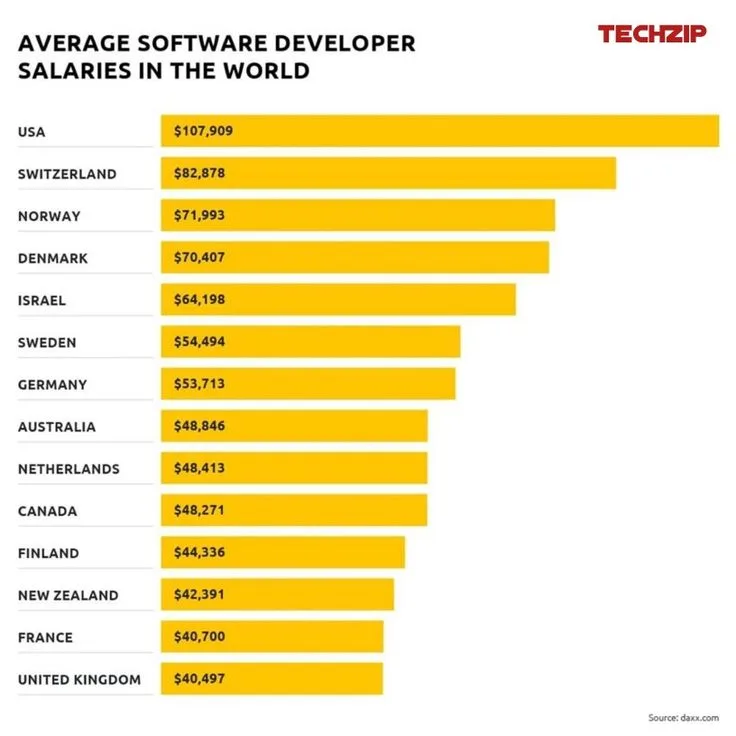
Software engineer salaries differ widely by seniority, company tier, location, and the mix of cash and equity. Base pay is only one part of a package at many technology companies, where bonuses, signing payments, restricted stock, and refresh grants can substantially affect total compensation. Internal levels are not directly equivalent across employers, so accurate comparisons require matching role scope as well as title.
Ask ten software engineers what they earn and you will get ten different answers - not because they are being evasive, but because the range is genuinely vast.
A junior engineer at a regional insurance company and a senior engineer at Google can both truthfully call themselves software engineers while earning $75,000 and $450,000 respectively.
That six-figure gap is not random noise. It is the product of level, company tier, geography, equity structure, and a compensation system that most engineers do not fully understand when they enter the profession.
Understanding how software engineering compensation actually works matters more now than it did a decade ago. The rise of remote work collapsed geographic salary arbitrage for some roles while expanding it for others.
The normalisation of equity as a major compensation component - documented extensively in Levels.fyi data - means that base salary alone is now a poor proxy for actual earnings.
And with layoffs at major tech companies between 2022 and 2024 pushing experienced engineers onto the open market, knowing your market rate has become a survival skill, not just a negotiation tactic.
This article breaks down software engineer compensation across every dimension that actually matters: seniority level, company tier, and country. It distinguishes base salary from total compensation, explains how equity works in practice, and references the most current publicly available data so you can benchmark yourself accurately.
"Most engineers leave 20-30% of their compensation on the table simply because they do not know what the market actually pays for their level. The data is public - use it."
- Zuhayeer Musa, co-founder of Levels.fyi, in a 2023 interview[6]
Key Definitions
Base Salary: The fixed annual cash amount paid regardless of company performance or individual results. Used for mortgage applications and financial planning. At most companies, base salary is the smaller portion of total compensation.
Total Compensation (TC): The sum of base salary, annual performance bonus, and the annualised value of equity grants. This is the number engineers at top-tier companies compare when evaluating offers, and the figure Levels.fyi collects and publishes.
RSU (Restricted Stock Unit): A grant of company shares that vests over time - typically four years with a one-year cliff. At public companies, RSUs convert to taxable cash at vest. The value fluctuates with the stock price, making TC volatile year to year.
Leveling: Each company uses an internal seniority ladder - L3 through L8 at Google, E3 through E9 at Meta, SDE I through Principal at Amazon. These levels do not map perfectly across companies; a senior engineer at one company may be considered mid-level at a larger firm.
Equity Refresh: Additional stock grants awarded to existing employees, typically annually, to prevent the golden handcuff effect of vested shares losing retention power. At companies like Google and Meta, refresh grants are a standard tool for retaining high performers beyond their initial vesting cliff.
Signing Bonus: A one-time payment made when an engineer joins a company, often used to offset unvested equity being left behind at the previous employer. Signing bonuses at top-tier companies range from $20,000 for new graduates to $150,000+ for senior hires.
Software Engineer Salaries by Level: US Summary
| Level | Equivalent Level | Base Salary (US) | Total Comp (Tier-1) | Total Comp (Tier-2/3) |
|---|---|---|---|---|
| Junior / New Graduate | L3/E3/SDE I | $100,000-$160,000 | $180,000-$230,000 | $75,000-$130,000 |
| Mid-Level | L4/E4/SDE II | $140,000-$200,000 | $240,000-$350,000 | $120,000-$180,000 |
| Senior | L5/E5/SDE III | $180,000-$250,000 | $300,000-$500,000 | $150,000-$250,000 |
| Staff | L6/E6 | $210,000-$280,000 | $350,000-$650,000 | $220,000-$380,000 |
| Principal | L7/E7 | $250,000-$350,000 | $500,000-$1,000,000+ | $200,000-$400,000 |
The Bureau of Labor Statistics (BLS) 2024 Occupational Employment Statistics report lists the median annual wage for software developers and software quality assurance analysts at $132,270.[1] This number, while authoritative, obscures the enormous spread that exists by level.
Salary by Level in the United States
Junior Engineer (L3 / SDE I / New Graduate)
At top-tier companies, new graduate engineers entering at L3 (Google) or E3 (Meta) receive total compensation packages between $180,000 and $230,000, dominated by base salary of $130,000-$160,000 with signing bonuses and a four-year RSU grant.
This is not representative of the industry. At mid-tier tech companies, new graduates earn $100,000-$140,000 base. At regional employers, consulting firms, and non-tech companies with engineering departments, $75,000-$95,000 is common.
Levels.fyi 2024 data shows the median total compensation for a new graduate software engineer across all companies reporting is approximately $157,000, pulled upward by the outsized presence of top-tier companies in their dataset.[2]
The gap between FAANG new graduate compensation and the broader market has widened significantly since 2018.
According to Stack Overflow's 2024 Developer Survey, which collected data from over 65,000 respondents in more than 180 countries, the global median salary for developers with less than two years of experience is approximately $55,000 - a figure that captures the full international range, including markets where $30,000-$45,000 is the local norm.[8]
Mid-Level Engineer (L4 / SDE II / 3-5 Years Experience)
This is where compensation begins diverging sharply. At Google, L4 total compensation ranges from $240,000 to $350,000. At Meta, E4 runs from $220,000 to $310,000. At well-funded startups with Series B and beyond funding, mid-level engineers often earn $160,000-$220,000 in base alone, with equity upside that is harder to value.
At enterprise technology companies - the IBMs, Oracles, and legacy financial institutions - mid-level engineers at three to five years of experience typically earn $120,000-$165,000 in base with modest bonuses and minimal equity.
Mid-level is also the point where geographic salary differentiation within the US is sharpest. A mid-level engineer in San Francisco or Seattle earns materially more than the same engineer in Austin or Chicago, even at the same company tier.
Remote work policies have moderated this somewhat, but location-based pay adjustments remain standard practice at most large tech companies as of 2024.
Senior Engineer (L5 / SDE III / E5 / 6-10 Years Experience)
Senior engineer is the terminal level for most practitioners - the highest rung many engineers reach before the path forks into management or staff-level individual contributor work. It is also the most competitive and well-compensated broadly accessible level.
At FAANG and Tier-1 companies (Google, Meta, Apple, Amazon, Netflix, Microsoft, Stripe, Airbnb), senior engineer total compensation falls in the $300,000-$500,000 range. Base salary typically reaches its company-set ceiling - around $200,000-$250,000 - meaning further compensation growth comes almost entirely through larger equity grants.
At Tier-2 companies (well-funded startups, mid-size public tech companies, fintech firms), senior engineers earn $170,000-$280,000 total compensation. At Tier-3 employers (regional companies, agencies, non-tech corporations), $120,000-$170,000 base is the norm.[9]
Senior engineers who transition between companies strategically often see compensation increases of 20-40% at each move, according to LinkedIn Talent Insights data from 2023-2024.[7]
The market for senior engineering talent remained competitive even through the 2022-2024 tech correction, with specialized skills in machine learning infrastructure, distributed systems, and security commanding additional premiums.
Staff Engineer (L6 / E6 / 8-15+ Years Experience)
Staff engineer represents the first truly differentiated level on the individual contributor track - a role that requires technical leadership across multiple teams, not just execution on assigned work.
Fewer than 10% of engineers who enter the profession reach this level, according to estimates from engineering leadership researchers including Will Larson, author of Staff Engineer (2021).[4]
Total compensation for staff engineers at Tier-1 companies ranges from $350,000 to $650,000. At Tier-2 companies, $220,000-$380,000. The equity component becomes increasingly dominant at this level; a staff engineer at a company with strong stock performance may see their annual equity vest exceed their base salary.
At Google in 2024, L6 engineers receiving strong performance ratings ("Exceeds Expectations" or above) routinely received equity refresh grants of $400,000-$700,000 over four-year vesting schedules, stacking on top of the original grant from their hire.
This compounding equity structure is one of the primary mechanisms through which top-tier tech companies retain their most valuable individual contributors.
Principal Engineer (L7 / E7 / Decade+ Experience)
Principal engineers operate at a scope that influences entire product areas or technical platforms. There are very few of them - typically fewer than one per hundred engineers at large companies.
Levels.fyi data from 2024 shows principal engineer total compensation at Google (L7), Meta (E7), and Amazon (Principal SDE) ranging from $500,000 to over $1,000,000 when large stock grants are included.
These numbers represent the extreme end of the distribution. The median principal or distinguished engineer in the broader market - including those at financial services firms, large enterprises, and late-stage startups - earns $200,000-$400,000.[11]
Salary by Company Tier
FAANG and Tier-1 Tech
The companies that set the ceiling for software engineering compensation include Google (Alphabet), Meta, Apple, Amazon, Netflix, and a second tier of companies that compete for the same talent: Microsoft, Stripe, Coinbase, Lyft, Uber, Airbnb, and OpenAI.
These companies use aggressive total compensation packages to compete with each other; they also use internal equity refresh grants to retain engineers who have finished their initial vesting cliff.
Netflix is an outlier worth noting: the company pays exclusively in cash - no equity - at extremely high base salaries, with senior engineers earning $300,000-$700,000 in base alone. This model appeals to engineers who prefer predictability and liquidity over potential upside.
OpenAI has emerged as a new force in Tier-1 compensation since 2022. Its rapid valuation growth and talent competition with Google DeepMind and Meta AI has pushed AI research engineer compensation to levels that exceed even traditional FAANG packages.
Senior AI/ML engineers at frontier model labs reported total compensation of $600,000-$1,500,000 in 2024, including profit interest units that carry potential upside above even RSU-based compensation.
Startups (Pre-IPO)
Startup compensation trades current cash for future equity. Early-stage (Seed, Series A) startups typically pay $100,000-$140,000 base with equity grants of 0.1%-1% depending on stage and role.
The equity is in options, usually ISOs, which require exercise and carry significant risk - most startups do not achieve the exits that make these valuable.
Series B and C startups pay closer to market base rates - $150,000-$220,000 for senior engineers - with smaller percentage equity grants but in companies with more validation. Late-stage pre-IPO companies often approach Tier-1 total compensation packages using preferred share grants whose value is more estimable.
The expected value calculation for startup equity is deeply unfavorable for most cases. Research by venture capital firm Correlation Ventures found that fewer than 1% of funded startups achieve exits of $1 billion or more.[14]
The vast majority of startup equity grants return nothing or far less than the equivalent cash from a public company employer.
Engineers who rationally prefer startup risk should be targeting late-stage pre-IPO companies with clear exit timelines, not early-stage startups unless the cash compensation is competitive.
Enterprise and Non-Tech Companies
Banks, insurance companies, retailers, and legacy technology firms employ more software engineers than the tech sector in absolute numbers, according to BLS data.
They pay meaningfully less - typically 30-50% below FAANG for equivalent experience - but offer greater job stability, better work-life balance in many cases, and defined benefit structures that pure tech companies have largely eliminated.
A senior engineer at JPMorgan or Goldman Sachs earns $180,000-$300,000 total compensation - competitive by most standards, but below what a counterpart at Google earns. The trade-off is meaningful: lower ceiling, but also lower risk of layoff in the cycles that periodically hit pure tech.
| Company Type | Senior Engineer TC | Job Security | Work-Life Balance | Equity Upside |
|---|---|---|---|---|
| FAANG/Tier-1 Tech | $300,000-$500,000 | Moderate (layoff cycles) | Variable | High |
| Tier-2 Tech / Fintech | $170,000-$280,000 | Moderate | Moderate | Moderate |
| Investment Banks (IB) | $180,000-$300,000 | Moderate-High | Poor-Moderate | Low-Moderate |
| Large Enterprise (non-tech) | $120,000-$170,000 | High | Good | Low |
| Early Startups | $120,000-$160,000 + equity | Low | Variable | High (theoretical) |
| Government / Public Sector | $100,000-$150,000 | Very High | Good | None |
Salary by Country
| Country | Senior Engineer Base | Senior Engineer TC | Notes |
|---|---|---|---|
| USA (Bay Area, NYC) | $200,000-$260,000 | $300,000-$500,000 | FAANG premium market |
| USA (Remote/other) | $160,000-$210,000 | $220,000-$380,000 | Some companies pay location-adjusted |
| UK (London) | GBP 80,000-130,000 | GBP 95,000-180,000 | Less equity at most UK employers |
| Germany | EUR 70,000-110,000 | EUR 80,000-140,000 | Strong employment protections offset lower pay |
| Canada (Toronto/Vancouver) | CAD 130,000-180,000 | CAD 160,000-280,000 | US company offices pay higher |
| India (MNC offices) | INR 40-80 lakh | INR 50-100 lakh | Wide range; top US MNCs pay higher |
| Australia (Sydney) | AUD 130,000-180,000 | AUD 150,000-230,000 | US tech offices above average |
| Netherlands | EUR 65,000-100,000 | EUR 75,000-130,000 | Hub for US tech EU presence |
United Kingdom
Senior software engineers in London earn GBP 80,000-130,000 base salary. Outside London, GBP 60,000-90,000 is more typical. Total compensation is harder to compare to the US because equity participation is less common outside of startups and the UK arms of US tech companies.
Glassdoor and Levels.fyi UK data from 2024 show median senior engineer total compensation of approximately GBP 95,000.
The UK tech market has been significantly influenced by the presence of US tech companies establishing London as their European headquarters.[12]
Google, Amazon, Meta, and Goldman Sachs all pay near-US compensation for senior engineers at their UK offices, pulling up the London market average while creating a two-tier system between those inside and outside the US tech ecosystem.
Germany
Germany has a growing tech sector centred in Berlin, Munich, and Hamburg. Senior engineers earn EUR 70,000-110,000 base, with Berlin slightly below Munich. German employment law makes layoffs more difficult and provides more statutory protections than the US.
Total compensation at German branches of US tech companies approaches US figures; local German employers lag significantly.
Germany also benefits from a strong social safety net that partially offsets lower nominal compensation: statutory minimum of 20 paid vacation days (in practice 25-30 at most tech employers), strong healthcare coverage, and parental leave provisions that significantly exceed US standards.
When adjusted for these benefits, the effective compensation gap between German and US tech employment is narrower than the base salary comparison alone suggests.
Canada
Canadian software engineers benefit from proximity to the US talent market and the presence of US tech company offices in Toronto, Vancouver, and Waterloo. Senior engineers earn CAD $130,000-$180,000 at local companies, rising to CAD $180,000-$280,000 at US company Canadian offices.
Currency conversion has historically meant Canadian engineers earn approximately 70-75% of US counterparts in absolute dollar terms.
Canada's engineering talent ecosystem has also been strengthened by immigration policy.
The Global Talent Stream visa stream, introduced in 2017, allows tech companies to hire skilled foreign workers in as little as two weeks, making Canada a staging ground for international engineering talent that often eventually moves to the US or stays in Canada's growing tech ecosystem.
India
India's technology sector is among the largest in the world by headcount. At Indian multinational technology companies - Infosys, TCS, Wipro - senior engineers earn INR 15-25 lakh annually. At the Indian offices of US tech companies (Google India, Microsoft India, Flipkart), senior engineers earn INR 40-80 lakh plus equity.
Engineers who transition to US-based remote roles for US companies increasingly earn near-US compensation, a trend that accelerated post-2020.
Hyderabad and Bangalore are the primary hubs for high-compensation engineering work in India, with the presence of US hyperscaler offices (Amazon, Microsoft, Google, Oracle) creating salary floors significantly above local tech company norms.
The talent pipeline from IITs and NITs feeds both US companies' India offices and direct immigration to the US via the H-1B visa program.
How Equity Actually Works
The equity component of software engineering compensation is the most misunderstood by newcomers and the most important for wealth accumulation at top-tier companies.
RSUs at public companies are the most straightforward form. An engineer receives a grant - say, $400,000 in Google stock - that vests over four years, typically 25% per year or monthly after the first year cliff. At vest, the shares become taxable ordinary income.
The risk is stock price movement: that $400,000 grant could be worth $280,000 or $560,000 at vest depending on performance.
Stock options at private companies are more complex. The engineer receives the right to purchase shares at a fixed "strike price." If the company's fair market value rises above the strike price and a liquidity event occurs (acquisition or IPO), the options have value.
Many options expire if the engineer leaves the company without exercising them, and exercise requires cash. The 90-day exercise window after departure is a documented source of significant financial loss for engineers who cannot afford or choose not to exercise expiring options.
Performance-based equity refreshes - common at Amazon and some other companies - grant additional RSUs annually based on performance ratings. This creates an equity accumulation system where strong performers receive compounding grants over time, substantially increasing effective TC versus the initial offer letter.
The Tax Implications Engineers Often Miss
Equity taxation is one of the most consequential financial topics for senior engineers and is poorly understood until it costs real money.
RSUs are taxed as ordinary income at vesting - the full market value at vest is added to your W-2. This means a large vest in a high-income year can push an engineer into the 37% federal bracket plus state income tax. In California (where FAANG headquarters are concentrated), combined marginal rates on RSU income can exceed 52%.
Incentive Stock Options (ISOs) at private companies have different treatment: they are not taxed at exercise, but the spread between strike price and fair market value at exercise counts as an AMT (Alternative Minimum Tax) preference item, potentially creating a large tax liability even on illiquid shares.
Engineers who exercise options in year X and then see the company's value decline or fail before a liquidity event in year X+2 have reported owing taxes on gains they never realized.
The difference between exercising early (83(b) election) versus waiting, between ISOs and Non-qualified Stock Options (NSOs), and between short-term and long-term capital gains treatment creates a decision tree that can be worth tens or hundreds of thousands of dollars over a career.
This is an area where specialized equity compensation tax advice typically pays for itself many times over.
The 2022-2024 Correction and What Changed
The tech layoff cycle that began in late 2022 and continued through 2024 affected approximately 260,000 tech workers in 2023 alone, according to Layoffs.fyi tracking.[13] This was the largest contraction in tech employment since the dot-com bust of 2001.
The correction affected compensation in several ways that are still playing out as of 2025-2026. First, FAANG companies increased performance-managed departures, raising the effective bar for retention at existing compensation levels.
Second, hiring froze or slowed significantly at mid-tier companies, reducing the competitive pressure on salaries in the $150,000-$220,000 range.[10]
Third, the supply of experienced engineers on the open market - many from Meta, Google, and Amazon - compressed compensation expectations at the senior level.
However, the correction did not affect all specializations equally. Engineers with deep expertise in machine learning, large language model infrastructure, security engineering, and distributed systems at scale remained in extremely high demand throughout the downturn, with compensation holding firm or rising.
The layoffs disproportionately affected generalist roles, program management, and engineering positions adjacent to advertising businesses.
As of 2024-2025, hiring velocity has returned to pre-correction levels at most large tech companies, but the compensation inflation of 2020-2022 (when zero interest rate policy drove massive VC investment and heated competition for all engineering talent) has not fully returned.
Practical Takeaways
Before your next negotiation or job search, understand which tier your target employers fall into and benchmark specifically against that tier using Levels.fyi, Glassdoor, Blind, and the Compensation & Total Rewards subreddits.[5][3]
Do not compare your enterprise salary to FAANG total compensation and conclude you are underpaid - the comparison is only valid within tiers.
Always negotiate on total compensation, not base salary. Many companies have base salary caps by level but unlimited refresh grant budgets; a recruiter who cannot move base by $20,000 may be able to offer $80,000 in additional equity without escalation.
Know your level. Misleveling - being hired at a level below your experience - is one of the most common and expensive mistakes in tech hiring. A single level difference at a top-tier company can represent $100,000-$200,000 in annual compensation.
Ask explicitly which level a role is at before your first interview, and prepare to discuss your scope and impact in terms of the company's leveling rubric.
Finally, understand the difference between an offer's stated TC and its risk-adjusted value. A $400,000 TC offer from a pre-IPO startup is worth considerably less than a $400,000 TC offer from a public company, once you account for the probability distribution of liquidity outcomes.
The market rate for illiquid equity risk is a premium of 30-50% over equivalent public company compensation - meaning the startup must offer $520,000-$600,000 in total paper compensation to be economically equivalent to a $400,000 public company offer.
Sources & Further Reading
- Bureau of Labor Statistics. (2024). Occupational Employment and Wage Statistics: Software Developers, Quality Assurance Analysts, and Testers. US Department of Labor. bls.gov
- Levels.fyi. (2024). End of Year Pay Report 2024. levels.fyi/2024-pay-report
- Glassdoor. (2024). Software Engineer Salary Data. glassdoor.com
- Larson, Will. (2021). Staff Engineer: Leadership Beyond the Management Track. Staffeng.com Press.
- Blind. (2024). Tech Salary Survey 2024. teamblind.com
- Musa, Z., & Schulman, C. (2023). Levels.fyi Salary Transparency Report. levels.fyi
- LinkedIn Talent Insights. (2024). Software Engineering Hiring Trends Report. linkedin.com
- Stack Overflow. (2024). Developer Survey 2024. survey.stackoverflow.co/2024
- Robert Half Technology. (2024). 2024 Technology and IT Salary Guide. roberthalf.com
- Indeed Hiring Lab. (2024). Tech Sector Wage Trends Report Q3 2024. indeed.com
- CompStudy. (2024). Annual Compensation Survey: Technology Sector. compdata.com
- European Commission. (2024). Digital Economy and Society Index: Digital Skills and Jobs. ec.europa.eu
- Layoffs.fyi. (2024). Tech Layoffs Tracker 2022-2024. layoffs.fyi
- Correlation Ventures. (2023). Startup Exit Outcomes: A Data-Driven Analysis. correlationvc.com