
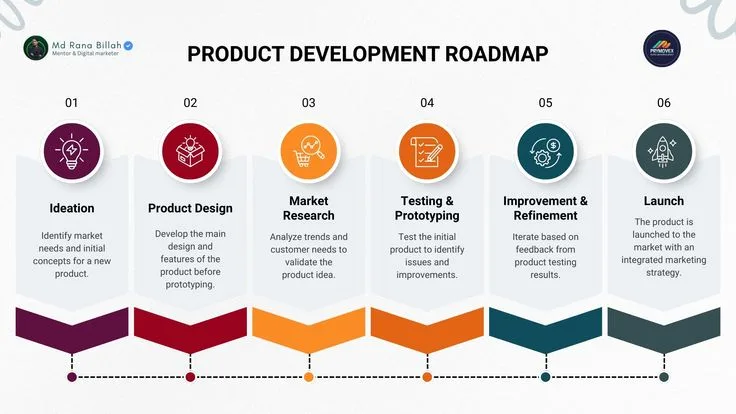
A product roadmap is a strategic communication document that conveys the direction, priorities, and planned evolution of a product over time. It aligns stakeholders - engineers, executives, sales teams, and customers - around what is being built, why it matters, and roughly when it will happen.
Building an effective roadmap is one of the most important skills in product management, and getting it wrong is one of the most common sources of organizational dysfunction in technology companies.
This guide covers the main roadmap formats, how to choose between them, how to build a roadmap grounded in strategy rather than pressure, and how to maintain it as a living document without either ignoring it or treating it as a sacred contract.
What a Product Roadmap Is (and What It Is Not)
The Core Definition
A product roadmap is a communication tool. That word - communication - is the most important part of the definition. A roadmap exists to convey information about direction and priorities to an audience. It is not a promise, not a contract, and not a detailed project plan.
It answers the question "where are we going and roughly when?" - with the word "roughly" doing substantial work.
Martin Cagan, partner at the Silicon Valley Product Group and author of Inspired: How to Create Tech Products Customers Love (2008, revised 2017), has argued for decades that the fundamental purpose of a roadmap is to communicate strategy, not to schedule features.
When a roadmap becomes a feature delivery schedule, it stops being a strategic tool and becomes a project management artifact - one that creates perverse incentives to ship features regardless of whether they solve the intended problem.
What a Roadmap Is Not
A roadmap is not a backlog. A product backlog is a prioritized list of specific tasks, stories, and bugs organized for execution. A roadmap operates at a higher level of abstraction - goals, themes, and strategic bets. Items from a roadmap get decomposed into backlog items when they move into active planning.
Confusing the two leads to roadmaps that are too granular to communicate strategy and too strategic to drive daily work - serving neither purpose.
A roadmap is not a release plan. A release plan specifies when specific features will ship. A roadmap communicates direction and priorities without necessarily committing to precise delivery dates.
As Melissa Perri writes in Escaping the Build Trap (2018), conflating roadmaps with release plans is one of the primary ways product organizations lose their strategic focus - they begin optimizing for shipping on time rather than for achieving outcomes.
A roadmap is not a feature list. The best roadmaps communicate outcomes - problems to solve and goals to achieve - rather than prescribing specific features. "Reduce first-week churn by 20%" is a roadmap item; "add onboarding checklist" is a feature hypothesis that might or might not achieve that outcome.
The distinction matters because it preserves the team's latitude to discover the best solution rather than being locked into a predetermined one.
"If you are just using your roadmap to communicate a list of features and dates, you are just a feature factory. Your roadmap should tell the story of how you are going to achieve your vision." - Melissa Perri, Escaping the Build Trap (2018)
A Brief History of Product Roadmaps
The concept of roadmapping originated not in software but in industrial manufacturing. Motorola is widely credited with creating one of the first formal technology roadmaps in the late 1970s, mapping out semiconductor capabilities against future product requirements.
The approach spread through the electronics and automotive industries during the 1980s, where long development cycles and hardware constraints made forward planning essential.
When software development adopted roadmaps in the 1990s, the format transferred almost unchanged: Gantt-style charts with features mapped to quarterly or annual timelines.
This made sense in the era of waterfall development, where software was shipped in annual or semi-annual releases and changing course mid-cycle was prohibitively expensive.
The Agile Manifesto of 2001 challenged this model. Agile methodology emphasized responding to change over following a plan, which created a tension with traditional roadmaps that persists to this day.
The evolution of roadmap formats since then - from rigid timelines to flexible themes to pure outcomes - represents the product management profession's ongoing effort to reconcile the need for strategic direction with the reality that the future is uncertain.
Janna Bastow, co-founder of ProdPad and a leading voice in modern product management, formalized the Now/Next/Later roadmap format around 2012, explicitly designed to acknowledge uncertainty rather than pretend it does not exist.
Teresa Torres and Marty Cagan have since championed outcome-based roadmaps that focus on results rather than deliverables. These innovations represent a gradual maturation of the discipline.
The Main Roadmap Formats
The Timeline Roadmap
The timeline roadmap is the most traditional and widely recognized format. Features, initiatives, and themes are laid out against a time axis - typically quarters or months. Stakeholders can see when specific work is planned to happen.
When it works: Products with strong external dependencies benefit from timeline roadmaps. Regulatory deadlines (GDPR compliance by a specific date), contractual commitments to enterprise customers, hardware manufacturing schedules, and coordinated multi-team launches all represent genuine constraints that a timeline reflects accurately.
A medical device company preparing for an FDA submission needs a timeline. A defense contractor working to a government procurement schedule needs a timeline.
When it fails: For most software products operating in uncertain markets, the future is genuinely unknown. Committing to a delivery date for a feature that has not been designed, tested, or validated forces a later choice: ship something substandard to meet the date, or miss the deadline and erode trust.
Timeline roadmaps in these contexts often become exercises in managing to the roadmap rather than managing toward the strategic goal - a form of metric displacement at the organizational level.
The Now/Next/Later Roadmap
The Now/Next/Later roadmap replaces time axes with three buckets:
- Now: What the team is actively building. High confidence, well-defined scope.
- Next: What is being prepared for after the current work. Medium confidence, scope being refined.
- Later: What is on the horizon but not yet being actively planned. Low confidence, exploratory.
This format, popularized by Janna Bastow and adopted widely in agile product teams, avoids false precision. It acknowledges that commitments become less reliable the further into the future they project, and it structures the roadmap to reflect that honestly.
When it works: Startups, rapidly evolving products, and teams working in genuinely uncertain environments benefit from Now/Next/Later because it accurately represents what is known. It reduces the pressure to fabricate certainty that does not exist and allows the team to be transparent about the current state of planning.
When it fails: Some stakeholders - particularly enterprise sales teams and large customers with their own planning cycles - need more temporal precision.
"Later" is not a useful answer to a prospect asking "when will you support single sign-on?" In these contexts, the format may need to be supplemented with more specific commitments for the near-term items.
The Outcome-Based Roadmap
The outcome-based roadmap organizes work around goals and metrics rather than features. Instead of "Add in-app notifications," it shows "Increase day-7 retention from 40% to 55%." The feature is treated as a hypothesis about how to achieve the outcome; the outcome itself is the actual commitment.
This format, championed by product thinkers like Teresa Torres (author of Continuous Discovery Habits, 2021) and Marty Cagan, makes explicit what a good roadmap should always imply: the team is accountable for results, not deliverables.
Shipping a feature that does not move the target metric is not success - it is a failed experiment that should inform the next approach.
When it works: Mature product organizations with strong discovery practices and robust analytics infrastructure can run outcome-based roadmaps credibly. The format enables teams to stay focused on impact, iterate on solutions, and have honest conversations about what is and is not working.
When it fails: Organizations that have not invested in measurement and analytics cannot run this format. If you cannot measure whether you achieved the outcome, the roadmap collapses into a vague intention document with no accountability mechanism.
The format also requires cultural comfort with experimentation and failure - shipping three approaches to achieve a metric, with two failing, must be seen as learning rather than waste.
The Theme-Based Roadmap
Between feature lists and pure outcomes lies the theme-based roadmap, which organizes work around strategic areas of investment. Themes might include "Onboarding and activation," "Enterprise admin tools," "Performance and reliability," or "International expansion."
Themes communicate priorities without prescribing solutions. They allow teams to make commitments about which areas they will invest in while preserving flexibility about how. This format works particularly well for communicating with executives and board members who care about strategic direction but not implementation details.
| Format | Precision | Flexibility | Best Audience | Best Context |
|---|---|---|---|---|
| Timeline | High | Low | Enterprise customers, regulated industries | Hardware, contracts, compliance deadlines |
| Now/Next/Later | Low | High | Internal teams, agile organizations | Startups, early-stage products, uncertain markets |
| Outcome-based | Medium | High | Product teams, data-literate executives | Mature orgs with strong measurement practices |
| Theme-based | Medium | Medium | Executives, board members, investors | Mid-stage products, strategic planning cycles |
How to Build a Product Roadmap: A Step-by-Step Process
Building a product roadmap starts with grounding it in strategic context: business goals, product vision, and known constraints. From there, gather input from customer research, usage data, sales, engineering, and competitive intelligence, then prioritize ruthlessly using a framework such as RICE or an impact versus effort matrix. Choose a presentation format suited to each audience, and write each roadmap item around a goal, its strategic rationale, rough scope, and confidence level rather than a fixed feature specification.
Step 1: Ground the Roadmap in Strategic Context
Before deciding what goes on the roadmap, you must understand what the product is trying to achieve and why. This means knowing:
- The company's business goals: Revenue targets, user growth objectives, retention benchmarks, competitive positioning
- The product vision: The state of the world the product is working toward over a multi-year horizon. A vision is not a feature set - it is a description of the value the product creates and for whom.
- Current constraints: Engineering capacity, budget, technical debt, platform dependencies, regulatory requirements
A roadmap not grounded in strategy is a list of things people want. Strategy is what filters that list into a coherent plan. Richard Rumelt, author of Good Strategy Bad Strategy (2011), defines strategy as a coherent set of analyses, concepts, policies, and actions that respond to a challenge.
A product roadmap should be the expression of that coherent response, not a collection of unrelated initiatives.
Step 2: Gather Input from Multiple Sources
Good roadmaps synthesize diverse inputs through a strategic lens:
- Customer and user research: What problems are users experiencing? What outcomes are they trying to achieve? What are they working around? Teresa Torres's continuous discovery framework recommends weekly customer interviews to maintain a current understanding of user needs.
- Quantitative data: Where do users drop off? Which features are heavily used and which are abandoned? What does the data say about which problems are most impactful to solve?
- Sales and customer success: What do prospects ask for? What objections prevent deals? What would prevent churn among existing customers?
- Engineering: What technical investments would unlock future capabilities? What technical debt is limiting velocity or reliability?
- Market and competitive intelligence: What are competitors building? What expectations are being set in the market? Where are there unaddressed gaps?
The product manager's job is to synthesize these inputs through the lens of strategy, not to represent each constituency equally. Equal representation produces roadmaps that try to satisfy everyone and satisfy no one.
Step 3: Prioritize Ruthlessly
A roadmap that includes everything is a roadmap that communicates nothing. Prioritization is the core skill, and several frameworks exist to structure it:
RICE (Reach, Impact, Confidence, Effort): Developed by Intercom, this framework scores each initiative on estimated reach (how many users it affects), impact on key metrics, confidence in those estimates, and effort required.
Dividing the product of reach, impact, and confidence by effort produces a priority score that facilitates comparison across different types of initiatives.
Impact vs. Effort Matrix: A simpler 2x2 framework that separates quick wins (high impact, low effort) from major projects (high impact, high effort), fill-in tasks (low impact, low effort), and time sinks (low impact, high effort). The visual format makes it easy to identify no-brainer priorities and obvious deprioritizations.
Weighted Scoring with Strategic Alignment: Assign weights to strategic criteria (e.g., 40% revenue impact, 30% user retention impact, 20% strategic differentiation, 10% technical enablement) and score each initiative against those criteria.
This forces explicit discussion of what the organization values and creates a defensible rationale for prioritization decisions.
No framework eliminates judgment. They structure it. The most important prioritization discipline is being explicit about what is not on the roadmap and why - because the roadmap represents choices, and choices have opportunity costs.
Step 4: Choose the Right Format for Each Audience
Different audiences need different views of the same strategic plan:
- Engineering teams need enough specificity to plan sprints and allocate work, but not so much detail that the roadmap becomes a specification.
- Executives need strategic framing - how the roadmap serves company goals - with enough granularity to evaluate resource allocation.
- Customers and prospects need to know you are working on problems relevant to them, without commitments you cannot keep.
- Sales teams need enough specificity to have honest conversations with customers without overpromising.
This often means maintaining multiple views of the same roadmap rather than creating separate documents. Tools like Productboard, Aha!, Linear, and Notion allow product managers to create filtered views of a single source of truth, showing different levels of detail to different audiences while maintaining consistency.
Step 5: Write the Roadmap Items
A well-written roadmap item includes:
- The goal or outcome: What problem does this solve? What metric does it move? Why does it matter?
- The strategic context: Why now? Why does this matter more than the alternatives that were deprioritized?
- The rough scope: Not a full specification, but enough to communicate what is being considered and what is not.
- The confidence level: Is this committed work that will happen barring unforeseen circumstances, or a hypothesis that needs validation before full investment?
What a roadmap item does not include: exhaustive feature specifications, precise delivery dates for work that has not been estimated, or every idea anyone has ever suggested.
Keeping the Roadmap Alive
Establish a Review Cadence
Most product teams review and update their roadmaps on a quarterly cadence, aligned with business planning cycles. This is a minimum, not a maximum.
Significant new information - a major customer churning, a competitor shipping a game-changing feature, a fundamental technical constraint being uncovered, a market shift - should trigger an ad hoc roadmap review.
Jeff Patton, author of User Story Mapping (2014), recommends treating the roadmap as a hypothesis that is continuously refined as the team learns. Each quarter's review asks: What did we learn? What changed? What should we adjust?
Distinguish Between Changing Your Mind and Being Unreliable
There is a critical difference between updating a roadmap in response to new information and changing it because of internal politics or the loudest voice in the room. The former is good product management; the latter erodes trust.
When a roadmap changes, communicate transparently:
- What changed: Be specific about which items were added, removed, or reprioritized.
- Why it changed: Explain the new information or strategic reasoning that drove the decision.
- What the change means: Address the impact on previously planned work and affected stakeholders.
Teams that maintain this transparency build stakeholder confidence over time. Stakeholders accept roadmap changes more readily when they trust that changes are made thoughtfully and communicated honestly.
Manage the Graveyard
Every roadmap accumulates a "Later" section or unprioritized backlog of ideas and requests. This is healthy - it signals that feedback is captured rather than ignored. But the graveyard needs periodic maintenance.
Items that have been in "Later" for more than two years with no movement toward prioritization should be explicitly closed, archived, or deprioritized with a note explaining why.
A backlog with three years of undifferentiated requests is not a repository of future value - it is a source of confusion, false hope, and strategic noise.
How to Say No (and Make It Stick)
One of the hardest skills in product management is declining feature requests without damaging relationships. The requests that arrive most forcefully - from executives, from the company's largest customers, from sales teams trying to close deals - are often the ones that would most distort the roadmap if accepted uncritically.
Frame Around Strategy, Not Preference
"That feature doesn't fit our current focus" is less convincing and more personal than: "Our current investment in onboarding is designed to address the 35% first-week churn rate that our data shows is the primary driver of revenue loss.
This feature addresses a different problem and would displace work that directly serves our retention goal. I'd like to capture it for the next prioritization cycle."
The second response requires the product manager to have done the strategic work - clearly defined goals, explicit prioritization criteria, and supporting evidence. But it puts the conversation on strategic ground rather than personal preference, which is where productive disagreement happens.
Use the Opportunity Cost Frame
Every "yes" is a "no" to something else. Making opportunity costs explicit changes the nature of the conversation.
"If we build this integration, we will delay the SSO work that five enterprise prospects worth $2.4M in annual contract value are waiting for" is no longer a debate about whether the requester's idea is good.
It is a debate about which tradeoff is better - and that is the right debate to have.
Acknowledge Without Committing
"I've logged this and I'll bring it into the next prioritization cycle with the strategic context you've provided" is not a yes, but it is not a dismissive no. It acknowledges the request as legitimate while preserving the right to deprioritize it through the established process.
Most requesters want to feel heard more than they want an immediate yes. The psychology of communication supports this: acknowledgment reduces frustration even when the answer is ultimately no.
Common Roadmap Mistakes
The feature factory: A roadmap organized entirely around features without reference to problems, outcomes, or strategic goals. This type of roadmap gets longer over time, never questions whether shipped features are actually working, and optimizes for output over impact.
John Cutler, a product management thinker, coined the term "feature factory" in 2016 to describe organizations that measure success by shipping velocity rather than by outcomes achieved.
False precision: A roadmap with specific delivery dates for work that has not been designed, estimated, or validated. Specific dates invite stakeholders to hold the team to them, creating pressure that compromises quality, judgment, and the latitude to learn from discovery.
The yes-to-everything roadmap: A roadmap that includes everything every stakeholder has asked for, prioritized by whoever was most persistent or most senior. This is not a roadmap; it is an abdication of strategic responsibility.
The secret roadmap: A roadmap that is never shared beyond the product team. This prevents organizational alignment and invites other teams to pursue their own agendas in the absence of visible strategy, leading to duplicated effort and conflicting priorities.
The immortal roadmap: A roadmap that is written once and never updated, gradually diverging from reality until it is ignored entirely. An outdated roadmap is worse than no roadmap because it creates false expectations.
Tools for Roadmapping
The roadmapping tool landscape has matured significantly. A brief overview of the major options:
- Productboard: Strong for customer-driven product organizations. Integrates customer feedback directly into prioritization.
- Aha!: Feature-rich, enterprise-oriented. Supports multiple roadmap views and detailed strategic planning.
- Linear: Developer-oriented, clean interface. Growing roadmapping capabilities built on top of strong project management.
- Notion: Flexible, general-purpose. Good for teams that want to customize their roadmap format without being constrained by a specialized tool's opinions.
- Miro/FigJam: Visual collaboration tools useful for roadmap workshops and alignment sessions, though not purpose-built for ongoing roadmap management.
- Spreadsheets: Still used by many teams, especially early-stage companies. Simple and flexible, but difficult to maintain as the organization scales.
The tool matters less than the thinking. A strategically sound roadmap in a spreadsheet is better than a strategically empty roadmap in the most sophisticated tool.
Conclusion
A product roadmap is one of the most powerful communication tools a product team possesses - and one of the most commonly misused. The format matters less than the strategic thinking behind it. The best roadmaps are honest about uncertainty, grounded in strategy, focused on outcomes over features, and maintained with discipline.
Building a roadmap that serves these purposes requires courage as much as craft: the courage to say no to powerful stakeholders, to avoid false precision that feels comfortable but creates harmful commitments, and to update the roadmap when reality changes rather than defending a plan that no longer serves the product or its users.
Get the strategy right, choose a format that fits your context, and maintain the roadmap as a living document. The deliverable is not the document itself - it is the alignment, clarity, and strategic focus that the document creates.
Sources & Further Reading
- Cagan, Marty. Inspired: How to Create Tech Products Customers Love. 2nd ed. Wiley, 2017.
- Perri, Melissa. Escaping the Build Trap: How Effective Product Management Creates Real Value. O'Reilly Media, 2018.
- Torres, Teresa. Continuous Discovery Habits: Discover Products That Create Customer Value and Business Value. Product Talk LLC, 2021.
- Doerr, John. Measure What Matters: How Google, Bono, and the Gates Foundation Rock the World with OKRs. Portfolio/Penguin, 2018.
- Rumelt, Richard. Good Strategy Bad Strategy: The Difference and Why It Matters. Crown Business, 2011.
- Patton, Jeff. User Story Mapping: Discover the Whole Story, Build the Right Product. O'Reilly Media, 2014.
- Cutler, John. "12 Signs You're Working in a Feature Factory." Hackernoon, 2016.
- Bastow, Janna. "The Now/Next/Later Roadmap." ProdPad Blog. View source
- Intercom. "RICE: Simple Prioritization for Product Managers." View source
- Olsen, Dan. The Lean Product Playbook. Wiley, 2015.