
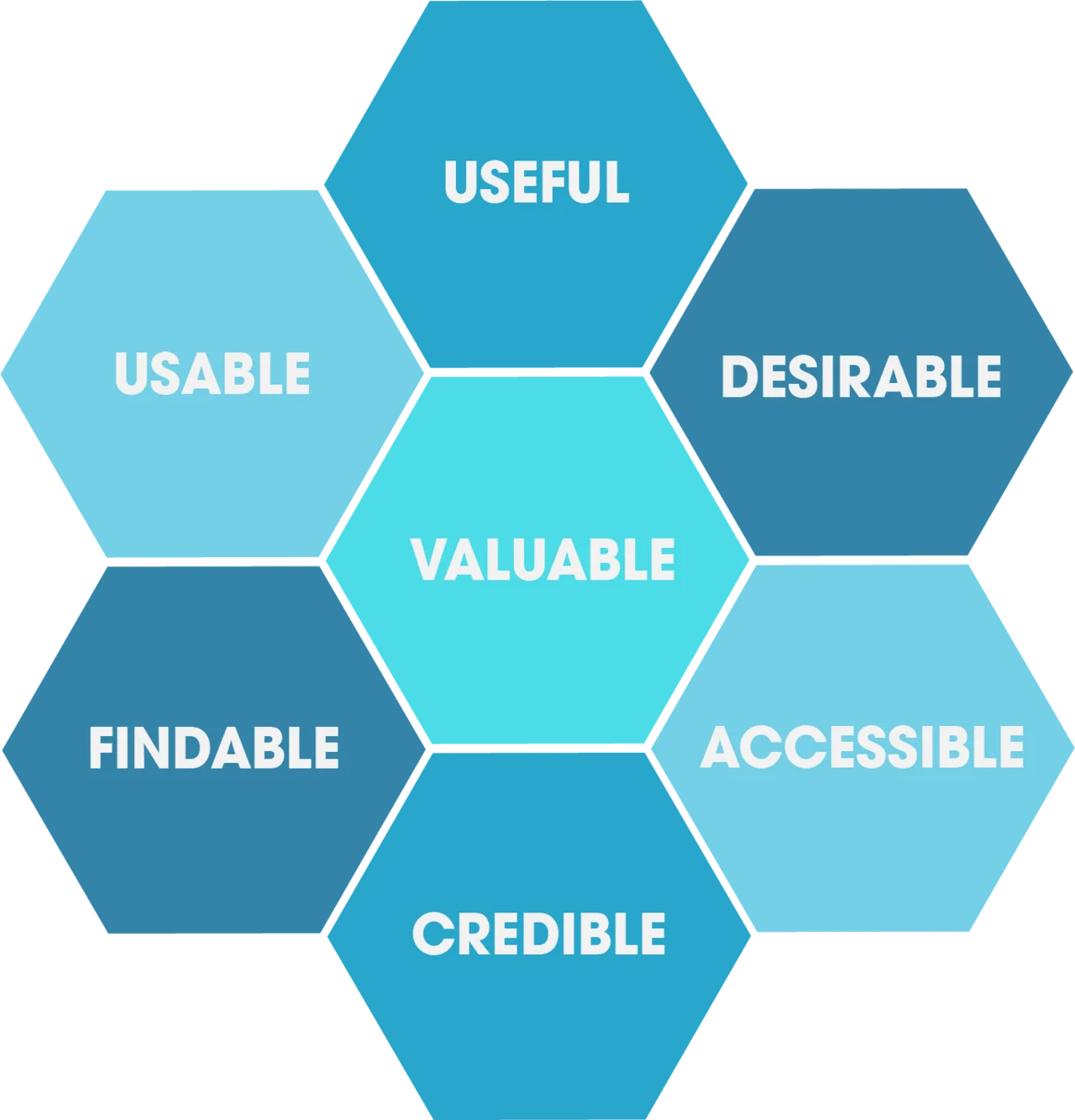
The answer to what is user experience is the overall quality of using a product, service, or system, including usefulness, usability, accessibility, findability, credibility, desirability, and value. UX design uses research, information architecture, interaction design, and testing to meet real needs. It differs from UI design, which focuses more narrowly on a product's visual and interactive surface, though roles can overlap in practice.
What Is UX Design?
User experience (UX) design is the discipline of designing products, services, and systems with deliberate attention to the quality of experience they create for users - encompassing usability, accessibility, findability, and the emotional response to interacting with a product.
It draws on user research, interaction design, information architecture, and visual design to ensure that products serve real human needs efficiently and satisfyingly.
The field was named and formalized by cognitive scientist Donald Norman in the early 1990s and has since expanded from physical product design into digital interfaces, services, and organizational systems.
In 1993, Donald Norman joined Apple and brought with him a title that had not previously existed: User Experience Architect.
He coined the term himself, dissatisfied with existing labels like "human interface" or "usability," because he wanted to capture something broader - not just whether a product's interface worked, but the entire quality of a person's experience with a product, from first encounter through regular use and eventual abandonment.
The term stuck, spread, and has since proliferated to the point of occasional meaninglessness. Today "UX" appears on business cards, in job postings, in product roadmaps, and in organizational strategy documents with a range of meanings from precise to vague.
A UX designer at one company might spend most of their time conducting user research and synthesizing behavioral insights into design recommendations. A UX designer at another might be primarily creating high-fidelity visual mockups.
Understanding what UX design actually is - what practitioners do, what methods the field uses, what principles underpin it, and where it sits relative to other design disciplines - is useful for anyone building products, working in technology, or considering a career in the field.
What User Experience Design Is
User experience design is the practice of designing products, services, and systems with careful attention to the quality of experience they create for the people who use them. It is concerned with:
- Whether a product is useful: does it address a real need?
- Whether it is usable: can people accomplish their goals with it without excessive difficulty?
- Whether it is findable: can users navigate to what they need?
- Whether it is accessible: can people with disabilities use it effectively?
- Whether it is credible: does it build appropriate trust?
- Whether it is desirable: does the aesthetic and emotional experience encourage engagement?
- Whether it is valuable: does it deliver sufficient value to both users and the organization?
These seven dimensions, from information architect Peter Morville's "User Experience Honeycomb" model (2004), describe the full scope of what UX aspires to address.
Morville, co-author of "Information Architecture for the World Wide Web" (1998, with Louis Rosenfeld), argued that UX practitioners who focus too narrowly on usability miss the dimensions that drive whether users adopt and stay with a product.
In practice, different projects prioritize different dimensions, and individual designers specialize in different parts of this scope.
The field has grown substantially. LinkedIn's 2023 Emerging Jobs Report listed UX designer among the top ten fastest-growing roles, and the US Bureau of Labor Statistics projected 3% growth for web and digital interface designers through 2032 - a figure that significantly understates UX growth because many UX roles are classified under software developer and product designer categories.
"Design is not just what it looks like and feels like. Design is how it works." - Steve Jobs
UX vs. UI: The Persistent Confusion
The most common question about UX is how it differs from UI (user interface) design. The distinction is real but blurry in practice.
UI design is primarily concerned with the visual and interactive layer of a product: the appearance of screens, the style of interactive elements (buttons, inputs, menus), typography, color, iconography, animation, and the micro-interactions that give visual feedback to user actions.
UI design is visual in nature and closely related to graphic design, though specialized toward digital interfaces.
UX design is concerned with the broader experience: the overall structure and information architecture of a product, the logic of user flows, the research process that reveals what users need, the testing process that reveals where designs succeed and fail, and the strategic decisions about what to build and how to organize it.
UX operates at a higher level of abstraction than UI.
The relationship can be summarized: UX design shapes what exists and how it is organized; UI design shapes how those things look and feel.
An analogy: if building a house, UX is the floor plan - where the rooms are, how they connect, which functions are adjacent - while UI is the interior design, the choice of materials and surfaces that make the space feel a certain way.
In small teams and startups, both are often done by the same person - commonly called a product designer. In larger organizations, the roles may be distinct.
There are also related specializations: UX researchers who focus exclusively on the research and testing component; interaction designers who focus on the behavioral logic of interfaces; information architects who focus on content organization and navigation systems; service designers who apply UX thinking to end-to-end service experiences beyond the digital product.
| Role | Primary Focus | Key Deliverables |
|---|---|---|
| UX Designer | Experience structure, user flows, research | Wireframes, user flows, research synthesis, prototypes |
| UI Designer | Visual layer, aesthetics, interactions | Visual designs, style guides, animation specs |
| UX Researcher | User understanding, behavior, needs | Research reports, usability findings, persona documents |
| Product Designer | End-to-end: research through visual design | All of the above |
| Information Architect | Content structure, navigation, taxonomy | Site maps, navigation models, content audits |
| Service Designer | End-to-end service journeys | Service blueprints, journey maps, ecosystem diagrams |
The Intellectual Foundations of UX
Human Factors and Ergonomics
UX design draws on a much older discipline: human factors (also called ergonomics), which studies the relationship between humans and the systems they use. Human factors research originated in World War II, when poor cockpit design contributed to pilot error and accidents.
Alphonse Chapanis's wartime research at Johns Hopkins demonstrated that systematic attention to how humans interact with designed systems could save lives - a finding that transformed industrial and military design.
The insights from human factors - that systems should be designed around human capabilities and limitations, not the other way around - are the intellectual foundation of UX. The difference is that UX extends this principle from physical equipment to digital products, and from physical ergonomics to cognitive and emotional ergonomics.
Cognitive Psychology
UX design relies heavily on cognitive psychology - the study of how humans perceive, attend to, remember, and reason about information. Key findings that directly inform UX practice:
Miller's Law (Miller, 1956): Working memory can hold approximately 7 (+/- 2) chunks of information simultaneously.
This finding, one of the most replicated in cognitive psychology, directly informs information architecture decisions: navigation menus with more than 7 primary options burden working memory; forms with too many fields create cognitive overload.
Hick's Law (Hick, 1952): Decision time increases logarithmically with the number of choices. More options mean slower, harder decisions. This is why good UX often involves reducing options, not adding them - a counterintuitive finding for product teams who equate features with value.
Fitts's Law (Fitts, 1954): The time to move to a target is a function of the target's distance and size. Larger, closer interactive elements are faster to tap or click.
This principle directly governs the design of touch interfaces: critical actions should be large and thumb-reachable; destructive actions should be small and distant.
Gestalt principles (Wertheimer, Kohler, Koffka, early 20th century): Humans perceive visual elements as organized patterns rather than isolated items. Principles of proximity, similarity, continuation, and closure describe how visual groupings are perceived, informing layout and visual hierarchy decisions.
Don Norman's Principles
Don Norman's 1988 book "The Design of Everyday Things" (originally published as "The Psychology of Everyday Things") is the foundational text of user-centered design.
It argues that when design fails - when people cannot figure out how to use a door, a thermostat, or a software interface - the failure is usually the designer's, not the user's.
Norman articulated several principles that have become standard vocabulary in UX:
Affordances and Signifiers
An affordance is a relationship between an object and a person that enables a particular action - a chair affords sitting, a button affords pressing. But affordances are only useful if they are perceived; a button that looks like a decorative graphic is not a functional affordance.
A signifier is the element that communicates the affordance - the visual or physical cue that tells a person what to do. Good design makes affordances visible through clear signifiers: a button that looks pressable, a scrollbar that shows there is more content, a text field with a visible cursor insertion point.
Much poor digital design fails on signifiers: interactive elements that look like static text, navigation labels that do not indicate their function, form fields with no clear indication of expected input.
The proliferation of "ghost buttons" - transparent outlined buttons that are easy to miss - and flat design's elimination of visual depth cues created a generation of interfaces where users could not reliably identify what was tappable.
Feedback
Feedback is the signal that an action has been taken and what its result was. When you press a physical button, it clicks and depresses - feedback confirms the action. When feedback is absent or delayed in digital interfaces, users repeat actions, creating errors.
Loading states, confirmation messages, error messages, and visual state changes are all feedback mechanisms.
Response time research (Nielsen, 1993) established three time thresholds that remain relevant: 100ms (instantaneous, no feedback needed), 1 second (noticeable delay, no loading indicator needed but user may feel uncertain), 10 seconds (user loses attention, progress indicator required).
Interactions that violate these thresholds without providing appropriate feedback generate frustration disproportionate to the actual delay.
Conceptual Models
A conceptual model is the mental model a design communicates to its users about how the system works. When a design's conceptual model matches users' mental model - their intuitions about how the system should work - it is easy to use. When they diverge, users make predictable errors.
The file-and-folder metaphor in desktop operating systems is a designed conceptual model. It maps to users' existing mental model of physical files and folders, making the abstract concept of hierarchical file storage immediately understandable.
Interfaces that fail to establish coherent conceptual models - that seem to work differently in different contexts without obvious reason - generate confusion even when individual screens are well-designed.
Mapping
Mapping describes the relationship between a control and its effect. Natural mapping - where the spatial relationship between controls mirrors the spatial relationship between effects - is intuitive. Car audio controls placed on the steering wheel at the position corresponding to the speaker locations are naturally mapped.
Controls organized arbitrarily require users to memorize relationships rather than intuit them. Norman documented numerous examples of stove top designs where the spatial layout of knobs bore no relationship to the spatial layout of burners - forcing users to mentally decode a mapping rather than act on spatial intuition.
The UX Research Process
UX without research is guesswork. The defining discipline of professional UX practice is the systematic investigation of user needs, behaviors, and mental models before, during, and after design.
Discovery Research
Before designing, UX researchers investigate the space: who are the users, what are their goals, what problems do they encounter, what context do they use the product in, and what alternatives do they currently rely on?
Methods include:
- Contextual inquiry: Observing users in their natural environment while they work or complete relevant tasks. Developed by Beyer and Holtzblatt (1998), contextual inquiry generates insights that interview methods miss because it captures behavior in context rather than self-reported behavior in a research setting.
- User interviews: Semi-structured conversations to understand goals, workflows, mental models, and pain points. The quality of insights from interviews is highly sensitive to interviewer skill - leading with solutions, asking closed questions, or failing to probe unexpected answers all significantly degrade the value of the data collected.
- Surveys: Broader quantitative picture of user demographics, preferences, and reported behavior
- Analytics review: Understanding what users are currently doing in an existing product
Discovery research is about understanding the problem space before defining solutions. Skipping it - assuming you know who the user is and what they need - is one of the most common and costly errors in product development.
IBM's design thinking research found that products built with structured discovery research were brought to market twice as fast with 33% lower development costs than products without research-informed design (IBM Institute for Business Value, 2018), because discovery catches false assumptions before they are engineered.
Usability Testing
Usability testing involves watching representative users attempt to complete defined tasks with a design - whether a prototype or a live product - and observing where they succeed, where they struggle, and what mental models they apply.
A basic usability test involves:
- Recruiting 5 to 8 participants who represent the target user population
- Defining 3 to 5 tasks that reflect real usage goals
- Asking participants to think aloud while attempting the tasks
- Observing and noting points of confusion, error, and unexpected behavior
- Synthesizing findings into prioritized design recommendations
Research by Jakob Nielsen (Nielsen, 1993) demonstrated that 5 participants uncover approximately 85 percent of usability problems in a given design - a finding often cited to justify lean testing rather than large sample sizes.
This principle has been somewhat refined: Nielsen's finding holds for discovering any usability problem, but rare or severity-dependent problems may require larger samples.
The practical implication is that small, frequent usability tests with 5-8 participants each are more valuable than infrequent large studies.
Remote usability testing - conducted via screen sharing tools rather than in-person - has dramatically reduced the cost and logistical complexity of testing, enabling teams to test more frequently and with more geographically diverse participants.
Tools including UserTesting.com, Maze, and Lookback have created infrastructure for unmoderated remote testing, where participants complete tasks on their own while being recorded.
Quantitative Research
Qualitative methods (interviews, observation, usability tests) generate deep understanding of why users behave as they do. Quantitative methods measure how many users behave in particular ways and with what frequency.
- A/B testing: Randomly splitting users between two design variants and measuring behavioral differences (conversion rates, task completion, click-through) to determine which performs better
- Funnel analysis: Tracking the percentage of users who complete each step in a multi-step flow to identify where drop-off occurs
- Heatmaps and session recordings: Visualizing where users click, scroll, and hover to identify areas of confusion or missed affordances
The combination of qualitative and quantitative research is more powerful than either alone. Analytics tells you where users are dropping off; qualitative research tells you why. A funnel analysis might show that 40% of users abandon a registration form at the address field.
Usability testing reveals that users are confused about why a product that will be delivered digitally needs their physical address. Neither insight is available from the other method alone.
The Design Process: From Diverge to Converge
UX design practice organizes work into a process that alternates between divergent thinking (generating many possible approaches) and convergent thinking (narrowing to the best one). Multiple frameworks describe this process; the most widely taught is the Double Diamond, developed by the British Design Council in 2005.
The Double Diamond has four phases:
Discover: Divergent research phase - understanding the problem space broadly before committing to any particular problem definition. User interviews, contextual inquiry, competitive analysis.
Define: Convergent synthesis phase - making sense of research and articulating a clear problem statement. Persona development, journey mapping, "How Might We" problem statements.
Develop: Divergent solution phase - generating many possible design approaches and exploring them through sketches, wireframes, and early prototypes.
Deliver: Convergent refinement phase - testing and iterating on the most promising approach, refining through usability testing and design critique until a solution is ready for production.
This alternating structure reflects an important principle: committing to a specific problem definition before research is complete produces solutions to the wrong problem. Committing to a specific design before testing produces solutions to the right problem that don't work in practice.
Design Thinking
Design thinking - a problem-solving methodology closely related to UX process - was popularized by IDEO and the Stanford d.school, and has spread from product design to business strategy and organizational problem-solving.
IDEO's Tim Brown defined it as "a human-centered approach to innovation that draws from the designer's toolkit to integrate the needs of people, the possibilities of technology, and the requirements for business success" (Brown, 2008).
IBM invested heavily in design thinking at scale, training over 100,000 employees in the methodology between 2014 and 2020. IBM's internal tracking found that design-led projects delivered products to market twice as fast and with significantly higher user satisfaction scores than projects without structured design thinking.
Accessibility: Designing for Everyone
Accessibility in UX design means ensuring that products can be used effectively by people with a range of abilities, including visual, auditory, motor, and cognitive disabilities.
The World Health Organization estimates that 1.3 billion people live with some form of disability - approximately 16% of the global population. In the context of digital products, the relevant figure is the percentage of users who rely on assistive technologies or who are disadvantaged by inaccessible design choices.
Microsoft's Inclusive Design team has documented that accessibility features designed for people with permanent disabilities consistently benefit users with situational limitations (holding a baby, bright sunlight, cold hands) - a finding that reframes accessibility from niche accommodation to universal improvement.
The primary international standard is the Web Content Accessibility Guidelines (WCAG), published by the World Wide Web Consortium (W3C). WCAG 2.1 defines three levels of compliance (A, AA, AAA) across four principles:
Perceivable: Information must be presentable in ways users can perceive. This means text alternatives for images (alt text), captions for video, and sufficient color contrast between text and background. WCAG 2.1 AA requires a contrast ratio of 4.5:1 for normal text - a threshold that many common design choices fail.
A 2022 audit by WebAIM of the top 1 million websites found that 96.8% had detectable WCAG failures on their home pages, with low contrast text being the most common failure (found on 83.9% of home pages).
Operable: Interface components must be operable by users who cannot use a mouse. This means full keyboard navigation, sufficient time to complete tasks, and no content that could trigger seizures.
Understandable: Information and operation must be understandable. This means readable language, predictable behavior, and helpful error identification and recovery.
Robust: Content must be robust enough to work across a variety of technologies, including assistive technologies like screen readers and voice control software.
Accessibility is legally required in many jurisdictions. In the United States, the Americans with Disabilities Act has been applied to websites and apps through litigation, with courts ruling that digital products constitute "places of public accommodation." The number of ADA web accessibility lawsuits in the US increased from 2,256 in 2019 to 3,255 in 2022 (UsableNet, 2023) - a 44% increase that reflects both growing awareness and active legal enforcement.
Similar requirements exist in the EU through the European Accessibility Act, which requires public sector digital services to meet WCAG 2.1 AA standards.
A Day in the Life of a UX Designer
The daily experience of a UX designer varies substantially by organization type, seniority, and phase of project. A rough sketch:
At a startup or small company: UX designers often own the entire design scope - research, wireframing, visual design, and sometimes front-end implementation. They work closely with founders and engineers, and the pace is fast with frequent pivots.
The advantage is breadth and ownership; the challenge is lack of specialized support and the cognitive load of context-switching between deep research work and fast visual execution.
At a large technology company: Roles are more specialized. A UX designer might focus on specific parts of a product, working within established design systems, and collaborating with dedicated researchers, product managers, and engineers on a defined feature area.
There is more process, more review, and more documentation. The advantage is depth and support; the challenge is bureaucratic friction and the distance from user impact that large-scale organizational structure can create.
In an agency or consultancy: Projects are defined-scope engagements with external clients. Work is often faster-paced with tighter deadlines, and the designer must quickly develop enough domain understanding to design effectively without years of exposure to the specific product.
Agencies provide exposure to a wide range of domains and problem types; the disadvantage is that designers rarely see the long-term outcomes of their work.
Across contexts, common daily activities include:
- Reviewing and annotating designs in tools like Figma, Sketch, or Adobe XD
- Collaborating in standups or review meetings with product and engineering teams
- Conducting or preparing user research activities (recruiting participants, writing discussion guides, running sessions, synthesizing findings)
- Iterating on wireframes or prototypes based on feedback from colleagues or testing
- Reviewing design implementations in the live product or staging environment
- Documenting design rationale and specifications for engineering handoff
Figma has become the dominant design tool of the current era, used by an estimated 4 million+ designers. Its shift to browser-based, multiplayer design in 2016 - enabling multiple team members to collaborate on designs in real time - transformed how design teams work.
Adobe's announced acquisition of Figma in 2022 was blocked by European regulators in 2023 on competition grounds, leaving Figma as an independent platform with dominant market position.
The Business Case for UX
Investment in UX generates measurable returns. The Forrester Research consultancy has estimated that every $1 invested in UX returns $100 - a ratio often cited and sometimes contested, but consistent in direction with multiple independent analyses.
McKinsey's 2018 McKinsey Design Index (Sheppard et al.), which analyzed 300 publicly listed companies over five years, found that companies in the top quartile on design metrics outperformed their industry peers by 32 percentage points in total return to shareholders and 56 percentage points in revenue growth.
The study controlled for industry and was one of the largest empirical analyses of UX ROI conducted at that time.
IBM's design thinking practice found that projects applying structured UX methodology delivered products twice as fast with 33% lower development costs compared to projects without structured design process - primarily because upfront research and testing prevented expensive late-stage rework.
Baymard Institute's research on e-commerce UX found that the average large e-commerce site can increase conversion rates by 35.26% through improved checkout UX alone - a finding based on analysis of over 4,500 unique checkout elements across 584 e-commerce sites.
Applied to US e-commerce, this represents approximately $260 billion annually in recoverable revenue from abandoned checkouts.
The business case for UX is not merely that it makes products prettier. It is that understanding users before building, testing designs before engineering them, and iterating based on evidence rather than assumption systematically reduces the cost of building the wrong thing.
Getting Into UX Design
UX design has become an accessible career path without a single required educational track. Practitioners enter from backgrounds including visual design, psychology, sociology, anthropology, computer science, library science, and communications.
Portfolio quality is more important than credentials for most hiring decisions. A portfolio demonstrating a complete UX process - problem definition, research, ideation, wireframes, testing, iteration - is more compelling than a degree without evidence of applied work.
Many practitioners build initial portfolios through personal projects, redesign exercises, volunteer work for nonprofits, or bootcamp capstone projects.
UX Bootcamps
UX-specific bootcamps (General Assembly, Springboard, CareerFoundry, Designlab) offer 3-9 month intensive programs. Course Report's 2023 survey found that 76% of UX bootcamp graduates who sought employment were hired in a design role within 6 months, with a median starting salary of $64,000.
These programs vary significantly in quality; the most rigorous provide mentorship from practicing UX designers and genuine portfolio project development.
Salary Ranges
| Role | Experience | Base Salary (US) |
|---|---|---|
| Junior UX Designer | 0-2 years | $55,000-$80,000 |
| Mid-level UX Designer | 2-5 years | $80,000-$120,000 |
| Senior UX Designer | 5+ years | $120,000-$160,000 |
| UX Lead / Principal | 8+ years | $150,000-$220,000 |
| Director of UX | Management track | $170,000-$280,000 |
| UX Researcher (Senior) | 5+ years | $110,000-$170,000 |
Sources: Glassdoor, LinkedIn Salary, Bureau of Labor Statistics, 2024 estimates.
Compensation is significantly higher at large technology companies (Google, Apple, Meta, Amazon) than at agencies, non-tech companies, or smaller startups. Geographic variation is substantial: San Francisco and Seattle base salaries run approximately 20-30% above national medians for equivalent roles.
Core tools to know: Figma (the dominant current industry tool for design and prototyping), Miro or FigJam for collaborative whiteboarding and workshop facilitation, Maze or UserTesting.com for unmoderated usability testing, basic understanding of HTML/CSS (not required but genuinely useful for engineering collaboration and design feasibility judgment), and data analysis basics (for interpreting quantitative research).
UX in the Age of AI
The emergence of AI-powered tools is changing UX design practice in two directions simultaneously: automating some aspects of the production work, and creating new categories of design challenge.
On the automation side: tools like Figma's AI features, Adobe Firefly, and Midjourney can generate design variations, style alternatives, and placeholder content at a pace that previously required significant manual production time.
UX writing assistants can generate interface copy variations for testing. Automated accessibility checking tools can identify WCAG failures at scale that manual auditing would miss.
On the new challenges side: designing AI-powered products requires UX frameworks that do not map cleanly onto deterministic software. AI outputs are probabilistic - they may be wrong, and they are often wrong in unpredictable ways.
UX design for AI systems requires new approaches to: communicating uncertainty, handling errors that users cannot understand in traditional cause-and-effect terms, designing for appropriate trust calibration (neither over-trusting AI outputs nor reflexively dismissing them), and managing the ethical implications of algorithmic outputs that may reflect training data biases.
Kristina Halvorson, founder of Brain Traffic and author of "Content Strategy for the Web" (2009), has argued that conversational AI interfaces represent the most significant UX design challenge in the field's history: "We are designing for systems that have no consistent behavior, no reliable error taxonomy, and no clear mental model to offer users.
Everything we know about predictable design has to be rethought."
The research, synthesis, and strategic judgment components of UX practice are proving more durable than the production components. The career trajectory for UX designers who invest in research skills, systems thinking, and AI product design is strong.
Those who specialize primarily in visual execution at the expense of research and strategy face the greatest displacement risk from design automation.
The fundamental principle that gives UX its value has not changed: products that understand their users before building for them produce better outcomes than products that do not. The methods for applying that principle are evolving, but the principle itself is as relevant as it has ever been.