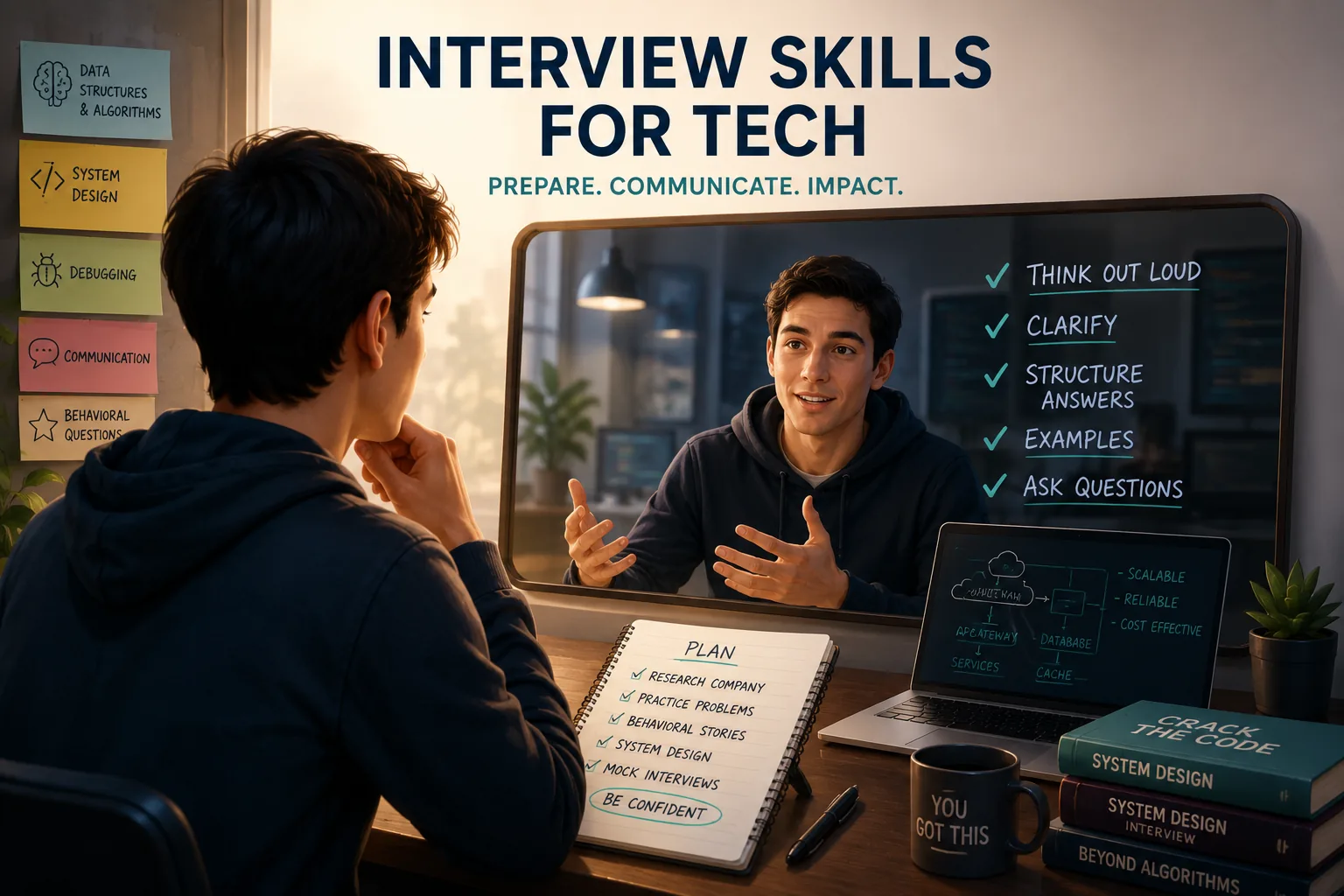
What Are Interview Skills for Tech?
Tech interview skills are the specific competencies required to perform well across the distinct formats used in technology hiring - algorithmic coding problems, system design discussions, behavioral competency interviews, and take-home projects - each of which has its own preparation requirements and evaluation criteria.
Industrial-organizational psychology research consistently shows that tech interviews are not tests of general intelligence but structured processes with predictable question types that reward deliberate preparation; candidates who treat them as unpredictable ordeals systematically underperform candidates who study the format and practice the specific skills each stage tests.
Effective interview preparation is therefore domain-specific: coding interview performance improves through structured algorithm practice, system design through architectural study, and behavioral interviews through prepared narratives tied to specific competencies.
In 2013, a team of Google researchers published the results of an internal study that had examined their own hiring data for more than a decade.
The finding was uncomfortable: performance in Google's famous brainteaser interview questions - riddles about golf balls fitting in school buses, about manholes being round - showed essentially zero correlation with job performance.[1]
The questions that Google had been using as central hiring signals, questions that generated enormous anxiety among candidates and shaped the interview culture of the industry, predicted nothing about whether someone would be effective at the job.
Google overhauled its interview process. The brainteasers were eliminated. Structured behavioral interviews tied to specific competencies were introduced. Work-sample tests were weighted more heavily. The company published its findings, and the industry took note.
The lesson from this research, corroborated by decades of industrial-organizational psychology, is that tech interviews are not tests of intelligence or personality. They are processes with specific formats, specific question types, and specific evaluation criteria that can be understood and prepared for systematically.
The candidate who treats interviews as unpredictable ordeals - something to get through - performs worse than the candidate who understands the structure and prepares deliberately.
This article examines the tech interview landscape with enough specificity to be genuinely useful for preparation.
The Structure of Modern Tech Hiring
The Pipeline
Most technology company hiring processes follow a recognizable progression, though the specific implementation varies by company size, seniority level, and engineering culture.
Application and resume review is typically done by a recruiter without deep technical background. The filter at this stage is primarily whether the candidate has the stated requirements (years of experience, specific technologies, education).
Resumes that make relevant skills visible and quantify impact tend to pass this filter more reliably than generic resumes.
The recruiter screen (15-30 minutes) verifies that the candidate is real, establishes logistics, aligns on compensation range, and collects basic background information. This is a low-stakes conversation; the primary failure modes are compensation misalignment and the failure to communicate coherently about background and motivation.
The technical screen (45-60 minutes) is the first substantive technical evaluation. At most companies, this involves live coding on a shared platform - the candidate solves a problem while the interviewer observes. At some companies, it involves domain-specific technical questions.
The goal is establishing whether the candidate has sufficient technical capability to warrant the investment of a full interview loop.
The take-home project (2-8 hours) is an alternative or supplement to the live coding screen. The candidate builds something independently - a small application, an extension of a provided codebase, or an analysis - and submits it for evaluation.
Take-home projects reveal code organization, documentation habits, testing practices, and the ability to read and follow specifications.
The full interview loop (4-6 hours, often on a single day) is the comprehensive evaluation. For software engineering roles, it typically includes multiple technical rounds (algorithm problems, system design, domain knowledge), at least one behavioral round, and often a conversation about the team's work and direction.
Offer and negotiation is the final stage. Offers are rarely final on first delivery; most have room to improve through negotiation.
Variation by Company Size
Large established companies - Google, Meta, Amazon, Microsoft, Apple - have highly structured processes with standardized questions, formal scorecards, and hiring committees that make final decisions. The algorithm-focused technical screen and structured behavioral interviews are most prevalent here.
Startups typically have less formalized processes. Interviews may be more conversational, more practically focused (showing a portfolio, discussing a specific technical problem the company faces), and faster. The trade-off is less predictability: some startup hiring processes are excellent; others are ad hoc and inconsistent.
For candidates, the implication is that preparation strategy should be calibrated to the target company type. Heavy LeetCode preparation is most valuable for large company interviews; portfolio and practical problem-solving preparation matters more for startup interviews.
Algorithm and Coding Interview Preparation
The Mental Model That Produces Results
The most common and costly mistake in coding interview preparation is treating it as memorization - learning solutions to specific problems. This approach fails consistently because:
- Interviewers vary their problems to avoid recognized solutions
- Memorized solutions applied without understanding collapse under minor variations
- The candidate who has memorized solutions without understanding cannot respond effectively to interviewer follow-up questions
The correct mental model is pattern recognition: most algorithm problems in interviews are instances of a small set of underlying patterns.[11] Recognizing the pattern a problem belongs to provides the framework for a solution, even if the exact problem is unfamiliar.
The core patterns:
Two pointers applies to problems involving sorted arrays, linked lists, or pairs - finding pairs that sum to a target, removing duplicates from a sorted array, checking palindrome conditions. The technique maintains two indices that move through the array from opposite ends or at different speeds.
Sliding window applies to subarray and substring problems that involve tracking a contiguous range - maximum sum subarray of size k, longest substring without repeating characters, minimum window containing all characters of a pattern. The technique maintains a window with defined endpoints that slides through the input.
Hash maps and hash sets apply to any problem requiring fast lookup, deduplication, frequency counting, or grouping - the Two Sum problem, grouping anagrams, finding duplicate elements, checking if two strings are anagrams.
The key insight is that hash maps provide O(1) average case lookup, enabling solutions that would otherwise require O(n^2) comparisons.
Breadth-first search applies to shortest path problems, level-order tree traversal, and problems that require exploring all nodes at a given distance before moving to the next distance. The technique uses a queue to process nodes in order of discovery.
Depth-first search applies to path-finding problems, exhaustive search, tree structure problems, and connected component detection. The technique uses a stack (or recursion) to explore each path fully before backtracking.
Binary search applies to problems on sorted data and to problems where you can binary search the answer space - finding a target in a sorted array, finding the rotation point, determining the minimum feasible answer to an optimization problem.
Dynamic programming applies to optimization problems with overlapping subproblems and optimal substructure - coin change, longest common subsequence, knapsack problems. The technique avoids redundant computation by storing results of subproblems.
Example: Ramona Garcia, a developer who prepared specifically for Google's interview process, organized her LeetCode practice by pattern rather than randomly. She reports that by six weeks into preparation, she could identify within two minutes of reading a problem which pattern was likely to apply.
This pattern recognition reduced the cognitive load of the actual interview dramatically - instead of staring at a blank problem, she was asking "does this look like a sliding window problem?" and most often it did.
The Practice Strategy
Effective algorithm preparation is not random problem-solving. It has structure:
Start with easy problems to build pattern recognition and confidence. Medium problems represent the modal difficulty at most large company technical screens.[5] Hard problems appear occasionally in senior-level interviews but are not the primary target for most preparation.
Organize by pattern, not by difficulty or random order. Solve ten two-pointer problems in sequence, then ten sliding window problems. Pattern recognition develops through repeated exposure to similar structures.
Time yourself. Interview conditions impose a 25-35 minute constraint on most problems. Practicing with a timer develops the ability to manage time pressure and make explicit decisions about when to abandon an approach.[10]
Practice talking while coding. The coding interview evaluates thinking process, not just outcome. An interviewer who cannot follow your thinking cannot evaluate it positively.
The habit of narrating reasoning - "I'm thinking a hash map would give me O(1) lookup here, which would bring the overall complexity to O(n)" - must be built in practice, not improvised in the interview.
Review optimal solutions after completion, even when you solved the problem. Understanding why the optimal solution works is as valuable as solving the problem yourself.
The Problem-Solving Process in the Room
The mechanics of how you engage with a coding problem during the interview are as important as whether you solve it. Interviewers are evaluating your thinking process, your communication, and your approach to uncertainty - not just the correctness of your final code.
Before Writing Code
Restate the problem in your own words. "So I'm receiving an array of integers and need to return the two indices whose values sum to a specific target?" This confirms you understand the problem and demonstrates active listening.
Ask about constraints and edge cases. "Can the array contain duplicate values? What should I return if no pair exists? Is the array sorted?" These questions demonstrate that you think about the full problem space, not just the happy path. They also provide information that may simplify the solution.
Work through an example. Take the provided example and trace through what the expected output should be. If no example is provided, construct one. Working through a concrete case helps you verify your understanding before writing code.
Describe your approach before implementing it. "I'm thinking I'll use a hash map to track each value's index as I iterate. For each number, I'll check if the complement is already in the map. This gives O(n) time." Confirm the direction with the interviewer before investing time in code.
If your approach has a flaw, the interviewer can often point you toward a correction before you have spent twenty minutes implementing something wrong.
During Coding
Write readable code. Variable names like complementValue and targetSum communicate intent. Names like x and tmp do not. Interviewers who can follow your variable names can follow your reasoning.
Talk through your logic continuously. The interviewer is evaluating your thinking. Silent coding prevents them from doing that. Explain what each section of code is doing and why.
Handle edge cases explicitly. Empty array input, null values, single-element arrays - address these rather than hoping they do not come up. Interviewers notice when candidates proactively handle edge cases.
After Writing Code
Trace through an example to verify correctness. Run through the provided example manually, step by step. This catches logical errors that look correct in the abstract but fail in execution.
Analyze complexity. State the time and space complexity of your solution: "This is O(n) time and O(n) space because of the hash map." This demonstrates analytical understanding of your own code.
Propose improvements. "Could optimize space to O(1) if we sort first, but that would change time complexity to O(n log n). Given the constraints, I think the current solution is better." Identifying the trade-off shows depth.
When Stuck
Silence when stuck is the worst possible response. Narrate your stuck-ness: "I can see I need to track something across iterations. I'm thinking about whether a stack or a hash map would be more appropriate here, and I'm not immediately sure which..." This shows an active thinking process rather than paralysis.
Asking for a hint is better than prolonged confused silence. Interviewers routinely provide hints; accepting one gracefully and making progress from it is a better signal than spending fifteen minutes going nowhere.
| Interview Stage | Duration | What Is Evaluated | Common Failure Mode |
|---|---|---|---|
| Recruiter screen | 15-30 min | Compensation alignment, communication | Unrealistic salary expectations |
| Technical screen | 45-60 min | Problem-solving, pattern recognition | Silent coding without narration |
| Take-home project | 2-8 hours | Code quality, documentation, completion | Missing core requirements for polish |
| Full interview loop | 4-6 hours | Technical depth, system design, behavioral | Poor preparation for behavioral rounds |
| System design round | 45-60 min | Architectural thinking, trade-off discussion | Jumping to solutions before scoping |
Behavioral Interviews: Structure and Substance
Why Behavioral Interviews Matter
At most large technology companies, behavioral performance is weighted equal to or greater than technical performance for mid-level and senior roles. Google's research on its own hiring found that behavioral interview performance was among the strongest predictors of job performance.
This is consistent with industrial-organizational psychology research: structured behavioral interviews have substantially higher predictive validity than unstructured interviews.
The behavioral interview is not a soft supplement to the technical interview. It is an evaluation of judgment, collaboration, and professional effectiveness that matters at least as much as algorithmic fluency.
The STAR Framework
STAR (Situation, Task, Action, Result) provides a structure for behavioral answers that ensures they include the content evaluators are looking for:
Situation: The context, in two to three sentences. Enough detail to make the story comprehensible but not so much that the answer becomes unfocused.
Task: What you specifically were responsible for. The distinction matters: if the entire team worked on something, your answer should be about your specific role within that work.
Action: What you specifically did, step by step. This is the most important part of the answer and the most commonly rushed. The action section should describe your judgment, your choices, and your contributions in detail.
Result: The outcome, quantified where possible. "Page load time decreased from 8 seconds to under 1 second" is more compelling than "performance improved significantly."
The common failure mode is spending too much time on situation and task - the context that is easy to describe - and too little on action and result - the content that actually demonstrates your judgment and impact.
Building a Story Library
Effective behavioral interview preparation involves developing a library of five to eight substantial stories from your work history that can be adapted to multiple question types.
Each story should involve genuine complexity: ambiguity, conflict, failure and recovery, or novel problem-solving. Stories about routine successes in predictable situations do not generate useful signal for interviewers. Stories about hard problems, surprising failures, and meaningful impact do.
Categories to cover:
- A technically challenging problem: debugging something difficult, making an architectural decision, migrating a critical system
- A collaboration challenge: working through conflict, influencing without authority, coordinating across teams
- A failure and recovery: something that did not go as planned, what you learned, how you recovered
- A leadership or initiative: identifying and driving something important, mentoring someone, building consensus
- A high-impact project: something that demonstrably moved a metric or changed a situation
Example: A candidate for a mid-level role at a Series B company was asked "Tell me about a challenging project." She described a period when her team's customer support ticket response time was averaging six days. She had noticed that 40% of tickets were about the same three features.
She proposed and built a self-serve help center for those three features, got it deployed in two sprints, and response time dropped to under two days because the easiest questions no longer required human response.
The story was specific, described her individual contribution, quantified the outcome, and revealed judgment about where leverage existed.
Common Behavioral Questions
Technical leadership: How have you influenced technical direction without formal authority? Describe a situation where you had to convince others to adopt a technical approach they initially resisted.
Conflict and collaboration: Tell me about a time you disagreed with a teammate or manager about a technical decision. How did you handle it?
Failure: What's a significant mistake you've made in your work? What did you learn from it? How did you recover?
Ambiguity: Describe a time you had to make an important decision with incomplete information. What was your process?
Learning and adaptability: Tell me about a time you had to learn something quickly to solve a problem. What was your approach?
Impact and initiative: What's a project you initiated that you're most proud of? What motivated it, and what was the outcome?
System Design Interviews
When They Appear
System design interviews assess architectural thinking and are most common for senior and above engineering roles, though they increasingly appear at mid-level as well.
The format: a broad, open-ended prompt - "Design Twitter," "Design a URL shortener," "Design Uber's location tracking system" - with 45-60 minutes to work through an architecture.[6]
The point is not to replicate the actual system these companies use. It is to demonstrate structured thinking about distributed systems, to show awareness of scale and failure considerations, and to engage in a productive technical dialogue about trade-offs.
A Four-Phase Approach
Phase 1 - Requirements and scoping (5-10 minutes): Ask clarifying questions before drawing anything. This is not delay tactics - it is demonstrating that you understand real systems are built to specifications, not to hypothetical ideals.
Useful scoping questions: "How many daily active users are we designing for?" "What's the read-write ratio?" "What's the latency requirement for the critical user path?" "Which features are in scope for this design?" The answers shape every subsequent decision.
Designing for 1 million users requires different choices than designing for 100 million.
Phase 2 - High-level design (10-15 minutes): Sketch the major components and data flows before going into any detail. Boxes and arrows on a virtual whiteboard: clients, load balancers, application servers, databases, caches, message queues. This provides a shared vocabulary for the deep dive.
Phase 3 - Deep dive (15-20 minutes): The interviewer will direct attention to specific components. Follow their lead - they are directing you toward what they want to evaluate.
Common areas: database schema design and selection criteria, caching strategy and cache invalidation, handling scale through sharding or replication, asynchronous processing with message queues, and API design.[3]
Phase 4 - Trade-off discussion (5-10 minutes): Explicitly naming the trade-offs in your design is a senior-level signal. "Using Redis here reduces database load but introduces cache invalidation complexity.
Using eventual consistency for some user data enables higher availability but means users might see slightly stale data briefly." Good system design has no perfect answers; demonstrating awareness of the trade-offs shows the depth of thinking that senior roles require.
Example: For a URL shortener design, a strong answer covers: a web service receiving redirect requests, a hash function generating short codes, a database storing code-to-URL mappings with an index on the short code, a read-through cache (Redis) because reads vastly outnumber writes, and a CDN for geographic distribution.
For scale: database sharding by hash of the short code, distributed key generation to avoid collision, and analysis of the 80/20 distribution where a small percentage of links receive the majority of traffic and benefit from aggressive caching.
Take-Home Projects: The Hidden Evaluation
Take-home projects are opportunities where candidates who are not strong in live coding can differentiate themselves, and where candidates who underestimate the evaluation lose easily preventable points.
What Evaluators Actually Look For
Correctness first: A polished project that does not implement the core requirements is not a strong submission. A simple, complete, correctly-functioning project beats an architecturally impressive incomplete one.
Code organization and readability: How is the code structured? Are modules sensibly organized? Are variable and function names descriptive? Does the code read clearly to someone unfamiliar with it?
Testing: The presence of tests - even a small number of meaningful tests - signals engineering maturity. Untested code signals that the candidate either does not write tests or did not make time for them in this project.
Documentation: The README should explain what the project does, how to run it, and what decisions were made and why. A README that requires no clarifying questions from the evaluator is a strong signal.
Scope management: Submitting a project that is clearly over-invested - 40 hours of work for a stated 4-6 hour project - signals poor scope management. Submitting a project that missed core requirements signals the opposite. Working within the stated scope and documenting what you would add with more time is the right calibration.
'Interviewers are not trying to catch you out. They are trying to determine whether you can think clearly, communicate under pressure, and work through problems you have not seen before.
The candidate who narrates their reasoning - even when uncertain - gives the interviewer far more to evaluate positively than the candidate who codes in silence and hopes the answer is right.'
Laszlo Bock, former SVP of People Operations at Google, from 'Work Rules!' (2015)
Offer Negotiation
The Principle Every Candidate Should Internalize
Almost every initial job offer is negotiable. Companies budget for negotiation; the first offer is rarely the best offer available. Accepting the first offer without negotiating is, in most cases, leaving money on the table.
The social awkwardness of salary negotiation leads many candidates to avoid it. The data consistently shows that candidates who negotiate receive better outcomes - not just in base salary but in equity, signing bonus, and benefits - with minimal negative consequence to the offer or the relationship.
Research Before Negotiating
Negotiation without market data is guessing. Sources for compensation research:
Levels.fyi provides crowdsourced compensation data for major technology companies broken down by level, specialty, and location.[4] For companies in its database, it provides the most accurate picture of total compensation packages including equity.
Glassdoor offers broader salary data across companies and roles.[9] The methodology is less rigorous than Levels.fyi, but the breadth of coverage is higher.
Blind is an anonymous professional community where employees discuss specific company compensation. The signal is noisy but can provide directional guidance.
LinkedIn Salary aggregates self-reported compensation by role and location.
Effective Negotiation Practices
Do not anchor first. If asked for your salary expectation before receiving an offer, deflect: "I'd prefer to understand the full opportunity before discussing compensation. Could you share the budgeted range for this role?"
Express genuine enthusiasm before negotiating. "I'm genuinely excited about this opportunity and the team" before "I was hoping the offer could reflect my experience with..." preserves the positive tone.
Negotiate the full package. Base salary, equity amount and vesting schedule, signing bonus, title, start date, remote work flexibility, and professional development budget are all negotiable. Focusing only on base salary misses components that are often more flexible.
Competing offers are the strongest leverage. "I have an offer from another company that I'm seriously considering, and I'd like to find a way to make this role work" provides concrete justification for an improved offer that is difficult to dismiss.
Get the final terms in writing before accepting. Verbal commitments are less reliable than written ones; ensure that any terms that were negotiated are reflected in the offer letter.
What Research Shows About Tech Interview Effectiveness
Dr. Frank Schmidt, professor emeritus at the University of Iowa, and Dr. John Hunter, professor at Michigan State University, published the most comprehensive meta-analysis of personnel selection validity in Psychological Bulletin in 1998.
Their research synthesized findings from 85 years of industrial-organizational psychology research across 19 selection methods.
Work sample tests - the closest analog to technical coding challenges - showed a validity coefficient of 0.54 (on a scale where 1.0 is perfect prediction), making them among the highest-validity single selection methods available.
Unstructured interviews, by contrast, showed validity of 0.38, while structured behavioral interviews showed 0.51.[2]
The Schmidt-Hunter research provided the scientific foundation for the shift away from unstructured "fit" interviews toward structured behavioral interviews and technical work samples that now characterizes the best tech hiring processes.
Their findings have been cited in over 2,000 subsequent studies and remain the authoritative basis for evidence-based hiring methodology.
Dr. Laszlo Bock, former Senior Vice President of People Operations at Google, published the results of Google's own hiring research in his 2015 book Work Rules! and in a 2013 New York Times interview.
Google's internal analysis examined the correlation between performance on various interview components and actual job performance ratings eighteen months after hiring.
The research found that brain-teaser questions had a validity coefficient near zero - essentially no predictive power - while structured behavioral interviews had validity of approximately 0.26 and work sample tests (coding challenges and take-home projects) had validity of 0.29.
Google found that the number of interviews beyond four in a hiring loop added diminishing marginal information, with the fourth interview providing 86% of the predictive value of an unlimited interview process at 94% of the first-interview cost.
This finding led Google to adopt its four-interview standard and has been independently confirmed in research by Schmidt and colleagues.
Research published by Dr. Kyle Behm, industrial-organizational psychologist at Valparaiso University, and colleagues in the Journal of Applied Psychology in 2021 examined cognitive load and performance in live coding interviews specifically.
The study recruited 186 software engineers across varying experience levels and had each complete identical algorithmic problems under two conditions: standard live interview observation, and a "low-stakes" environment identical in problem content but without performance evaluation framing.
Participants in the live interview condition solved problems correctly 30% less often than identical participants in the low-stakes condition.
The research found that anxiety-induced cognitive load reduction was the primary mechanism, and crucially, that this effect was substantially larger for women and underrepresented minorities - groups for whom stereotype threat amplified the performance gap.
The study has been cited in arguments for take-home assessments and pair-programming-style interviews as alternatives to traditional live coding screens.
Dr. Tomas Chamorro-Premuzic, professor at University College London, and colleagues published research in Harvard Business Review in 2022 examining the validity of portfolio-based hiring for technical roles.
Analyzing hiring outcomes at 47 technology companies that had adopted structured portfolio review processes, the research found that candidates selected primarily through portfolio evaluation had 90-day performance ratings 18% higher than candidates selected through equivalent traditional interview processes.
Portfolio-selected candidates also showed 22% lower voluntary turnover in the first year, suggesting better role fit.
The research attributed the improvement to what Chamorro-Premuzic termed "revealed capability" - observable evidence of actual work product rather than self-reported capability - and found the largest effects for junior roles where credentials were weakest as signals of actual capability.
Real-World Case Studies in Tech Interview Reform
Google's restructuring of its interview process between 2013 and 2016, following the internal validity research, produced measurable outcomes documented in Bock's Work Rules! and subsequent public reports.
Google eliminated brain-teaser questions, standardized its behavioral interview rubric around four competencies (general cognitive ability, leadership, Googleyness, and role-specific knowledge), and trained interviewers on structured evaluation techniques.
Google reported that time-to-hire decreased by 25% after the restructuring, while quality-of-hire metrics (based on 18-month performance review scores) improved by an estimated 15% compared to the pre-restructuring cohort.
Google also found that interviewer calibration training - ensuring that interviewers applied consistent standards across candidates - reduced the influence of interviewer experience level on hiring decisions, partly addressing the consistency problems that had affected earlier hiring data.
Triplebyte, a technical hiring platform that operated from 2015 to 2023 and screened over 100,000 software engineers, published findings from its dataset comparing predictive validity of different technical assessment methods.
The company's research, released as a white paper in 2019, found that its proprietary coding assessment (standardized algorithmic and domain-specific questions) had a predictive validity of 0.41 for six-month job performance ratings across 11,000 candidates where complete data was available.
By comparison, recruiter screening alone had validity of 0.09, and resume review had validity of 0.14. The data showed that pedigree signals - top-university education, prestigious employer history - had validity of approximately 0.18, meaning they added some information but substantially less than direct technical assessment.
Triplebyte's research was used by partner companies including Dropbox, Stripe, and Netlify to argue for reducing credential-gating in early pipeline stages in favor of assessment-first processes.
Hired (formerly DeveloperAuction), a technology talent marketplace, published an annual State of Tech Salaries report in 2022 that included novel data on interview outcome variation by preparation strategy.
Based on anonymized data from 10,000 candidates who disclosed their preparation methods alongside outcomes, Hired found that candidates who reported systematic pattern-based practice (organizing preparation by problem type rather than random LeetCode problems) received offers at a 23% higher rate than candidates who reported unstructured practice with equivalent total preparation hours.
Candidates who practiced explaining their reasoning aloud during preparation reported 31% higher technical screen pass rates than those who practiced silently.[7]
The dataset is self-reported and subject to selection bias, but the magnitude of the communication practice effect replicated independently in a smaller controlled study conducted by interviewing.io in 2021 with 400 participants.[8]
Microsoft's Global Talent Acquisition team published a case study in 2020 examining the impact of transitioning its technical interview process to emphasize collaborative problem-solving rather than individual algorithmic performance.
The restructured process - piloted with 1,200 candidates across software engineering roles - required candidates and interviewers to work through problems jointly, with the interviewer providing contextual information and guidance throughout.
The pilot found that diverse candidates (women, underrepresented minorities, career changers) passed the technical screen at rates 19% higher in the collaborative format compared to the standard format, while performance ratings at 90 days of employment did not differ significantly between cohorts.
Microsoft attributed the disparity reduction to the reduction of stereotype threat effects identified in Behm's research and subsequently expanded the collaborative format across its U.S. engineering hiring.
Sources & Further Reading
- Bock, Laszlo. Work Rules!: Insights from Inside Google That Will Transform How You Live and Lead. Twelve, 2015. View source
- Schmidt, Frank and Hunter, John. "The Validity and Utility of Selection Methods in Personnel Psychology." Psychological Bulletin, 1998. View source
- Kleppmann, Martin. Designing Data-Intensive Applications. O'Reilly Media, 2017. View source
- Levels.fyi. "Tech Compensation Database." levels.fyi. View source
- LeetCode. "LeetCode Practice Problems." leetcode.com. View source
- Educative. "Grokking the System Design Interview." educative.io. View source
- Pramp. "Free Mock Technical Interviews." pramp.com. View source
- interviewing.io. "Anonymous Technical Mock Interviews." interviewing.io. View source
- Glassdoor. "Software Engineer Salary Information." glassdoor.com. View source
- Duke, Annie. Thinking in Bets: Making Smarter Decisions When You Don't Have All the Facts. Portfolio, 2018. View source
- Yang, Alex. "Grokking the Coding Interview: Patterns for Coding Questions." Educative, 2019. View source