
When Vlad Magdalin co-founded Webflow in 2013, the company raised its first funding round with a slide deck built in Webflow itself - a website created without a single line of code, used to convince investors that non-developers could build professional web experiences.
The irony was not lost on the technical community, which had long assumed that real software required real programmers. Webflow went on to raise over $330 million and reach a valuation of $4 billion.
The slide deck argument proved itself over the following decade as no-code tools matured from curiosity to genuine infrastructure for thousands of businesses.
No-code development is now one of the most consequential shifts in how software gets built, because it dramatically expands who can build software.[3]
This matters not just for entrepreneurship or product development, but for how organizations move, how operations teams solve problems, and how quickly ideas can be validated before committing to expensive engineering projects.
This guide explains what no-code actually means, what you can realistically build with it, where its limits are, and how to think about it as a long-term capability rather than a shortcut.
"Software is eating the world." - Marc Andreessen
"The exponential organization is not just about technology. It is about applying information-based models to create scalable impact." - Salim Ismail
"The way to get startup ideas is to look for problems, preferably problems you have yourself." - Paul Graham
"We're at the beginning of a massive shift to the cloud, and no-code is the layer that makes that shift accessible to everyone." - Aaron Levie
What No-Code Actually Means
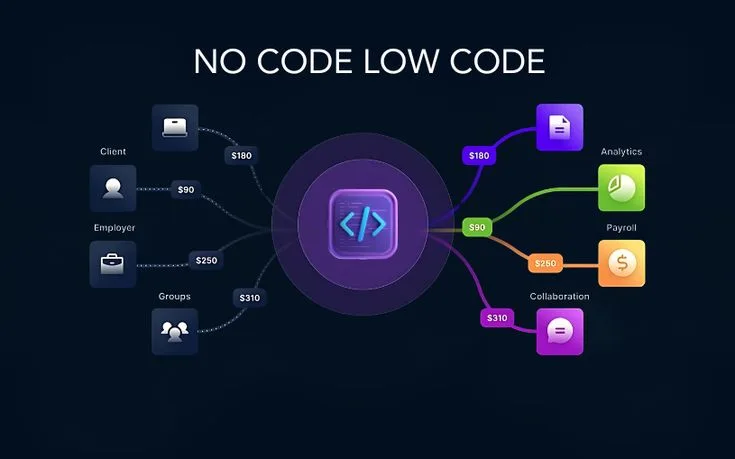
No-code refers to software development platforms that allow users to build functional applications, websites, databases, and automated workflows using visual interfaces - drag and drop, point and click, configuration menus - instead of writing programming languages.
The platforms handle the code underneath; the user configures behavior through visual metaphors.
The key word is "functional." No-code platforms are not presentation tools that produce mockups or wireframes. They produce working software that stores data, responds to user input, enforces logic, connects to other systems, and runs in production serving real users.
The software Bubble produces can have user authentication, payment processing, real-time data updates, and custom business logic. It is not a demonstration. It is a live application.
This distinction matters because no-code is sometimes dismissed as a toy by technical audiences. The more accurate framing is that no-code platforms are highly opinionated software frameworks that trade flexibility for accessibility.
Just as a developer choosing Django over writing a web server from scratch is accepting constraints in exchange for productivity, a no-code builder is accepting a different and more constrained set of tradeoffs.
A Brief History: From Spreadsheets to the 2018 Wave
The history of no-code is longer than most people assume, because spreadsheets are, in a meaningful sense, the original no-code tool. VisiCalc, released in 1979, allowed users to build computational models without programming.
Lotus 1-2-3 and then Microsoft Excel expanded this capability to hundreds of millions of users who would never have been able to write financial modeling code. The spreadsheet made quantitative analysis accessible to anyone who could organize a table.
HyperCard, released by Apple in 1987, went further. It allowed users to build interactive applications using a visual card-based metaphor and a simplified scripting language. Thousands of people built databases, games, and simple applications without traditional programming skills.
HyperCard was arguably ahead of its time; Apple discontinued it in 2004, but its influence on visual development tools persisted.
The early 2000s saw the rise of what we now call SaaS - Software as a Service - and this represented another no-code moment. Salesforce, founded in 1999, allowed businesses to deploy a full customer relationship management system without writing a line of code.
The configuration happened through the web interface. The software ran on Salesforce's servers. Businesses could customize fields, workflows, and reports without any programming. By this definition, Salesforce was among the earliest enterprise no-code platforms, even if nobody called it that.
The current no-code wave accelerated around 2018 and was driven by several converging factors. Cloud infrastructure became cheap and reliable enough to serve as the backend for platforms hosting millions of users' applications.
API ecosystems matured, allowing different software systems to communicate with each other in standardized ways.
Visual design tools improved dramatically. And a generation of entrepreneurs, operations professionals, and product managers developed a deeper understanding of software concepts without formal computer science training, creating demand for tools that matched their conceptual understanding without requiring syntax fluency.
Between 2018 and 2023, Webflow, Bubble, Airtable, Notion, Glide, and dozens of other platforms raised hundreds of millions in venture capital, serving what analysts at Gartner estimated would grow into a $26.9 billion market by 2023.
No-Code vs. Low-Code vs. Traditional Development
These three terms describe a spectrum, not discrete categories. Understanding the distinctions helps you choose the right approach for a given project.
Traditional development means writing code in programming languages like Python, JavaScript, Go, Ruby, or Java. Developers have complete control over every behavior of the system. There are no platform constraints. Performance can be optimized precisely.
Any integration that has an API is reachable. The cost is that traditional development is slow, expensive, and requires specialized skills that are in short supply.
Low-code platforms are primarily visual but expose code escape hatches for advanced use cases. OutSystems, Mendix, and Microsoft Power Apps are canonical examples.
They allow professional developers to build applications faster than writing everything from scratch while retaining the ability to write custom code when the visual tools are insufficient. Low-code is aimed at developers who want speed, not at non-technical users.
No-code platforms require no programming and are designed for users who have no programming background. They achieve this by constraining what is possible to what the platform's visual interface supports.
The constraint is real - you cannot build arbitrary software with a no-code tool - but for a large and growing set of use cases, those constraints do not matter.
The distinction has blurred at the edges. Webflow exposes CSS and HTML editing for users who want it. Bubble allows JavaScript injection for advanced needs. Airtable has a scripting environment. But the core experience of each is visual and non-code.
| Dimension | No-Code | Low-Code | Traditional Code |
|---|---|---|---|
| Who it's for | Business users, founders, operators | Professional developers wanting speed | Software engineers |
| Skill needed | None; visual configuration only | Some programming knowledge | Full development expertise |
| Scalability | Limited; platform ceilings apply | Moderate; custom code extends limits | Unlimited with right architecture |
| Example tools | Bubble, Webflow, Glide, Airtable | OutSystems, Mendix, Power Apps | React, Django, Go, Rails |
What You Can Actually Build
The range of what is realistically buildable with no-code tools has expanded substantially, though it still has real limits. Honest assessment requires distinguishing between the marketing claims of platforms and what teams actually deploy successfully in production.
Web Applications
Bubble is the leading platform for building full-featured web applications. It provides a database, user authentication, API connections, dynamic page rendering, and conditional logic - all visual.
Startups have launched real products on Bubble with paying customers: scheduling applications, marketplaces, internal dashboards, and community platforms.
The limitations become apparent at high user volumes and complex data requirements, but many applications never reach those limits.
Specific companies built on Bubble include Dividend Finance, which built a lending platform on Bubble before raising significant venture capital. The fact that they could ship a working product to test their business model before hiring a full engineering team was precisely the point.
Websites and Content Experiences
Webflow occupies a distinct category: professional websites built with code-level design control. Traditional website builders like Squarespace constrain design to templates.
Webflow exposes the full CSS box model visually, giving designers pixel-precise control while generating clean, hosted code. Its CMS handles structured content like blog posts, team pages, and product listings with publication workflows.
Marketing agencies and design studios use Webflow for client work. Product companies use it for marketing sites. The hosting and CMS infrastructure handles production traffic without the maintenance burden of managing a server.
Databases and Internal Tools
Airtable built its product on a simple insight: most businesses need databases, but most databases require technical setup. Airtable presents a database as a grid - familiar enough for anyone who has used Excel - while exposing relational data structures, field types, views, automations, and an interface builder underneath.
Teams at startups and enterprises use Airtable as the operational backbone for processes that previously lived in spreadsheets: content calendars, project tracking, vendor management, recruiting pipelines, and inventory management.
Its automation layer connects Airtable changes to external systems via Zapier integrations or native connections.
Retool and Internal take a different approach: they help technical users build internal tools by connecting to existing databases and APIs through a visual interface.
They occupy the boundary between low-code and no-code, requiring some technical understanding of data structures but dramatically reducing the time to build internal dashboards and admin interfaces.
Workflow Automation
Zapier and Make (formerly Integromat) automate workflows across applications using trigger-action logic. When a form is submitted in Typeform, create a contact in HubSpot, send a Slack notification to the sales team, and add a row to a Google Sheet - all without any code, running automatically every time the trigger fires.
These tools are covered in more depth in the automation guide, but their role in the no-code ecosystem is central. Most no-code applications are not isolated islands; they connect to the broader software environment through automation platforms that route data between them.
Mobile Applications
Glide creates mobile applications directly from Google Sheets or Airtable bases. You structure your data in a spreadsheet, connect it to Glide, configure the visual layout using Glide's editor, and publish an app that runs on iOS and Android - without writing a single line of code.
Glide has been used to build field service management apps, employee directories, inspection checklists, and event guides.
Adalo provides a more traditional app-building interface for cases where the spreadsheet-as-database model is too limiting. Both platforms work well for internal tools and simple consumer apps but show limitations for complex, performance-sensitive applications.
Who No-Code Is Actually For
Non-technical founders are the most visible no-code users. The ability to ship a working version of an idea without hiring developers has changed the calculus of early-stage startups. A founder can validate whether people will pay for a product and use it before committing to the engineering investment required for a custom-built version.
Operations and business teams are perhaps the larger and less visible population.
When a sales operations manager builds an Airtable base to manage the entire sales pipeline without involving engineering, or a marketing coordinator builds a Zapier workflow that automatically routes leads from a landing page to the CRM and assigns them to sales reps, they are doing no-code development.
The Gartner term for this is "citizen development" - business users building their own operational tools with IT governance.
This matters for understanding the scale of the no-code movement. It is not primarily about startups trying to avoid hiring developers.
It is about the large proportion of operational software that organizations need but never get built because engineering resources are always allocated to product priorities. No-code allows those operational needs to be met without competing for scarce engineering time.
Designers also benefit significantly. Webflow gives designers the ability to implement their own designs rather than translating them into specifications for a developer who then translates those specifications imperfectly into code. Eliminating that translation step produces better results faster.
The Real Limitations
Vendor lock-in is the most serious structural risk of building on no-code platforms. Your application logic lives inside the platform's proprietary environment.
If the platform changes its pricing - as Bubble has done, to significant user frustration - you face a difficult choice: absorb higher costs or undertake a costly migration to a custom-code alternative.
If the platform shuts down, your software disappears. Webflow, Bubble, and Airtable are well-funded and seem likely to persist, but history is full of platforms that seemed permanent until they were not.
The scalability ceiling is real for applications with large user volumes and complex performance requirements. Bubble applications running thousands of concurrent users with complex database queries can be slow. Airtable has row limits per base and performance degradation at large data volumes.
These limits matter for some applications and not at all for others.
Complex custom logic is genuinely difficult or impossible without code. No-code platforms work well when your logic can be expressed in their visual vocabulary.
When the logic requires custom algorithms, complex data transformations, unusual integrations with proprietary systems, or real-time processing at high throughput, the visual tools become inadequate. Every no-code platform has a boundary, and experienced builders know when they are approaching it.
Performance-critical applications - anything requiring sub-100ms response times, high-frequency data processing, or fine-grained resource optimization - are generally not appropriate for no-code platforms where the execution environment is abstracted and not tunable.
Cost Comparison: No-Code vs. Hiring Developers
The cost comparison is frequently cited as the primary argument for no-code, and it is compelling - with important caveats.
Building a simple web application from scratch with a professional development agency typically costs $50,000 to $150,000 for an initial version. A dedicated full-time developer in a US market costs $120,000 to $200,000 annually in salary, benefits, and overhead.
The same application built on Bubble with a no-code developer (a genuine profession, with practitioners earning $50,000 to $120,000 annually) might cost $10,000 to $30,000, running on a platform subscription of $50 to $500 per month.
This calculation holds for applications that fit within the platform's capabilities.
It breaks down when platform limitations require workarounds that add complexity, when the application needs to scale beyond what the platform handles efficiently, or when the accumulated platform subscription costs over years rival what custom development would have cost.
The honest version of the cost comparison is: no-code dramatically lowers the cost of starting and validating an idea. It is the right economic choice when speed to market and validation speed matter more than long-term technical optionality.
When the product is proven and the requirements are stable, migrating to custom development often makes sense - and many companies use no-code explicitly as a stepping stone to that outcome.
When to Switch to Code
Several signals indicate that no-code has reached its usefulness for a given application. Platform costs are growing faster than the business benefit. Performance is becoming a user experience problem. You are spending significant time working around platform limitations.
Security or compliance requirements exceed what the platform can certify. The application's logic has become so complex that it is difficult to understand and maintain inside the platform's visual environment.
The switch to code is not a failure. It is often evidence that the no-code strategy worked: you validated the product, proved user demand, and generated enough revenue to justify investing in custom architecture.
Companies like Webflow itself - which built its own marketing site in Webflow - eventually run substantial infrastructure alongside their no-code tools.
The skill developed through no-code work also transfers in useful ways. Someone who has built complex Bubble applications understands database design, authentication flows, API integrations, and conditional logic.
They can have productive conversations with developers and make better architectural decisions than someone who has never thought about these structures.
Practical Takeaways
No-code is genuinely useful, genuinely limited, and genuinely changing who can build software. The most effective way to think about it is as a tool with a specific ideal use range rather than either a revolution that makes developers obsolete or a toy unsuitable for serious work.
If you are validating an idea, building an internal tool, creating a marketing website, or automating an operational workflow, no-code tools can deliver real results faster and at lower cost than custom development.
If you are building a high-performance consumer application with complex requirements and a long runway, you will likely eventually need to code, but no-code might still be the right starting point.
The practical first step is to be specific about what you are building. Map the data structures, the user flows, the integrations required, and the performance expectations. Then evaluate whether the capabilities of available platforms match those requirements.
The what-is-no-code tools comparison guide covers specific platform selection in depth.
The second step is to take vendor risk seriously. Document your workflows and data structures independently of any platform. Build export routines early. Do not build a single point of failure on a platform whose business model you do not fully understand.
The no-code movement is real, it is producing real value, and it will expand further as platforms improve. The right question is not whether to engage with it, but where in your specific situation it creates more value than it costs.
What Research Shows About No-Code Adoption
The academic and institutional research on no-code adoption has moved substantially beyond advocacy and into rigorous measurement.
The most authoritative overview comes from the McKinsey Global Institute, whose 2021 report The Future of Work After COVID-19 identified no-code and low-code platforms as one of the structural accelerants of workforce change - tools that allow organizations to deploy software capability without the talent pipeline constraints that previously governed technology adoption timelines.
Gartner's research team, led by analyst Jason Wong, has tracked enterprise low-code and no-code adoption since 2017.[2] Their data shows that by 2025, 70 percent of new applications developed by enterprises are expected to use low-code or no-code technologies, up from less than 25 percent in 2020.
Wong's analysis attributes this acceleration primarily to the "developer deficit": a structural shortfall of software engineers relative to organizational demand for software, which creates sustained pressure toward platforms that lower the skill threshold for building applications.
MIT's Computer Science and Artificial Intelligence Laboratory has contributed relevant research through Dr. Arvind Satyanarayan's work on visualization grammars and expressive visual interfaces.
His research demonstrated that constrained visual vocabularies - the kind that no-code platforms use - can support a surprisingly high proportion of real-world tasks without requiring the expressiveness of a full programming language.
The implication is that the limitations of no-code platforms matter less than critics assume, because the tasks most people need to accomplish fall within those constraints.
Professor Hoda Eldardiry at Virginia Tech has researched the democratization effects of no-code tools on organizational innovation, finding that teams with access to no-code platforms produced significantly more internal tools and process improvements than comparable teams without access, even when engineering resources were held constant.
The "hidden demand" for software inside organizations - operational tools that never get built because engineering is allocated to product - turns out to be substantial.
The World Economic Forum's Future of Jobs Report 2023 identified no-code development skills as one of the fastest-growing capability areas among non-technical workers, with 39 percent of surveyed organizations reporting that they were actively training employees in no-code tools as part of digital transformation programs.[1]
Real-World Case Studies in No-Code Deployment
The companies whose no-code adoption is most thoroughly documented span from early-stage startups using no-code as a validation tool to large enterprises using it for operational infrastructure.[4]
Zapier's own company history is the canonical case study in no-code-enabled growth. Wade Foster, Zapier's co-founder and CEO, has described how the company processed its first paying customers through manually assembled workflows and spreadsheets before automating those workflows using the tools the company was building.
The early product iterations were tested and validated using no-code tooling, which allowed rapid adjustment before committing engineering resources to production infrastructure.
Zapier reached $140 million in annual recurring revenue and over 700 employees with an entirely remote, heavily automated operational model.
Bubble has documented dozens of companies that launched commercially on its platform.[5]Dividend Finance, a residential solar lending company, built its entire customer-facing loan application platform on Bubble before raising $2 billion in financing.
The ability to demonstrate a working product with real users and real transactions before building a custom technical stack was essential to raising that capital. The transition to custom development happened later, after product-market fit was established.
Airtable's enterprise adoption provides a different dimension of the case study. At VICE Media, the editorial operations team built a full content production management system in Airtable, tracking pitches, assignments, edits, and publication schedules across a global editorial team.
The system replaced a combination of Google Sheets, email chains, and informal Slack coordination that was producing missed deadlines and content gaps. The Airtable implementation was built and deployed by operations staff with no engineering involvement, taking three weeks rather than the months a custom system would have required.
Webflow's impact on the design industry is documented through a community of agencies and studios that have restructured their service models around the platform.
Sketch, the design tool company, rebuilt its marketing website and documentation in Webflow, allowing its design team to iterate on content and design without engineering bottlenecks. The time from design decision to published change dropped from days to hours.
Evidence-Based Approaches to No-Code Success
The research on what distinguishes successful no-code implementations from failures points to several concrete practices that are consistently associated with positive outcomes.
Start with constraint mapping, not tool selection. The single most common cause of no-code project failure documented in practitioner surveys is selecting a platform before clearly defining what the application needs to do.
Forrester Research analyst John Rymer, who has studied enterprise low-code adoption for over a decade, consistently emphasizes that teams which begin with a precise specification of data structures, user flows, and integration requirements before opening any platform consistently outperform teams that begin by exploring platforms and building to fit the tool's affordances.
Treat vendor risk as a first-class design consideration. The experience of users affected by Bubble's 2022 pricing restructuring - which increased costs by up to 400 percent for some plans - demonstrated concretely what "vendor lock-in" means in practice.
Teams that had maintained data exports and documented their logic independently of the platform were able to evaluate migration options or absorb the price changes from a position of knowledge.
Teams that had built deeply into the platform's proprietary features and maintained no independent documentation faced more difficult choices.
Use no-code as a stepping stone, not a destination. The most productive framing, supported by research from the MIT Sloan Management Review's coverage of digital product development, treats no-code tools as vehicles for the validation phase of product development.
The question "would I build this in code if I were confident it would succeed?" is a useful heuristic: if yes, use no-code to validate first and migrate to code when success is proven.
Match platform to team capability, not aspirational skill level. Platforms like Bubble have a genuine learning curve.
Research on technology adoption consistently shows that tools selected for their ceiling capabilities - what an expert can build - rather than for their floor accessibility - what a novice can build in their first week - produce lower adoption rates and more abandoned implementations.
The right platform for a team with no prior no-code experience is usually not the most capable platform available.
Sources & Further Reading
- Forrester Research. (2021). The Case For Low-Code: How Low-Code Development Platforms Support Digital Transformation. Forrester Research, Inc.
- Gartner. (2021). Magic Quadrant for Enterprise Low-Code Application Platforms. Gartner, Inc.
- Hyman, S. (2020). No-Code: The New Programming Paradigm and Its Implications for Business. O'Reilly Media.
- IDC. (2022). Worldwide Low-Code Development Technologies Forecast, 2022-2026. International Data Corporation.
- Bubble.io. (2022). State of No-Code: Annual Report on the No-Code Movement. Bubble Group, Inc.