
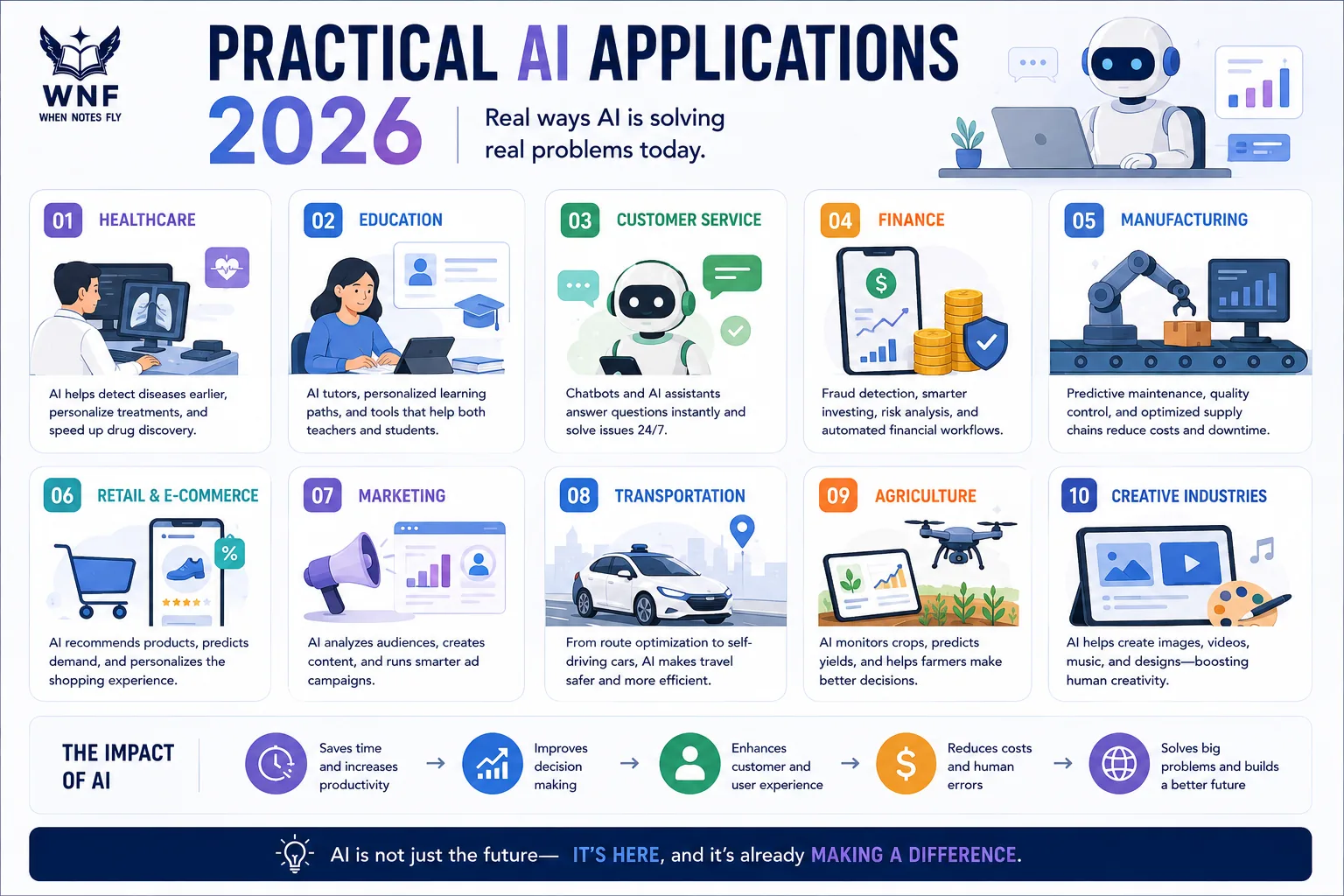
Practical: A software engineer at a mid-size company recently described her workflow: "I draft code with an AI assistant, run it through an AI-powered review tool, test it with AI-generated test cases, and deploy it through a pipeline that uses AI to detect anomalies.
Three years ago, none of this existed." Her experience is not unusual. By 2026, AI has moved from novelty to infrastructure - not by replacing human workers but by embedding itself into the tools they already use.
The question is no longer whether AI is useful but which applications genuinely deliver value and which are still more promise than substance.
This article is organized around that distinction. For each major application area, it examines what AI is actually doing in 2026, what the measurable evidence shows about effectiveness, where the limitations are real and consequential, and what practitioners and decision-makers need to understand to deploy AI productively rather than wishfully.
A practical AI application is one that delivers measurable value in real deployment conditions - not just in controlled research settings - with limitations that are understood and managed rather than ignored.
What distinguishes a practical application from hype is evidence: productivity gains that survive independent measurement, limitations that have been characterized honestly, and deployment contexts where human oversight is appropriately maintained.
The distinction matters because AI is simultaneously overhyped in aggregate and genuinely valuable in specific, well-understood use cases; conflating the two leads organizations either to miss real opportunities or to deploy AI in contexts where it produces harm or waste.
Software Development: Where AI Value Is Clearest
"The organizations getting the most from AI in 2026 are not the ones that have deployed it most broadly. They are the ones that have identified the specific workflows where AI reliability meets genuine business value and deployed it there with appropriate human oversight." - Erik Brynjolfsson, Stanford Digital Economy Lab, 2025
| Application Domain | Current AI Capability | Measured Impact | Key Limitation |
|---|---|---|---|
| Software development | Code completion, generation from natural language, test writing, code review assistance | 55% faster task completion (GitHub, 2022); 30-35% suggestion acceptance rate | Bugs and security vulnerabilities in generated code; poor performance on novel algorithmic problems |
| Customer service | Automated resolution of routine inquiries; intent classification; sentiment detection | 40-60% ticket deflection for tier-1 queries in well-trained deployments | Failure on edge cases; customer frustration when AI cannot escalate appropriately |
| Medical imaging | Detection of cancers, diabetic retinopathy, and other conditions in X-rays, MRIs, pathology slides | FDA-cleared tools matching specialist accuracy on specific conditions | Poor generalization across institutions and imaging equipment; requires clinical validation |
| Legal and contract review | Document summarization, clause extraction, risk flagging, precedent search | 70-80% reduction in initial review time for standard contracts | Cannot exercise legal judgment; misses context-dependent interpretation issues |
| Content creation | Drafting, editing, research synthesis, translation, image generation | Significant productivity gains for high-volume routine content | Quality variance; hallucination in research-heavy content; brand voice inconsistency |
| Financial analysis | Earnings call summarization, document parsing, pattern detection in structured data | Efficiency gains in data-intensive research tasks | Unreliable on forward-looking analysis; overconfident predictions from historical patterns |
Software development has become the domain where AI value is most clearly demonstrated and most consistently measurable. The reasons are structural: code is a high-volume, high-value output; quality is measurable; and the inputs and outputs are in the digital formats that AI systems handle well.
Code Generation and Completion
GitHub Copilot, launched in 2021 and now used by well over a million developers, generates code suggestions that developers accept at a rate of roughly 30-35%.
A 2022 study by GitHub found that developers using Copilot completed tasks 55% faster than those without it - a productivity gain that, if reproducible at scale, represents a substantial economic impact.[1]
By 2026, AI code generation has expanded well beyond simple autocomplete. Current tools (GitHub Copilot Enterprise, Cursor, Codeium, Amazon CodeWhisperer) can:
- Generate complete functions from natural language descriptions
- Refactor existing code for improved clarity or performance
- Translate code between programming languages
- Generate test cases from function specifications
- Explain complex code in plain language for onboarding and documentation
Example: Stripe, the payment processing company, reported in 2024 that AI coding assistance had measurably increased engineer productivity across their codebase.
Their engineering team found that AI tools were particularly valuable for "boilerplate" code - the repetitive scaffolding that every project requires - and for code in less-familiar languages or frameworks where developers were not as fluent.
More experienced engineers also reported that AI tools allowed them to spend more time on architectural decisions and less on implementation details.
Limitations: AI code generation is not reliable without human review. Current tools produce syntactically correct code that may have logic errors, security vulnerabilities, or performance problems. The productivity gain depends on developers critically evaluating suggestions rather than accepting them uncritically.
Security researchers have documented cases where Copilot-generated code contained known vulnerability patterns, particularly in security-sensitive contexts.
Code Review and Quality Assurance
AI-assisted code review tools analyze pull requests before human review, flagging potential issues: logic errors, security vulnerabilities, performance problems, style violations, and deviations from established patterns.
This reduces the cognitive load on human reviewers by surfacing routine issues automatically, allowing reviewers to focus on higher-level design and correctness questions.
Companies including Meta, Uber, and Google have deployed internal AI code review systems that have measurably reduced the time to merge code changes and the defect escape rate (bugs that make it to production).
For organizations without resources to build internal tools, products like Snyk Code, Deepsource, and SonarQube now incorporate AI analysis.
Healthcare: High Stakes, Real Progress, Genuine Limitations
Healthcare AI has progressed from research demonstrations to clinical deployment, with measurable impact on specific tasks - while remaining clearly limited in others.
Medical Imaging and Diagnostics
AI diagnostic tools for medical imaging have matured significantly. In radiology, pathology, ophthalmology, and dermatology, AI systems regularly match or exceed specialist performance on specific imaging tasks in controlled studies.[6]
Radiology: AI tools for chest X-ray analysis can detect pneumonia, tuberculosis, and pleural effusion with accuracy comparable to radiologists.
Critical finding detection systems that flag urgent findings (potential aortic dissection, tension pneumothorax) for immediate radiologist attention reduce the time to diagnosis for time-critical conditions. The FDA had cleared over 700 AI medical devices by 2025, the majority in radiology.[2]
Pathology: Digital pathology AI systems analyze whole-slide images to assist with cancer detection and grading. Paige.AI received FDA de novo authorization in 2021 for prostate cancer detection; by 2026, several pathology AI systems are in clinical use across cancer types.
The value is not in replacing pathologists but in reducing the cognitive burden of reviewing large numbers of slides and reducing inter-observer variability in grading.
Ophthalmology: AI systems for diabetic retinopathy screening - where early detection prevents blindness - have been in clinical use in some healthcare systems since 2018. The UK's NHS deployed AI retinal screening at scale, reaching patients in areas without adequate ophthalmologist access.
The ability to screen at scale in under-resourced settings is where medical AI delivers its most distinctive value.
Example: Apollo Hospitals in India deployed AI-assisted cardiac diagnosis tools starting in 2022 that analyze ECGs and echocardiograms to flag potential conditions for cardiologist review.
In a system with significant physician shortages and geographic access constraints, AI screening tools that prioritize which patients need specialist attention can meaningfully extend the reach of limited specialist capacity.
Limitations: Medical AI performance in controlled studies frequently degrades when deployed in real clinical environments.
Distribution shift - the difference between training data (often academic medical center data from high-income countries) and deployment data (community hospitals, different patient populations, different imaging equipment) - is a persistent problem.
AI tools that have been cleared by regulators for specific indications are not validated for all patient populations or all deployment contexts.
Clinical Documentation and Administrative Work
The most immediately scalable AI application in healthcare may be administrative: AI documentation tools that convert physician-patient conversations into clinical notes, reducing the documentation burden that many physicians cite as a leading contributor to burnout.[3]
Products including Nuance DAX, Suki, Nabla, and Abridge use conversational AI to listen to clinical encounters and generate structured clinical documentation.
Studies at institutions including Mayo Clinic and University of Michigan Health have shown time savings of 50-70% on clinical documentation, with physician satisfaction significantly improving.
This application has progressed rapidly because it does not require the same regulatory approval as diagnostic AI, physicians adopt it without requiring patient consent for each encounter (the recordings are used for documentation with appropriate privacy protections), and the return on investment is immediate and measurable.
Legal and Professional Services: Genuine Capability, Qualified Deployment
Legal Research and Document Review
Legal AI has moved beyond the limited document review tools of the previous decade to genuinely capable research and analysis systems.
Legal research: AI systems can now research case law, identify relevant precedents, summarize holdings, and draft preliminary legal arguments at a level that meaningfully assists attorneys.
Systems from LexisNexis (Lexis+AI), Thomson Reuters (Westlaw AI), and legal AI startups including Harvey AI and Casetext (acquired by Thomson Reuters in 2023) are in active use at major law firms.[4]
Harvey AI, used by major law firms including Allen & Overy and PwC Legal, can draft legal memoranda, analyze contracts, review regulatory filings, and answer complex legal questions.
A partner at a major law firm who uses it described the tool as "raising the floor" - ensuring that preliminary research is comprehensive rather than contingent on which associate happened to be assigned - while requiring attorney judgment to assess the quality and applicability of results.
Document review: AI-assisted document review in litigation has been standard practice for large e-discovery projects since the mid-2010s.
By 2026, AI review tools have become sufficiently capable that courts have accepted AI-only preliminary review in some matters, with attorney certification that the review was appropriately supervised.
Firms using AI document review routinely report cost reductions of 50-70% on review-intensive matters.
Limitations: AI hallucination in legal contexts is a documented problem. The now-infamous case of a New York attorney who submitted a brief citing AI-generated fictitious case citations (Mata v. Avianca, 2023) prompted heightened attention to AI reliability in legal work.
Most legal AI tools now include citations to actual sources and verification mechanisms, but the requirement for attorney verification of all AI-generated legal content remains essential.
Financial Services
Financial services has been an early and aggressive adopter of AI, with applications across trading, risk assessment, customer service, fraud detection, and compliance.
Fraud detection: AI fraud detection systems analyzing transaction patterns in real-time are now standard practice at major financial institutions. Visa's AI fraud detection system analyzes over 500 transaction variables in under a millisecond to score transaction risk.[8]
The system blocks billions of dollars in fraudulent transactions annually that rule-based systems would have missed.
Credit underwriting: AI-assisted credit assessment incorporates more data points and more sophisticated pattern recognition than traditional credit scoring.
Lenders including Upstart and CommonBond have used AI underwriting that incorporates factors like education and employment history alongside traditional credit metrics, showing lower default rates and broader credit access for historically underserved borrowers in some studies.
Regulatory scrutiny of algorithmic lending for disparate impact remains ongoing.
Investment research and trading: Quantitative hedge funds have used machine learning for trading for over a decade. By 2026, AI systems are used by most major asset managers for research assistance, portfolio analysis, and risk monitoring.
Goldman Sachs, Morgan Stanley, and other major banks have deployed AI coding assistants for their quantitative analysts and AI research tools for analysts and advisors.
Customer Operations: Automation at Scale
Customer Service and Support
Customer service AI has advanced substantially from the frustrating rule-based chatbots of the early 2010s. Modern AI customer service systems handle significantly more complex inquiries, with much higher customer satisfaction rates.
Current capabilities: AI systems can handle account inquiries, process standard requests (returns, cancellations, address changes), troubleshoot common technical issues, and route complex issues to appropriate human agents with full context - all without human involvement for the majority of inquiries.
The key improvement over earlier chatbots is natural language understanding sophisticated enough to interpret varied phrasing of the same request rather than requiring customers to use specific keywords.
Example: Intercom's AI product "Fin," launched in 2023, handles customer support inquiries by drawing on a company's support documentation and knowledge base to answer questions.[9]
Companies using Fin report that it handles 40-60% of inbound support inquiries fully autonomously, with customer satisfaction scores comparable to human agents for the inquiries it handles.
The remaining inquiries that require human judgment are routed to agents with the AI-generated conversation context.
Realistic expectations: Customer service AI works well for high-volume, structured inquiries with clear right answers. It struggles with complex, emotionally charged interactions; situations that fall outside training data; and cases requiring judgment about how to handle unusual circumstances.
Hybrid designs that route these cases to human agents while handling routine cases automatically produce better overall outcomes than either full automation or full human handling.
Sales and Marketing Automation
AI applications in sales and marketing have proliferated across the pipeline: lead scoring, personalized content generation, ad targeting, email optimization, and conversion rate optimization.
Personalization at scale: AI-powered personalization allows companies to customize marketing content, product recommendations, and pricing for individual customers based on their behavior history. Amazon's recommendation engine, which has been using machine learning for decades, generates an estimated 35% of Amazon's revenue.
Netflix's recommendation system is estimated to save over $1 billion annually in customer acquisition costs by reducing churn.
These are mature implementations; the current wave is extending similar personalization to smaller companies through off-the-shelf AI tools.
Content generation for marketing: Generative AI for marketing content - email subject lines, ad copy, social media posts, product descriptions - is now standard practice at many marketing teams.
Tools including Copy.ai, Jasper, and similar products have been joined by general-purpose AI assistants that marketing teams use for content creation.
A/B testing of AI-generated versus human-written marketing content shows mixed results: AI often performs well on volume production of routine content while human writers continue to outperform on creative campaigns and brand voice consistency.
Education: Personalization with Significant Caveats
Educational AI has generated significant excitement and significant concern. The potential - genuinely personalized instruction that adapts to each student's pace, style, and gaps - is real. The current reality is more limited.
AI Tutoring Systems
AI tutoring systems that provide personalized practice, explain concepts, and give immediate feedback have demonstrated measurable learning outcomes in controlled studies. Khanmigo, built on Khan Academy's extensive content library with GPT-4, provides tutoring-style assistance to students working through Khan Academy courses.
Carnegie Learning's MATHia has shown significant gains in math proficiency compared to traditional instruction in multiple randomized controlled studies.
The key design principles that distinguish effective AI tutoring from ineffective: immediate feedback on practice problems, adaptive difficulty that adjusts to demonstrated competence, explanation of mistakes rather than just marking them wrong, and encouraging productive struggle rather than providing answers too quickly.
The cheating problem: The same AI capability that makes tutoring possible also makes completing assignments trivially easy, which creates significant challenges for assessment.
Universities and high schools are navigating a fundamental tension: AI assistance with learning is valuable, but AI completion of assessments makes it impossible to measure what students have learned.
Assessment design that is robust to AI assistance - oral exams, in-class work, process-focused evaluation - is an active area of educational innovation in 2026.
What Makes AI Applications Actually Work
Across these domains, the AI applications that deliver genuine value share identifiable characteristics:
High volume of similar tasks: AI reliably outperforms on tasks done thousands or millions of times where patterns exist. AI creates less value for rare, novel situations without historical patterns to learn from.
Measurable output quality: Applications where output quality can be objectively measured - code that either works or doesn't, diagnoses that can be verified against ground truth - enable the iteration and improvement that makes AI systems better.
Applications where quality is subjective and difficult to measure are harder to improve systematically.
Human oversight where it matters: The most successful AI deployments are not full automation but human-AI collaboration: AI handling the high-volume, pattern-driven component; humans providing judgment on exceptions, high-stakes decisions, and cases outside the training distribution.
Deployments that remove human oversight to reduce cost often regress to worse outcomes.
Appropriate deployment context: AI performs best in contexts where the training distribution matches the deployment distribution.
Organizations deploying AI in contexts substantially different from where it was trained - different geographies, patient populations, legal jurisdictions, or product types - should expect performance degradation and should validate performance before full deployment.
Organizational change management: AI tools that work technically but fail to be used effectively by the people they are meant to assist still fail. Implementation requires workflow redesign, training, and cultural change alongside the technical deployment.
The practical question for any organization considering AI investment is not "can AI do this task?" but "will AI do this task well enough, in this specific context, with the oversight and change management we can provide, to justify the investment?" That question requires honest evaluation of all the factors, not just the technology capabilities.
See also: Prompt Engineering Best Practices, AI Safety and Alignment Challenges, and Automation Use Cases Explained.
What Research Shows About AI Productivity Effects
Rigorous economic research on AI's productivity impact in real deployments has produced a body of findings that diverges in important ways from both the most optimistic projections and the most skeptical dismissals.
Erik Brynjolfsson, Danielle Li, and Lindsey Raymond at MIT and Stanford published "Generative AI at Work" (NBER Working Paper 31161, 2023), a study tracking 5,179 customer support agents at a Fortune 500 software company over 14 months following the introduction of an AI-assisted tool that provided conversation suggestions in real time.[10]
The study found that access to the AI tool increased worker productivity - measured as issues resolved per hour - by 14 percent on average.
Crucially, the productivity gains were strongly heterogeneous: the lowest-skilled workers (those in the bottom quartile of baseline performance) improved by 34 percent, while the most skilled workers showed gains of only 4 percent.
The AI tool effectively transferred the tacit knowledge of the best workers (whose successful conversation patterns trained the model) to the least experienced workers, compressing the performance gap between novices and experts.
The study also found that AI assistance improved customer satisfaction scores by 1.3 percent and reduced employee attrition by 25 percent in the treatment group relative to control - suggesting workforce stability benefits alongside productivity gains.
Brynjolfsson's finding that AI most benefits lower-skill workers on the tasks it assists has since been replicated in multiple studies across knowledge work domains.
Shakked Noy and Whitney Zhang at MIT published "Experimental Evidence on the Productivity Effects of Generative AI" (Science, 2023), a randomized controlled trial in which 453 college-educated professionals in mid-level writing occupations were randomly assigned to use ChatGPT for work tasks or to complete tasks without AI assistance.
Workers with access to ChatGPT completed writing assignments 40 percent faster than the control group, and independent evaluators rated the AI-assisted writing 18 percent higher on quality dimensions including clarity, persuasiveness, and structure.
The study found that the productivity gains were largest for workers who began with lower baseline writing quality, consistent with Brynjolfsson et al.'s finding of compression in performance distributions.
Noy and Zhang also found that AI-assisted workers reported higher job satisfaction and lower time pressure - qualitative improvements that may affect long-term workforce retention beyond the immediate productivity effects.
David Autor, professor of economics at MIT and a leading researcher on technology and labor markets, updated his analysis of AI's employment effects in "The Labor Market Impacts of Technological Change: From Unbounded to Bounded Rationality" (Annual Review of Economics, 2024).
Autor's key empirical finding: unlike previous waves of automation (which primarily displaced routine physical and cognitive tasks, automating middle-skill jobs), AI disproportionately affects high-skill cognitive tasks including legal research, financial analysis, medical diagnosis assistance, and software development.
This represents a different distributional pattern from prior automation. Autor's analysis of 2023 Bureau of Labor Statistics data and survey data from AI deployment adopters found that occupations in the top income decile showed the highest rates of AI-tool adoption (67 percent of workers in high-income occupations reported using AI tools at least weekly, compared to 23 percent of workers in the bottom income decile).
Autor's projection: AI may produce income compression at the top of the skill distribution - reducing the wage premium for high-skill workers in AI-affected tasks - rather than primarily displacing low-skill workers, which is the pattern that historical automation evidence would predict.
The McKinsey Global Institute's 2023 report "The Economic Potential of Generative AI: The Next Productivity Frontier," authored by Michael Chui, Eric Hazan, Roger Roberts, and colleagues, modeled the potential economic impact of generative AI across 63 use cases.[5]
The analysis estimated that generative AI could add between $2.6 trillion and $4.4 trillion annually to the global economy across the identified use cases, with customer operations ($400-660 billion), software engineering ($250-450 billion), and R&D acceleration ($240-460 billion) representing the largest categories.
The McKinsey analysis is often cited, but the Institute itself acknowledges that these figures represent the potential if use cases are fully deployed at scale with current technology - actual realized value requires successful deployment, organizational change management, and verification of performance in specific contexts, each of which involves substantial friction.
The analysis estimated that 75 percent of the identified value falls in four domains: customer operations, marketing and sales, software engineering, and research and development.
Real-World Case Studies in Measured AI Deployment Outcomes
Nuance DAX and Clinical Documentation: Quantified Physician Time Savings. Nuance Communications (acquired by Microsoft in 2022) deployed its DAX (Dragon Ambient eXperience) ambient clinical intelligence system across over 400 health systems in the US by 2024.
DAX uses ambient microphone capture during physician-patient encounters to automatically generate clinical documentation, which physicians then review and approve.
Studies at Mass General Brigham (published in the Journal of the American Medical Informatics Association, 2023), conducted by Adam Landman and colleagues, found that DAX reduced documentation time by an average of 7 minutes per patient encounter - approximately 50 percent of average documentation time.
In a study of 50 physicians over three months, the system reduced total administrative time by 2.3 hours per physician per day. A survey of 1,000 DAX users conducted by Nuance found that 70 percent reported lower burnout scores after three months of use, and 77 percent reported that DAX improved their work-life balance.
Microsoft's CEO Satya Nadella cited DAX as an example of AI's impact on healthcare in the 2024 annual shareholder letter, noting that the system had processed over 250 million clinical encounters.
Harvey AI at Law Firms: Measurable Efficiency Gains in Legal Work. Harvey AI, founded in 2022 by Gabriel Pereyra (a former DeepMind and Meta researcher) and Winston Weinberg (a former litigator), raised $100 million at a $1.5 billion valuation in 2024 and counted Allen and Overy, PwC Legal, and Ashurst among its enterprise clients.
Allen and Overy's 2023 pilot study, involving 3,500 lawyers across 43 offices using Harvey for research, drafting, and document review, found that Harvey-assisted lawyers completed first-draft memos 33 percent faster than lawyers working without AI assistance, and that senior associate review of Harvey-generated drafts required 25 percent less revision time than review of junior associate drafts on comparable matters.
The firm's innovation team estimated annual efficiency gains of approximately 25,000 billable hours across the firm - time redirected from low-value drafting to higher-value client advisory work.
PwC Legal's deployment across 4,000 legal professionals in 2024 focused on regulatory compliance analysis, where Harvey was used to identify relevant regulatory provisions across jurisdictions; PwC reported that compliance research tasks that previously required 4-6 hours of attorney time could be completed in 45-90 minutes with Harvey assistance.
Carnegie Learning MATHia: RCT Evidence on AI Tutoring Outcomes. Carnegie Learning's MATHia platform, an AI-driven math tutoring system used by over 600,000 students in the United States, has been the subject of multiple randomized controlled trials evaluating its effect on student math outcomes.
The largest RCT, conducted by researchers at RAND Corporation (researcher Susannah Faxon-Mills and colleagues) in 2021-2022 across 52 middle schools, found that students using MATHia for at least 45 minutes per week showed statistically significant improvements in standardized math assessment scores compared to control students, with an effect size of 0.19 standard deviations - equivalent to approximately 2-3 additional months of learning over the study period.
A 2023 study by Carnegie Learning researchers tracking students across 8,500 schools found that students using MATHia reached proficiency in Algebra I concepts 20 percent faster on average than historical cohorts using traditional instruction.[7]
The MATHia case is notable for having more rigorous evaluation than most ed-tech products - the use of RCT methodology and external evaluators provides higher-quality evidence than the self-reported outcome data that dominates ed-tech marketing claims.
Amazon Alexa and Retail AI: Recommendation Revenue Attribution. Amazon's machine learning-driven recommendation system, which powers the "Customers who bought this also bought" and "Recommended for you" features visible throughout the Amazon retail experience, was described by Amazon's former chief scientist Andreas Weigend in his 2017 book "Data for the People" as generating approximately 35 percent of Amazon's total revenue.
McKinsey's subsequent analysis estimated the figure at 35 percent of Amazon's ecommerce revenue as of 2023, representing approximately $130 billion annually at current revenue levels.
The recommendation system uses collaborative filtering (identifying users with similar purchase and viewing histories) combined with session-level behavioral signals (items viewed, cart additions, dwell time) to rank product recommendations in real time.
Amazon's engineering blog described the system as processing over 100 billion product interactions daily and generating personalized recommendation slates in under 100 milliseconds per user.
The Amazon recommendation engine represents the longest-running and most financially validated AI deployment in consumer retail, providing an empirical anchor for ROI estimates in recommendation system investments across the retail industry.
Sources & Further Reading
- GitHub. "The economic impact of the AI coding assistant." GitHub Blog, 2022. View source
- FDA. "Artificial Intelligence and Machine Learning in Software as a Medical Device." FDA, 2024.
- Verghese, Abraham et al. "The Importance of Being Present: A Roadmap for AI in Health Care." NEJM, 2023. View source
- Thomson Reuters. "Thomson Reuters acquires Casetext." Thomson Reuters Press, 2023.
- McKinsey Global Institute. "The economic potential of generative AI." McKinsey and Company, 2023.
- Topol, Eric. Deep Medicine: How Artificial Intelligence Can Make Healthcare Human Again. Basic Books, 2019. View source
- Carnegie Learning. "MATHia Research Results." Carnegie Learning, 2023. View source
- Visa. "Visa Advanced Authorization Fact Sheet." Visa Inc..
- Intercom. "Fin AI Agent." Intercom.
- Brynjolfsson, Erik et al. "Generative AI at Work." NBER Working Paper, 2023. View source