
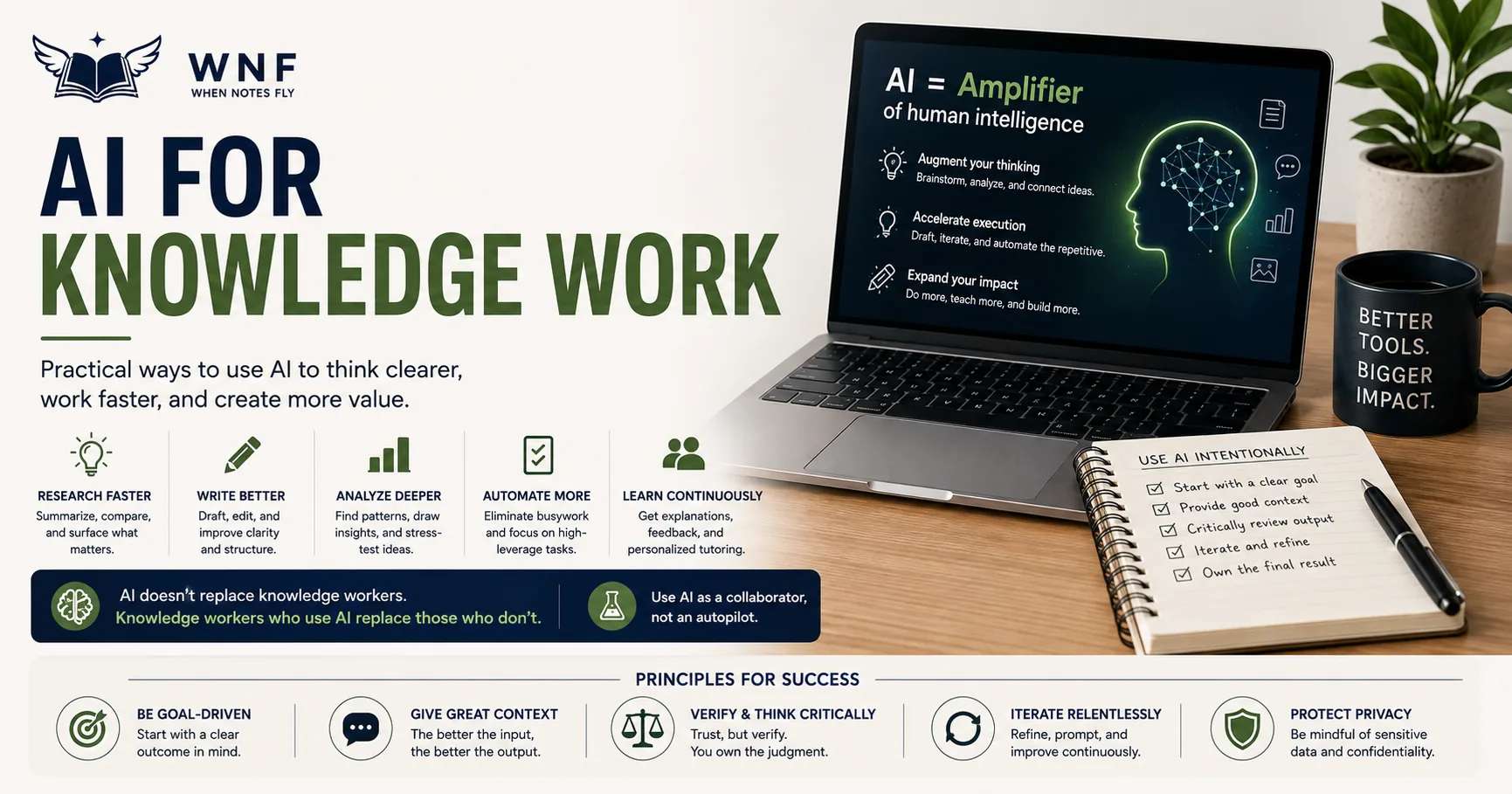
Large language models produce plausible continuations rather than retrieve verified facts, so their best uses are transformations of material already supplied and editable first drafts. AI for knowledge work becomes reliable only when people treat outputs as raw material, check important claims, and retain responsibility for accuracy.
Artificial intelligence has moved from novelty to daily tool for a large share of knowledge workers. Used well, large language models can compress hours of research, drafting, and analysis into minutes. Used carelessly, they introduce fabricated facts, shallow reasoning, and a false sense of confidence into work that depends on accuracy.
This hub is a practical guide to using AI tools for real knowledge work - research, writing, analysis, and learning - without sacrificing the quality and trustworthiness that make the work worth doing.
It is organised around concrete workflows rather than tool reviews, because the tools change monthly while the underlying principles of good use change slowly.
It assumes you have access to a capable general-purpose AI assistant (ChatGPT, Claude, Gemini, Copilot, or similar) and want to use it as a serious instrument rather than a toy.
What AI Is Good and Bad At for Knowledge Work
Effective use starts with an accurate model of where these tools are strong and where they fail. Large language models are not databases, search engines, or reasoning engines in the way those terms are normally understood.
They are systems that generate plausible continuations of text based on patterns learned from training data. That single fact explains most of their strengths and most of their failures.
Where AI Is Genuinely Strong
- Transformation of text you provide. Summarising, reformatting, restructuring, changing tone, translating, and extracting structure from material you supply. When the source is in the prompt, fabrication risk is far lower.
- First drafts and overcoming the blank page. Generating an initial structure or draft that you then edit is faster than starting from nothing, provided you treat the output as raw material, not finished work.
- Explanation and tutoring. Explaining concepts at different levels, generating analogies, and answering follow-up questions - particularly for well-established topics where the training data is dense and reliable.
- Brainstorming and divergent thinking. Generating many options, alternative framings, or counterarguments quickly, where the value is in breadth and you supply the judgment.
- Mechanical language tasks. Fixing grammar, tightening prose, generating variations, and adapting register.
Where AI Fails or Misleads
- Factual recall of specific details. Citations, statistics, dates, quotes, and names are frequently fabricated with complete confidence. This failure mode - hallucination - is the single most important risk in knowledge work. See AI Hallucinations Explained.
- Current events and recent information. Models have a training cutoff and no inherent knowledge of events after it unless connected to live retrieval.
- Genuine reasoning about novel problems. Models can imitate reasoning patterns but do not reliably reason through genuinely novel multi-step problems, especially where the answer is not well represented in training data.
- Knowing what they do not know. Models rarely signal uncertainty appropriately. A confident answer and a fabricated one look identical.
- Domain-specific judgment. Legal, medical, financial, and other high-stakes professional judgment should never rest on AI output alone.
The practical implication: AI is most trustworthy when working with information you provide, and least trustworthy when asked to supply specific facts from memory. Structure your workflows around that asymmetry.
Research Workflows
Research is where AI offers the largest time savings and carries the largest accuracy risk. The goal is to use AI to accelerate the parts that are safe to accelerate while keeping verification firmly in human hands.
Workflow: Orientation, Not Authority
Use AI to orient yourself in an unfamiliar topic - the key concepts, the main debates, the vocabulary, the questions worth asking. Do not use it as the authoritative source for any specific claim.
- Ask the model to outline the main concepts and sub-questions of a topic.
- Ask it to define the key terms and explain the main positions in any debate.
- Use that orientation to construct better searches in primary and authoritative sources.
- Verify every specific claim you intend to use against a primary source. Treat AI-supplied citations as leads to check, never as evidence.
Workflow: Document Interrogation
When you supply the source material, AI is far more reliable. Paste or upload a document and ask targeted questions about its contents.
- Provide the full document in the prompt or via upload.
- Ask for a structured summary, the main arguments, or specific information.
- Ask the model to quote the exact passage supporting each claim it makes - then verify the quote appears in the source.
- Be alert: models can still misattribute or paraphrase inaccurately even with the source present. Spot-check.
For the underlying technique that makes document-grounded answers more reliable, see Retrieval-Augmented Generation Explained.
Writing and Editing Workflows
AI is a capable writing assistant and a poor author. The distinction matters. Used to assist your thinking and tighten your prose, it improves output. Used to replace your thinking, it produces generic, often subtly wrong text that reads fluently and says little.
Workflow: Draft-Then-Own
- Write the core argument or outline yourself - the ideas should be yours.
- Ask AI to expand sections, suggest structure, or produce a rough first draft from your outline.
- Rewrite the draft in your own voice, correcting errors and removing filler. The output is raw material, not the final text.
- Use AI for a final mechanical pass: grammar, consistency, tightening. Keep editorial judgment yours.
Workflow: Adversarial Editing
One of the most valuable uses is asking AI to critique your work rather than produce it.
- "What is the weakest argument in this piece?"
- "What would a skeptical expert reader object to?"
- "Where is this unclear, and what specifically is confusing?"
- "What important counterargument have I not addressed?"
This uses the model's breadth to stress-test your own reasoning, while keeping you as the author and decision-maker.
Analysis and Summarisation Workflows
Summarisation is one of AI's most reliable functions - when the source is supplied - but it carries a specific risk: the model can omit the most important nuance or introduce claims not in the original.
Workflow: Layered Summary
- Ask for a one-sentence summary, then a one-paragraph summary, then a detailed bullet summary. Comparing layers reveals what the model considers most central.
- Ask explicitly: "What important caveats, limitations, or counterpoints does the source raise?" Summaries tend to drop nuance unless prompted for it.
- For any summarised claim you will rely on, locate it in the source.
Workflow: Structured Extraction
For turning unstructured text into structured data - extracting entities, categorising, building comparison tables - AI is efficient and reasonably reliable when the source is present. Always validate the structure against the source for a sample of rows before trusting the whole.
Learning Workflows
AI can be a powerful learning aid, but it can also create the illusion of learning - fluent explanations that you nod along to and immediately forget. Pair AI use with what learning science actually shows works: retrieval practice and spaced review.
Workflow: AI as Socratic Tutor
- Ask the model to explain a concept, then to ask you questions to check your understanding rather than simply telling you more.
- Attempt to answer from memory before checking - this is retrieval practice, which produces far stronger retention than re-reading. See The Testing Effect.
- Ask the model to generate practice questions or problems, and to explain where your answers went wrong.
- Verify factual claims for anything you are learning seriously - tutoring models hallucinate too.
For the broader evidence base on how to learn effectively, see How Learning Works: A Research Guide.
Prompting Principles That Actually Matter
Most "prompt engineering" advice is folklore. A small number of principles account for most of the difference between poor and good results.
- Provide context and source material. The single highest-leverage move. Models work far better on material you supply than on material they must recall.
- Specify the role, audience, and format. "Explain this for a non-technical manager in five bullet points" beats "explain this."
- Ask for reasoning, then the answer. Requesting the model show its working improves quality on multi-step tasks and makes errors visible.
- Iterate rather than perfect. Treat the first response as a draft to refine through follow-up, not a one-shot result.
- Ask for uncertainty and sources. "Flag anything you are not confident about" and "cite where each claim comes from" surface weak points - though you must still verify.
For a deeper treatment, see What Is Prompt Engineering and Large Language Models Explained.
Verification and Trust: The Non-Negotiable Step
Every workflow above ends with the same step: verification. This is not optional overhead - it is the part that makes AI-assisted knowledge work trustworthy rather than merely fast. The discipline is simple to state and easy to skip: never act on, publish, or share an AI-supplied specific claim without independent verification.
We maintain a structured protocol for exactly this - evaluating an AI-generated answer before trusting it. It covers checking whether a source is named and reachable, whether the citation actually supports the claim, fabrication signals, and matching verification depth to decision risk.
Use the AI Source Trust Checklist on any AI claim that carries consequence. It takes about two minutes and is the difference between AI as a liability and AI as a tool.
Limitations and Risks
Beyond hallucination, several risks deserve explicit attention in professional knowledge work:
- Confidentiality. Do not paste confidential, personal, or proprietary information into consumer AI tools without understanding the provider's data handling. Treat anything you submit as potentially retained.
- Homogenisation. Heavy reliance on AI drafting tends to flatten voice and produce generic output. The competitive value of knowledge work lies in original thinking, which AI does not supply.
- Skill atrophy. Offloading thinking that you should be doing yourself erodes the underlying skill over time. Use AI to extend your capability, not to avoid developing it.
- Automation bias. People systematically over-trust automated output. The fluent, confident interface makes weak answers feel authoritative. Calibrated skepticism is a learned discipline.
- Plausible-but-wrong reasoning. The most dangerous errors are not obvious nonsense but subtly flawed reasoning that looks correct. These require domain knowledge to catch.
A Practical Setup
A workable default configuration for serious knowledge work:
- Use a capable general-purpose assistant as your primary tool, and learn its specific failure patterns.
- Default to supplying source material rather than relying on the model's memory.
- Build the verification step into every workflow that produces facts you will use.
- Keep a personal record of where the tool has failed you - it builds the calibrated skepticism that no amount of general advice can.
- For high-stakes work, treat AI output as a draft requiring expert review, never as a finished answer.
Related Reading on WhenNotesFly
- AI Source Trust Checklist - verify AI answers before you trust them
- AI Hallucinations Explained
- Large Language Models Explained
- Retrieval-Augmented Generation Explained
- What Is Prompt Engineering
- What Are AI Agents
- How Learning Works: A Research Guide
- Better Decisions Under Uncertainty
- Deep Work vs Shallow Work