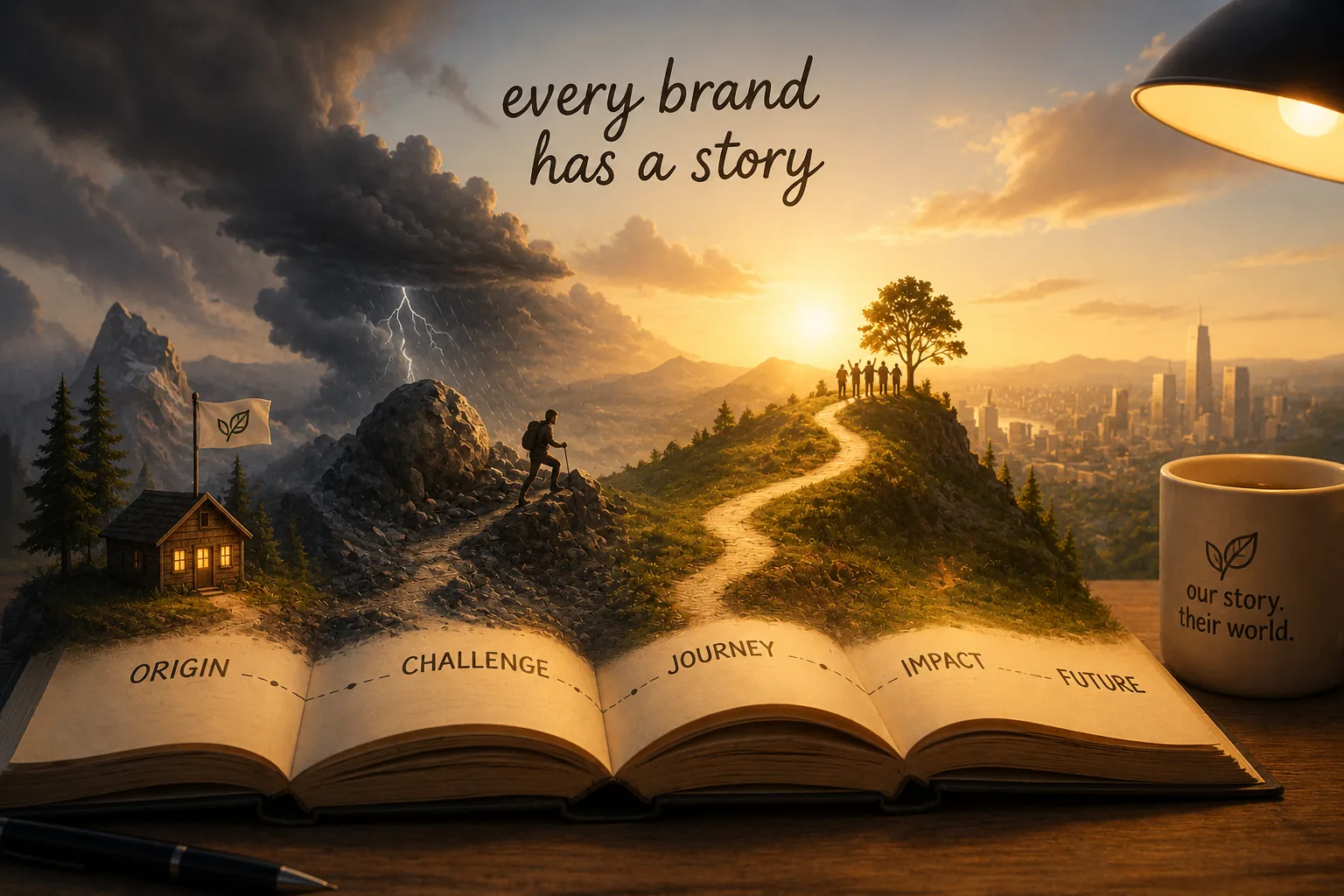
Storytelling in branding uses transformation, origin, adversary, customer-hero, and values-based narratives to make a brand's purpose and value concrete. Stories can create engagement and connection that feature lists rarely produce, especially when customers recognize their own challenge in a credible before-and-after account. Effective use requires a meaningful narrative rather than treating a product as the automatic hero of every story.
A neuroscience lab at Princeton University made a discovery in 2010 that would have profound implications for anyone trying to build a brand. Researchers Greg Stephens, Lauren Silbert, and Uri Hasson used fMRI scanning to observe what happens in the brain when someone listens to a compelling story.
They found that the listener's brain activity begins to mirror the storyteller's brain activity - a phenomenon they called neural coupling. The more engaged the listener, the more closely the brain patterns synchronized.
In some cases, the listener's brain actually anticipated the storyteller's next move, processing the narrative in advance.
This finding explains something that marketers have intuited for millennia: stories do not merely convey information. They create shared experience. When a brand tells a story effectively, it is not transmitting a message to a passive audience.
It is synchronizing neural activity, creating a temporary but genuine connection between the brand's consciousness and the audience's consciousness. No bullet-pointed list of product features, no matter how compelling, achieves this effect.
The science behind storytelling's power runs deeper than neural coupling. When we hear a story involving action, our motor cortex activates. When a story describes a scent, our olfactory cortex lights up. Stories engage the entire brain in a way that factual statements simply cannot.
And crucially, stories trigger the release of oxytocin - the neurochemical associated with empathy, trust, and social bonding - which directly influences purchasing behavior and brand loyalty.
| Story Structure | Core Dynamic | Brand Application | Emotional Response |
|---|---|---|---|
| Transformation arc | Before/after journey | Product as catalyst | Aspiration, hope |
| Origin myth | Founder overcomes obstacle | Company purpose | Trust, admiration |
| Us vs. them | Challenger vs. incumbent | Positioning against status quo | Belonging, loyalty |
| Customer hero | Brand as guide, customer as hero | Customer success stories | Empathy, motivation |
| Values in action | Belief demonstrated through deed | Mission-driven campaigns | Respect, alignment |
"Marketing is no longer about the stuff that you make, but about the stories you tell."
Seth Godin
The Structural DNA of Brand Narratives
Every effective brand story, whether it is a 30-second advertisement or a company's founding mythology, shares fundamental narrative structures that have been studied since Aristotle's Poetics. Understanding these structures transforms storytelling from intuitive art into repeatable craft.
The transformation arc is the most powerful structure available to brand storytellers. It follows a protagonist through a state of dissatisfaction or challenge, introduces a catalytic element (the brand, its product, or its philosophy), and traces the resulting transformation.
The protagonist emerges changed - more capable, more confident, more connected, or more fulfilled.
Example: Nike's "Find Your Greatness" campaign (2012, Olympics) told stories of ordinary people - an overweight teenager jogging down a rural road, a young girl doing a headstand against a wall - pursuing athletic achievement without the talent or resources of professional athletes.
The transformation was not about becoming elite; it was about redefining what "greatness" means. Nike positioned itself not as the brand of champions but as the brand of anyone willing to try.
The origin myth explains why the brand exists by rooting its founding in a moment of insight, frustration, or discovery that the audience can relate to. The structure is: founder encountered problem, existing solutions were inadequate, founder created something better, and the company carries forward that founding purpose.
Example: Sara Blakely's Spanx origin story - cutting the feet off pantyhose before a party, spending two years developing a prototype, being rejected by every manufacturer before finding one whose daughters convinced him to take a chance - is one of the most retold founding stories in American business.
It works because every element is specific, relatable, and demonstrates the determination that became central to the Spanx brand identity. Blakely did not just sell shapewear; she sold the story of a woman who refused to accept "no."
The adversary narrative positions the brand against a clearly defined opponent - not necessarily a competitor, but a force, condition, or convention that the audience also opposes. This structure creates tribal identification: the brand and the audience are on the same side against a common enemy.
Example: Apple's legendary "1984" Super Bowl commercial, directed by Ridley Scott, positioned IBM as Big Brother and Apple as the rebel liberator. The adversary was not just IBM but conformity itself.
Forty years later, Apple continues to use adversary narratives, positioning itself against complexity (simplicity as rebellion), against surveillance (privacy as rebellion), and against mediocrity (creativity as rebellion).
Customer Stories: The Most Underutilized Brand Asset
The most credible stories a brand can tell are not its own - they are its customers'. Customer transformation stories carry inherent credibility because they are experienced by someone the audience can identify with, and they demonstrate value through lived experience rather than marketing claims.
The before-and-after framework documents a customer's situation before encountering the brand, the moment of engagement, and the measurable transformation that followed.
The specificity of the "before" state is critical - the more precisely the audience recognizes their own situation in the customer's pre-transformation state, the more powerfully they project themselves into the post-transformation outcome.
Salesforce has built its entire marketing ecosystem around customer stories. The company's "Customer 360" platform showcases detailed case studies from companies like Spotify, Amazon Web Services, and Unilever - but also from small businesses and nonprofits whose transformations are relatable to a broader audience.
Each story follows the same arc: challenge, Salesforce engagement, measurable results. The repetition of this structure across hundreds of stories creates cumulative social proof.
The unexpected advocate is a customer story variant that highlights someone who would not be expected to use or endorse the product.
When the British Army featured a recruitment story from a Muslim soldier discussing how the military accommodated his prayer schedule, the story was powerful precisely because of the tension between stereotype and reality.
The unexpected advocate disrupts assumptions and creates cognitive engagement that conventional testimonials cannot.
Brands that systematize customer story collection gain a compounding advantage. Every support ticket, sales call, and online review contains potential story material.
The companies that recognize this - and invest in processes for identifying, documenting, and obtaining permission to tell these stories - build an ever-expanding library of authentic narratives.
Neuroscience Research on Why Stories Outperform Facts in Brand Communication
The neural basis for storytelling's commercial effectiveness has been investigated across a growing body of neuroscience research that moves beyond the metaphorical to provide precise biological explanations for the practitioner intuition that stories sell better than facts.
Dr. Paul Zak of Claremont Graduate University, director of the Center for Neuroeconomics Studies, conducted experimental research establishing the relationship between narrative engagement and oxytocin release.[2]
Zak's research, reported in Harvard Business Review (2014) as "Why Your Brain Loves Good Storytelling," found that compelling character-driven narratives increased blood plasma oxytocin concentrations by an average of 47% during exposure.
Participants with higher oxytocin responses donated an average of 56% more money to a charitable cause mentioned at the end of the narrative than participants with lower oxytocin responses.
Critically, Zak's research found that the oxytocin effect was story-structure dependent: the same factual content presented as a narrative generated 2.4 times more oxytocin than the same content presented as statistics.
This finding established the biological mechanism through which brand stories drive generosity - the willingness to pay, recommend, or commit - that factual brand communication cannot match.
Research by Greg Stephens, Lauren Silbert, and Uri Hasson at Princeton University (Hasson leads Princeton's Hasson Lab) published in Proceedings of the National Academy of Sciences (2010) demonstrated what they termed "neural coupling" between speaker and listener brains during effective communication.[1]
Using fMRI simultaneous scanning of storytellers and listeners, Hasson's team found that listener brain activity mirrored speaker brain activity in multiple regions including the prefrontal cortex, temporal lobe, and parietal lobe - but only during engaging narrative communication, not during recitation of factual information.
The degree of neural coupling correlated significantly with comprehension scores (r = 0.53) and with listeners' ability to predict subsequent plot developments (r = 0.61), establishing that the shared neural state created by storytelling is functional rather than merely correlational.
Professor Melanie Green of the University at Buffalo (then at the University of North Carolina) and Timothy Brock of Ohio State University developed "Transportation Theory" - a framework for understanding how narrative engagement affects attitudes and beliefs.
Their research, published in the Journal of Personality and Social Psychology (2000), found that "narrative transportation" (the degree to which a reader or listener is absorbed into the world of a story) was the primary mediator between narrative exposure and attitude change.
Participants with high transportation scores showed 31% stronger attitude change in the direction of the narrative's implicit argument than low-transportation participants, and these attitude changes persisted longer (67% retention at 4-week follow-up vs. 41% for low-transportation participants). The research established that storytelling changes minds through immersive absorption rather than rational persuasion - a finding with direct implications for brand storytelling strategy.
Case study - Charity: Water's Story-Driven Fundraising: Charity: water, founded by Scott Harrison in 2006, built its entire fundraising model on storytelling rather than statistics.
While most international development organizations led with impact statistics (millions without clean water, health outcomes data), Charity: water invested in professional photography, documentary-quality video, and written narratives following specific individuals in Ethiopia, Rwanda, and Cambodia through the process of gaining water access.
Research conducted by MassChallenge (2015) analyzing 150 social impact organizations found that Charity: water's story-centric approach generated average donation sizes of $147 per donor - 3.2 times the sector average of $46 per donor.
The organization's donor retention rate (62% annual retention) was 2.1 times the industry average (29%).
Charity: water attributed the donor engagement premium specifically to story format: their A/B tests found that appeal emails leading with a named individual's story generated 87% higher revenue than equivalent emails leading with aggregate impact statistics.
Case study - Dove Real Beauty Sketches: Narrative Virality: Dove's "Real Beauty Sketches" campaign (2013, produced by Ogilvy Brazil, director Tom Carey) deployed a structured narrative arc - FBI-trained forensic artist draws women as they describe themselves, then as strangers describe them, revealing that self-perception is harsher than others' perception - that became the most-watched online advertisement in history at the time of release.
Research by Unilever's marketing science team, presented at the Advertising Research Foundation annual conference (2013), found that the video achieved 180 million views in the first month across 25 languages - at a media cost equivalent of approximately $140 million based on equivalent paid placement.
Consumer research conducted by Millward Brown with 2,000 women in 7 countries found that 76% of viewers reported the video "made them think differently about their appearance" and 70% reported increased positive feelings toward Dove as a brand.
Brand equity tracker data showed Dove's "relevant for me" scores increased 14 percentage points in markets where the video achieved high organic reach, directly attributing business impact to the narrative format.
The StoryBrand Framework and Its Limitations
Donald Miller's StoryBrand framework, published in Building a StoryBrand (2017), has become one of the most widely adopted storytelling methodologies in marketing.[3]
Its central insight is that the customer - not the brand - should be the hero of the story, and the brand should position itself as the guide who helps the hero achieve their goal.
The framework follows a seven-part structure:
- A character (the customer) has a problem
- The problem has external, internal, and philosophical dimensions
- A guide (the brand) appears who demonstrates empathy and authority
- The guide provides a plan (clear steps to engagement)
- The guide issues a call to action
- The character avoids failure (what happens without the solution)
- The character achieves success (what happens with the solution)
The framework's strength is its clarity and applicability. It forces brands to center the customer's experience and articulate the stakes of inaction.
Many businesses that adopt StoryBrand see immediate improvements in website clarity, email effectiveness, and sales conversations because the framework eliminates the self-referential messaging that plagues most brand communication.
Its limitation is homogeneity. When every brand in a category uses the same seven-part framework, the resulting narratives begin to blur together. The framework produces competent storytelling, not distinctive storytelling.
For brands competing on the basis of unique identity and emotional connection - as opposed to functional clarity - the StoryBrand framework is a starting point, not a destination.
Authenticity: The Non-Negotiable Requirement
The single factor that separates brand storytelling that builds trust from brand storytelling that erodes it is authenticity. And authenticity is not a communication technique - it is a state of alignment between what the brand says and what the brand does.[9]
Patagonia's storytelling works because the company's actions align with its stories.
When founder Yvon Chouinard tells the story of Patagonia's founding as a climbing equipment company that evolved into an environmental activism organization, every operational decision - donating 1% of sales to environmental causes, suing the Trump administration over national monument reductions, publishing The Footprint Chronicles that reveal supply chain impacts - corroborates the narrative.[4]
The story is not layered on top of the business; it emerges from the business.
Contrast this with Volkswagen's "Clean Diesel" storytelling, which positioned TDI engines as an environmentally responsible choice.
When the 2015 emissions scandal revealed that VW had installed software to cheat on emissions tests, the gap between story and reality destroyed decades of brand trust. The financial cost exceeded $30 billion in fines and settlements. The reputational cost was incalculable.
Authenticity testing for brand stories involves asking:
- Would we tell this story if no one was watching?
- Does every employee recognize this story as true to their experience?
- If a journalist investigated the claims in this story, would we be comfortable with their findings?
- Are we telling customers' stories or projecting stories onto customers?
Any brand story that fails these tests is a liability, not an asset.
Narrative Across Channels: Coherence Without Repetition
A brand story must maintain coherence across channels - website, social media, email, advertising, packaging, customer service - without being identical in each context. The challenge is adaptation without fragmentation.
The narrative kernel is the irreducible core of the brand story that must remain consistent everywhere: the fundamental tension, the transformation promised, and the values expressed.
For Dove, the narrative kernel is the tension between artificial beauty standards and real beauty, the transformation from self-doubt to self-acceptance, and the value of authenticity.
This kernel appears in every Dove communication, from the "Real Beauty" campaign (launched 2004) to product packaging copy to social media content.[7]
Channel-specific expression adapts the kernel to each medium's constraints and conventions. On Instagram, Dove tells its story through user-generated photography of real women. On YouTube, it tells the story through documentary-style videos like the "Real Beauty Sketches" (2013, 180+ million views).
On its website, the story is told through product descriptions that emphasize moisturizing over transformation and through the Dove Self-Esteem Project, which provides resources for young people struggling with body image.
The failure mode is when different teams manage different channels without a shared understanding of the narrative kernel. When the social media team tells one story, the sales team tells another, and the product team tells a third, the audience experiences dissonance that undermines brand trust.
Narrative governance - ensuring that everyone who creates brand content understands and can articulate the core story - is as important as visual brand governance.
The Founder Story: Power and Peril
Founder stories carry unique narrative power because they personify the brand. When audiences connect with a founder's journey, they transfer that emotional connection to the company. This is why investor pitches almost always begin with a personal story about why the founder cares about the problem.
Whitney Wolfe Herd's founding story for Bumble - a woman who experienced harassment at a previous dating company and created a platform where women make the first move - directly embodies the product's differentiation. The story does not just explain why Bumble exists; it makes the product's design decisions feel inevitable.
Phil Knight's origin story for Nike - selling shoes out of the trunk of his car at track meets, recruiting his former track coach Bill Bowerman as co-founder, and building the company on the insight that serious athletes deserved better footwear - establishes credibility and mission simultaneously.
The story was mythologized in Knight's memoir Shoe Dog (2016), which became a bestseller and reinvigorated the brand's origin narrative for a new generation.[5]
The peril of founder stories emerges when the founder's identity becomes inseparable from the brand's identity.
When Travis Kalanick's aggressive personal brand became synonymous with Uber's corporate culture, the negative associations that attached to him - allegations of fostering a toxic workplace, confrontational interactions with drivers captured on video - became the brand's story.
Uber's recovery required not just a CEO change but a deliberate narrative shift away from founder-centricity.
The strategic question is: does the founder story serve the brand's future, or does it limit the brand to the founder's personal arc?
Brands that scale beyond their founders - Chanel without Coco Chanel, Apple without Steve Jobs, Disney without Walt Disney - eventually need narratives that transcend individual biography while honoring it.
Research on Narrative Structures That Drive Commercial Outcomes
Beyond the neurological basis of storytelling effectiveness, researchers have examined which specific narrative structures, elements, and formats produce the strongest commercial outcomes in brand contexts.
Professor Arch Woodside of Boston College, with Soren Ashwell and Erik Ko, published "Advancing Means-End Chains by Incorporating Heider's Balance Theory, Fuzzy Set Qualitative Comparative Analysis, and Affect Theory" in the Journal of Business Research (2009), which examined 400 brand stories across 12 categories.
The research found that brand stories following the classic three-act structure (disruption of equilibrium, struggle, restoration at higher level) produced 47% higher brand recall scores than brand stories that presented information sequentially without dramatic tension.
More importantly, three-act structured stories generated purchase consideration rates 31% higher than information-equivalent non-narrative presentations. Woodside's team attributed the difference to "narrative transportation" effects and the encoding advantage of emotionally structured information in episodic memory.[10]
Cassie Mogilner of Wharton, with Jennifer Aaker and Jessica Kamvar of Stanford GSB, published research in Journal of Consumer Research (2012) examining how different narrative focal points affect consumer response.[6]
Their experiments compared brand stories focused on "happiness" outcomes (consumer feels happy) versus "meaningfulness" outcomes (consumer achieves something important), finding that meaningfulness-focused stories generated 43% higher premium price tolerance and 27% stronger brand advocacy intent.
The research found that meaning-focused narratives activated the prefrontal cortex regions associated with long-term value assessment, while happiness-focused narratives activated reward circuits associated with short-term gratification.
The distinction has direct strategic implications: brands seeking long-term loyalty should tell meaningfulness stories; brands seeking immediate conversion should tell happiness stories.
Research by Escalas and Bettman (2005), published in the Journal of Consumer Research, examined "self-brand connections" - the degree to which consumers incorporate brands into their self-concept.
Their experiments found that narrative advertising (stories featuring brand use) created self-brand connections 2.7 times stronger than information-based advertising presenting identical brand attributes.
The research found that narrative self-brand connections persisted significantly longer: at 90-day follow-up, narrative-generated connections showed 74% retention versus 41% for information-generated connections.
These findings establish story as a uniquely effective tool for building the durable brand-consumer relationships that drive repeat purchase and advocacy.
Case study - John Lewis Christmas Advertisements and Brand Trust: UK department store John Lewis has published annual Christmas story-driven television advertisements since 2008, each featuring a narrative arc rather than product promotion.
Research by Millward Brown tracking brand perception annually found that John Lewis's "brand emotional connection" scores increased by 31 percentage points between 2008 and 2018 - the decade of story-driven advertising - compared to 14 percentage points average improvement for a panel of comparable UK retailers.
A 2016 analysis by Enders Analysis estimated that John Lewis's advertising effectiveness ratio (revenue generated per pound of advertising spend) was 4.2 times the UK retail average, which Enders attributed to the viral sharing of story content (generating earned media worth an estimated 5-8 times the paid media spend) and the sustained emotional brand equity built over a decade of consistent narrative.
Case study - Nike's "Just Do It" as Narrative Framework: Nike's "Just Do It" slogan, introduced in 1988 by advertising agency Wieden+Kennedy, functions not as a product claim but as a narrative invitation - an imperative that positions every Nike purchase as a story the consumer is writing about themselves.
Research on the Just Do It campaign examined how "Just Do It" campaigns compared to prior Nike campaigns in generating long-term brand equity.
The analysis found that Nike's market share in athletic footwear grew from 18% to 43% between 1988 and 1998 - the decade following the slogan's introduction.
A brand equity analysis by Interbrand tracking the decade found that Nike's brand value grew at 2.1 times the rate of Adidas (its primary competitor) despite similar quality ratings, distribution, and pricing.
The research attributed the outperformance to Nike's systematic story investment: "Just Do It" created a narrative frame into which individual consumer stories could be inserted, making the brand's story and the consumer's story indistinguishable.
Data-Driven Storytelling: Numbers That Move People
The integration of data into brand storytelling has become increasingly sophisticated, driven by the recognition that emotional narratives and empirical evidence are not opponents but complements.
Spotify Wrapped is perhaps the most successful data-driven storytelling campaign in modern marketing.[8]
Each December, Spotify transforms users' listening data into personalized narrative summaries: "You were in the top 1% of Taylor Swift listeners." "Your taste was so eclectic you traveled through 847 genres." Each data point becomes a story about the user's identity, delivered in a format designed to be shared on social media.
The campaign generates billions of social media impressions annually because it transforms abstract data into personal narrative.
The key principle is: data provides the evidence; narrative provides the meaning. A statistic - "our product saves customers an average of 4.7 hours per week" - is data. A story - "Maria was spending every Sunday evening preparing weekly reports that nobody read.
She got those hours back and now spends them at her daughter's soccer games" - is narrative. The most effective brand communication pairs both: the specific story provides emotional engagement, and the aggregate data provides rational justification.
Understanding how behavioral economics shapes decision-making helps storytellers recognize that audiences process narrative and statistical evidence through different cognitive pathways. Stories engage System 1 (fast, intuitive) processing, while data engages System 2 (slow, analytical) processing.
Effective brand storytelling activates both systems, creating both emotional resonance and rational confidence.
Building a Story Bank: Systematizing Narrative
The companies that tell the best stories are not the ones with the most creative marketing teams. They are the ones that have built systematic processes for capturing, curating, and deploying narrative material from across the organization.
Capture mechanisms include structured debrief questions in sales calls ("What was the customer's situation before they found us?"), customer success check-ins that probe for transformation stories, automated surveys triggered by milestone events, and social media monitoring for organic customer narratives.
Curation processes evaluate captured stories against criteria: Is the transformation significant and specific? Is the protagonist relatable to the target audience? Is the story verifiable? Has the customer given permission to share? Does the story demonstrate a value proposition that matters to prospects?
The best stories are tagged by use case (website, sales deck, advertising, social media) and stored in an accessible repository.
Deployment discipline matches stories to contexts. Sales teams need stories that address specific objections. Marketing needs stories that illustrate brand values. Customer success needs stories that model ideal usage patterns. Recruiting needs stories that demonstrate company culture.
A single customer story can serve all these functions with appropriate framing, but each deployment should feel tailored rather than recycled.
HubSpot's customer story operation exemplifies this systematic approach. The company produces detailed case studies, short video testimonials, social media quotes, and data-driven impact summaries from each customer relationship.
These assets are organized in a searchable library that sales and marketing teams can query by industry, company size, challenge type, and product used. The result is that every HubSpot communication can be supported by relevant, specific customer evidence.
Cultural Storytelling: When Brands Become Part of the Conversation
The most powerful form of brand storytelling occurs when the brand's narrative becomes part of the culture's conversation - when people discuss, share, remix, and extend the brand's story without being prompted.
Coca-Cola's "Share a Coke" campaign (2011, originated in Australia by Ogilvy) replaced the logo on bottles with 250 of the most popular first names. The campaign did not tell a story in the traditional sense; it created the conditions for millions of individual stories.
Finding your name (or a friend's name) on a bottle became a micro-narrative of surprise and personal connection. Customers photographed and shared their bottles on social media, generating earned media that dwarfed the paid campaign budget.
Red Bull's content ecosystem tells a single meta-story - human beings pushing the limits of what is physically possible - through an owned media empire that includes Red Bull Media House, Red Bull TV, The Red Bulletin magazine, and hundreds of sponsored athletes and events.
Felix Baumgartner's 2012 stratospheric skydive, viewed live by 8 million people on YouTube, was not an advertisement for energy drinks. It was a chapter in Red Bull's ongoing narrative about the human capacity to transcend limits. The brand's association with that narrative is more powerful than any product claim could be.
The creator economy has expanded the possibilities for cultural storytelling by enabling brands to collaborate with individual creators who have their own narrative authority.
When a creator with an established audience and authentic voice tells a brand story within their existing narrative framework, the result can be more credible than any story the brand tells directly.
Stories That Backfire: Cautionary Cases
Not all brand storytelling attempts succeed, and the failures are instructive.
Pepsi's Kendall Jenner advertisement (2017) attempted to tell a story of unity and peace, depicting the model handing a Pepsi to a police officer at a protest. The ad was pulled within 24 hours after widespread criticism that it trivialized social justice movements.
The failure was one of narrative appropriation - Pepsi attempted to insert itself into a cultural narrative (protest movements) that it had no authentic connection to, and audiences immediately recognized the inauthenticity.
WeWork's founding narrative - as told by Adam Neumann - positioned the company as a community-building movement that would "elevate the world's consciousness." The story was compelling enough to support a $47 billion valuation.
But when the gap between narrative (spiritual community) and reality (real estate subletting with unsustainable unit economics) became apparent during the failed 2019 IPO, the storytelling itself became evidence of deception rather than inspiration.
These failures share a common lesson: story amplifies reality. If the underlying reality is strong, storytelling magnifies its impact. If the underlying reality is weak or false, storytelling magnifies the eventual backlash. The relationship between storytelling and ethical practice is not optional - it is structural.
Where Brand Storytelling Goes From Here
The next frontier of brand storytelling is not a new platform or technology. It is the recognition that the most powerful brand stories are the ones that brands do not tell at all - they are the stories that customers tell about brands in the course of living their lives.
The companies that will dominate the next decade of brand storytelling are those that design products, services, and experiences so remarkable that customers cannot help but narrate them. The product itself becomes the story engine. The customer experience becomes the narrative.
And the brand's role shifts from storyteller to story architect - designing the conditions under which compelling stories naturally emerge.
Sources & Further Reading
- Hasson, Uri, et al. "Speaker-Listener Neural Coupling Underlies Successful Communication." Proceedings of the National Academy of Sciences. View source
- Zak, Paul J. "Why Your Brain Loves Good Storytelling." Harvard Business Review. View source
- Miller, Donald. Building a StoryBrand. HarperCollins Leadership. View source
- Chouinard, Yvon. Let My People Go Surfing. Penguin Books. View source
- Knight, Phil. Shoe Dog: A Memoir by the Creator of Nike. Scribner. View source
- Aaker, Jennifer, and Andy Smith. The Dragonfly Effect. Jossey-Bass. View source
- Dove. "The Dove Real Beauty Pledge." View source
- Spotify. "Wrapped Campaign Case Study." Spotify for Brands. View source
- Sachs, Jonah. Winning the Story Wars. Harvard Business Review Press.
- Woodside, Arch G., et al. "Brand-Consumer Storytelling Theory and Research." Psychology & Marketing. View source