
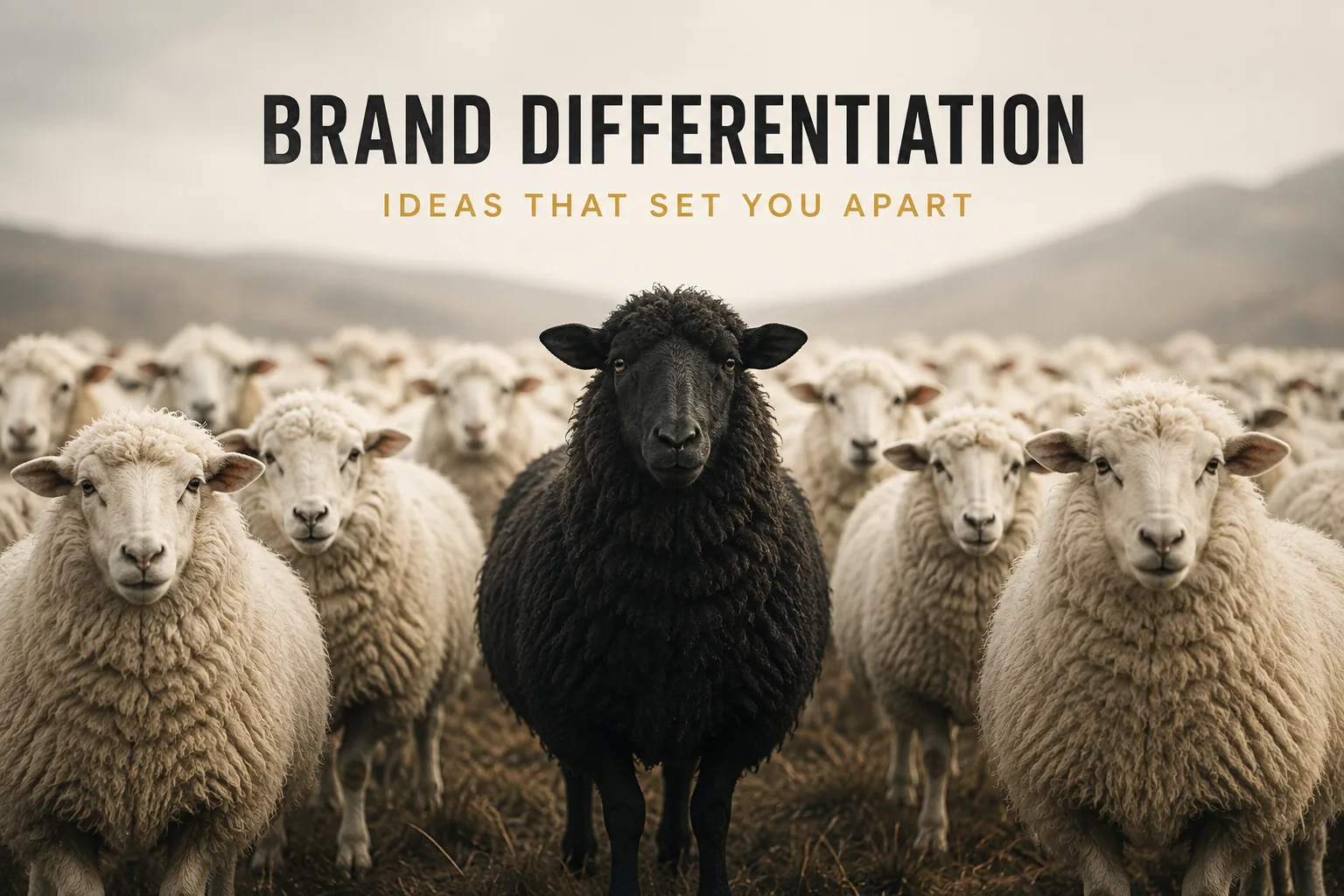
Being different is not enough if customers do not value the difference or competitors can reproduce it easily. Brand differentiation ideas work when they create a meaningful, consistently deliverable reason to choose one offering over similar alternatives, reducing reliance on price alone.
What Is Brand Differentiation?
Brand differentiation is the strategic process of creating meaningful, perceivable distinctions from competitors on dimensions that target customers value. A differentiated brand gives customers a clear reason to choose it over functionally similar alternatives, reducing competition based purely on price.
Effective differentiation is not merely being unusual; it requires that the distinction be genuinely valued by the audience, consistently deliverable by the organization, and difficult enough for competitors to replicate that it produces durable competitive advantage.
| Differentiation Type | Sustainability | Cost to Copy | Customer Value | Examples |
|---|---|---|---|---|
| Price | Low | Low | High (short-term) | Ryanair, Aldi |
| Product features | Medium | Medium | High | Apple, Dyson |
| Customer experience | High | High | Very high | Ritz-Carlton, Zappos |
| Brand values/story | Very high | Very high | High | Patagonia, TOMS |
| Business model | High | Very high | High | Spotify, Netflix |
| Community | Very high | Extremely high | Very high | Harley-Davidson, Lego |
Introduction: The Paradox of Competitive Markets
In 2010, Warby Parker entered the eyewear industry-one of the most commoditized, monopolized markets imaginable.
The competitive landscape:
- Luxottica controlled 80% of the market
- Designer frames cost $300-$500+ despite $15-$30 manufacturing costs
- Identical frames sold under different brand names at similar markups
- The value proposition was identical across brands: "Luxury eyewear for discerning customers"
Warby Parker's market entry seemed doomed.
Instead, they asked a different question: "What if we differentiated on dimensions the industry ignored?"
Their differentiation strategy:
1. Price transparency: $95 frames, including prescription lenses. Made the markup visible.
2. Convenience: Try 5 frames at home before buying. Eliminated the awkward store experience.
3. Social mission: "Buy a pair, give a pair" to someone in need. Purpose beyond profit.
4. Personality: Witty, approachable brand voice instead of luxury pretension. Named after literary characters.
5. Design: Stylish but accessible. "You can look good without spending $400."
The result:
- $250M revenue in first 7 years
- Valued at $3 billion by 2020
- Forced entire industry to respond
- Created new category: "affordable premium eyewear"
They didn't differentiate on product (frames are frames). They differentiated on price model, convenience, mission, personality, and values.
This is the lesson of strategic differentiation: In crowded, commoditized markets, the brands that win don't just have better products-they redefine the dimensions of competition.
"Don't try to be better. Be different. Differentiation is about becoming the only choice for a specific type of customer, not the best choice for everyone." - Marty Neumeier[8]
The harsh reality:
- Most markets are crowded
- Products increasingly converge (technology democratizes features)
- Price competition erodes margins
- "Being better" isn't enough; you must be different in ways that matter
This article explores:
- Types of differentiation beyond product features
- Frameworks for identifying differentiation opportunities
- Real-world examples across industries
- How to communicate differentiation effectively
- Sustaining differentiation over time
- Common pitfalls and how to avoid them
Part 1: Understanding Differentiation
What Differentiation Actually Means
Differentiation: Creating meaningful distinction from competitors on dimensions your target customers value.[1]
Three critical components:
1. Meaningful: Not different for the sake of being different. Different in ways that create customer value.
2. Distinction: Clear, perceivable difference. Customers can articulate what makes you different.
3. Valued: The difference matters to your target audience. Not all differences are valuable to all customers.
Why Differentiation Matters
Without differentiation, you compete on price.
"In a crowded marketplace, fitting in is a failure. In a busy marketplace, not standing out is the same as being invisible." - Seth Godin[5]
The commoditization trap:
- Products/services become similar
- Customers can't perceive meaningful differences
- They default to price as decision criterion
- Price competition erodes margins
- Race to the bottom
Example: Airline industry (mostly failed at differentiation)
- Most airlines offer nearly identical service
- Differences are minimal (seat configurations, snacks)
- Customers choose based on price and schedule
- Result: Brutal price competition, low margins, poor customer experience
With differentiation, you create switching costs and preference.
The differentiation advantage:
- Customers perceive unique value
- They're willing to pay more (or switch less)
- You attract specific segment that values your difference
- Competition based on value, not just price
- Higher margins and loyalty
Example: Southwest Airlines (succeeded at differentiation)
- Point-to-point routes (vs. hub-and-spoke)
- No assigned seating
- No baggage fees
- Friendly, casual culture
- Low prices through operational efficiency
- Result: Profitable for 47 consecutive years, high customer loyalty
Differentiation vs. Competitive Advantage
Differentiation: What makes you different
Competitive advantage: What makes you better or harder to copy
The relationship:
- All competitive advantages involve differentiation
- Not all differentiation creates lasting competitive advantage
Example:
Differentiation without competitive advantage: Offering 24/7 customer support when competitors offer business hours
- Different? Yes
- Valuable? Yes
- Sustainable? No (competitors can easily copy)
Differentiation with competitive advantage: Zappos building entire culture around customer service obsession
- Different? Yes
- Valuable? Yes
- Sustainable? Yes (culture is hard to copy, requires years to build)
Goal: Differentiate on dimensions that are valuable AND difficult for competitors to replicate. The most defensible differentiation creates genuine competitive advantage through second-order effects.
Part 2: Dimensions of Differentiation
Beyond Product Features: 10 Ways to Differentiate
1. Target Audience Specificity
Strategy: Serve a specific segment exceptionally well instead of everyone adequately.[10] This is one of the most reliable strategic frameworks that work in competitive markets.
Examples:
Basecamp: Project management for small teams (not enterprises)
- Simple, opinionated software
- Flat pricing ($299/month for unlimited users)
- Explicitly rejects enterprise features
- Differentiation: "We're not for everyone, but perfect for small teams"
Rolex: Luxury watches for status-conscious buyers
- Not competing on accuracy (quartz watches are more accurate)
- Competing on prestige, craftsmanship, heritage
- Differentiation: Exclusivity and status signal
REI: Outdoor gear for committed outdoor enthusiasts
- Owned by members (co-op structure)
- Expert staff who use the products
- Supports conservation and outdoor access
- Differentiation: Authentic outdoor community, not just retail
When it works: You understand your niche deeply, can serve them better than generalists, and niche is large enough to sustain business.
2. Price-Value Equation
Strategy: Position on the price spectrum strategically-ultra-premium, premium, mid-market, budget, or ultra-budget.
Important: It's not just about price; it's about perceived value at that price point.
Examples:
Dollar Shave Club: Razors delivered monthly for $1-$9
- vs. Gillette's $20+ cartridges
- Differentiation: Convenience + affordability + humor
- "Our blades are f***ing great"
Yeti: $300 coolers in a market of $30 coolers
- 10 price but perceived as 10 better quality
- Built cult following among outdoorsmen
- Differentiation: Ultra-premium durability and status
IKEA: Affordable furniture with modern design
- Self-assembly = lower costs
- Showroom experience makes shopping fun
- Differentiation: "Good design shouldn't cost a fortune"
When it works: You can sustainably deliver value at your price point, and there's an underserved segment seeking that value equation.
3. Service and Experience Quality
Strategy: Compete on how you deliver, not just what you deliver.
Examples:
Ritz-Carlton: "Ladies and gentlemen serving ladies and gentlemen"
- $2,000 per employee empowerment budget (solve guest problems without approval)
- Staff remembers guest preferences
- Differentiation: Anticipatory, personalized service
Amazon: Obsessive focus on convenience
- One-click ordering
- Free two-day shipping (Prime)
- Easy returns
- Differentiation: Frictionless buying experience
Trader Joe's: Friendly, helpful staff in grocery context
- Employees cook the products they sell (can recommend authentically)
- Will open any product for customers to try
- Nautical theme, hand-drawn signs, whimsical atmosphere
- Differentiation: Personal connection in impersonal industry
When it works: Service excellence is systematized into culture and operations, not dependent on individual heroics.
4. Convenience and Accessibility
Strategy: Make it easier to buy or use than competitors.
Examples:
Uber: On-demand rides without calling dispatcher or carrying cash
- vs. taxi medallion system
- Differentiation: Convenience through technology
Netflix: Unlimited streaming for flat monthly fee
- vs. Blockbuster's per-rental pricing and late fees
- Differentiation: Accessibility without friction
Square: Credit card processing for small businesses
- vs. complex merchant account applications
- Plug into iPhone, start accepting cards in minutes
- Differentiation: Radical simplification
When it works: You identify and remove friction that competitors accept as "just how it's done."[3]
5. Brand Personality and Voice
Strategy: Be memorable through distinctive personality.
Examples:
Mailchimp: Playful, quirky brand in boring email marketing space
- Illustration-heavy design
- Puns and humor in copy
- Chimp mascot (Freddie)
- Differentiation: Fun vs. corporate
Patagonia: Environmental activism baked into brand
- "Don't buy this jacket" ad (anti-consumption)
- 1% for the Planet commitment
- Repairs and resells used gear
- Differentiation: Values-first business
Old Spice: Absurdist humor targeting men's grooming
- "The man your man could smell like"
- Over-the-top, self-aware masculinity
- Differentiation: Comedy in traditionally serious category
When it works: Personality is authentic (not a marketing veneer), consistent across touchpoints, and resonates with target audience. Understanding how values shape decisions explains why brands with genuine missions attract more loyal customers.[6]
6. Business Model Innovation
Strategy: Change how value is created, delivered, or captured.[9]
Examples:
Spotify: Subscription streaming vs. pay-per-song downloads (iTunes)
- Unlimited access for $10/month
- Differentiation: Access over ownership
Costco: Membership fee + low margins on products
- Makes profit from memberships, not markups
- Can offer lower prices than competitors
- Differentiation: Different profit source enables better prices
Tesla: Direct-to-consumer sales (no dealerships)
- Online ordering, home delivery
- No negotiating, no commissioned salespeople
- Differentiation: Bypassing traditional distribution
When it works: New model delivers superior value to customers and/or better economics for you.
7. Content and Education
Strategy: Lead with teaching, not selling.
Examples:
HubSpot: Free marketing education before CRM sales
- Comprehensive guides, certifications, tools
- Built authority in inbound marketing
- Differentiation: Educator-first, seller-second
Home Depot: DIY workshops and project guides
- Free in-store classes
- Online tutorials
- Differentiation: Empowering customers vs. just selling supplies
Peloton: Fitness instruction, not just equipment
- Live and on-demand classes
- Instructor personalities and community
- Differentiation: Connected fitness experience
When it works: You have genuine expertise to share, content creates trust that leads to sales, and you can sustain content creation.
8. Transparency and Authenticity
Strategy: Radical honesty about how you operate.
Examples:
Buffer: Open salaries, revenue, and equity formula
- Publishes exactly what every employee earns
- Shares revenue and growth metrics publicly
- Differentiation: Complete transparency
Everlane: "Radical Transparency" in fashion
- Shows factory conditions
- Breaks down cost structure of each product
- "Know Your Factories" initiative
- Differentiation: Honesty in opaque industry
Cards Against Humanity: Honest about being "a party game for horrible people"
- Admits the game isn't for everyone
- Pranks customers (sold actual bullshit for Black Friday)
- Differentiation: Self-aware irreverence
When it works: Transparency reveals something positive about your operations, and you're comfortable with scrutiny.
9. Community Building
Strategy: Create belonging around your brand.
Examples:
Harley-Davidson: Rider community and identity
- H.O.G. (Harley Owners Group)
- Rallies and events
- Differentiation: Lifestyle and belonging, not just motorcycles
Sephora: Beauty Insider community
- Online forums and reviews
- Beauty classes and events
- Differentiation: Beauty education and community
CrossFit: "Box" (gym) culture and community
- Daily WOD (Workout of the Day)
- Shared suffering builds bonds
- Differentiation: Community fitness, not solo
When it works: Your product/service naturally creates opportunities for connection, and you facilitate it authentically.
10. Speed and Responsiveness
Strategy: Deliver faster or respond quicker than competitors.
Examples:
Domino's Pizza: 30-minute delivery guarantee (historically)
- Not the best pizza, but reliably fast
- Differentiation: Speed over quality (for their target market)
Amazon: Same-day or next-day delivery in many markets
- Massive logistics investment
- Differentiation: Instant gratification
Zappos: Free overnight shipping on all orders
- Surprise customers (they expect 5-7 days)
- Differentiation: Over-delivering on speed
When it works: Speed is operationally sustainable and valued by your target market.
Research on What Makes Differentiation Stick: Evidence from Academic Studies
The strategic intuition behind brand differentiation is supported by a substantial body of marketing research examining how consumers perceive, process, and respond to brand distinctions across competitive categories.
Professor Byron Sharp of the Ehrenberg-Bass Institute for Marketing Science at the University of South Australia conducted one of the most influential large-scale analyses of brand differentiation in his 2010 book How Brands Grow, which synthesized decades of consumer panel research across multiple categories and countries.[2]
Sharp's findings challenged the conventional differentiation narrative: he found that competing brands within a category share the majority of their buyers (a phenomenon he called "double jeopardy"), and that genuine attitudinal differentiation - consumers perceiving meaningful unique qualities in one brand versus another - was far less common than brand managers assumed.
However, Sharp's research also identified that the brands achieving the highest market penetration tended to be those with the strongest "mental availability" - distinctive assets such as colors, shapes, sounds, and slogans that trigger brand recognition instantly at the point of purchase, rather than deep attitudinal differences in what consumers believe about the brand.
Professor Youngme Moon of Harvard Business School, in Different: Escaping the Competitive Herd (2010), documented what she calls "reverse positioning", the counterintuitive strategy of removing expected category features rather than adding them.[7]
Her case study of IKEA, which eliminated customer service, free delivery, and assembled furniture (all standard category expectations) while adding a showroom experience, restaurant, and design ethos, illustrates how subtracting category conventions can create a distinct competitive position that direct feature-for-feature competition cannot replicate.
Case study - Dollar Shave Club: Dollar Shave Club's 2012 launch and subsequent 2016 acquisition by Unilever for roughly $1 billion is one of the most widely cited examples of differentiation built on pricing transparency, humor, and subscription convenience rather than competing on traditional razor-category dimensions like blade technology or retail availability.
The company demonstrated that a meaningful share of razor buyers were purchasing established brands by default rather than genuine preference, and that a sufficiently different value proposition could convert that inertia into active choice.
Case study - Warby Parker: Warby Parker built its differentiation around a direct-to-consumer model, transparent pricing, a home try-on program, and a strong brand identity in a category historically dominated by a few large, high-margin players.
The company has reported high customer satisfaction and loyalty figures publicly, and industry commentary consistently attributes a meaningful share of its growth to word-of-mouth and brand affinity rather than paid acquisition, though independently verified, precise figures for its Net Promoter Score or customer acquisition cost relative to industry averages are not part of the public record.
Beyond strategic frameworks, neuroscience research has examined the biological mechanisms through which brand familiarity and emotional resonance shape consumer decision-making.
Antonio Damasio's "somatic marker hypothesis," documented in Descartes' Error (1994), established that emotional memory and bodily feeling states are prerequisite to effective decision-making: we cannot make rational choices without emotional signals that flag options as "good" or "bad."
Separately, neuroscience research on brand familiarity (including well-known fMRI work on how brand context affects perceived product value, most famously in blind taste tests) has found that familiar, well-differentiated brands can activate reward-related brain regions more strongly than unfamiliar competitors, even when the underlying products are functionally similar.
Brand differentiation that creates genuine emotional resonance - as values-based, personality-based, and mission-based differentiators do - appears to embed itself in memory more durably than differentiation based purely on functional claims. This may help explain why emotionally differentiated brands like Patagonia, Harley-Davidson, and Apple retain customer loyalty across decades, while purely functional differentiators often lose their advantage once competitors copy the underlying feature.
Professor Aradhna Krishna of the University of Michigan's Ross School of Business has studied what she terms "sensory marketing", how differentiation across senses beyond sight can create distinctiveness that purely visual brand elements cannot achieve, synthesized in Customer Sense: How the 5 Senses Shape the Shopping Experience (2013).
Singapore Airlines' signature scent, used on flight attendants' uniforms, hot towels, and cabin air, is one of the most frequently cited real-world examples of sensory branding in the marketing literature, illustrating how a consistent multisensory identity can reinforce a brand's positioning beyond what visual branding alone communicates.
Case study - Southwest Airlines: Southwest's operational differentiation, no assigned seating, no baggage fees for many years, point-to-point routing, and a distinctive service culture, is one of the most extensively studied cases in business strategy literature, underpinning a profitability streak spanning multiple decades that is widely regarded as the longest in commercial aviation history.
Researchers and case writers have consistently attributed a substantial part of that advantage to Southwest's lower operating costs and stronger employee engagement relative to legacy carriers, though the specific comparative cost and turnover figures cited for any particular year should be checked against Southwest's own public financial filings rather than assumed from secondary sources.
Case study - Lush Cosmetics: Lush's differentiation strategy, deliberately strong in-store scent, unpackaged products, visible "naked" product displays, and handmade positioning, stands in deliberate contrast to conventional cosmetics retail.
It is frequently cited in retail and sensory-marketing literature as an example of using multiple senses simultaneously to create a distinctive shopping experience that is difficult for conventional retailers to replicate without fundamentally changing their operating model.
Part 3: Finding Your Differentiation
The Differentiation Framework
"Positioning is not what you do to a product. It's what you do to the mind of the prospect. You position the product in the mind of the buyer." - Al Ries
Step 1: Competitive Audit
What do all competitors do similarly?
These are category conventions-assumptions about "how things are done" in your industry.
Example: Mattress industry before Casper
- Sold in retail stores
- Test by lying down in store
- Immediately take home or delivery in weeks
- High-pressure sales tactics
- Confusing product names and pricing
Category conventions are differentiation opportunities.
Step 2: Customer Pain Points
What frustrates customers about the category?
Research methods:
- Read reviews (yours and competitors')
- Interview customers (ask about frustrations)
- Browse forums and social media
- Customer support ticket analysis
- NPS survey follow-ups ("Why that score?")
Example: Casper's research revealed
- Mattress shopping is stressful and confusing
- Pressure to decide immediately in store
- Can't really evaluate comfort in 5 minutes
- Delivery is complicated and expensive
Step 3: Your Authentic Strengths
What can you do better than anyone?
Consider:
- Founder expertise and passion
- Team capabilities
- Operational excellence
- Technology or processes
- Existing relationships or assets
Key: Differentiation must be authentic. Don't claim what you can't deliver.
Example: Casper's strengths
- E-commerce expertise
- Foam technology (compress mattress for shipping)
- Understanding of modern consumer expectations
- Willingness to disrupt traditional model
Step 4: Intersection Analysis
Your differentiation sweet spot is where:
- Competitors have conventions (opportunities)
- Customers have pain points (unmet needs)
- You have authentic strengths (capability to deliver)
Example: Casper found intersection
- Competitors: In-store only, immediate decision
- Customer pain: Stressful, can't evaluate properly
- Casper strength: E-commerce, shipping innovation
- Differentiation: Ship compressed mattress in a box, 100-night trial at home
This became their defining differentiator.
Testing Differentiation Ideas
Before committing, validate:
1. Does it matter to customers?
- Ask: "If we did X, would that change where you buy?"
- Test messaging with small audience
- Look for strong reactions (positive or negative-indifference is worst)
2. Can you deliver sustainably?
- One-time differentiation is marketing gimmick
- Lasting differentiation requires operational excellence
- Ask: "Can we do this consistently for years?"
3. Is it defensible?
- How easily can competitors copy?
- What makes it hard to replicate?
- Best differentiators compound over time (brand equity, culture, network effects)[4]
4. Does it align with your vision?
- Differentiation shapes your brand for years
- Choose something you want to be known for
- Authenticity matters; forced differentiation fails
Part 4: Communicating Differentiation
Making Your Difference Clear
The clarity test: Can customers articulate your differentiation in one sentence?
Strong differentiation communication:
Apple: "Think Different" → "Design-focused technology for creative people"Volvo: "Safety" → "The safest car you can buy"FedEx: "When it absolutely, positively has to be there overnight"
Clear, specific, memorable.
Weak differentiation communication:
Generic SaaS company: "We help businesses succeed through innovative solutions"What does this mean? Nothing specific. Everyone claims this.
Communication Principles
1. Show, don't tell
Weak: "We have the best customer service"Strong: "Our average response time is 47 seconds, and 94% of issues are resolved in first contact"
Weak: "Premium quality"Strong: "Lifetime warranty. We'll repair or replace free, forever"
Concrete beats abstract.
2. Use customer stories
Let customers explain your differentiation:
Example: Zappos
- Customer story: Ordered shoes for funeral, Zappos overnighted them free
- Shows: Service commitment beyond policy
- More powerful than company claiming "great service"
3. Comparative positioning (when appropriate)
Sometimes, direct comparison clarifies difference:
Example: Mac vs. PC ads
- Mac (Justin Long): Casual, creative, friendly
- PC (John Hodgman): Stiff, corporate, problematic
- Made difference visceral and entertaining
Caution: Only works when you can clearly demonstrate superiority. Don't punch down at weaker competitors.
4. Consistent reinforcement
Differentiation must be obvious across all touchpoints:
- Website messaging
- Product experience
- Customer service interactions
- Marketing materials
- Social media presence
- Employee behavior
Inconsistency erodes differentiation.
Example: Ritz-Carlton
- Every employee empowered to spend $2,000 solving guest problems
- This policy reinforces "exceptional service" differentiation through actual behavior, not just words
Common Communication Mistakes
1. Vague claims
- "Leader in innovation"
- "Customer-focused"
- "High-quality products"
Everyone says this. Meaningless.
2. Feature lists without context
- "We have 47 features!"
- So what? How do features make customer's life better?
3. Differentiation buried
- Website talks about company history before differentiation
- Most important thing should be obvious immediately
4. Trying to differentiate on everything
- "We're faster AND cheaper AND higher quality AND better service"
- Sounds implausible. Focus on 1-2 key differences.
Part 5: Sustaining Differentiation
Why Differentiation Erodes
Three threats:
1. Competitor copying
- Successful differentiation attracts imitators
- Features and processes can be reverse-engineered
- First-mover advantage is temporary
2. Differentiation becomes table stakes
- What was different becomes expected
- Example: Free shipping was differentiator; now it's expected
- Must evolve differentiation
3. Market shifts
- Customer needs change
- New competitors enter with fresh approaches
- Technology disrupts existing models
Building Sustainable Differentiation
Characteristics of defensible differentiation:
1. Rooted in culture
- Zappos' service obsession
- Patagonia's environmentalism
- Culture is hard to copy (requires years to build, can't be faked)
2. Requires operational excellence
- Amazon's logistics network
- FedEx's tracking systems
- Southwest's point-to-point routing
- Competitors can't match without massive operational changes
3. Network effects
- eBay: More buyers attract more sellers, which attracts more buyers
- LinkedIn: More professionals make it more valuable for each member
- Differentiation strengthens automatically with scale
4. Brand equity accumulated over time
- Rolex's prestige (100+ years of consistency)
- Coca-Cola's nostalgia
- Can't be built overnight
5. Authentic mission
- Patagonia: "We're in business to save our home planet"
- TOMS: "One for One" giving model
- Mission-driven differentiation attracts aligned customers and employees
The compounding effect: Best differentiation gets stronger over time, not weaker.
When to Evolve Your Differentiation
Signals you need to adapt:
1. Competitors have caught up
- Your differentiator is now standard in category
- Must find new dimension to compete
Example: Airlines matched Southwest's low fares → Southwest had to differentiate on culture/experience
2. Customer priorities shifted
- What mattered five years ago may not matter now
- Stay tuned to evolving needs
Example: Blockbuster's convenience (nearby locations) → didn't matter once streaming emerged
3. You're reaching new segments
- Differentiation that appeals to one segment may not work for another
- May need to evolve or create sub-brands
Example: Honda motorcycles in U.S.: Started with "You meet the nicest people on a Honda" (differentiated from Harley's rebel image), later introduced sport bikes for different segment
4. Market saturation
- When everyone copies your differentiation, it's no longer differentiating
- Find next wave
"Your brand is what other people say about you when you're not in the room. Differentiation has to be real, consistent, and earnable over time-not a claim." - Jeff Bezos
The cycle:
- Differentiate on new dimension
- Succeed and attract imitators
- Differentiation becomes standard
- Find next differentiation opportunity
Key: Don't change differentiation frivolously. Consistency builds equity. Only evolve when truly necessary.
Part 6: Differentiation Pitfalls
Common Mistakes and How to Avoid Them
1. Differentiating on irrelevant dimensions
Mistake: Being different in ways customers don't care about.
Example: Restaurant differentiates on "locally sourced ingredients from within 50-mile radius"
- If customers don't value this, it's meaningless
- Cost of sourcing locally may even hurt (higher prices, limited menu)
Solution: Validate that customers care before investing in differentiation.
2. False differentiation (claiming without delivering)
Mistake: Marketing says one thing, reality is another. This is a textbook example of good intentions leading to bad outcomes in brand management.
Example: Bank claims "We put customers first" but has predatory fees and poor service
Result: Erodes trust, negative word-of-mouth
Solution: Only claim differentiation you can consistently deliver.
3. Differentiation that's too narrow
Mistake: Serving such a specific niche that market is too small.
Example: "CRM for left-handed dentists in Alaska"
- Hyper-specific, but market may be 15 people
Solution: Niche down to segment large enough to sustain business. Test market size.
4. Trying to be everything to everyone
Mistake: Refusing to choose, trying to please all segments.
Example: Restaurant that's simultaneously "Fine dining" and "Family-friendly" and "Quick casual"
- Confusing positioning
- Doesn't excel at any
Solution: Choose a clear positioning. Accept you'll lose customers who want something else.
5. Copying competitors' differentiation
Mistake: Seeing competitor succeed, trying to copy their differentiator.
Example: Competitor succeeds with "Premium, eco-friendly products," so you pivot to same
Result: You're late, less credible, and competing directly instead of differentiating
Solution: Find your own unique angle. Don't follow; lead.
6. Differentiation without operational alignment
Mistake: Claiming differentiation but operations don't support it.
Example: Claim "White-glove customer service" but customer service team is understaffed and undertrained
Result: Promise-delivery gap, disappointed customers
Solution: Build operational capability before claiming differentiation.
Part 7: Category Design and Differentiation
Creating New Categories vs. Competing in Existing Ones
Most powerful differentiation: Redefine the category.
Category design: Creating new market category where you're the first and only player. This is first principles thinking applied to competitive strategy.
Examples:
Salesforce: Created "Cloud CRM" category
- Before: CRM was enterprise software installed on servers
- After: "No software" (cloud-based SaaS)
- Differentiation: Created new category where they had no competitors initially
Red Bull: Created "Energy Drink" category
- Before: Soda (Coke, Pepsi) dominated beverage market
- After: Energy drinks are separate category
- Differentiation: Not competing with Coke; different use case (energy vs. refreshment)
iPhone: Created "Smartphone" category
- Before: "Phones" and "PDAs" were separate
- After: Converged into new category
- Differentiation: Not a better phone; a new category of device
Category design advantages:
- You define the rules and evaluation criteria
- No direct competitors initially
- Own mindshare in new category
- Higher margins (no price competition yet)
Category design challenges:
- Must educate market (people don't know they need it)
- Higher initial marketing investment
- Risk that category never takes off
When to create category vs. differentiate within existing:
- Create category: You have genuinely new innovation, existing categories don't fit, you have resources for market education
- Differentiate within: Market is established, customers understand category, you want faster traction
Conclusion: Differentiation as Strategic Imperative
In commoditized markets, differentiation is not optional-it's survival.
The choice:
- Differentiate meaningfully → Attract loyal customers willing to pay premium
- Fail to differentiate → Compete on price → Race to bottom → Eroding margins
Key principles:
1. Differentiate on dimensions customers value
- Not different for the sake of being different
- Solve real frustrations or fulfill real desires
2. Differentiate authentically
- Based on genuine strengths
- Can be delivered consistently
- Aligns with your vision and values
3. Communicate clearly
- Customers can articulate your difference
- Show, don't tell
- Reinforce across all touchpoints
4. Build defensibility
- Rooted in culture, operations, or network effects
- Gets stronger over time
- Hard for competitors to copy
5. Evolve when necessary
- Stay tuned to market shifts
- Don't cling to outdated differentiation
- But don't change frivolously-consistency matters
The compounding effect of differentiation:
Year 1: Establish clear, meaningful difference
Year 2: Attract customers who value your difference
Year 3: Build reputation and word-of-mouth
Year 5: Category association ("When I think X, I think you")
Year 10: Difficult to displace (brand equity and loyalty)
Differentiation is an investment that compounds.
Start by asking:
- What do all competitors do the same? (Category conventions)
- What frustrates customers? (Unmet needs)
- What can we do better than anyone? (Authentic strengths)
- Where do these intersect? (Your differentiation opportunity)
Then commit fully: Align operations, communicate clearly, and sustain consistently.
In a world of endless options, customers choose brands that stand for something distinct. Give them a clear reason to choose you.
Differentiate or die.
Sources & Further Reading
- Trout, J., & Ries, A. "Positioning: The Battle for Your Mind." McGraw-Hill, 2001.
- Sharp, B. "How Brands Grow: What Marketers Don't Know." Oxford University Press, 2010.
- Christensen, C. M., Hall, T., Dillon, K., & Duncan, D. S. "Competing Against Luck: The Story of Innovation and Customer Choice." Harper Business, 2016.
- Aaker, D. A. "Aaker on Branding: 20 Principles That Drive Success." Morgan James Publishing, 2014.
- Godin, S. "Purple Cow: Transform Your Business by Being Remarkable." Portfolio, 2005.
- Collins, J. C., & Porras, J. I. "Built to Last: Successful Habits of Visionary Companies." Harper Business, 1994.
- Kim, W. C., & Mauborgne, R. "Blue Ocean Strategy: How to Create Uncontested Market Space and Make the Competition Irrelevant." Harvard Business Review Press, 2015.
- Neumeier, M. "Zag: The Number One Strategy of High-Performance Brands." New Riders, 2006.
- Osterwalder, A., & Pigneur, Y. "Business Model Generation: A Handbook for Visionaries, Game Changers, and Challengers." John Wiley & Sons, 2010.
- Moore, G. A. "Crossing the Chasm: Marketing and Selling Disruptive Products to Mainstream Customers." Harper Business, 2014.